


Combined Inkstand and Bell
| Categories | Dual Purpose Inkstands |
| Type | Bell |
| Material | Brass, Nickel Silver |
| Markings | See Narrative |
| Manufacturer | Undetermined |
| Origin | United States |
| Date or Era | circa 1872 |
| Measuring | 7” across; 5” high |
| Patent | No. 131,692 Patented Sep. 24, 1872 |
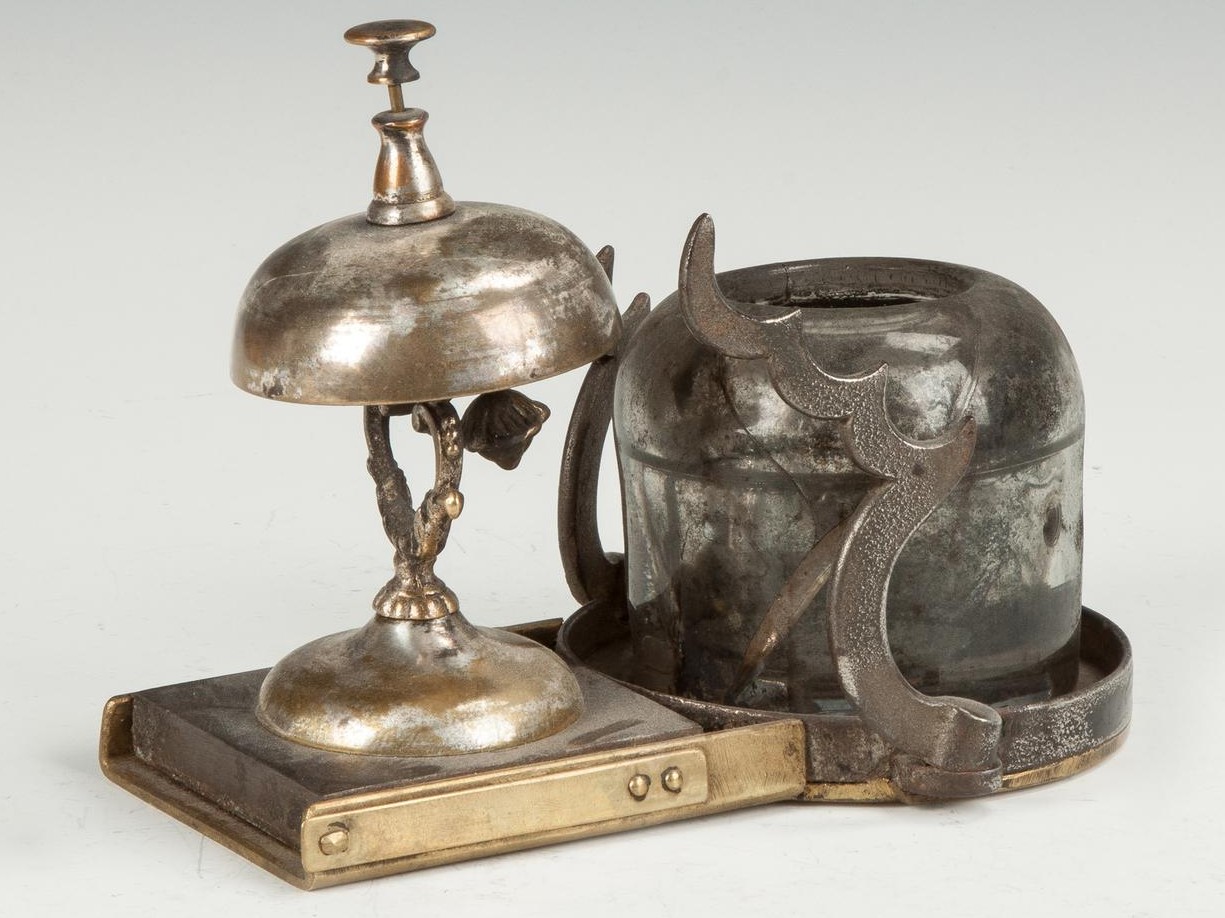
This inkstand was patented by Addison J. Lyon of Mount Vernon, New York, on September 24, 1872. This “Improvement in Combined Inkstands and Bells” solved the problem of desktop clutter by allowing two distinct tools to function as a single unit.
The Patent Design & Mechanism
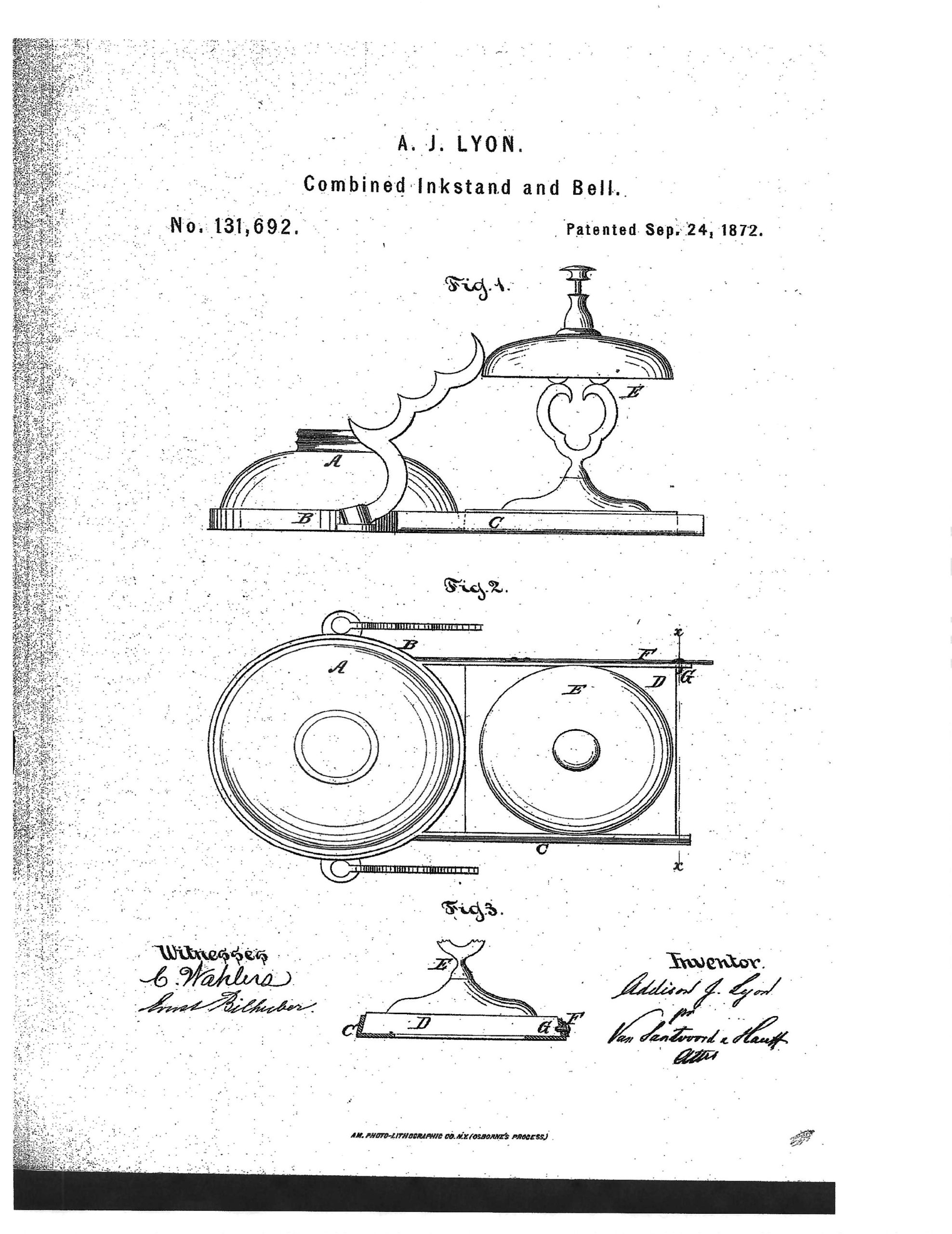
The primary innovation of Patent #131,692 is the detachable dovetail connection. Rather than being a fixed casting, the set is designed to be “connected to form one piece or be detached from each other to be used in different locations.”
- The Joint (C & D): The frame of the inkstand (B) features a rearward extension (C) with sides bent inward to form a female dovetail joint. The base of the bell (D) is beveled to act as the male portion, allowing the bell to slide into the inkstand frame with facility.
- The Locking Catch (F & G): To prevent the bell from sliding out accidentally, the patent describes a spring (F) with a catch (G) that works through the side of the extension. This automatically locks the bell in place once it is fully seated in the joint.
Description
The set consists of:
- The Inkstand: A heavy glass reservoir sits within a metal frame. The frame features two prominent, decorative scalloped or serrated arms. These serve as functional pen rests, allowing several pens to be cradled horizontally.
- The Bell: A classic Victorian-style tap bell or “call bell.” It features a central plunger that strikes an internal clapper when pressed. The bell is mounted on an ornamental pedestal which, as the patent specifies, is beveled at the bottom to fit the sliding joint.
- Material and Finish: This piece is made of a cast alloy (brass) with a worn nickel plating.
Purpose of the Invention
Lyon’s document emphasizes that this design does not “weaken or injure the articles” or require “essential alterations” to their standard construction. It was intended to provide the convenience of a combined stand without the bulkiness of a permanent, non-detachable base, ensuring that if a user preferred to move the bell to a different part of the room, they could do so without moving the ink.
Estimated value: $150
Content disclaimer. The information posted is the owner’s best knowledge and may not have been vetted by the SOIC. We welcome comments, corrections, and additions, working to make our website information comprehensive and accurate.
Join the Society of Inkwell Collectors (SOIC) – it’s free!
Founded in 1981 as a non-profit organization,
we are documenting inkwells (and accessories).
We’re here to help and inform!