

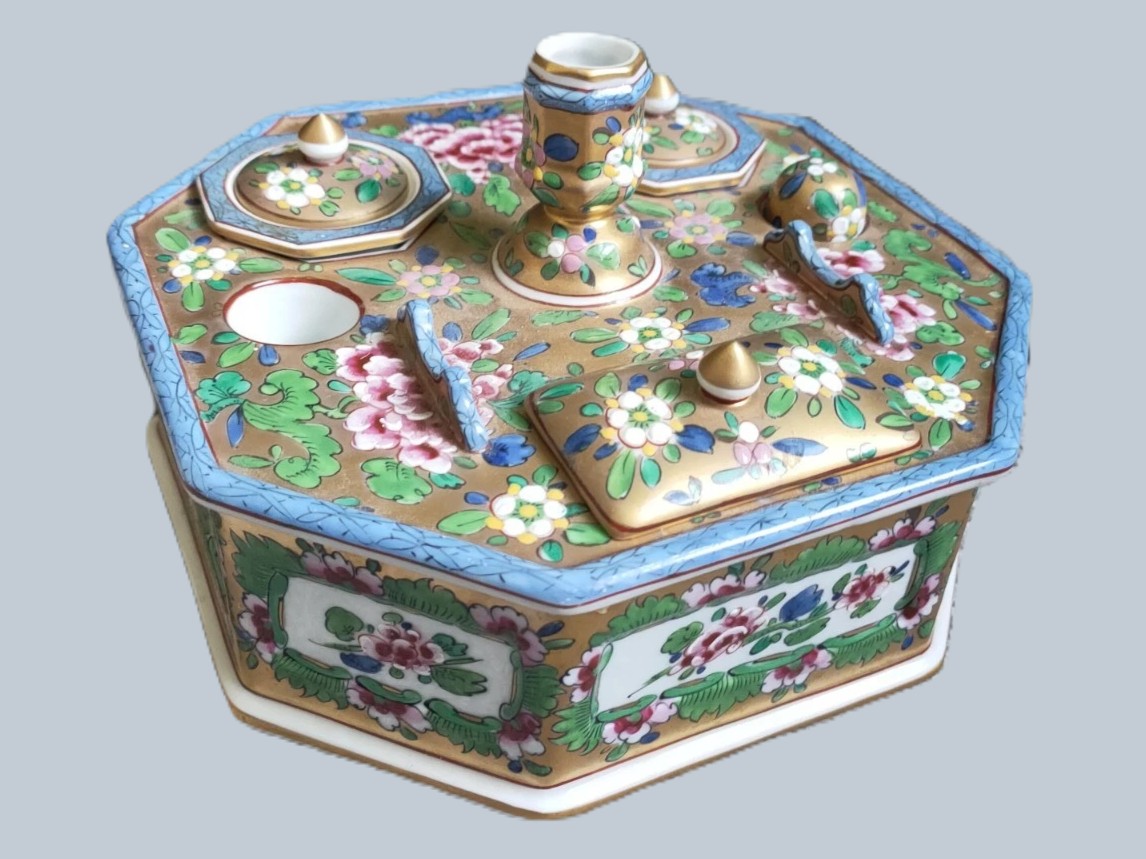
“Chinese Export Style” Octagonal Porcelain Inkstand
| Categories | Ceramics/Porcelain "Named" Makers |
| Material | Porcelain |
| Markings | See Narrative |
| Manufacturer | Samson Edmé et Cie |
| Origin | France |
| Date or Era | circa 1890 |
| Measuring | 7” across |
Description
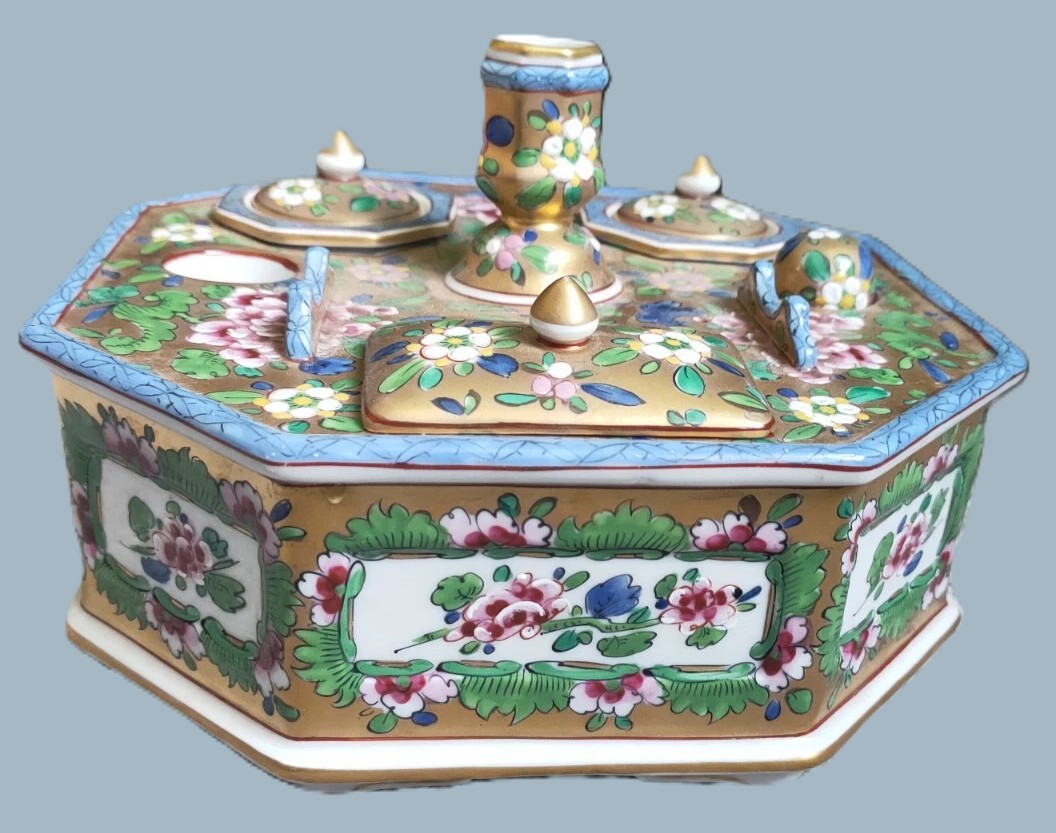
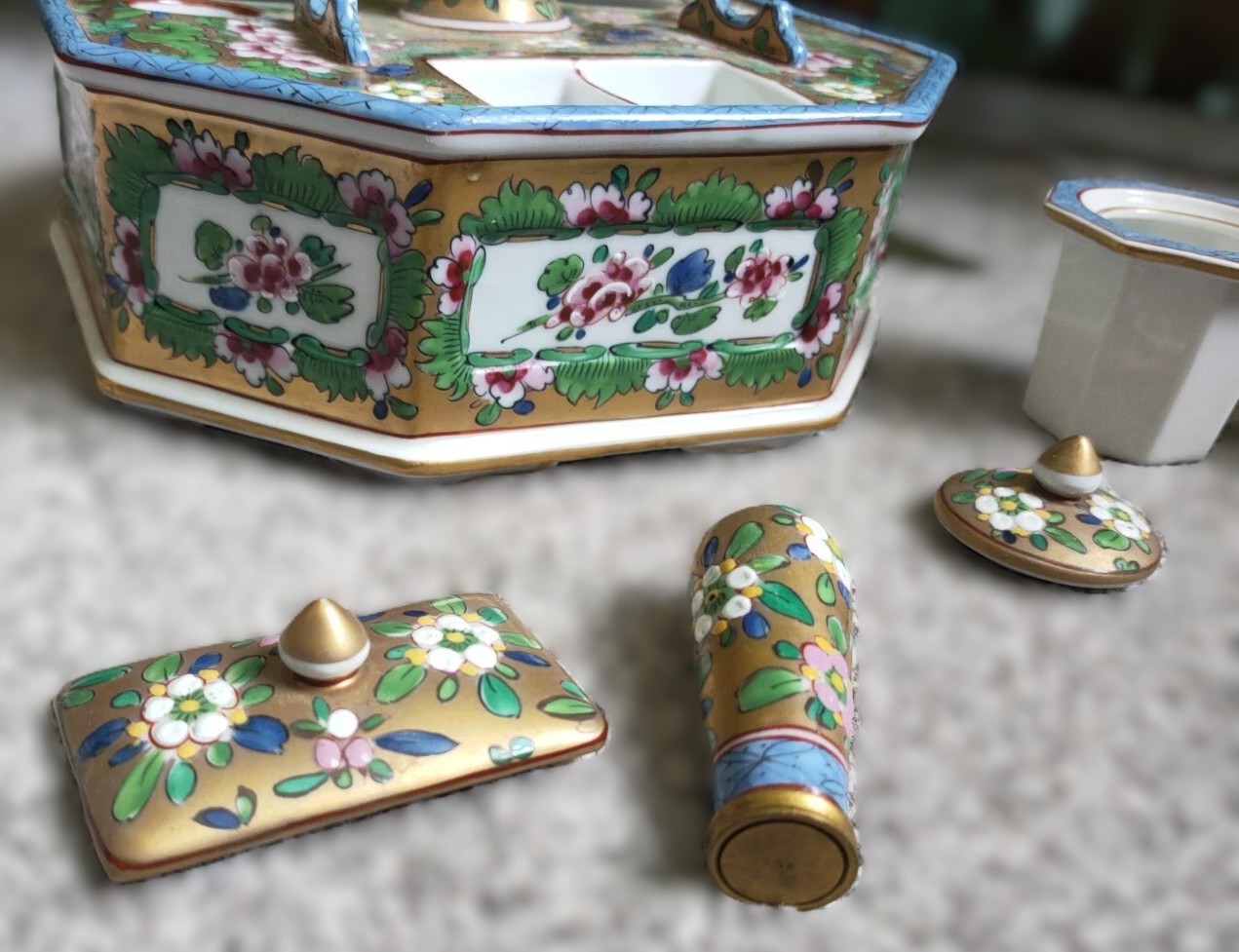
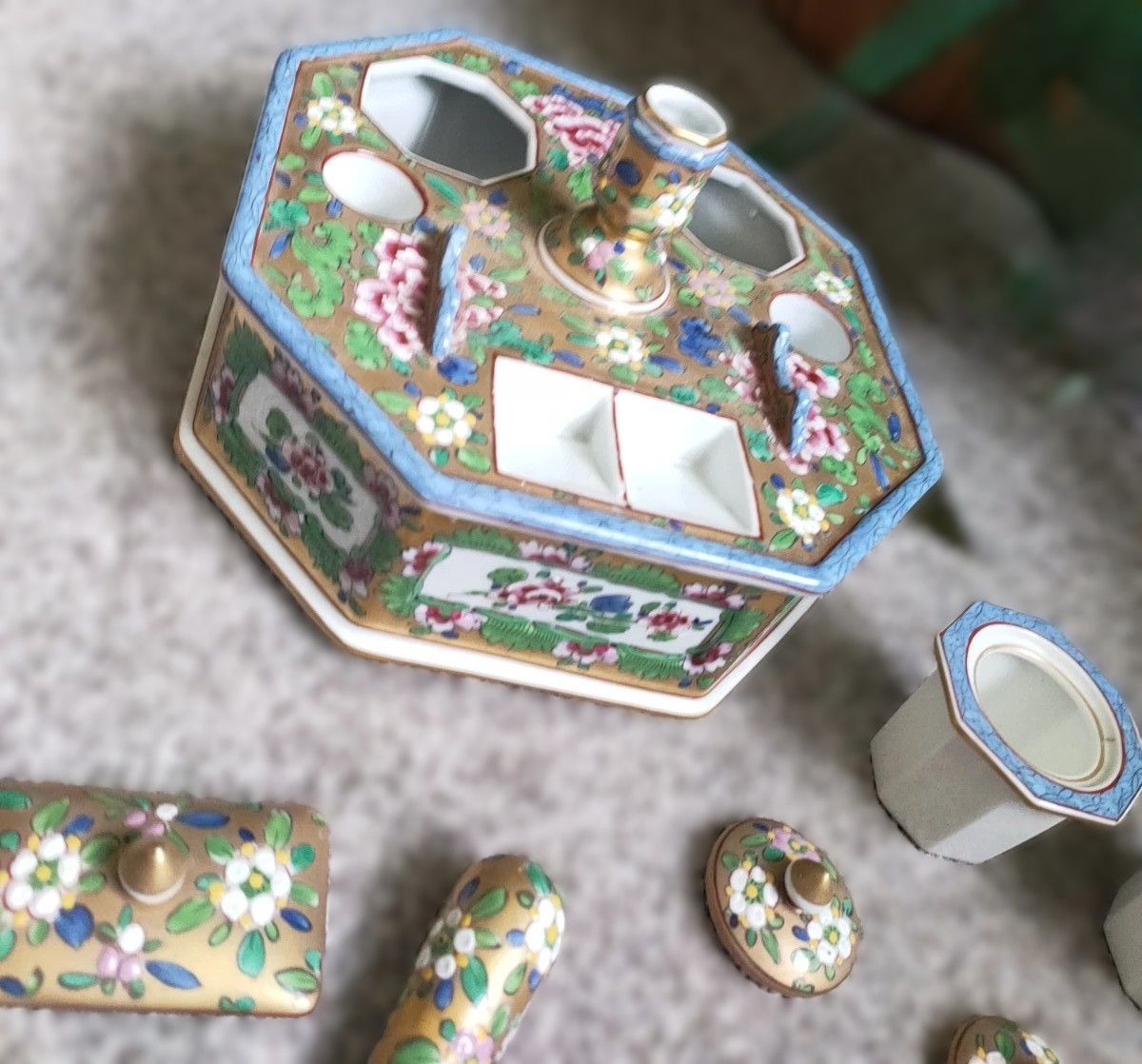
This elaborate, multi-piece octagonal porcelain inkstand is crafted in the style of 18th-century Chinese Export porcelain (specifically Famille Rose / Rose Canton):
- Form & Composition:
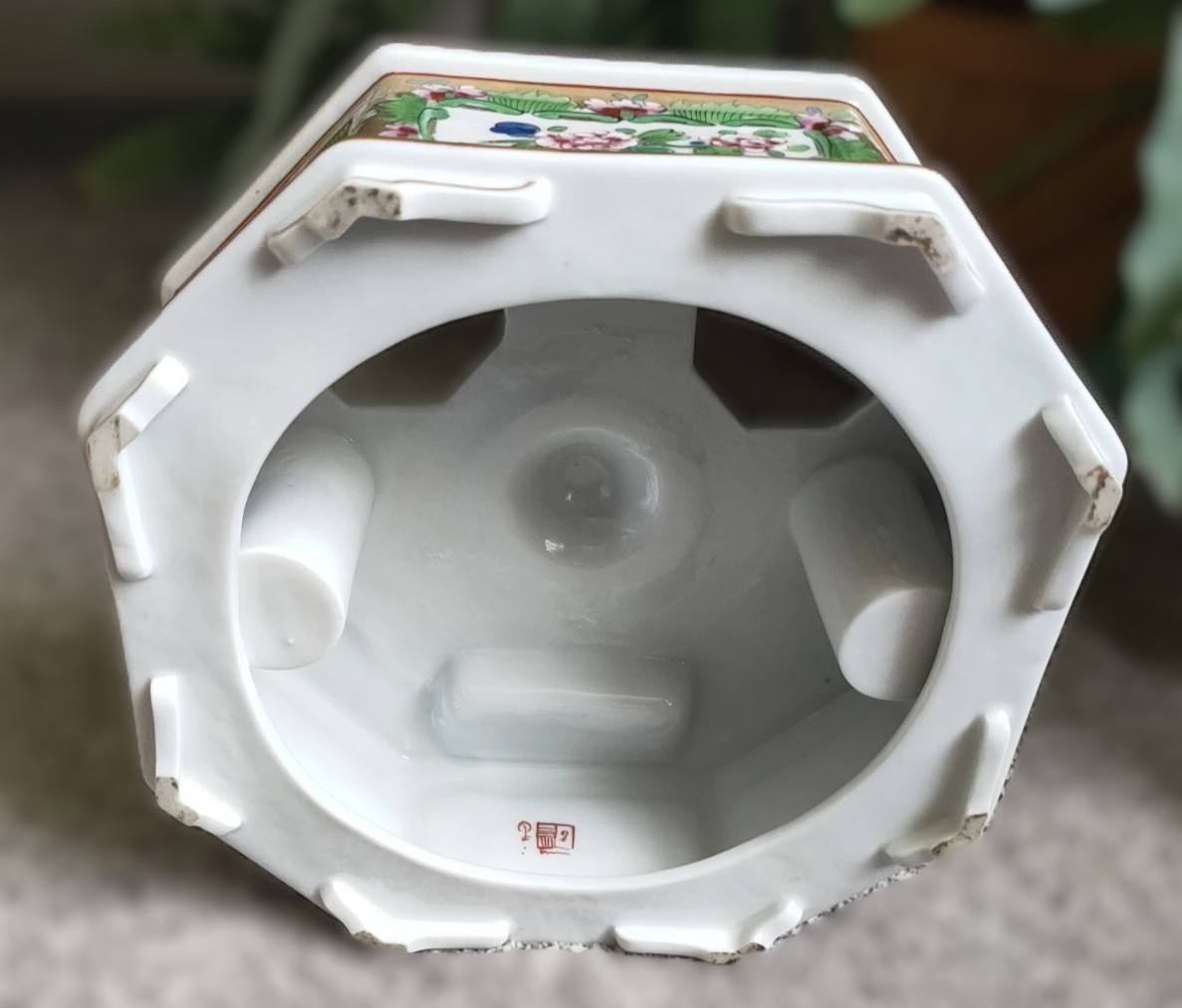
- Base Structure: An octagonal, deep-walled main casing resting on bracket-style feet.
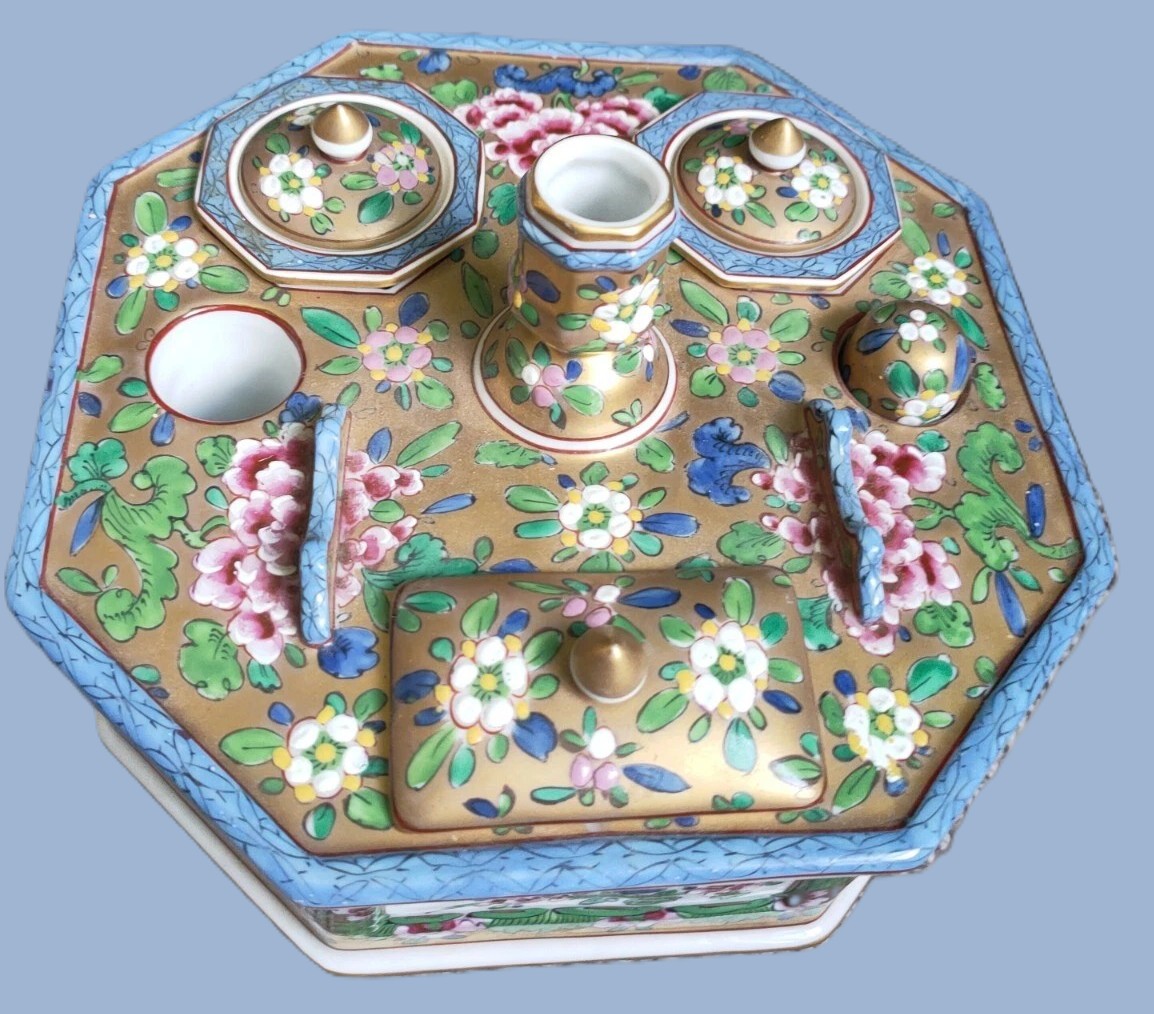
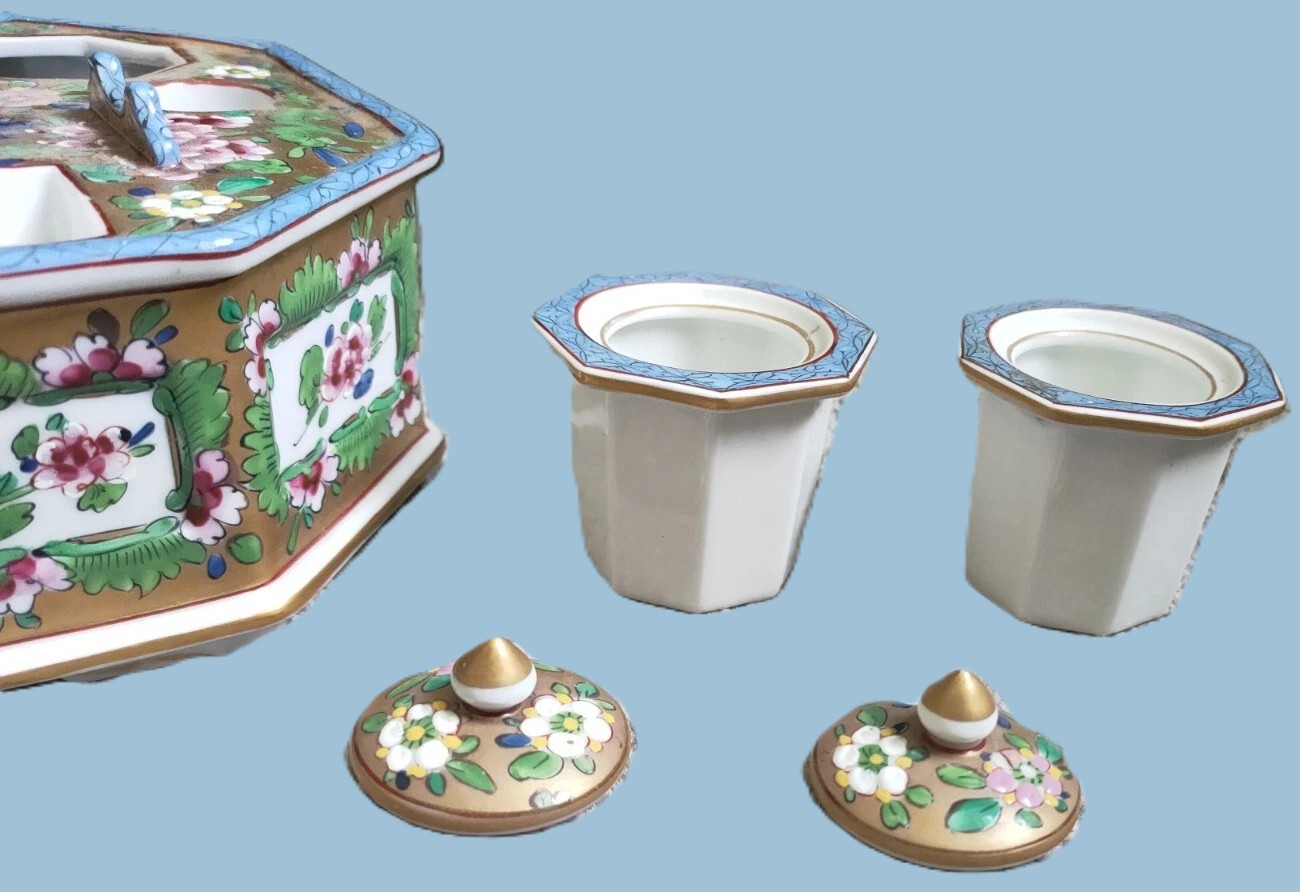
- Removable Components: Includes two octagonal ink pots with fitted, domed lids topped by gilded acorn finials; a central rectangular dual-compartment box lid with a matching gilt finial; a central removable candlestick socket; and a wax seal.
- Pen Rests: Two raised, scalloped blue brackets mounted on top to support quills or pens.
- Decoration & Palette:
- Richly painted with a thick gilt ground overlaying floral sprigs, pink peonies, and bright green scrolling foliage.
- Bordered by light blue cell patterns with dark blue line accents along the upper rim.
- The outer vertical faces feature framed white reserves filled with hand-painted floral sprays.
Origin, Maker, and Date
- Where is it from? Paris, France.
- Who made it? Edmé Samson et Cie (Maison Samson).
- How old is it? Made in the late 19th century to early 20th century (circa 1880–1910).
Identification of the Mark
The maker is Samson.
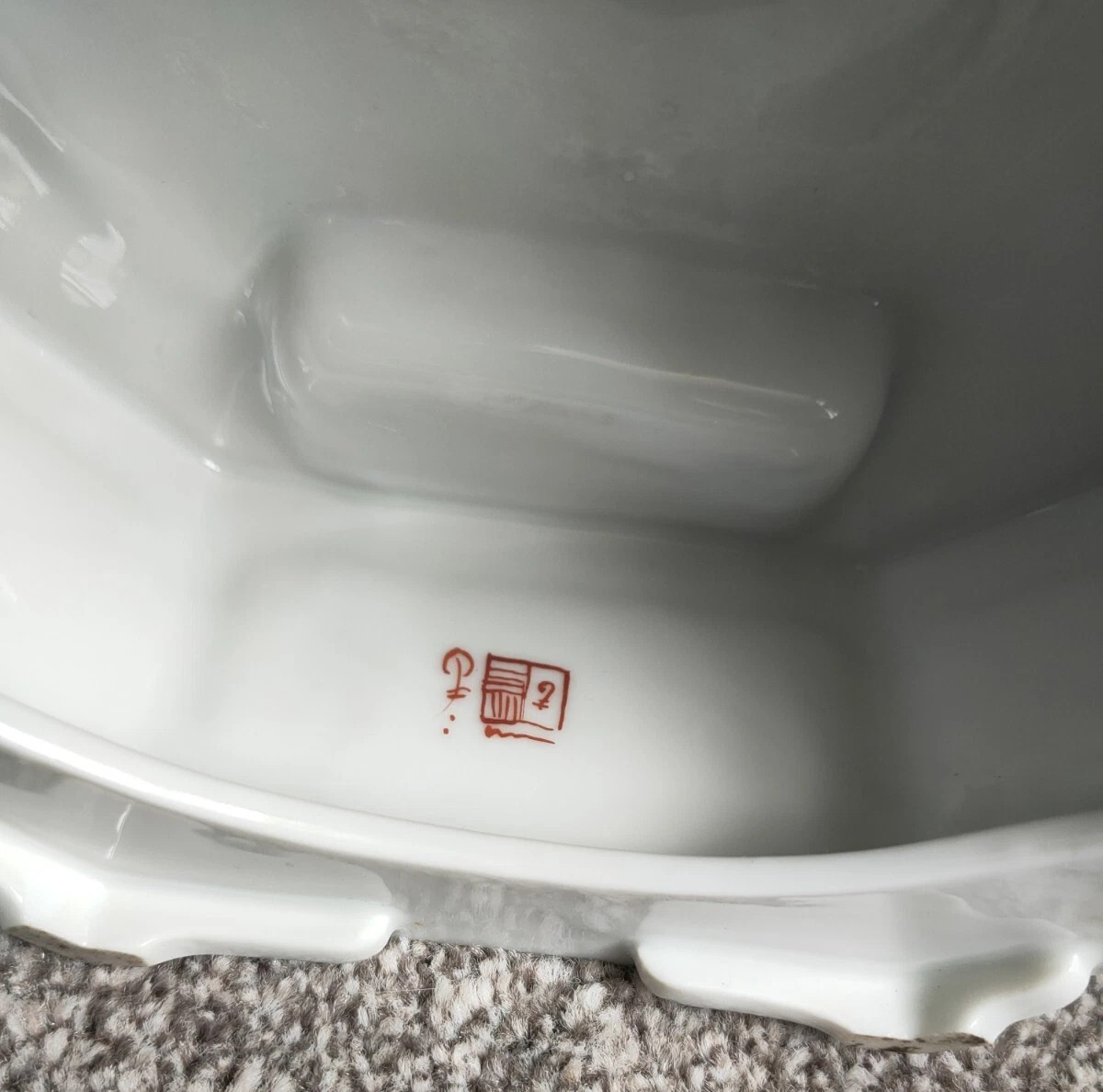
The iron-red mark painted on the underside consists of:
- A stylized letter “S” accompanied by small dots.
- An adjoining pseudo-Chinese square seal character.
Samson routinely used these apocryphal red pseudo-Chinese seals—often paired with their own discreet “S” symbol—to mark high-quality reproductions of Chinese Export, Armorial, and Famille Rose wares.
History of Edmé Samson et Cie
- Founding: Established in Paris in 1845 by Edmé Samson (1810–1891).
- Specialization: Samson gained international fame for producing precise copies and interpretations of museum-quality ceramics. Rather than creating original contemporary designs, the firm specialized in reproducing:
- Chinese Export & Japanese Imari porcelain
- European hard- and soft-paste masterpieces (Meissen, Sèvres, Chelsea, Worcester, Derby)
- Persian, Iznik, and Majolica earthenwares
- Materials & Craftsmanship: Unlike many early Chinese originals made of soft or specific local clay compositions, Samson utilized durable, highly translucent European hard-paste porcelain fired at high temperatures, decorated with heavy enamel work.
- Legacy: While originally intended as legal reproductions or replacements for historic dinner services and decorative sets, Samson’s exceptional quality meant that many pieces were later confused with 18th-century originals. Today, authentic 19th-century Samson porcelain is prized in its own right. The company remained operational until 1969.
Sold for $110 in June 2026
Content disclaimer. The information posted is the owner’s best knowledge and may not have been vetted by the SOIC. We welcome comments, corrections, and additions, working to make our website information comprehensive and accurate.
Join the Society of Inkwell Collectors (SOIC) – it’s free!
Founded in 1981 as a non-profit organization,
we are documenting inkwells (and accessories).
We’re here to help and inform!