

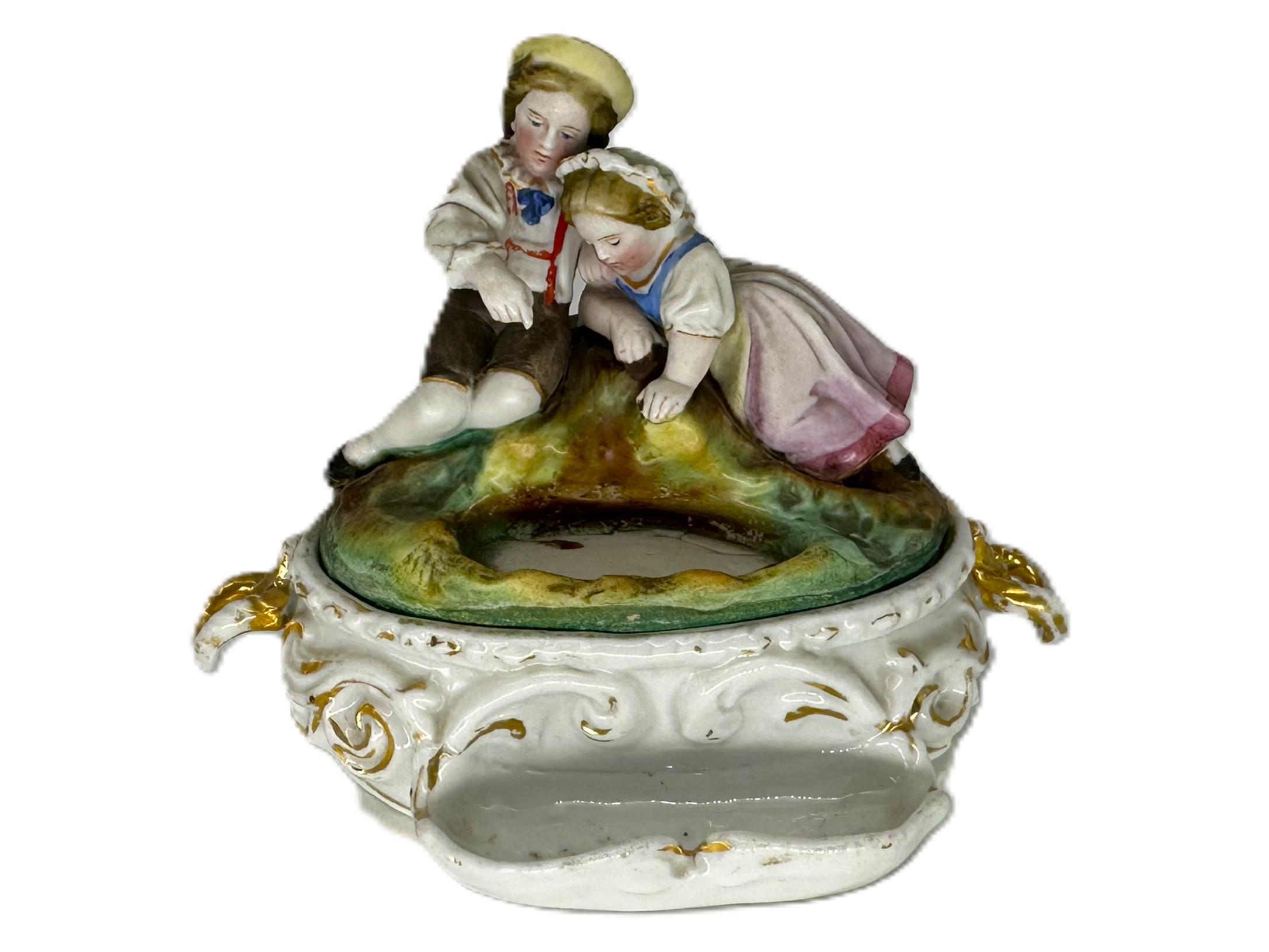
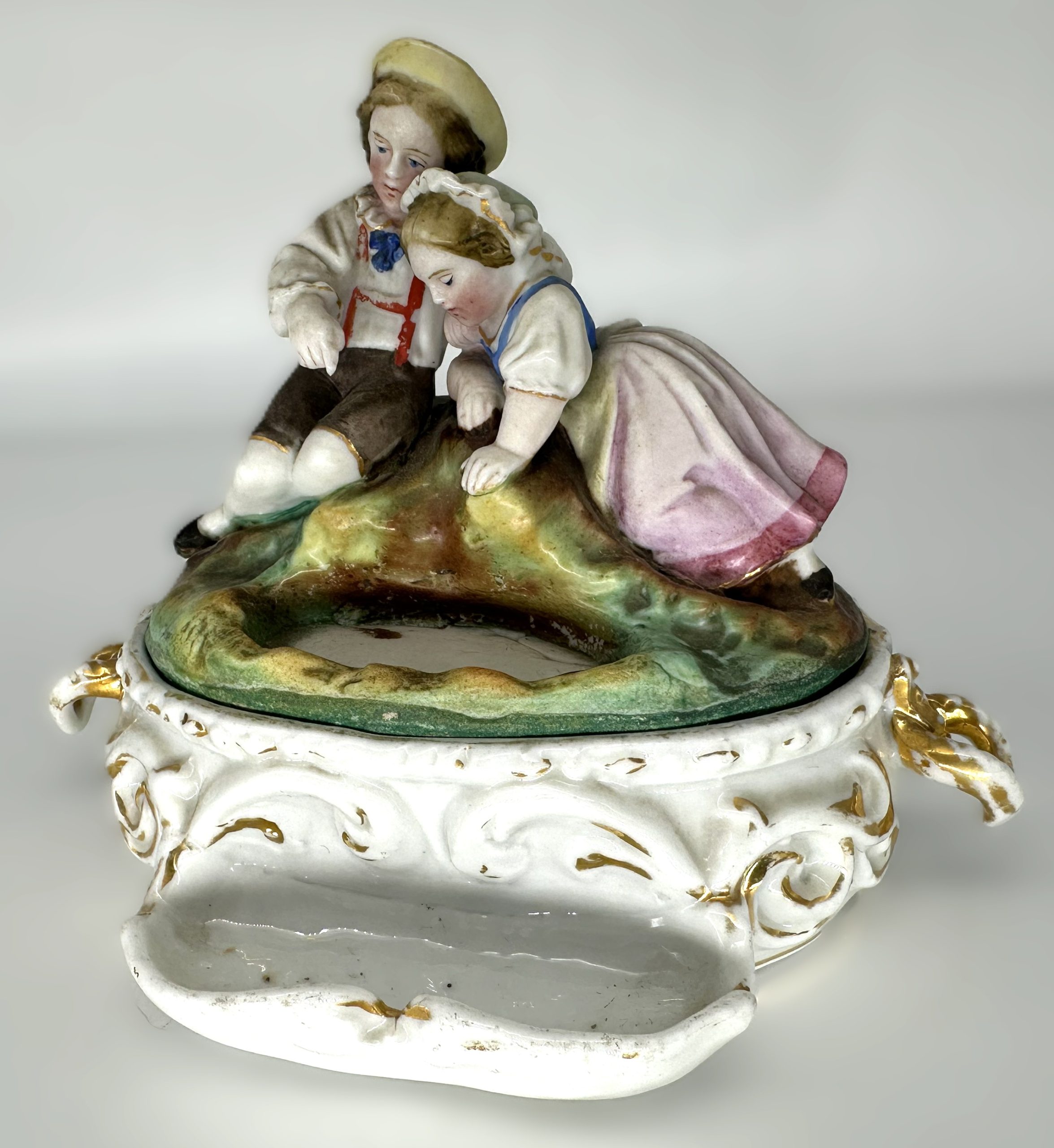
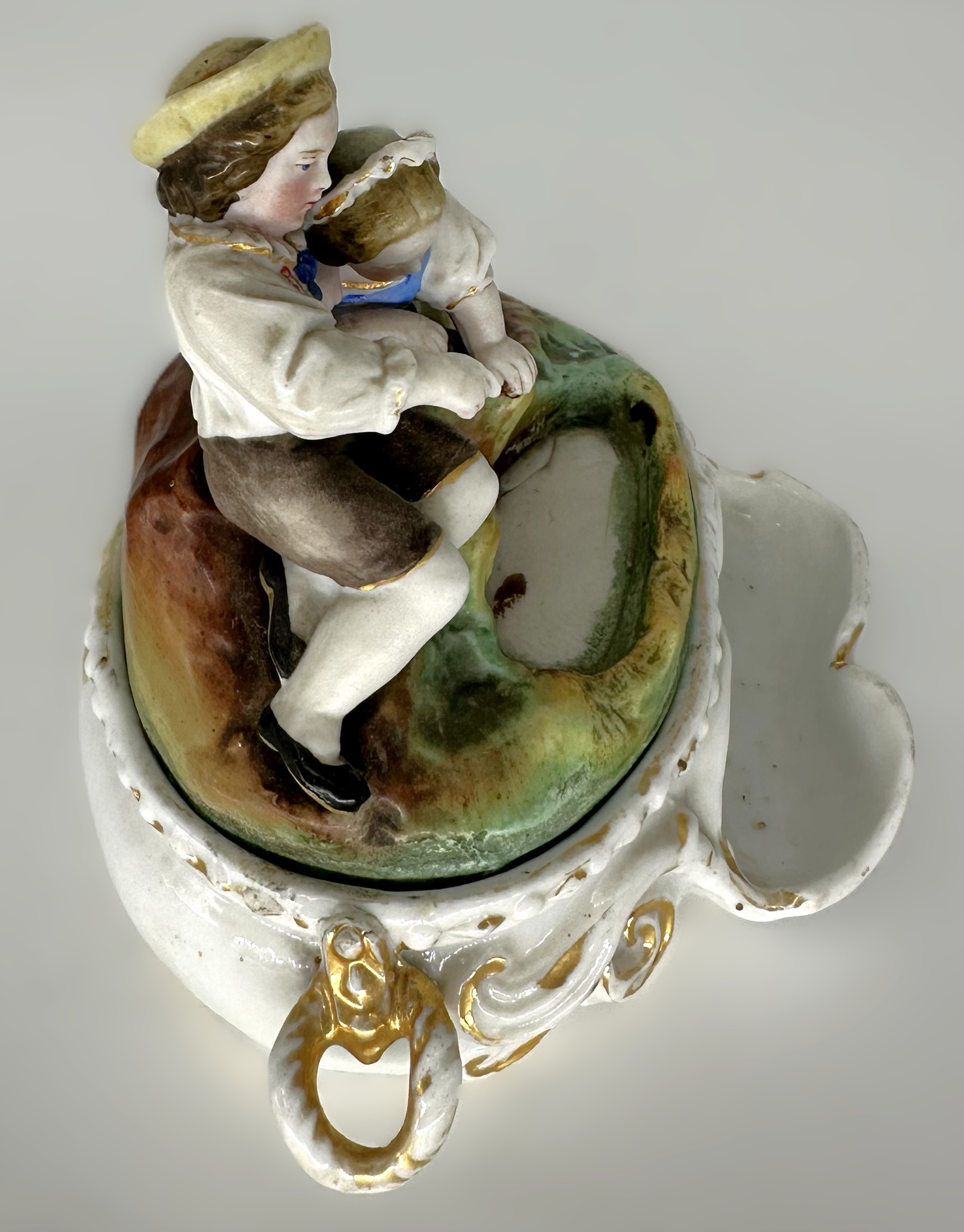
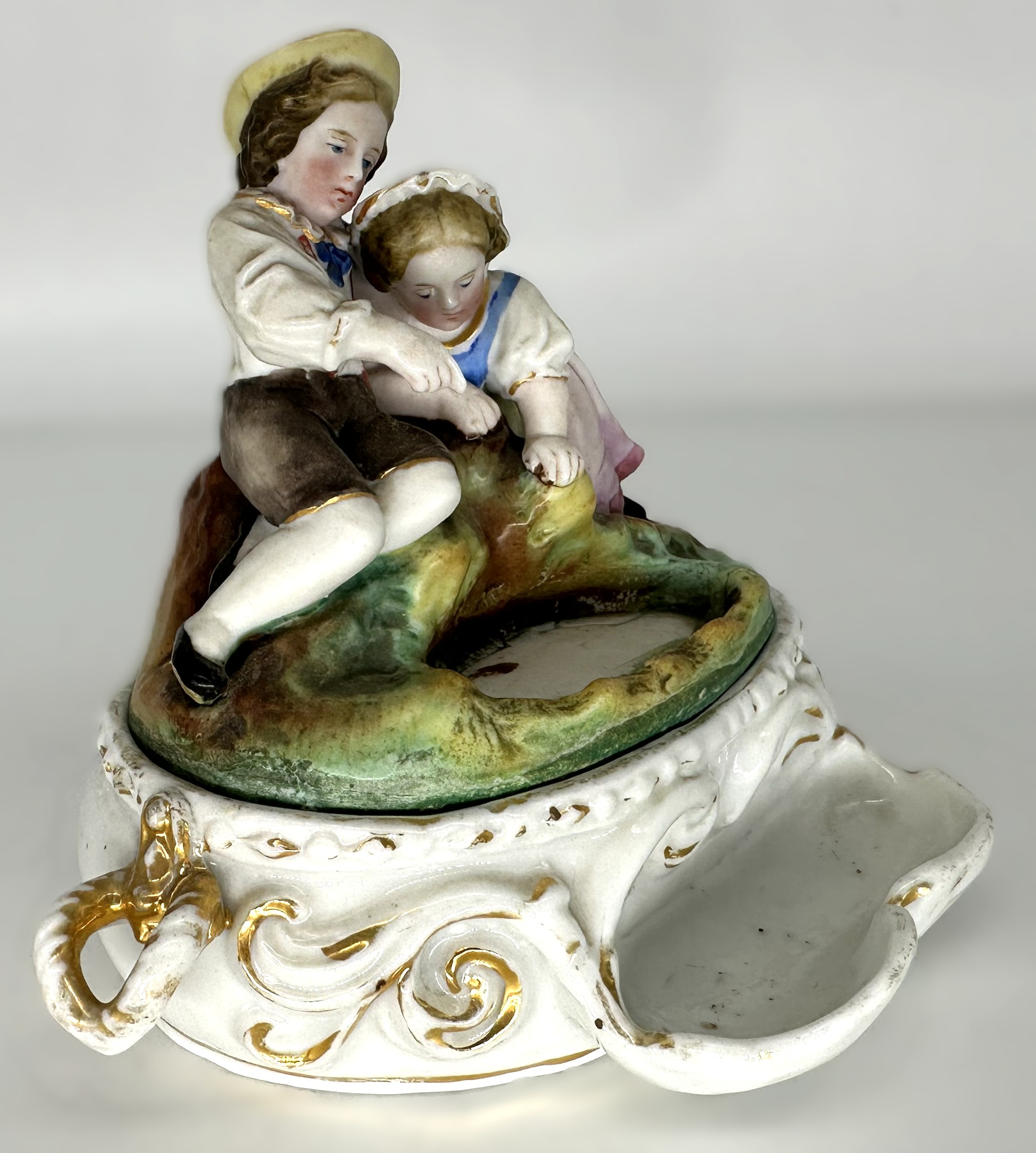
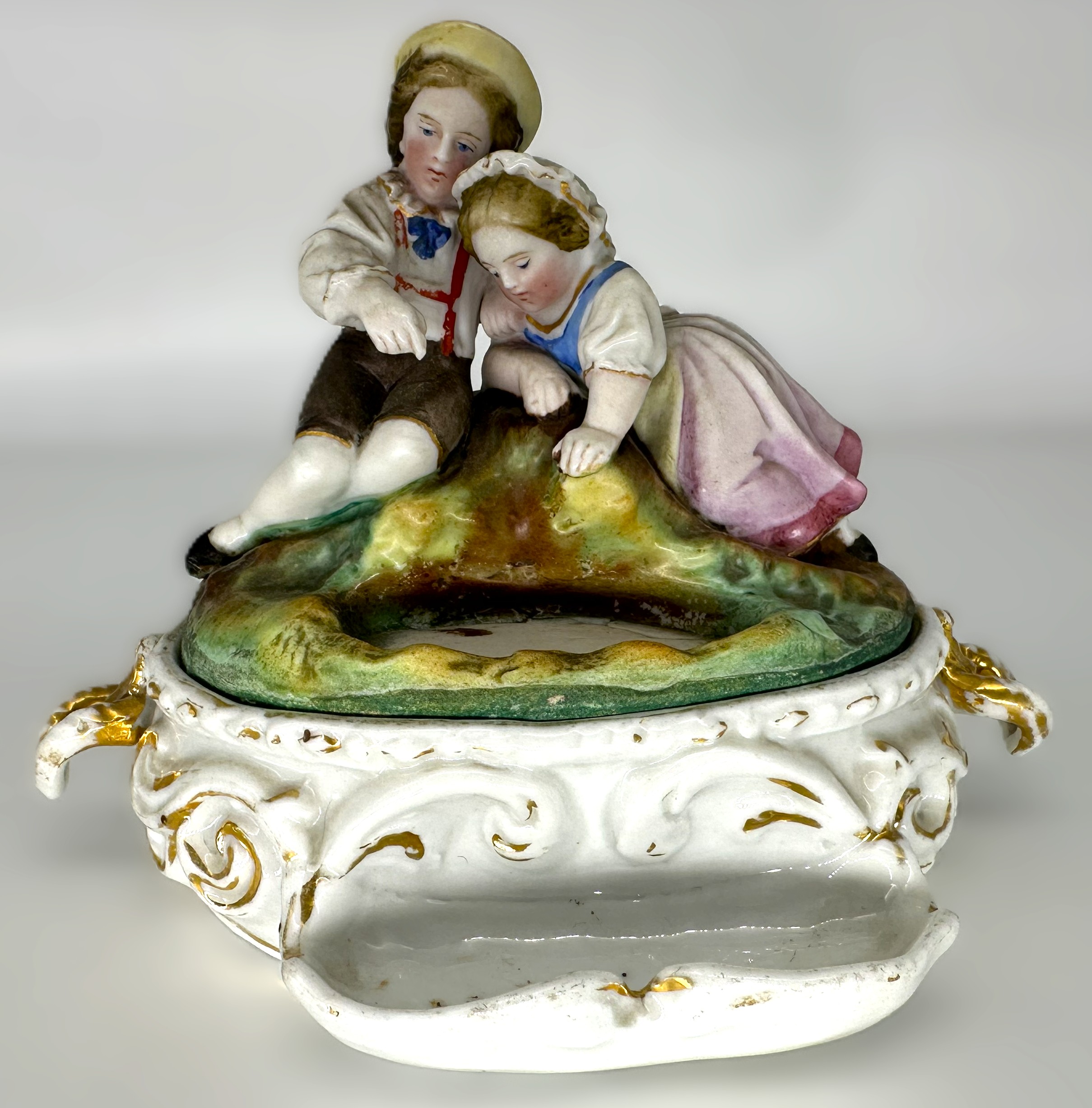
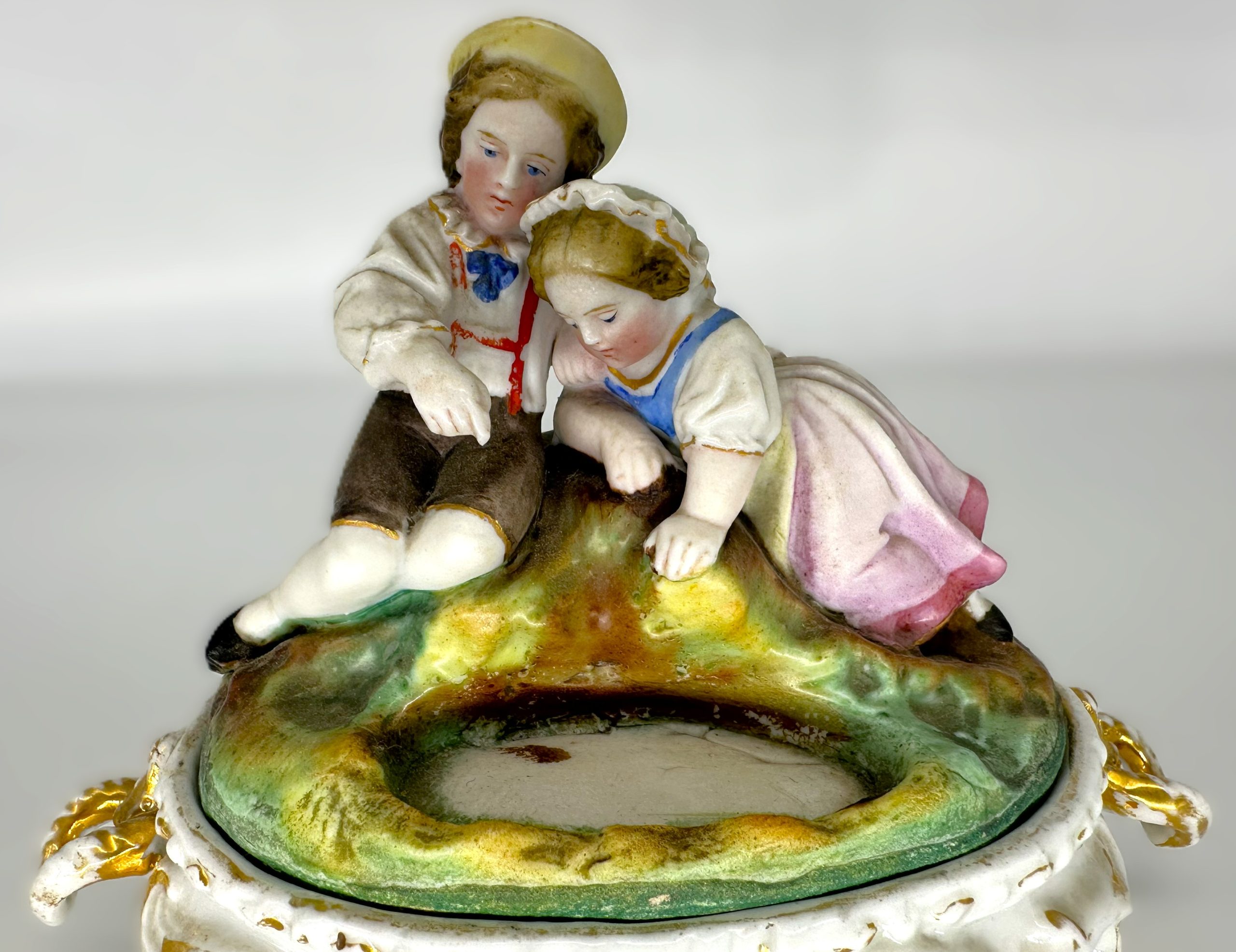
“Children at the Pond” Inkstand
| Categories | Ceramics/Porcelain Figural |
| Type | Children |
| Material | Porcelain |
| Markings | Unmarked |
| Manufacturer | Undetermined |
| Origin | Germany |
| Date or Era | circa 1870 |
| Measuring | 5 ¼” x 4” x 4 ¼” high |
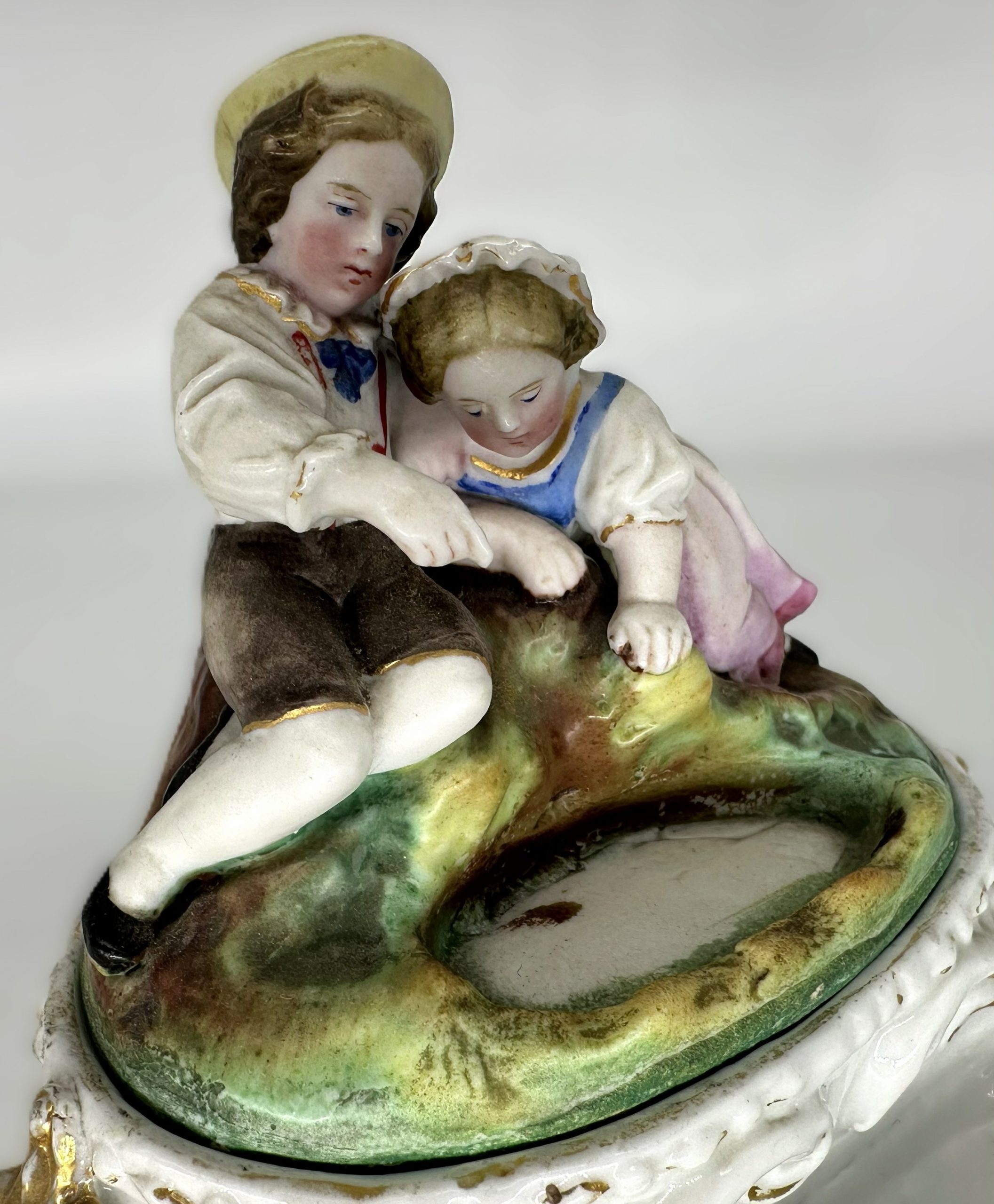
This Continental (most likely German) figural porcelain desk set / inkstand features a scene of a young boy and girl sitting atop a grassy bank or pond side.
Description
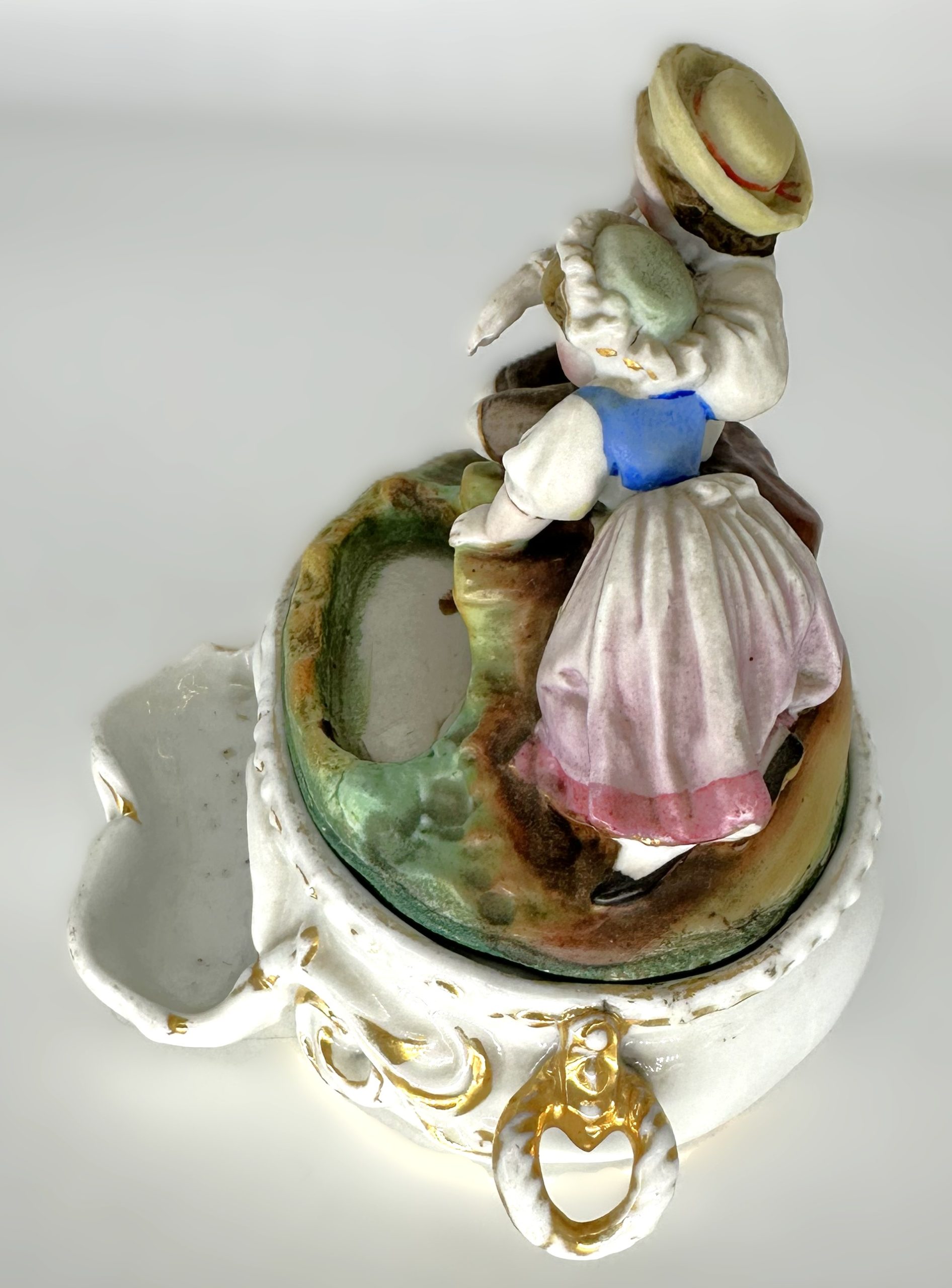
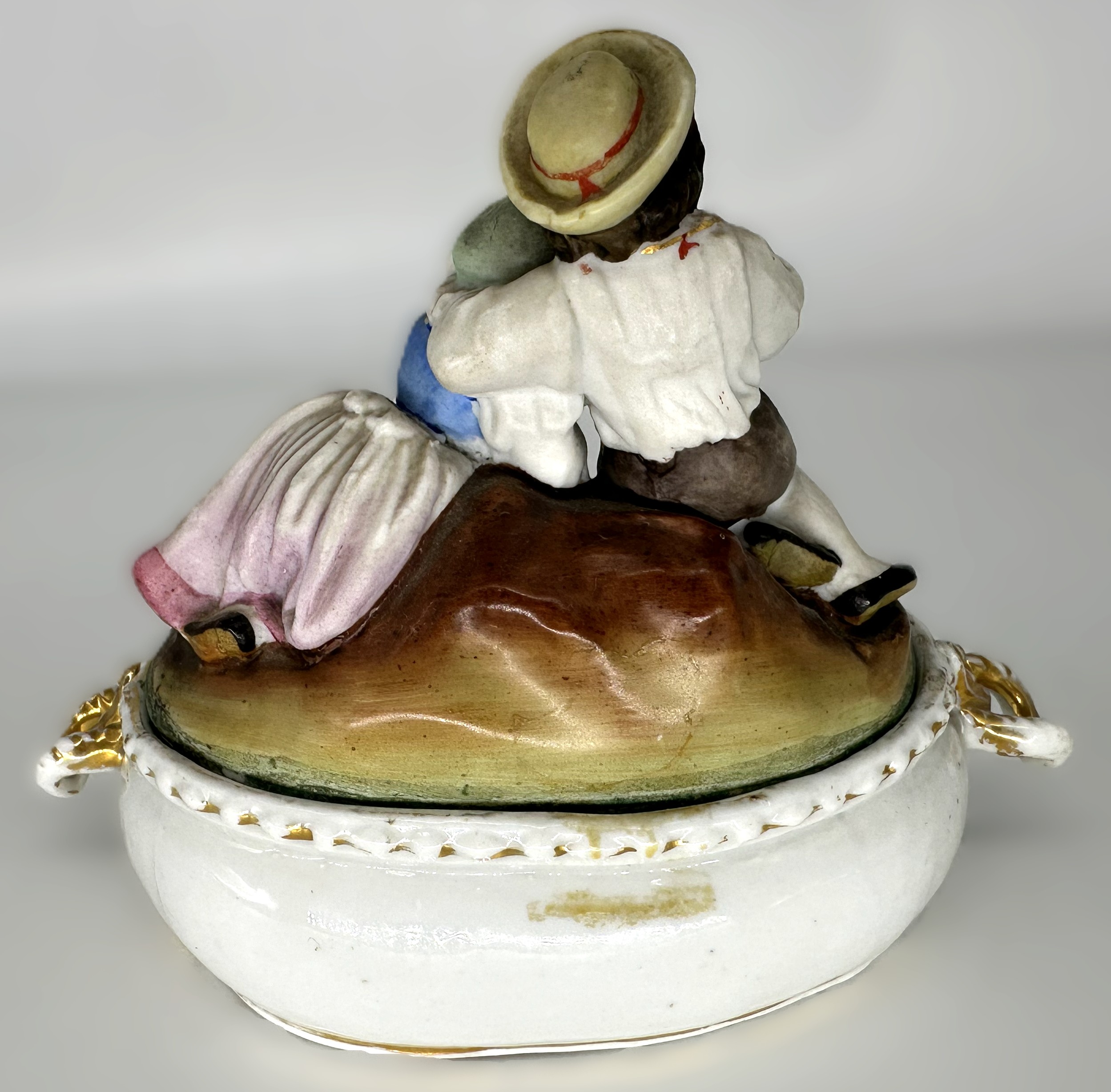
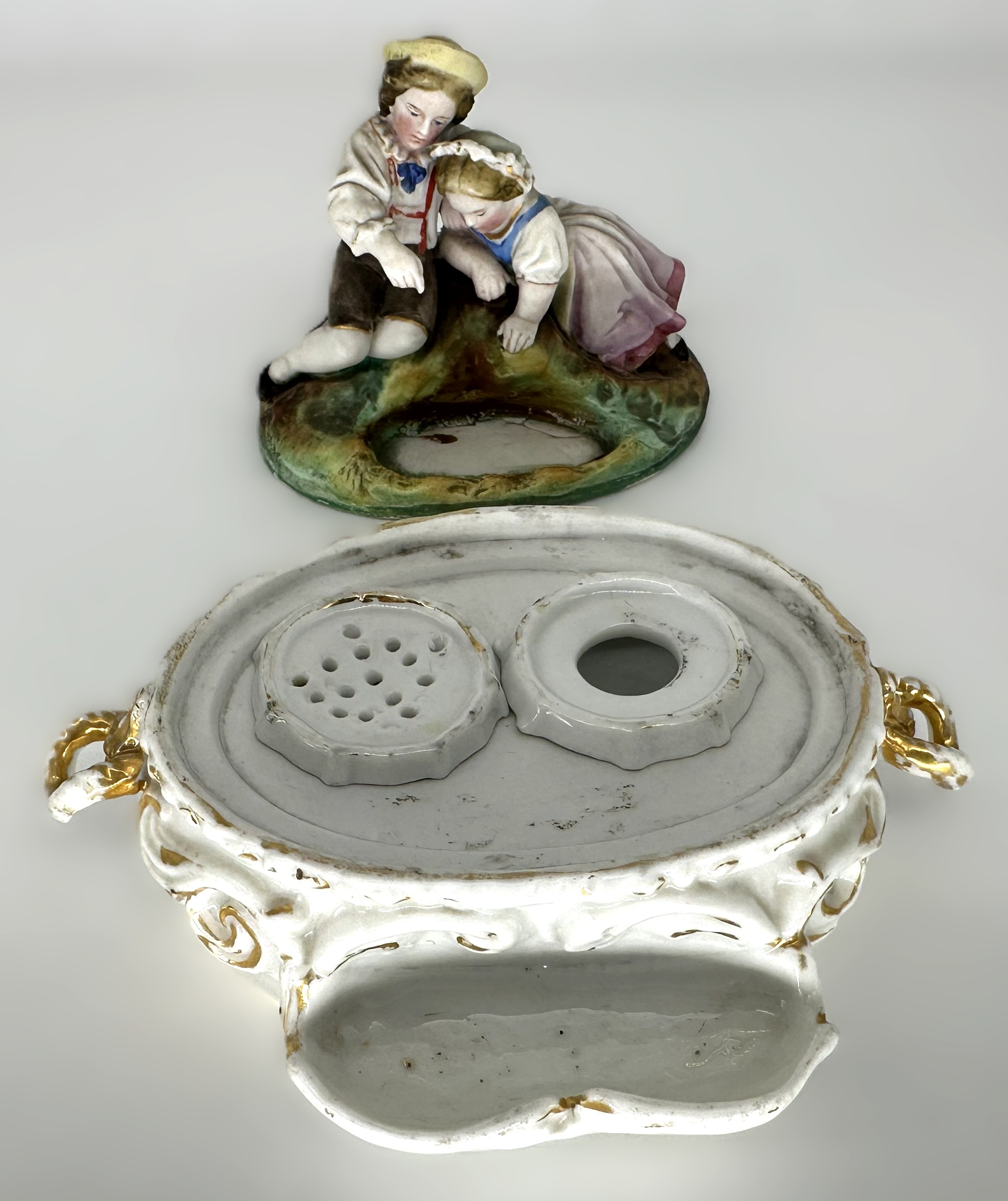
- Lid/Cover: The upper, removable cover features two children in mid-19th-century regional attire. The boy wears a wide-brimmed hat, brown breeches, white shirt, and suspenders; the girl wears a white bonnet, blue bodice, and a pink-trimmed skirt. They lean over a mossy green and brown bank/pond rim, looking downward. When in place, the cover conceals the utilitarian writing inserts beneath.
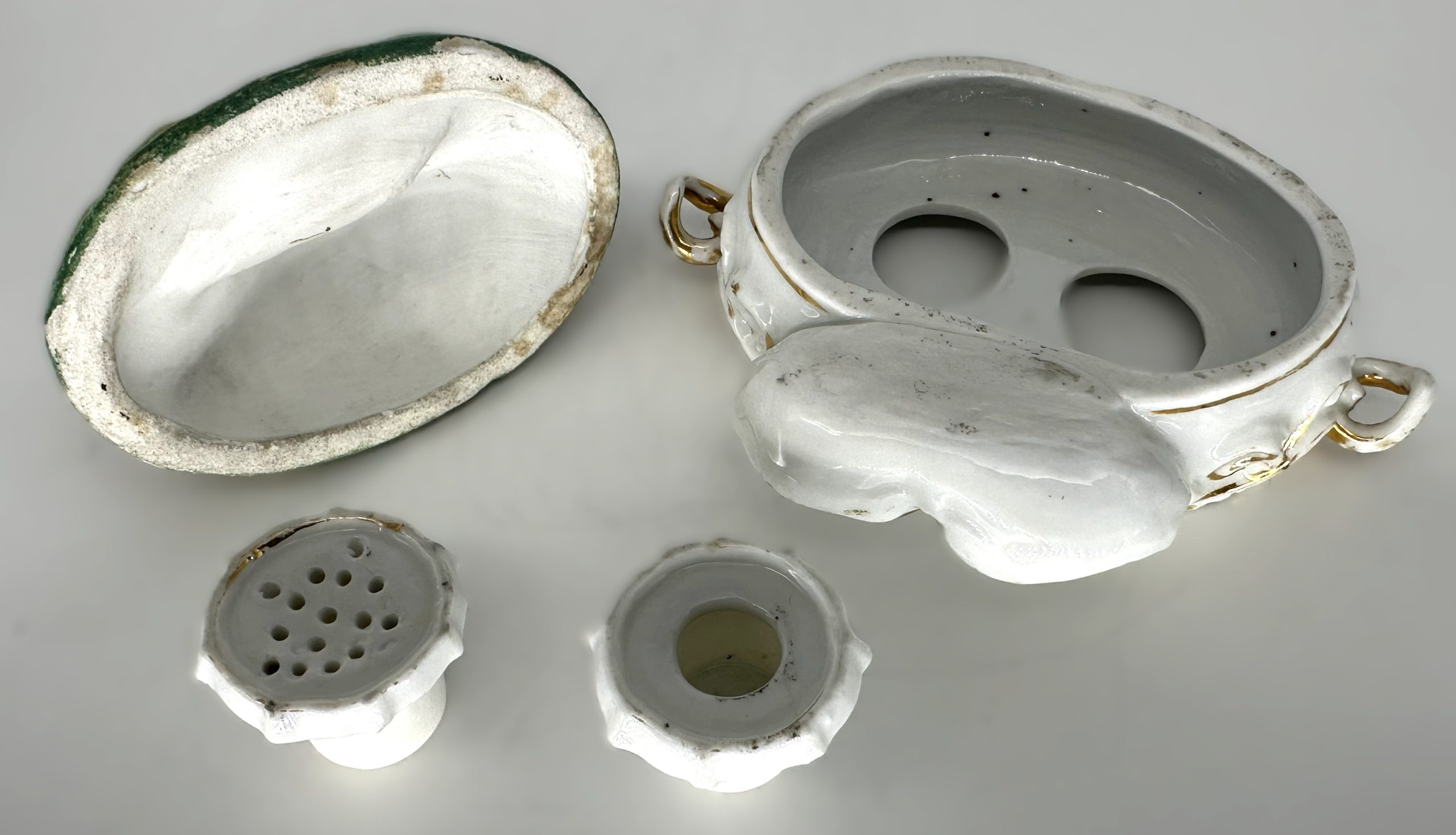
- Base Unit: The base is molded hard-paste porcelain decorated with Rococo-revival scrollwork and accents of gilt.
- Front Pen Tray: Attached directly to the front base is a built-in trough/tray for resting dip pens.
- Side Handles: Flanking the base are two ring handles molded in relief with gilt highlights.
- Writing Inserts: Lifting the lid reveals an inner deck housing two fitted porcelain inserts:
- Inkwell Insert: A circular insert with a wide center aperture for dipping a nib/pen.
- Sander / Pounce Pot: A matching circular insert topped with a perforated, multi-hole top.
Functionality: Inkwell & Sander (Pounce Pot)
The dual-pot setup was essential for 19th-century letter writing:
- The Inkwell: Held liquid iron gall or carbon ink.
- The Sander / Pounce Pot: Contained ground pounce (powdered cuttlefish bone, sandarac resin, or finely crushed mineral sand). Before writing, pounce was dusted onto porous paper to smooth the fibers and prevent ink bleed. Alternatively, fine drying sand was shaken over wet manuscript lines to absorb excess wet ink prior to folding the page.
Origin & Manufacturer Evaluation
- Attribution: The hand-painted facial features, molded Rococo base, soft glaze palette, and figural subject matter are typical of German (Thuringia region) porcelain manufacturers from the mid-to-late 19th century.
- Notable factories producing similar novelty writing accessories, trinket boxes, and match strikers include Conta & Boehme (Pößneck, Thuringia), Sitzendorf, or C.G. Schierholz & Sohn (Plaue). Conta & Boehme, in particular, was famous for molded figural porcelain groups, children at play, hidden lid-containers, and gilded scroll bases.
- Markings: Unmarked.
Period & Dating Evaluation
- Dating: Circa 1850–1870s (mid-19th century).
- Why mid-19th century?
- Sander Inclusion: As blotting paper became widely available and cheap in the 1860s–1880s, pounce pots/sanders gradually disappeared from standard writing sets. The inclusion of a dedicated, matching pounce pot confirms an earlier production timeframe.
- Costume & Stylistic Clues: The attire of the children (round-brimmed straw hat, suspenders, gathered skirts with bodices) reflects Victorian Biedermeier/Romantic genre art common between 1845 and 1875.
- Form & Finish: The Rococo Revival scrollwork along the base rim, brush-gilding, and soft-toned enameling on the figures align directly with mid-Victorian Continental export porcelain.
Estimated value: $125
Content disclaimer. The information posted is the owner’s best knowledge and may not have been vetted by the SOIC. We welcome comments, corrections, and additions, working to make our website information comprehensive and accurate.
Join the Society of Inkwell Collectors (SOIC) – it’s free!
Founded in 1981 as a non-profit organization,
we are documenting inkwells (and accessories).
We’re here to help and inform!