




Champlevé Enamel and Micro Mosaic Inkstand
| Categories | Enameled Metal, Souvenir |
| Type | Grand Tour |
| Material | Enameled Brass/Bronze/Metal, Glass |
| Markings | Unmarked |
| Manufacturer | Undetermined |
| Date or Era | circa 1880 |
| Measuring | 7 ½” x 7 ½” x 5” high |
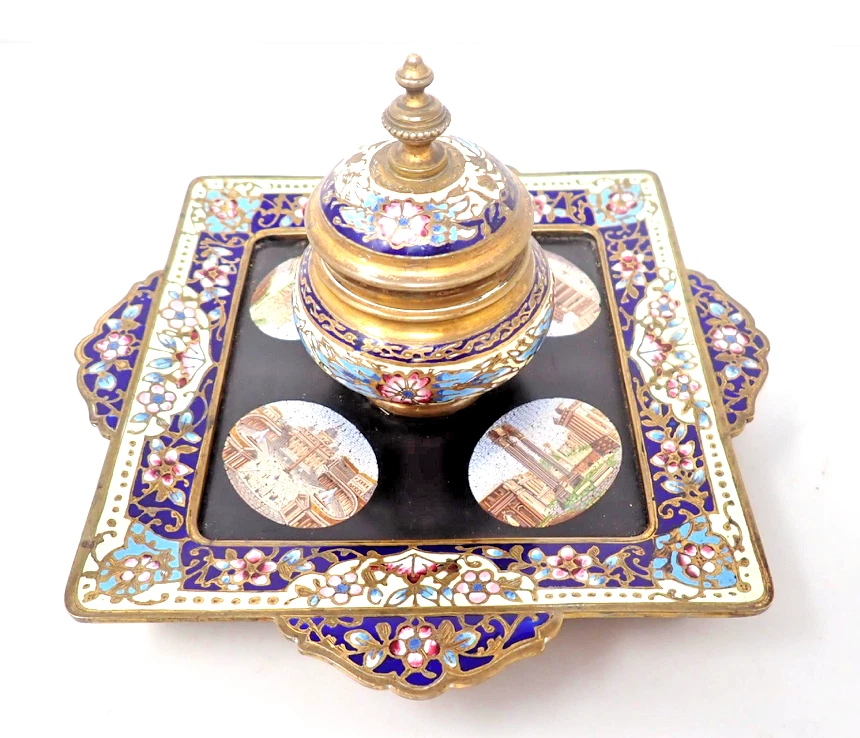
This is an exceptional Grand Tour object that marries two highly demanding, specialized decorative arts: Champlevé enamel and Roman micro mosaic.
- Description of the Inkstand
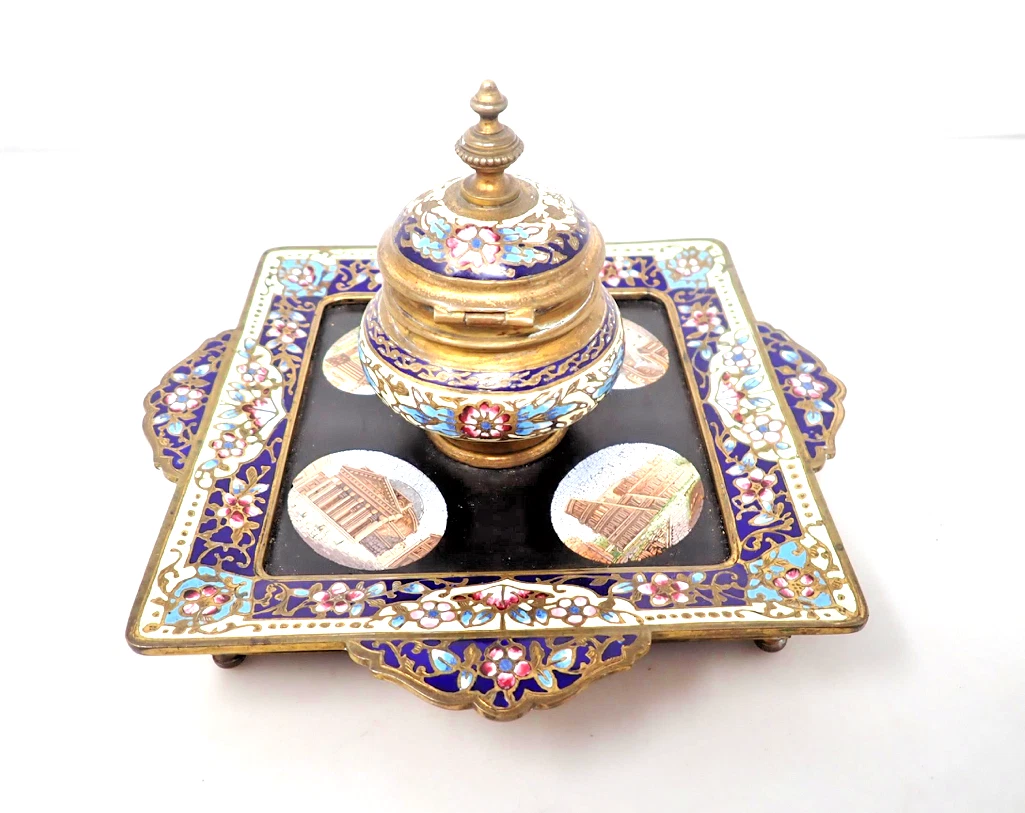
The piece consists of a square, bronze stand supported by small bun feet, with decorative, scalloped handles extending from the sides.
- The Base & Borders: The wide outer border and handles feature intricate Champlevé enameling with a vibrant palette of lapis blue, turquoise, white, and translucent rose/pink. The pattern is floral and foliate, showcasing an elegant, scrolling Victorian-era adaptation of Renaissance or Gothic styles.
- The Center Tray: The interior tray is inlaid with a highly polished black glass slab (historically referred to as paragone or Belgian black marble), which sets a stark, dramatic background for the central elements.
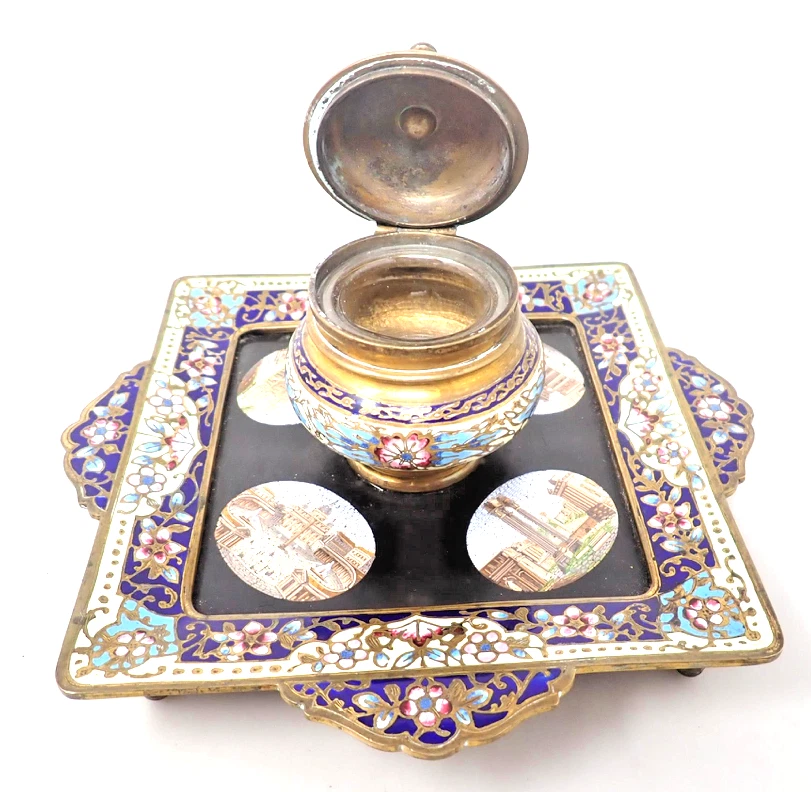
- The Inkwell: Resting in the center is a matching, spherical gilded-metal inkwell with a hinged lid and a decorative finial. The exterior of the well and lid is fully decorated in matching Champlevé enamel florals.
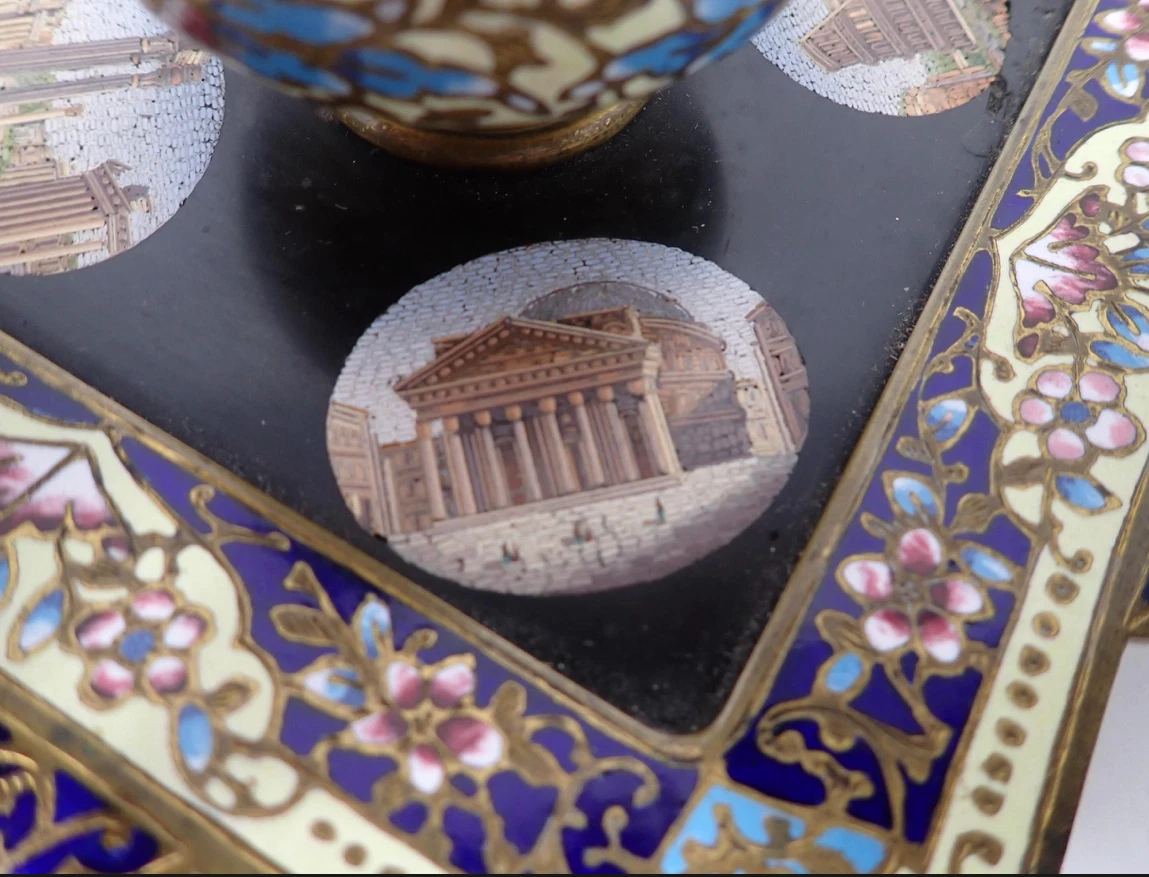
- The Mosaics: Inset into the black glass floor are four circular micro mosaic plaques (medallions) detailing iconic classical and religious architectural views.
- Processes Involved in Making This Piece
Champlevé Enameling
Unlike Cloisonné (where wire cells are soldered onto a surface), Champlevé involves carving, casting, or etching depressions directly into the thick metal base.
- Cells or troughs are created in the brass/bronze base to form the floral pattern.
- Finely powdered colored glass (enamel) is packed into these specific recessed areas.
- The piece is fired in a kiln at high temperatures, melting the glass so it fuses to the metal.
- Once cooled, the entire surface is ground down and polished flat so that the metal borders and the smooth glass enamel sit perfectly flush. Finally, the exposed metal lines are gilded.
Micro Mosaic (Mosaico Minuto)
The tiny pictorial plaques are an incredible feat of patience and precision, utilizing tiny glass threads called tesserae or smalti filati.
- Making the glass: Master glassmakers melt colored glass and pull it into incredibly thin, hair-like rods (often less than a millimeter wide). These rods can be multi-colored to create shading.
- Assembling the picture: The tiny rods are snapped into minuscule lengths. A master mosaicist uses tweezers to press hundreds—sometimes thousands—of these tiny glass bits per square inch into a slow-drying adhesive cement filled inside a small metal copper pan or “receptacle.”
- Finishing: Once the image is complete and the cement hardens, the surface is waxed, polished, and ground perfectly flat to resemble a seamless oil painting made entirely of glass.
- Identification of Buildings and Structures
These four circular plaques feature classic, recognizable views of historic Rome, which were standard “must-see” stops on the Grand Tour:
- Plaque 1: The Roman Forum / Temple of Vespasian and Titus. It depicts the iconic three remaining Corinthian columns of the temple, alongside ruins of the surrounding Forum.
- Plaque 2: St. Peter’s Square (Piazza San Pietro). This view shows the massive dome of St. Peter’s Basilica, the flanking curved Bernini colonnades, the central Egyptian obelisk, and the piazza fountains.
- Plaque 3: The Colosseum. A classic profile view of the flawed, majestic outer tier walls of Rome’s ancient amphitheater.
- Plaque 4: The Pantheon. This plaque highlights the grand portico with its classical columns and the massive concrete dome rising behind it.
- Origin, Maker, and Date
Where was it made?
This is a composite luxury object. The micro mosaic plaques were almost certainly manufactured in Rome, Italy, which was the absolute epicenter for this highly specialized micro-glass art form.
However, the gilded metalwork and Champlevé enameling were very frequently executed in France (Paris) or Austria (Vienna). Roman mosaic workshops regularly exported individual loose plaques to French and Austrian clockmakers, jewelers, and bronziers, who would mount them into high-end decorative objects like inkstands, paperweights, and jewelry boxes.
Who made it?
Because these items were rarely signed by the individual artisans, a definitive workshop name cannot be given without a stamped maker’s mark on the underside of the metal base. The mosaics likely originated from a prominent Roman workshop (such as the Vatican Mosaic Studio or commercial masters like Giacomo Raffaelli or Cesare Roccheggiani derivatives). The final assembly and enamel work are characteristic of high-end Parisian decorative arts firms supplying boutiques in the Palais-Royal.
When was it made?
Based on the specific style of the Champlevé enamel patterns, the rounded shapes, and the popularity of this specific style of Grand Tour souvenir, it was made during the Late Victorian / Napoleon III period, specifically circa 1870–1890.
It is a beautiful desk piece that represents the pinnacle of late 19th-century European souvenir craftsmanship for wealthy travelers!
Sold for $1,115 in May 2026
Content disclaimer. The information posted is the owner’s best knowledge and may not have been vetted by the SOIC. We welcome comments, corrections, and additions, working to make our website information comprehensive and accurate.
Join the Society of Inkwell Collectors (SOIC) – it’s free!
Founded in 1981 as a non-profit organization,
we are documenting inkwells (and accessories).
We’re here to help and inform!