

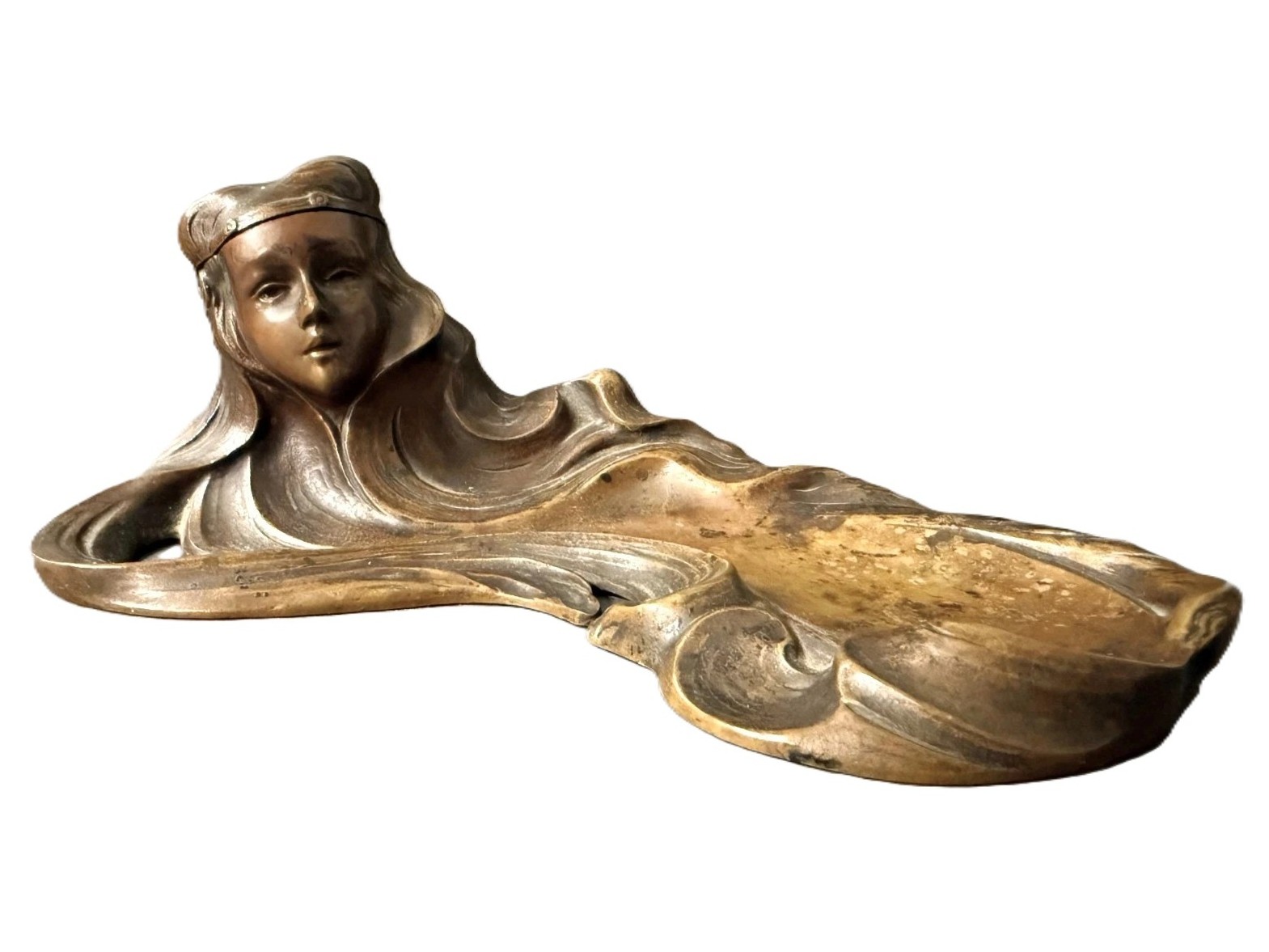


“Cascading Hair” Figural Inkwell & Pen Tray
| Categories | Art Nouveau |
| Material | Bronze |
| Markings | Unmarked |
| Manufacturer | Undetermined |
| Origin | Undetermined |
| Date or Era | circa 1900 |
| Measuring | 7 ⅞” x 4” x 2 ⅞” high |
This piece is a quintessential example of an Art Nouveau piece, seamlessly blending functional utility with organic, fine art sculpture.
- The Form: The inkwell features the stylized, idealized bust of a young woman with a serene, downcast gaze and softly parted lips. She wears a decorative headband or tiara accented with rivets, and a delicate four-petaled blossom is nestled in her hair at the side.
- The Pen Tray: Her voluminous, cascading hair flows outward and sweeps along the table surface, twisting into dramatic, asymmetric curls. These undulating lines form a long, shallow basin designed to act as a pen rest. This fluid integration of the human form with nature is a hallmark of the Art Nouveau whiplash style.
- The Lid & Reservoir: The top portion of her head and hair serves as a masterfully integrated, hinged lid. When flipped open via its rear pin-hinge, it reveals a hollow circular well designed to hold an ink reservoir. This piece is missing an insert.
- Patina & Condition: The exterior boasts a rich, multi-toned chocolate and golden-brown patina that beautifully emphasizes the texture of the hair strands. The interior of the well and the underside of the lid display a vibrant coating of green verdigris—a natural oxidation that occurs when copper-alloy metals react over many years with the acidic moisture of historic inks.
Sculptor’s Name?
When this exact unmarked model appears in specialized decorative arts galleries, it is cataloged as being in the style or manner of Gustav Gurschner (Austrian, 1873–1970), dating to circa 1900. The attribution to Gurschner’s signature style makes sense for several reasons:
- The “Hair-As-Tray” Design Concept
Gurschner was a master of the vide-poche (pocket-emptying tray) and desk sets. He became famous for a specific design vocabulary where a woman’s head transitions seamlessly into heavy, sweeping loops of hair that flatten out to form a functional basin. His famous “Ophelia” bowl (circa 1900) relies on this identical concept—using a maiden’s face at the edge of a vessel formed entirely by her flowing tresses.
- The Austro-French Crossover Style
Gurschner studied in Vienna but spent a formative chunk of his early career living and working in Paris before returning to participate in the inaugural exhibition of the Vienna Secession in 1898. This inkwell perfectly captures this dual identity:
- It features the soft, ethereal, romanticized face typical of French Art Nouveau (including the delicate headband and the flower tucked behind her ear).
- It pairs that delicate face with the heavier, more substantial, highly structured casting technique favored by the Viennese Jugendstil foundries.
- Why It Is “In the Manner of” Rather Than Signed
Authentic pieces cast under Gurschner’s direct supervision or by top-tier Viennese foundries (like A. Förster) are prominently stamped GURSCHNER, often accompanied by DEPOSE or WIEN/VIENNE.
Because this piece is unmarked, it is categorized by antiquarians as an excellent period casting done after or in the style of his work. Around the time of the 1900 Paris World Exposition, Gurschner’s desk designs were wildly popular and widely influential. Competitor foundries across Austria, Germany, and France frequently produced high-quality, unbranded versions of these exact motifs to capture the booming market for Vienna Secessionist style.
Sold for $200 in April 2026
Content disclaimer. The information posted is the owner’s best knowledge and may not have been vetted by the SOIC. We welcome comments, corrections, and additions, working to make our website information comprehensive and accurate.
Join the Society of Inkwell Collectors (SOIC) – it’s free!
Founded in 1981 as a non-profit organization,
we are documenting inkwells (and accessories).
We’re here to help and inform!