

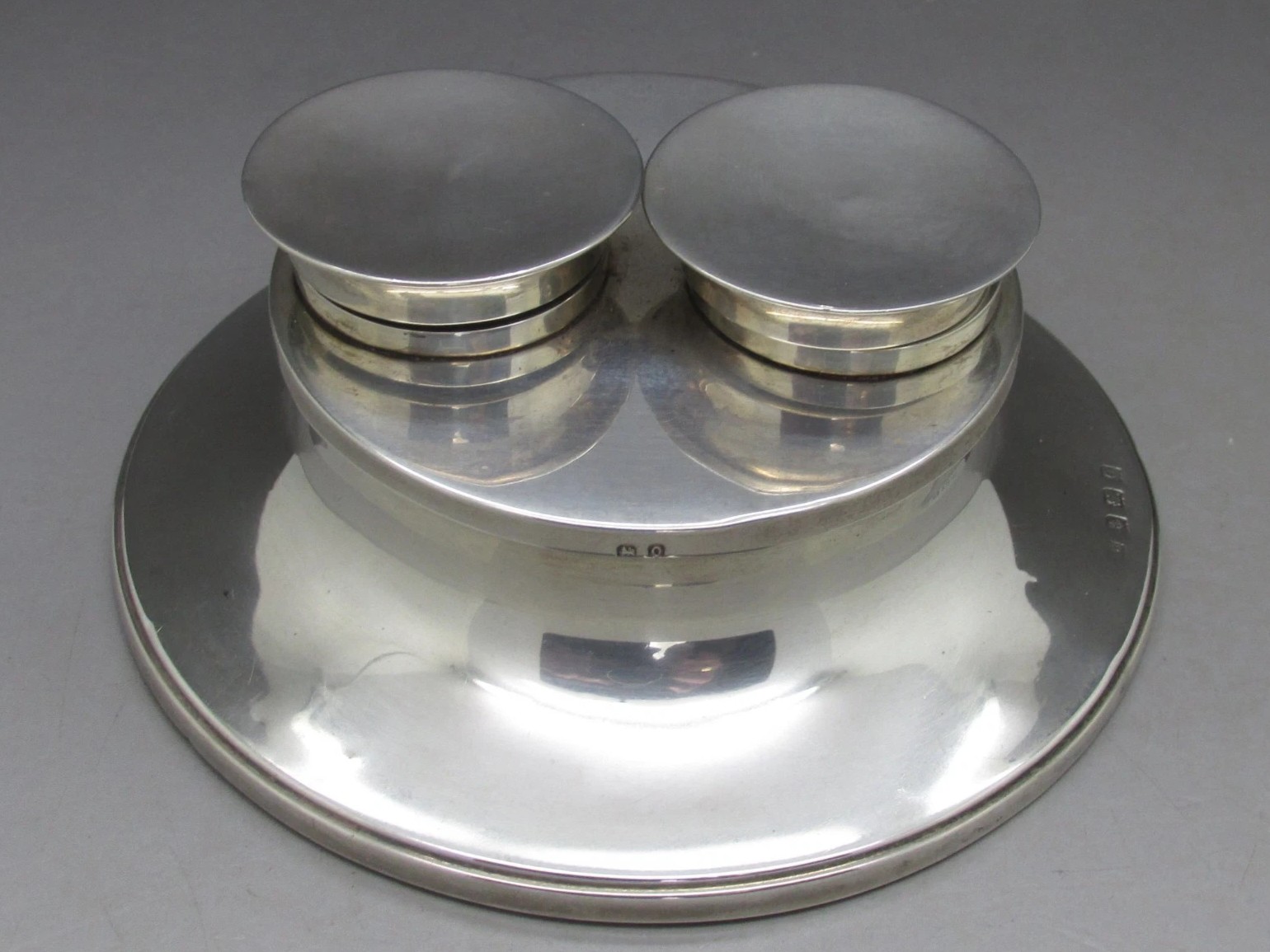
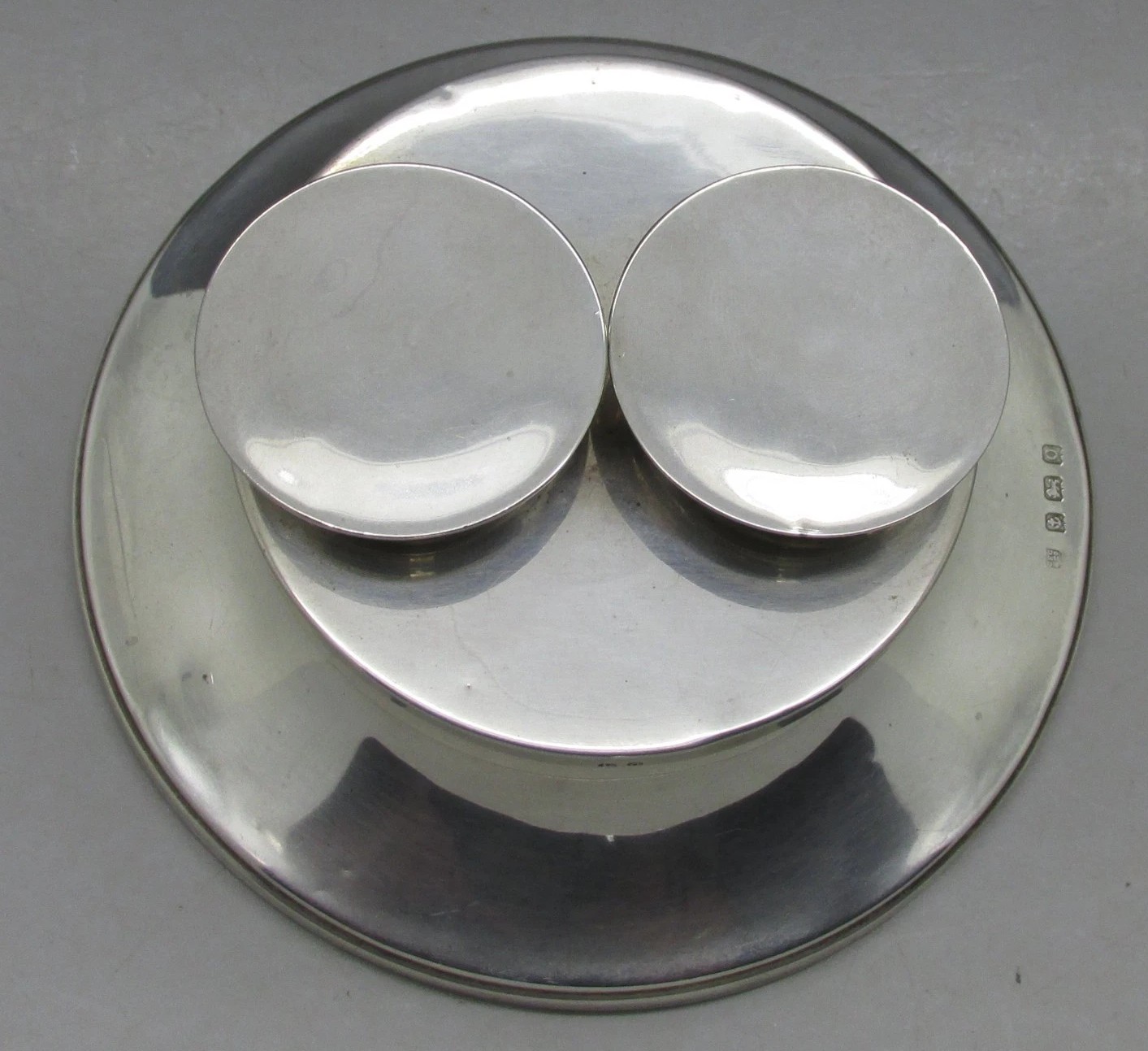
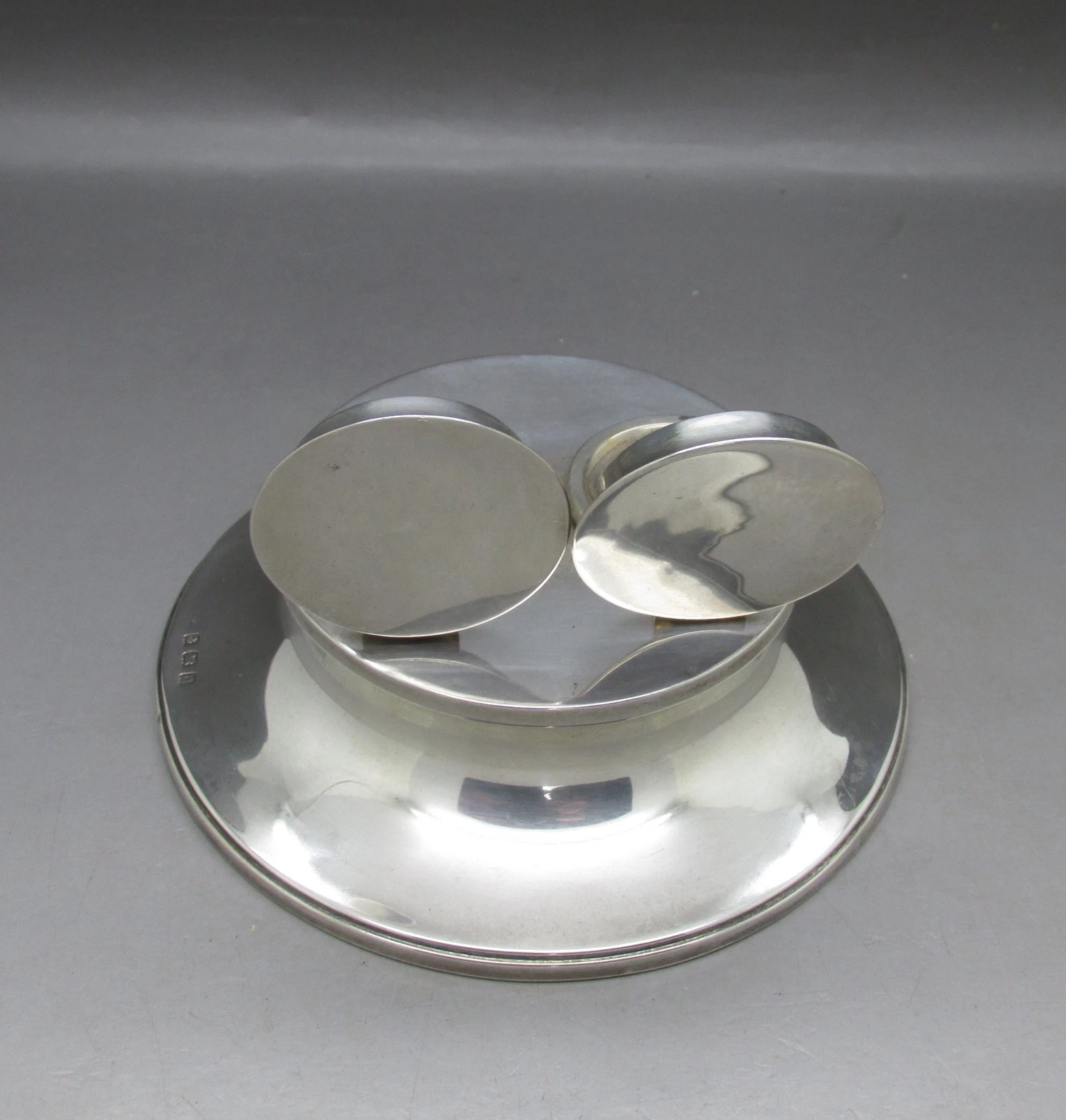
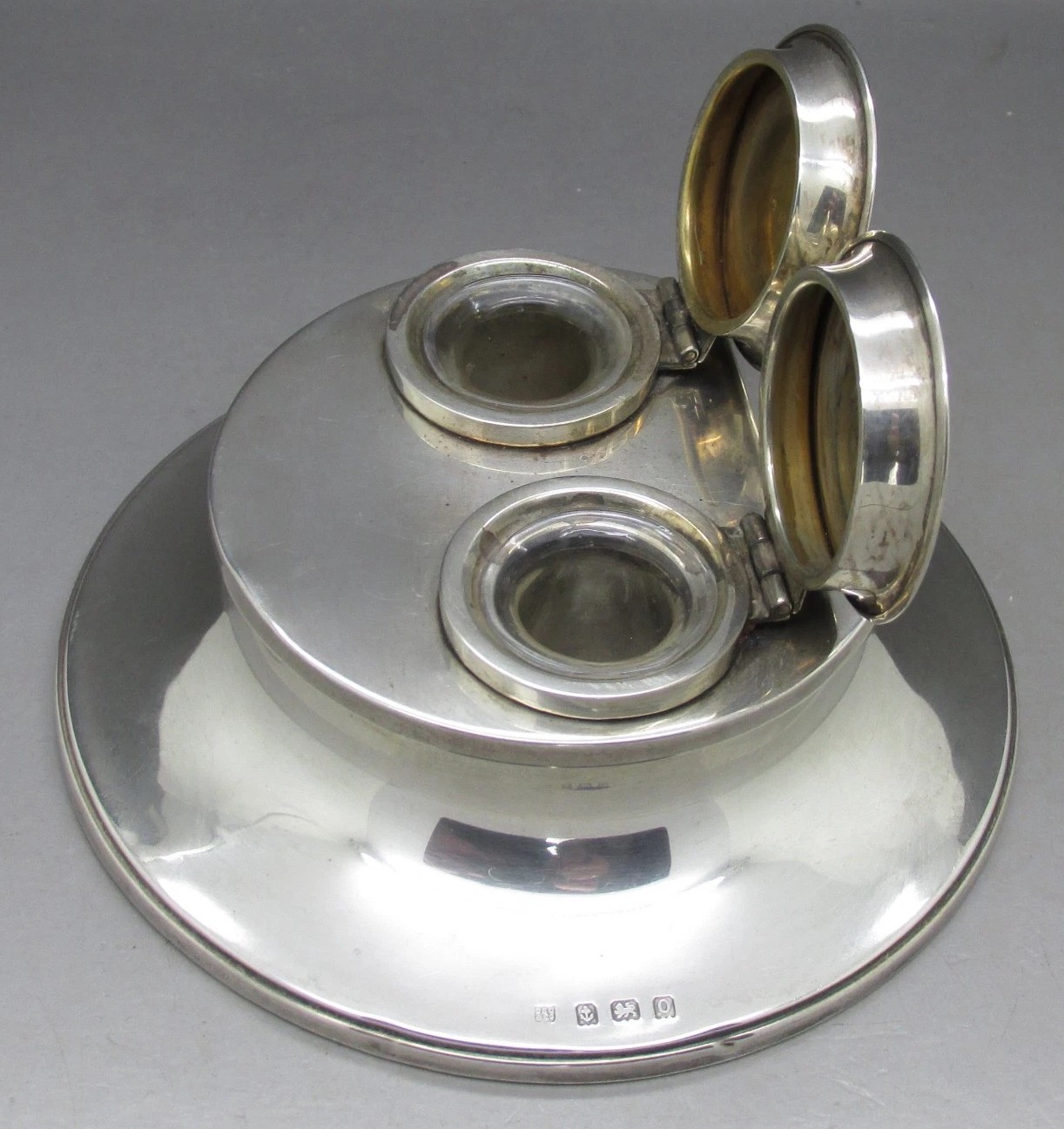


“Capstan” Form Double Inkstand
| Categories | Silver |
| Type | Capstan |
| Material | Silver |
| Markings | See Narrative |
| Manufacturer | Charles S. Green & Co. |
| Origin | England |
| Date or Era | circa 1913 |
| Measuring | 4 ½” diameter; 1 ¾” high |
Description
The “Capstan” Form & Double Configuration
The term Capstan is borrowed from nautical architecture, mimicking the shape of a ship’s deck windlass. It features a wide, dramatically flared circular apron base that tapers inward as it rises to an elevated central platform. This geometric design was the gold standard for luxury desk accessories because it shifted the center of gravity downward, making it nearly impossible to accidentally tip over and spill ink.
While single capstan inkwells from this era are relatively common, this double configuration is a much scarcer, more prestigious variant. The silver is beautifully raised to create a seamless, integrated twin deck.
Lids, Liners, and Interior Gilding
- The Lids: The twin hinged lids feature low-profile, perfectly flat, disc-shaped tops. Their minimalist, unadorned surfaces reflect the clean-lined aesthetic moving away from ornate Victorian styles toward early Art Deco sensibilities.
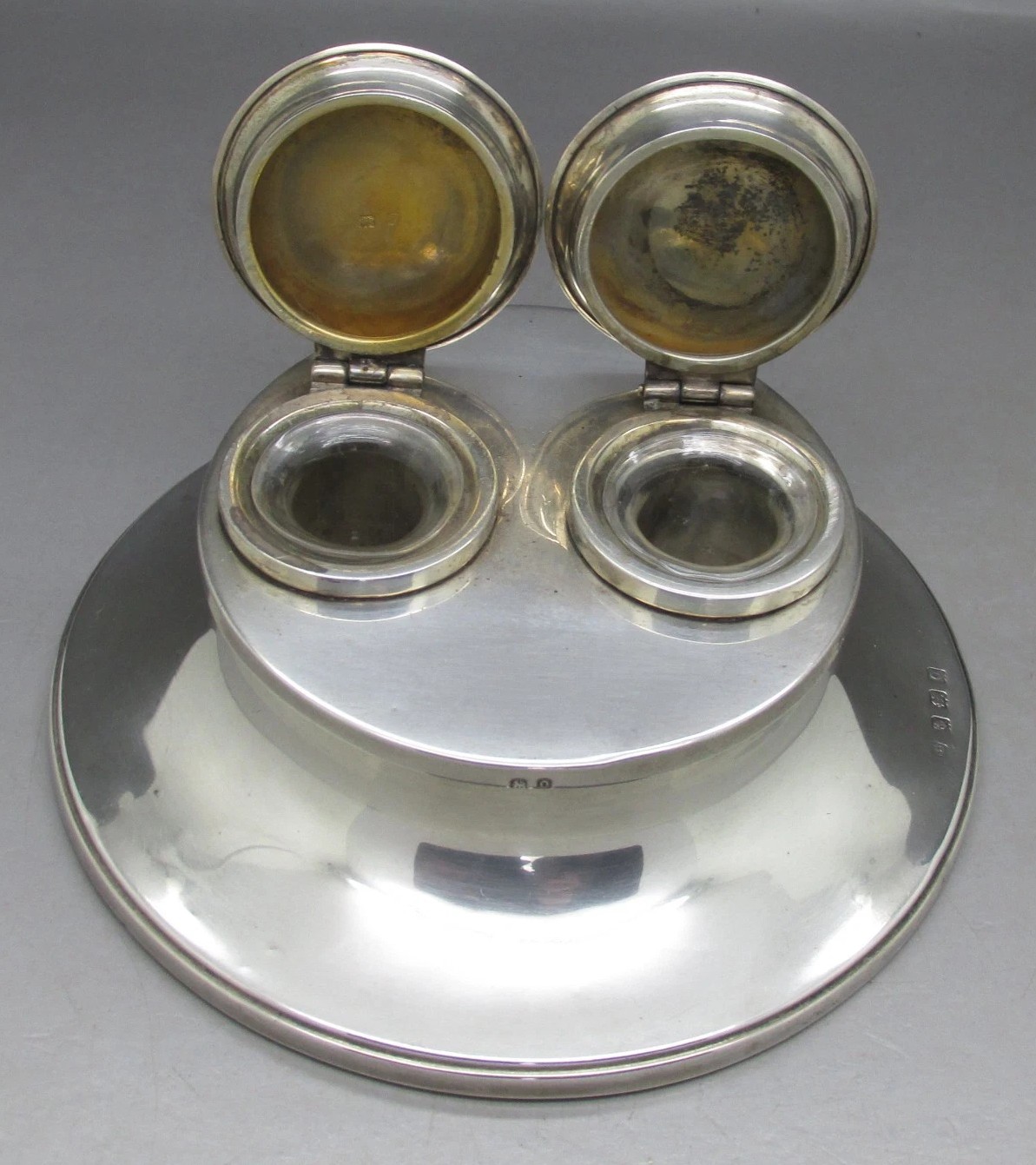
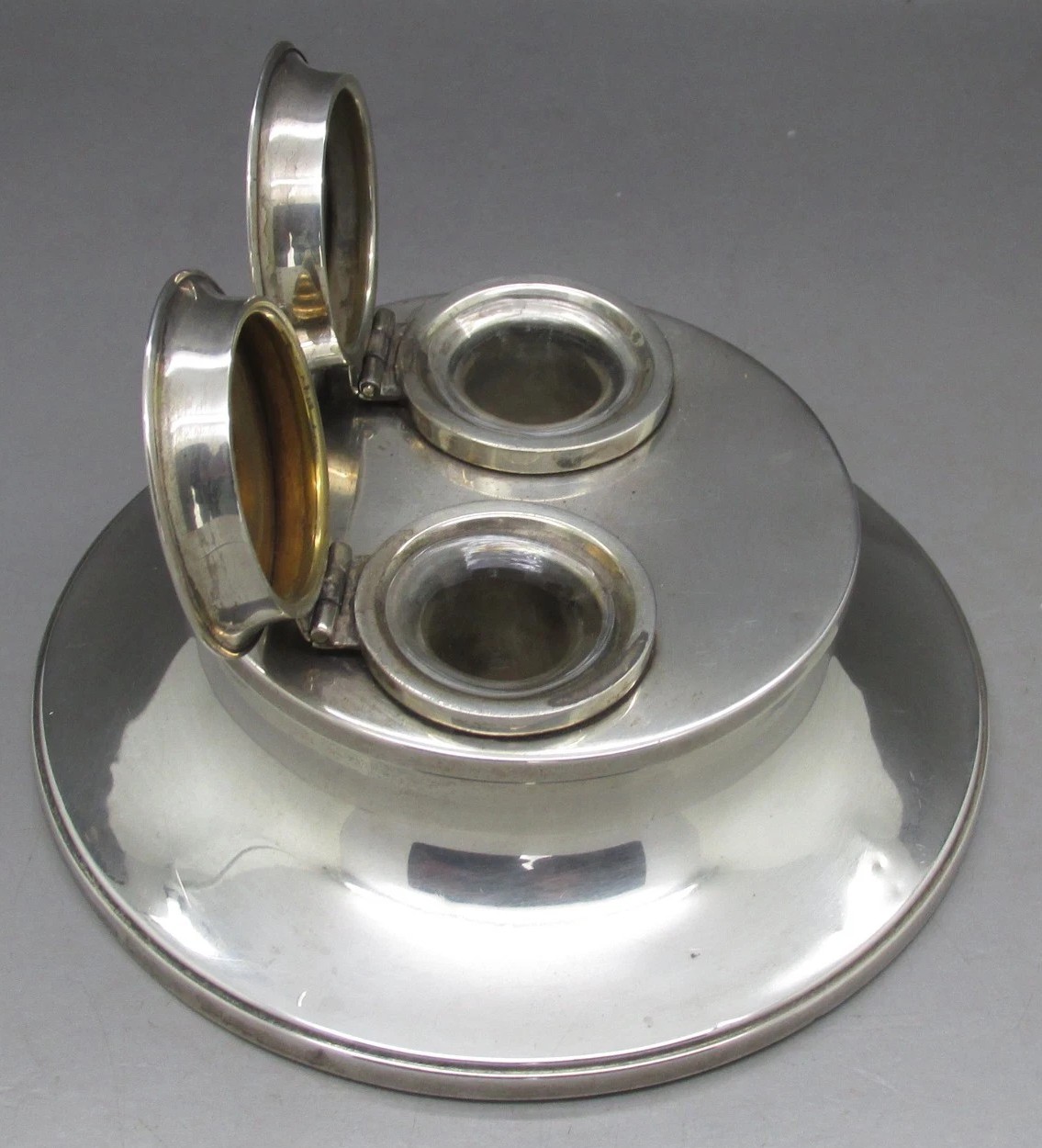
- The Vermeil Interior: Opening the smooth, flush-fitting hinges reveals a faint golden hue inside the lids. This is an original gold wash (vermeil). Silversmiths deliberately applied a thin layer of gold to the interiors of inkwells because historical inks were highly acidic and would rapidly corrode or tarnish unprotected sterling silver.
- The Glass Liners: The inkstand retains its original clear glass wells, featuring wide, flat-collared rims that rest flush within the silver mountings.
The Composition Base Lining
The glossy, terracotta/reddish-brown underside is an interesting period detail. Because capstan silver bodies are formed from relatively thin sheet silver, they were heavily weighted from the inside—usually filled with plaster of Paris, pitch, or lead—to give them their characteristic desk stability.
To seal this internal weight and prevent the rough filler or sharp silver edges from scratching highly polished mahogany or oak writing tables, the base had to be covered. While felt or leather was standard, high-end silversmiths during the Edwardian and early George V eras began experimenting with cutting-edge materials. This lining is a form of early molded composition material (such as celluloid, vulcanite, or an early polymer blend). It was favored because it provided a perfectly smooth, impervious, and easily wiped clean surface that wouldn’t rot, stain, or wear away like fabric or leather.
Hallmark Decipherment
The crisp set of stamps on the rim provides a flawless pedigree:
- CSG / & CO (inside a four-lobed punch): The sponsor/maker’s mark for Charles S. Green & Co.
- Anchor: The town mark for the Birmingham Assay Office, the historic heart of the British silver and jewelry trade.
- Lion Passant: The legal fineness mark certifying British Sterling Silver (.925 purity).
- Capital Letter O (inside a clipped corner shield): The official date letter for the year 1913.
About the Maker: Charles S. Green & Co.
Charles S. Green & Co. was a highly respected name in the Birmingham Jewelry Quarter, celebrated for producing exceptional small silver luxuries, vanity items, and desk suites.
- Origins: The company was established around 1903–1904 by Charles Stevenson Green. He was born into a prestigious lineage of Birmingham jewelers (his family ran Charles Green & Son, founded in 1824). Wanting to chart his own path in artistic silversmithing rather than traditional gold jewelry, Charles split from his brothers to start his own firm.
- The Secret Weapon: Charles was joined in the business by his wife, Winifred Green. Winifred was a highly talented artist and designer who is credited with creating almost all of the firm’s early, distinctive patterns. Her eye for elegant, clean forms helped the company successfully bridge the gap between late Art Nouveau fluidity and early Art Deco geometric simplicity.
- The Cogent Works: In 1907, the business relocated to the Cogent Works at 54 St. Paul’s Square, Birmingham. Operating from this historic square, they built a reputation for pristine execution, beautiful enamel work, and high-quality mechanism fittings (evident in the perfectly aligned, heavy-duty hinges on this inkstand’s lids).
Sold for $175 in April 2026
Content disclaimer. The information posted is the owner’s best knowledge and may not have been vetted by the SOIC. We welcome comments, corrections, and additions, working to make our website information comprehensive and accurate.
Join the Society of Inkwell Collectors (SOIC) – it’s free!
Founded in 1981 as a non-profit organization,
we are documenting inkwells (and accessories).
We’re here to help and inform!