


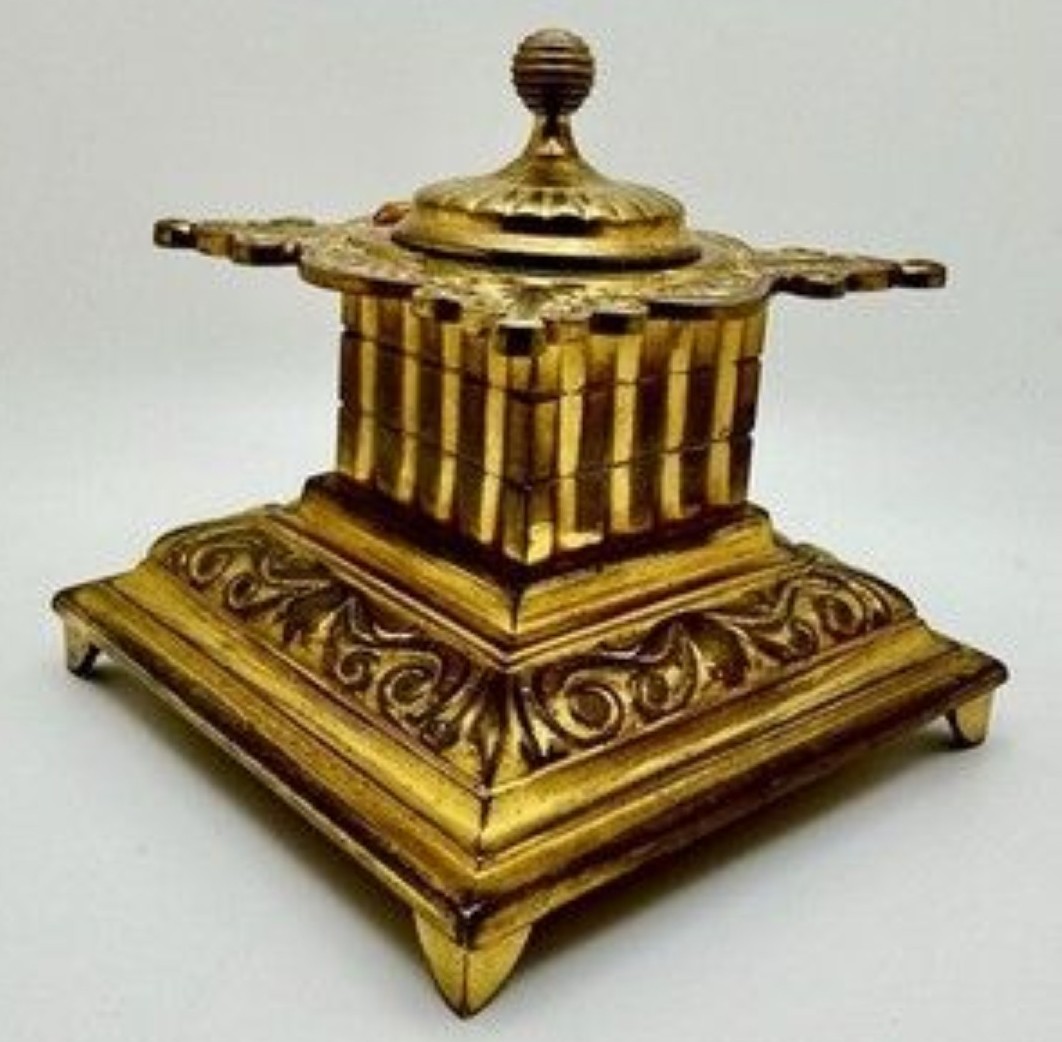
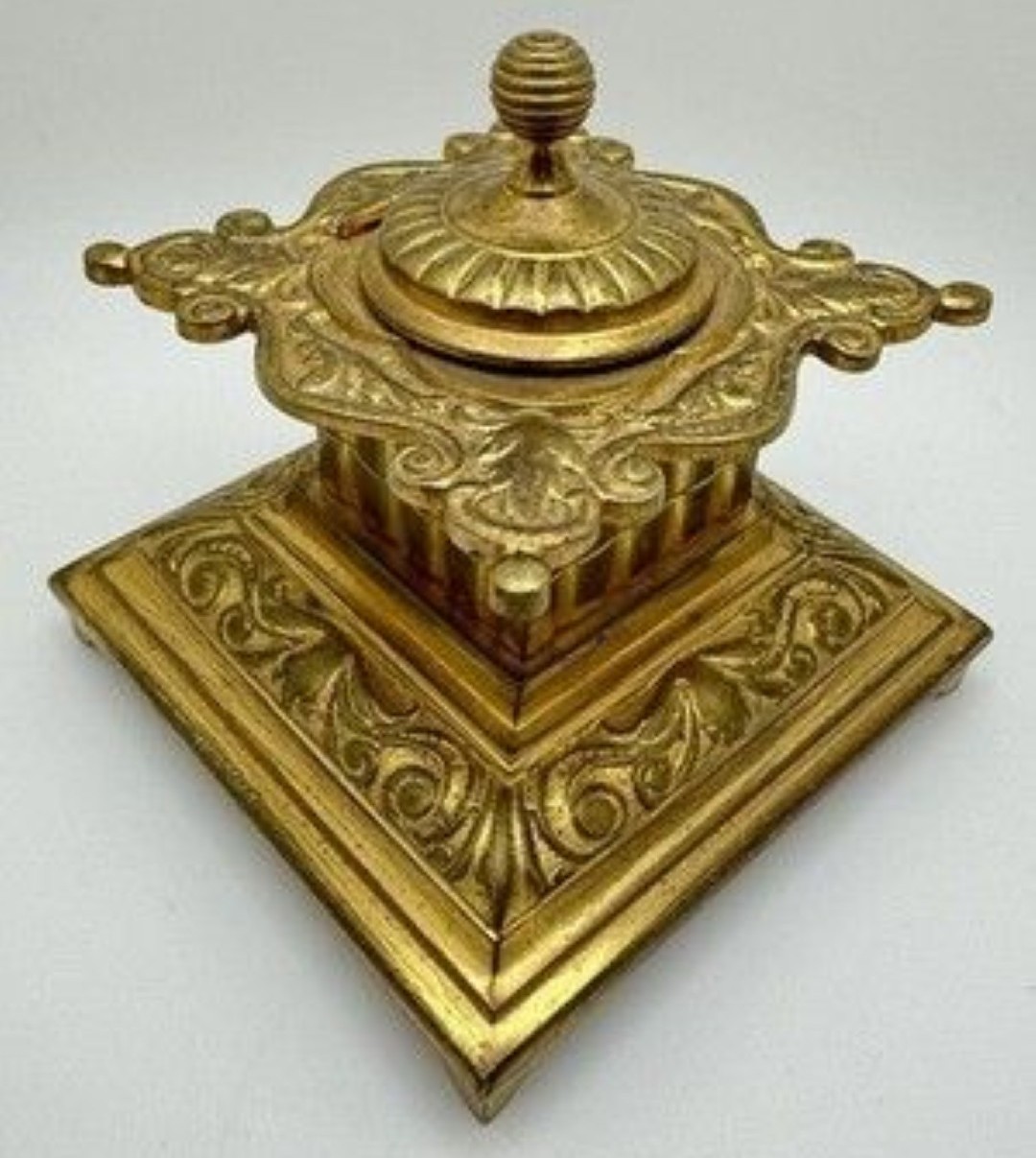
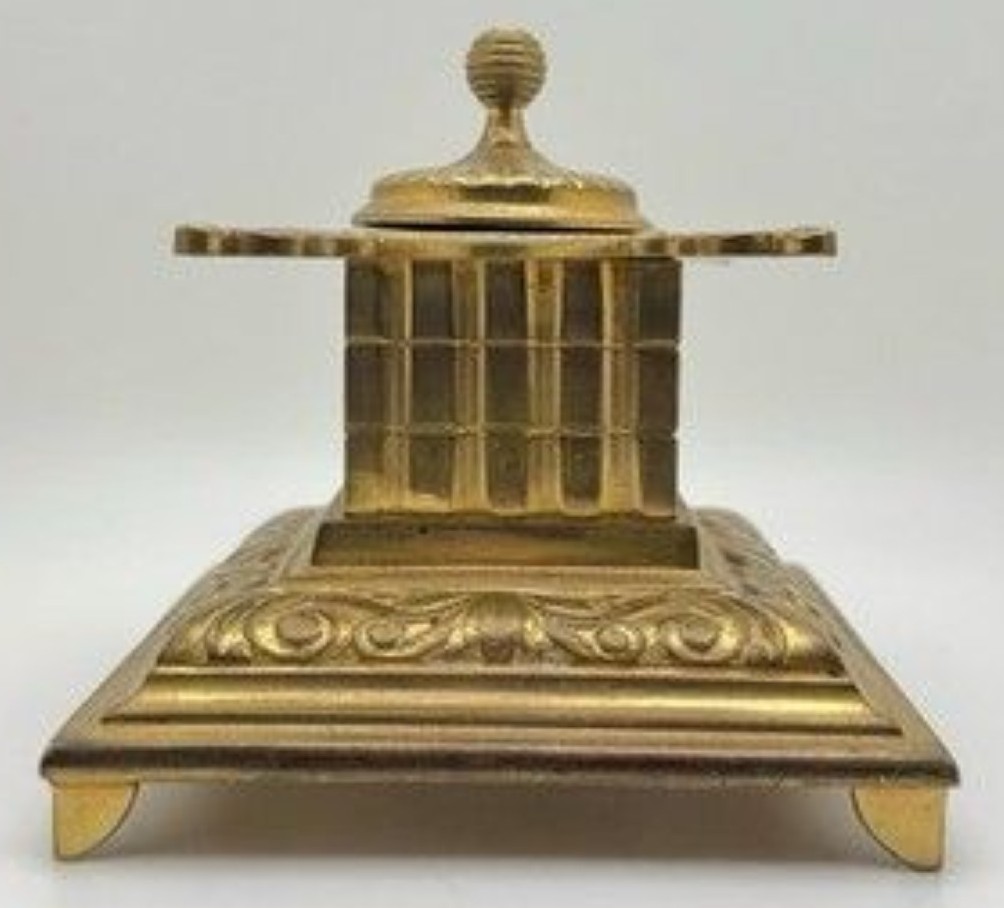


Buyer Be Aware – “Pagoda” Inkwell with Fake Tiffany Mark
| Categories | Modern-day Production / Reproduction / "Fake", Tiffany |
| Material | Gold Gilt Finish |
| Markings | See narrative |
| Manufacturer | Undetermined |
| Origin | Undetermined |
| Date or Era | circa 1900 |
| Measuring | 4” x 4” x 4” high |
This inkwell, while old, does not meet Tiffany & Co. production standards. There is a strong probability that this is a period Victorian inkwell (likely made by a company like Judd, Bradley & Hubbard, or a generic American foundry) that has been deceptively stamped with a spurious “TIFFANY & CO” mark to increase its value.
Here is a breakdown of the “Red Flags” that support this suspicion:
- The Mark: Location and Quality
- Location: Tiffany & Co. (and Tiffany Studios) almost exclusively marked their desk pieces on the underside (bottom). Stamping the exterior vertical edge of a decorative base is highly irregular. It disrupts the visual flow of the gilt finish, something a luxury maker like Tiffany would avoid.
- Content: Genuine Tiffany & Co. bronze or brass metalware from this period (late 19th/early 20th century) typically bears more than just the name. You would expect to see:
- “TIFFANY STUDIOS”
- “NEW YORK”
- A Pattern Number (e.g., 12345)
- The mark on this piece is a simple, serif font stamp that looks like it was applied with a handheld die set. The lettering is slightly uneven, which is characteristic of a mark added after the piece was made, rather than during the manufacturing process.
- The Underside and Construction
- Casting Quality: Looking at the underside, it shows a rough, hollow casting with “fins” or ridges left over from the mold.
- Tiffany Quality: A genuine Tiffany bronze inkwell would usually have a solid bottom or a finished metal plate covering the hollow cavity. If it was open, the interior casting would be smoother and more refined.
- The Hardware: The nut and bolt assembly holding the finial looks like standard industrial hardware. Tiffany usually finished their interior mechanics with greater care, often using specific screws or soldering that hid the construction mechanics.
- The Material and Finish
- “Gilded Bronze” vs. Spelter: While advertised as bronze, the casting quality (specifically the softness of the details in the scrollwork) suggests this is spelter (white metal) or cast iron that has been gilded.
- If you look at the wear on the underside corners, the base metal appearing through the gold looks greyish/silver, which indicates spelter. Real gilt bronze would show a copper/yellowish hue underneath. Tiffany almost exclusively worked in sterling silver, copper, and high-quality bronze—rarely spelter for this type of object.
- The Style
- Generic Victorian: The “Pagoda” or “Eastlake” style was incredibly popular in the 1880s and 90s. Manufacturers like Judd Manufacturing (Connecticut) and Bradley & Hubbard produced thousands of similar geometric/architectural inkwells.
- Attribution: I cannot find a documented Tiffany & Co. pattern that matches this specific “Pagoda” form. Tiffany’s “Japonisme” or “Chinese” style pieces were hand-hammered mixed metals (silver and copper) or very distinct, heavy bronze patterns (like the “Chinese” pattern in Tiffany Studios sets), which look very different from this molded piece.
Conclusion
The piece is likely a genuine antique (c. 1880s–1900), but the “TIFFANY & CO” mark is almost certainly fake.
It is a common trick for unscrupulous sellers (or previous owners) to take a high-quality but unmarked Victorian casting and apply a fake stamp to elevate it from a $50–$100 item to a $500+ item. The lack of a glass insert, the odd placement of the mark, and the rough underside all point to this conclusion.
Sold for $450 in November 2025
Content disclaimer. The information posted is the owner’s best knowledge and may not have been vetted by the SOIC. We welcome comments, corrections, and additions, working to make our website information comprehensive and accurate.
Join the Society of Inkwell Collectors (SOIC) – it’s free!
Founded in 1981 as a non-profit organization,
we are documenting inkwells (and accessories).
We’re here to help and inform!