


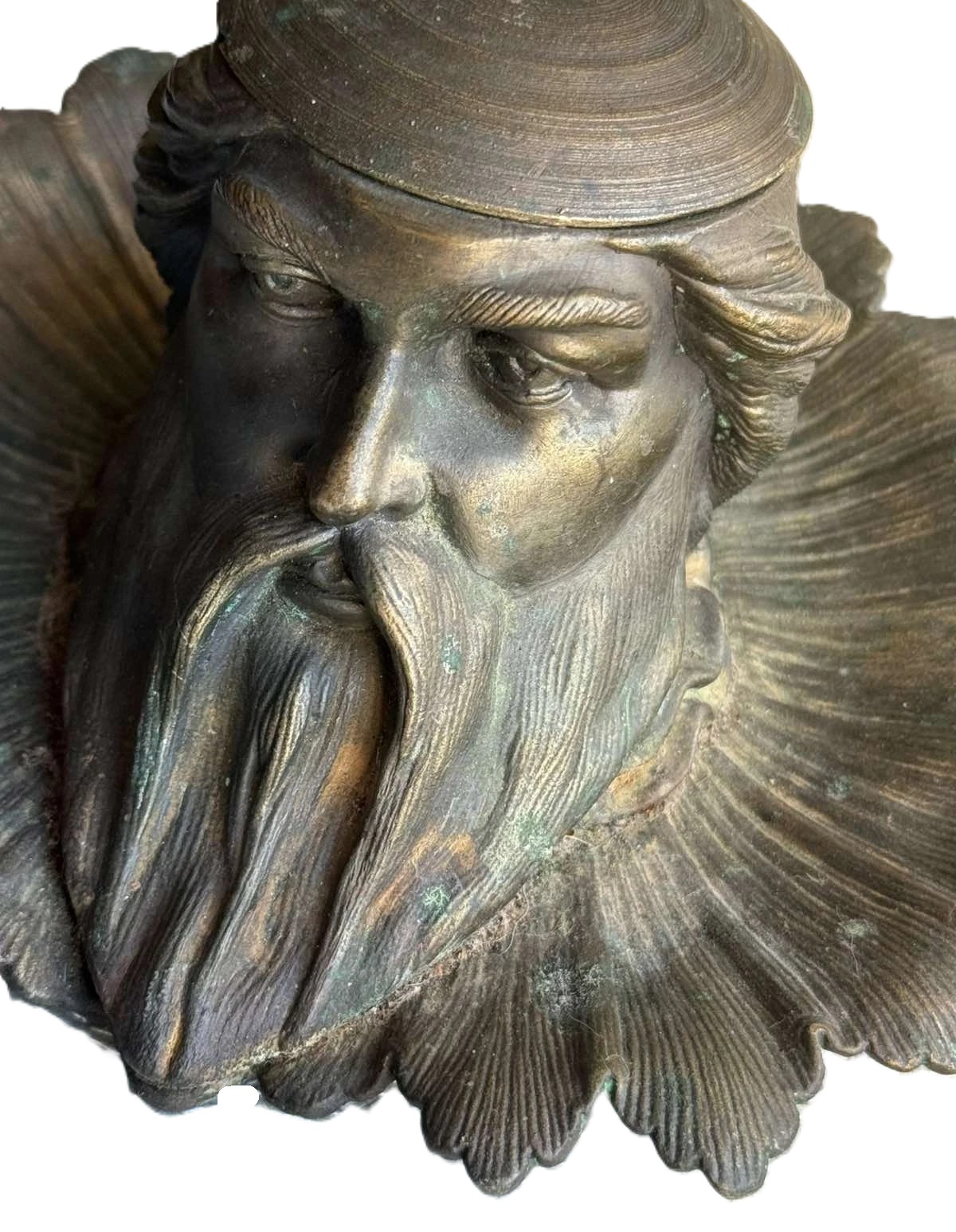


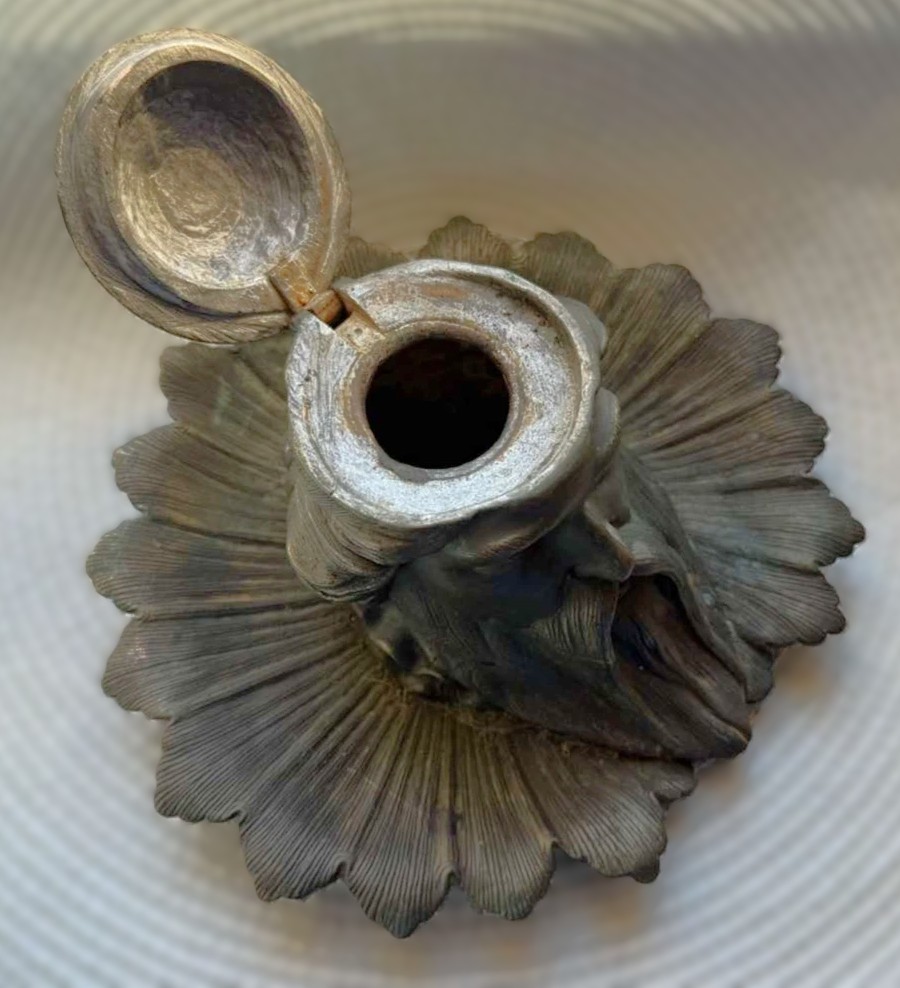

Bust of Cervantes
| Categories | Figural - Mythology; Literature; Religion; Fictional |
| Type | Literature |
| Material | Bronze |
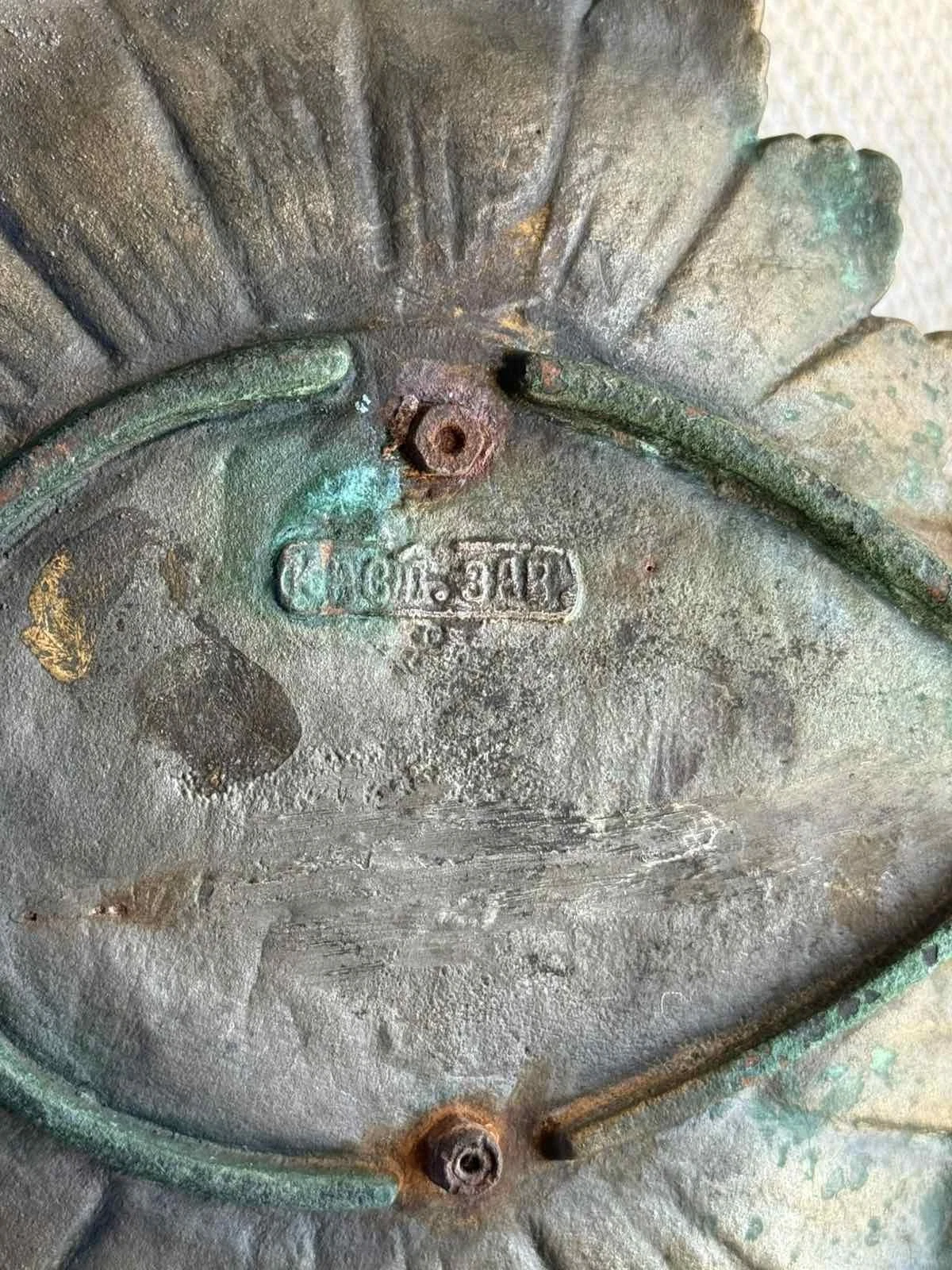
| Markings | See Narrative |
| Manufacturer | Kasli Iron Foundry |
| Origin | Russia |
| Date or Era | circa 1890 |
| Measuring | 7 ½” x 4 ⅜” |
This inkwell is a classic example of Russian artistic metalwork, specifically from the world-renowned Kasli Iron Foundry (Kaslinsky Zavod) in the Ural Mountains.
Maker and Origin
The mark on the underside, КАСЛ. ЗАВ. (KASL. ZAV.), is the official abbreviation for the Kasli Iron Foundry (Kaslinsky Zavod). The “Castle Mark” references the foundry’s hallmark, which features a stylized emblem or a rectangular stamp with the town’s name (“КАСЛИ”) that can resemble a small building or fortress at a glance.
Kasli became famous in the late 19th century for its “artistic casting,” a process that produced incredibly fine, detailed sculptures. While they are most famous for their “black” cast iron (finished with a special recipe of Dutch soot and lacquer), they also produced works in bronze and non-ferrous alloys, particularly for high-end desk accessories like this one.
Identity of the Figure
The bust depicts the legendary Spanish author Miguel de Cervantes (1547–1616), best known for Don Quixote.
- The Look: The high “wheel ruff” (or cartwheel ruff) collar, the pointed beard, and the high forehead are the standard iconography for Cervantes in 19th-century sculpture.
- Foundry Connection: Cervantes and his character Don Quixote were popular subjects for the Kasli foundry. They produced several variations of Cervantes’ bust, as well as full figures of Quixote and Sancho Panza, often modeled after designs by famous European sculptors that were then reproduced by Russian masters.
- The Artist: The model for this specific “Cervantes Head” inkwell is attributed to the Russian sculptor Nikolai Romanovich Bach (1853–1885). Bach was a graduate of the St. Petersburg Academy of Arts and spent his career at Kasli, where he became famous for his high-quality literary portraits and cabinet sculptures.
Age
Based on the style of the casting and the specific hallmark used, this inkwell likely dates to the late 19th or very early 20th century (roughly 1880–1914). This was the “Golden Age” of Kasli casting when the foundry won Grand Prix awards at several World Fairs, including the 1900 Paris Exposition.
Summary Table
| Feature | Details |
| Figure | Miguel de Cervantes (Writer) |
| Maker | Kasli Iron Foundry (Kaslinsky Zavod) |
| Artist | Nikolai Romanovich Bach |
| Era | Russian Imperial (c. 1880–1914) |
Estimated value: $250
Content disclaimer. The information posted is the owner’s best knowledge and may not have been vetted by the SOIC. We welcome comments, corrections, and additions, working to make our website information comprehensive and accurate.
Join the Society of Inkwell Collectors (SOIC) – it’s free!
Founded in 1981 as a non-profit organization,
we are documenting inkwells (and accessories).
We’re here to help and inform!