

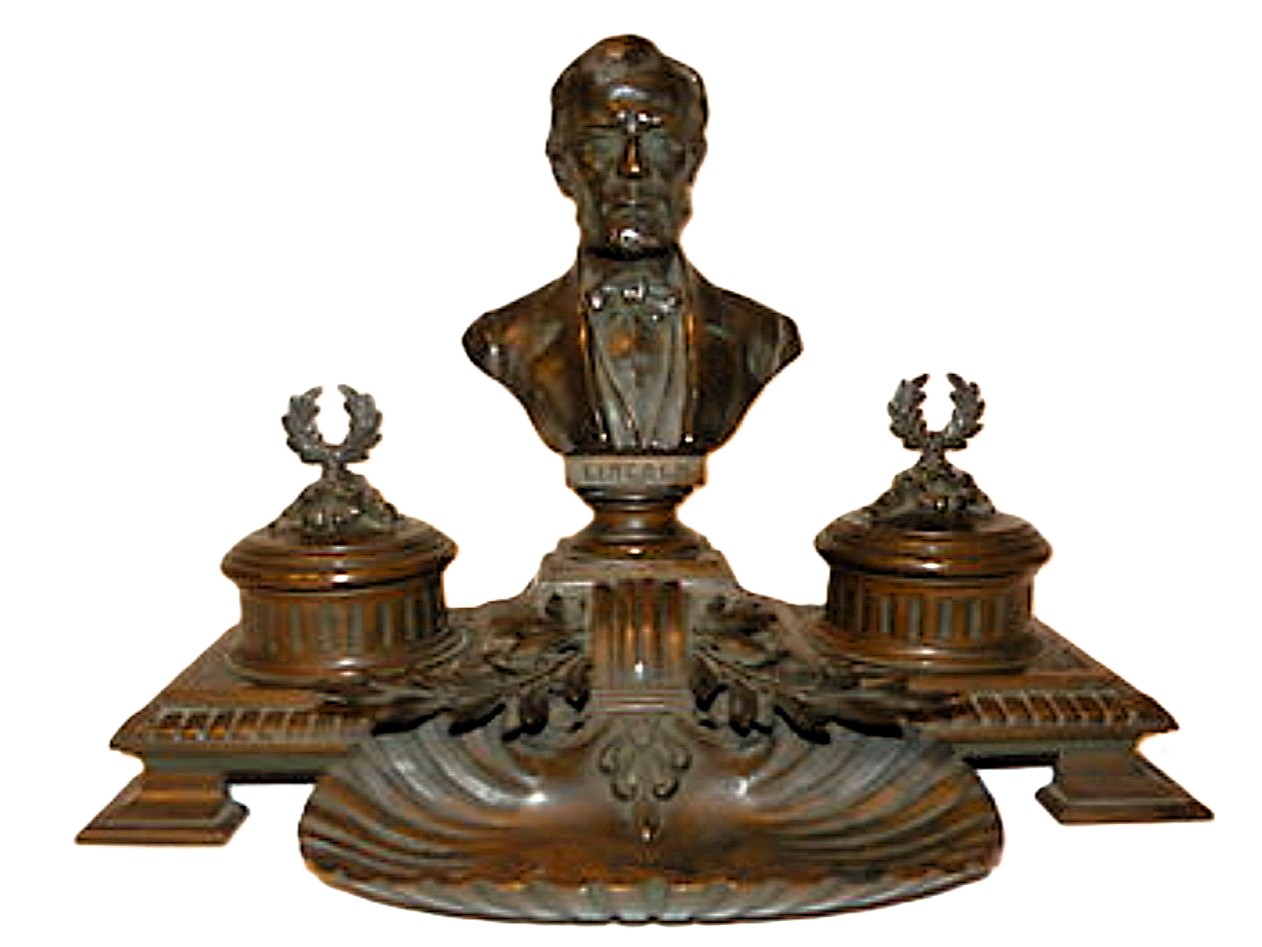
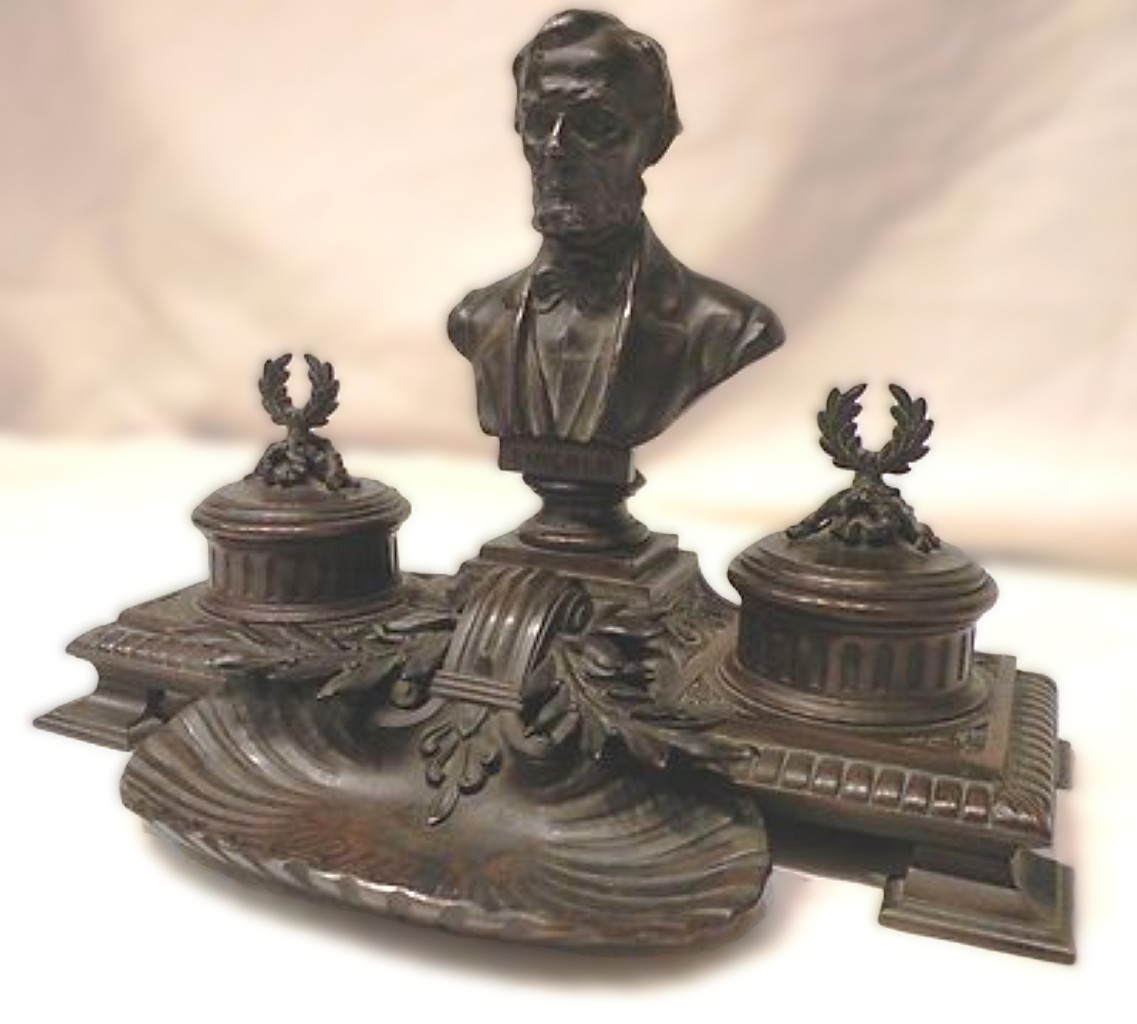
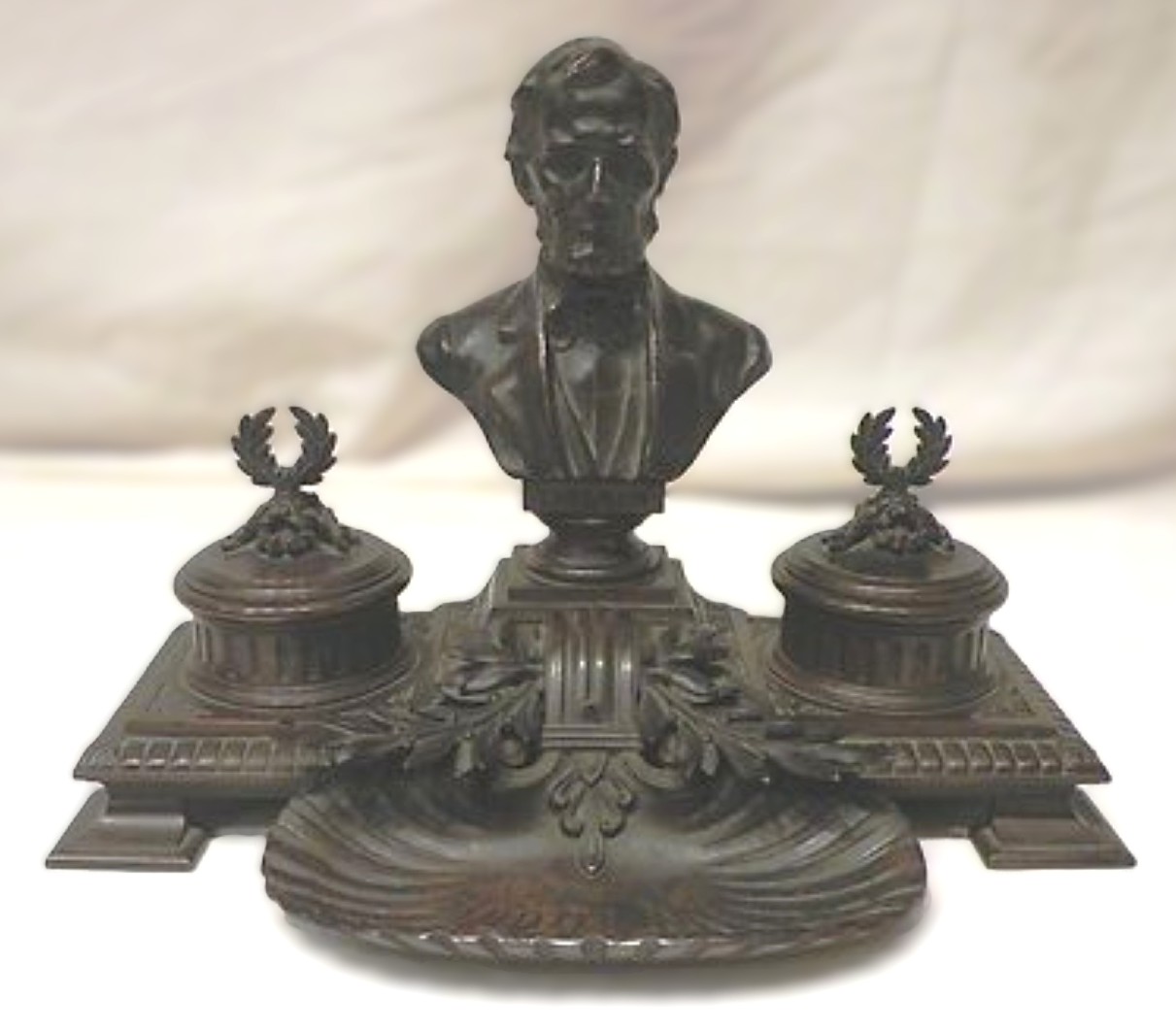
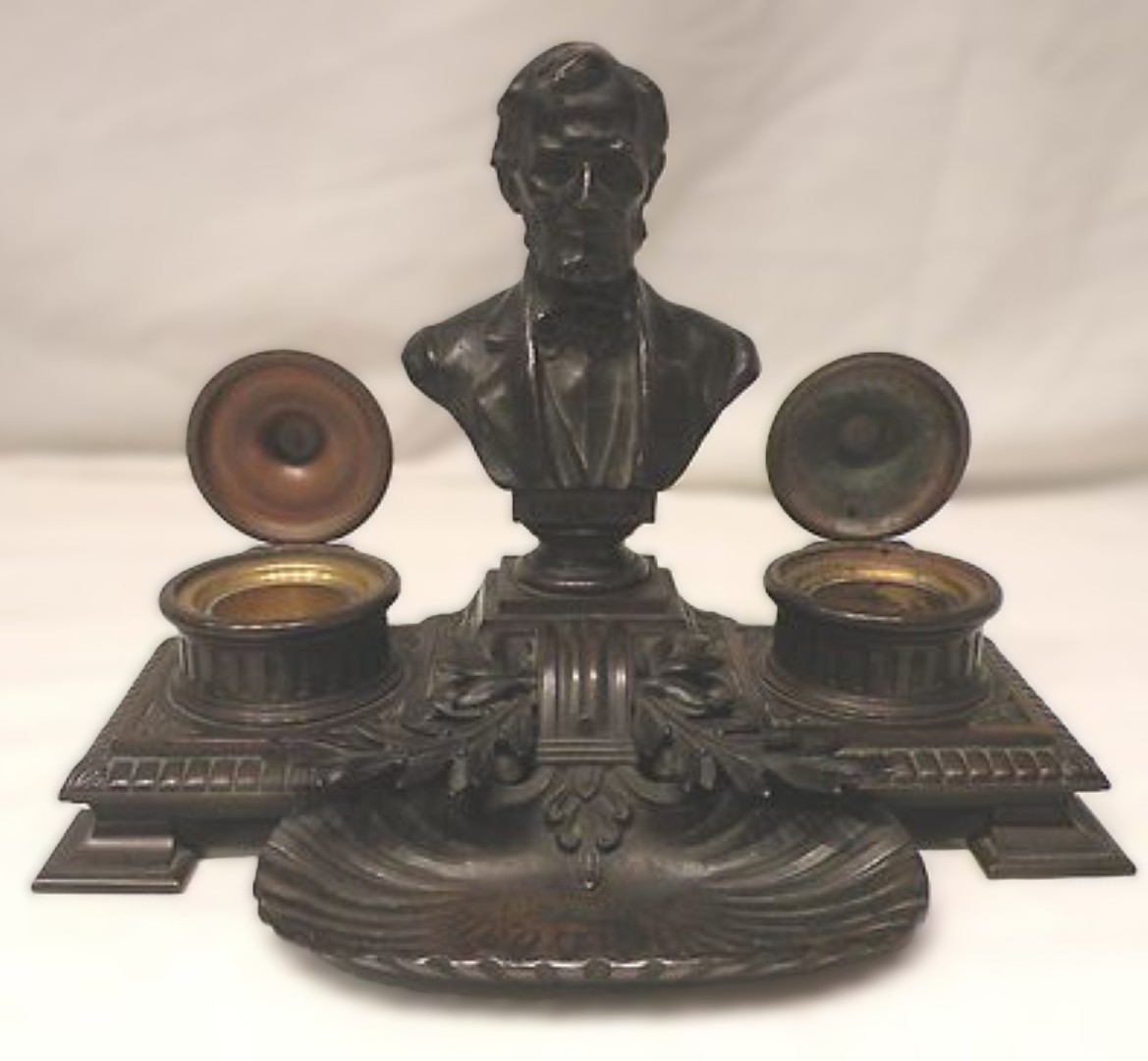
Bust of Abraham Lincoln Inkstand
| Categories | Figural - Persons |
| Type | Historical |
| Material | Bronze |
| Markings | See Narrative |
| Manufacturer | Hans Müller |
| Origin | Austria |
| Date or Era | circa 1910 |
| Measuring | 12” x 8” x 9” high |
Description
The Bust
The centerpiece is a finely sculpted, patinated bronze portrait bust of Abraham Lincoln, depicting him with his iconic beard, a formal frock coat, and a bow tie. The bust is supported by a turned pedestal socle resting on a raised central plinth. Directly beneath the lapels, the name “LINCOLN” is cast into the block base in a clean, sans-serif, slightly stylized Roman capital font.
Inkwells & Inserts
The inkstand balances symmetry with elaborate classical motifs.
- On either side sits a fluted, drum-shaped inkwell reservoir reminiscent of classical architectural columns.
- The hinged lids open via rear mounts to access the inkwells (glass inserts).
- Each lid is surmounted by an intricate finial: a beautifully cast, upright laurel wreath tied with a ribbon at the base—a classical symbol of victory, honor, and martyrdom entirely appropriate for a post-Civil War commemorative piece of Lincoln.
Pen Tray & Base Ornamentation
The front features a wide, undulating, scalloped sea-shell shaped pen tray. Bridging the space between the shell tray and the central Lincoln bust is a heavy, prominent architectural scroll motif flanked by cast, spreading oak leaf and acorn branches. In nineteenth-century iconography, the oak leaf symbolizes strength, endurance, and moral integrity. The entire structure is raised on a robust footed base with stepped, bracket-style corner feet and a classic repeating gadrooned border along the edges.
About the Artist: Hans Müller (1873–1937)
Hans Müller was a highly regarded and prolific Austrian sculptor who spent his life working in Vienna.
- Education: He studied at the prestigious Akademie der bildenden Künste Wien (Academy of Fine Arts Vienna) under the renowned sculptor Edmund von Hellmer, a master of Viennese Historicism and Monumentalism.
- Specialization: Müller achieved great success during the late Belle Époque and Interwar periods. He was celebrated for his high-society portrait busts, naturalistic animaliers, and powerful depictions of working-class laborers (such as blacksmiths and fishermen).
- The “Great Figures” Series: Notably, Müller cast a highly popular series of bronze desk accessories, inkstands, and busts depicting world-historic poets, composers, and statesmen—including Beethoven, Goethe, Longfellow, and Abraham Lincoln.
Müller’s work is characterized by an expert handling of dark brown patination and high-quality lost-wax or sand casting, frequently executed by elite Viennese foundries (such as the Arthur Krupp foundry or various Turn-Wien operations).
Production Context: When & Where
- Where it Was Made: This piece was produced in Vienna, Austria.
- When it Was Made: This inkstand was manufactured circa 1900–1915.
Contextual Note: Following the American Civil War and Lincoln’s 1865 assassination, European fascination with the late President grew exponentially, peaking around the Lincoln Centenary in 1909. Viennese foundries capitalized heavily on the export market to the United States during this era, producing high-end, artistic desk sets like this one for affluent American libraries and offices. The synthesis of classical French/Austrian Empire styling (the laurel wreaths, gadrooning, and architectural shell) with an American historical icon is characteristic of turn-of-the-century Viennese export bronze.
Sold for $1500 in June 2012
Content disclaimer. The information posted is the owner’s best knowledge and may not have been vetted by the SOIC. We welcome comments, corrections, and additions, working to make our website information comprehensive and accurate.
Join the Society of Inkwell Collectors (SOIC) – it’s free!
Founded in 1981 as a non-profit organization,
we are documenting inkwells (and accessories).
We’re here to help and inform!