

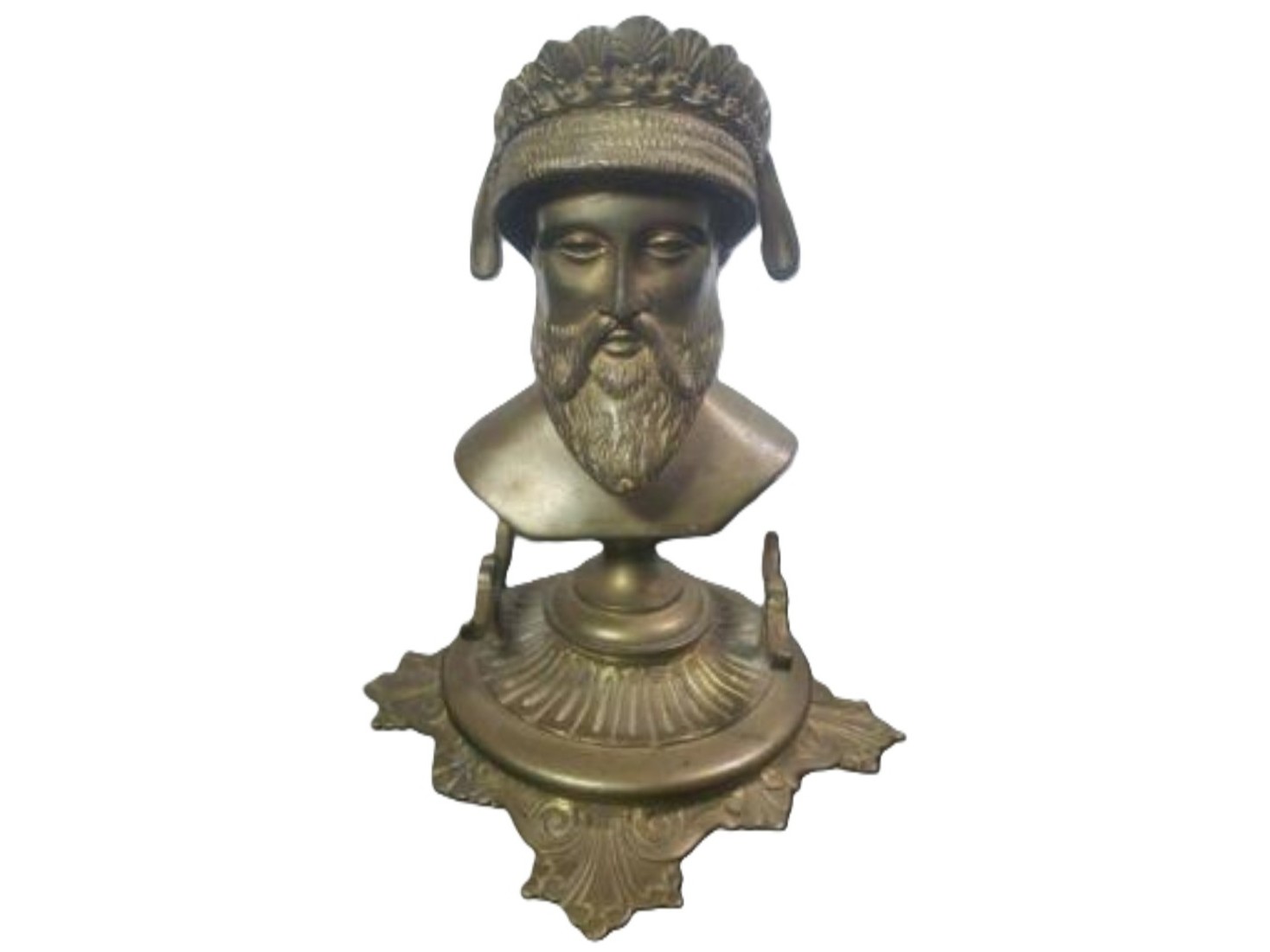


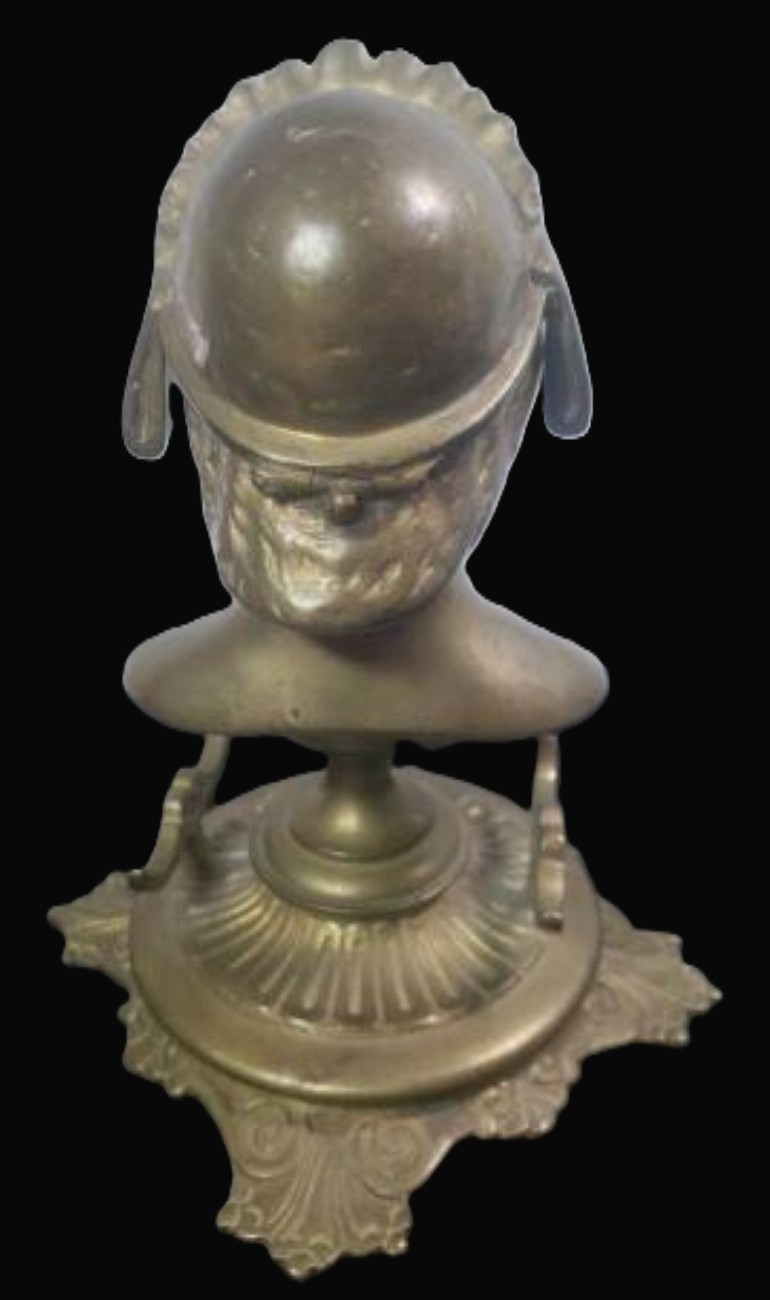

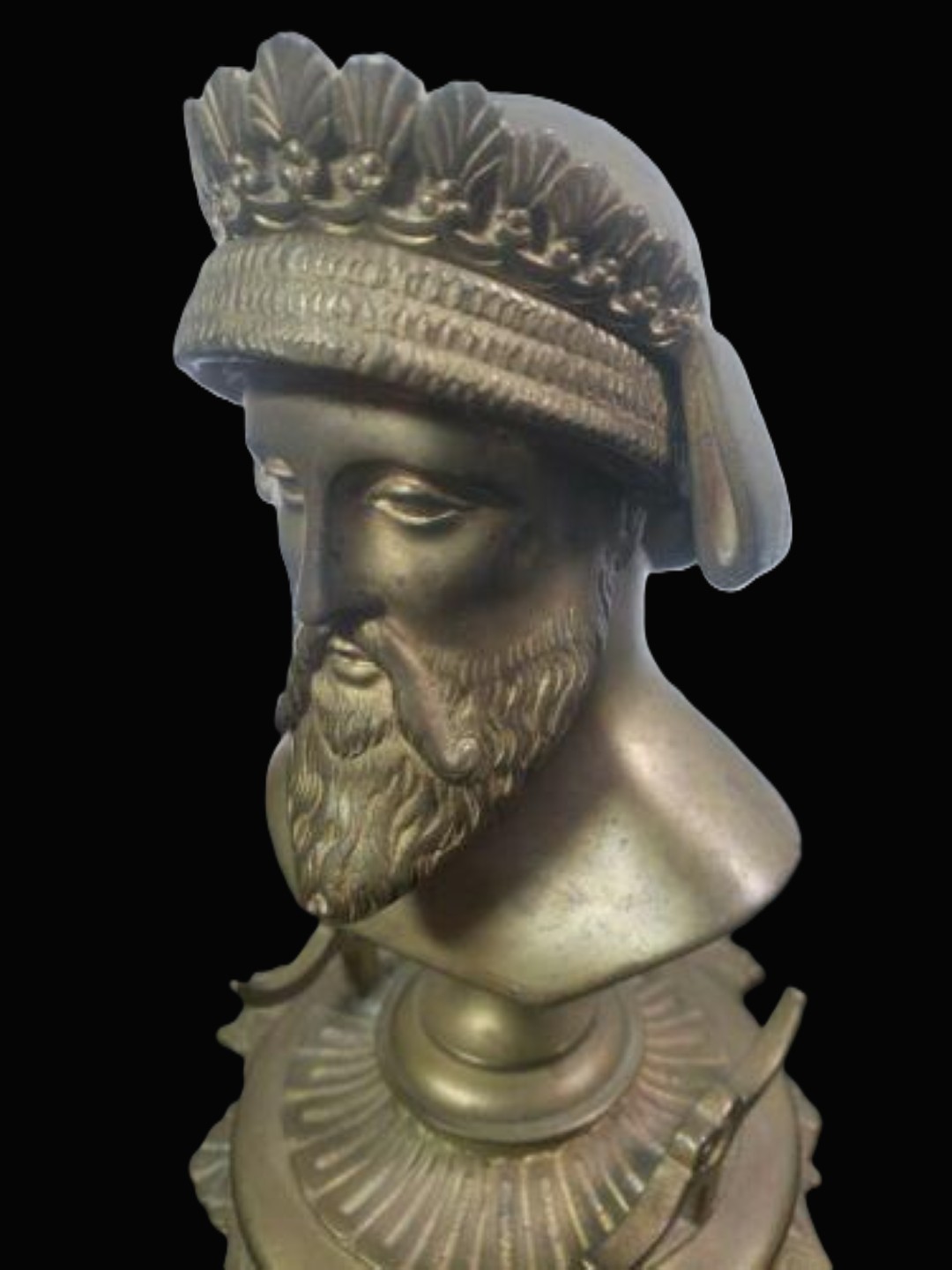


Bust of a Military Man
| Categories | Figural - Mythology; Literature; Religion; Fictional |
| Type | Military, Mythology |
| Material | Brass |
| Markings | Unmarked |
| Manufacturer | Undetermined |
| Origin | Undetermined |
| Date or Era | circa 1900 |
| Measuring | 5 ¾” high |
This inkwell exemplifies the 19th-century fascination with antiquity and historicism.
The Identity: Who is Portrayed?
Rather than a specific real-world king or general, this bust represents a stylized, romanticized classical or mythological warrior/ruler—frequently modeled after Mars (Ares), the god of war, or a legendary ancient hero (such as Hector or Achilles from Homer’s Iliad).
The identifying features are found in the specialized armor and iconography:
- The Crested Helmet & Diadem: He wears a classicized helmet topped with a prominent, fan-shaped palmette crest. Below the crest is a decorative band stylized to look like a jeweled diadem or a laurel wreath, denoting status or victory.
- The Infulae / Lappets: The flat, tongue-like straps hanging down over his ears are known as infulae or lappets. Historically worn by ancient priests, deities, and Roman emperors, they were utilized by 19th-century sculptors to immediately signal “antiquity and nobility.”
- The Bearded Classical Ideal: The highly stylized, symmetry of his braided mustache, prominent nose, and curly beard draws heavy inspiration from Greco-Roman sculptures and Renaissance revivals.
Age and Origin
- Date of Manufacture: Circa 1890–1905.
- Where it Was Made: Most likely France, Germany, or the United Kingdom. Western Europe had a massive market for decorative “Grand Tour” style desk accessories and historicist metalwork during this era.
- Material: This is a heavy, cast-metal piece of brass. Looking at the golden, burnished undertones coming through the darker patina on the high-relief areas (and the copper/golden hues on the raw underside), a high-quality brass alloy is very probable.
Object Analysis & Anatomy
The design of this piece is clever, combining fine art with a functional writing utility:
- The Hinged Lid: The head splits horizontally along the brim of the helmet. The top half of the helmet swings backward on a robust, integrated hinge to reveal the well cavity.
- The Interior: Originally, this cavity would have held a removable glass or porcelain ink insert.
- The Base and Pen Rests: The bust sits atop a heavily decorated, fluted pedestal that flares out into an ornate, four-cornered Rococo/Neoclassical base featuring acanthus leaf scrolls. Crucially, the base features two curved, hook-like brackets flanking the stem. These act as a built-in pen rack, designed to cradle a dip pen horizontally right below the bust.
- Construction: The underside shows a clean, smooth hollow casting with a central iron threaded rod and nut assembly holding the bust, stem, and base tightly together—a textbook example of late 19th-century assembly.
Estimated value: $200
Content disclaimer. The information posted is the owner’s best knowledge and may not have been vetted by the SOIC. We welcome comments, corrections, and additions, working to make our website information comprehensive and accurate.
Join the Society of Inkwell Collectors (SOIC) – it’s free!
Founded in 1981 as a non-profit organization,
we are documenting inkwells (and accessories).
We’re here to help and inform!