

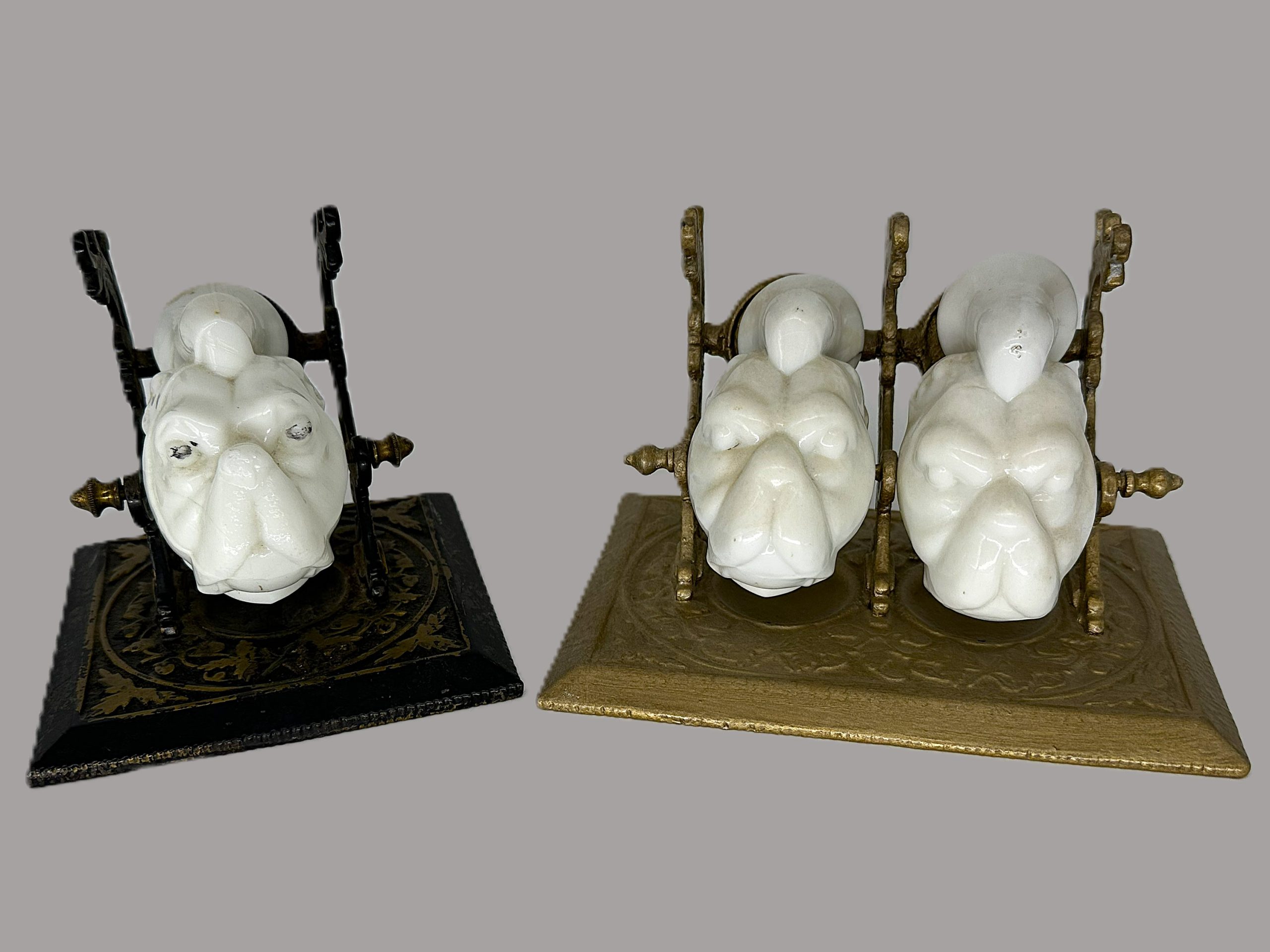
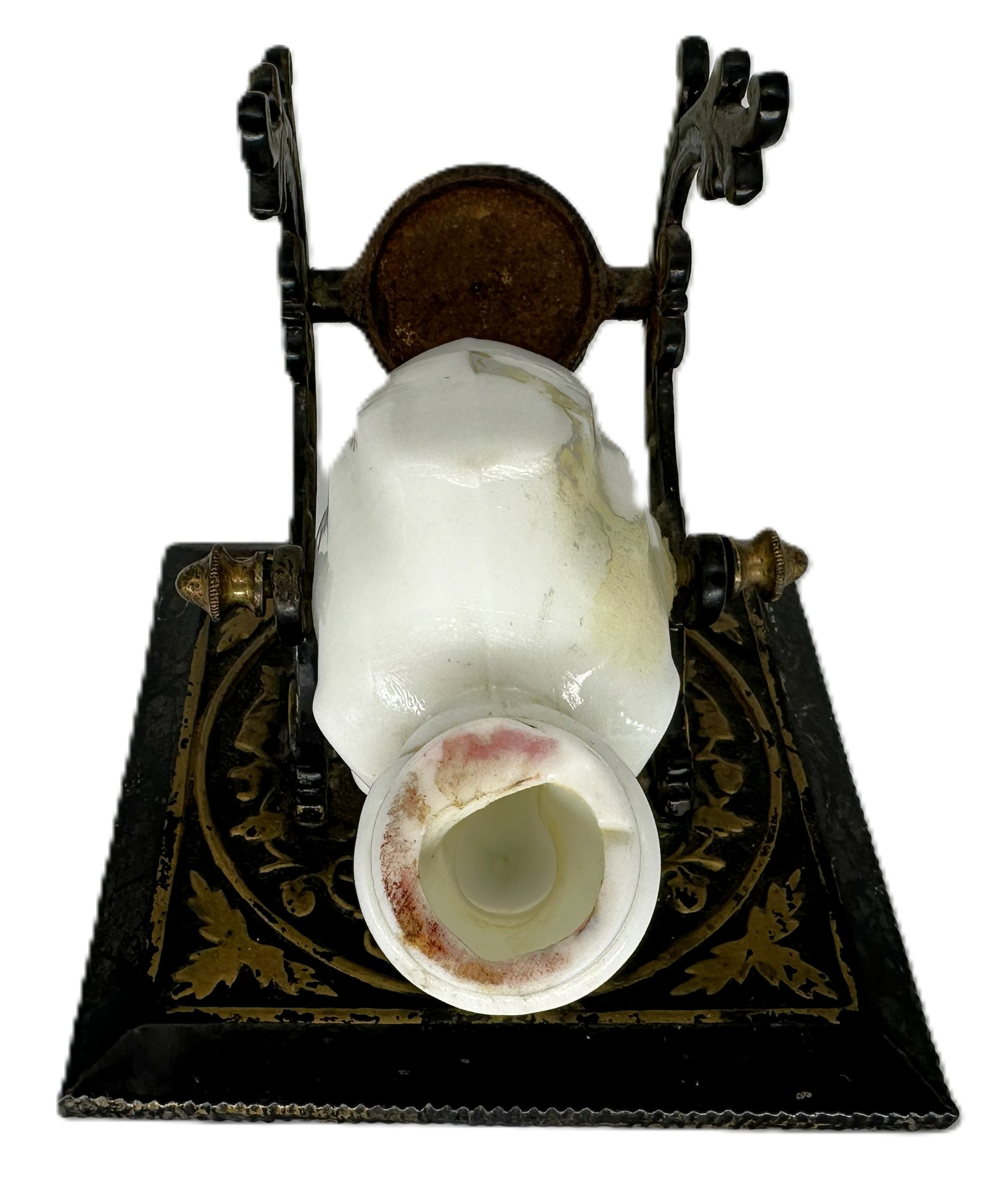
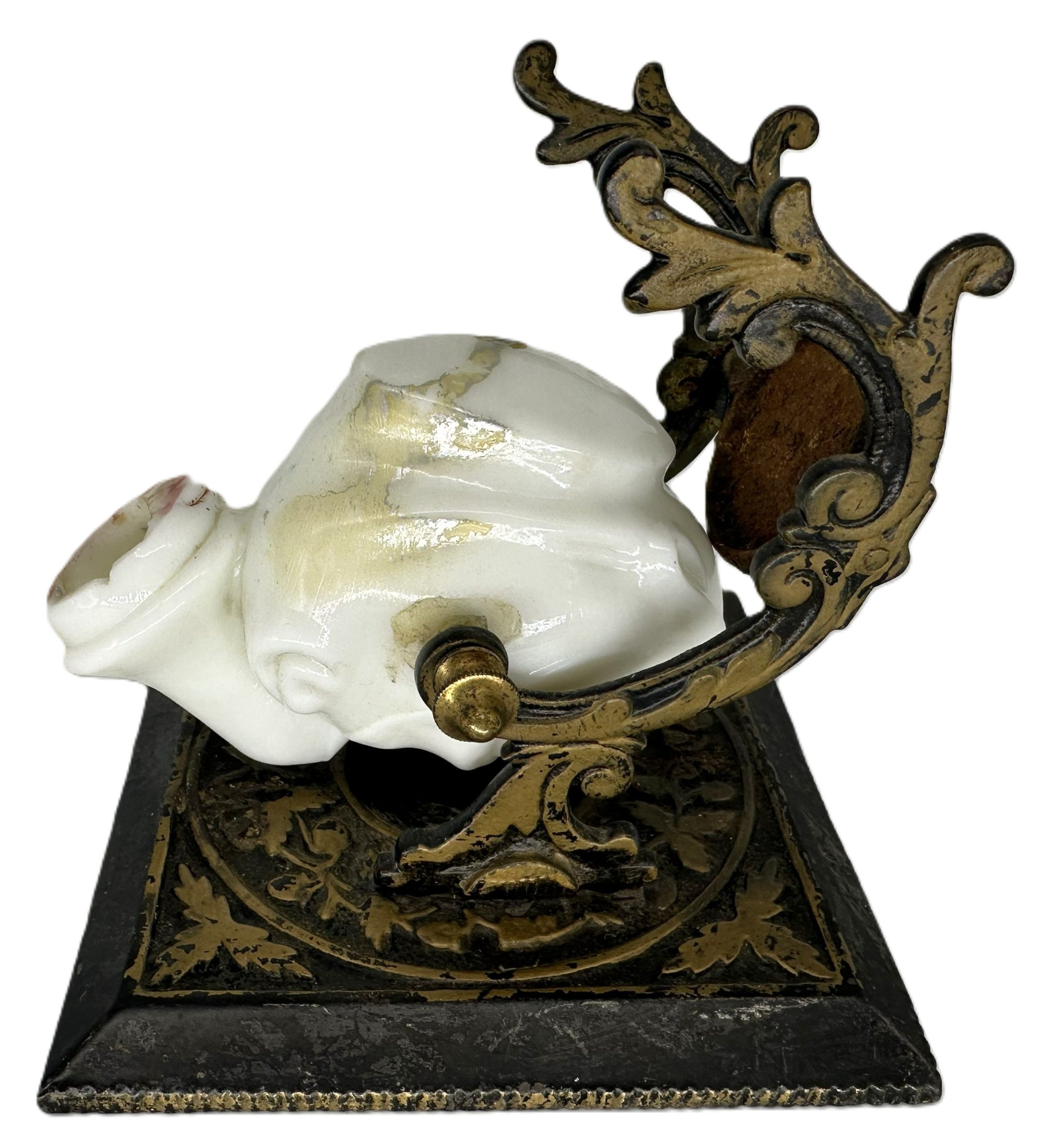
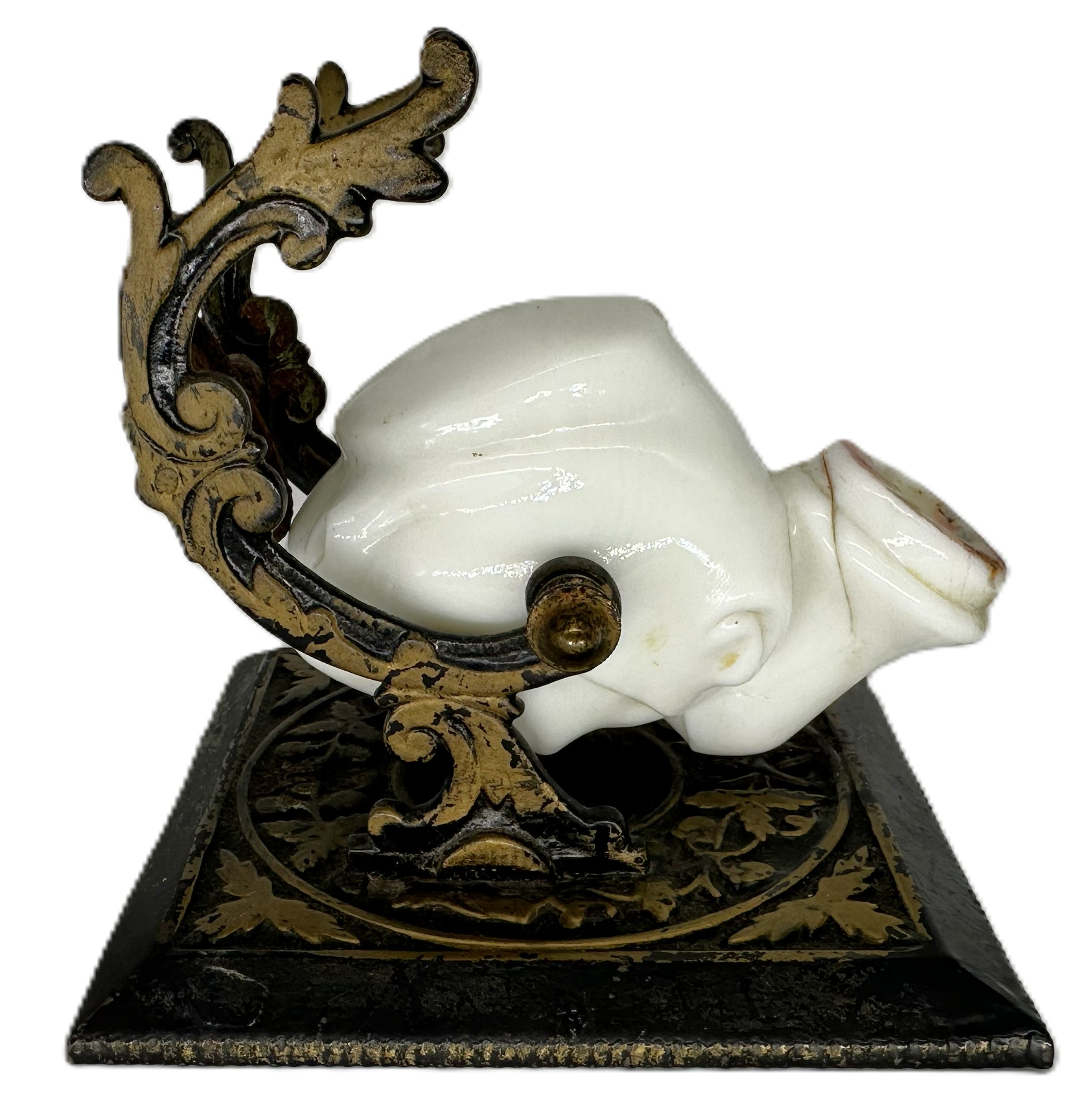
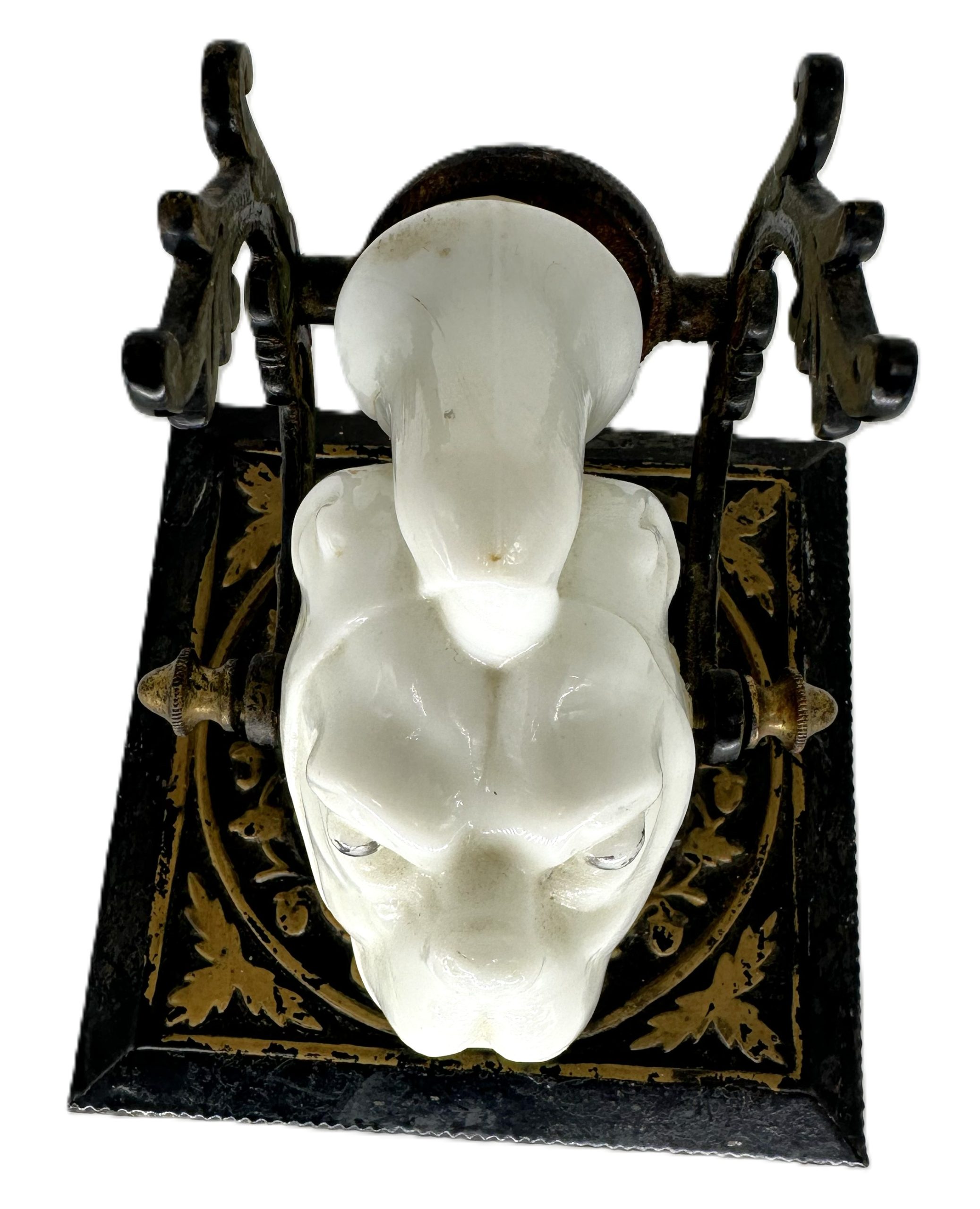
Bulldog Revolving Inkstand
| Categories | Mechanical - Snail / Pivoting |
| Type | dog |
| Material | Cast iron, Milk Glass |
| Markings | Unmarked |
| Manufacturer | Landers Frary & Clark |
| Origin | United States |
| Date or Era | circa 1880 |
| Measuring | Single: 4 ⅝ x 4 ⅝ x 4 ¼” high; Double:6 ¾” x 4 ¾” X 4 ¼” high |
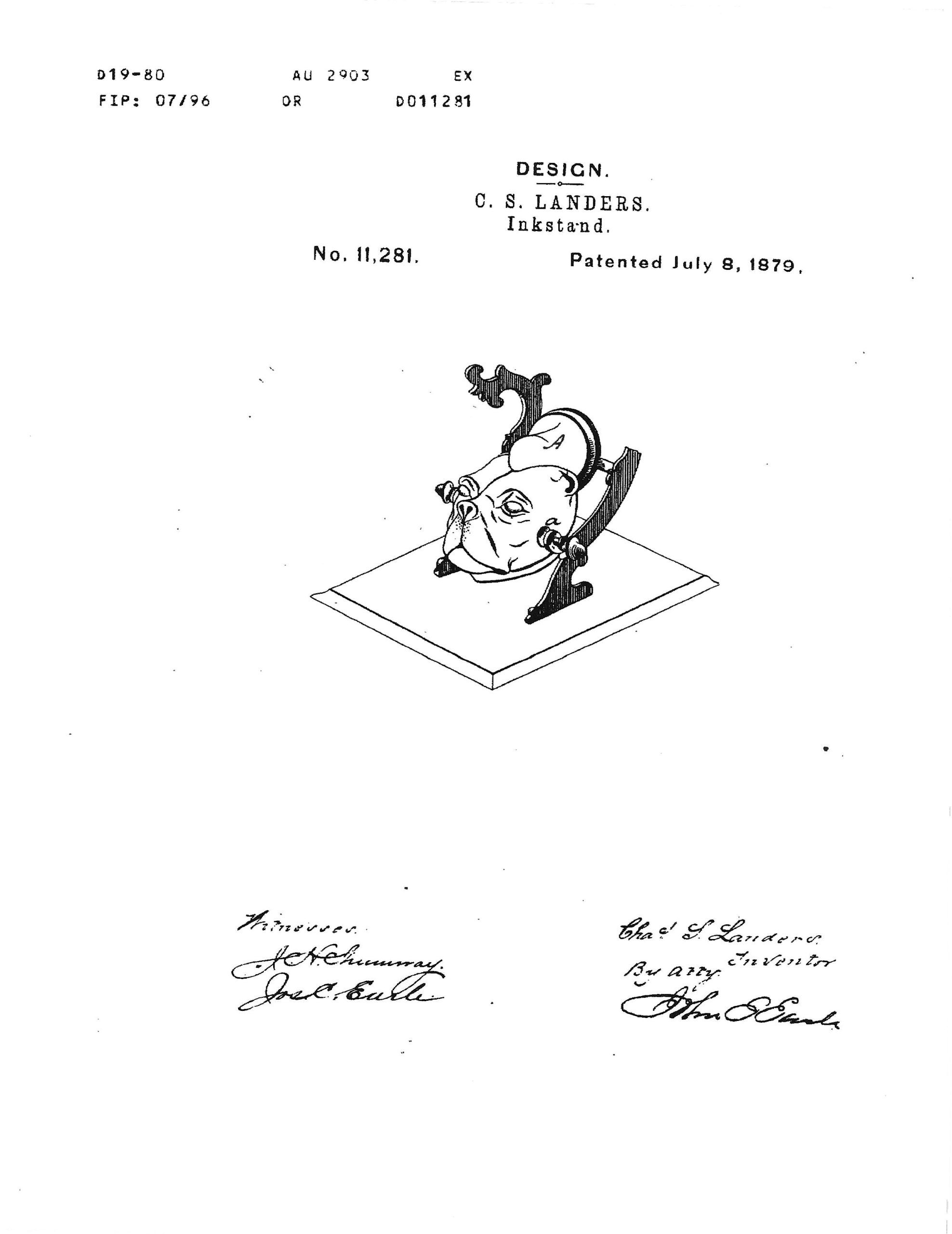
| Patent | Design Patent No. 11,281 - patented July 8, 1879 |
Description & Configurations
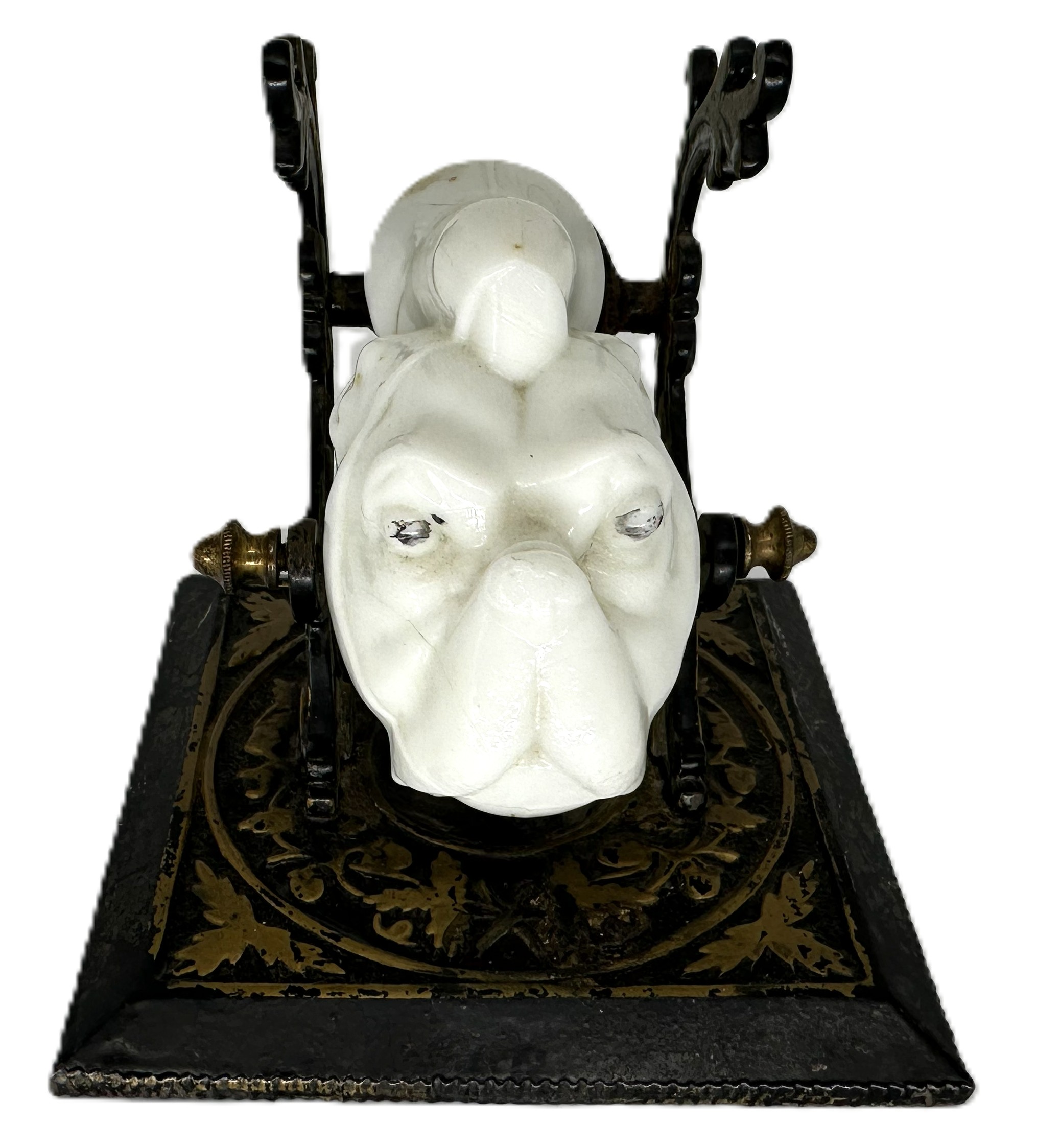
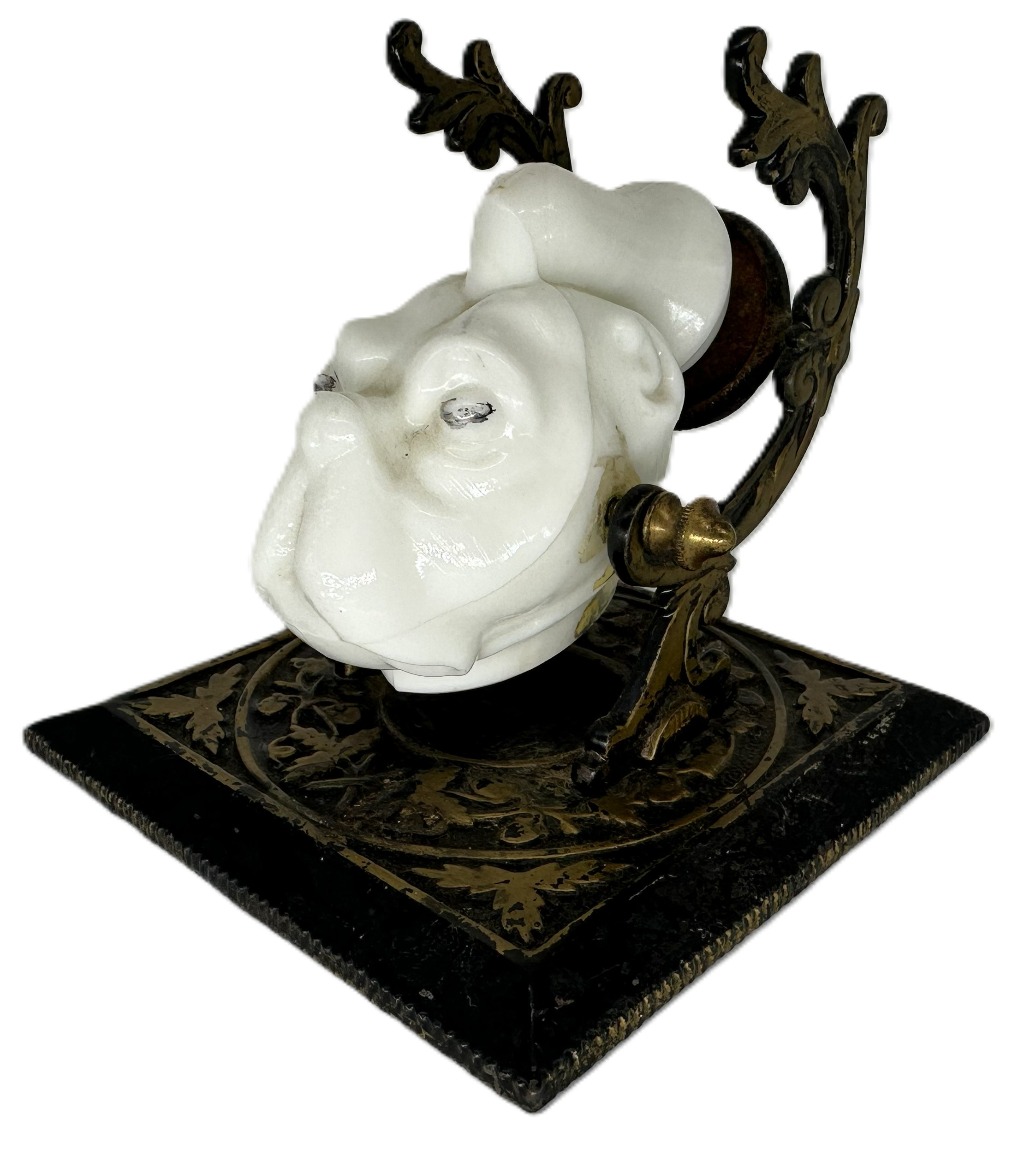
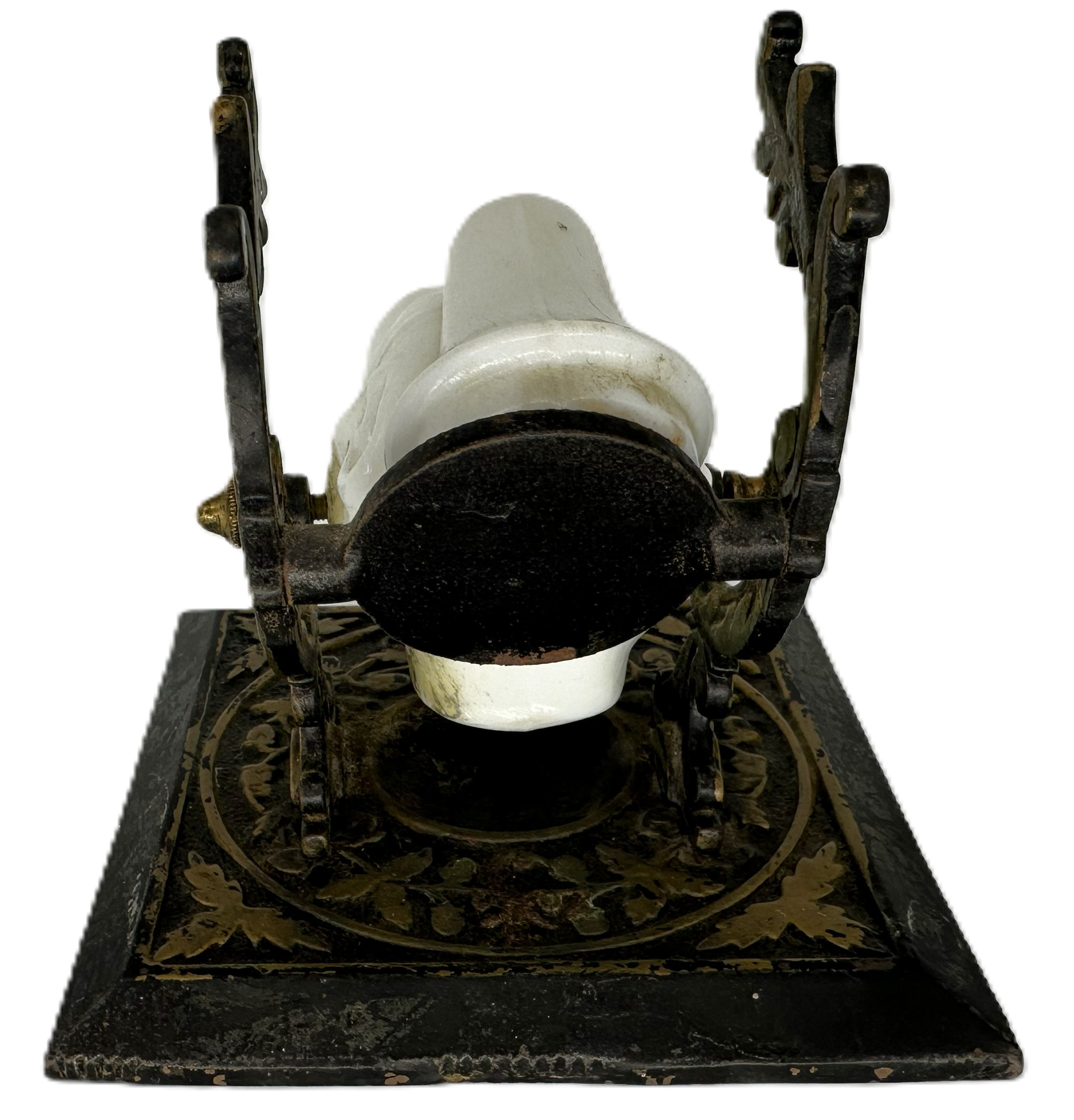
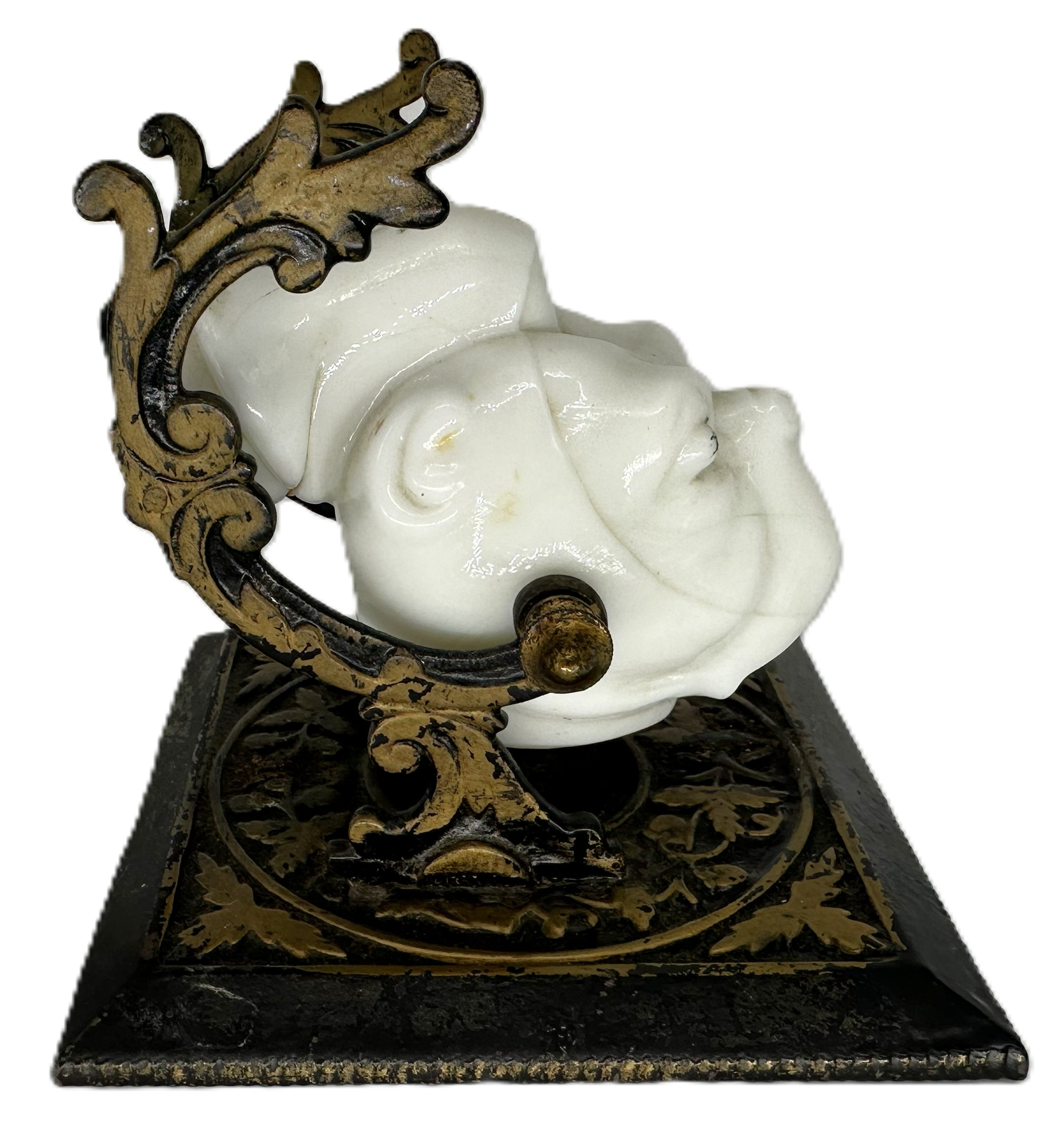
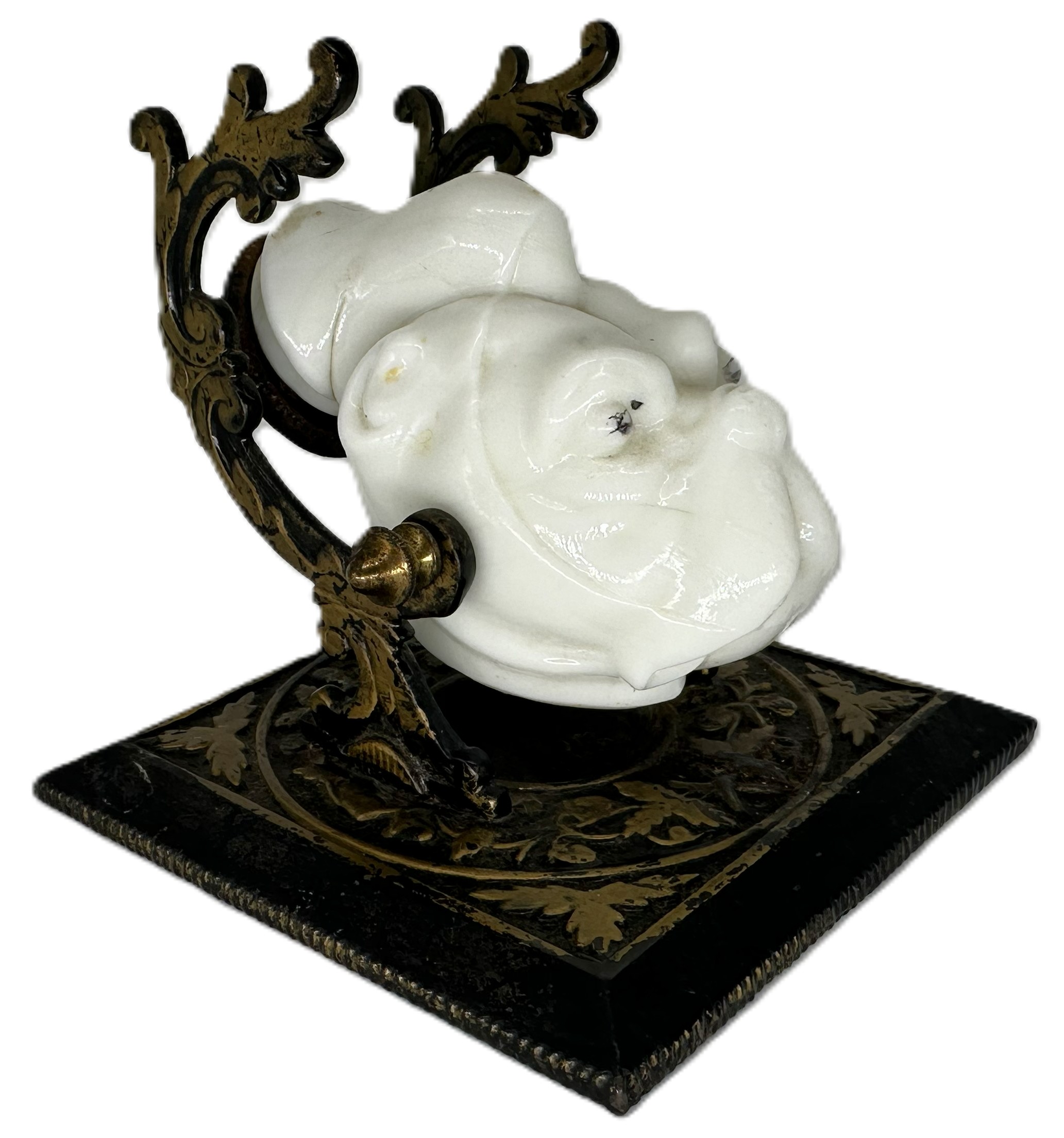
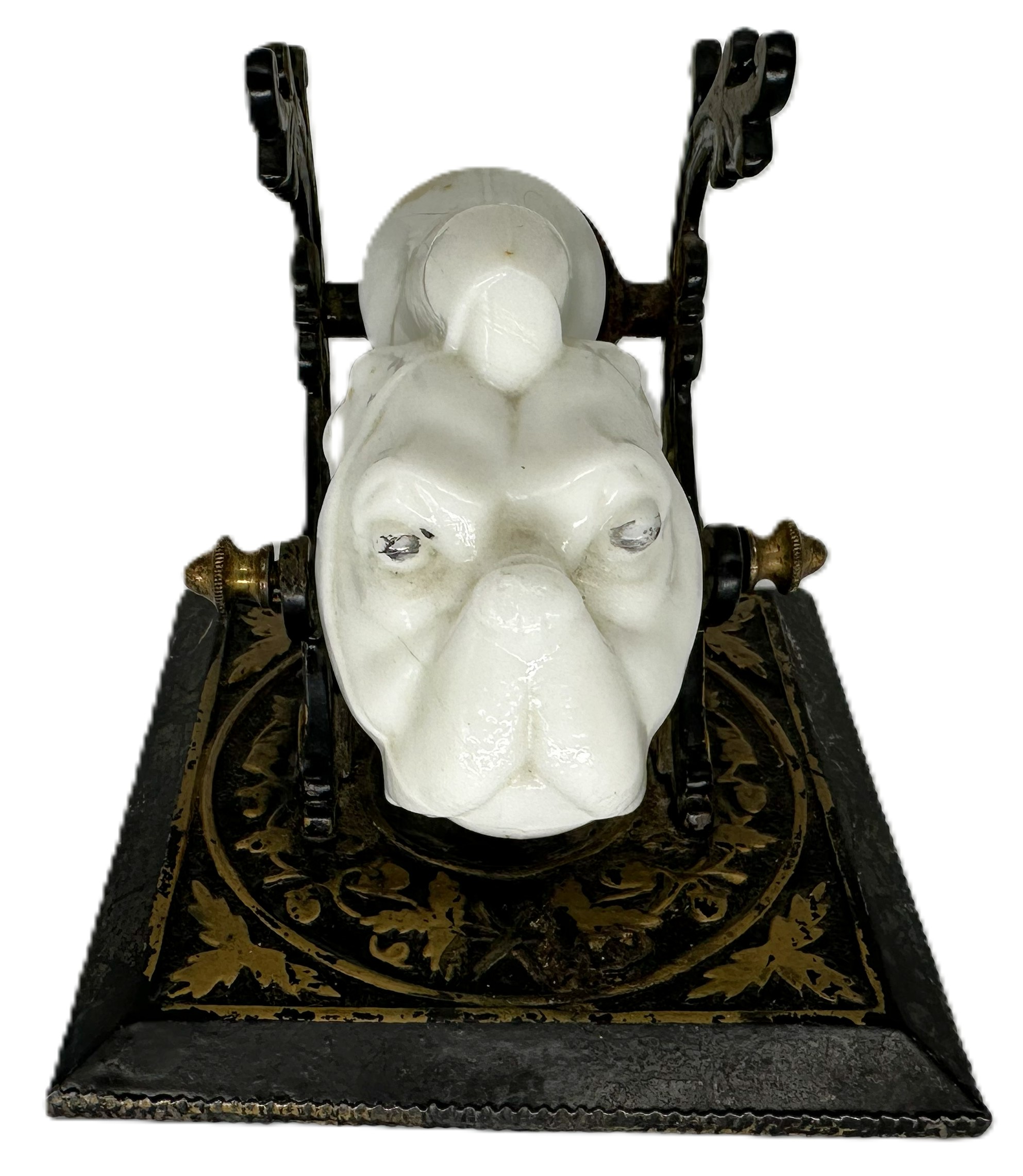
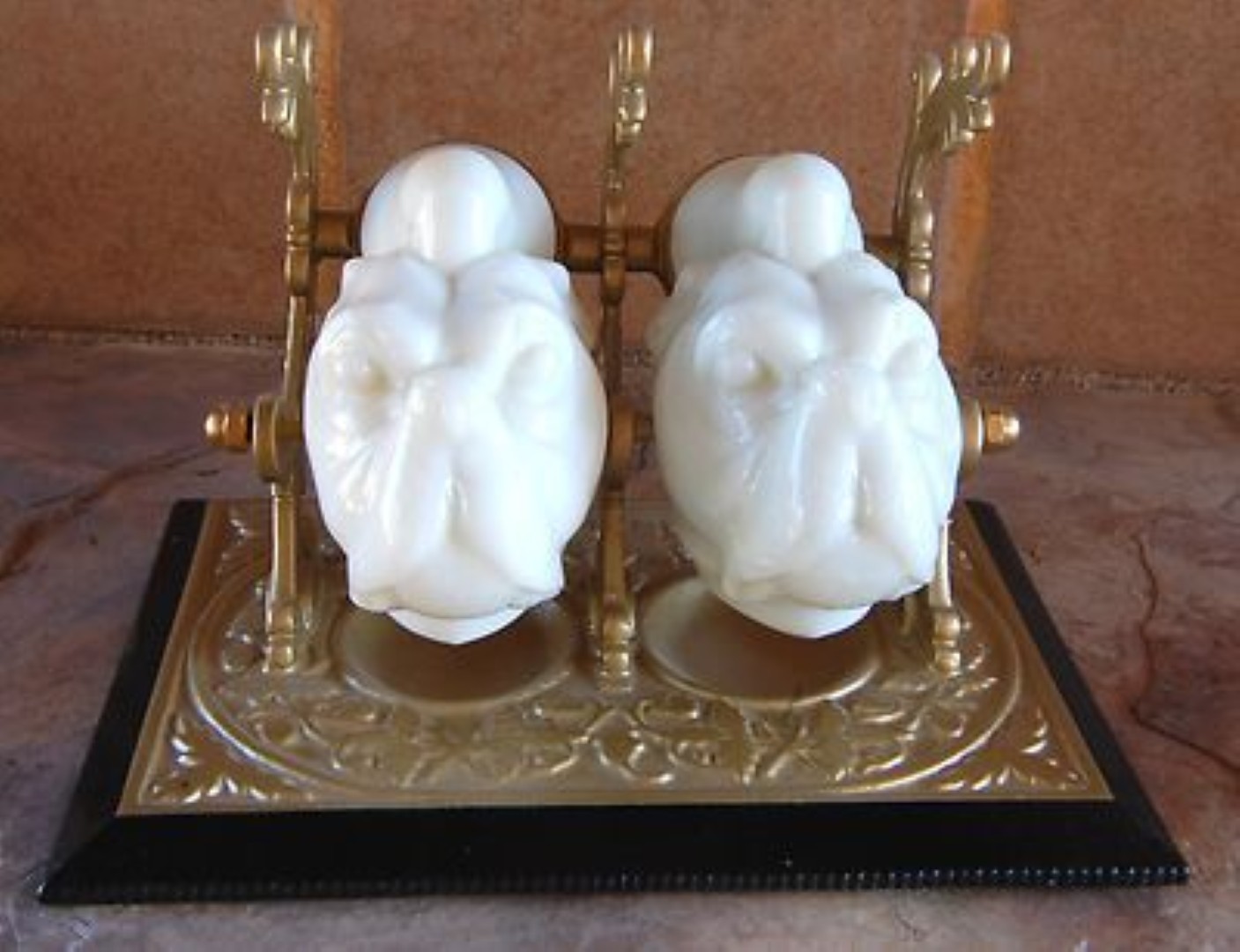
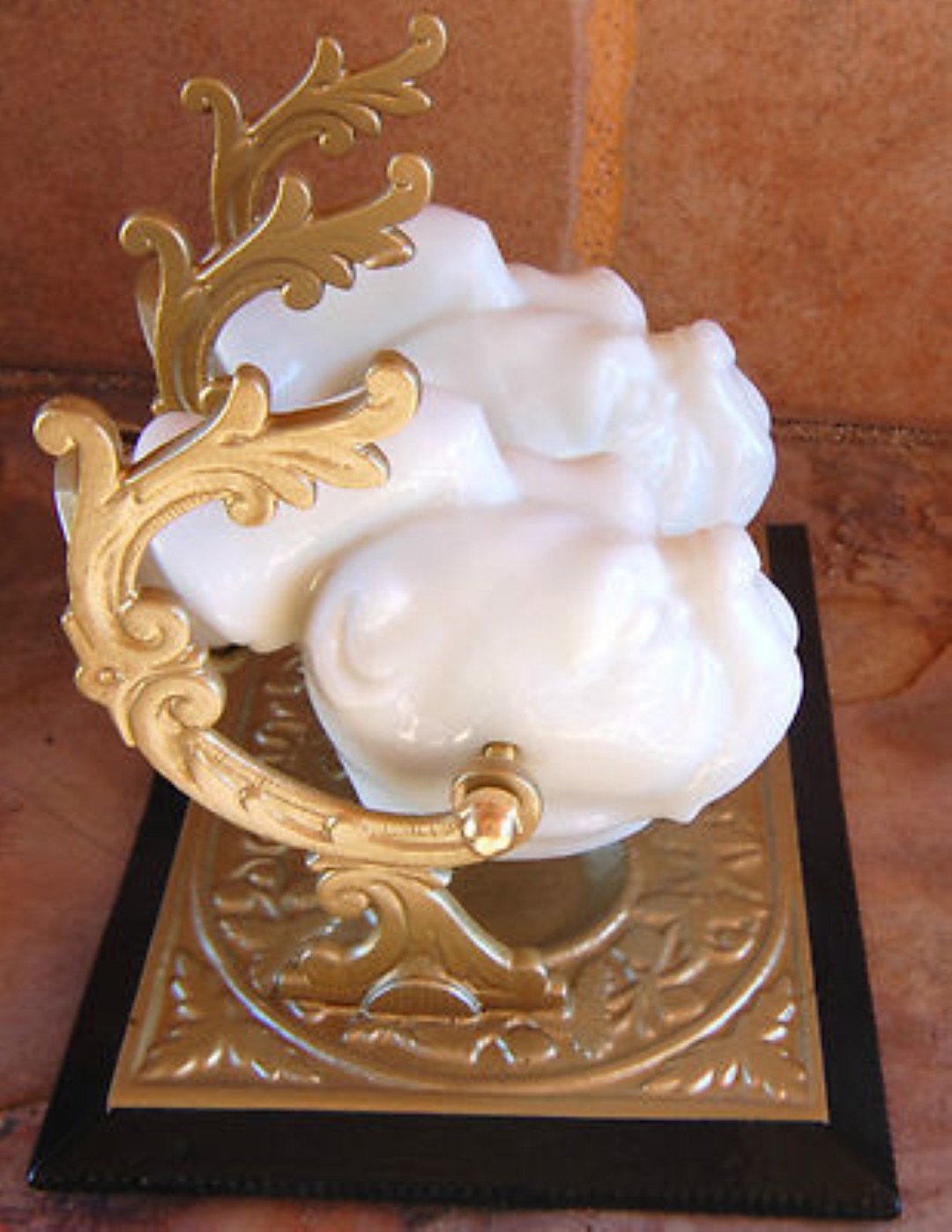
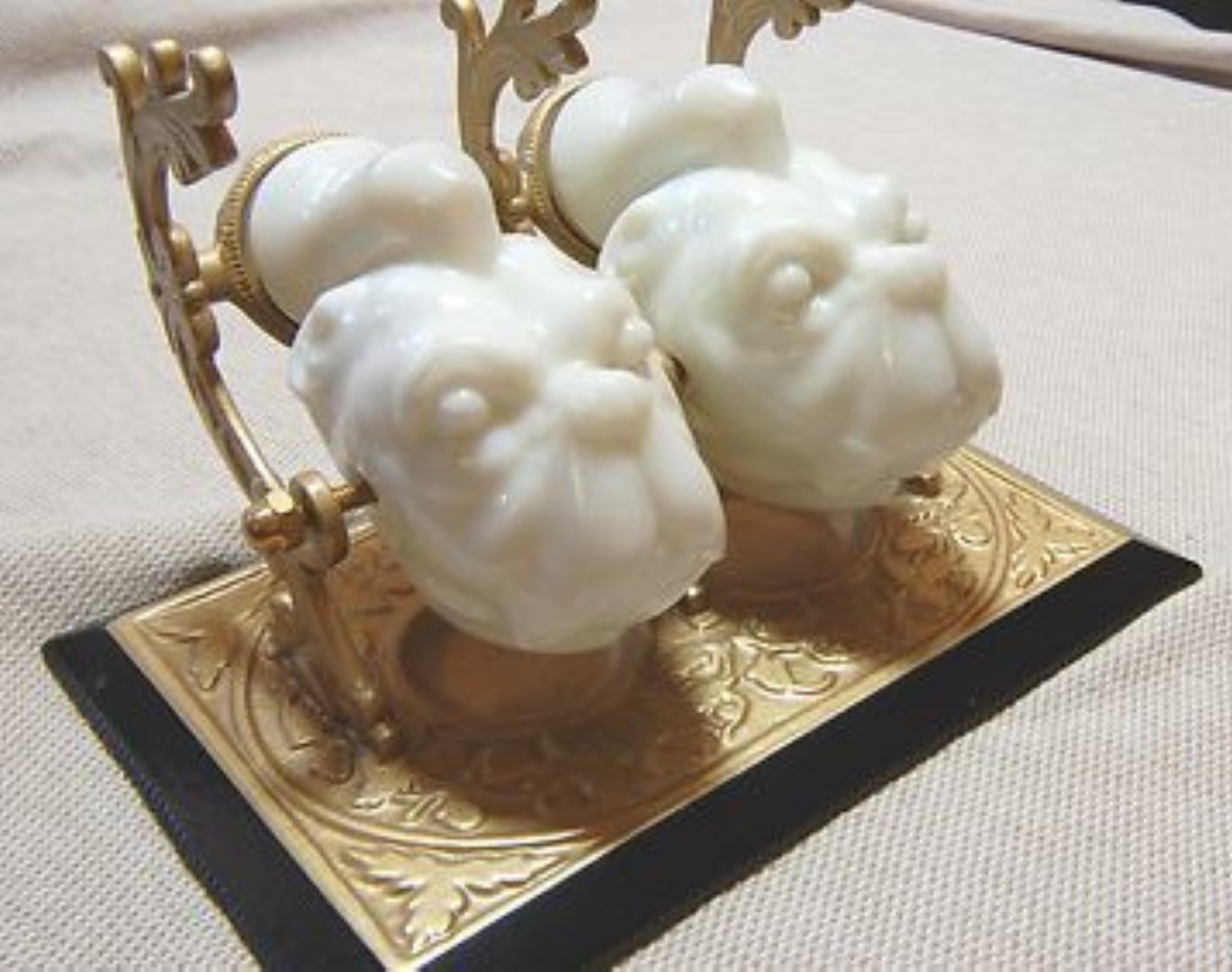
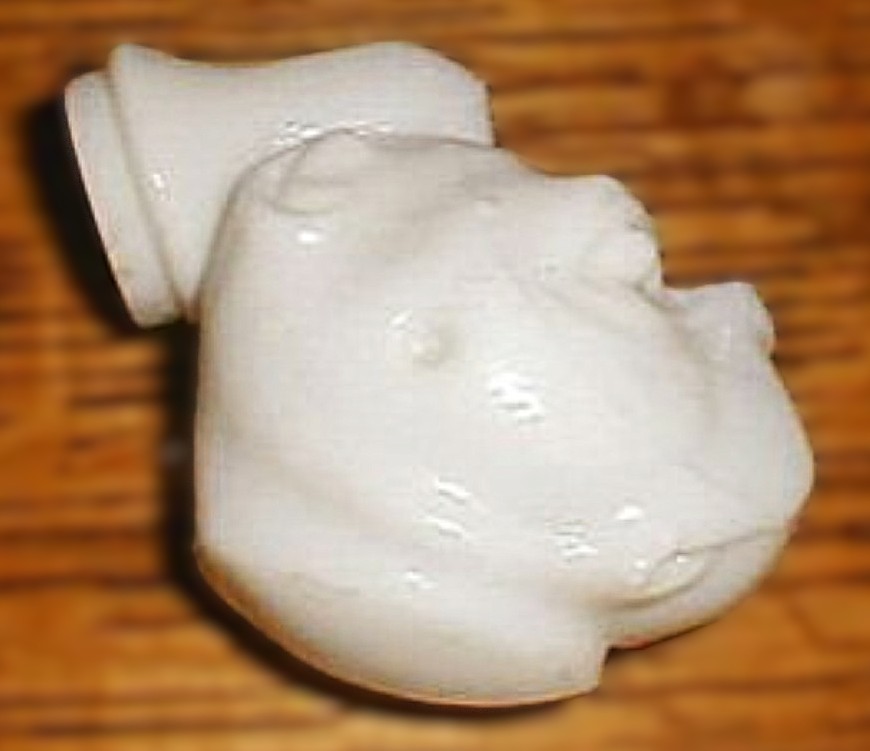
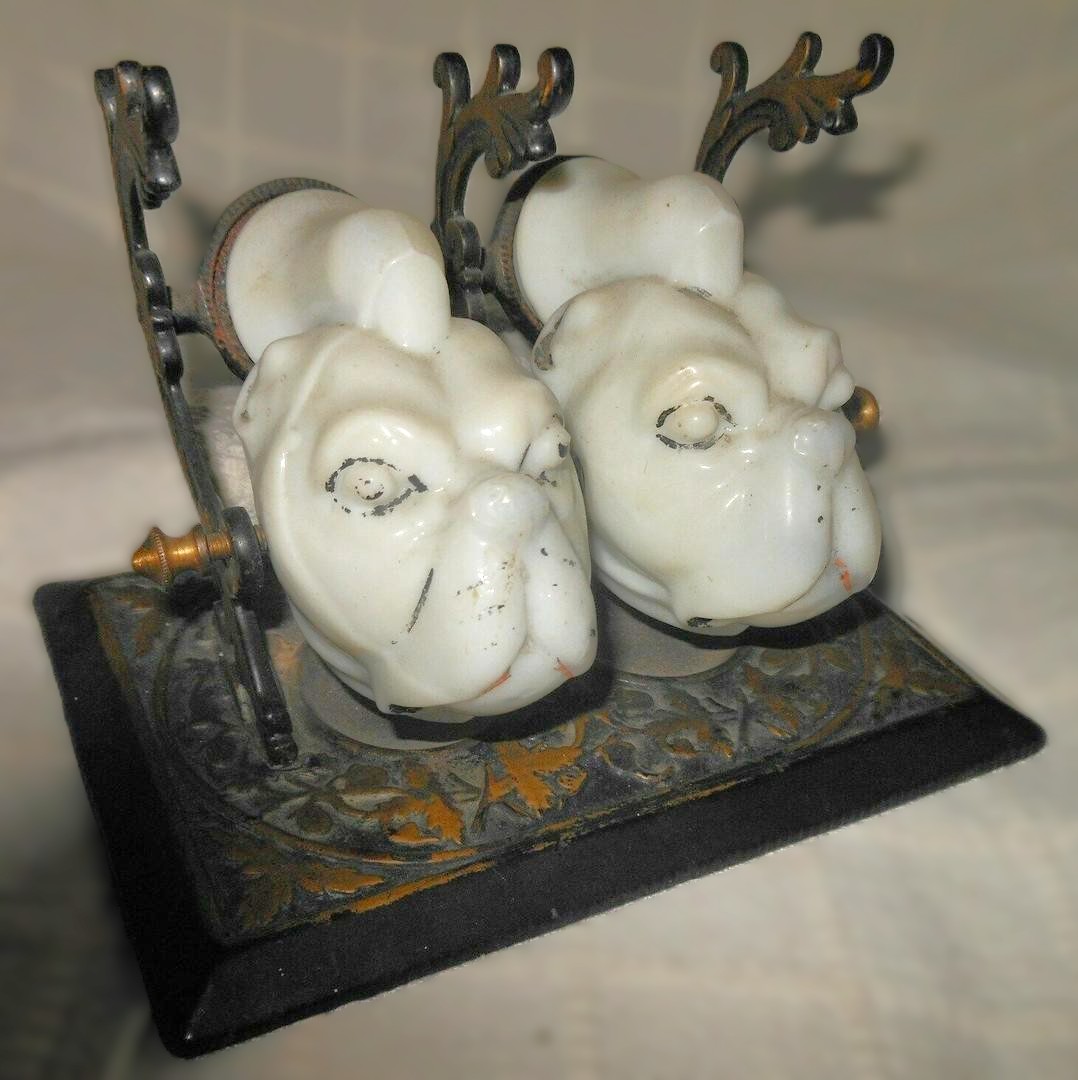
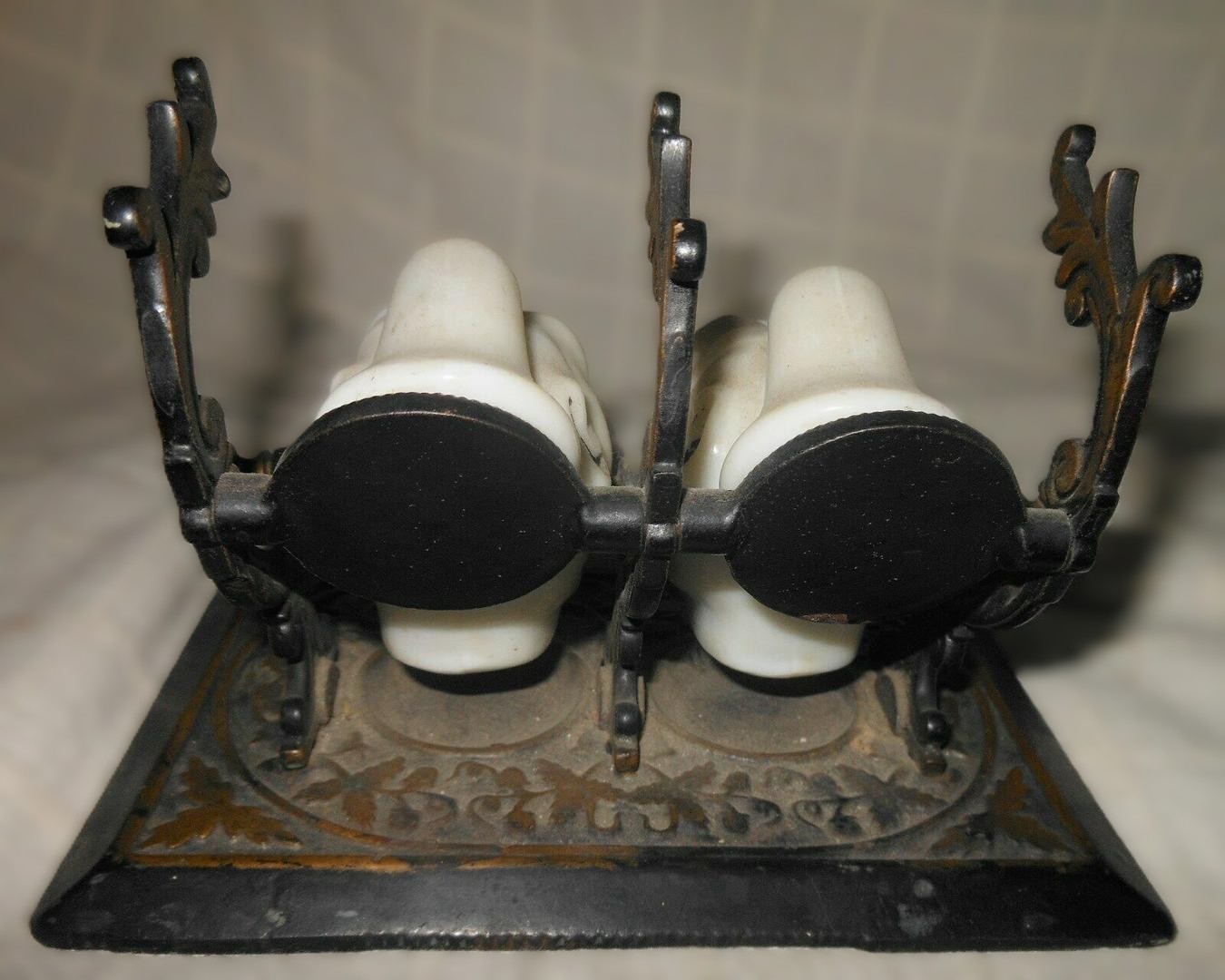
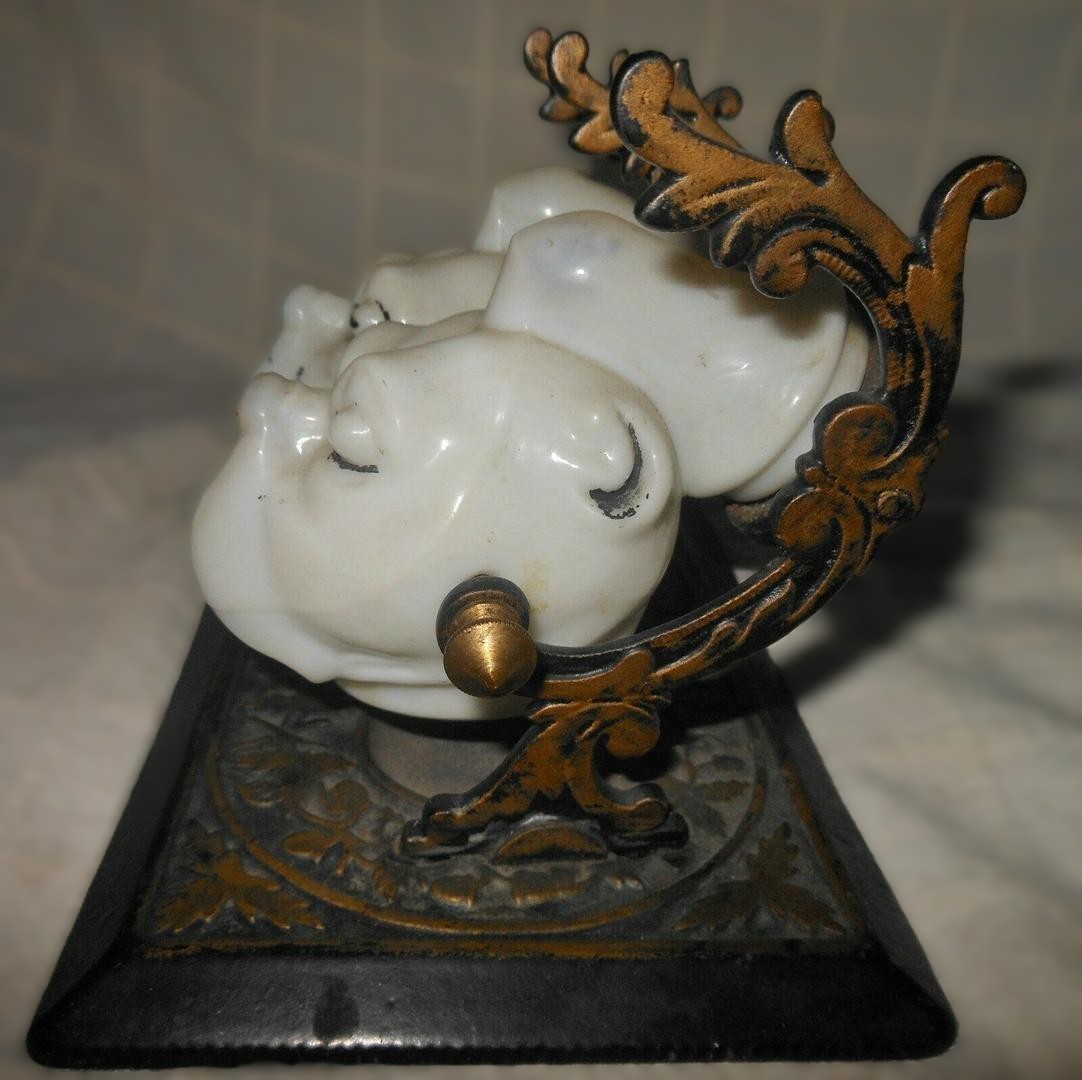
This distinct novelty item features a molded white milk glass reservoir (fount) shaped into a wrinkly bulldog’s head.
- The “Single” Version: This version features a single bulldog fount nestled into a square, ornate cast-iron frame finished with a black and gold-painted lacquer.
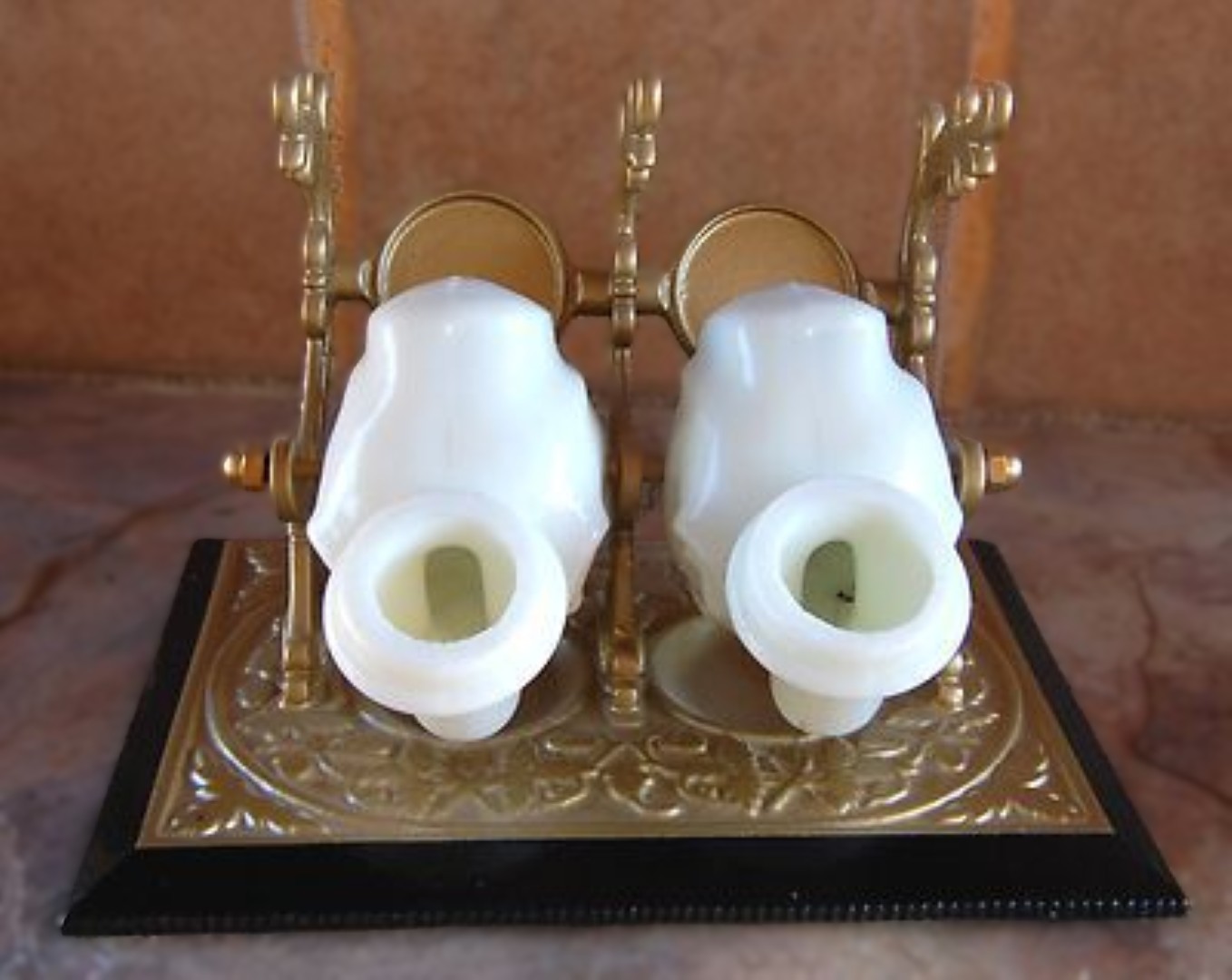
- The “Double” Version: This configuration utilizes an elongated rectangular base to house two side-by-side matching bulldog heads, typically used for containing two different colors of ink.
Mechanical Function
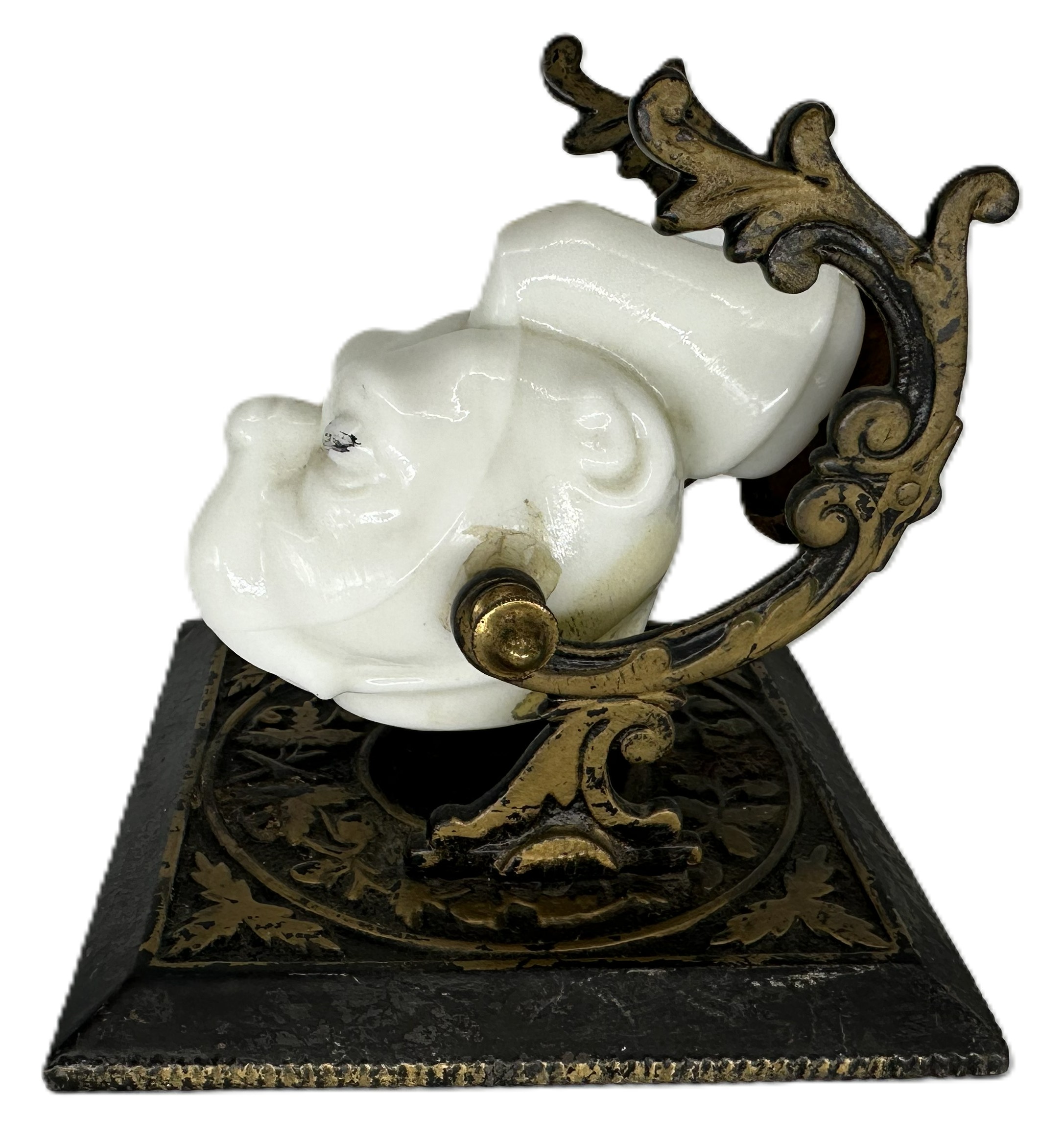
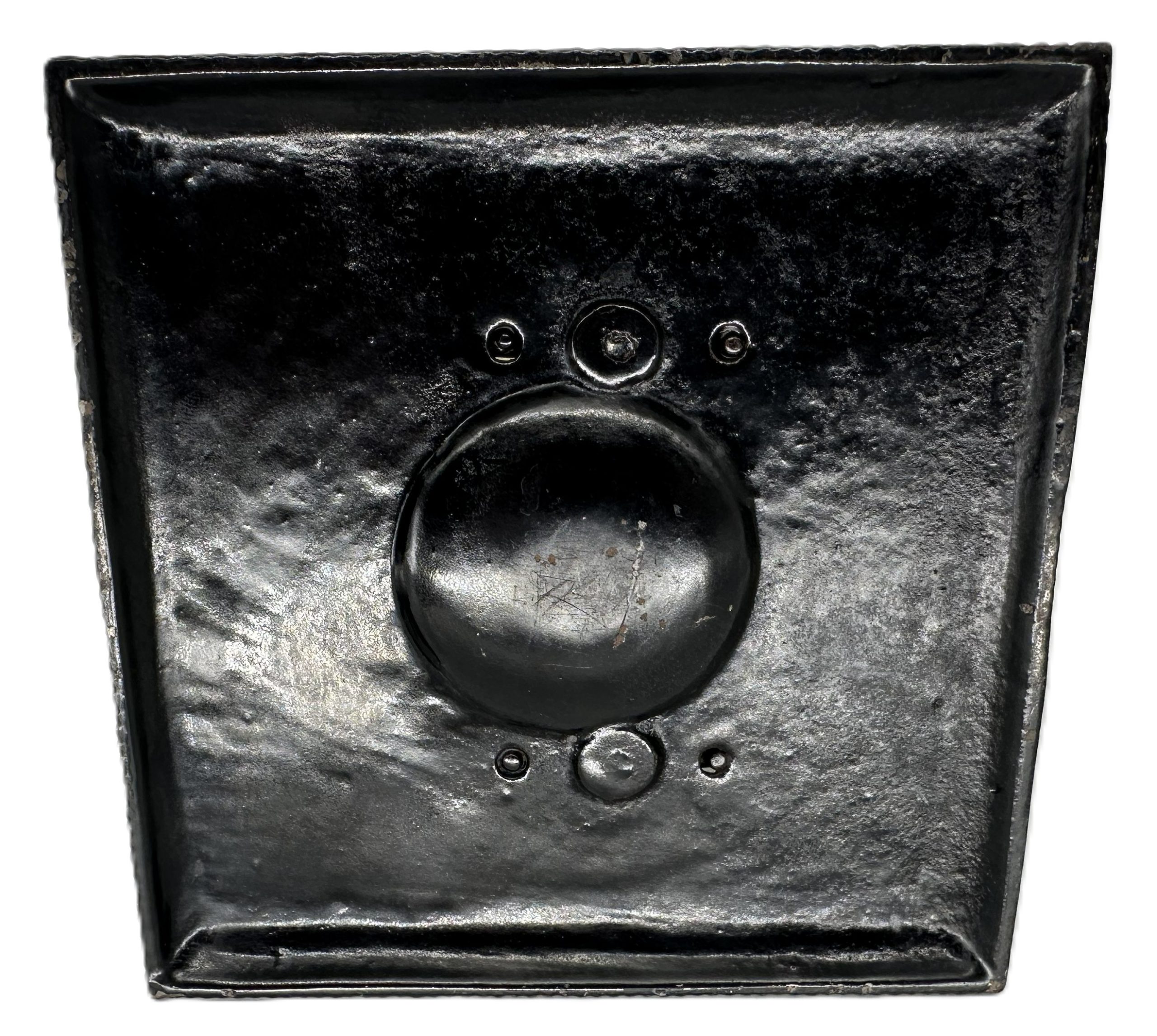
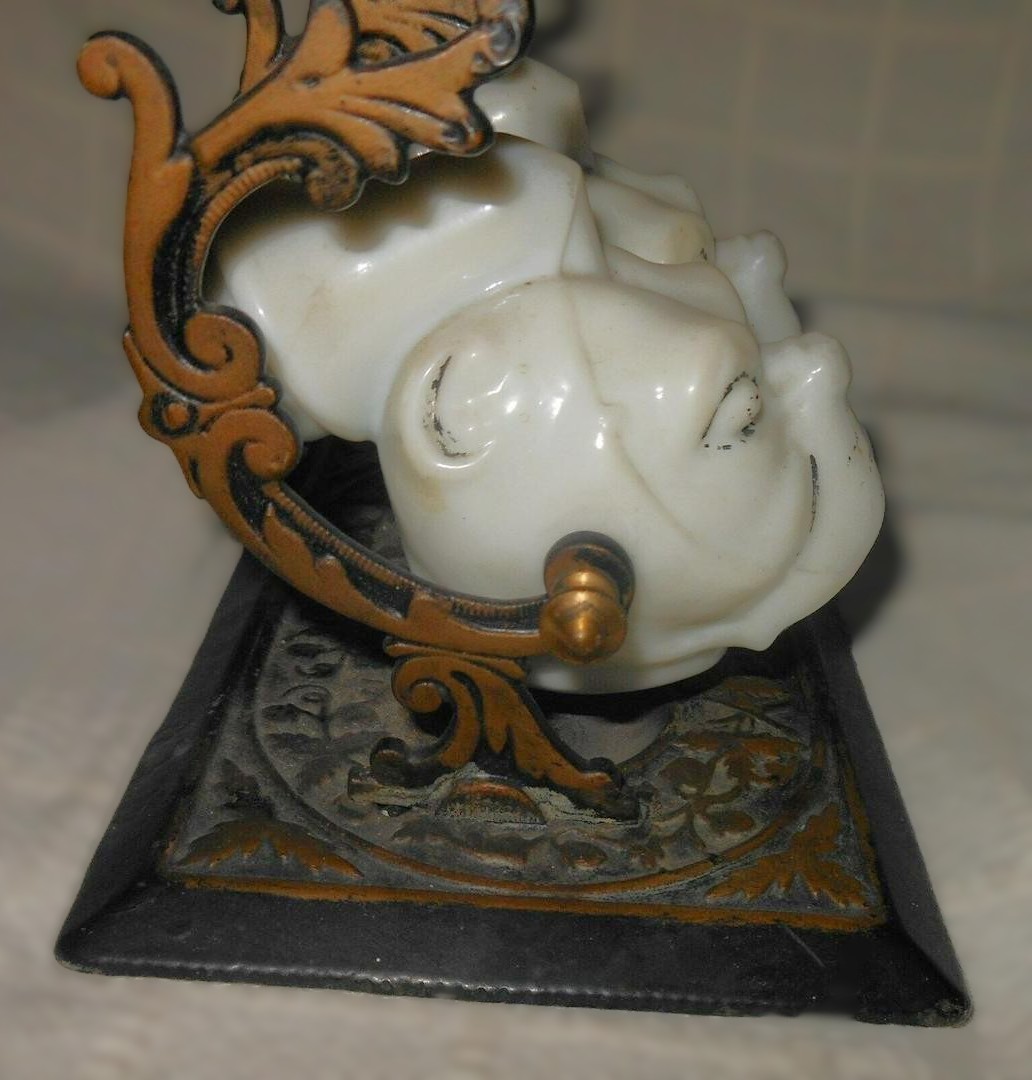
The cast-iron frame has two prominent sweeping, leaf-scroll side arms that double as a pen rack across the top. The bulldog’s head pivots on a central axis pin.
- Closed Position: When flipped forward, the dog’s collar or neck opening presses flush against an affixed metallic stopper plate built into the frame, sealing the ink away to prevent evaporation.
- Open Position: When rotated backward, the opening swings forward to allow a pen to be dipped directly into the neck.
Patent Information
- Inventor: Charles S. Landers
- Manufacturer: Landers, Frary & Clark of New Britain, Connecticut
- Patent Details: It was issued as a U.S. Design Patent for an Inkstand, described explicitly as consisting of a fount representing a “dog’s head” revolving within a frame.
The United States Design Patent details for the Landers bulldog revolving inkstand are as follows:
- Patent Number: Design No. 11,281
- Issue Date: July 8, 1879
Charles S. Landers officially assigned the design directly to the manufacturing firm Landers, Frary & Clark upon its successful filing and registration.
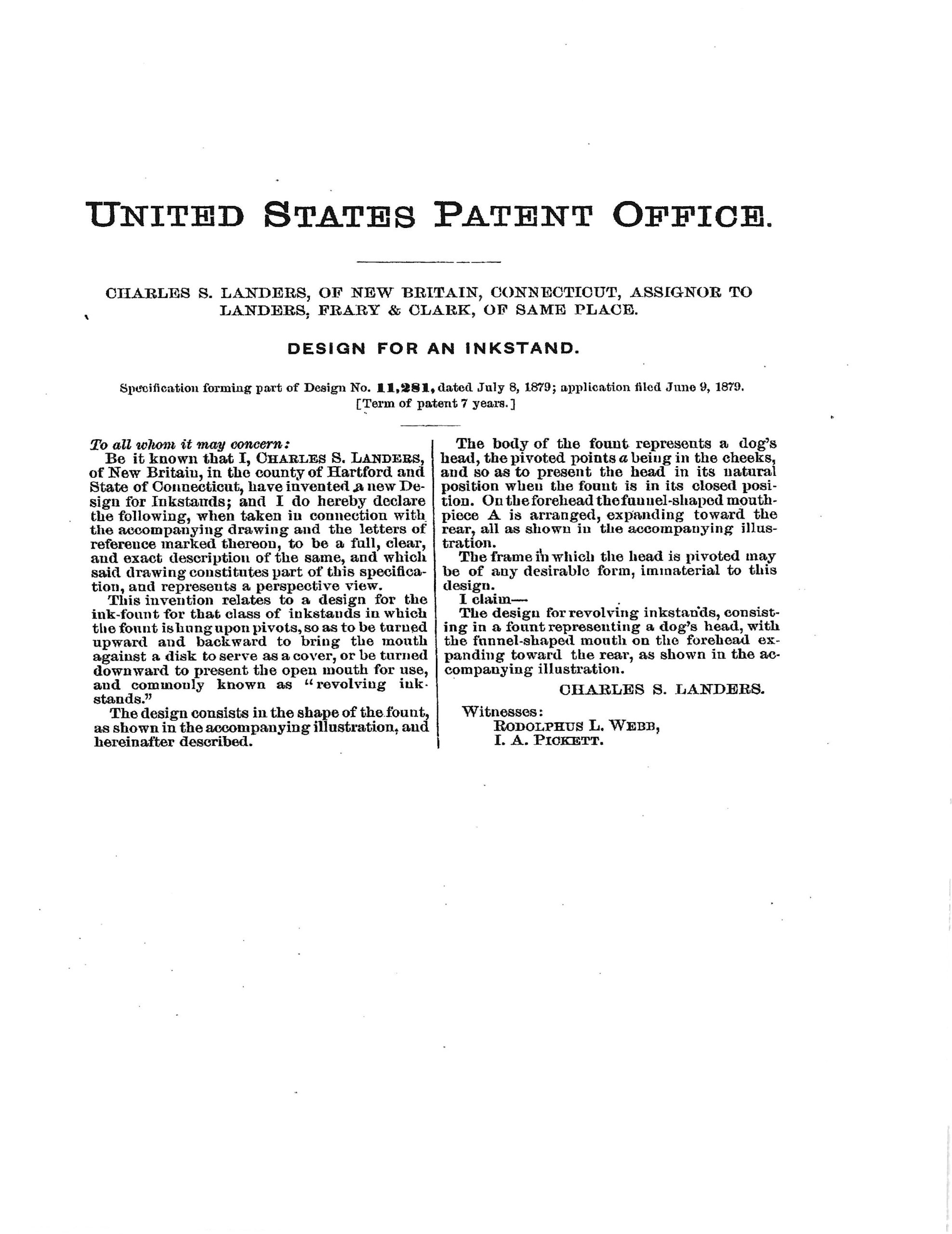
Here is a summary of what Charles S. Landers officially declared in United States Design Patent No. 11,281:
Scope and Classification
- The Intent: The patent establishes a brand-new “Design for Inkstands” specifically belonging to the established category commonly known as “revolving inkstands”.
- Mechanical Type: It applies to inkstands where the ink-fount is hung upon pivots, allowing it to be turned upward/backward to seal the mouth against a disk cover, or turned downward to present the open mouth for writing.
The Design Elements Explained
The document breaks down the configuration using specific anatomical reference markers:
- The Shape: The body of the ink reservoir explicitly represents a dog’s head.
- The Axis Points (a): The critical pivot points—labeled as letter a in the patent illustration—are placed directly in the dog’s cheeks. This ensures that when the fount is closed, the head rests in a realistic, upright “natural position”.
- The Aperture (A): The actual opening of the inkwell—labeled as letter A—is described as a “funnel-shaped mouthpiece” situated directly on the dog’s forehead, expanding backward toward the rear.
The Frame Disclaimer
The patent explicitly leaves the door open for multiple frame variations (such as the single and double variants. Landers states:
“The frame in which the head is pivoted may be of any desirable form, immaterial to this design.”
The Official Claim
The single, legally binding claim that protects this item legally summarizes the entire novelty of the invention:
“The design for revolving inkstands, consisting in a fount representing a dog’s head, with the funnel-shaped mouth on the forehead expanding toward the rear, as shown in the accompanying illustration.”
Design Flaws
It may look good on paper, but real world usage uncovered several inherent flaws in the physics of its design:
- The “Snout-Heavy” Auto-Deploy Issue
Standard revolving inkwells typically rely on radial symmetry so that the weight remains perfectly balanced as it rotates. However, the bulldog head has radical asymmetry. Because the dog’s neck is elongated (to increase ink capacity), the heavy, solid milk-glass face sits far forward from its rotational axis pin.
The bottle is “snout heavy”. This creates an unstable equilibrium where the inkwell is prone to deploy to the “open” position entirely on its own due to the sheer gravitational pull on the bulldog’s heavy nose and jaw.
- The Spilling & Overfilling Phenomenon
Because of the skewed internal volume distribution, the air/ink balance doesn’t function like a normal barometric fountain inkwell. When the bottle pivots open, one end of the reservoir aperture rises higher than the lip of the font. This completely disrupts the barometric vacuum point, forcing ink depth to rise over the lip and resulting in unprovoked spills. The asymmetric shape also makes it incredibly easy to accidentally overfill the reservoir, exacerbating the leaking.
- The Broken Nose
The bulldog’s nose sometimes suffers damage when pivoted open. Most swinging inkwells are built with mechanical stops built directly into the cast-iron hinges or framework to halt rotation safely. Landers failed to include one. Instead, the physical “stop” that prevents the bottle from flipping too far backward is the glass chin/jaw of the dog forcibly slamming directly into the iron frame components and the underside of the stopper plate. This brutal glass-on-iron impact, combined with the “snout-heavy” momentum pulling it forward, meant that everyday usage occasionally cracked, chipped, or shattered the fragile milk-glass noses and jaws of these pieces.
Manufacturer
Landers, Frary & Clark was a powerhouse of American manufacturing based in New Britain, Connecticut, operating under that name from 1862 until 1965. Famed for its massive output of housewares, cutlery, and eventually electric appliances, it was one of the premier companies that defined the hardware industry of New Britain – a city nicknamed the “Hardware Capital of the World”.
Origins & Early History
The roots of the company stretch back to 1842 when George M. Landers and Josiah Dewey formed a partnership called Dewey and Landers. They initially specialized in small, cast-metal brass hardware items like furniture casters, cupboard latches, and window springs.
After a couple of partnership shakeups (including operating as Landers and Smith Manufacturing in the 1850s), the company took its definitive shape in 1862. Upon purchasing the Meriden-based firm Frary & Carey, James D. Frary joined the business, and it officially incorporated as Landers, Frary & Clark.
Mid-to-Late 19th Century Expansion
Following incorporation, the company rapidly diversified beyond simple building hardware:
- Cutlery Boom: In 1866, they established the Aetna Works. Despite the plant burning down in a massive fire in 1874, they rebuilt a larger, ultra-modern facility. By 1903, Landers, Frary & Clark had become the largest cutlery manufacturer in the world.
- Household Wares & Novelties: Throughout the 1870s and 1880s, they leaned heavily into products designed to modernize or bring novelty to the American home. This included coffee grinders, balance food scales, cake mixers, and various cast-metal desk novelties—such as the patented revolving bulldog inkwells.
The Iconic “Universal” Brand
In 1898, the company introduced the Universal Food Chopper, a wildly successful manual kitchen tool that became a staple in households worldwide. From that point on, most of their premier consumer goods were marketed under the trade name Universal. Their Universal Bread Maker went on to win a gold medal at the 1904 St. Louis World’s Fair.
Electrification and 20th Century Peak
When home electricity began sweeping the nation in the early 1900s, company president Charles Smith aggressively pivoted the firm toward electric housewares.
- They pioneered some of the very first commercial electric coffee percolators, clothes irons, and toasters.
- They expanded the Universal line to include vacuum cleaners, electric ranges, washing machines, blenders, and even electric blankets.
- Wartime Production: During World War I and World War II, the company pivoted to support the military, manufacturing millions of canteens, mess kits, trench knives, and virtually all of the sabers utilized by the United States Cavalry.
Decline and Legacy
In the post-WWII era, the company faced stiff competition and declining margins. The historic cutlery division was shuttered in the early 1960s.
In 1965, the company was largely broken up and bought out. The corporate majority was taken over by the J.B. Williams Company, the famous food chopper line went to Union Manufacturing, and the crown jewel – the small electrical appliance division – was purchased by General Electric (GE). While the company itself is long gone, its vintage Universal appliances and 19th-century cast-iron novelties are appreciated by antique collectors today.
Values: Single $275; Double $400
Content disclaimer. The information posted is the owner’s best knowledge and may not have been vetted by the SOIC. We welcome comments, corrections, and additions, working to make our website information comprehensive and accurate.
Join the Society of Inkwell Collectors (SOIC) – it’s free!
Founded in 1981 as a non-profit organization,
we are documenting inkwells (and accessories).
We’re here to help and inform!