




Bradley & Hubbard Brass Inkstand – Double and Single Versions
| Categories | Bronze - Brass - Copper |
| Material | Brass |
| Markings | See Narrative |
| Manufacturer | Bradley & Hubbard |
| Origin | United States |
| Date or Era | circa 1905 |
| Measuring | 7” x 4” x 3” high |
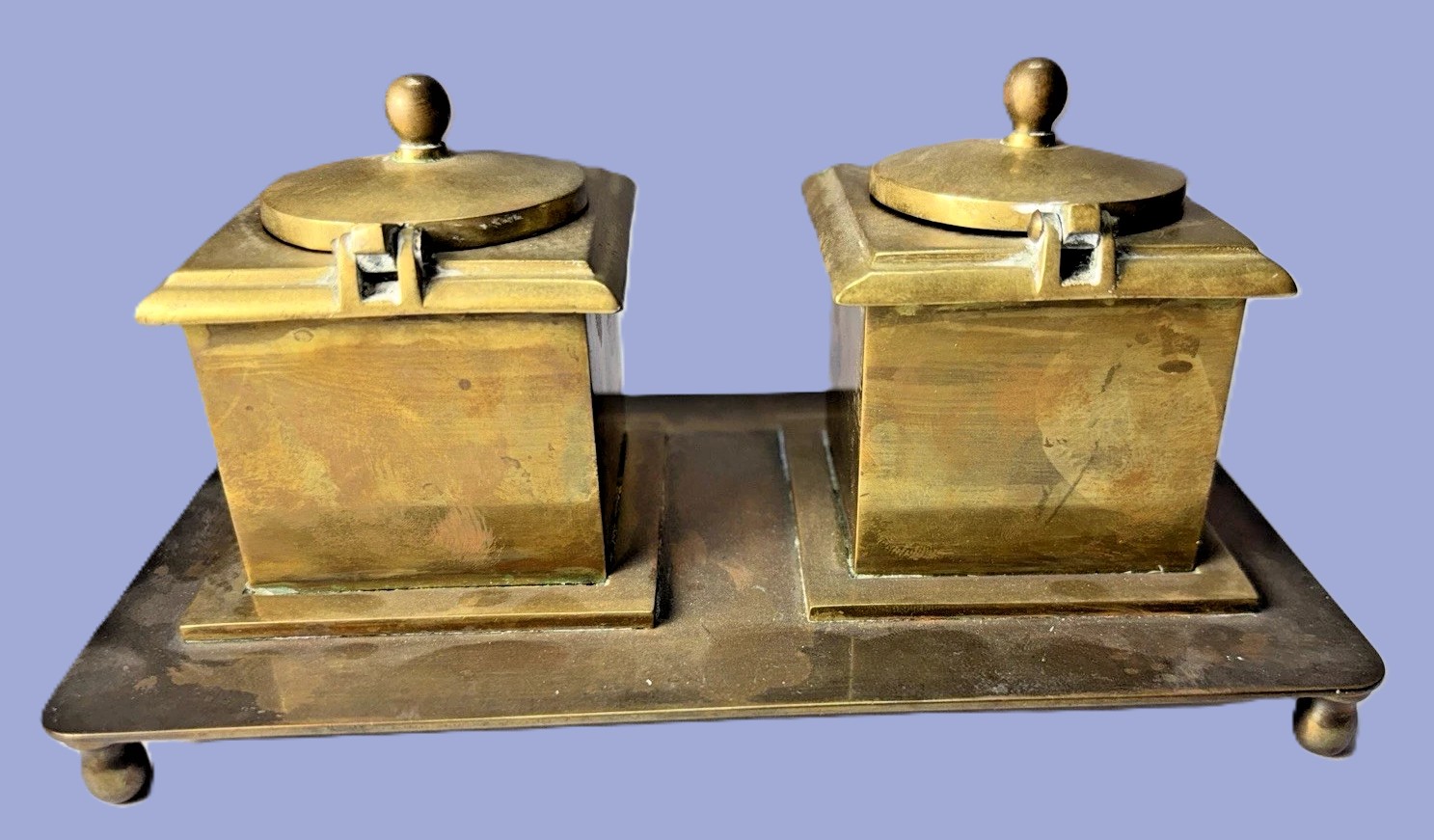
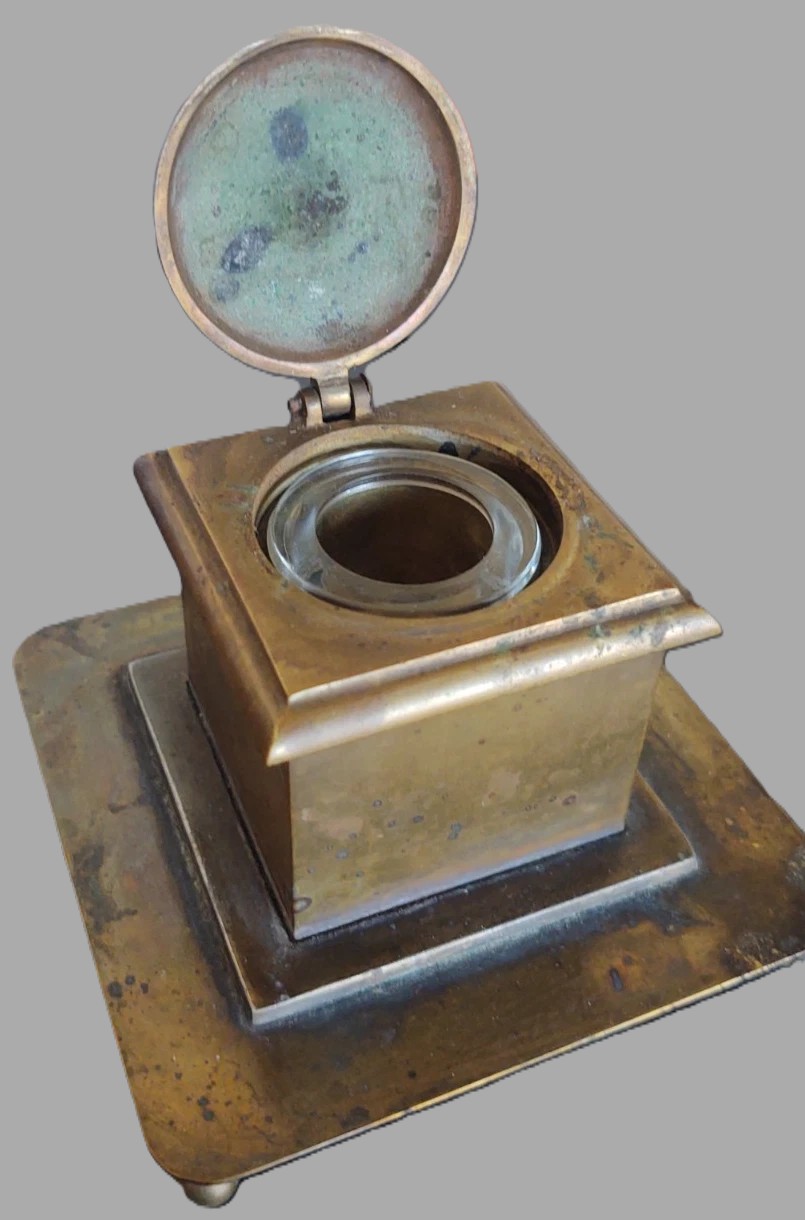
These Bradley & Hubbard Manufacturing Company inkstands, based on the manufacturer’s mark and the utilitarian design, likely date to the early 1900s. Two versions are shown – a “single” and a “double”.
Description
- Configuration: The inkstand consists of two identical, substantial square inkwells mounted symmetrically on a rectangular tray.
- Inkwells & Lids: Each inkwell is a solid brass cube with a stepped-edge top. The hinged lids are circular and slightly domed, topped with a simple spherical ball finial that serves as a handle.
- Reservoirs: Inside the brass housings are two clear glass reservoirs (or inserts).
- The Base: The rectangular brass tray has a flat, smooth surface with a slightly raised edge. It is supported by four turned ball feet.
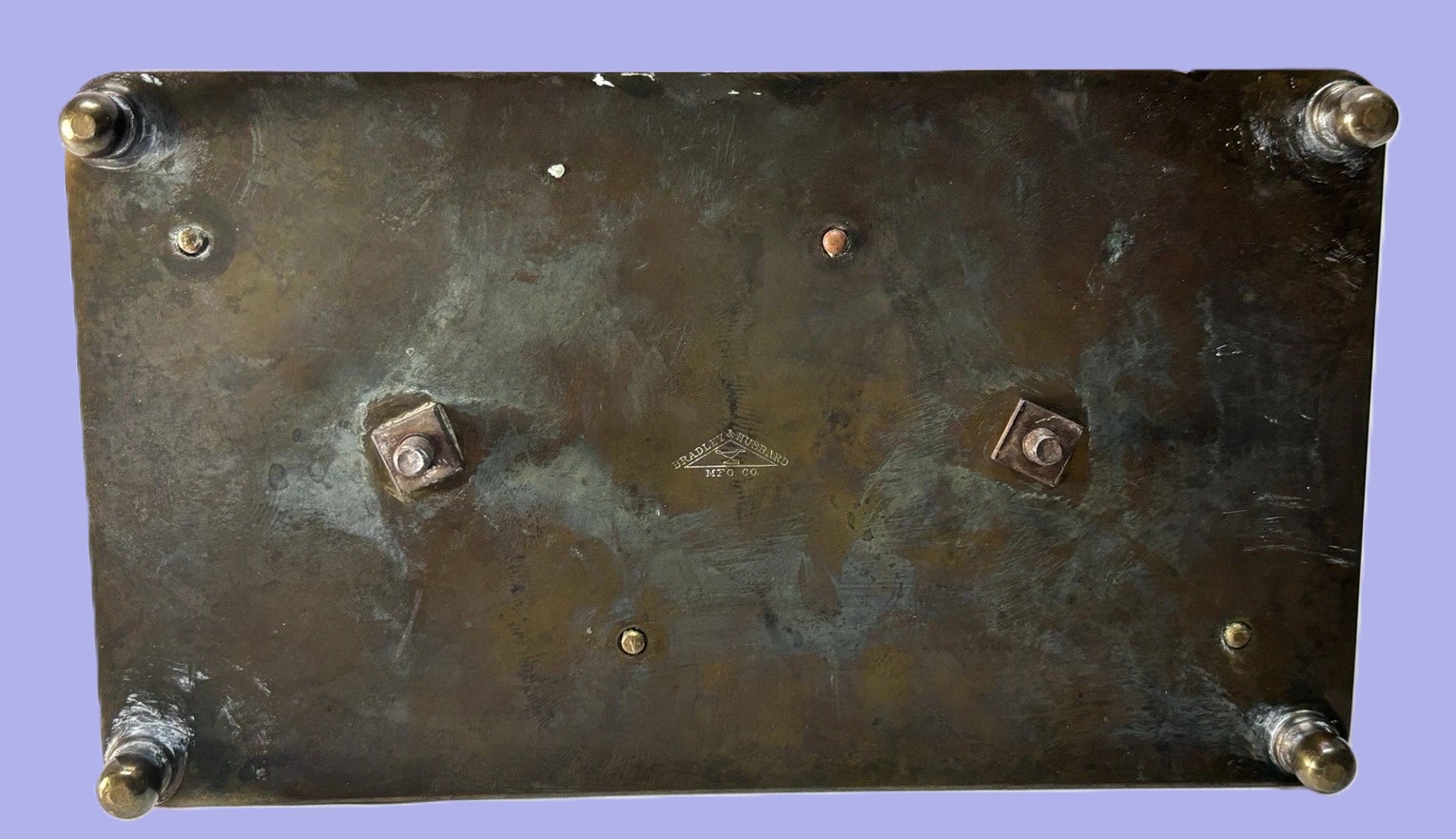
- Construction: The underside reveals the industrial nature of Bradley & Hubbard’s work, showing the heavy-duty bolts and nuts used to secure the inkwell housings to the base.
Maker’s Mark & Provenance
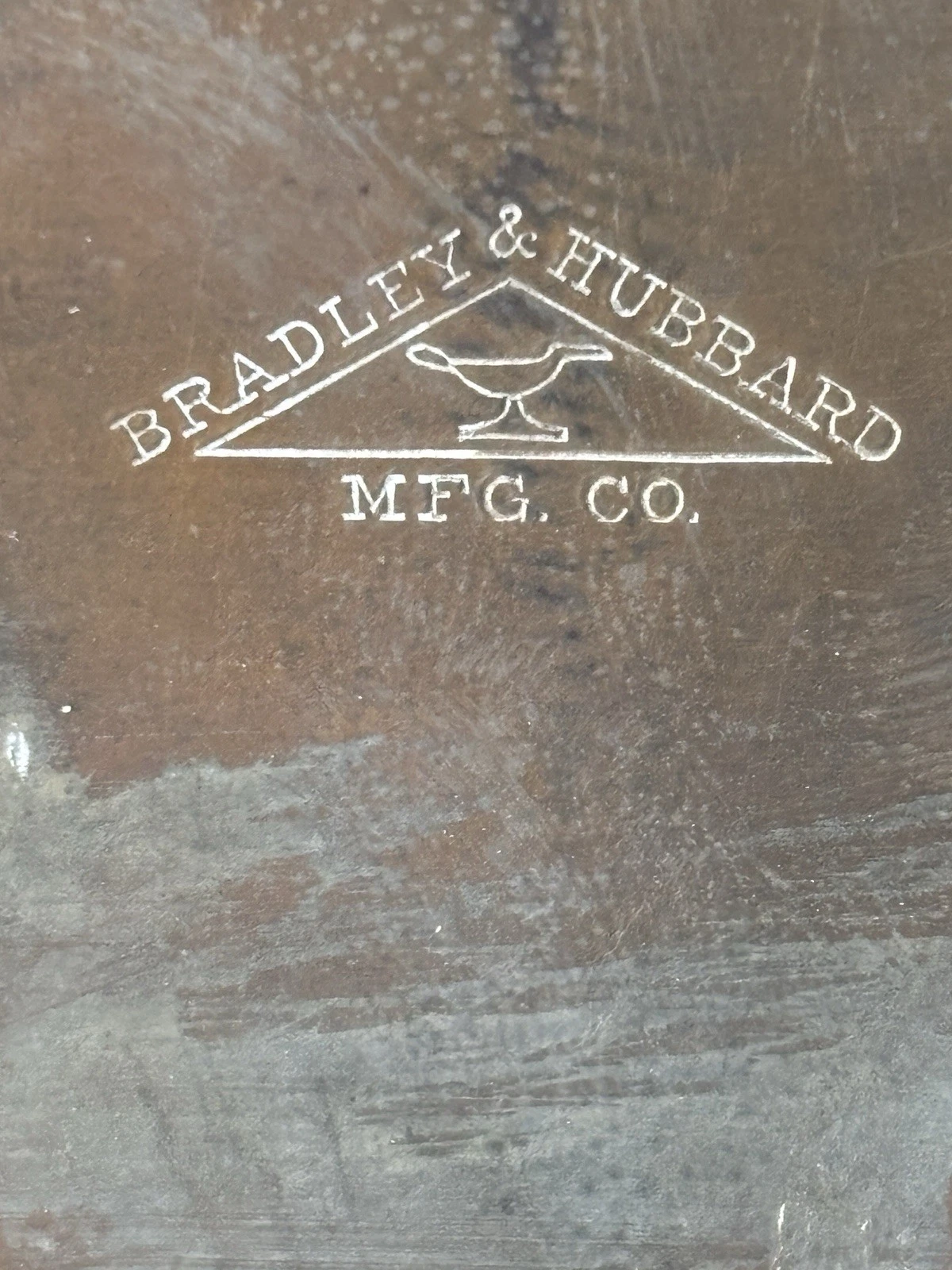
The bottom of the tray bears the iconic Bradley & Hubbard Mfg. Co. hallmark: a triangle containing a stylized oil lamp (the “lamp of knowledge”), surrounded by the company name.
- Company History: Based in Meriden, Connecticut, Bradley & Hubbard was one of the most famous American manufacturers of high-quality brass and bronze goods. While they are renowned for their lamps, their desk sets and architectural brass were staple items in professional offices across the United States.
Dating the Inkstand
Based on the hallmark and the specific industrial-transitional style of this piece, this inkstand was most likely produced between 1900 and 1905.
- The Mark: The triangle with the “lamp of knowledge” and “MFG. CO.” was the company’s most prolific mark, used after their reorganization in 1875 through their sale in 1940. However, the crisp, stamped (rather than cast-in) nature of the mark on the flat brass base is very characteristic of their production methods at the turn of the century.
- The Style: This piece sits in a “sweet spot” of design history.
- Pre-1900: B&H pieces were typically much more ornate, featuring Rococo scrolls, heavy figural castings, or Victorian “Eastlake” geometric patterns.
- Post-1905: The company began leaning heavily into the “Murano” line (filigree over glass) and more distinct Art Deco styles with “stepped” bases and thinner metalwork.
- 1900–1905: This inkstand reflects the Mission / Arts & Crafts movement’s influence—where “honesty of material” became popular. The use of heavy, plain brass cubes and simple ball feet represents this transition toward a cleaner, more modern look.
- The Hardware: The use of square-head nuts and threaded bolts to secure the wells is a hallmark of B&H’s early 20th-century assembly. Before 1890, you often see more hand-peened rivets or integrated castings; by the 1910s, assembly often became more streamlined and lighter.
Catalog Context
In B&H catalogs from the early 1900s, this was often referred to as a “Double Desk Set” or “Library Inkstand.” These were professional-grade items; while many homeowners bought single decorative wells, these double-well stands were designed for a busy desk—one well for black ink and one for red (or blue) ink.
Double sold for $33 in January 2026; Single sold for $73 in January 2026
Content disclaimer. The information posted is the owner’s best knowledge and may not have been vetted by the SOIC. We welcome comments, corrections, and additions, working to make our website information comprehensive and accurate.
Join the Society of Inkwell Collectors (SOIC) – it’s free!
Founded in 1981 as a non-profit organization,
we are documenting inkwells (and accessories).
We’re here to help and inform!