





Bohemian Iridescent Glass Inkwell
| Categories | Bohemian Art Glass |
| Material | Glass |
| Markings | Unmarked |
| Manufacturer | Undetermined |
| Origin | Bohemia |
| Date or Era | circa 1905 |
| Measuring | 5” diameter; 2” high |
Overview & Attribution
- Era / Date: Circa 1900–1910
- Style: Art Nouveau (Jugendstil)
- Origin: Bohemia (Austria-Hungary / Czech region)
- Attribution: Strongly attributed to Wilhelm Kralik Söhne or Carl Stölzle’s Söhne. Molded, heavy-ribbed iridescent shapes like this were typical of Bohemian glassworks competing with Loetz by utilizing highly structured, production-friendly press-molded techniques.
- Markings: Unmarked/unsigned. (A lack of signatures is standard for the vast majority of Bohemian glass production from this era, which was often only marked with temporary paper labels or export stamps).
Description
Glass Body
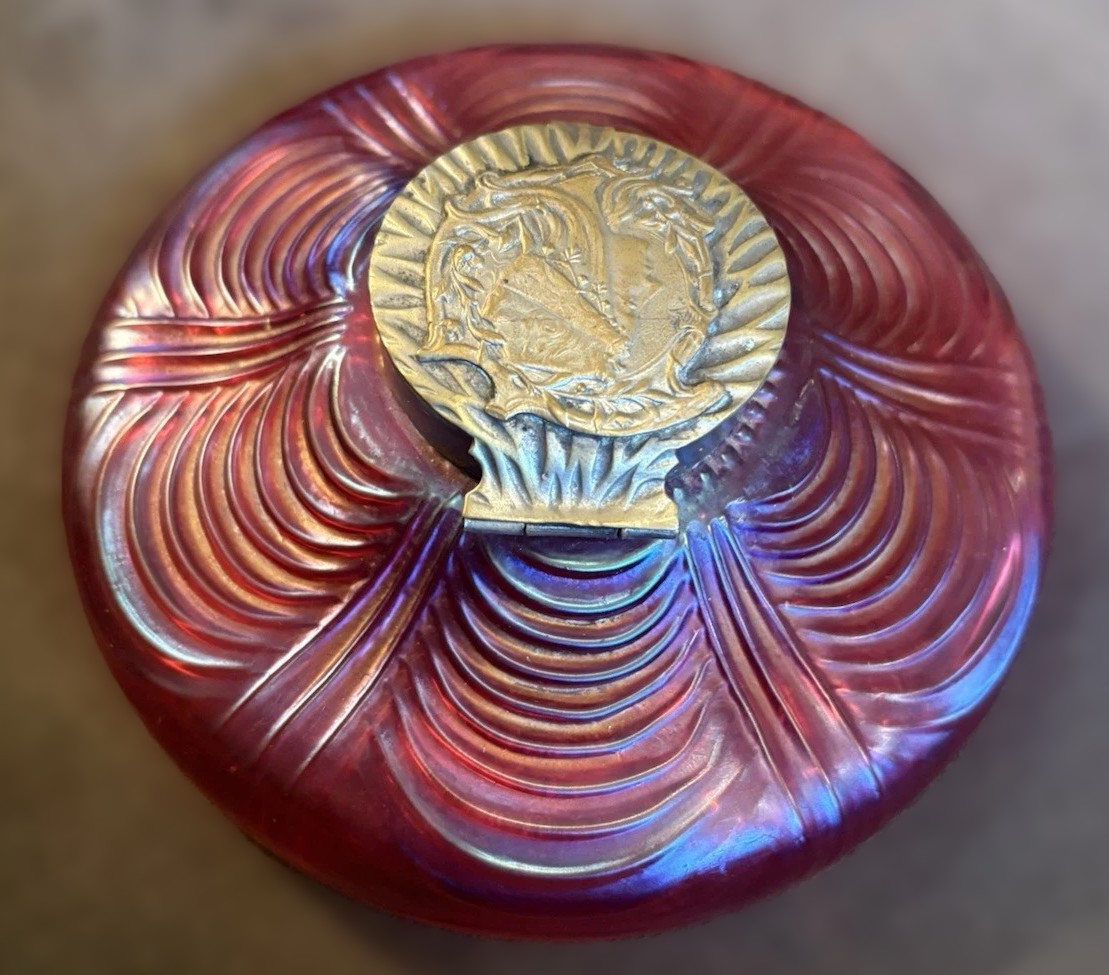
- Color & Finish: The glass boasts a striking, rich reddish-pink base with a brilliant iridescent “lustre” or “fumed” finish. This surface layer catches the light with shimmering violet, blue, and soft golden highlights.
- Form & Pattern: The body features a distinctive, low-profile, squat circular shape with a broad, flat bottom. The top surface consists of dramatic, deeply molded concentric wavy lines or scallops radiating symmetrically outward into four stylized, sweeping folds or “buttresses.”
Metal Collar & Lid
- Material: Cast brass or bronze.
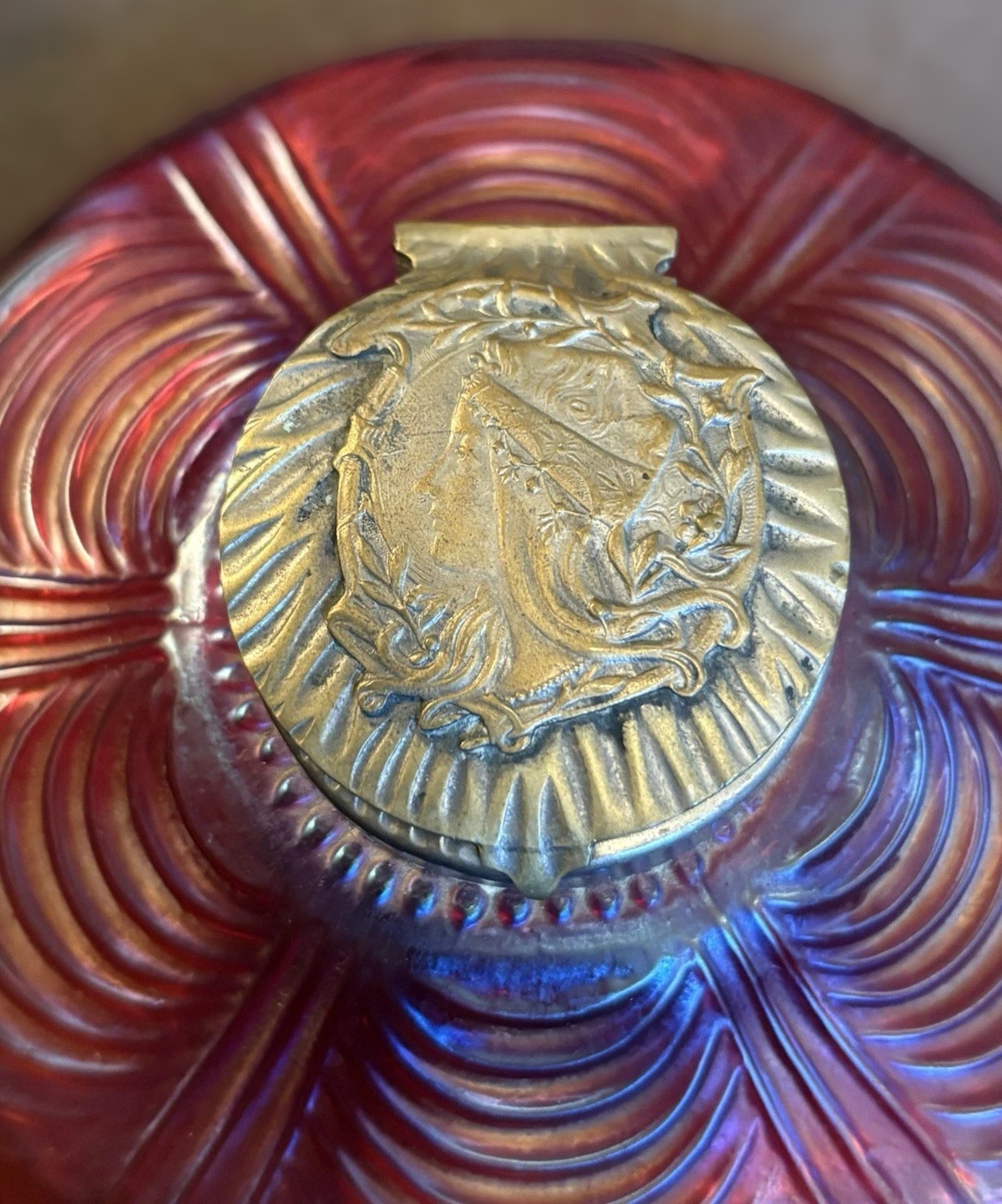
- Hinged Lid Design: The top of the lid features an exquisite, high-relief Art Nouveau repoussé design depicting the profile of a classic Jugendstil maiden with long, flowing tresses intertwined with organic leaf scrolls and vines. The outer border is framed by sharp, radiating sunburst or shell-like ribbing.
- Underside & Collar: When open, the underside of the lid reveals a textured, feather-like or stylized organic texture. The lid is attached via a sturdy integrated hinge to a smooth, circular collar rim.
Dimensions
- Height: Approximately 2 inches
- Base Diameter: Slightly over 5 inches
The lid provides a clue regarding the inkwell’s origin, though it points more toward the nature of the manufacturing partnership rather than isolating a single glasshouse.
In turn-of-the-century Bohemian production, the relationship between the glassworks and the metalwork was segmented:
- The Separation of Glass and Metal Production
Bohemian glasshouses like Kralik, Loetz, and Stölzle rarely cast their own metal fittings. Instead, they functioned as glass suppliers. Heavy molded bodies or blown glass inserts were sent to independent metal mountings manufacturers—often located in specialized metalworking hubs across Germany, Austria, and France.
- These foundries bought glass bodies in bulk from various competing regional factories.
- Because the foundries used identical standard-sized brass and bronze collars, the exact same Art Nouveau maiden lid can often be found mounted on glass produced by different competitors.
- Stylistic Identity: The Jugendstil Maiden
The high-relief repoussé image of a woman with long, organic, whipping tresses is the classic signature of Central European Jugendstil design (the German/Austrian variant of Art Nouveau).
- The distinct radiating sunburst/shell framing on the exterior edge and the matching stylized texture on the lid’s underside indicate a mass-produced, high-quality die-stamped cap characteristic of German or Austrian metalware providers from 1900–1905.
- Missing Legal Stamps
While it doesn’t narrow down the maker by name, the lack of markings on the underside of this specific lid is a clue in itself. Many premium Austrian and German metal foundries stamped their hinges with shorter-term design patents or copyright marks like D.R.G.M. (Deutsches Reichs-Gebrauchsmuster) or O.E.P. (Österreichisches Patent). The absence of these marks suggests either a smaller, un-patented regional foundry or an assembly line specifically desigmed for export markets where domestic patent markings weren’t legally required.
Summary
The lid confirms a Central European/Austrian trade origin circa 1901–1905. However, because these metal findings were distributed interchangeably to various glasshouses, the ultimate identification still relies heavily on the glass itself—where the deeply molded, non-ground base contours favor a structured, production-friendly Kralik or Stölzle molded mold over the organic hand-worked finishes of Loetz.
Sold for $152 in May 2026
Content disclaimer. The information posted is the owner’s best knowledge and may not have been vetted by the SOIC. We welcome comments, corrections, and additions, working to make our website information comprehensive and accurate.
Join the Society of Inkwell Collectors (SOIC) – it’s free!
Founded in 1981 as a non-profit organization,
we are documenting inkwells (and accessories).
We’re here to help and inform!