


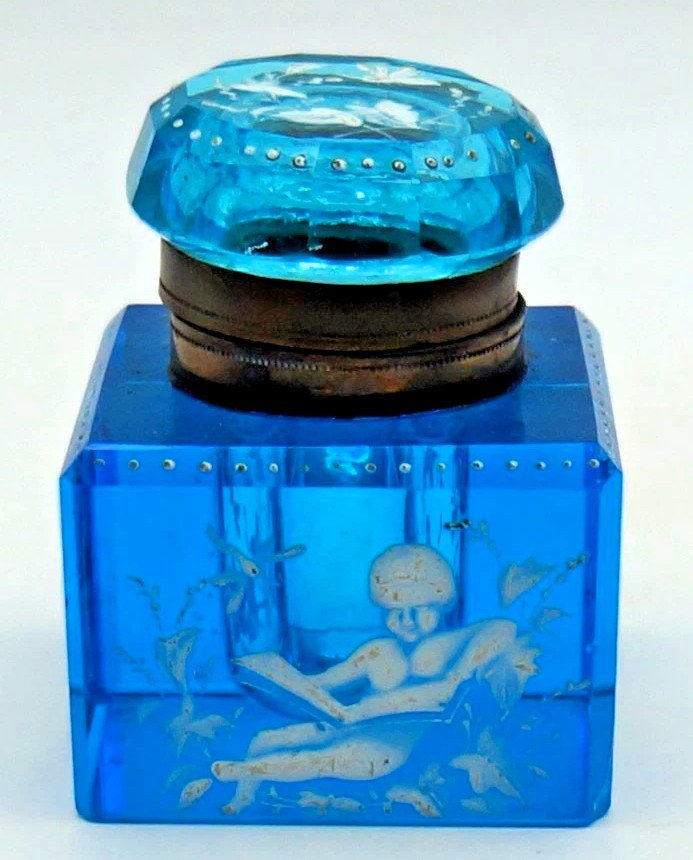
Blue Glass Inkwell with White Enameled Design
| Categories | Glass - Non-figural |
| Material | Glass |
| Markings | Unmarked |
| Manufacturer | Undetermined |
| Origin | Bohemia |
| Date or Era | circa 1900 |
| Measuring | 2 ¼” x 2 ¼” x 2 ¾” high |
This cobalt blue glass inkwell is a high-quality example of Mary Gregory-style glassware, characterized by its distinct white enameled “boy reading” motif.
Physical Description & Design
- The Subject: The front of the square well features a detailed white enamel scene of a young boy lounging while reading a book, surrounded by delicate foliage. The top of the hinged lid is decorated with white floral sprigs.
- Construction: The body is a thick, square-cut block of deep blue glass with beveled edges and a line of decorative white enamel “dots” bordering the top rim. It features a heavy, faceted circular lid attached by a dark metal hinge.
Origin and Age
- Where it was made: This style of glass is most commonly associated with Bohemia (modern-day Czech Republic). While named after an American decorator, the vast majority of this “Mary Gregory” white enamel glass was produced by Bohemian factories such as Moser or Hahn for export.
- Estimated Date: Circa 1885–1910. This type of whimsical, domestic-themed glassware was at its height of popularity during the late Victorian and Edwardian eras.
How Blue Glass is Made
The vibrant, deep blue color of this piece is achieved through a specific chemical process in the glass furnace:
- The Coloring Agent: The most common way to create this specific “Cobalt Blue” is by adding cobalt oxide to the molten glass batch.
- Potency: Cobalt is an incredibly powerful coloring agent; even a tiny amount—as little as 0.01% to 0.1% of the total mixture—is enough to produce this intense, saturated blue.
- The “Mary Gregory” Enamel: The white design is not etched or painted with standard paint; it is made of powdered white glass mixed with an oil medium. After being painted onto the cold blue glass, the piece was fired again at a lower temperature to fuse the white glass powder to the surface, creating that slightly raised, durable finish.
Sold for $51 in December 2025
Content disclaimer. The information posted is the owner’s best knowledge and may not have been vetted by the SOIC. We welcome comments, corrections, and additions, working to make our website information comprehensive and accurate.
Join the Society of Inkwell Collectors (SOIC) – it’s free!
Founded in 1981 as a non-profit organization,
we are documenting inkwells (and accessories).
We’re here to help and inform!