

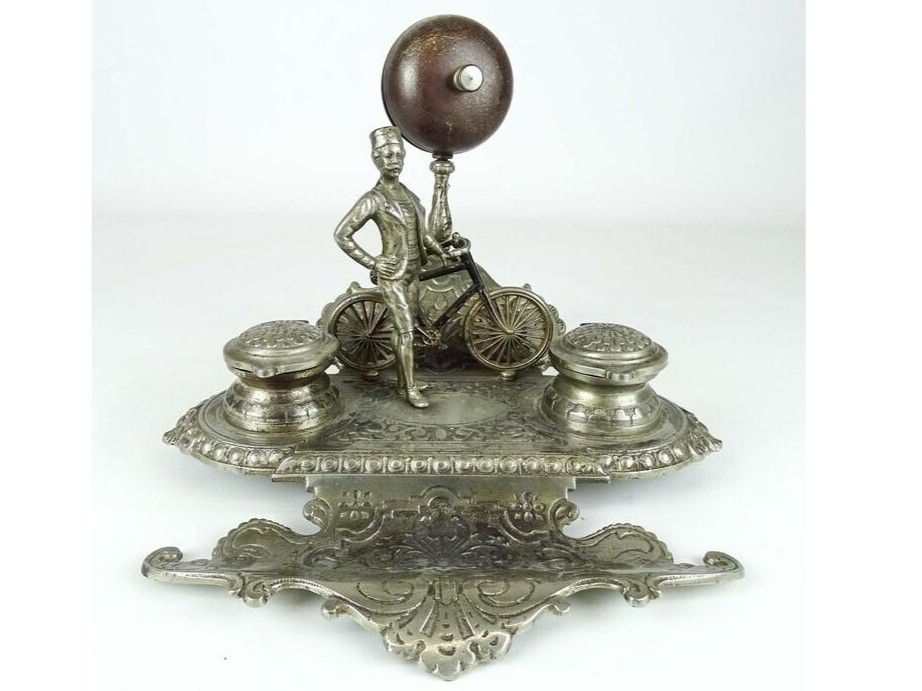


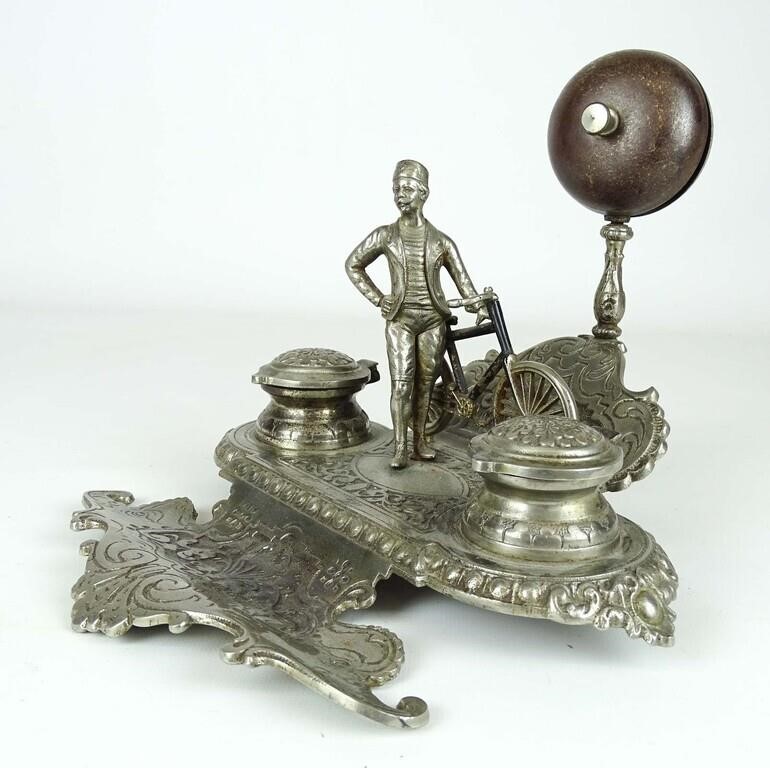

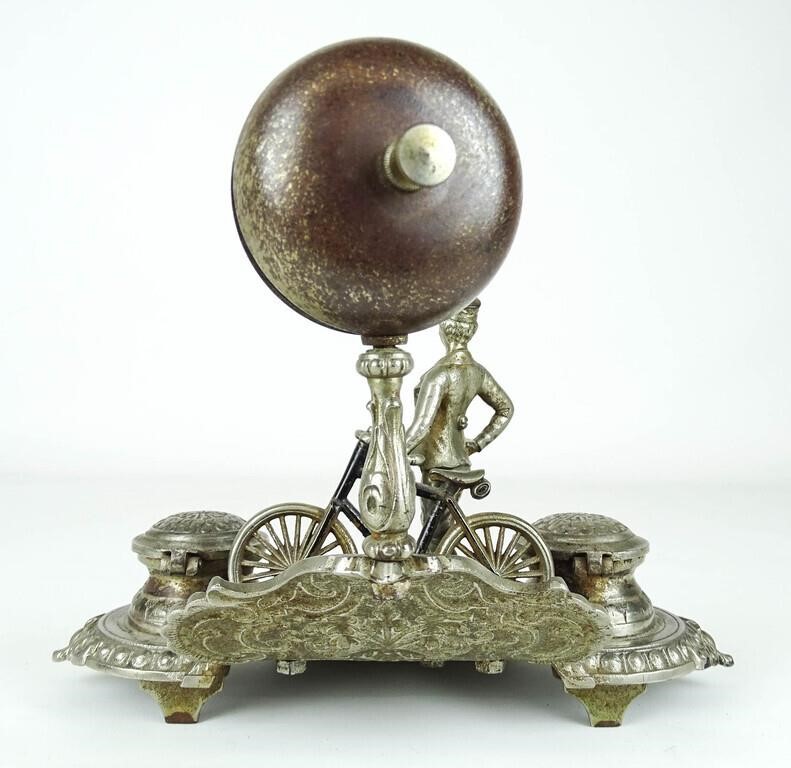
Bicyclist Inkstand with Bell
| Categories | Sports |
| Type | Bicycle |
| Material | White metal |
| Markings | Unmarked |
| Manufacturer | Undetermined |
| Origin | Undetermined |
| Date or Era | circa 1900 |
| Measuring | 9 ½” x 9” x 7 ½” high |
This inkstand dates from the height of the “Bicycle Craze” in the late 1890s.
Description
The piece is crafted from cast spelter (a zinc alloy) with a plated finish—likely nickel or silver—which was a common medium for highly detailed novelty inkwells of the era.
- The Figure: A gentleman cyclist is depicted in classic late-Victorian “cycling dress.” He wears a striped jersey (visible beneath his jacket), a short lounge jacket, and knickers (breeches) tucked into long socks. His headgear appears to be a pillbox-style cycling cap, popular with athletic clubs of the day.
- The Bicycle: This is a “Safety Bicycle,” featuring two wheels of near-equal size and a chain drive. This design revolutionized cycling by making it accessible to the general public, replacing the precarious “Penny Farthing” (high-wheeler) by the late 1880s.
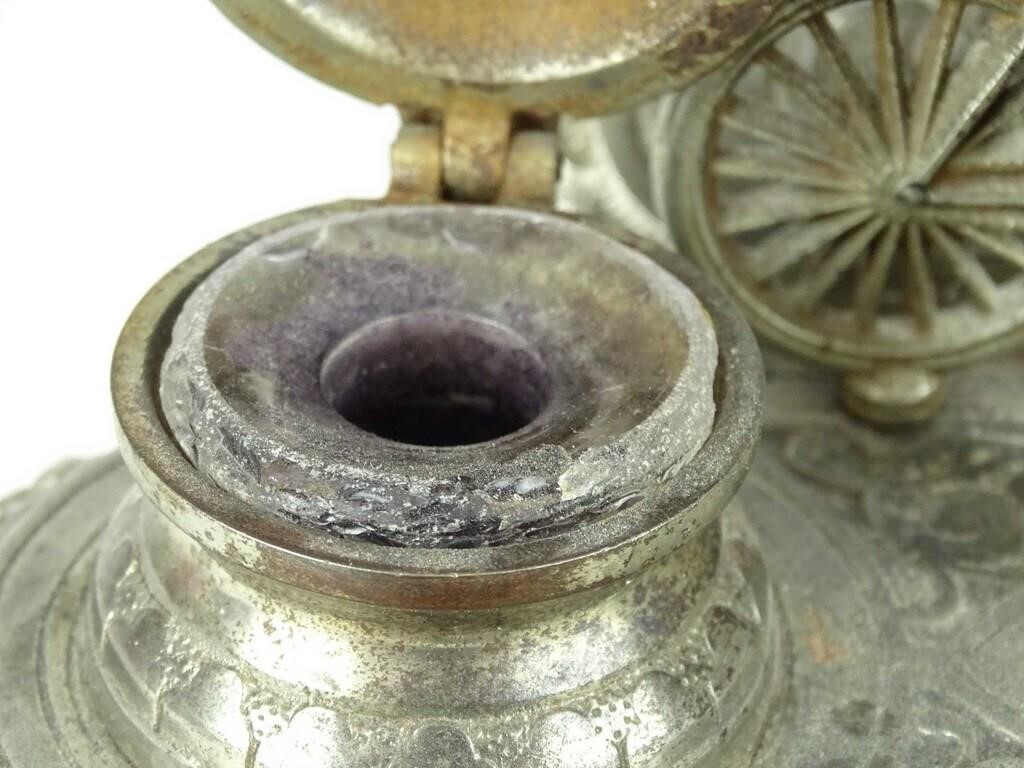
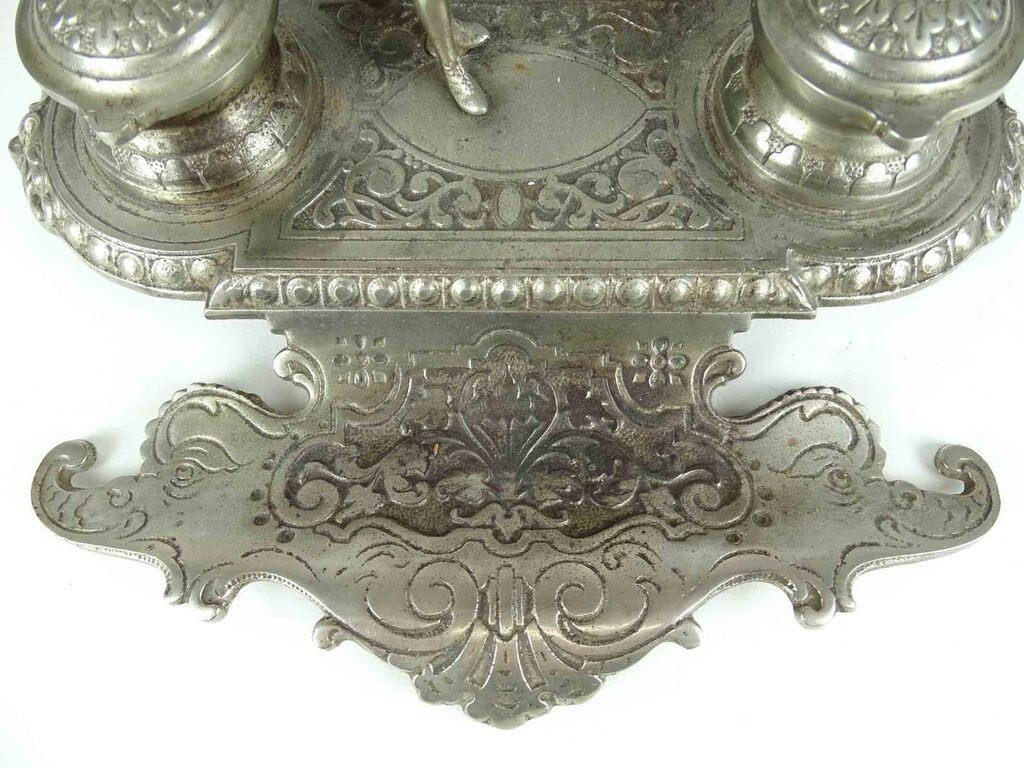
- The Stand: A double inkwell design with two lidded pots flanking the central figure. One pot still retains its original liner. The base is ornately decorated in the Rococo-revival style with foliage and a wide, recessed pen tray in the front.
The Bell:
The large, spherical object behind the cyclist is a desk call bell (sometimes called a service or servant bell).
- Purpose: In a Victorian household or office, this was used to summon a servant, clerk, or assistant. It allowed the writer to call for more paper, tea, or for a finished letter to be taken to the post without leaving their desk.
- Mechanism: It is a mechanical strike bell. You ring it by firmly pressing the knurled button/knob on the very top. Pressing this button triggers an internal spring-loaded hammer or clapper that strikes the bell’s “skirt” from the inside, producing a clear, sharp chime.
Age, Maker, and Origin
- Age: Circa 1890–1905. The popularity of the safety bicycle peaked in the mid-1890s, and by the end of the Edwardian era, desk sets with integrated bells were beginning to fall out of fashion.
- Maker: While often unmarked, pieces of this specific design and quality are frequently attributed to French founders or British brass and metal firms (such as those in Birmingham).
- Origin: Likely England or France. The man’s attire and the decorative scrollwork of the base are very consistent with European manufacturing for the export market.
Sold for $684 in October 2023
Content disclaimer. The information posted is the owner’s best knowledge and may not have been vetted by the SOIC. We welcome comments, corrections, and additions, working to make our website information comprehensive and accurate.
Join the Society of Inkwell Collectors (SOIC) – it’s free!
Founded in 1981 as a non-profit organization,
we are documenting inkwells (and accessories).
We’re here to help and inform!