

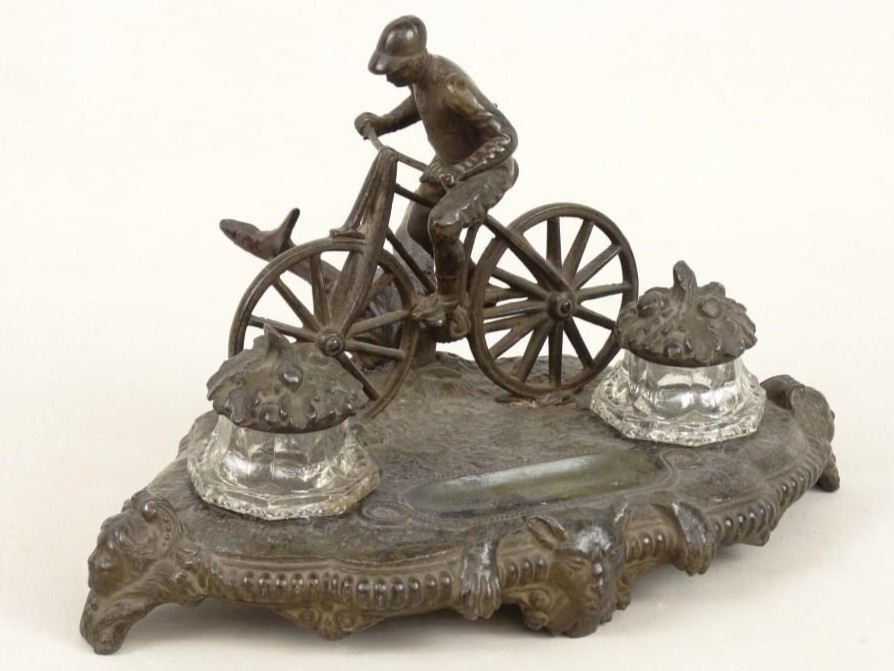
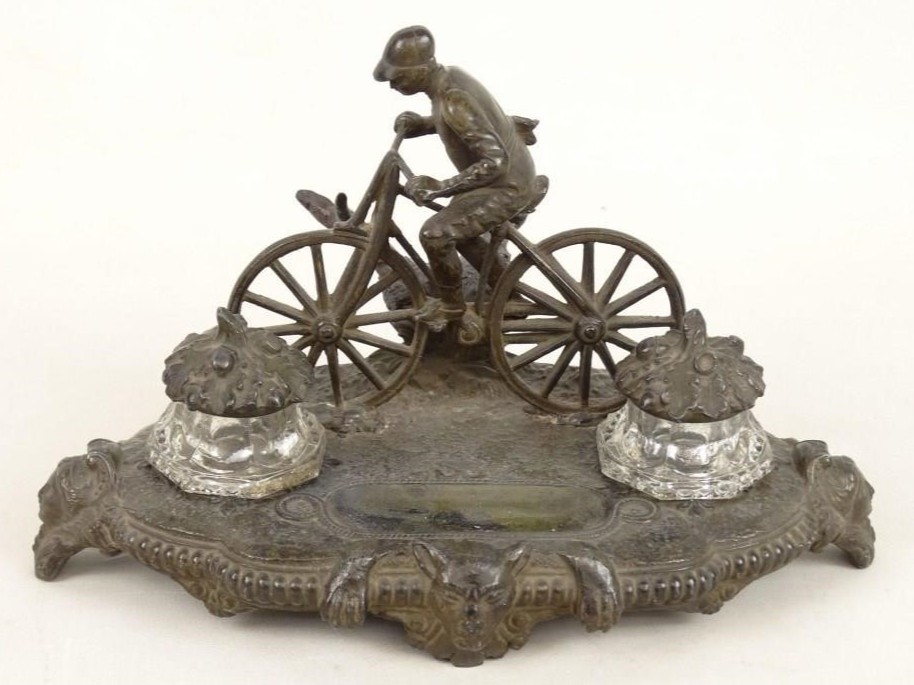
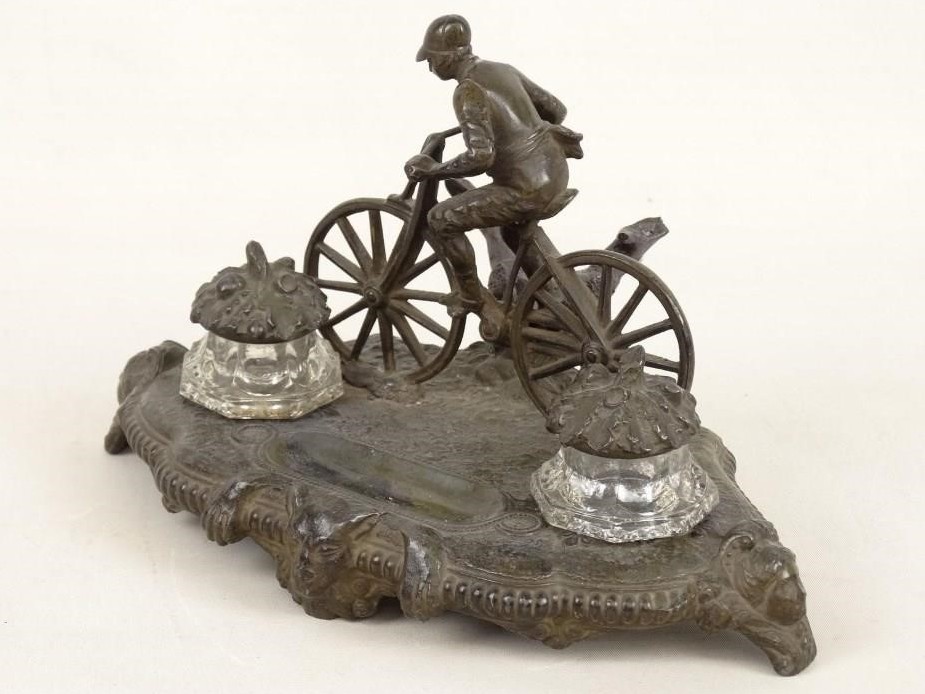
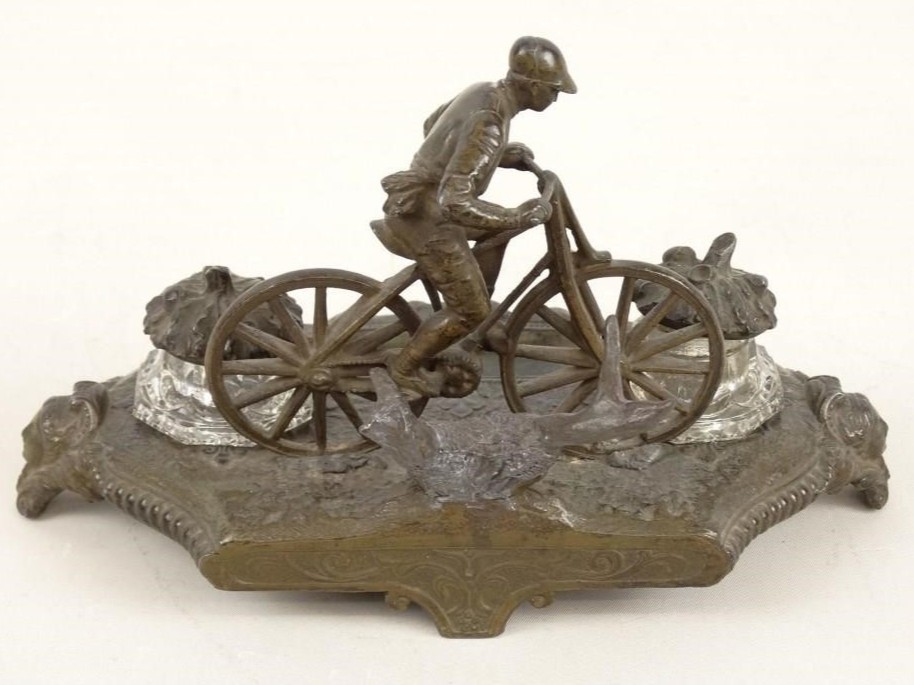
Bicycle Double Inkstand
| Categories | Sports |
| Type | Bicycle |
| Material | White metal |
| Markings | Unmarked |
| Manufacturer | Undetermined |
| Origin | Undetermined |
| Date or Era | circa 1890 |
| Measuring | 9” across |
This “safety bicycle” double inkstand captures the cycling craze that swept through Europe and America in the late 19th century.
Description
- The Cyclist: The central figure is a Victorian-era male cyclist riding a Safety Bicycle – identifiable by its two wheels of equal size and chain-driven rear wheel, which replaced the dangerous “High Wheeler” (Penny-Farthing) in the mid-1880s. The rider is captured in a dynamic, forward-leaning pose, wearing a cycling cap and period-appropriate “knickerbockers.”
- The Pen Holder: In the background is a rustic, gnarled tree stump or branch with a V-shaped notch designed to hold a pen. This “rustic” or “woodland” aesthetic is also reflected in the acorn and oak leaf design of the inkwell lids.
- The Inkwells: Flanking the cyclist are two clear glass inkwells. The metal lids are cast in the shape of acorns or oak leaves.
- The Base: The inkstand sits on a cast metal base with an integrated central pen channel. The edges are decorated with ornate scrollwork and bead-and-reel patterns.
Origin and Age
- Age: This piece likely dates to the 1890s (circa 1890–1900), the peak of the “Bicycle Craze” following the perfection of the safety bicycle design.
- Origin: It was most likely made in Austria (specifically Vienna) or France. Many of these bronzed spelter (zinc alloy) desk accessories were produced by Austrian foundries like Coronet or Bergman, who specialized in whimsical and sporting themes.
Significance of the “Gremlin-Type” Faces
The “gremlin-type” faces on the corners of the base are known in art history as mascarons or grotesques. In this specific context, they carry several layers of meaning:
- The “Cycle Demon”: In the 1890s, cycling was often criticized by traditionalists as “the devil’s work” because of the unprecedented speed it allowed. The inclusion of grotesque, horned faces (resembling Satyrs or Pan) playfully references the “Cycle Demon” or “Bicycle Fiend,” a common trope in early cycling humor and literature.
- Mythological Protection: In classical architecture and decorative arts, putting grotesque faces on corners (similar to gargoyles) was traditionally thought to ward off bad luck or “the evil eye,” essentially guarding the writer’s work and thoughts.
- Victorian Whimsy: During the Gothic Revival and early Art Nouveau periods, grotesque faces were a very popular “whimsical” decorative element, adding character and “old-world” charm to modern mechanical subjects like the bicycle.
Sold for $702 in April 2017
Content disclaimer. The information posted is the owner’s best knowledge and may not have been vetted by the SOIC. We welcome comments, corrections, and additions, working to make our website information comprehensive and accurate.
Join the Society of Inkwell Collectors (SOIC) – it’s free!
Founded in 1981 as a non-profit organization,
we are documenting inkwells (and accessories).
We’re here to help and inform!