

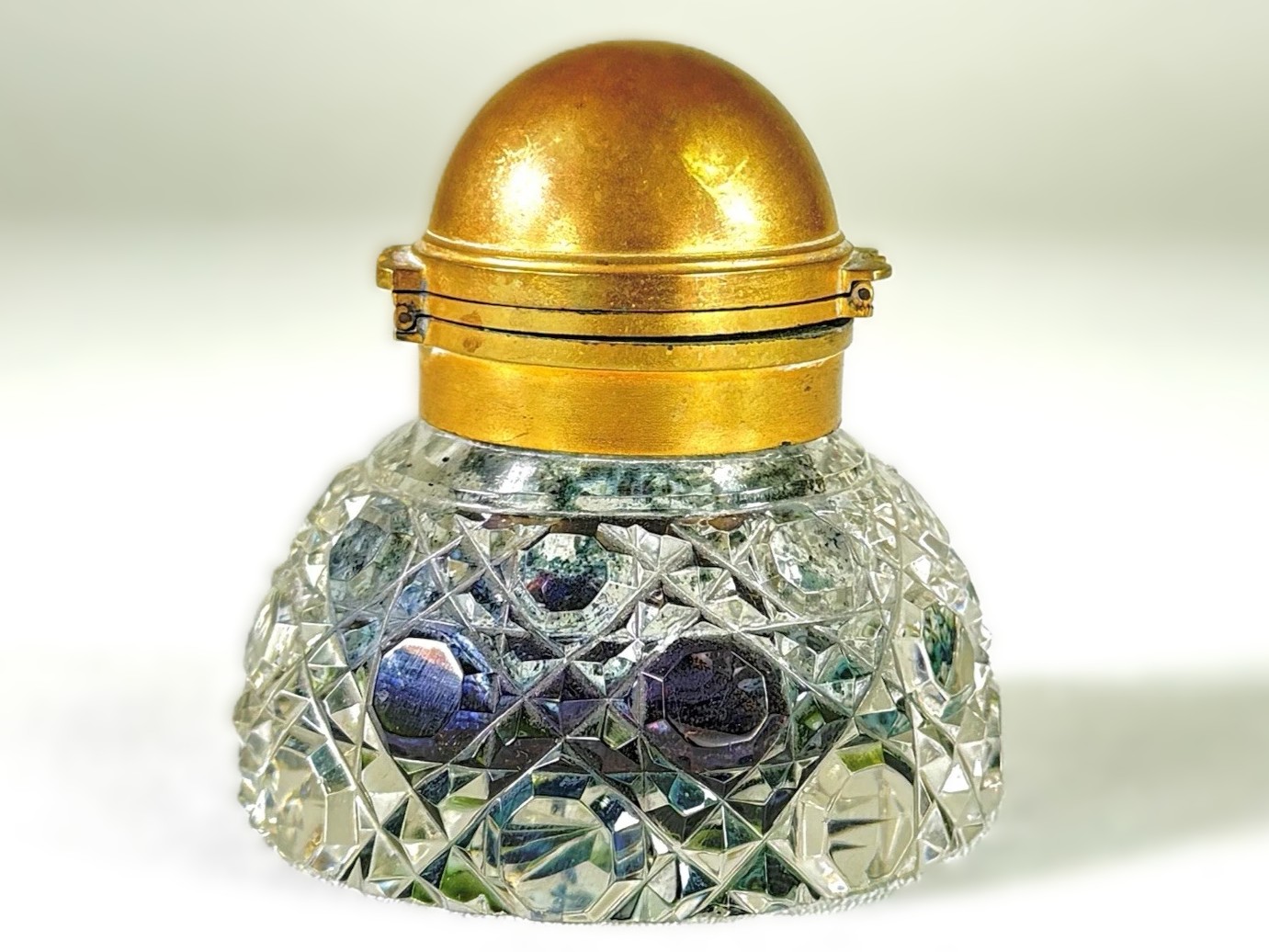
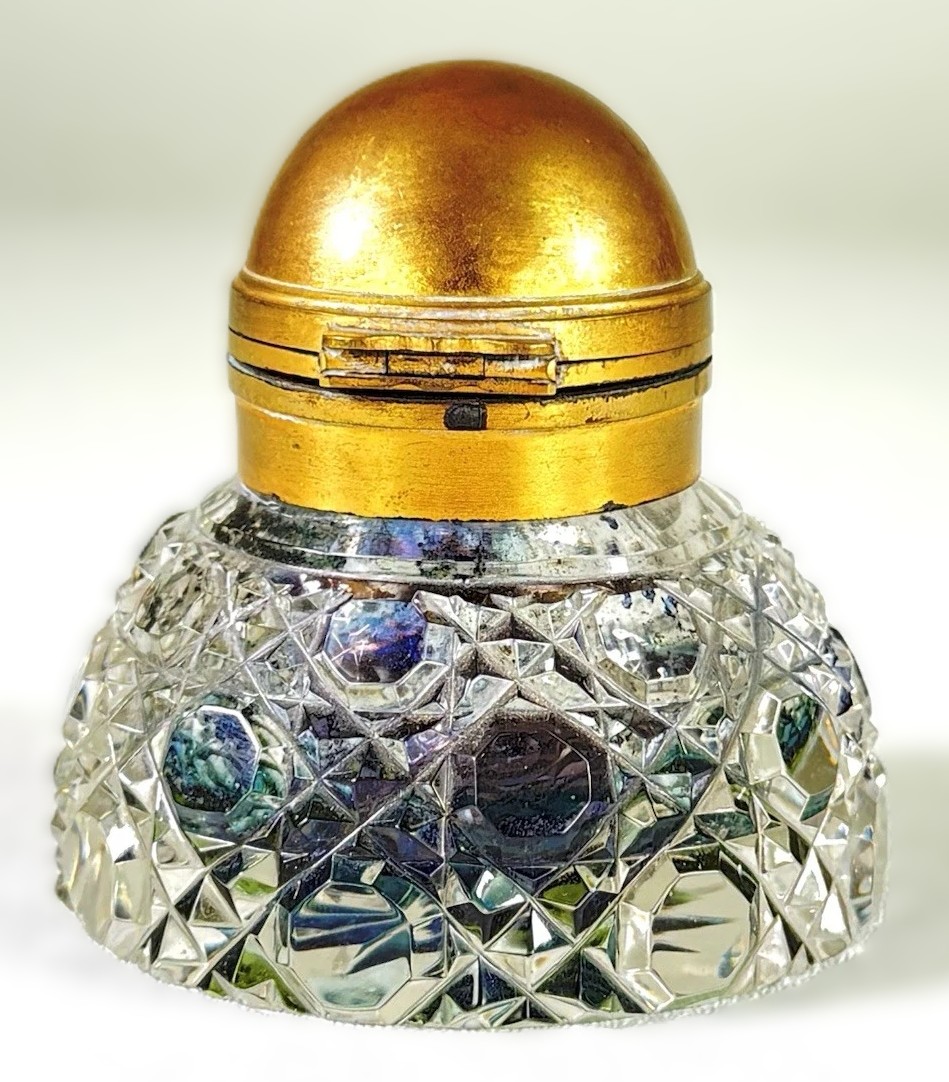
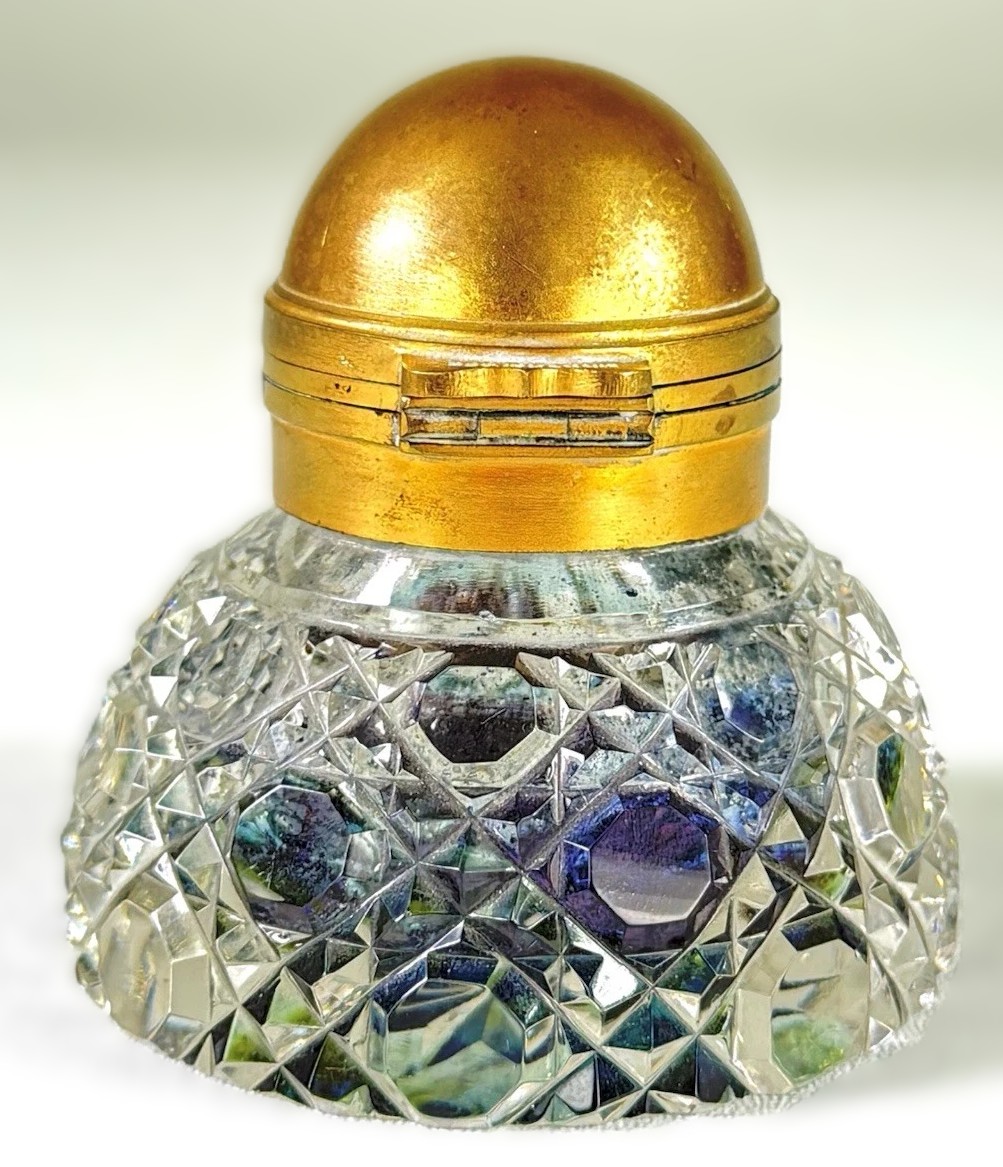
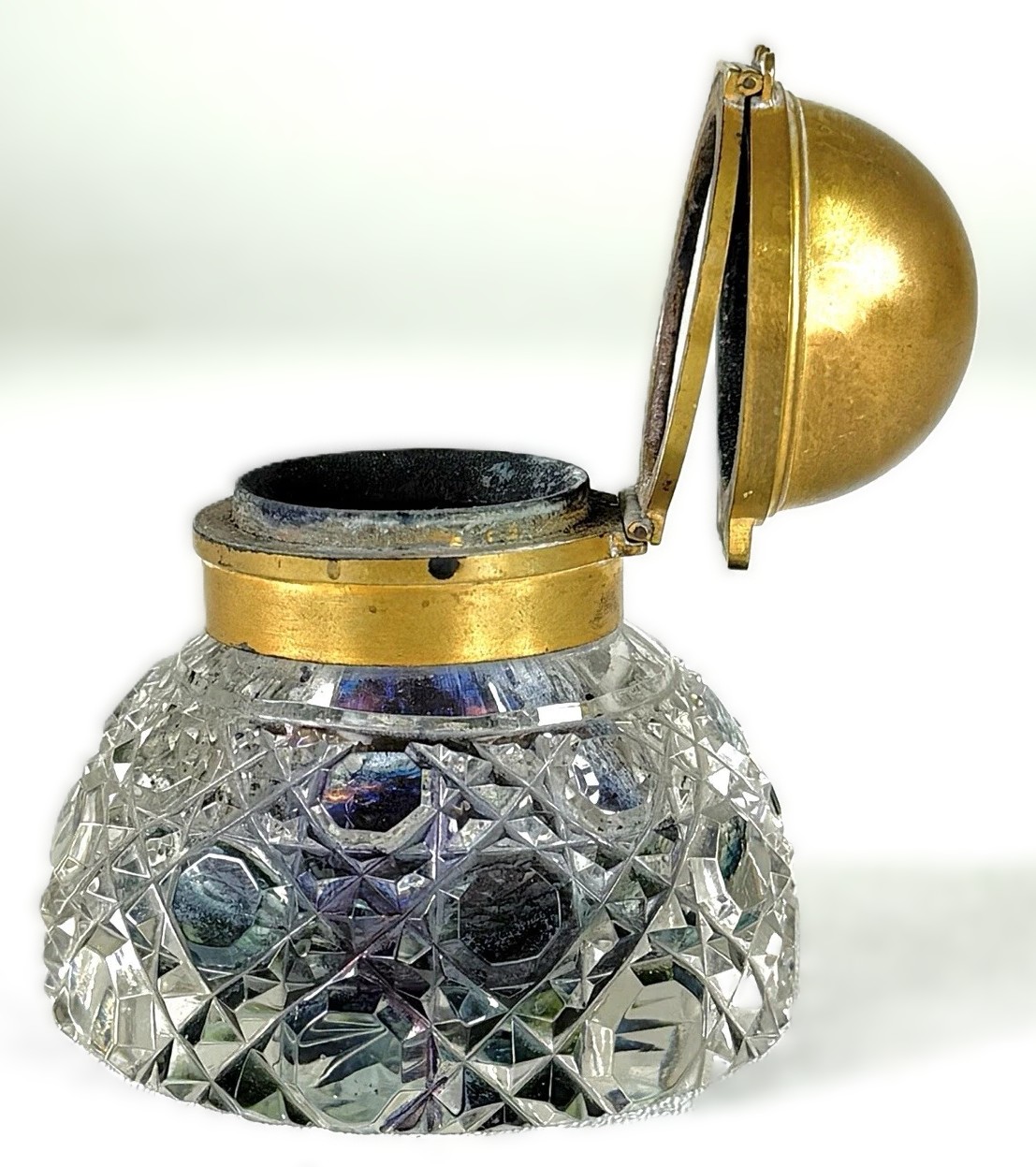
Betjemann & Sons Double-Hinged Inkwell
| Categories | Glass - Non-figural |
| Material | Brass, Glass |
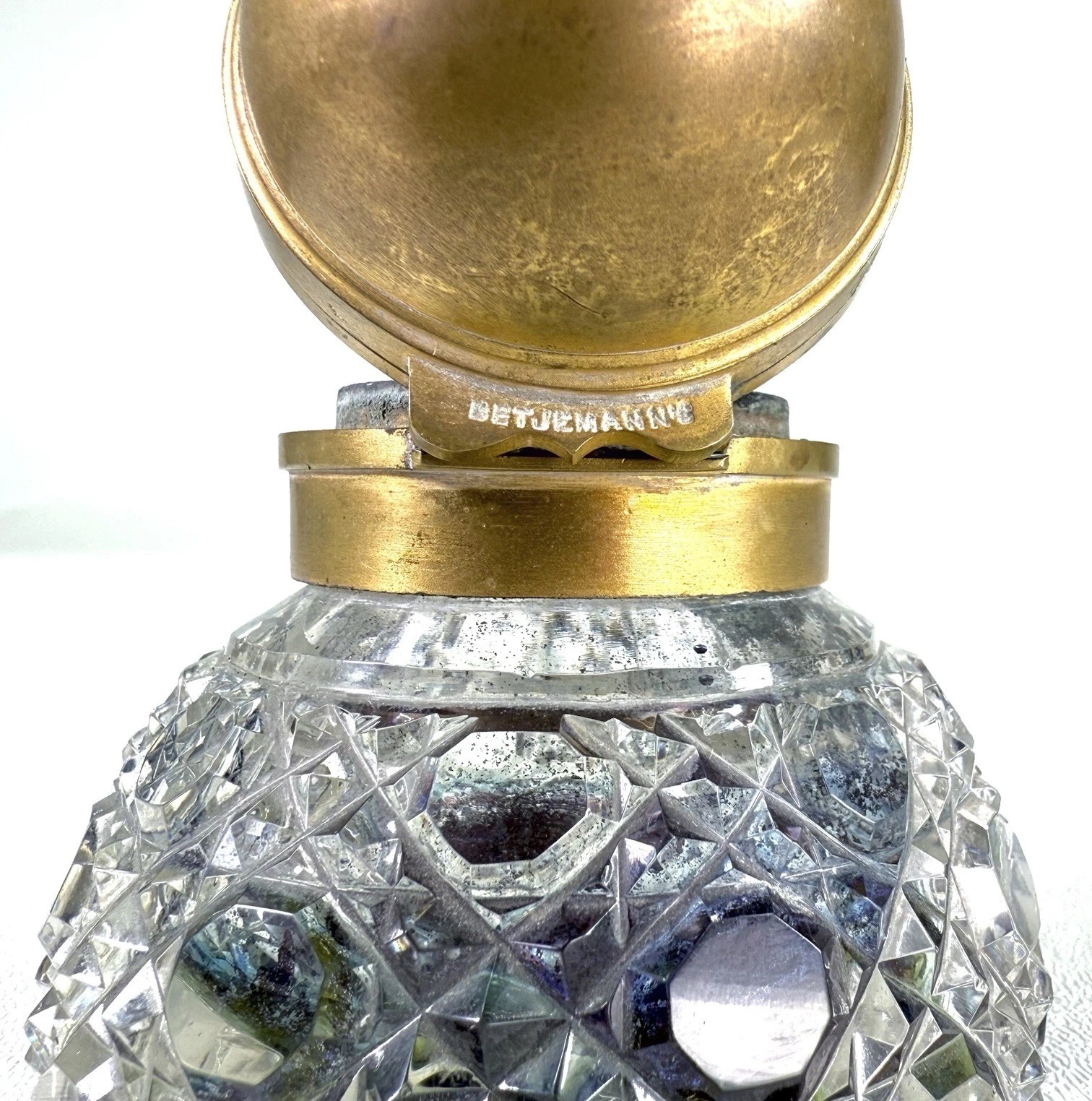
| Markings | Stamped "BETJEMANN'S" on the rear brass mount |
| Manufacturer | Betjemann & Sons |
| Origin | England |
| Date or Era | circa 1890 |
| Measuring | 3” diameter; 3 ¼” high |
| Patent | English patent 11049 (Circa 1889) |
The Manufacturer: George Betjemann & Sons
The mark on the collar identifies this piece as being from George Betjemann & Sons.
George Betjemann (great-grandfather of the famous poet Sir John Betjeman) was an apprentice to his father-in-law, a cabinet maker, before starting his own business in the 1830s. Based in Pentonville Road, London, the firm became world-renowned for “luxury dressing cases” and high-end desk furniture.
They were master patent holders. In fact, they are most famous for inventing the Tantalus (the locking liquor stand). This inkwell belongs to the same class of “ingenious” Victorian mechanisms they specialized in.
The Design: The “Partners” Desk Inkwell
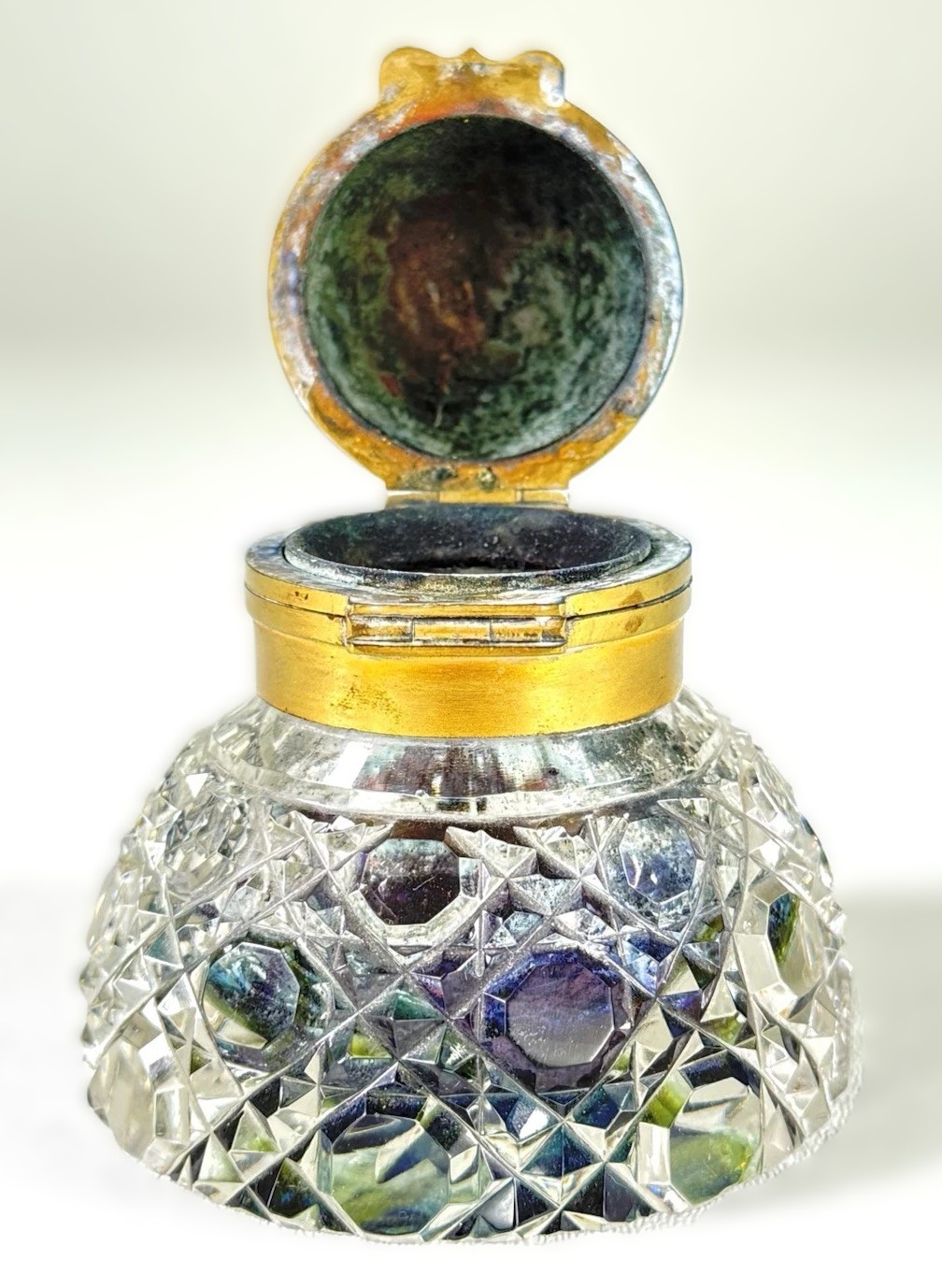
This design is often referred to as a “Double-Hinged” mechanism.
- Shared Access: By allowing the lid to swivel or hinge from both sides, it was perfectly suited for a Partner’s Desk—a large desk where two people sit facing each other. This allowed either person to flip the lid toward themselves without having to move the entire heavy crystal base.
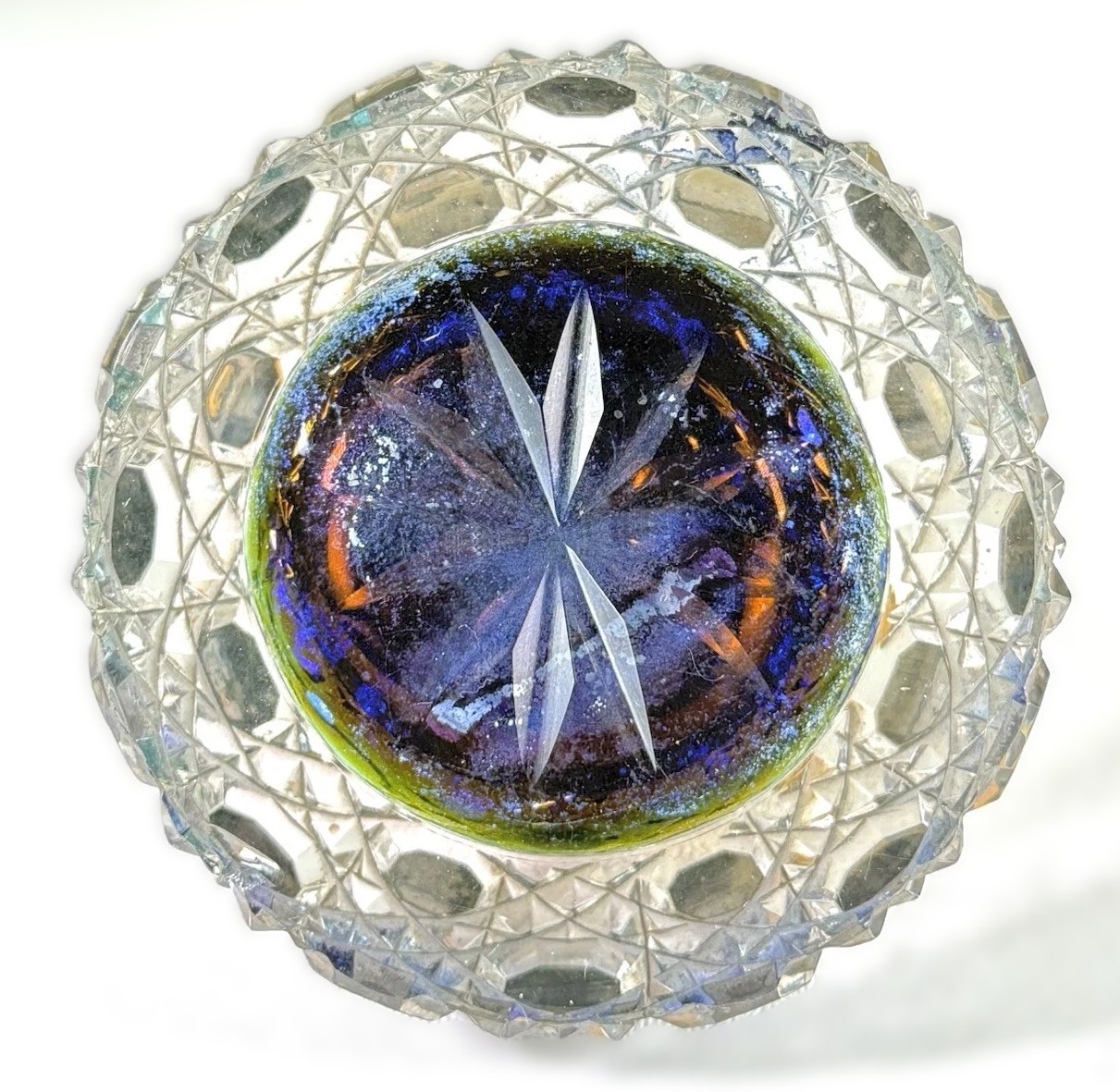
- The Crystal: This is heavy, hand-cut lead crystal. The pattern features deep diamond cuts and large “thumbprints” (the circular facets) around the base. The starburst cut on the bottom is a classic hallmark of quality crystal, designed to catch the light and hide any scratches from desk use.
Materials
- Materials: Body: High-lead cut crystal.
- Mounts: Gilt brass (brass with a thin layer of gold applied, often called ormolu).
The hallmark on this inkwell refers to one of the most prestigious names in Victorian desk furniture. Based on the “double-action” mechanism, the patent associated with this specific partner’s inkwell is:
The Patent: No. 11049
While Victorian patents can be complex to trace to a single day, this specific design was popularized and protected in the late 1880s (specifically circa 1889).
The patent covered the “double-hinged” or “swivel” mechanism. Most inkwells have a single hinge that opens to 90 or 180 degrees. Betjemann’s invention used a sophisticated dual-pivot system so that if two people were working at a large Partners’ Desk, the lid could be flipped toward either person without moving the heavy crystal base.
Who was George Betjemann & Sons?
They were a high-end firm of cabinet makers and “retailers of luxuries” based at 34–42 Pentonville Road, London.
- The Family: Founded by George Betjemann (1798–1886), the firm was later run by his sons. Interestingly, George was the great-grandfather of Sir John Betjeman, the famous UK Poet Laureate.
- The Specialty: They weren’t just glassmakers; they were mechanical innovators. They specialized in “Self-Acting” mechanisms—items that moved, locked, or opened in clever ways.
- The Tantalus: Their most famous invention is the Tantalus, the iconic wooden stand for spirit decanters that locks them in place so “Tantalus” (the thirsty observer) can see the liquor but not drink it. This inkwell carries that same DNA of “ingenious Victorian engineering.”
How old is it?
Given the patent timing and the specific style of the “Hobnail” and “Thumbprint” cut crystal, this inkwell dates to the Late Victorian period, approximately 1885–1895.
The starburst cut on the base and the heavy gauge of the brass indicate a high-quality “London-made” piece. These were expensive items in their day, often sold through luxury retailers like Asprey or Hardy Brothers.
Summary
- Maker: George Betjemann & Sons, London.
- Mechanism: Patented Double-Hinged “Partners” Lid.
- Patent No: 11049 (Circa 1889).
- Material: Hand-cut lead crystal and gilt brass.
Technical Description for your Records
Antique Victorian Cut Crystal Inkwell by George Betjemann & Sons
- Construction: Heavy lead crystal base with deep geometric diamond and facet cuts; star-cut underside.
- Mechanism: Patented double-hinged gilt brass collar and dome lid, allowing bi-directional access.
- Markings: Stamped “BETJEMANN’S” on the rear brass mount.
- Origin: London, England.
- Circa: 1890
Sold for $116 in January 2026
Content disclaimer. The information posted is the owner’s best knowledge and may not have been vetted by the SOIC. We welcome comments, corrections, and additions, working to make our website information comprehensive and accurate.
Join the Society of Inkwell Collectors (SOIC) – it’s free!
Founded in 1981 as a non-profit organization,
we are documenting inkwells (and accessories).
We’re here to help and inform!