

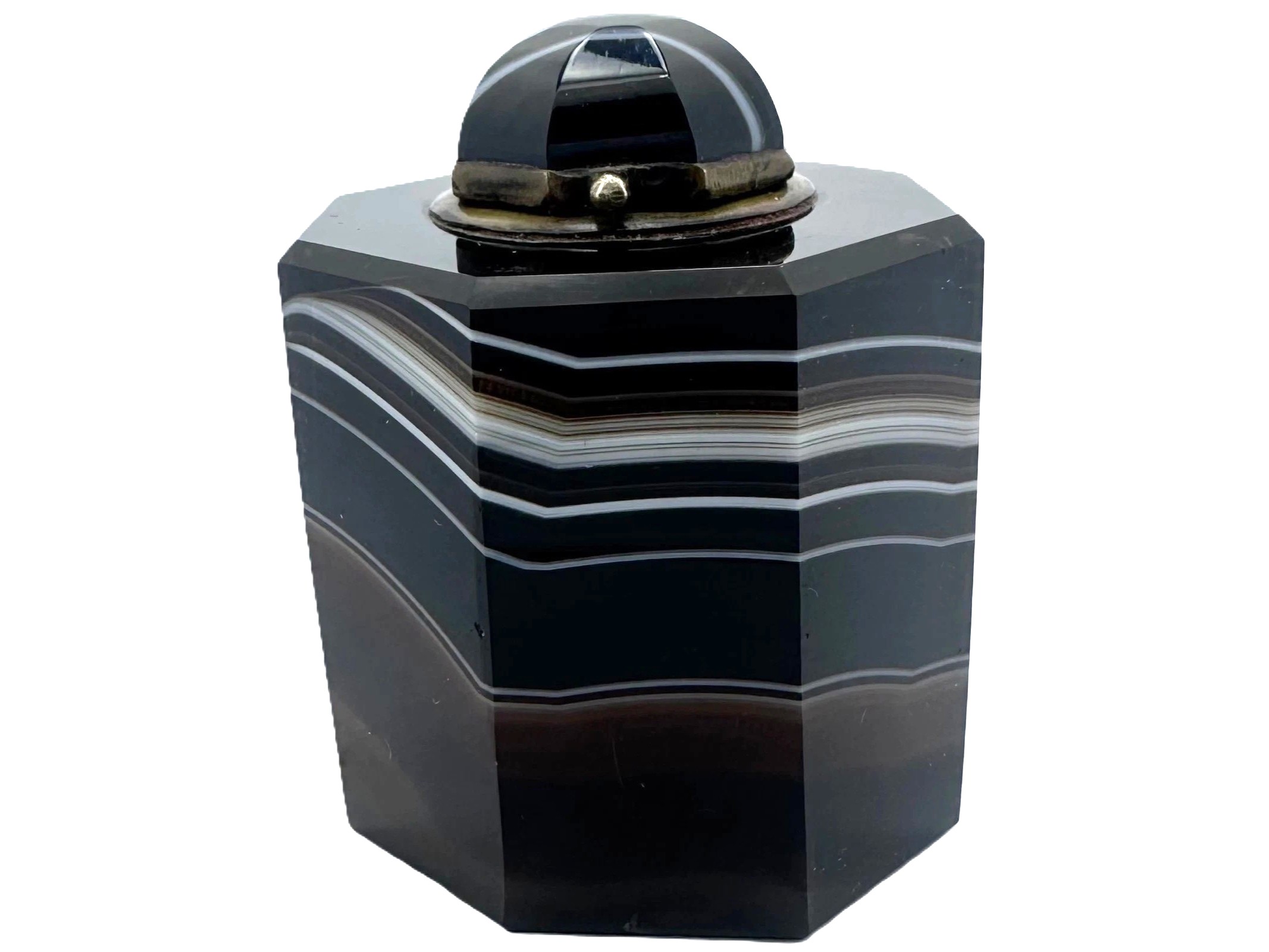
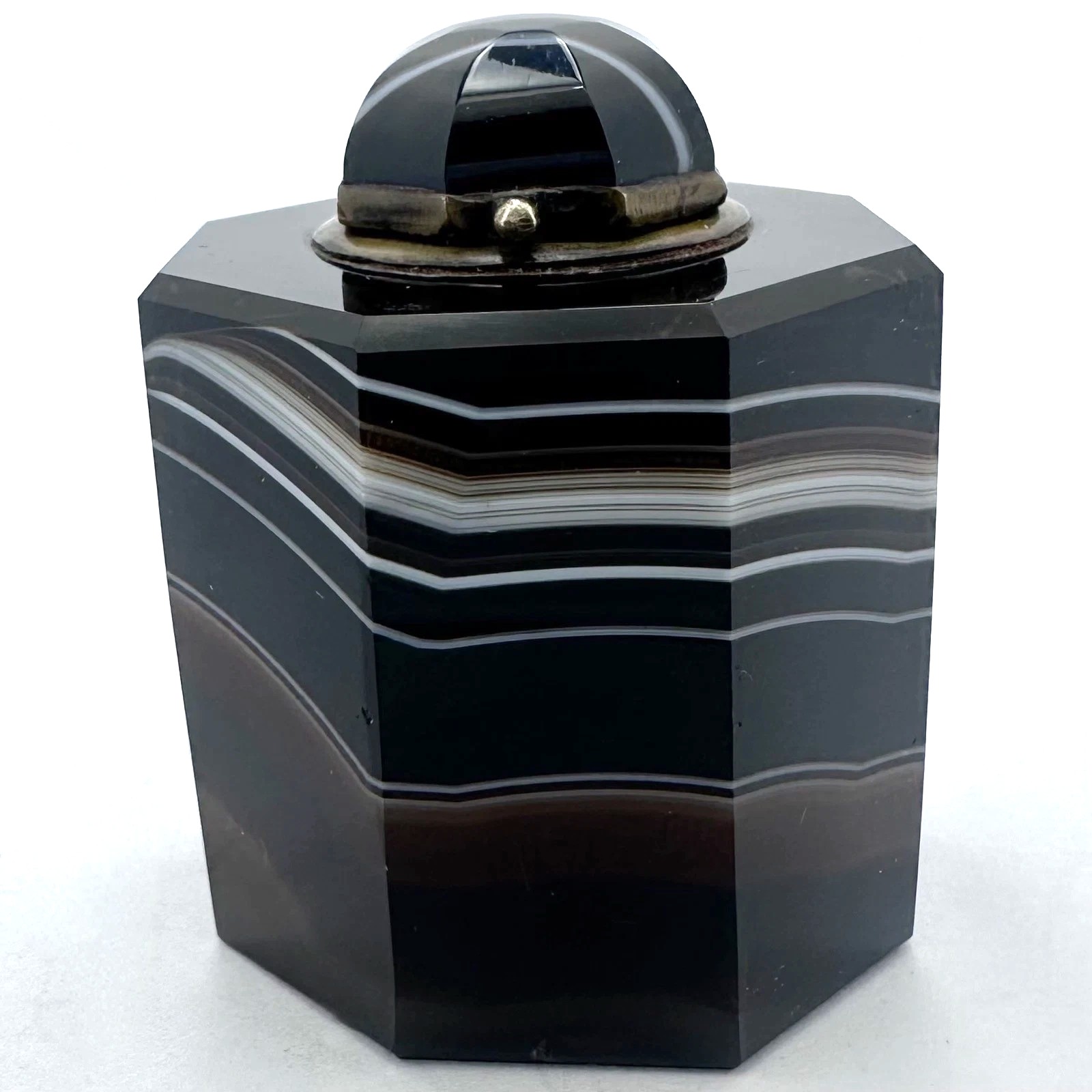
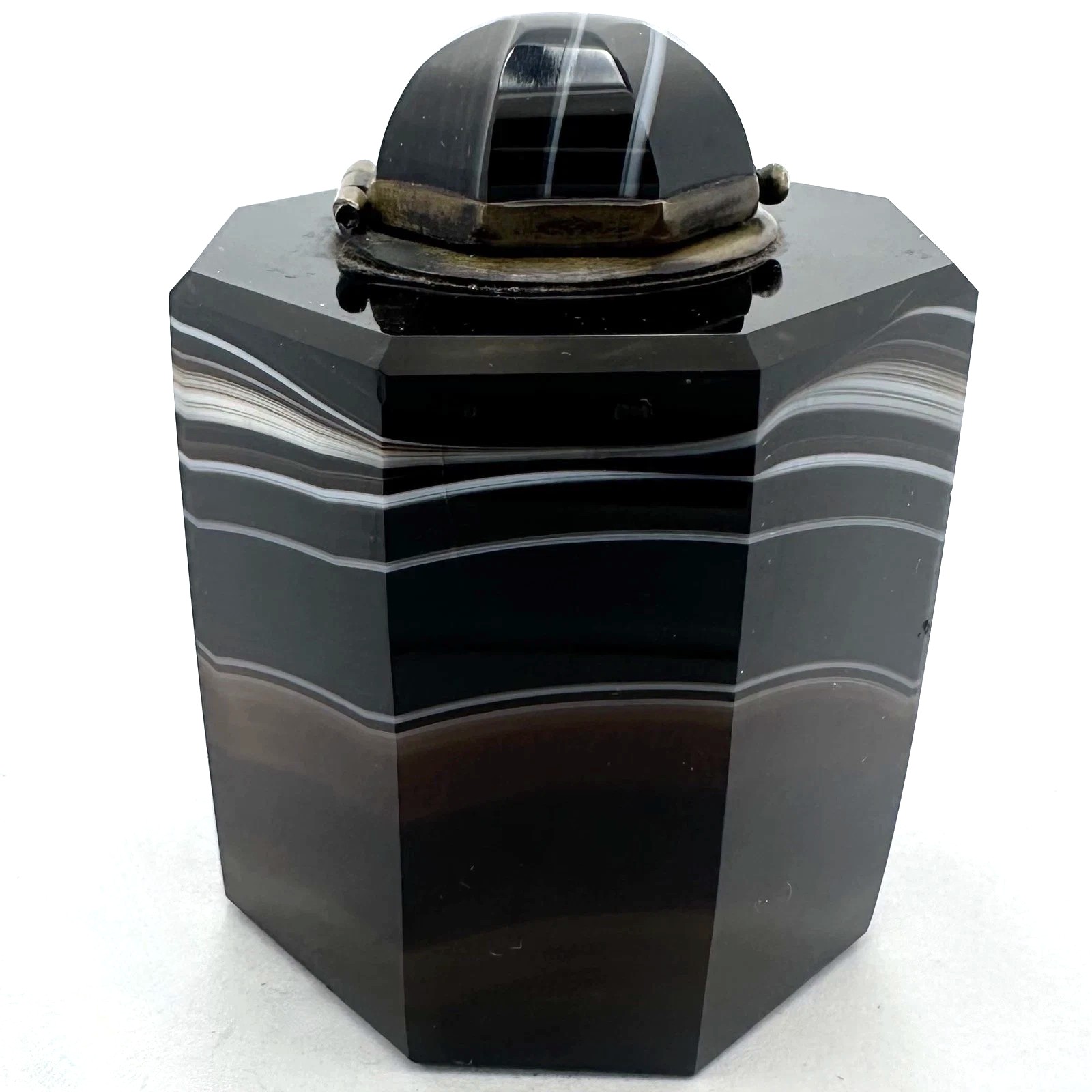
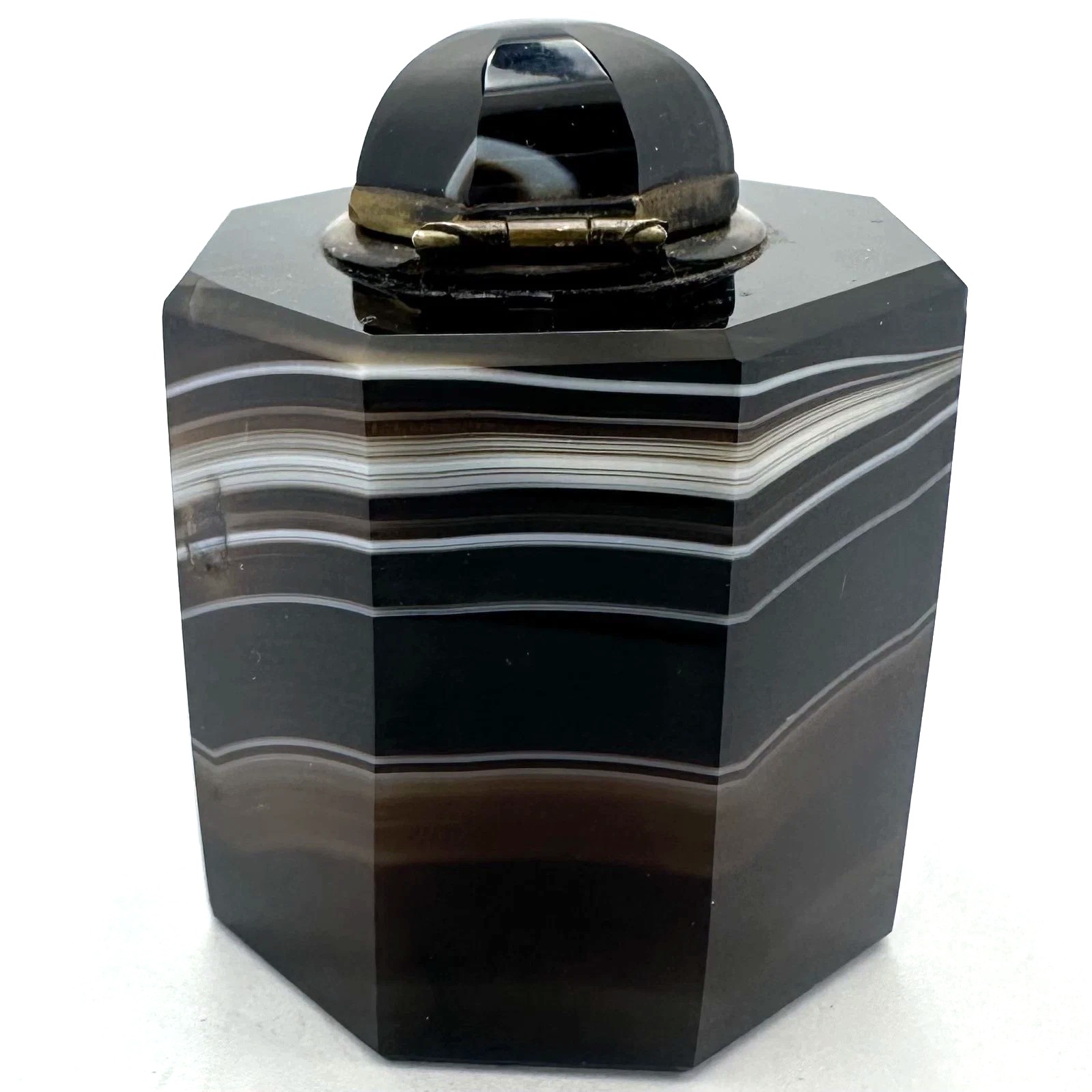
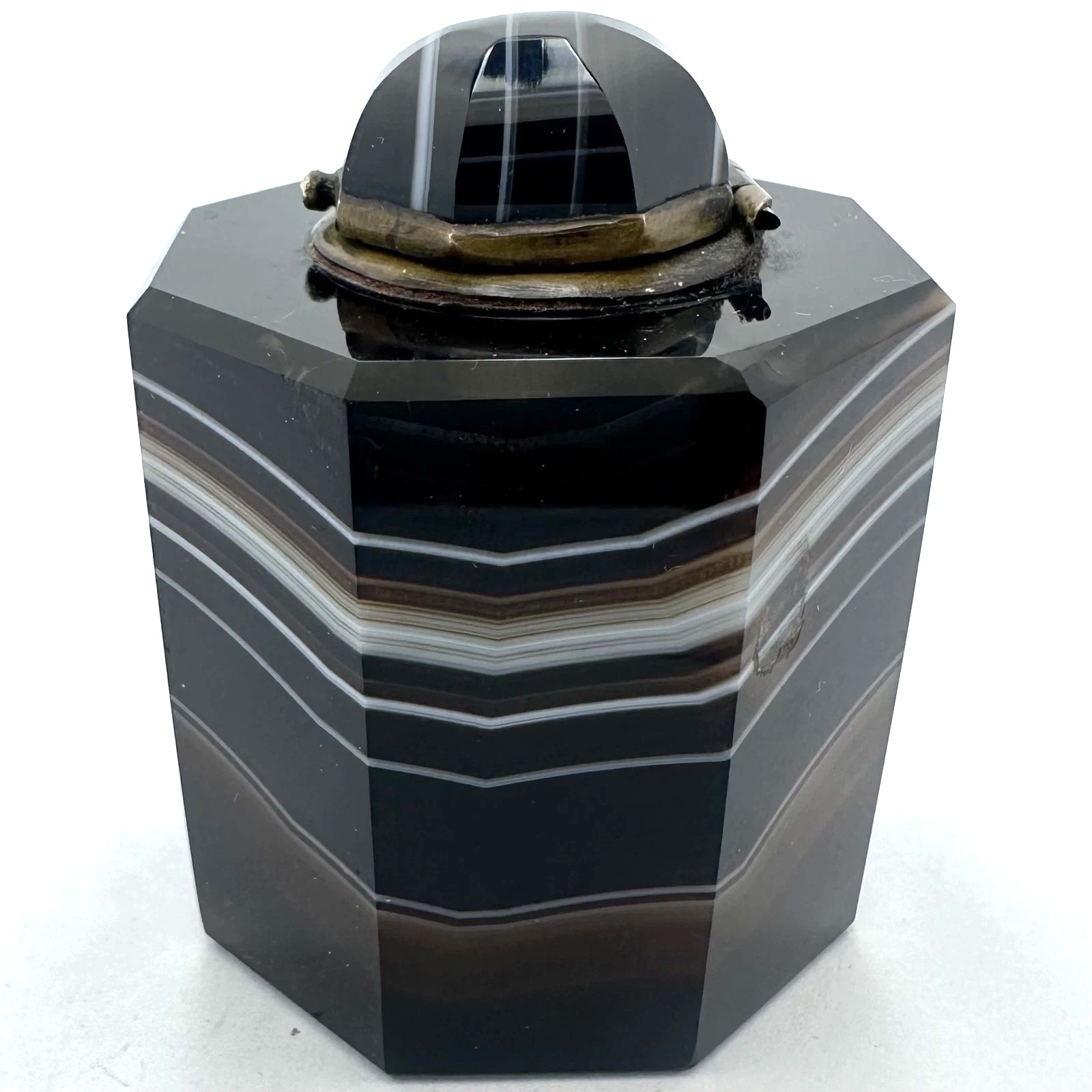
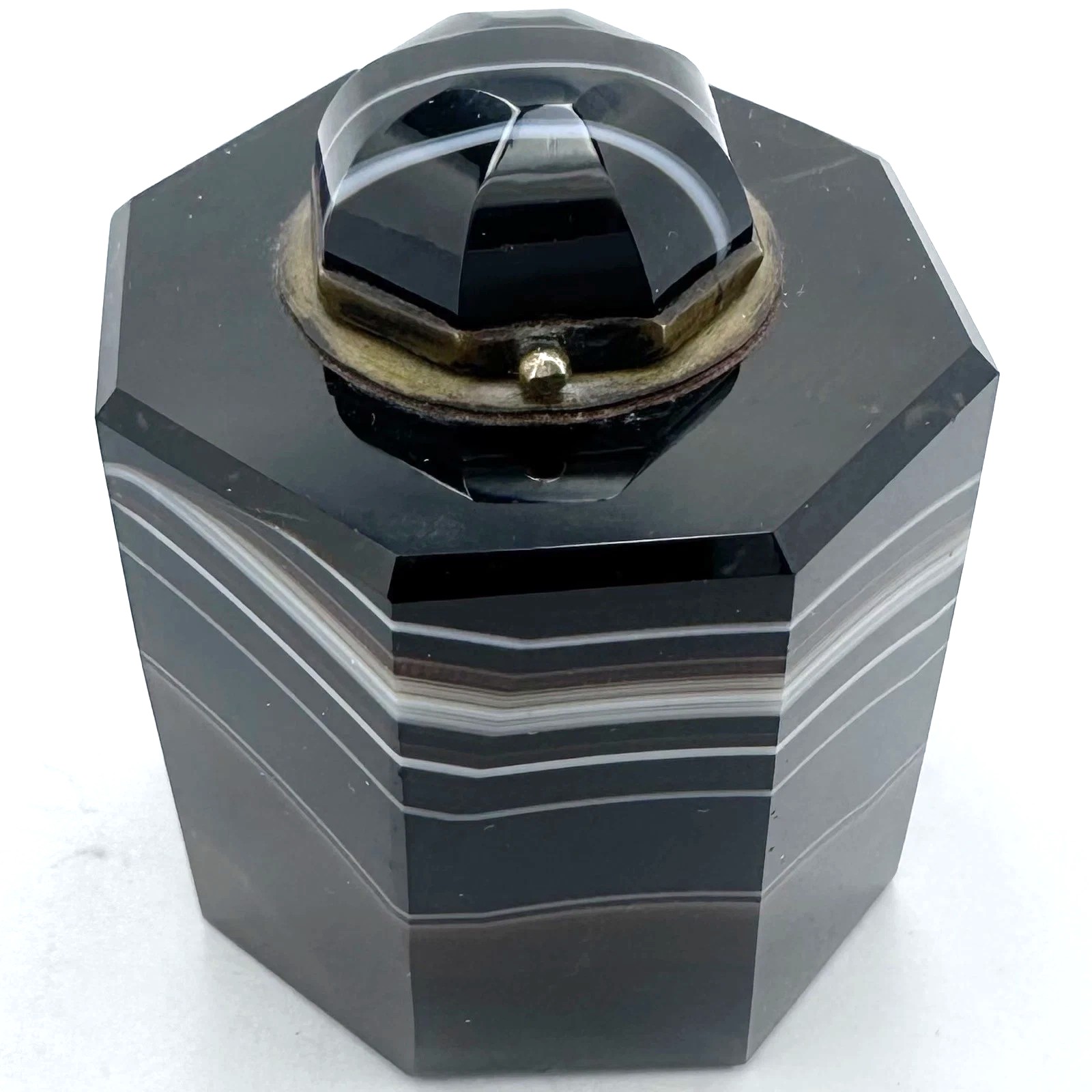
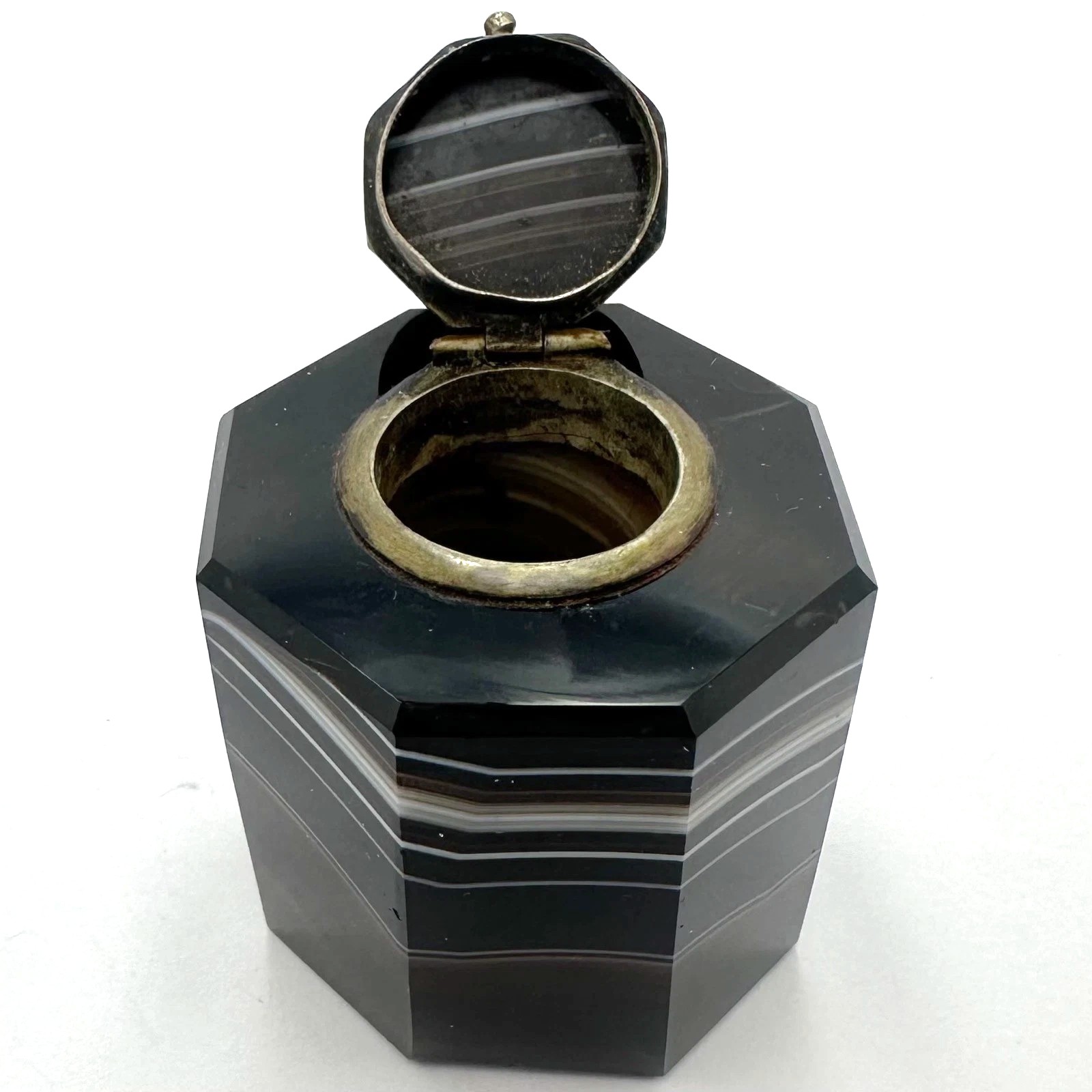

Banded Agate Inkwell
| Categories | Stone/Marble/Ivory/Bone/Hoof/Leather |
| Type | Stone |
| Material | Agate |
| Markings | Unmarked |
| Manufacturer | Undetermined |
| Origin | Germany |
| Date or Era | circa 1880 |
| Measuring | 1 ½” x 1 ½” x 2” high |
This banded agate inkwell, dating circa 1870–1890, was referred to in the period as “onyx agate” or “Scottish pebble” work. This as a classic example of late 19th-century lapidary skill, where the natural beauty of the stone is the primary “decoration.”
Description
- Material: The piece is carved from a single, large nodule of banded agate. It features striking horizontal layers (strata) ranging from translucent milky white and soft grey to deep charcoal and “toffee” brown.
- Form: It has an octagonal (eight-sided) body that tapers slightly from the base to the shoulder. The lid is also faceted and capped with a matching piece of agate, creating a seamless visual flow when closed.
- Mounting: The stone is fitted with a hinged metal collar, likely made of nickel silver (German silver). The hinge and small thumbpiece are characteristic of desk accessories from the 1880s.
Age and Origin
- Age: Circa 1870–1890. This style peaked in popularity during the late Victorian era, fueled by Queen Victoria’s love for Scottish culture and hardstone jewelry.
- Origin: While these were often retailed in England or Scotland, the stone carving was likely done in Idar-Oberstein, Germany. During the 19th century, Idar-Oberstein was the global epicenter for agate carving. German craftsmen used massive water-powered sandstone wheels to shape stones with incredible precision before shipping them to silver-smithing centers like Birmingham or London for mounting.
How It Was Made
The manufacturing of a monolithic (single-piece) agate inkwell was a labor-intensive process requiring several specialized steps:
- Sourcing & Slicing: A high-quality agate nodule was selected and sliced with a diamond-grit saw to reveal the best banding.
- Rough Shaping: The octagonal shape was achieved by “scoffing” or grinding the stone against large, rotating sandstone wheels. The craftsman would hold the stone by hand (often lying face down on a wooden bench for leverage) to grind the flat facets.
- Hollowing: The most difficult part was hollowing out the center. This was done using core drills and smaller abrasive grinders. Because agate is extremely hard (7 on the Mohs scale) and brittle, this had to be done slowly with constant water cooling to prevent the stone from cracking due to thermal shock.
- Polishing: The high-gloss “wet” look was achieved through multiple stages of polishing using progressively finer abrasives, ending with tripoli or tin oxide on a leather or felt wheel.
- Mounting: Finally, the metal collar was custom-fitted to the top of the stone and secured with a traditional “lapidary cement” (often a mixture of resin and brick dust).
Sold for $136 in March 2026
Content disclaimer. The information posted is the owner’s best knowledge and may not have been vetted by the SOIC. We welcome comments, corrections, and additions, working to make our website information comprehensive and accurate.
Join the Society of Inkwell Collectors (SOIC) – it’s free!
Founded in 1981 as a non-profit organization,
we are documenting inkwells (and accessories).
We’re here to help and inform!