

Inkipedia
Art Nouveau – Lotus Blossoms
| Categories | Art Nouveau |
| Material | White metal |
| Markings | See Narrative |
| Manufacturer | Mürrle Bennett & Co. |
| Origin | Germany |
| Date or Era | circa 1905 |
| Measuring | 6” x 5” x 2 ¾” high |
Description
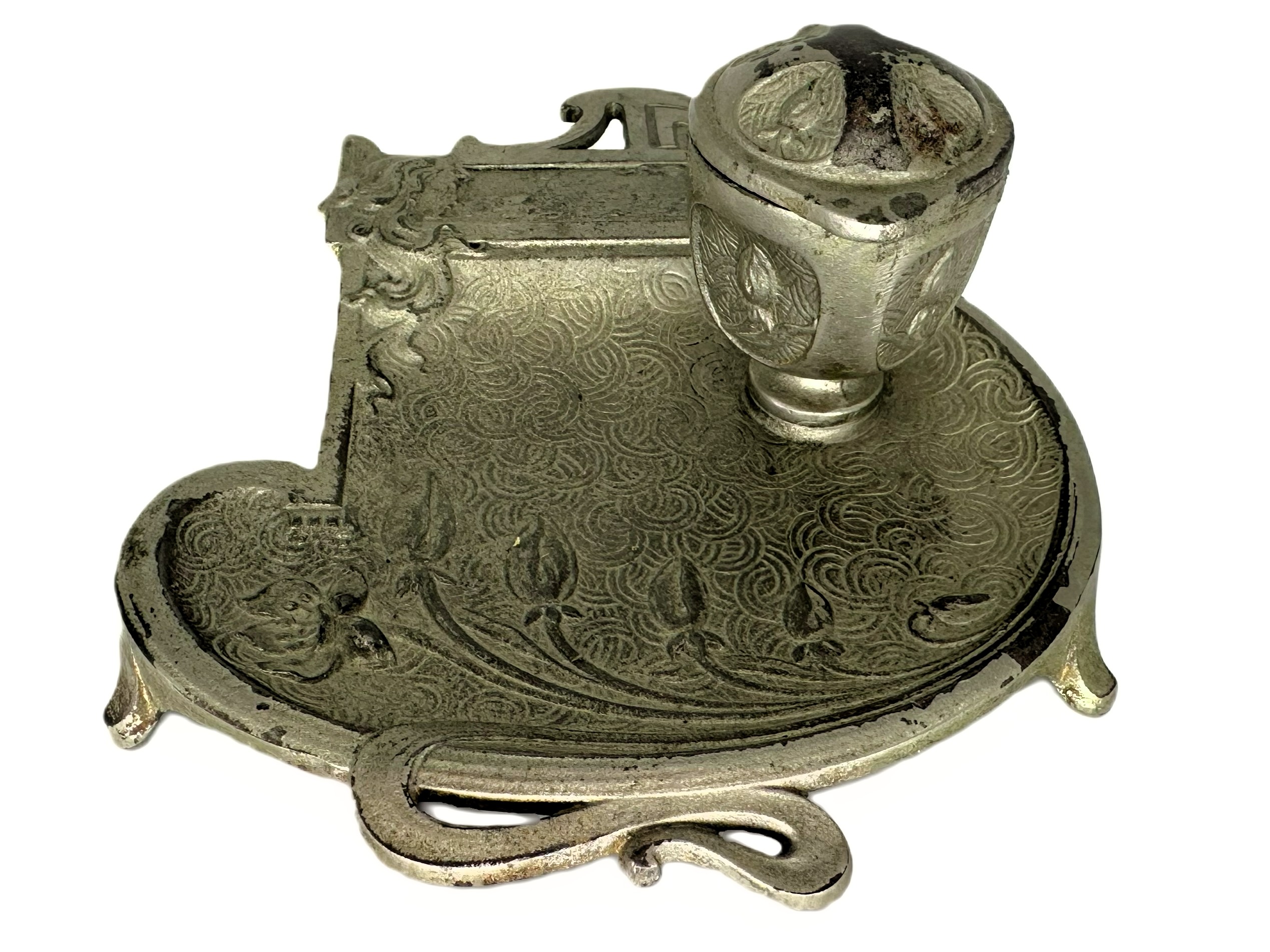
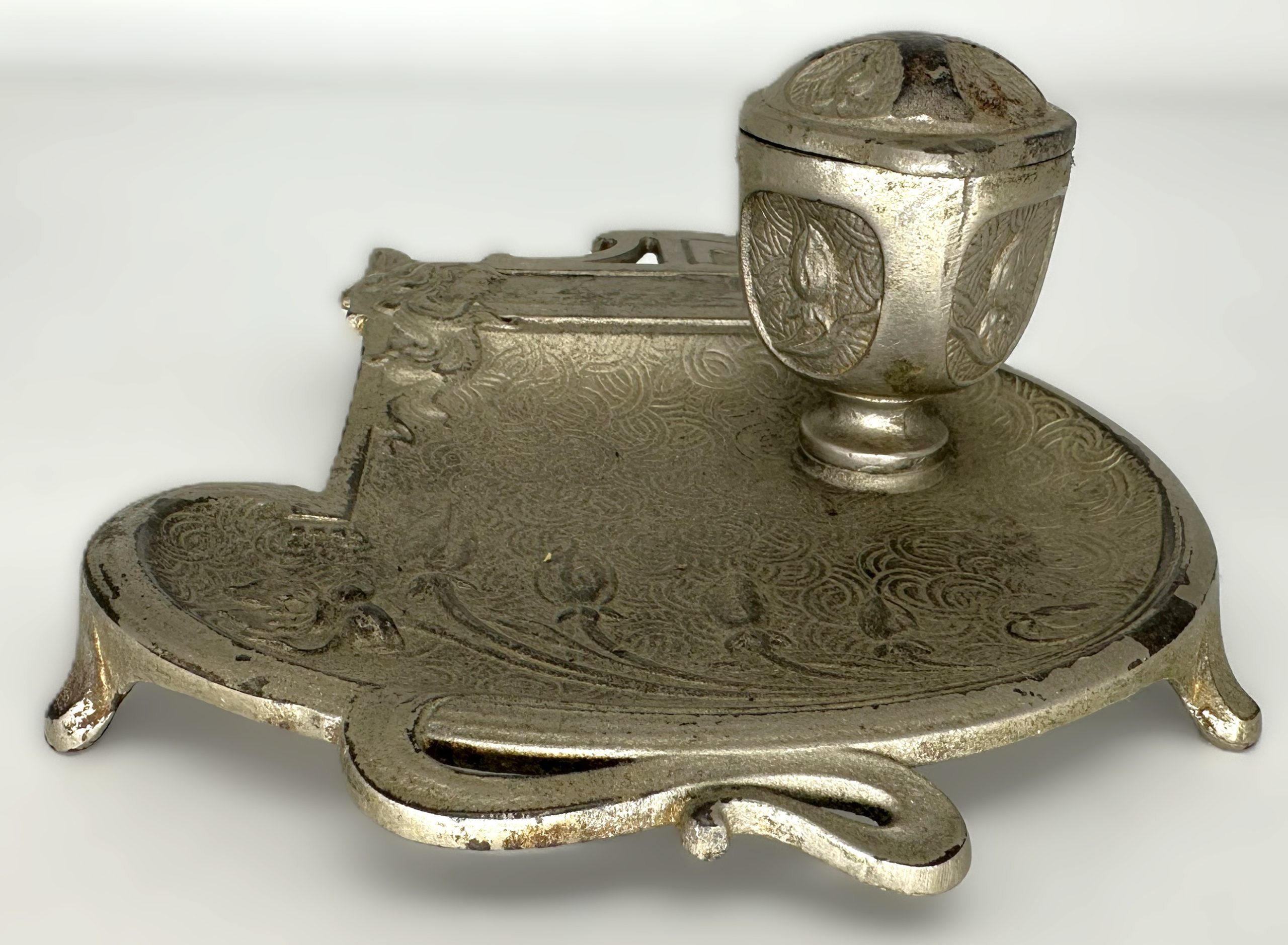
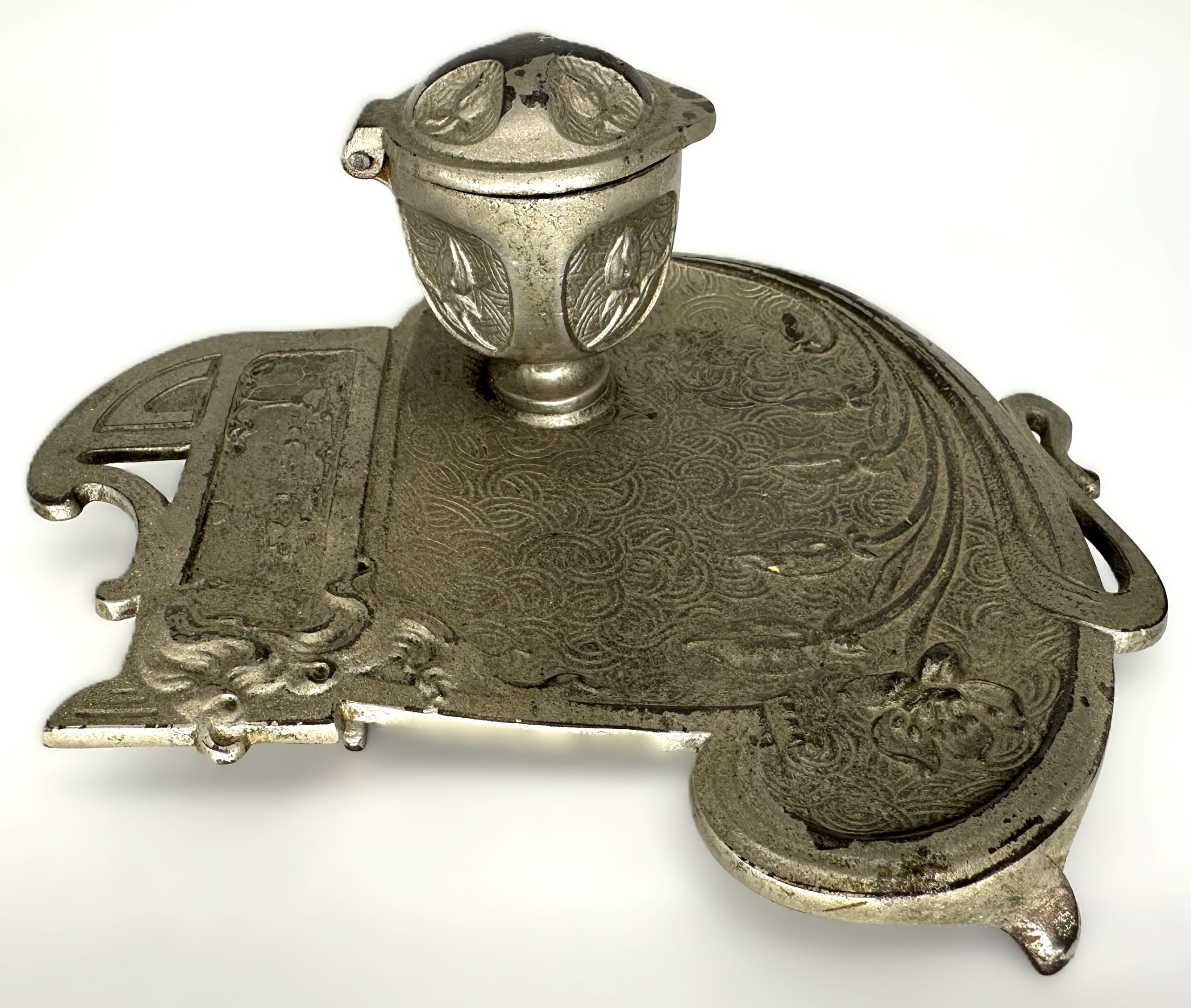
This Art Nouveau inkstand is cast in a white metal alloy.
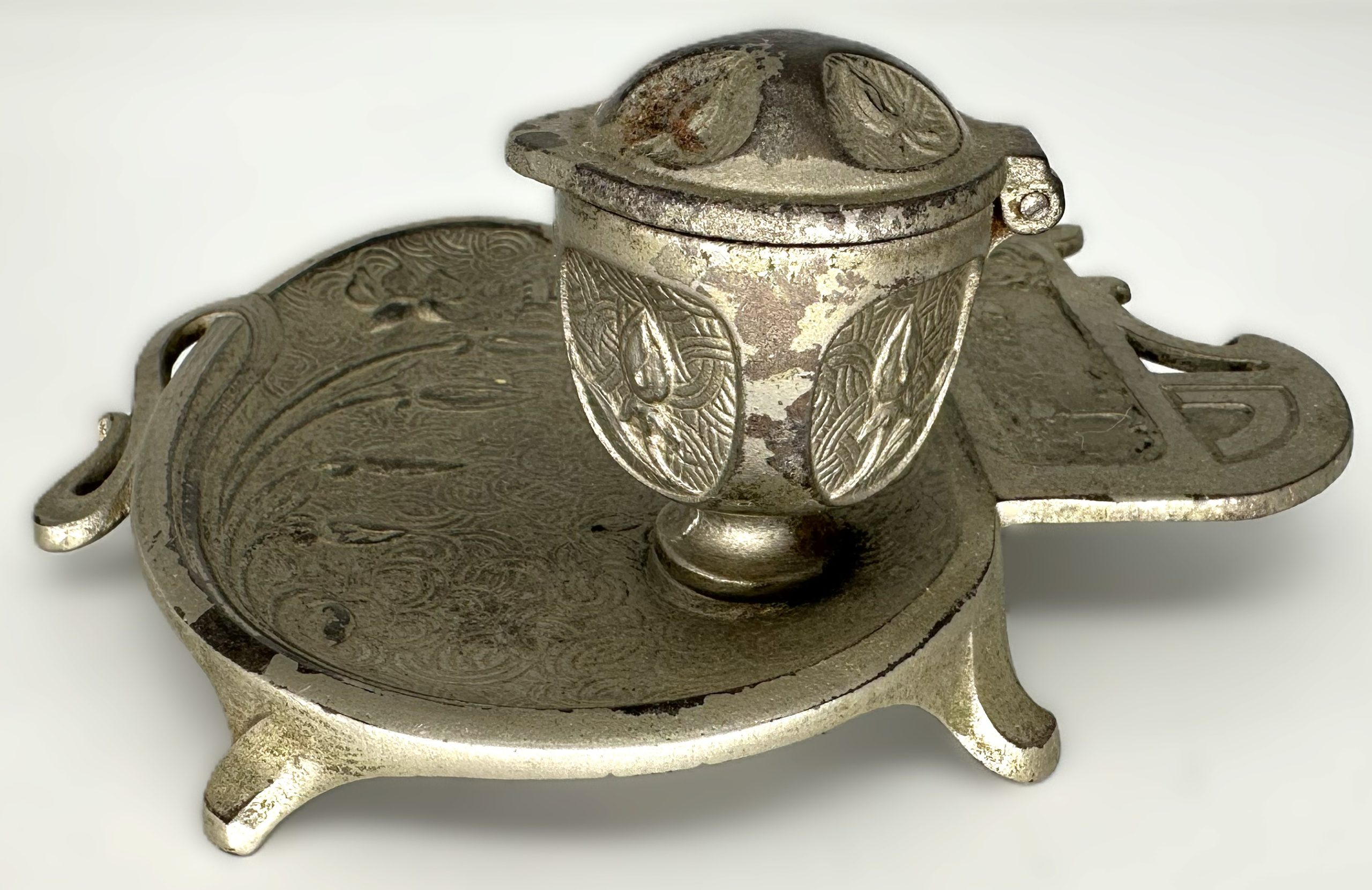
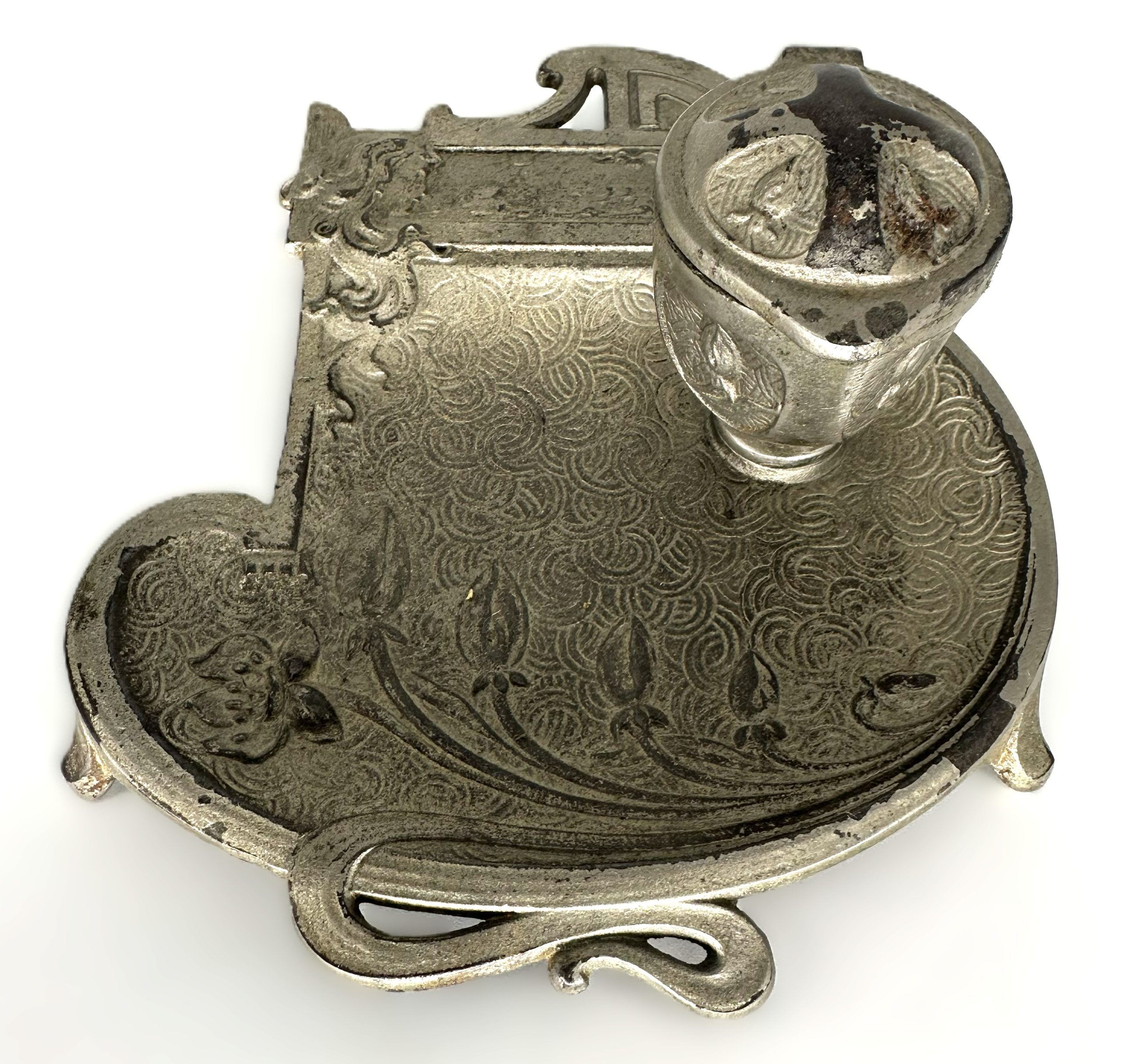
- Form & Composition: The base features an asymmetrical, fluid contour characteristic of classic Art Nouveau design, supported by integrated, gently splayed feet. An oval, raised, integrally cast inkwell pot sits elevated on a short-turned pedestal.
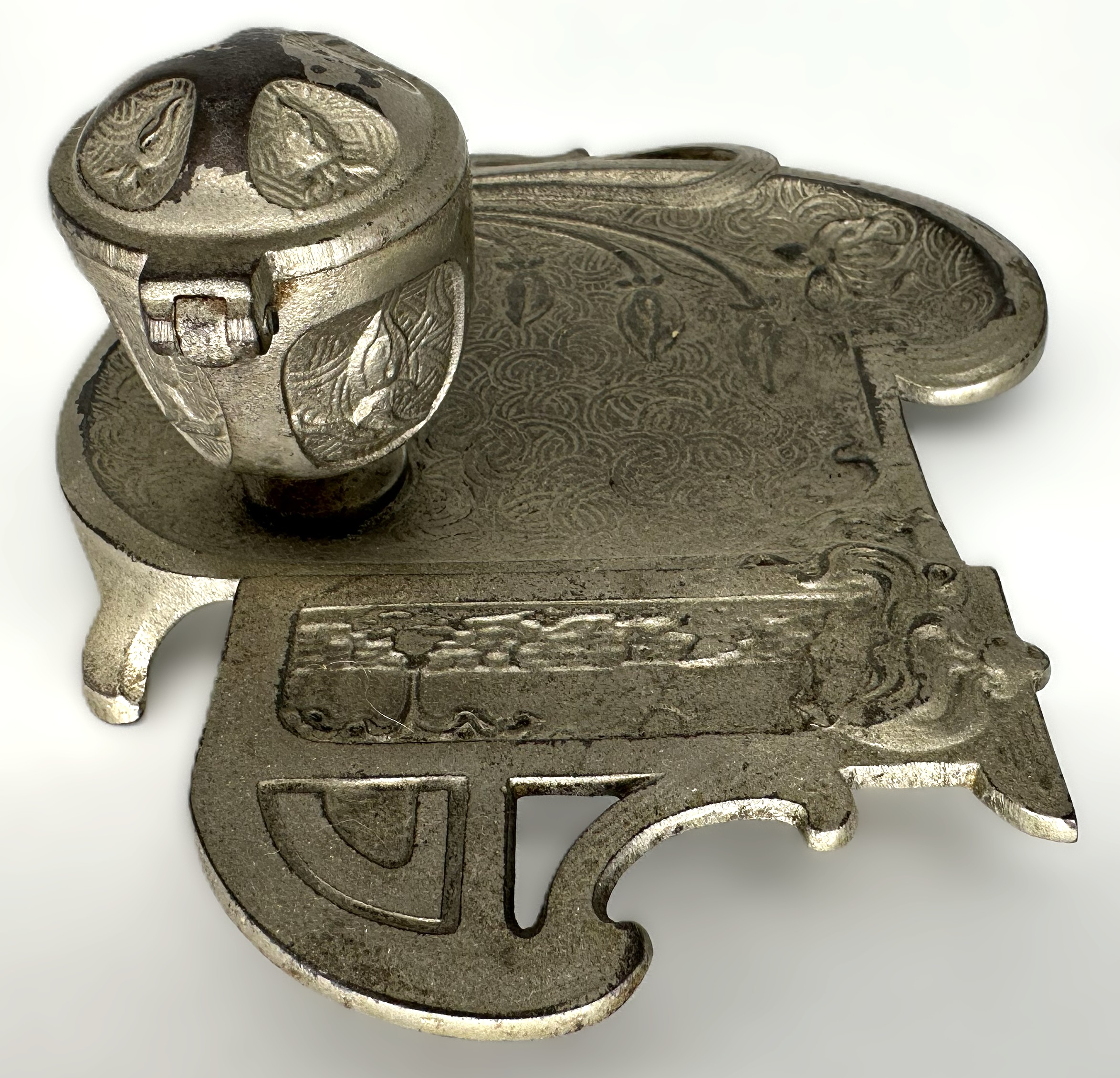
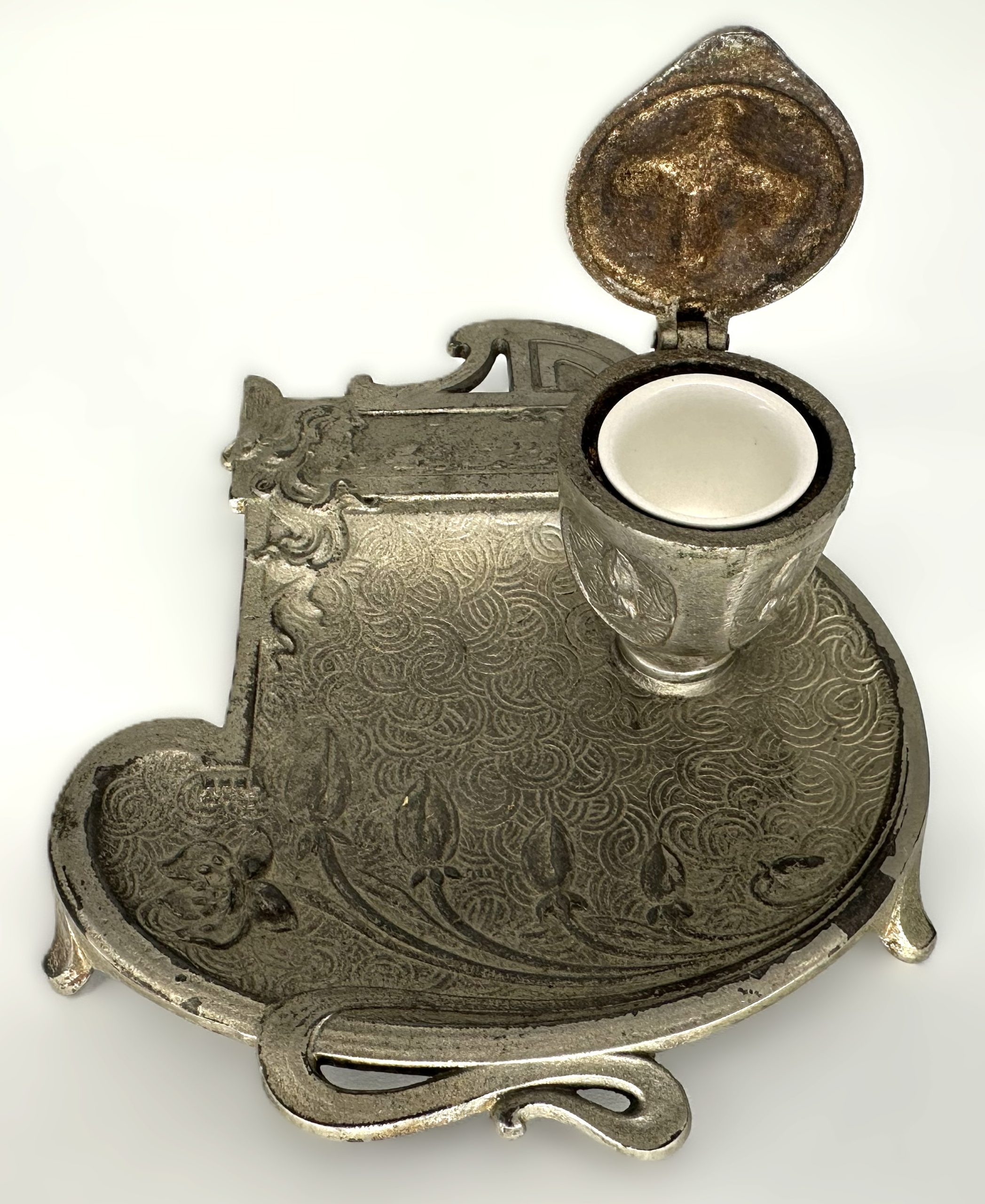
- Pen Tray & Surface Ornamentation: The broad, main surface of the stand serves as a pen tray, decorated with a relief pattern of stylized budding lotus blossoms or water lilies on sweeping, curved whip-cord stems. The entire field behind the floral relief is textured with a fine, swirling fish-scale or wave-like pattern.
- Openwork & Handles: The left edge integrates a flat openwork extension featuring geometric whiplash cutouts and an embossed cartouche panel.
- Inkwell & Insert: The matching hinged lid opens to reveal a ceramic insert. The outer body of the inkwell and the domed lid repeat the floral relief pattern seen on the base.
Identification & Origin
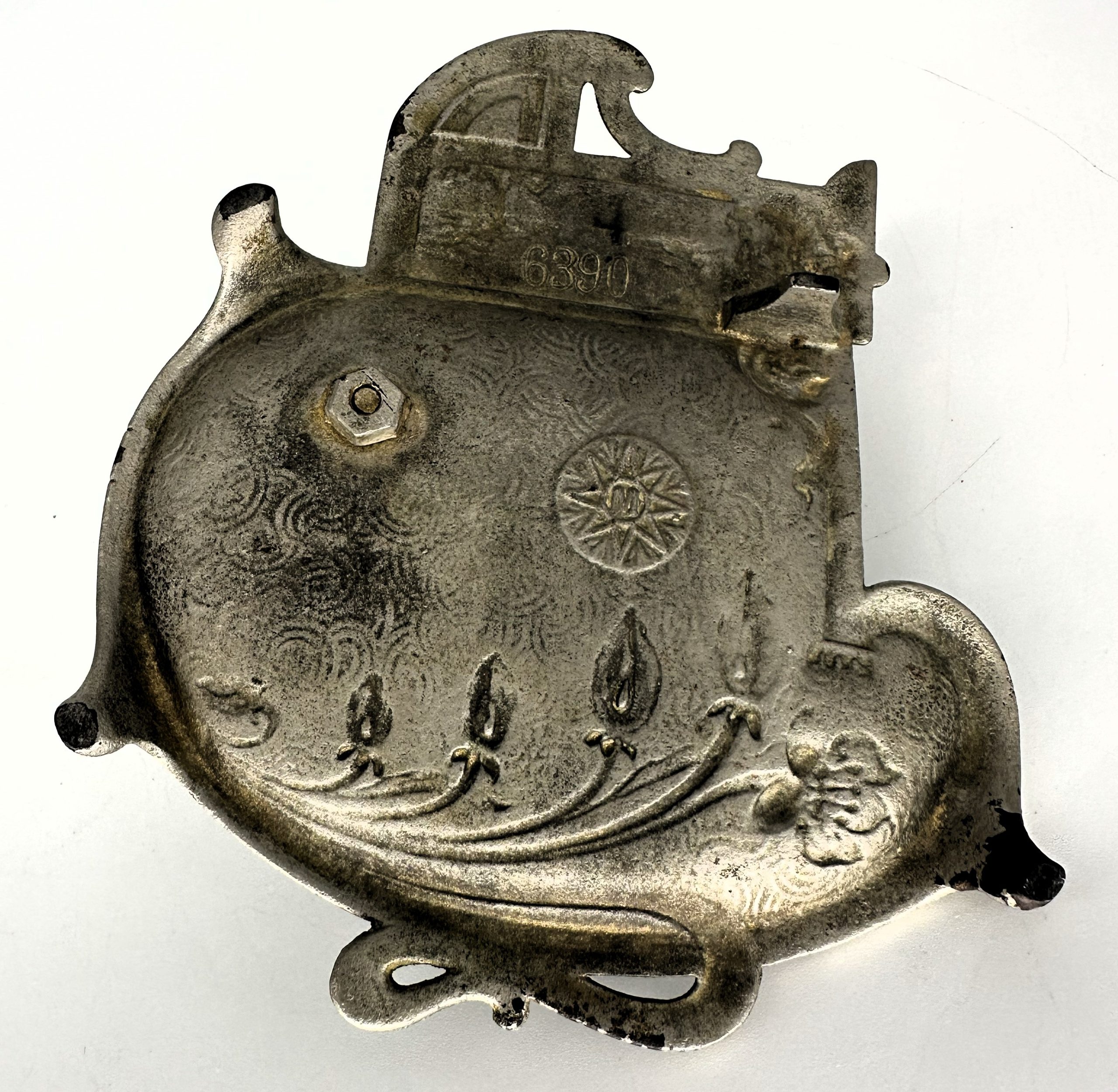
- Maker: Mürrle Bennett & Co. (associated with the “M in a starburst/radiant star” trademark) or a contemporary German/Austrian foundry produced for export. The letter “M” encircled by a multi-pointed radiant star is a recognized foundry stamp used on Jugendstil / Art Nouveau white metal, spelter, and metalware items.
- Model / Mold Number: 6390 (stamped directly into the casting on the underside).
- Origin: Germany or Austria (Central European Jugendstil movement). German foundries frequently produced electroplated white metal or Britannia metal desk accessories bearing numeric model numbers and maker marks for both domestic and British export markets.
- Date: Circa 1900–1908 (Peak Art Nouveau / Jugendstil period).
Company Origins & Structure
- Founding: Originally established in 1884 as Siegele & Bennett, the firm was reorganized in 1896 as Murrle, Bennett & Co. when German-born Ernst Mürrle partnered with John Bold Bennett.
- Dual-Headquarters: The business operated via a dual-location model designed specifically for cross-border trade. They maintained wholesale and distribution premises at 13 Charterhouse Street in London alongside manufacturing operations at 39 Bleich-Strasse in Pforzheim, Germany—the world’s premier center for modern metalwork and jewelry production at the time.
Key Partnerships & Stylistic Influence
- Bridging Design Movements: Murrle Bennett & Co. served as a primary commercial conduit between the German Jugendstil and British Arts & Crafts / Art Nouveau movements. They popularized continental European metalwork in the UK while incorporating British taste into their production runs.
- Liberty & Co. Relationship: The firm was a major wholesale supplier to London’s famous Liberty & Co. department store. Their clean, organic metalwork complemented Liberty’s celebrated Cymric and Tudric lines.
- Collaborations: Beyond internal manufacturing, Ernst Mürrle commissioned pieces from leading German avant-garde designers, most notably Theodor Fahrner of Pforzheim. Items produced through this partnership often bear both the Murrle Bennett mark and Fahrner’s “TF” stamp.
Marks & Production Scope
- Trademarks: While fine jewelry pieces were commonly stamped with an “MB&Co” cipher or monogram, their electroplated metalware, desk items, and vanity accessories frequently utilized the “M” within a radiant starburst foundry stamp.
- Dissolution (1916): With the onset of World War I, Ernst Mürrle was interned as an enemy alien on the Isle of Man and subsequently repatriated to Germany in 1916. The British government seized the firm’s assets, and the London operation was restructured under the name White, Redgrove & Whyte.
Content disclaimer. The information posted is the owner’s best knowledge and may not have been vetted by the SOIC. We welcome comments, corrections, and additions, working to make our website information comprehensive and accurate.
Join the Society of Inkwell Collectors (SOIC) – it’s free!
Founded in 1981 as a non-profit organization,
we are documenting inkwells (and accessories).
We’re here to help and inform!