

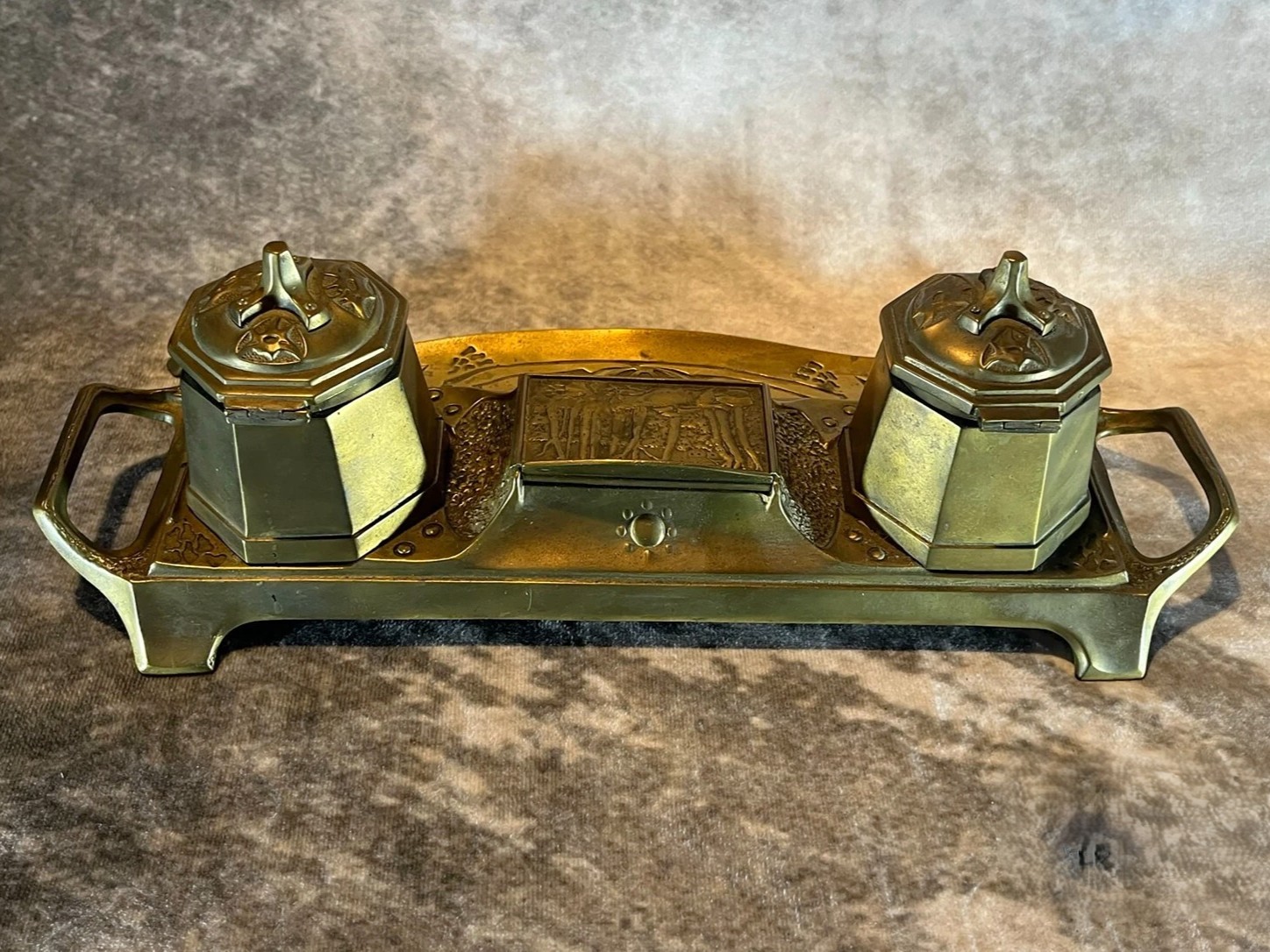
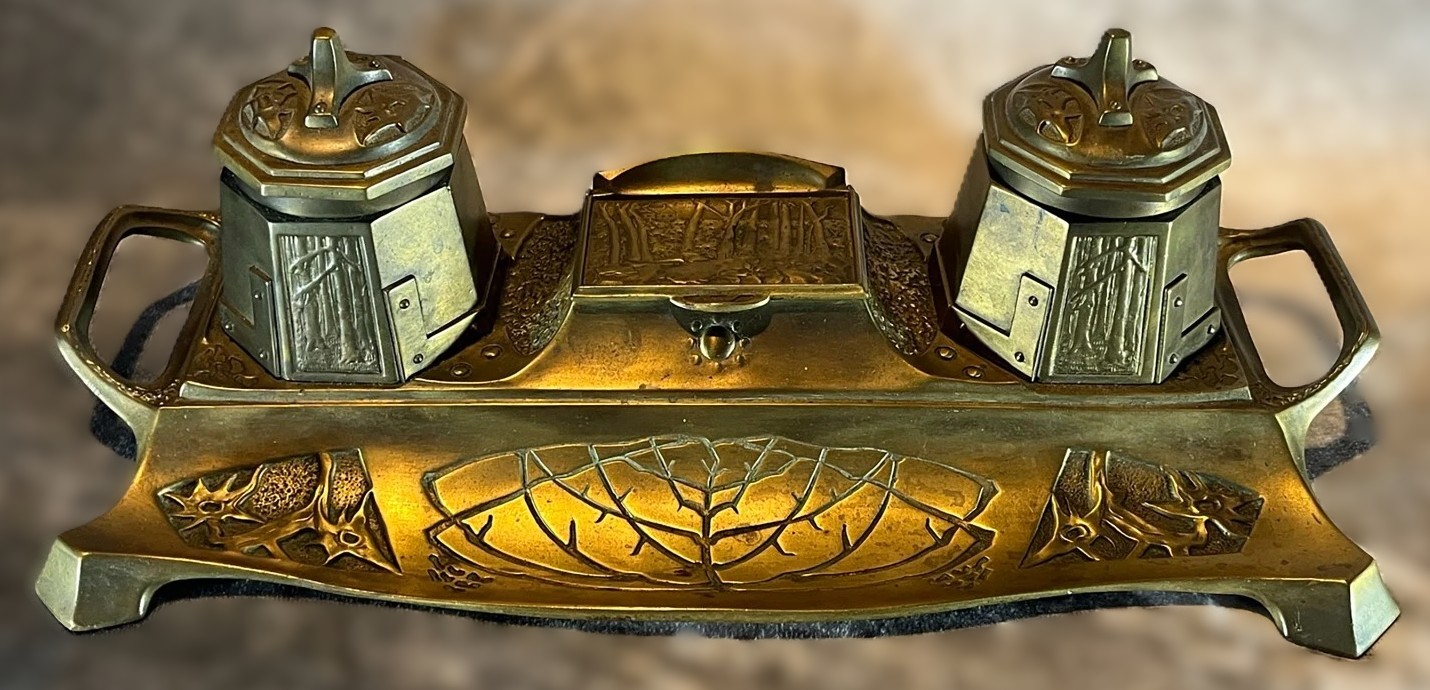


Art Nouveau Double Inkstand
| Categories | Art Nouveau |
| Material | Brass |
| Markings | Unmarked |
| Manufacturer | Undetermined |
| Origin | Germany |
| Date or Era | circa 1900 |
| Measuring | 14 ½” across |
This Art Nouveau (specifically Jugendstil) double inkstand, likely of German or Austrian origin, dates from the late 19th to early 20th century (circa 1895–1910).
Description
This heavy, cast brass desk set features a symmetrical design with two octagonal inkwells flanking a central rectangular stamp box.
- Motif: The standout feature is the “Woodland” or “Forest” theme. The sides of the inkwells and the lid of the stamp box are decorated with a relief scene of tall, slender trees (resembling birches or poplars) in a dense forest.
- The Tray: The base serves as a pen tray, dominated by a large, highly detailed chestnut or plane tree leaf that fills the central rest area. The handles on either side exhibit the characteristic “whiplash” curves and organic flow of the Art Nouveau movement.
- Stamp Box: The central box opens to reveal three compartments (typical for different postage denominations).
Where and When Was This Made?
- Origin: Most likely Germany. During this period, firms in the Lüdenscheid and Schwäbisch Gmünd regions (like Erhard & Söhne, Eduard Hueck, or Walter Scherf) specialized in high-quality brass and “Jugendstil” (the German Art Nouveau) metalwork.
- Date: Roughly 1900. The transition from the ornate Victorian style to the more organic, nature-inspired lines of Art Nouveau puts this piece right at the turn of the century.
How Was This Made?
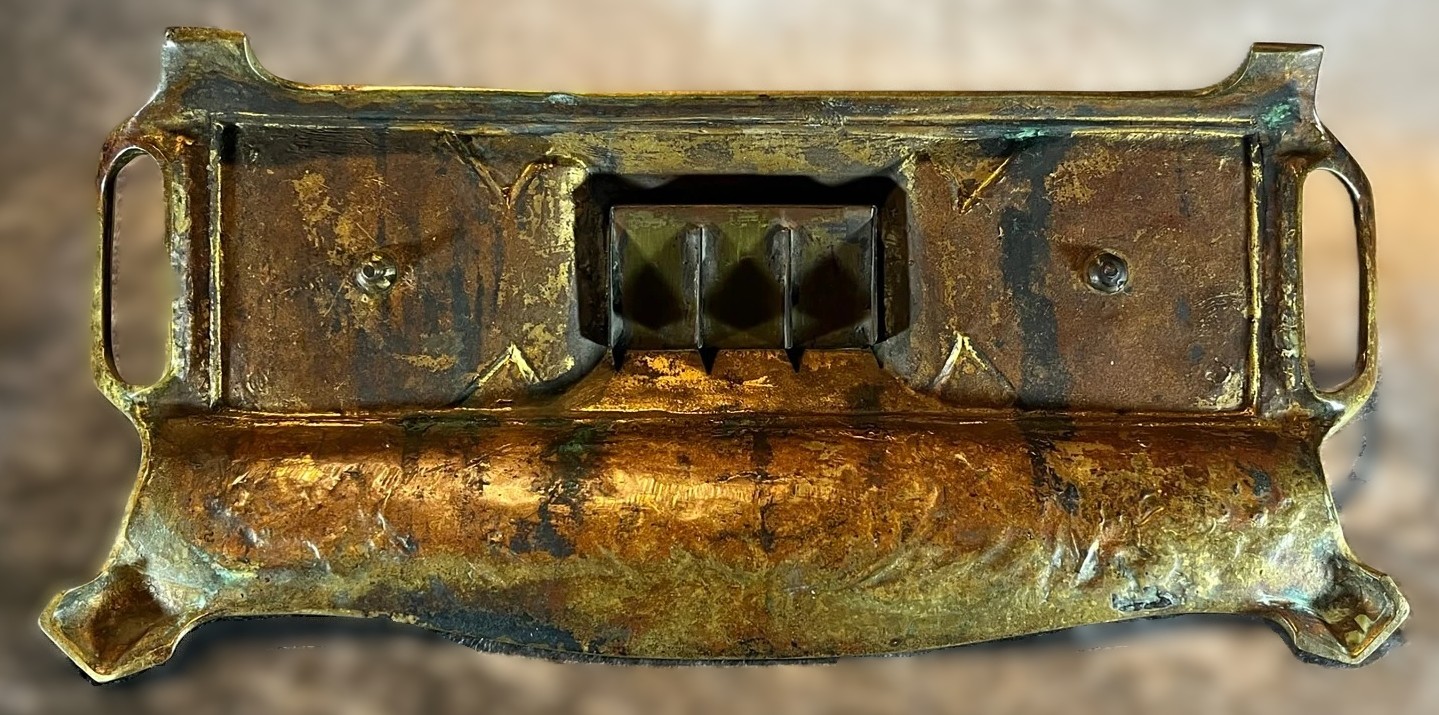
- Casting: This piece was produced using sand-casting. Molten brass was poured into a sand mold formed from a carved master pattern. You can see the rough, granular texture on the underside, which is typical of the sand-casting process.
- Chasing and Finishing: After the metal cooled, a craftsman would “chase” the piece—using small tools to sharpen the details of the trees and leaves—and then apply a finish.
- Assembly: The lids are attached with integrated pin hinges. The underside shows two protruding pins which are the remains of the casting or the internal supports for the inkwell reservoirs.
Sold for $75 in March 2026
Content disclaimer. The information posted is the owner’s best knowledge and may not have been vetted by the SOIC. We welcome comments, corrections, and additions, working to make our website information comprehensive and accurate.
Join the Society of Inkwell Collectors (SOIC) – it’s free!
Founded in 1981 as a non-profit organization,
we are documenting inkwells (and accessories).
We’re here to help and inform!