

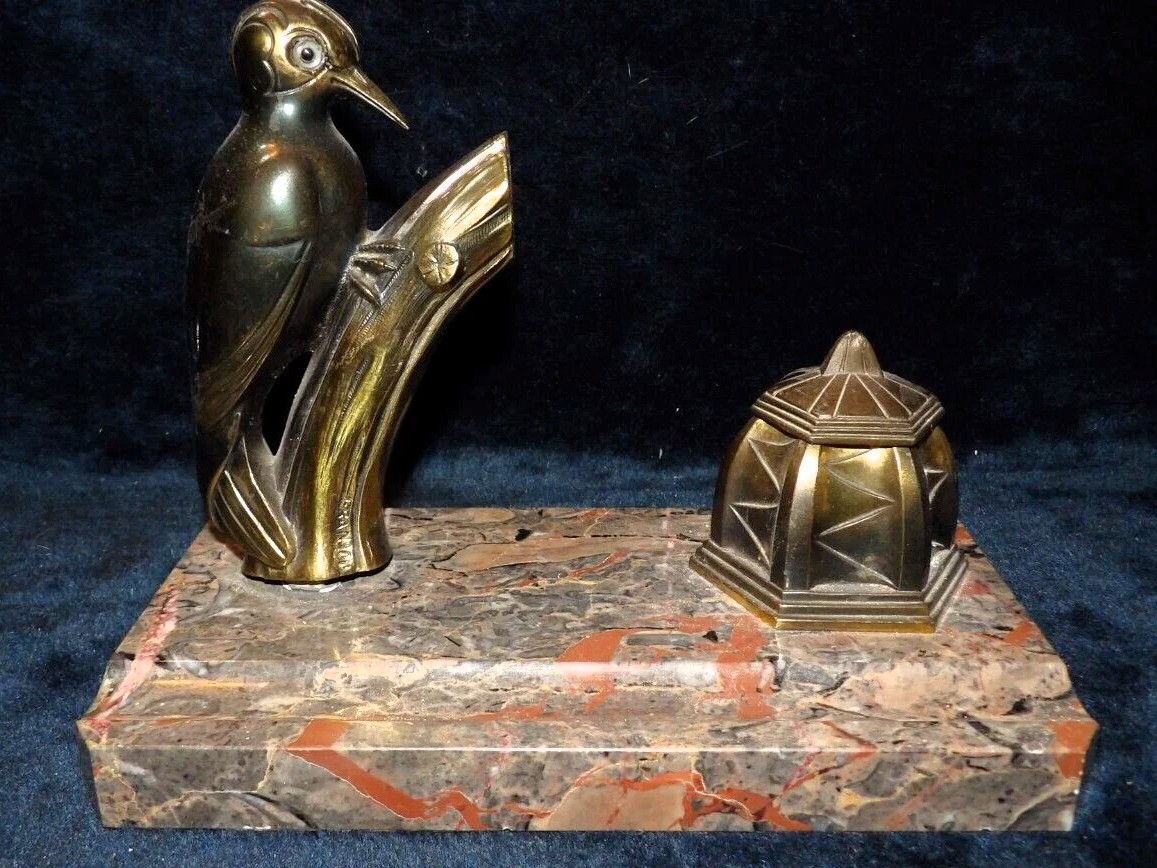


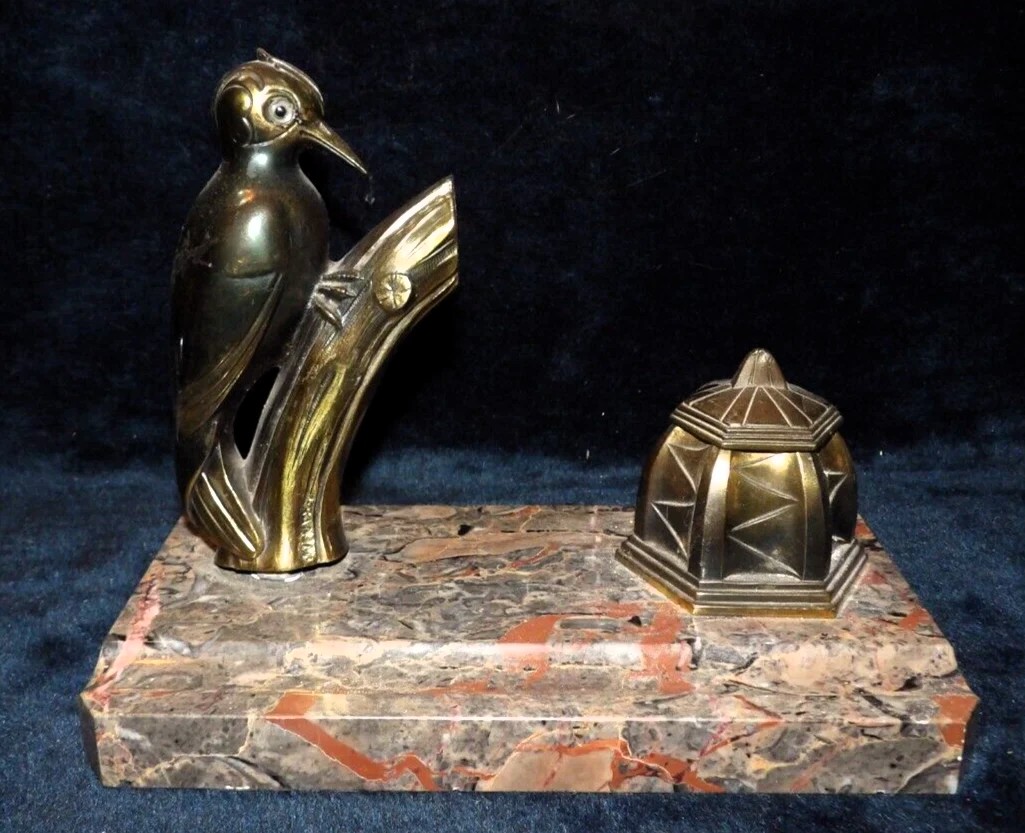
Art Deco Woodpecker Inkstand
| Categories | Art Deco |
| Type | Bird |
| Material | Brass, Onyx |
| Markings | "FRANJOU" |
| Manufacturer | Moreau workshops -FRANJOU |
| Origin | France |
| Date or Era | circa 1930 |
| Measuring | 8 ¾” x 4 ½” x 6 ½” high |
- Description and Materials
- Subject and Form: The inkstand features a woodpecker perched on a branch. This use of stylized, dynamic animal forms was extremely popular during the Art Deco era.
- The Bird: The woodpecker figure is made of brass and finished with a dark patina or bronzed coating. The inclusion of glass eyes adds a striking realism and is a hallmark of quality casting during this period.
- Style and Age:
- Style: Art Deco (c. 1920–1935). The blend of sharp, naturalistic detail with the geometric slab of the base is characteristic of the period’s transition from Art Nouveau curves to Deco structure.
- Age: Circa 1920–1935, placing it in the prime period of French Art Deco production.
- The Marble Base
The marble exhibits red, tan, brown, gray, and black colorings, indicating a type of Brecciated Marble or highly figured Onyx Marble.
- Most Likely Identity: This material is most likely a form of Onyx Marble (often misidentified as simple marble, but actually a banded, often translucent form of calcite), specifically a variety known for its multi-color veining and cloudiness. The inclusion of red and tan alongside the dark brown, gray, and black suggests a Pyrenees Onyx or a type of highly veined Italian/French Portoro or Broccatello marble.
- Aesthetic Impact: The multi-colored veins and dramatic clouding of the stone perfectly fulfill the Art Deco aesthetic, providing a rich, organic contrast to the sharp lines of the metal figure and the geometric cut of the base. The base is not merely a pedestal; it is an integrated element of color and texture.
- Structure: The base is cut into a clean, geometric slab, characteristic of the 1920s and 1930s style, ensuring the focus remains on the dramatic materials and the figure. There is a pen channel in the front.
III. Description of the Inkwell Holder
The functionality is integrated into the metal structure, ensuring the ink is housed securely on the right side of the piece.
- Metal Housing: The ink reservoir is contained entirely within a cast metal (brass) housing that is securely mounted on the right side of the marble base.
- Form: This brass housing is angular and has a hinged lid. This lid is often plain or may have a slight relief decoration that harmonizes with the bird’s naturalistic modeling.
- The Reservoir: The brass housing holds the original clear glass insert.
- The Artist: Franjou Hippolyte Moreau
The mark “FRANJOU” is associated with a member of the famous Moreau family of French sculptors, but specifically with the Moreau factory workshop that produced quality commercial bronzes and spelter castings.
- Franjou Hippolyte Moreau (1832–1917): While the piece is dated after his death, the name “Franjou” is a known pseudonym or trade name used by the Moreau workshops—likely a combination of ‘Fran’ (France) and ‘Jou’ (a common artistic name ending) or an abbreviated signature. The name is often attributed to Hippolyte Moreau, though it refers to pieces produced by his establishment or factory well into the 20th century.
- The Moreau Family Legacy: The Moreaus (Auguste, Mathurin, Hippolyte) were prolific and highly influential sculptors known for their figurative works throughout the late 19th century and beyond. Their workshops continued to produce high-quality, nature-inspired castings that easily adapted to the succeeding Art Deco style.
- Conclusion on Attribution: The inkstand was made in France, likely in a Parisian casting workshop associated with the Moreau legacy, using the “FRANJOU” trade name for commercial, high-quality, Art Deco metalware.
Sold for $114 in November 2025
Content disclaimer. The information posted is the owner’s best knowledge and may not have been vetted by the SOIC. We welcome comments, corrections, and additions, working to make our website information comprehensive and accurate.
Join the Society of Inkwell Collectors (SOIC) – it’s free!
Founded in 1981 as a non-profit organization,
we are documenting inkwells (and accessories).
We’re here to help and inform!