





Art Deco Catalin Desk Set
| Categories | Art Deco, Plastic - Bakelite - Gutta Percha |
| Material | Catalin |
| Markings | Unmarked |
| Manufacturer | Undetermined |
| Origin | Undetermined |
| Date or Era | circa 1930 |
| Measuring | Base: 5 ½” x 3 ⅛” |
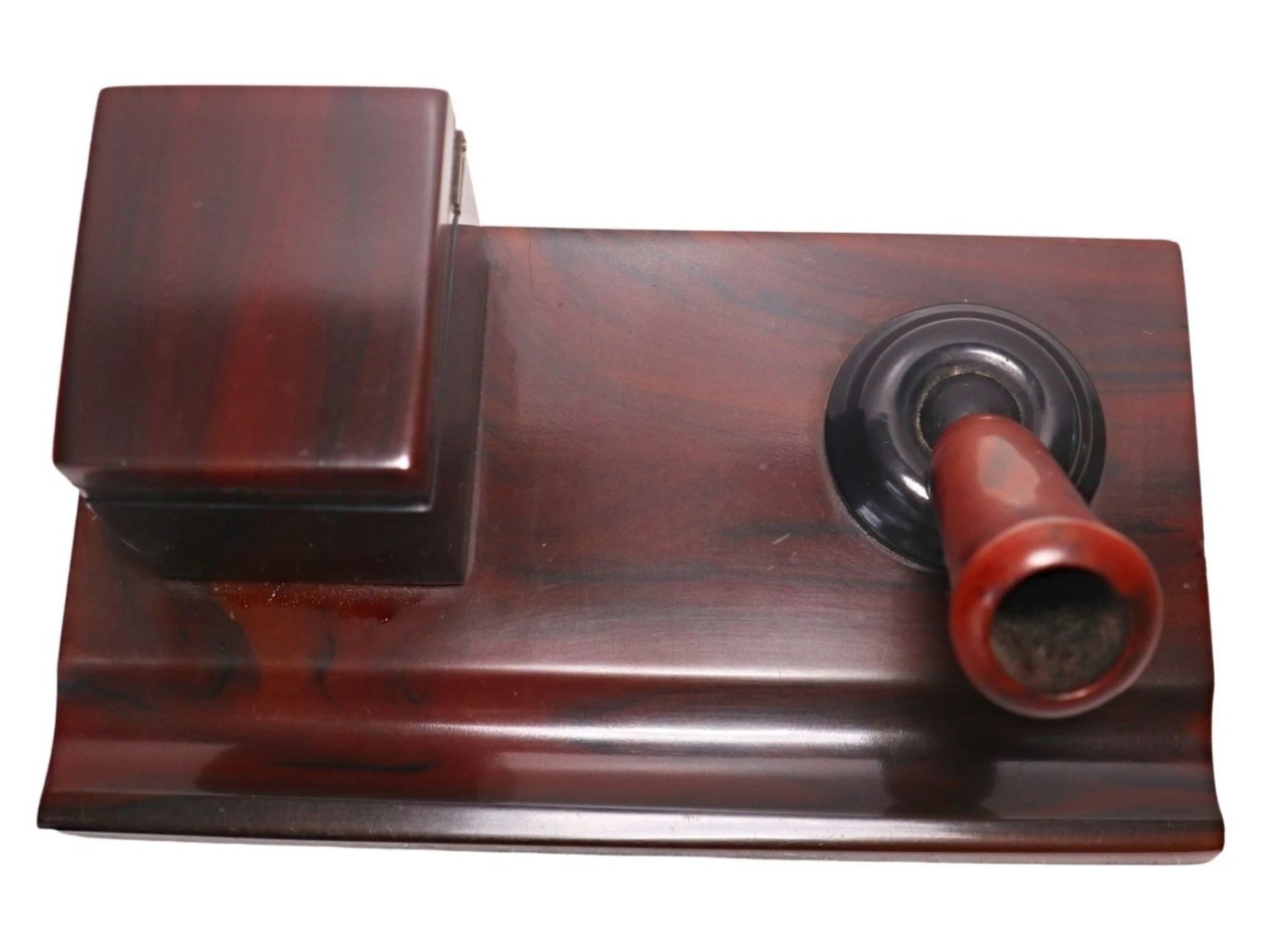
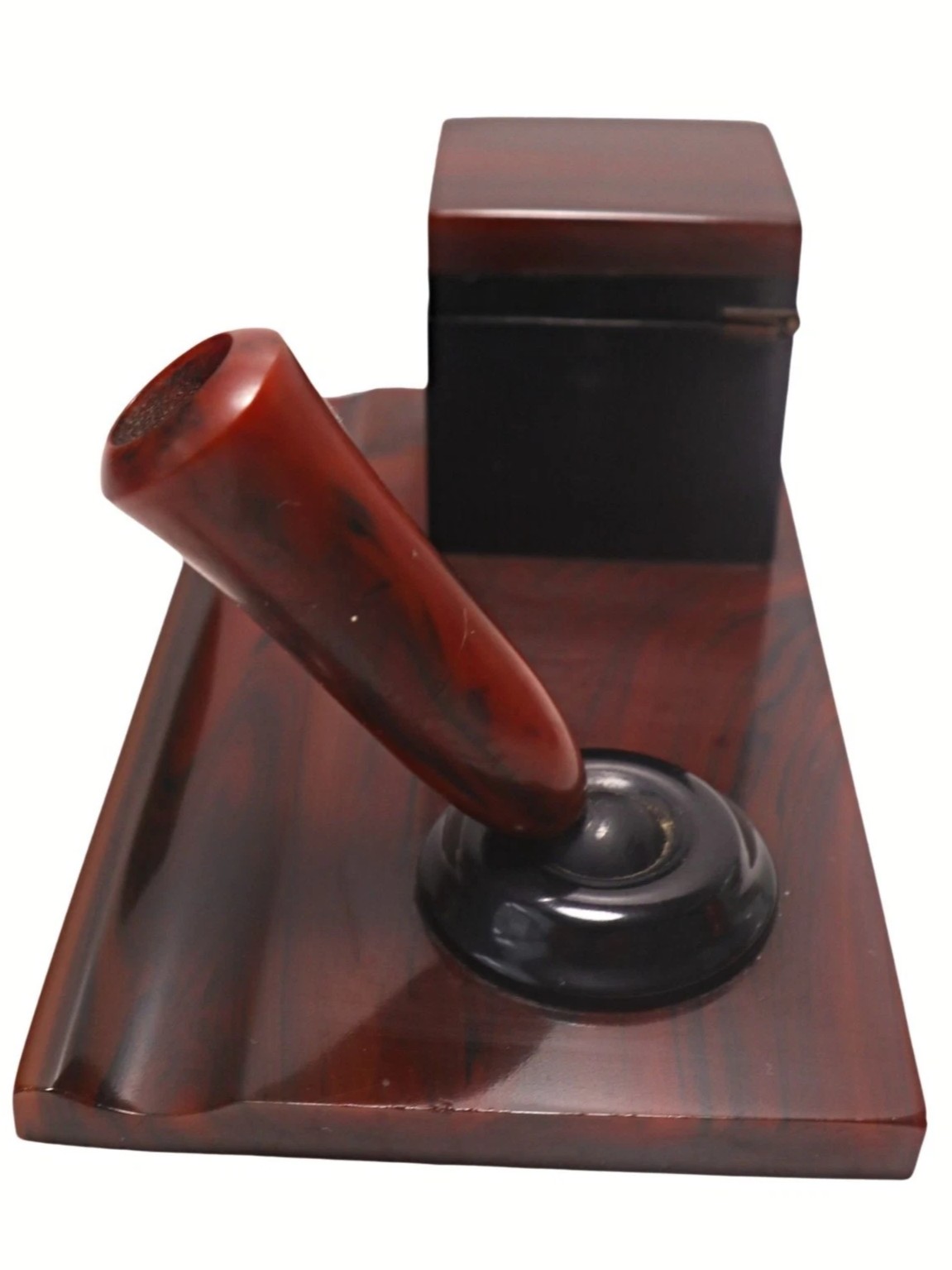
This Art Deco desk set is a quintessential example of early plastic design, crafted from Catalin in a rich “cherry juice” or “oxblood” marbled pattern.
Description
- The Components: The set features a rectangular base with a built-in pen tray along the front edge. It is equipped with a swivel pen socket on a black circular base and a hinged, cube-shaped inkwell.
- The Inkwell: The cube is made of a marbled red Catalin. The lid is secured by a brass piano hinge and opens to reveal a circular reservoir for a glass ink insert (missing from this piece).
- The Material Pattern: The “swirled” or marbled effect, visible most clearly on the base and the pen socket, was created by mixing different colored liquid resins before they hardened.
Bakelite vs. Catalin: Identification
While often used interchangeably, there is a technical difference that confirms this set is Catalin:
- Manufacturing: Bakelite was typically an opaque, industrial plastic often mixed with wood flour or asbestos, resulting in dark colors like brown or black. Catalin, introduced in 1927, was cast without fillers, allowing for the translucent, vibrant colors and marbling seen in this piece.
- Color Transition: Catalin is chemically unstable and “oxidizes” over time. A piece that was originally white might turn yellow (butterscotch), or a bright red might deepen into the dark “cherry” color this set now displays.
- The Underside: Looking at the bottom of the base, one can see the machined grinding marks. Unlike Bakelite, which was molded into a final shape, Catalin was cast into rods or sheets and then carved, ground, and polished like wood or stone.
Estimated Age
- Circa 1930–1940.
The streamlined, geometric forms and the specific use of marbled Catalin are hallmarks of the Art Deco period.
Sold for $940 in December 2025
Content disclaimer. The information posted is the owner’s best knowledge and may not have been vetted by the SOIC. We welcome comments, corrections, and additions, working to make our website information comprehensive and accurate.
Join the Society of Inkwell Collectors (SOIC) – it’s free!
Founded in 1981 as a non-profit organization,
we are documenting inkwells (and accessories).
We’re here to help and inform!