

Advertising Robert Whitfield’s Ink
| Categories | Advertising |
| Material | Stoneware |
| Markings | See Narrative |
| Manufacturer | Undetermined |
| Origin | England |
| Date or Era | circa 1840 |
| Measuring | 3 ⅝” x 3 ⅜” x 1 ⅝” high |
- Detailed Physical Description
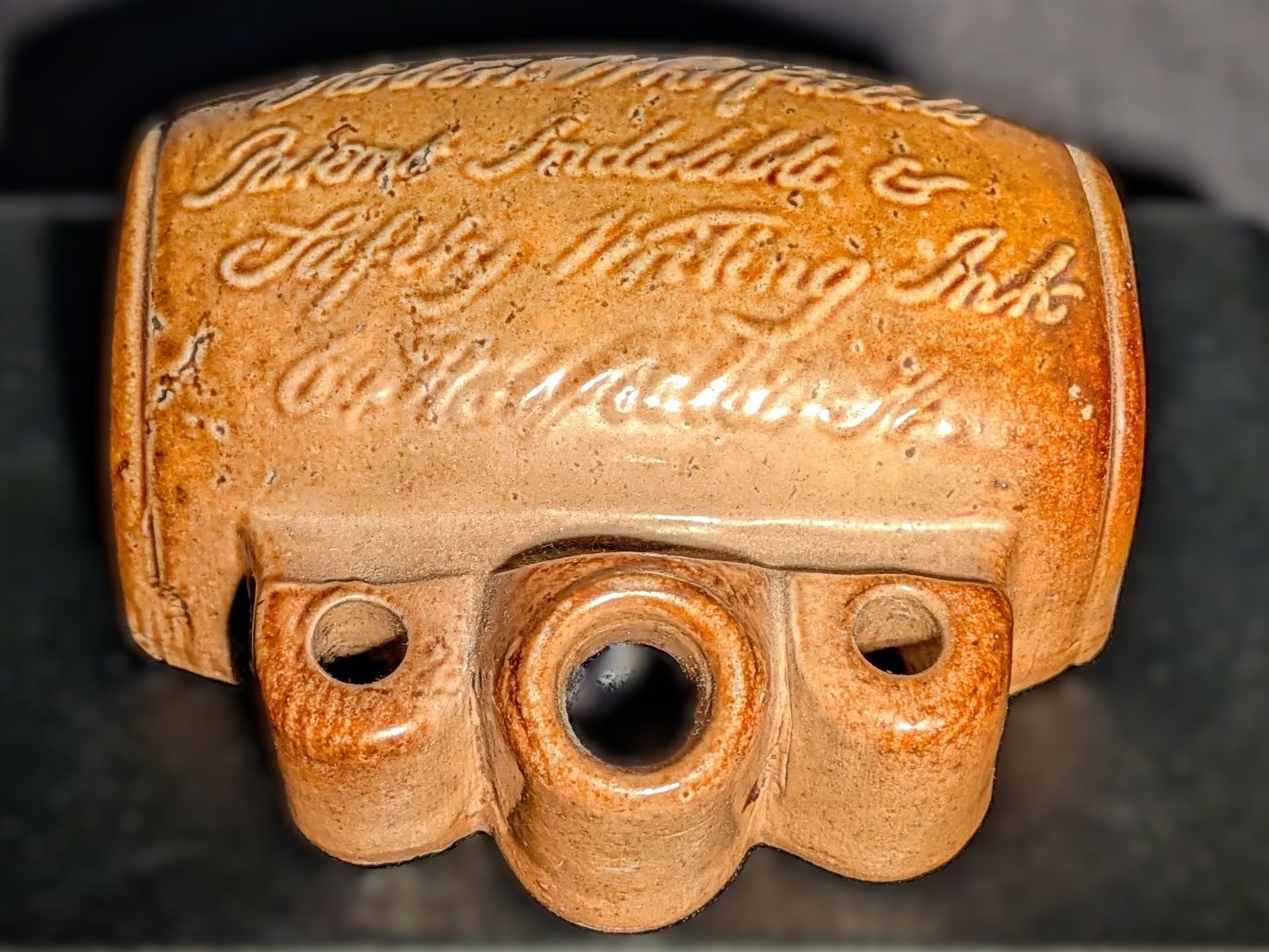
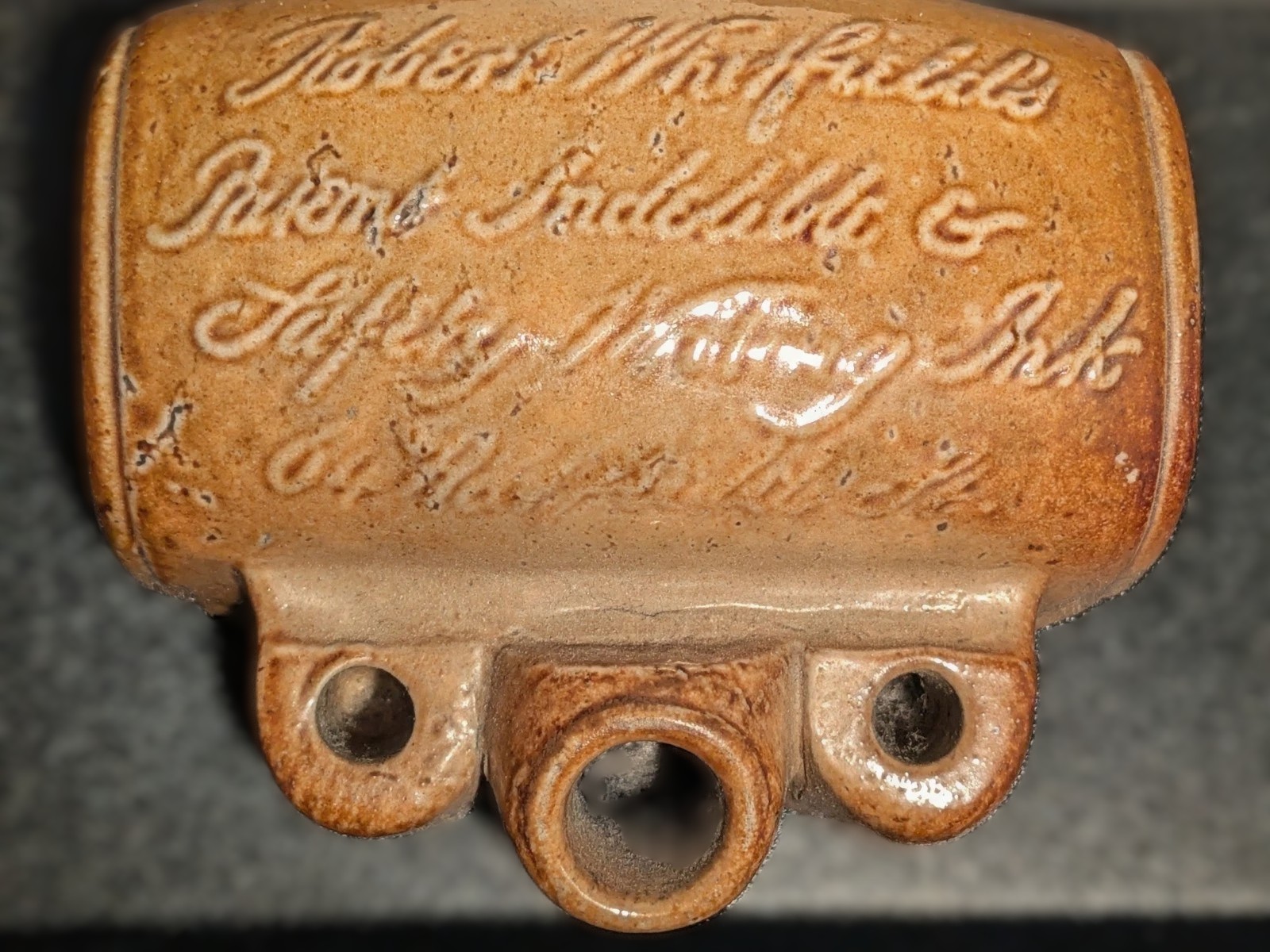
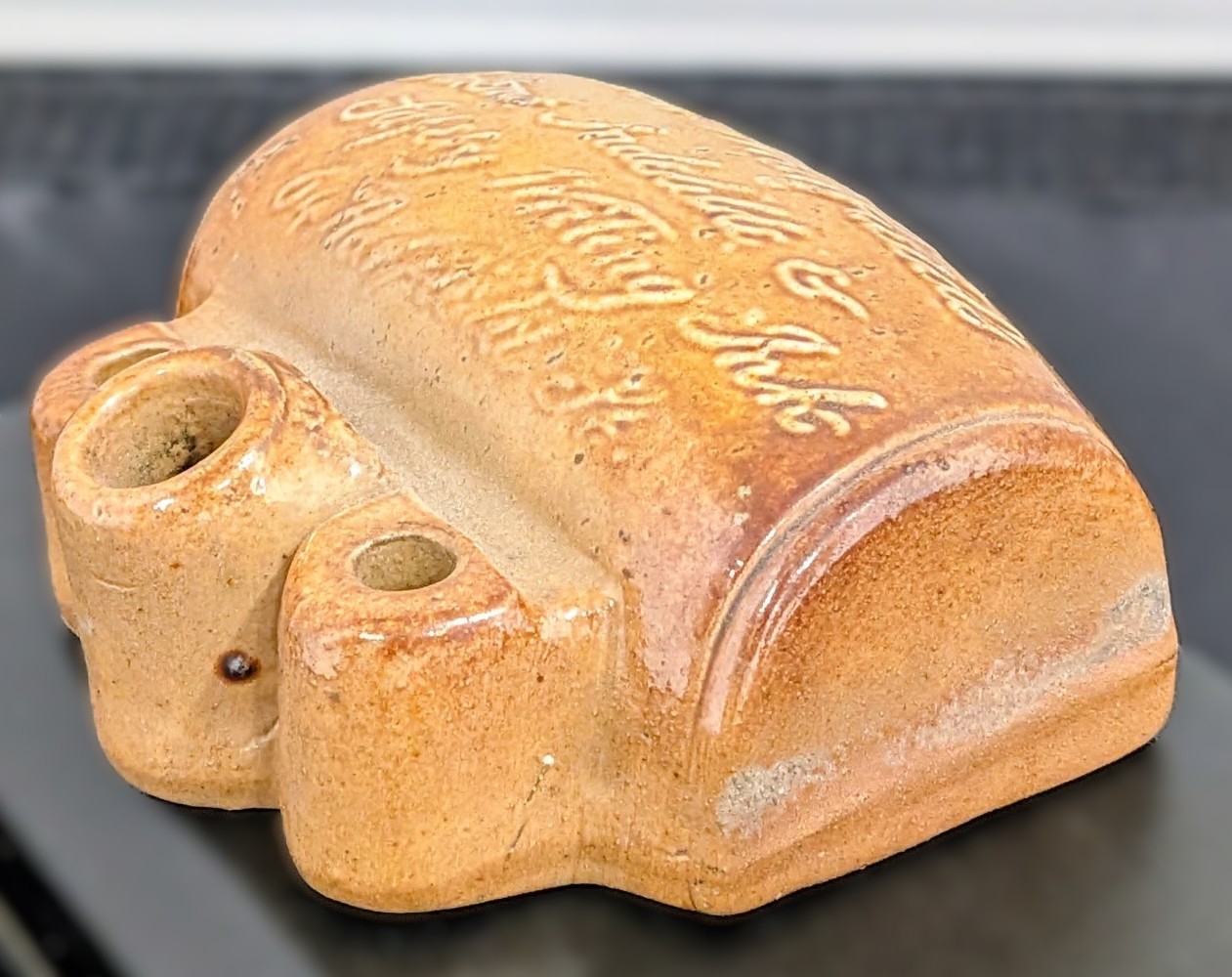
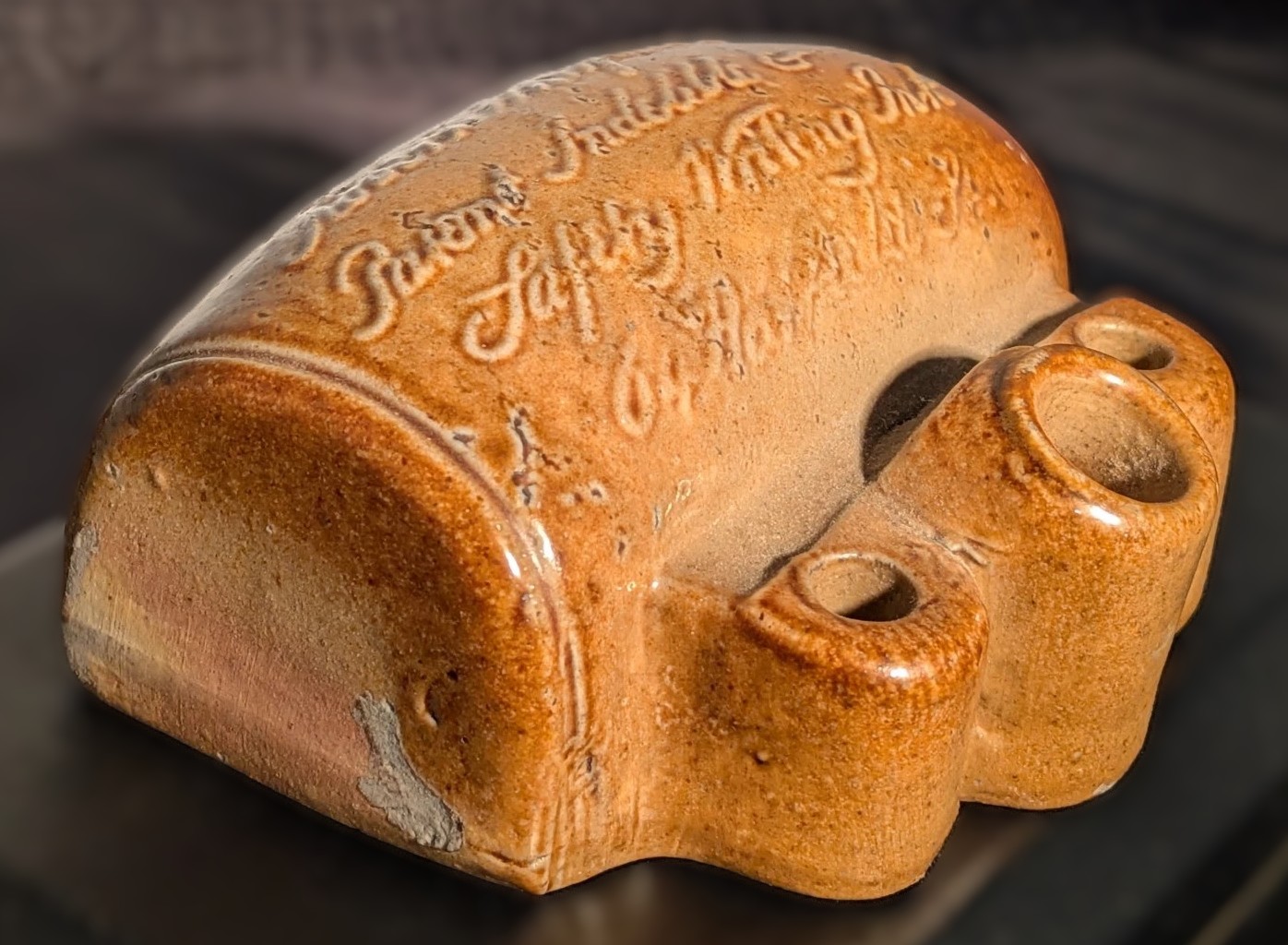
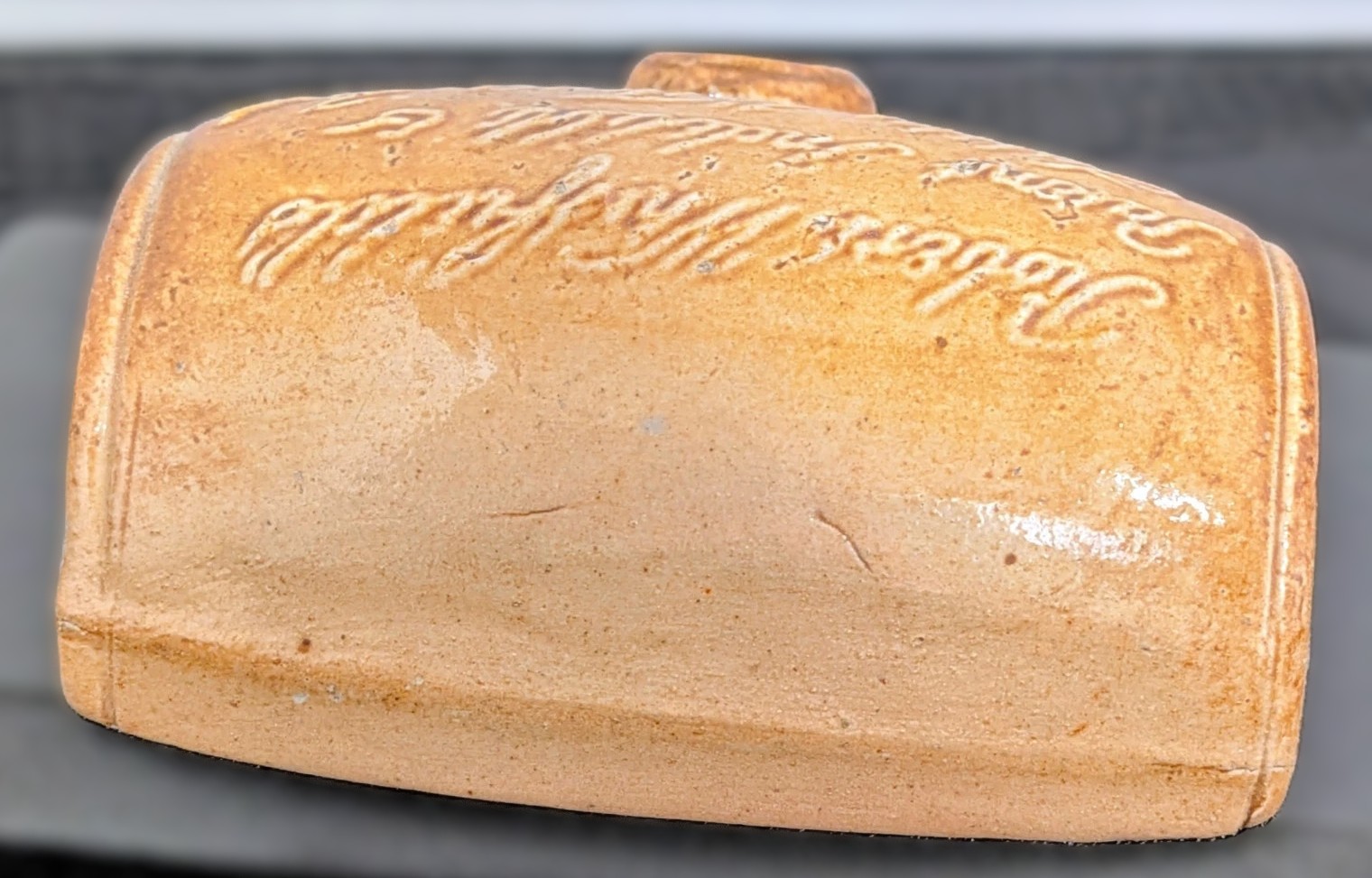
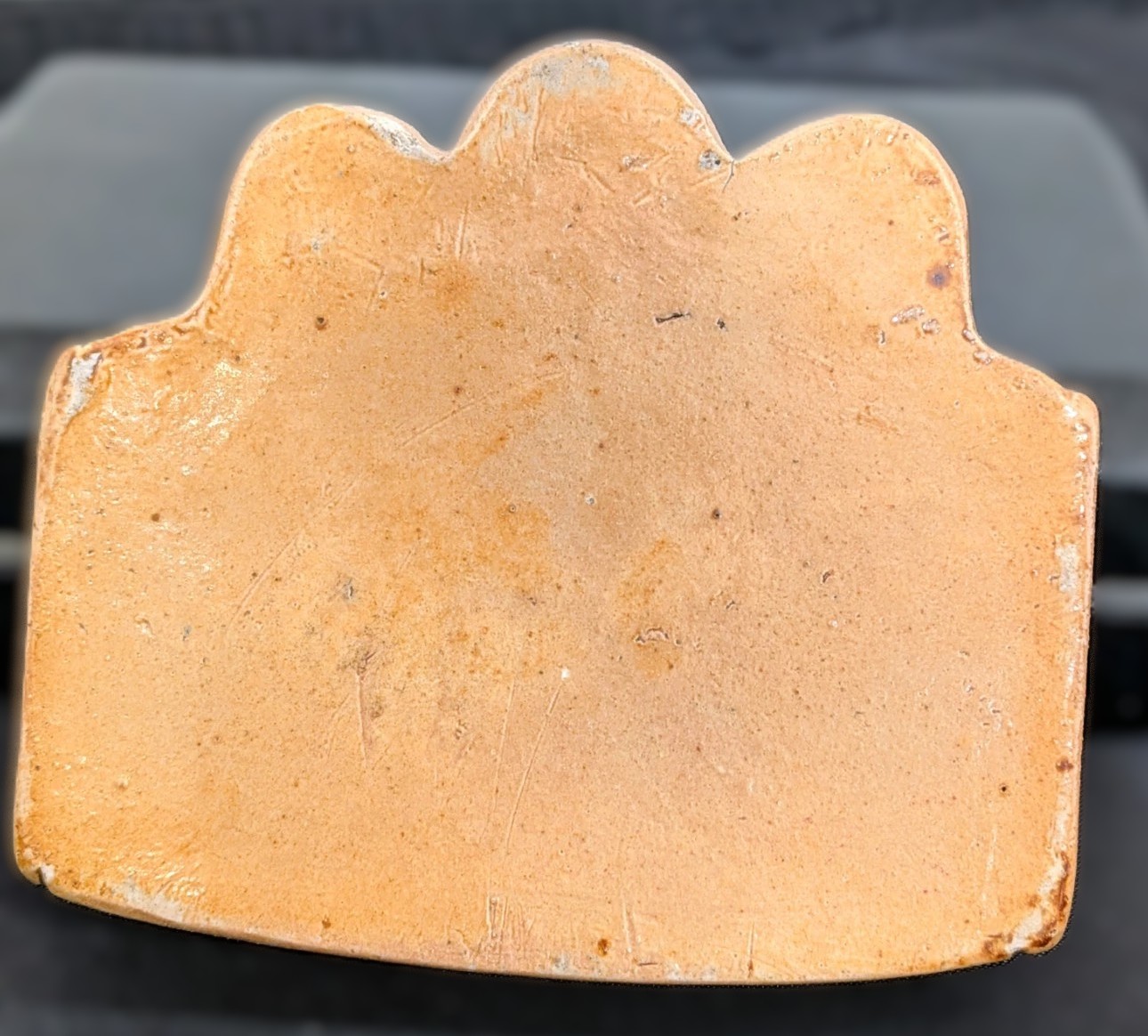
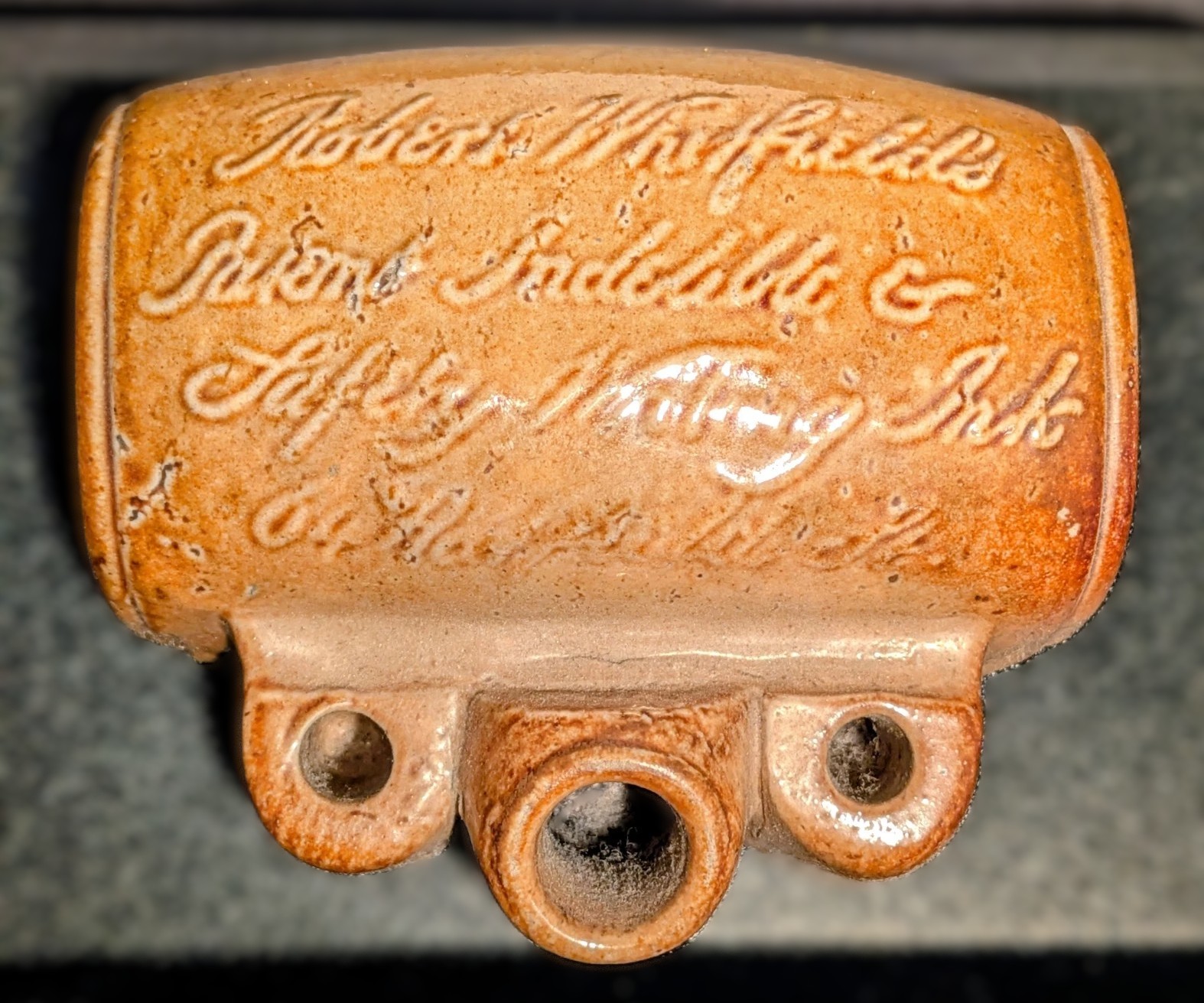
- Dimensions & Form: Measuring approximately 3 ⅝” x 3 ⅜” x 1 ⅝” high, this inkwell features a cylindrical, barrel-like upper body with a flat, stepped base. Projecting from the front is an integrated multi-port structure containing a larger central aperture (for the inkwell reservoir) flanked by two smaller vertical holes. These smaller sockets were designed to hold dip pens or quill pens upright when not in use.
- Material & Glaze: It is crafted from dense salt-glazed stoneware with a characteristic brownish, iron-oxide slip or “Albany-type” wash finish that yields a glossy, pebbled, salt-glazed texture.
- Embossed Markings: The curved top barrel is embossed in high-relief script:
Robert Whitfield’s Patent Indelible & Safety Writing Ink 64 Hatfield St.
- Use in Advertising
This piece served a dual purpose as both a functional desktop tool (an inkwell and pen stand) and a permanent three-dimensional advertisement for Robert Whitfield’s commercial writing ink.
During the 19th century, merchants and ink makers utilized stoneware inkwells molded with their brand names, addresses, and product claims. Placed prominently on the desks of merchants, clerks, and public offices, these heavy stoneware pieces acted as constant, durable billboards for the brand long after the original bottled ink had been consumed.
- What was patented: The ink or the inkwell?
The patent applied to the ink, not the inkwell.
- The inscription explicitly reads “Patent Indelible & Safety Writing Ink”.
- In the early-to-mid 19th century, document tampering, forgery, and chemical erasure (using acids to wash away ink on fraudulent checks or legal deeds) were major concerns. Ink makers raced to formulate “indelible” and “safety” writing inks that bound permanently to paper fibers or resisted chemical bleaching.
- The stoneware vessel itself was merely a clever marketing container and desk stand commissioned by Whitfield to merchandise his proprietary chemical ink formula.
- What is the history of Robert Whitfield’s ink?
- The Location (64 Hatfield St.): Hatfield Street (situated south of the Thames near Stamford Street in Blackfriars/Southwark, London) was a hub for light manufacturing, printing works, stationers, and chemical trades during the Victorian era.
- Commercial Context: In an era before fountain pens with internal sacs became mainstream, dip pens ruled offices. The market for specialized writing fluids was highly competitive. Inventors and stationers frequently patented chemical compositions designed to prevent fading over time (“indelible”) and foil document alteration (“safety”). Robert Whitfield operated out of the Southwark/Blackfriars district of London to supply legal, commercial, and government stationers with these specialized writing fluids.
- Dating the Inkwell – Evaluating the London Museum’s 1831–1850 date
- The London Museum’s Date (1831–1850?): The question mark assigned by the museum reflects the inherent difficulty in precisely dating utilitarian stoneware without hallmarks. However, this window is historically consistent and accurate for several reasons:
- Stoneware Technology & Form: Heavy salt-glazed stoneware inkwells featuring embossed, slip-highlighted lettering proliferated in Great Britain during the reigns of William IV and early Queen Victoria (roughly the 1830s through the 1850s) before being largely supplanted by molded glass and porcelain ink sets later in the 19th century.
- Urban Directory Context: The Southwark and Blackfriars industrial districts experienced a massive boom in chemical and stationery manufacturing following the expansion of London infrastructure in the 1830s.
- Conclusion on Dating: The piece can be confidently attributed to the circa 1830–1850 timeframe, fitting squarely within the early Victorian era.
- Historical Link to the Patent (1837)
- The Patent Record: Historical rolls of British patents confirm that a Robert Whitfield (originally of Hercules Buildings, Westminster Road) secured a patent formulation on November 14, 1837, for a specialized chemical composition.
- The Nature of the Invention: In 19th-century patent shorthand, his filing covered an invention described as “a composition, which he denominates ‘an…” (targeting specialized writing fluids designed to prevent forgery and smudging). The term “Patent Indelible & Safety Writing Ink” stamped on this inkwell directly references this chemical breakthrough.
- The Significance of 64 Hatfield Street
- The Location: Hatfield Street (located off Stamford Street near Blackfriars Road/Southwark south of the Thames) was a dense pocket of 19th-century London commerce, housing printers, ink manufacturers, and chemical stationers (such as Hudson & Kearns nearby).
- Business Evolution: Ink makers often updated their packaging or relocated slightly as their distribution grew. The presence of the 64 Hatfield St. address indicates that by the time these stoneware vessels were mass-produced for his business, Whitfield had established a commercial headquarters in this thriving Southwark industrial zone to supply law courts, counting houses, and merchant clerks across London.
Sold for $81 in October 2026
Content disclaimer. The information posted is the owner’s best knowledge and may not have been vetted by the SOIC. We welcome comments, corrections, and additions, working to make our website information comprehensive and accurate.
Join the Society of Inkwell Collectors (SOIC) – it’s free!
Founded in 1981 as a non-profit organization,
we are documenting inkwells (and accessories).
We’re here to help and inform!