

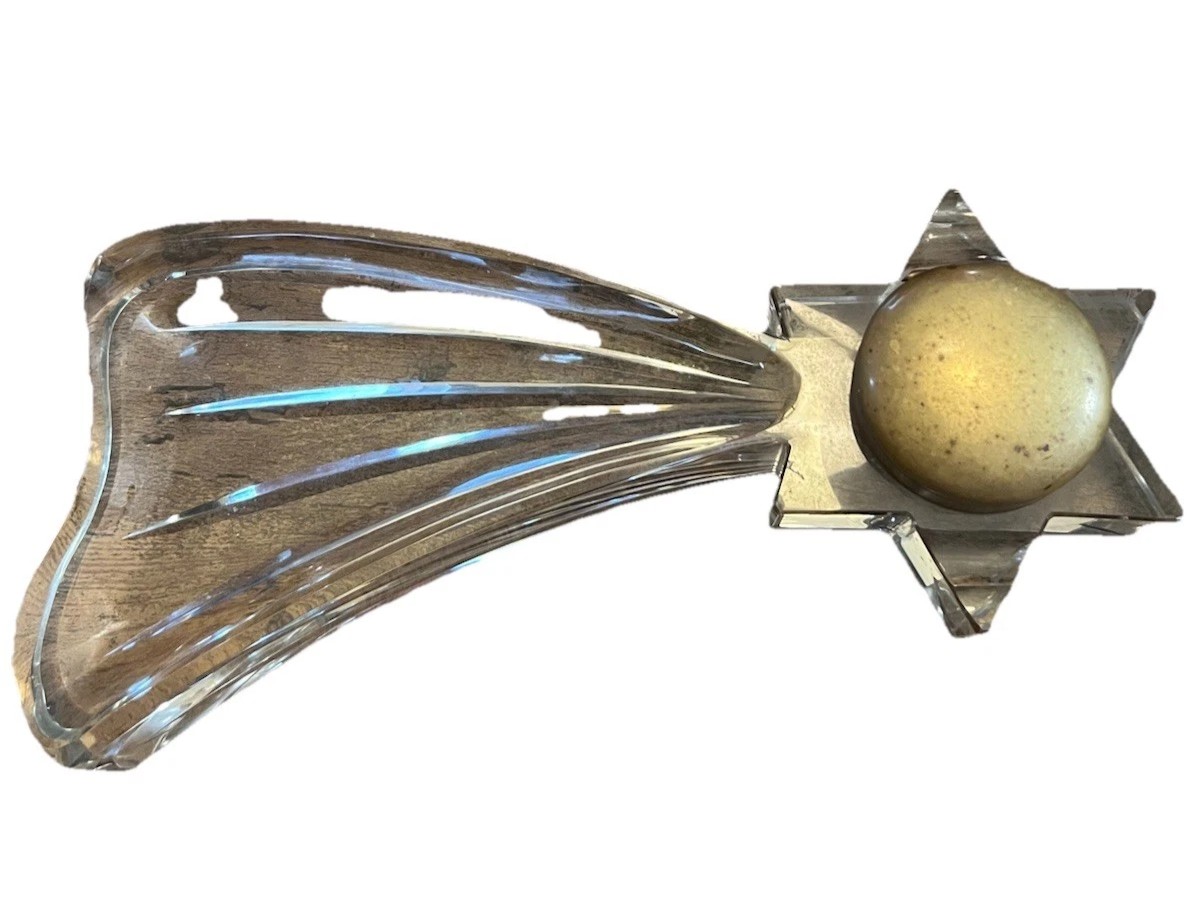
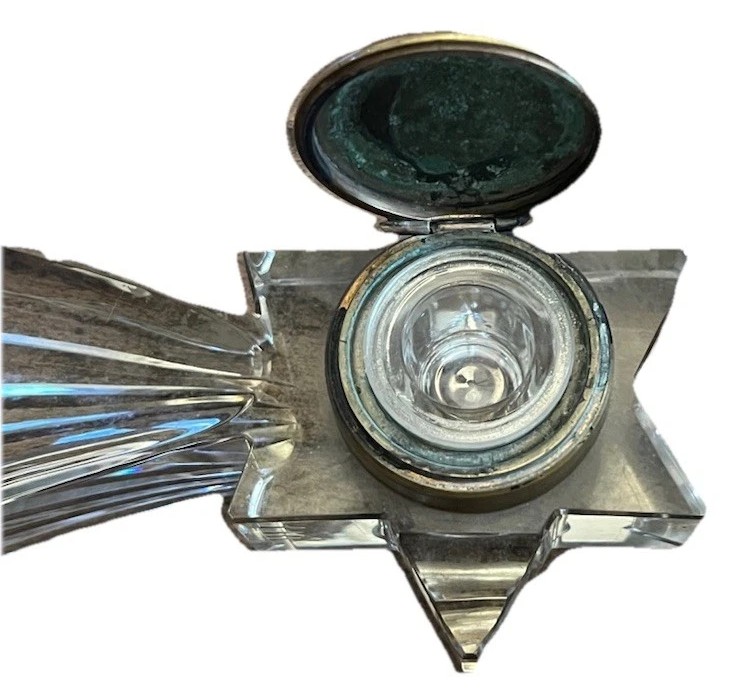
Molded Glass Comet-Shaped Inkstand
| Categories | Glass - Figural |
| Material | Glass |
| Markings | Unmarked |
| Manufacturer | Undetermined |
| Origin | Undetermined |
| Date or Era | circa 1910 |
Description
This molded glass comet-shaped inkstand commemorates Halley’s Comet.
- The Body: The heavy, clear pressed-glass tray is shaped like a celestial comet. The broad, sweeping tail features deep, linear fluting or ridges that catch the light to simulate glowing gas and dust streaming through space and serves as a place to rest a pen.
- The Inkwell: The head of the comet terminates in a multi-pointed star (resembling a starburst or six-pointed celestial star) which holds the inkwell.
- The Mountings: It features a fitted metal collar and a hinged, domed metal lid that flips open to reveal the original glass insert.
Commemorating Halley’s Comet
Celestial themes—and Halley’s Comet specifically—became massive cultural sensations during its historic 1910 return.
The world was gripped by comet fever in the spring of 1910. Because Halley’s visible approach coincided with the height of the Art Nouveau, artisans and manufacturers flooded the market with comet-themed commemorative novelty items, postcards, jewelry, glassware, and desktop trinkets.
Details of the 1910 Halley’s Comet Event
- The Passage: Halley’s Comet is the only known short-period comet that is regularly visible to the naked eye from Earth, returning every 75 to 76 years.
- Closest Approach & Earth’s Transit: Its closest approach to Earth occurred on May 19, 1910. Adding to the global drama, Earth actually passed straight through the tail of the comet on that night.
- Public Panics and Parlor Tricks: Spectators worldwide gathered on rooftops and hosted “comet-crescent” viewing parties. At the same time, sensationalist newspaper headlines falsely claimed that spectroscopic analysis had detected poisonous cyanogen gas in the comet’s tail, leading some panicked citizens to buy “comet pills” or seal their windows shut—while others popped champagne to toast the spectacle.
When and Where Was It Made?
- Date: Circa 1910 (right around the famous 1910 perihelion passage of Halley’s Comet).
- Maker / Location: While unmarked pieces like this can occasionally be challenging to pin down to a single factory, major European glass centers—particularly Bohemia (now the Czech Republic) and France, as well as prominent makers in England—specialized in novelty pressed-glass and mercury/silvered-glass desk wares during the late 19th and early 20th centuries. Bohemian and French glassworks were especially prolific in producing whimsical, highly figurative molded crystal inkstands tailored to contemporary public crazes.
Sold for $135 in September 2026
Content disclaimer. The information posted is the owner’s best knowledge and may not have been vetted by the SOIC. We welcome comments, corrections, and additions, working to make our website information comprehensive and accurate.
Join the Society of Inkwell Collectors (SOIC) – it’s free!
Founded in 1981 as a non-profit organization,
we are documenting inkwells (and accessories).
We’re here to help and inform!