

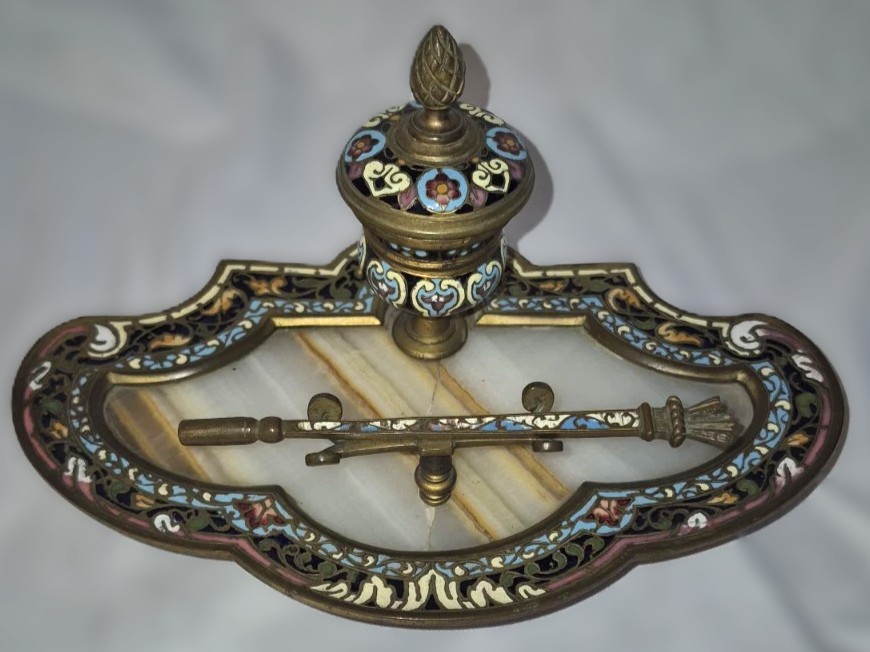
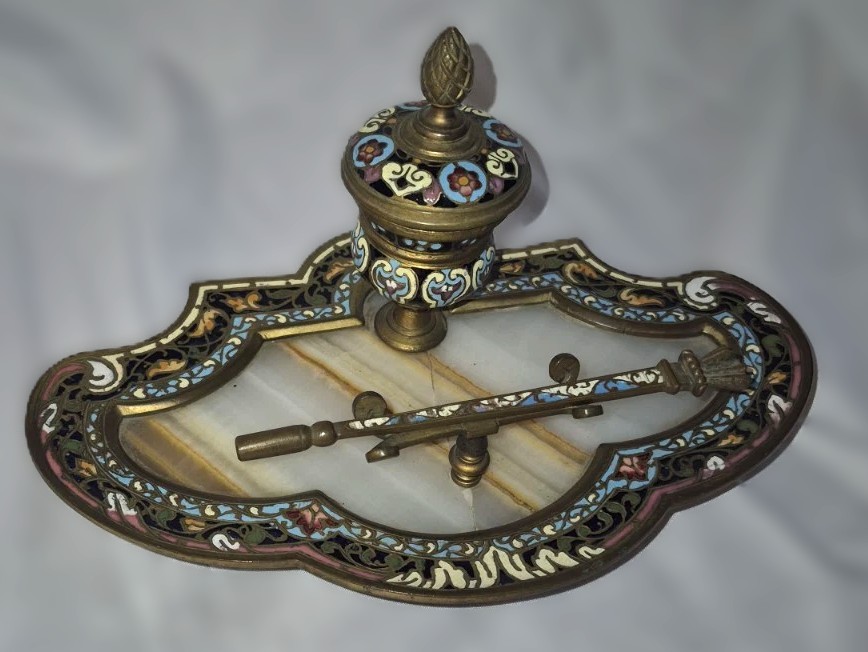
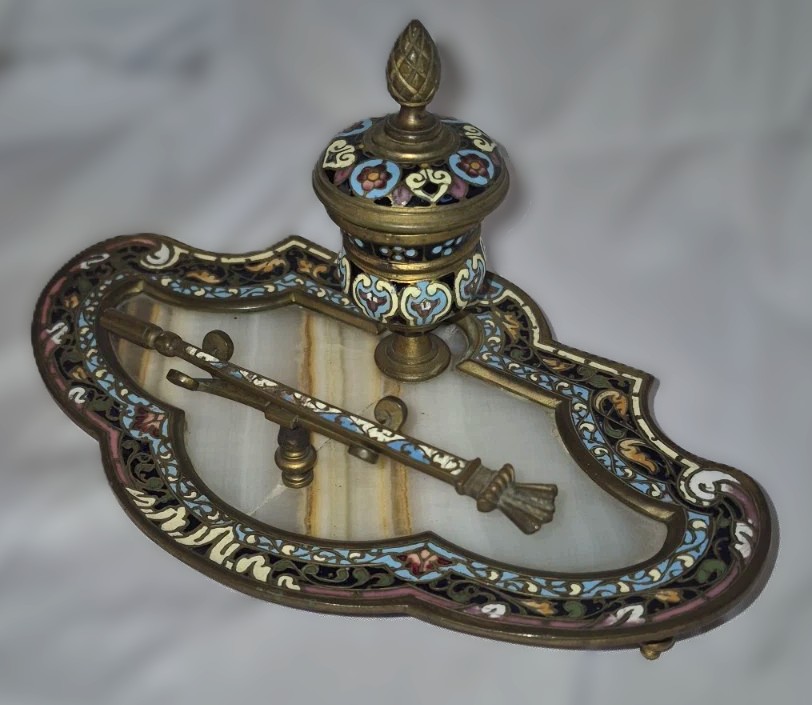
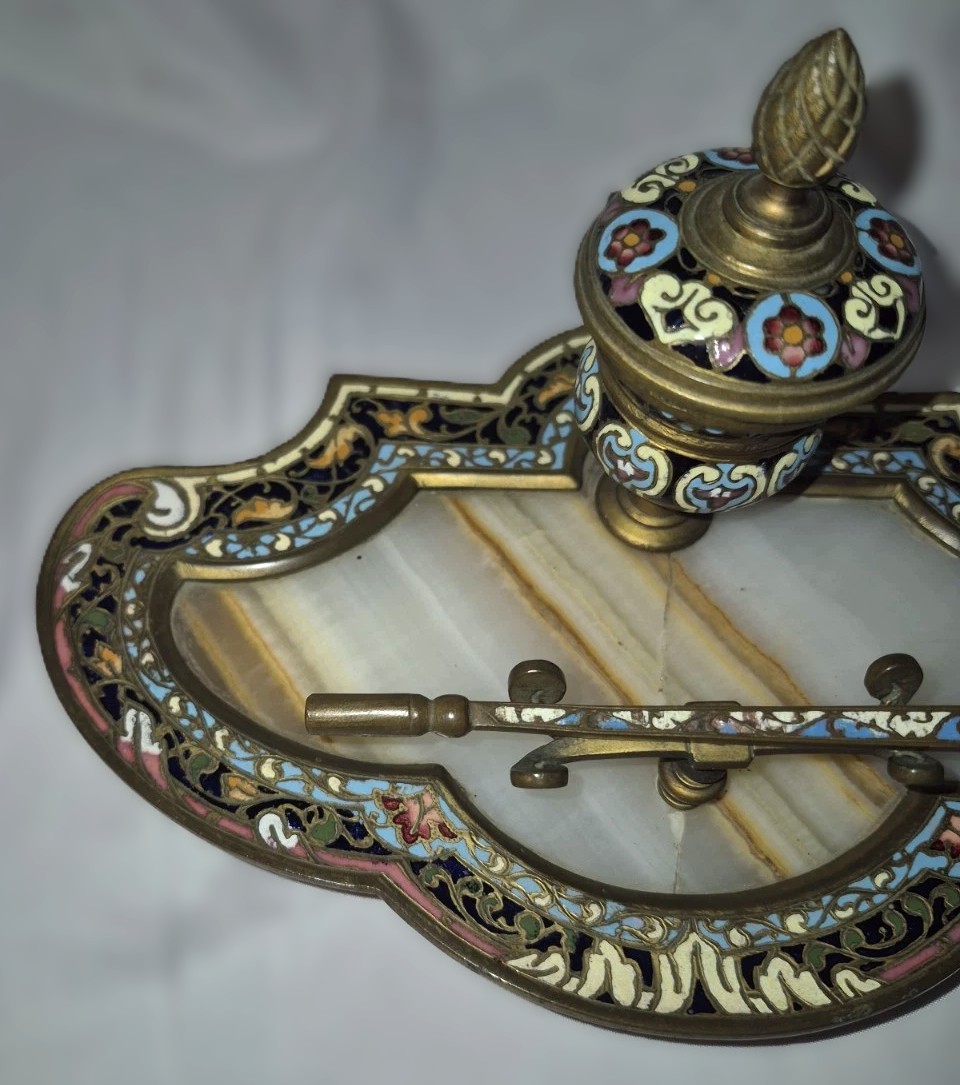
19th Century French Champlevé Inkstand
| Categories | Enameled Metal |
| Type | Champlevé |
| Material | Enameled Brass/Bronze/Metal, Onyx |
| Markings | See Narrative |
| Manufacturer | Undetermined |
| Origin | France |
| Date or Era | circa 1880 |
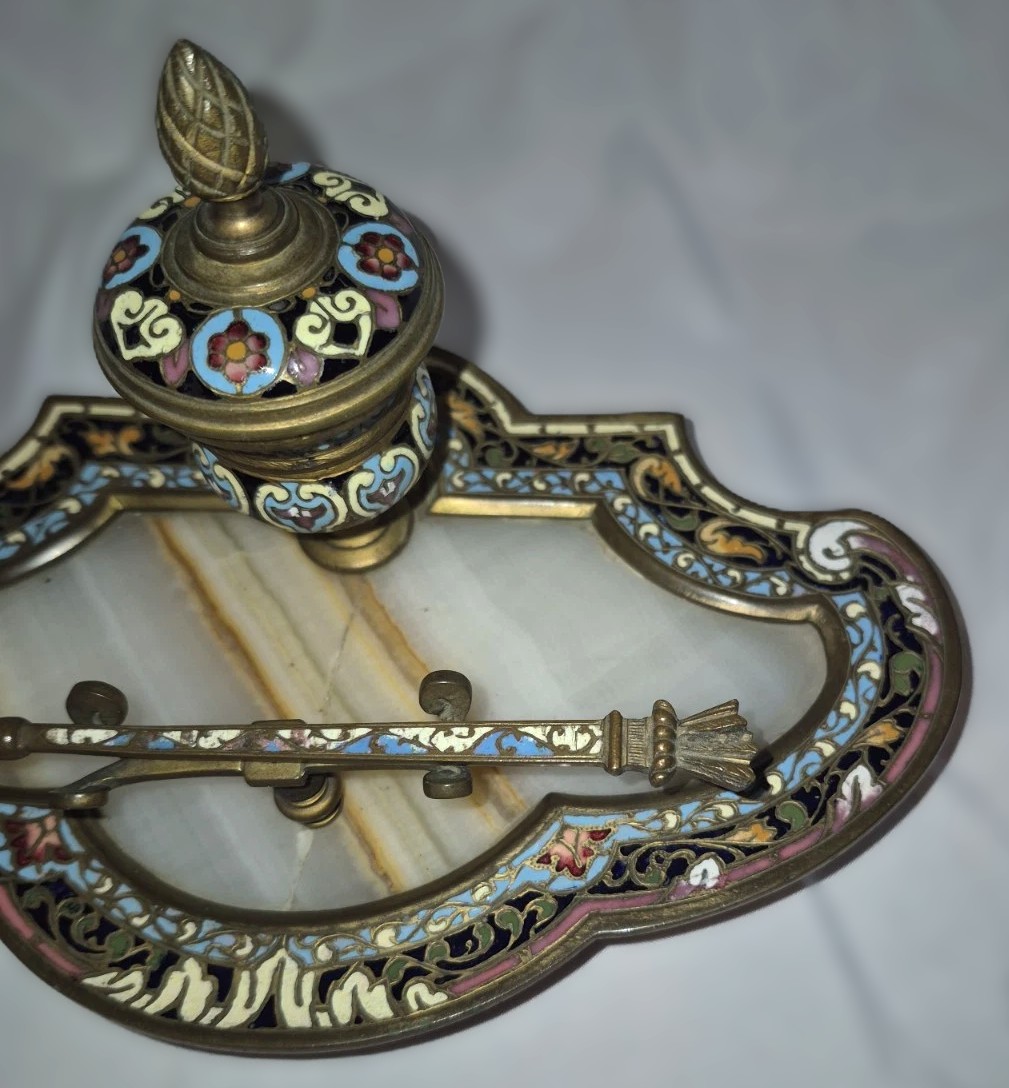
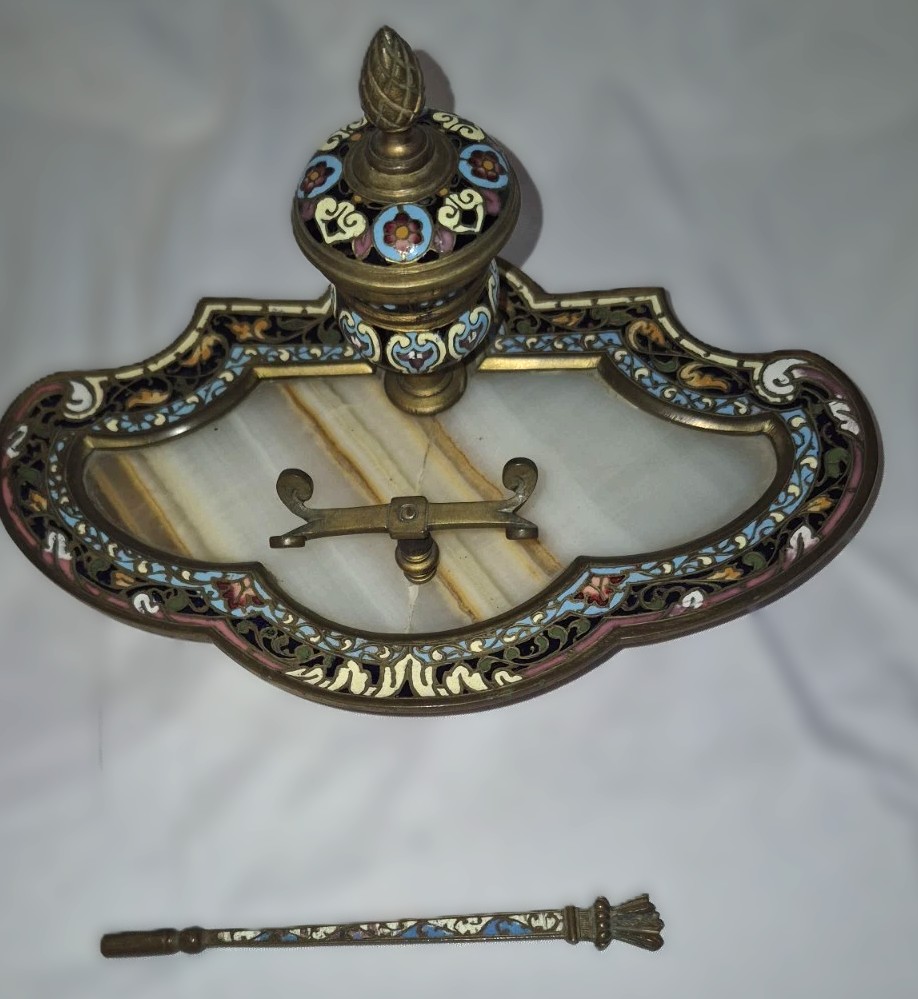
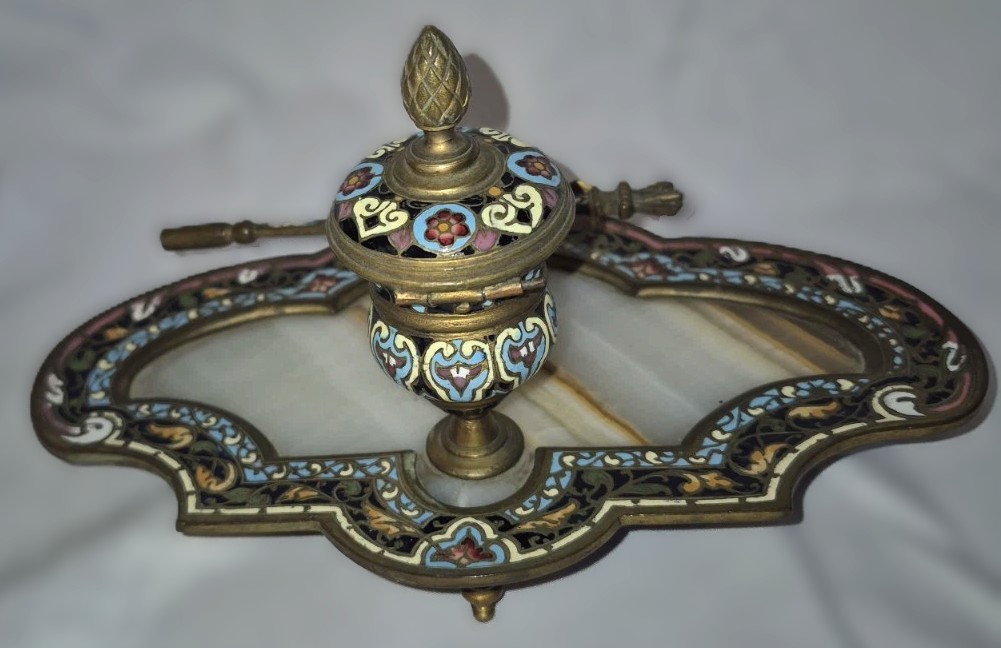
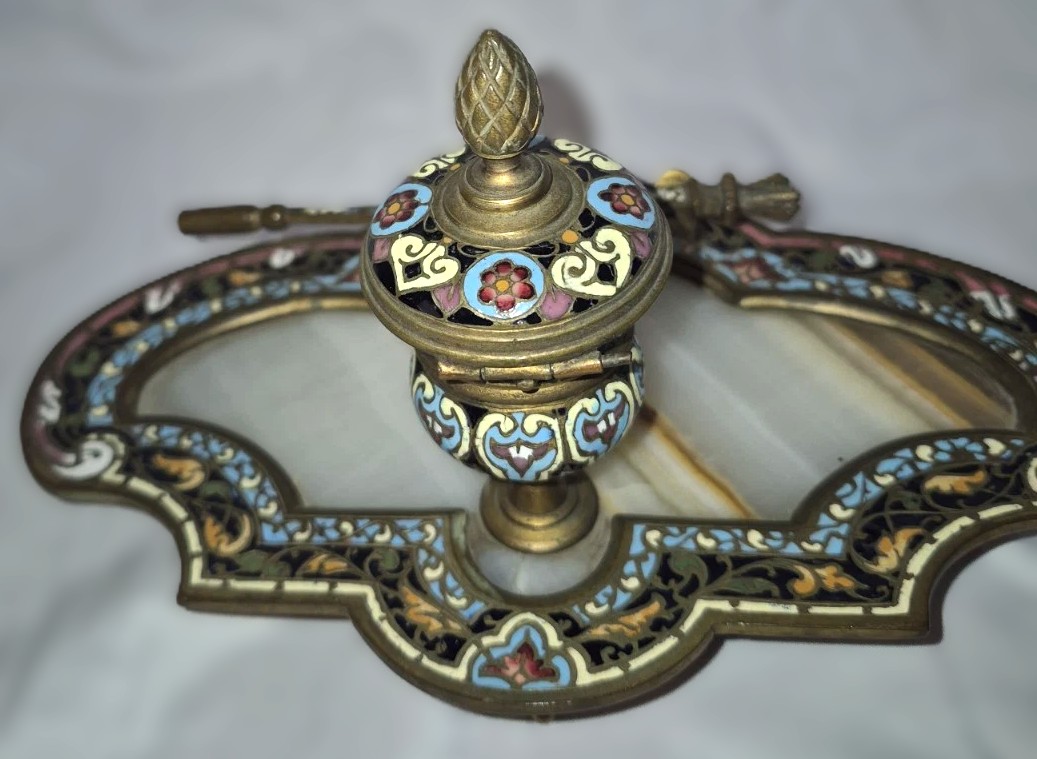
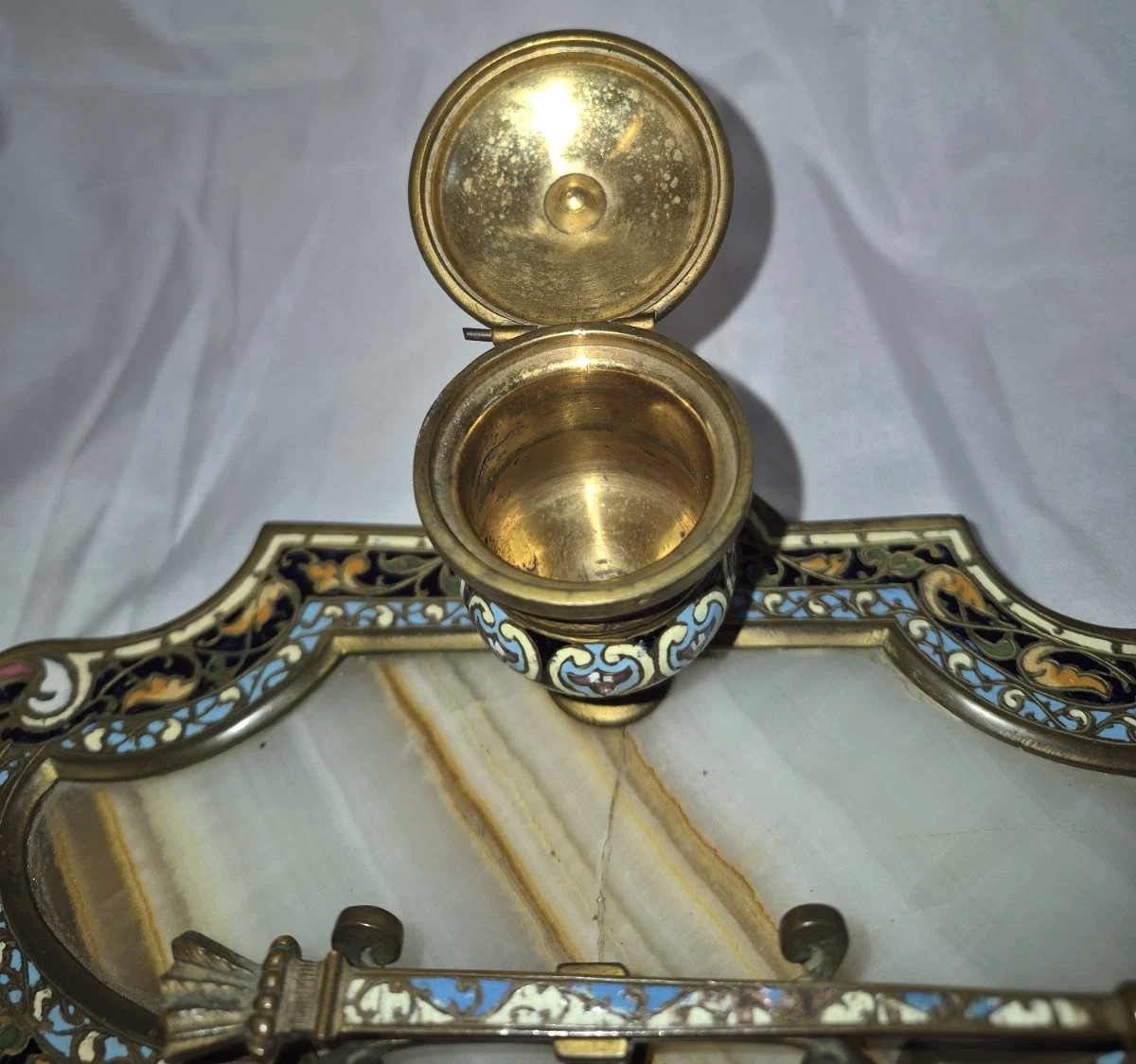
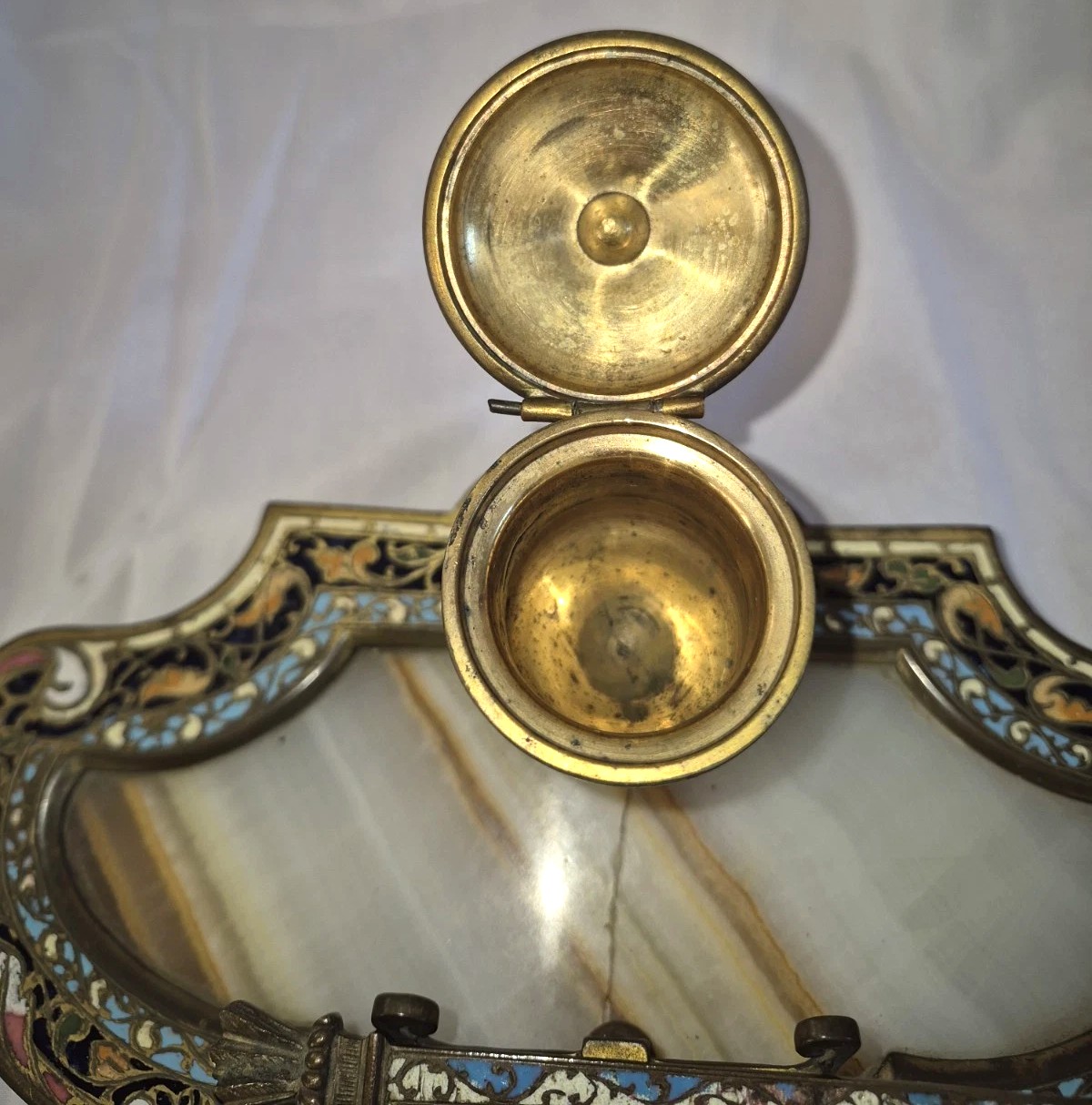
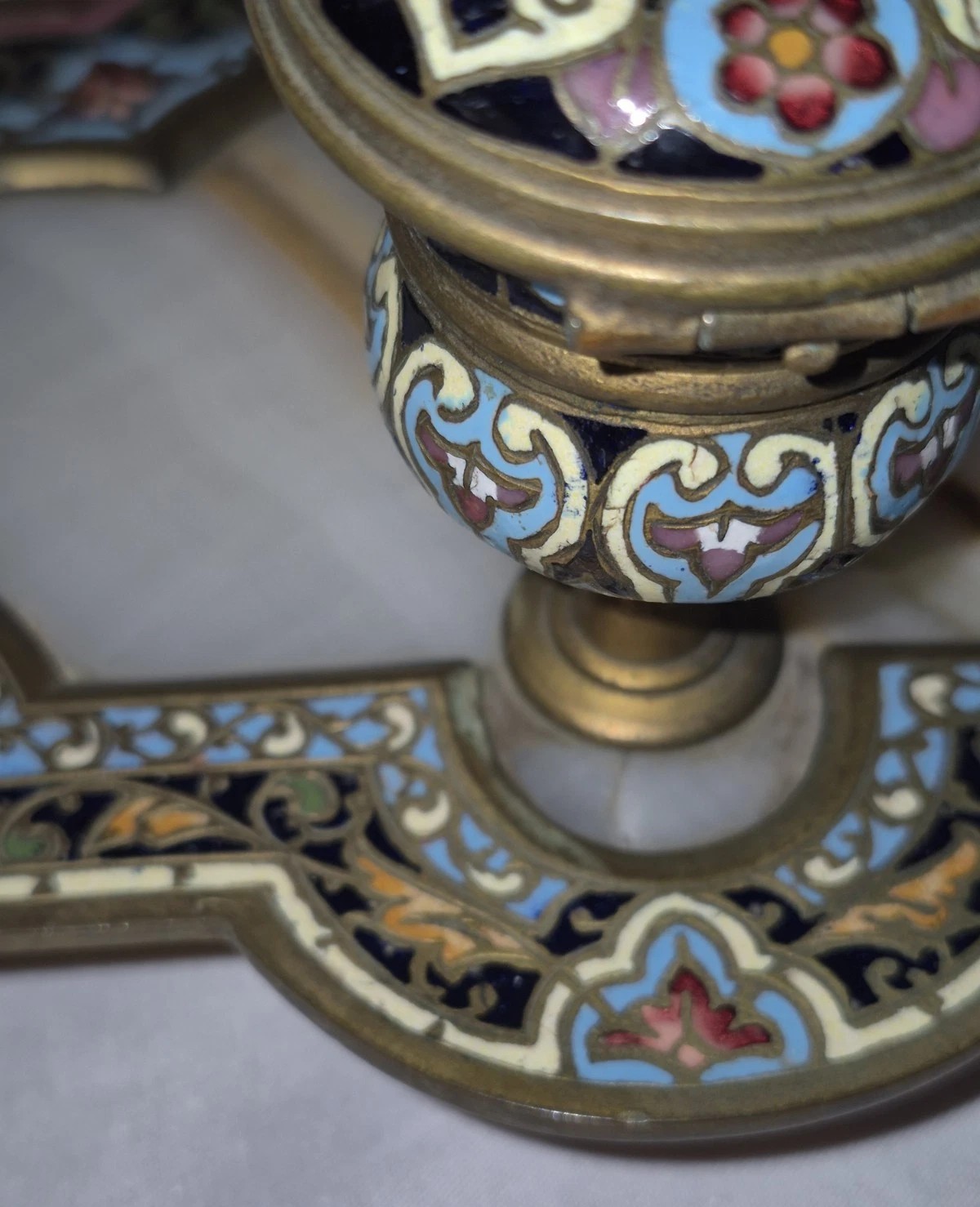
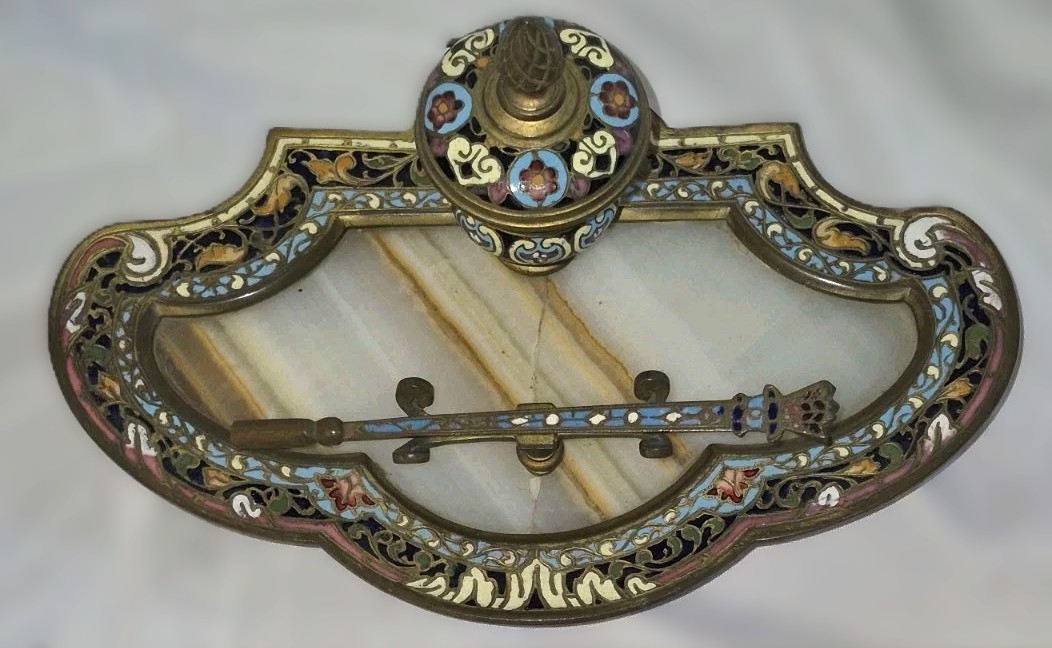
This 19th century luxury desk accessory is a masterclass in French decorative metalwork and lapidary art. The inkstand features an elegantly contoured base made from natural banded onyx, displaying warm, translucent white and honey-beige strata that provide a rich, luminous background.
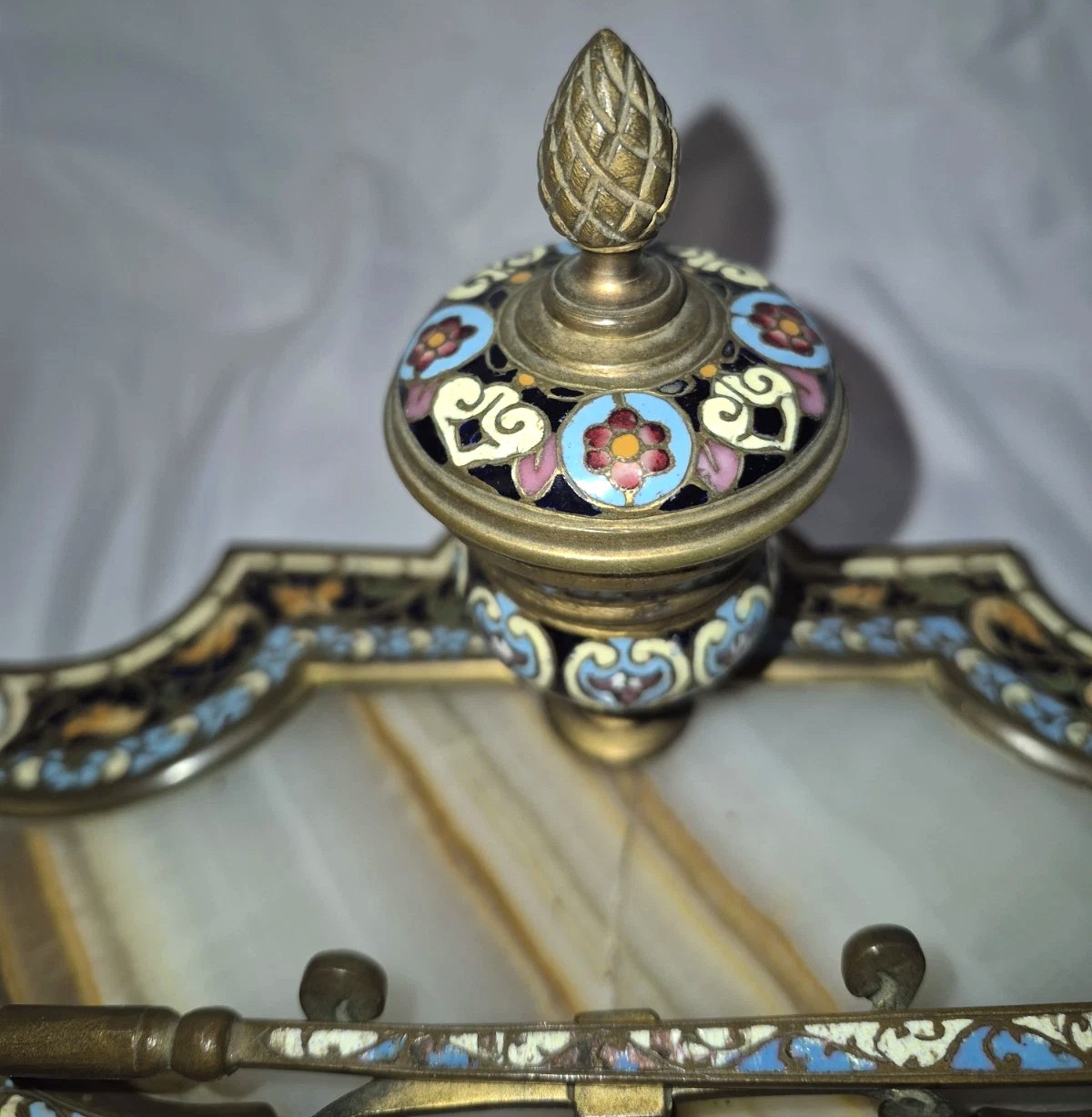
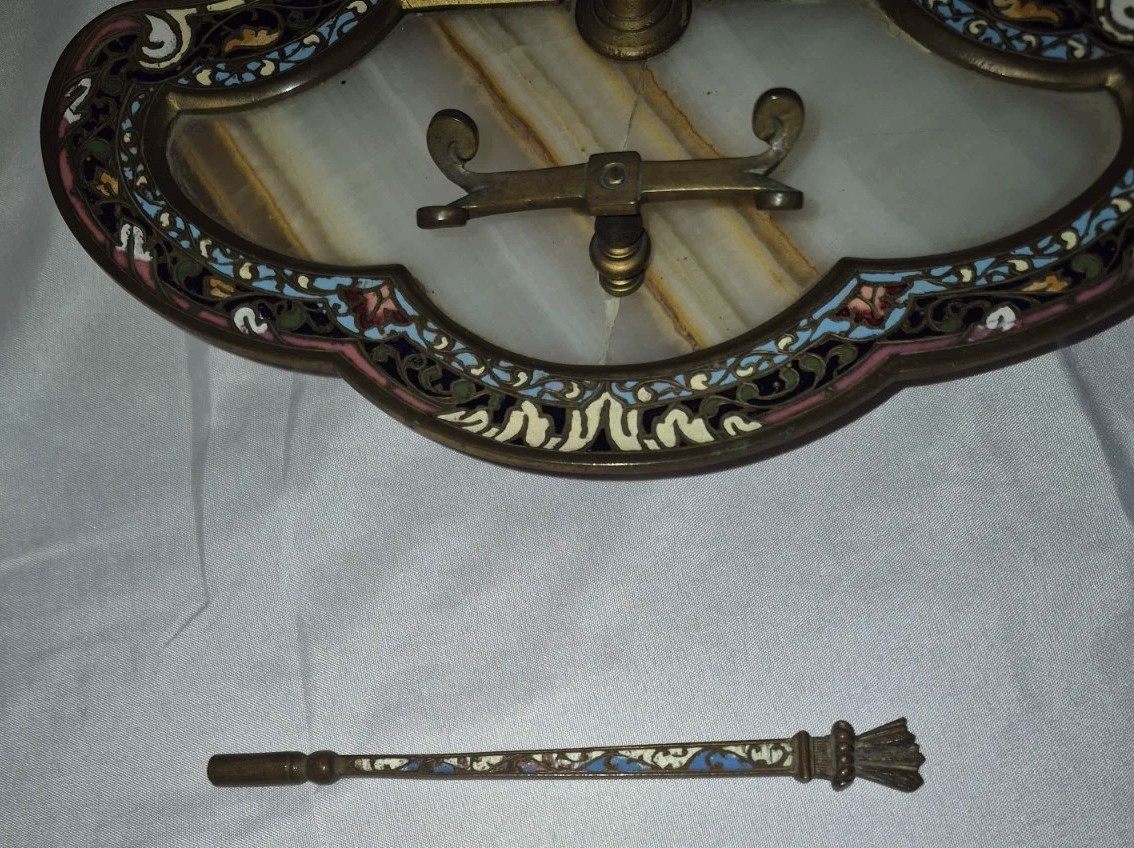
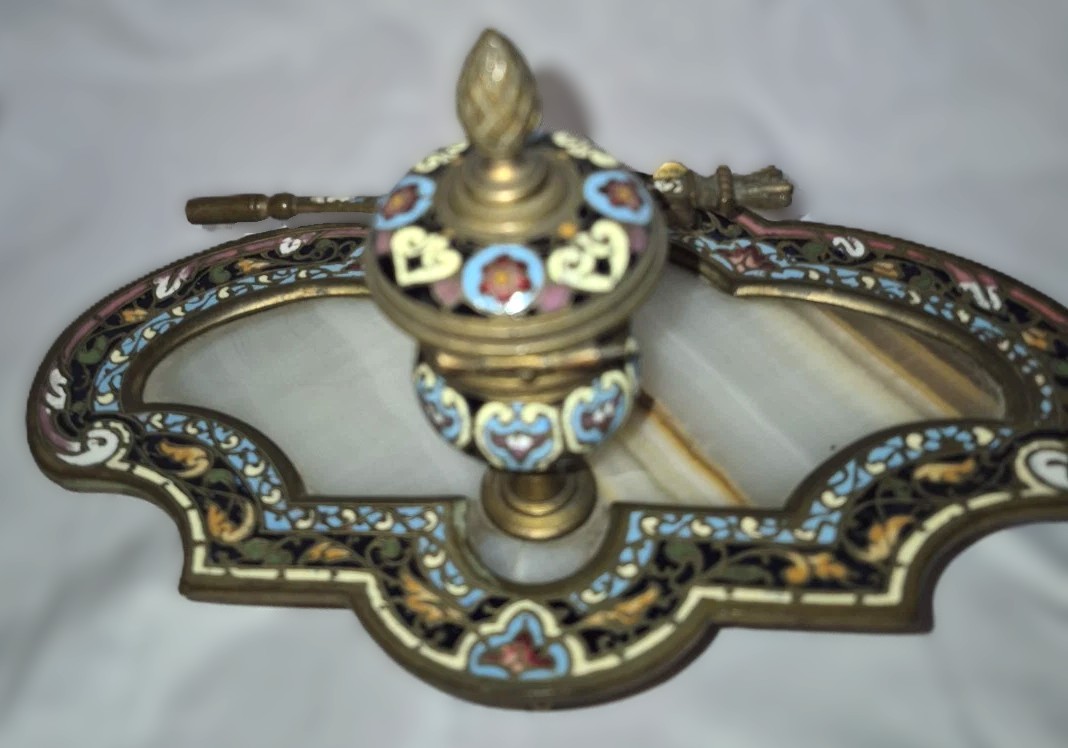
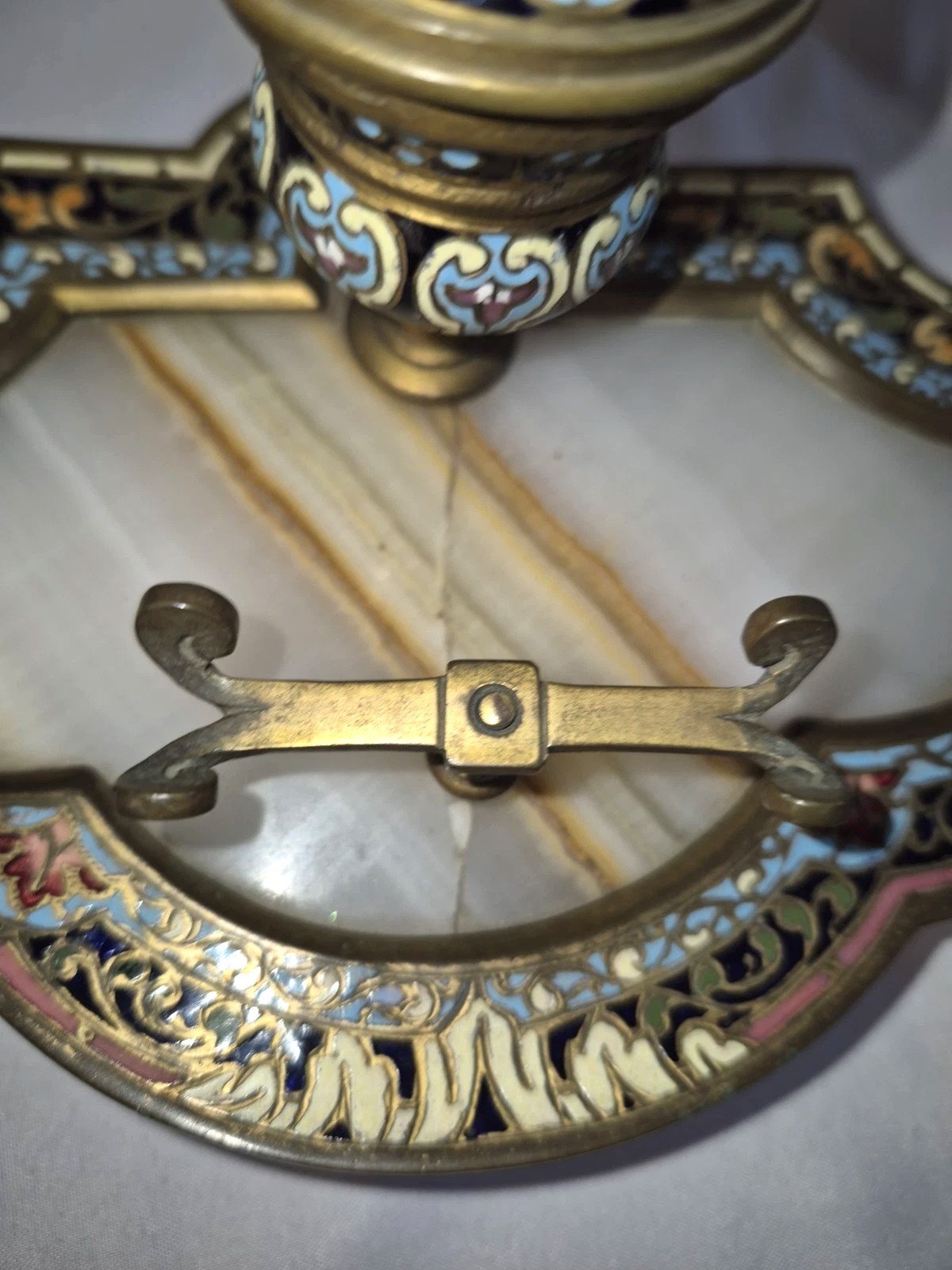
Framing the onyx is an ornate gilt-bronze (ormolu) mount decorated in vibrant champlevé enamel. The outer rim and the matching bulbous inkwell follow an undulating, asymmetrical Rococo-revival or Aesthetic Movement contour. The enamel palette includes tones of cobalt blue, turquoise, soft pink, opaque white, and olive green, forming intricate arabesques, floral motifs, and geometric scrolls.
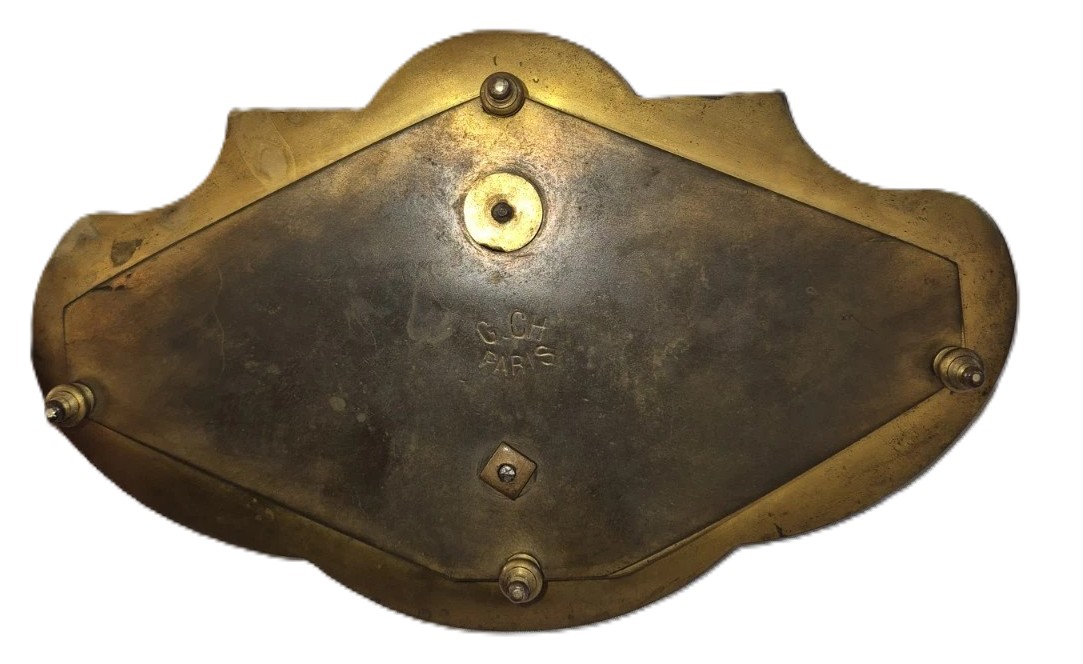
The inkwell, positioned centrally on an elevated tier, is crowned with a finial shaped like a stylized pinecone—a classical symbol of hospitality, regeneration, and eternal life. The set includes a matching champlevé-enameled dip pen/nib rest resting horizontally across the onyx tray. The base is supported by four delicate, tiered peg feet and secured on the underside by threaded brass screws.
What is Champlevé Enamel?
Champlevé (derived from the French for “raised field”) is an ancient vitreous enameling technique perfected during the Middle Ages and revived with exceptional skill by 19th-century French artisans.
- The Process: Unlike cloisonné (where wire partitions are soldered onto a metal surface to form cells), champlevé involves carving, gouging, or casting troughs, depressions, or channels directly into the thick body of the metal base (in this case, bronze).
- The Application: These hollowed-out recesses are then filled with powdered glass mixed with metal oxides (enamel paste).
- Firing & Finishing: The piece is fired at high temperatures in a kiln, causing the enamel to melt into a smooth, durable, colored vitreous glass layer flush with the metal partitions. Finally, the surface is ground down and polished to a seamless sheen, leaving the raised metal lines framing the vibrant colored glass fields.
Date of Manufacture
- Date Range: c. 1870 – 1890 (Late 19th Century, Napoleon III / Third Republic period).
- Stylistic Context: The blending of richly veined natural onyx with brightly colored champlevé enamel on cast bronze was a hallmark of high-end Parisian luxury goods (bronzes d’art) produced during the height of the Second Empire and the early Third Republic, heavily influenced by a fascination with both revived historical gothic/Renaissance methods and exoticism.
Manufacturer and Markings Analysis
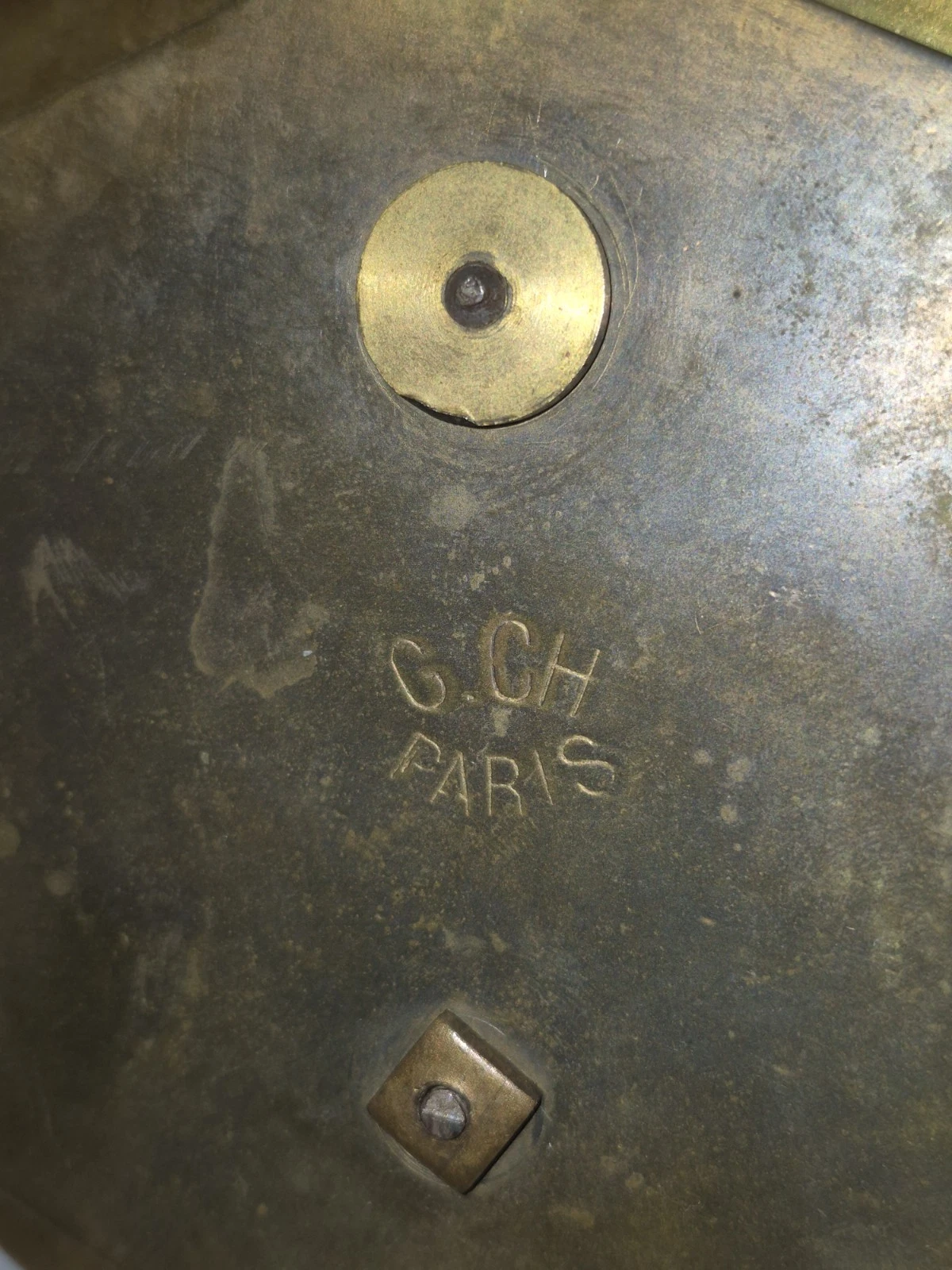
An examination of the underside reveals the stamped maker’s mark: G.CH over PARIS.
- Attribution: In 19th-century French bronze and foundry nomenclature, stamps of this format typically represent either a specialized Parisian bronzier, retailer, or decorative arts atelier operating during the late 1800s. While exact records linking every abbreviated stamp like “G.CH” to a specific master workshop can sometimes be obscured by the collaborative nature of Parisian bronze and enamel houses (where bronze-casting, stone-cutting, and enameling were often outsourced to specialized artisans), the stamp confirms genuine Parisian origin from a prominent trade workshop specializing in high-end desk garnitures and champlevé luxury wares for the international market.
Sold for $287 in September 2026
Content disclaimer. The information posted is the owner’s best knowledge and may not have been vetted by the SOIC. We welcome comments, corrections, and additions, working to make our website information comprehensive and accurate.
Join the Society of Inkwell Collectors (SOIC) – it’s free!
Founded in 1981 as a non-profit organization,
we are documenting inkwells (and accessories).
We’re here to help and inform!