

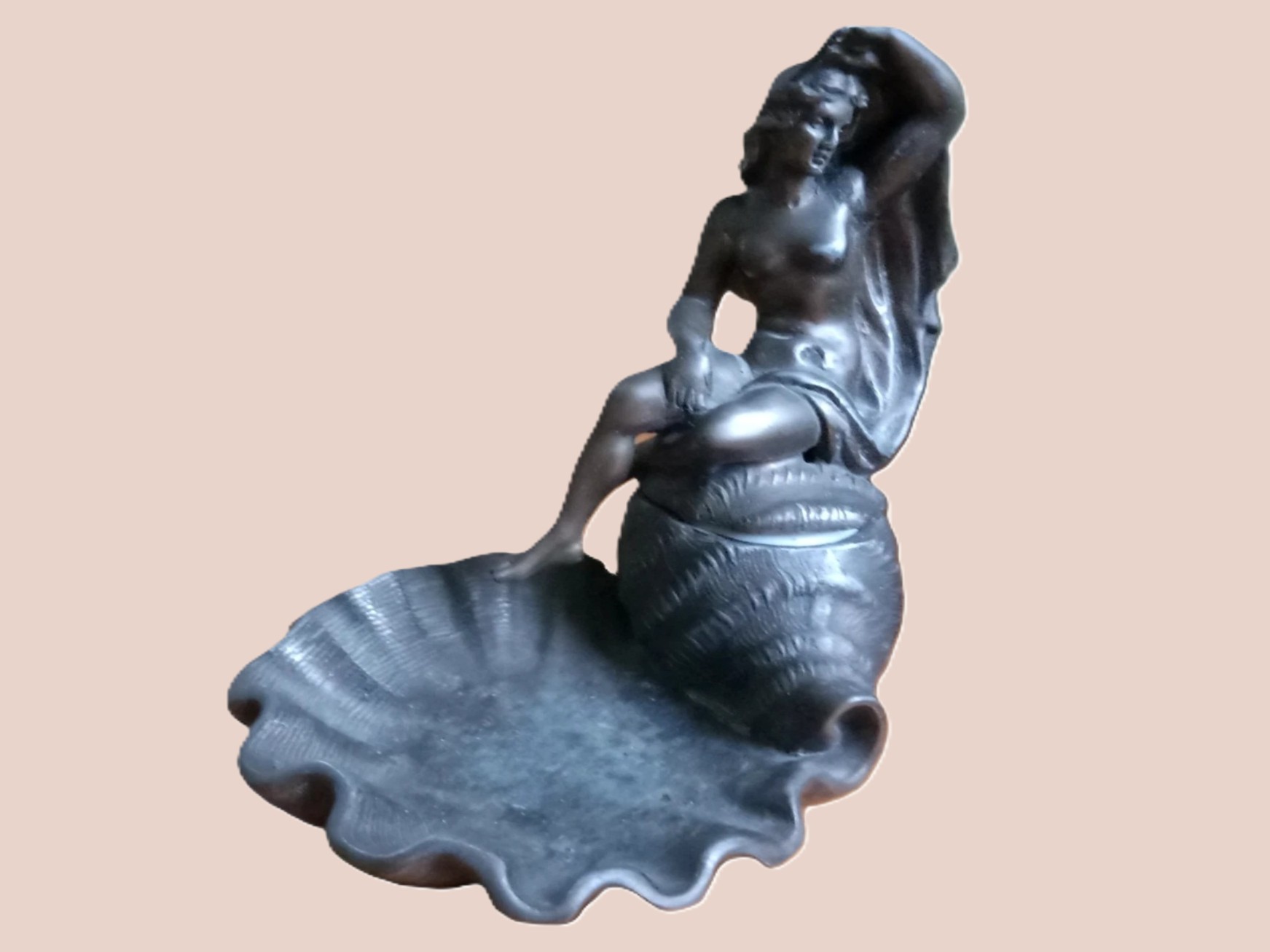
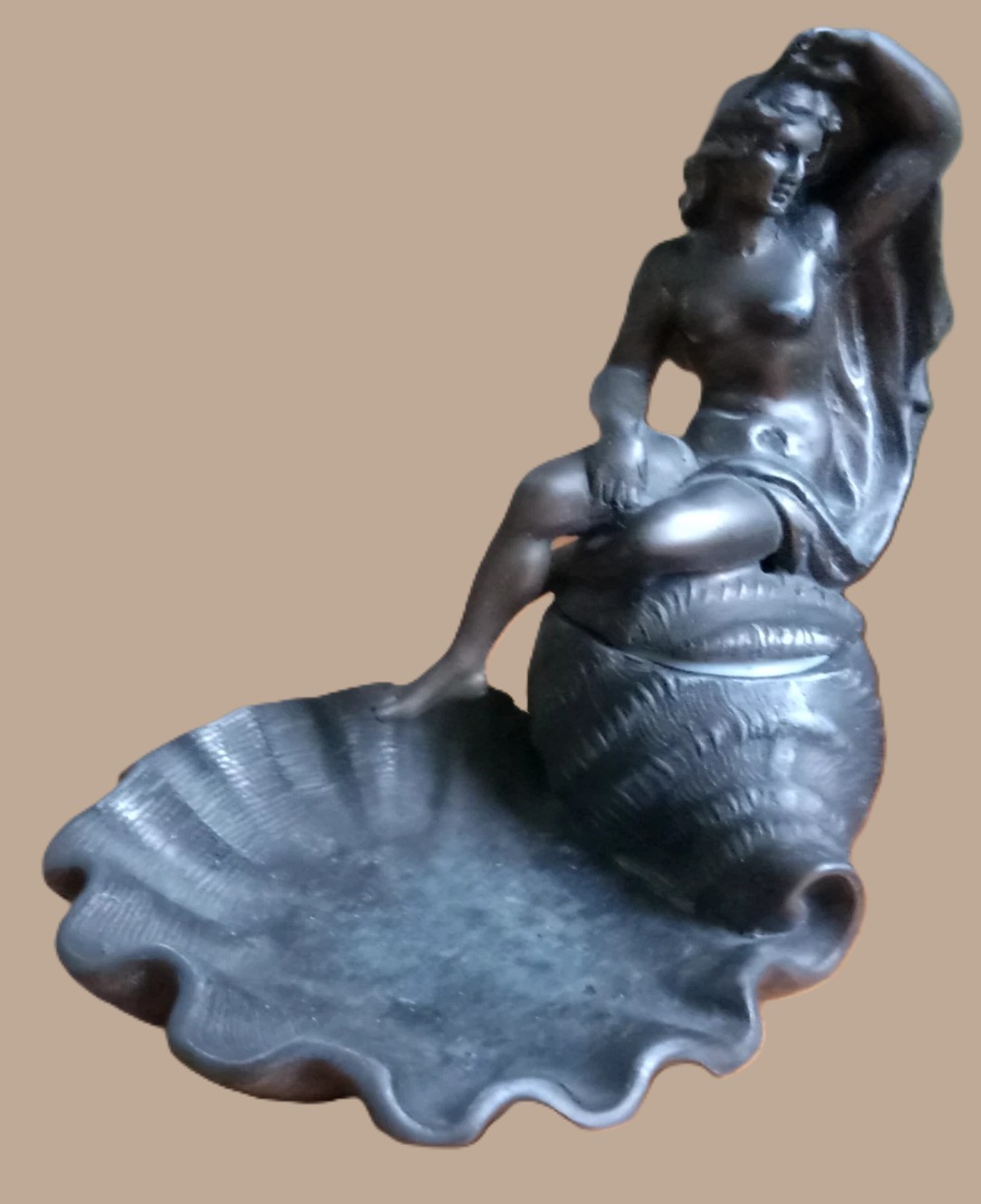
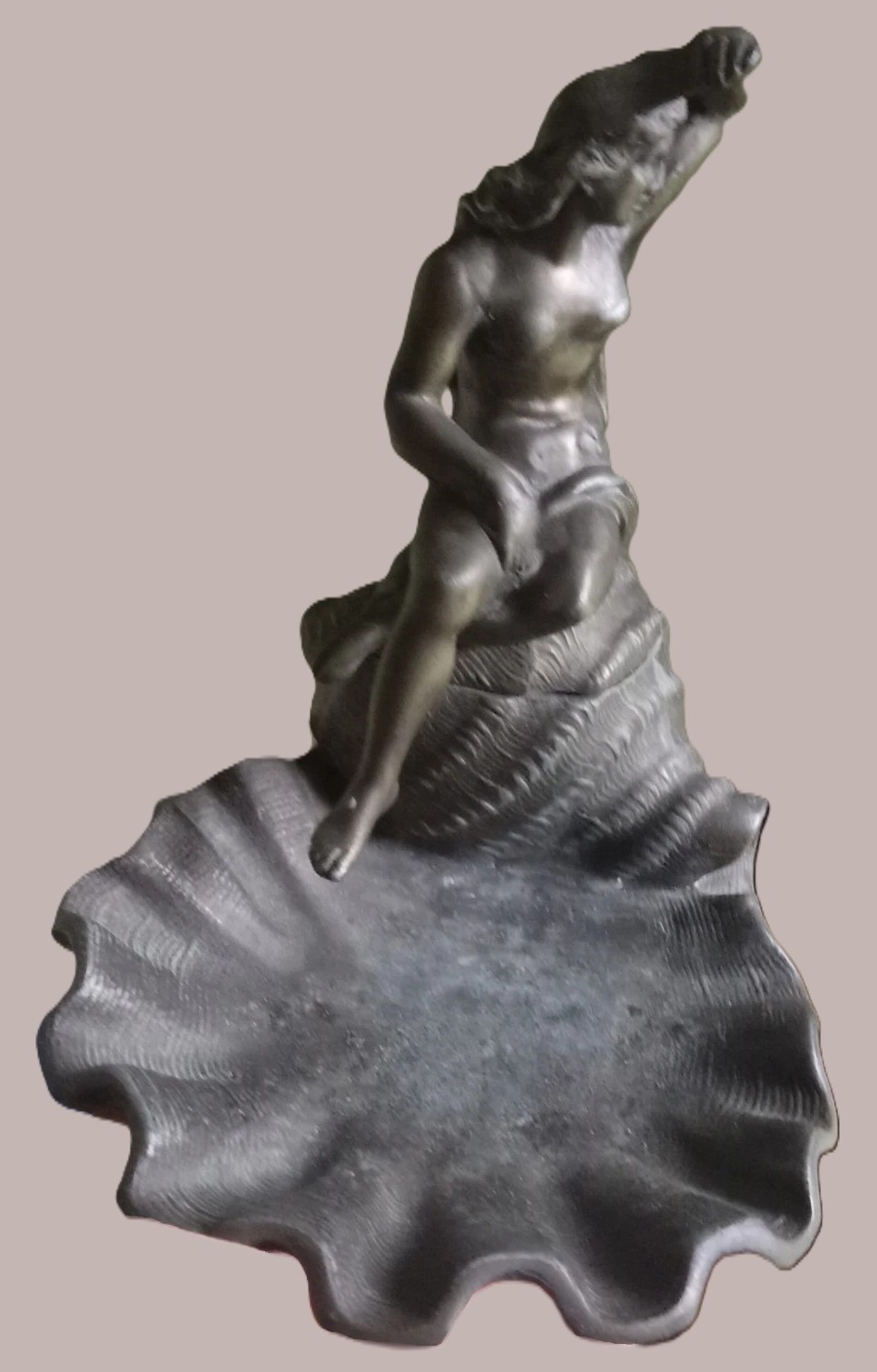
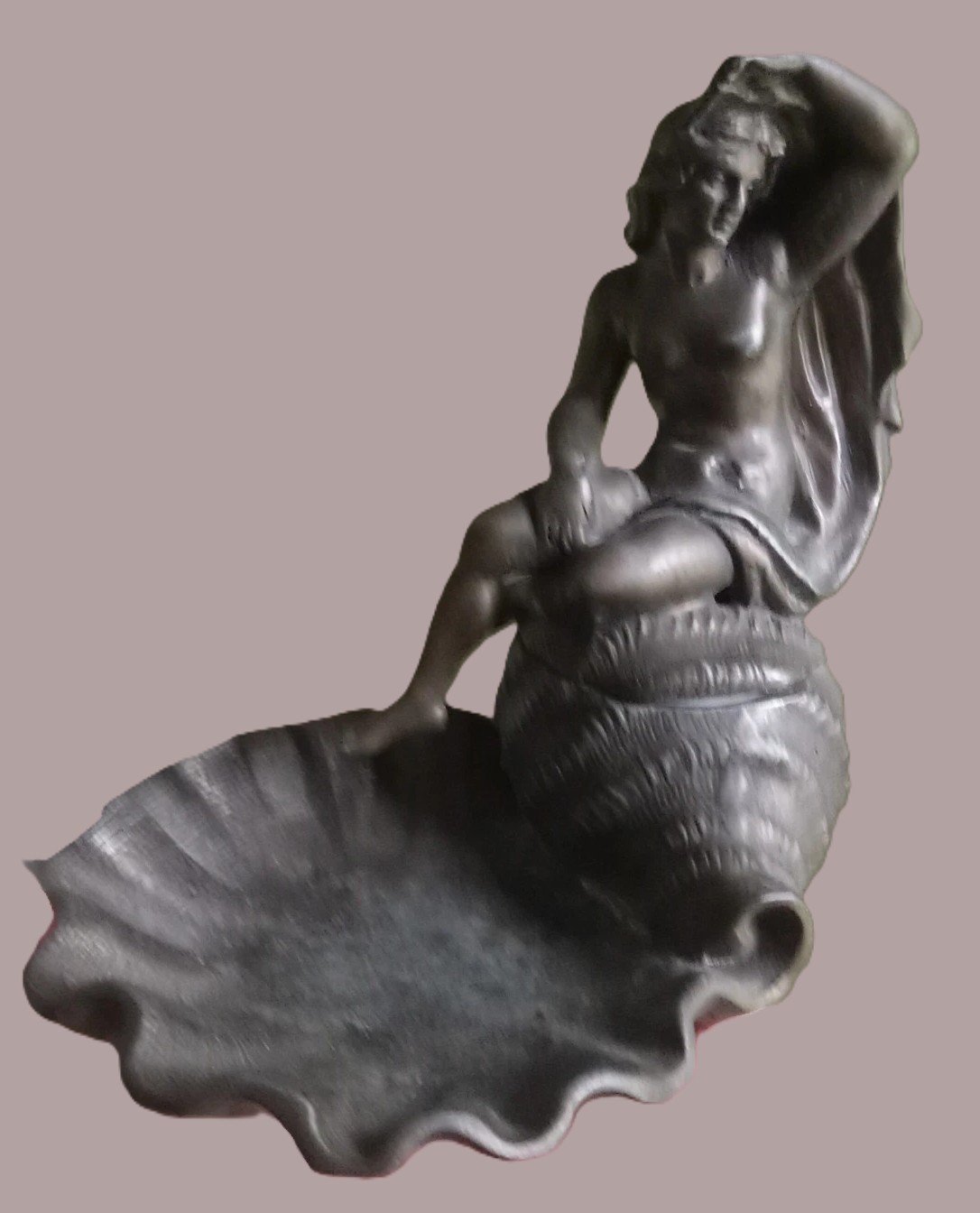
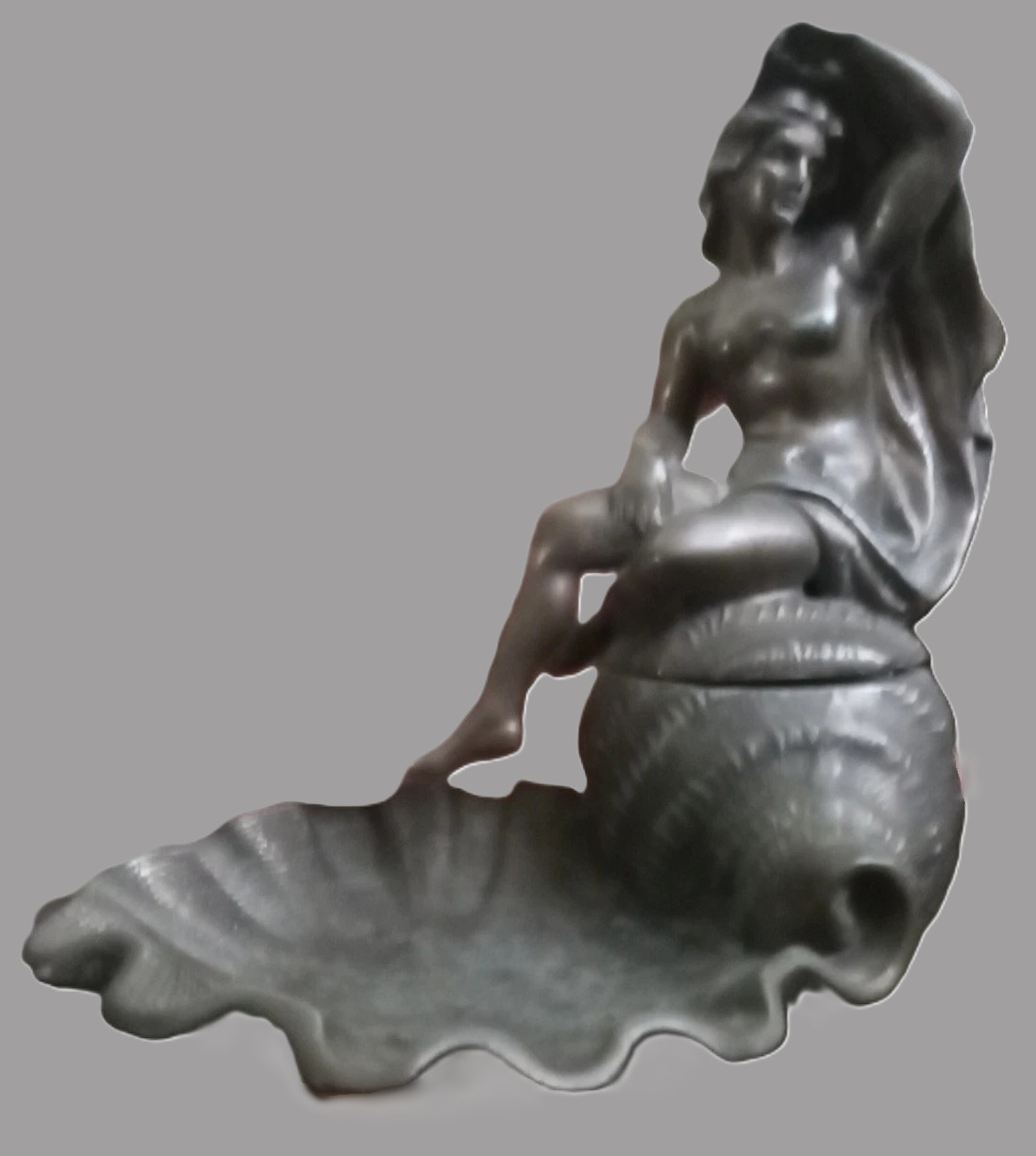
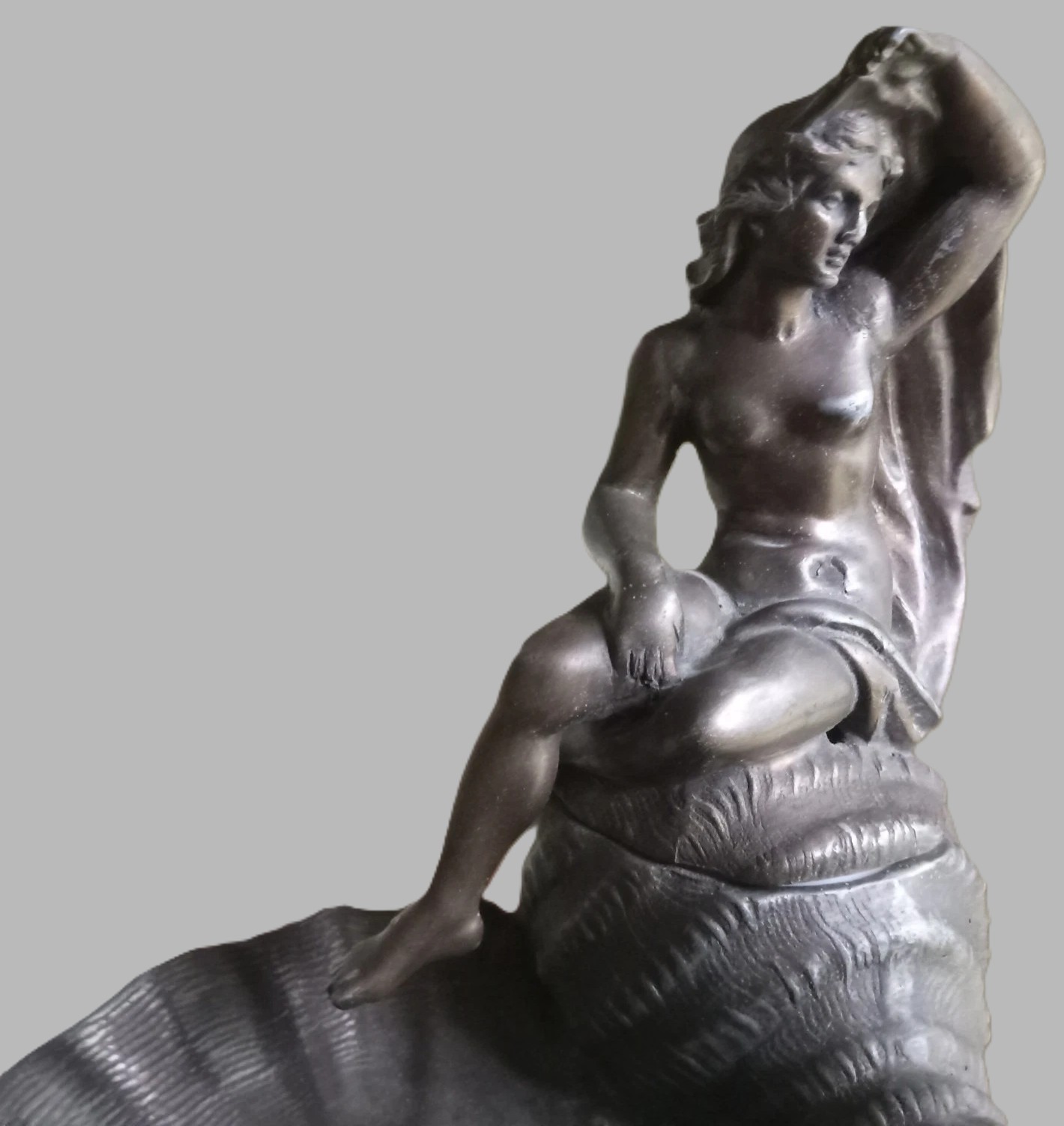
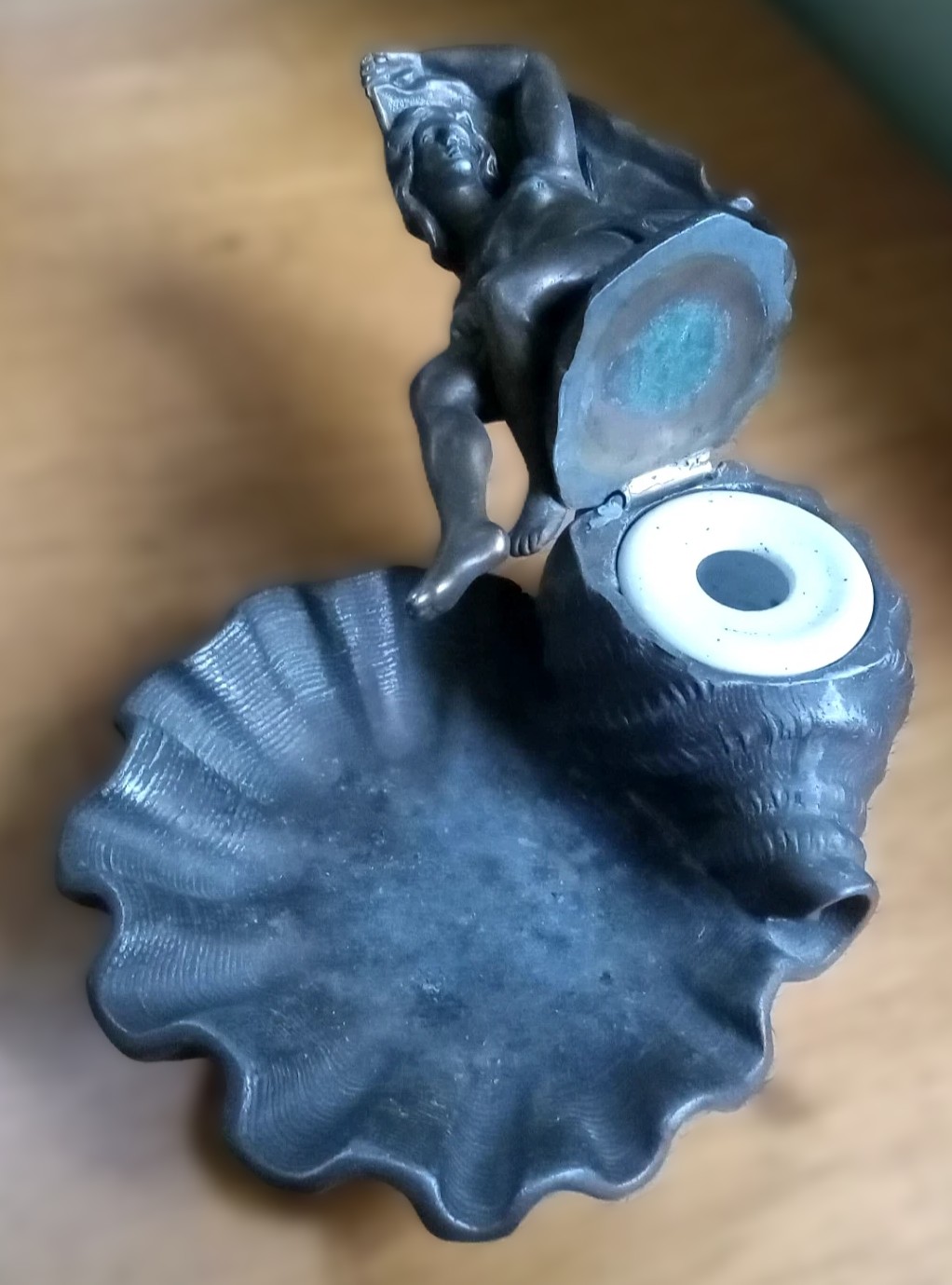
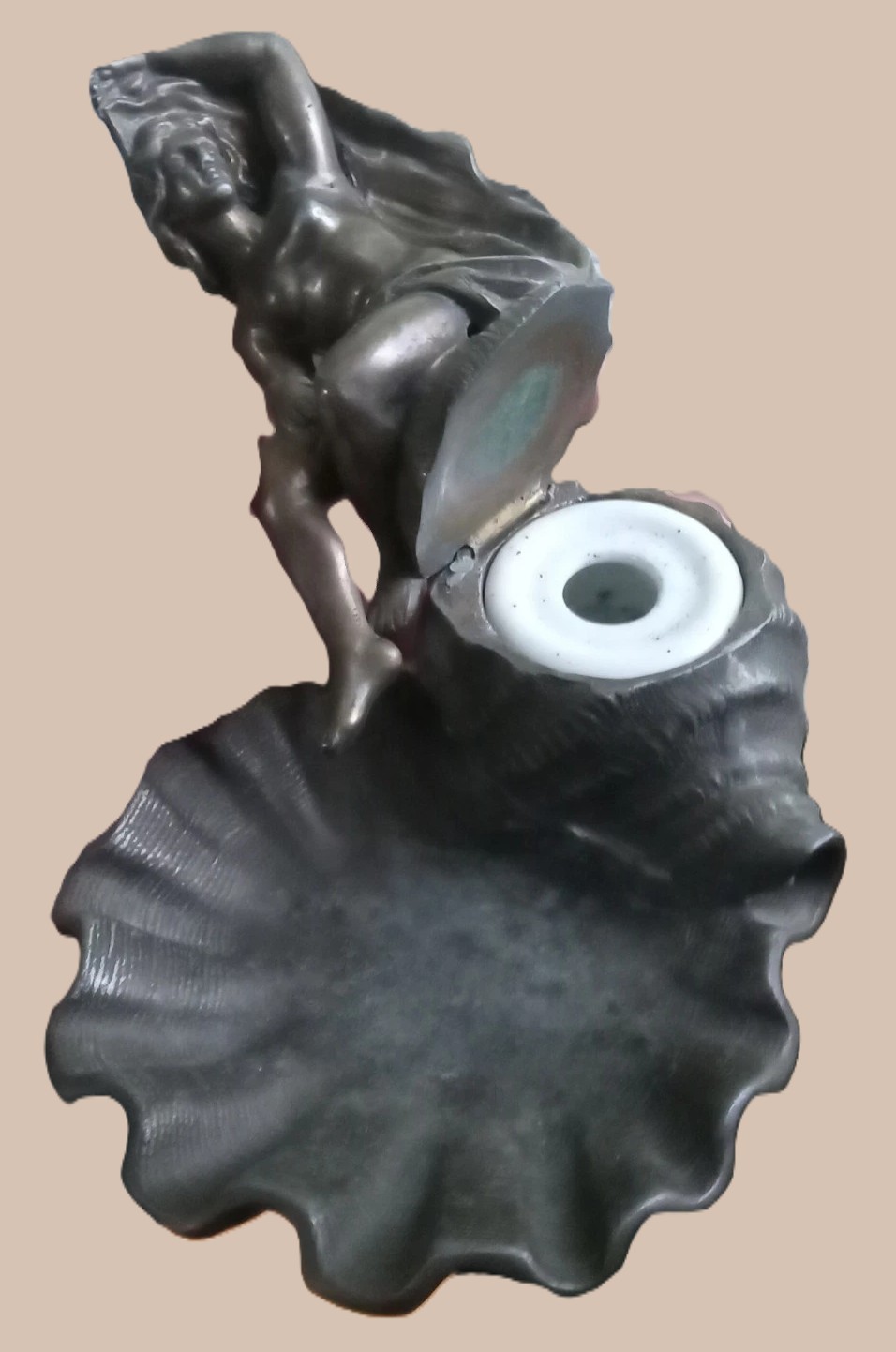
Nymph on Nautilus Shell Inkwell with Clam Shell Tray
| Categories | Art Nouveau |
| Type | Nude Woman |
| Material | Spelter |
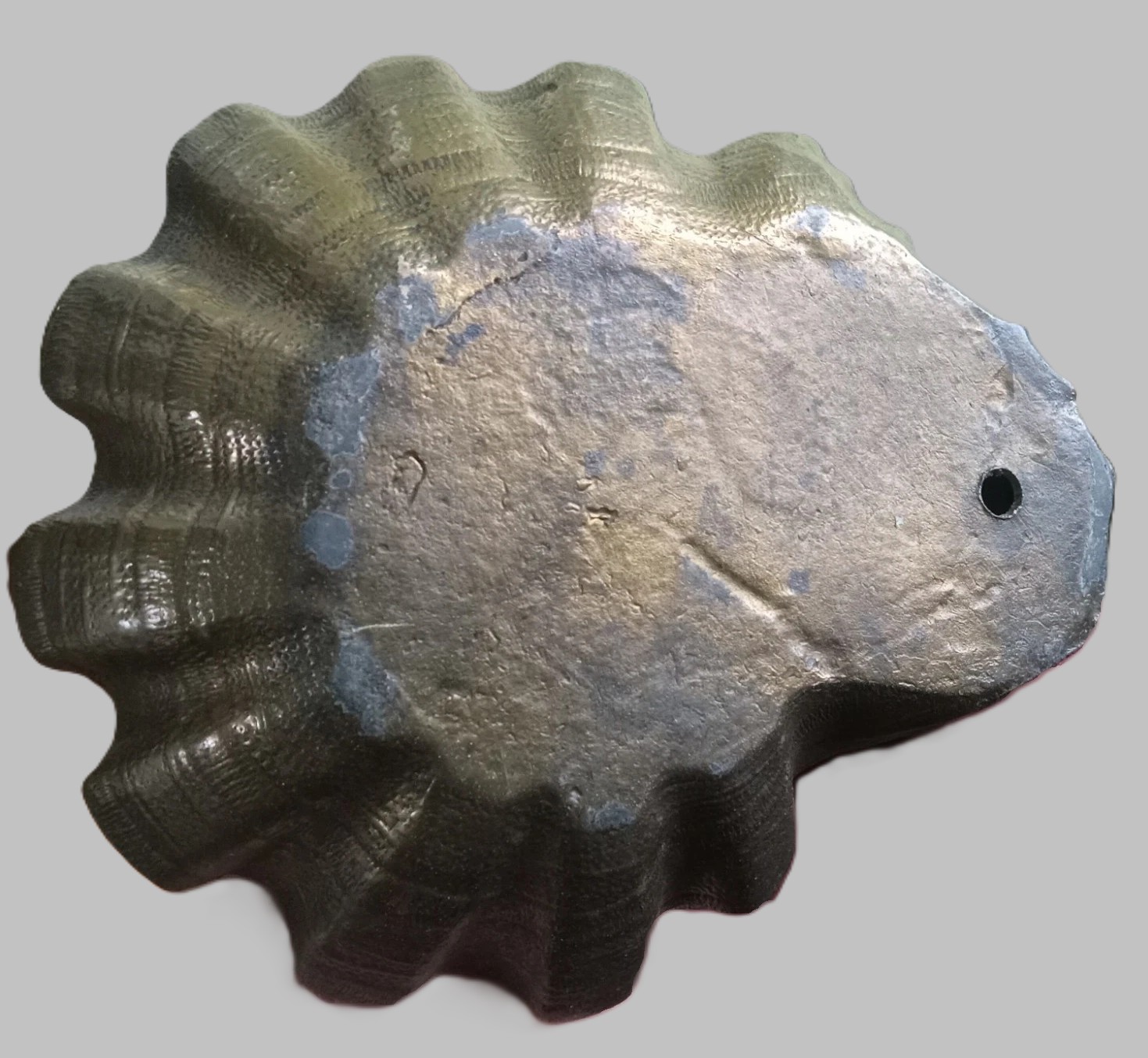
| Markings | Unmarked |
| Manufacturer | Undetermined |
| Origin | Undetermined |
| Date or Era | circa 1900 |
| Measuring | 6 ¼” high |
This Art Nouveau inkstand exemplifies the period’s fascination with organic marine forms, classical mythology, and the female form.
Description
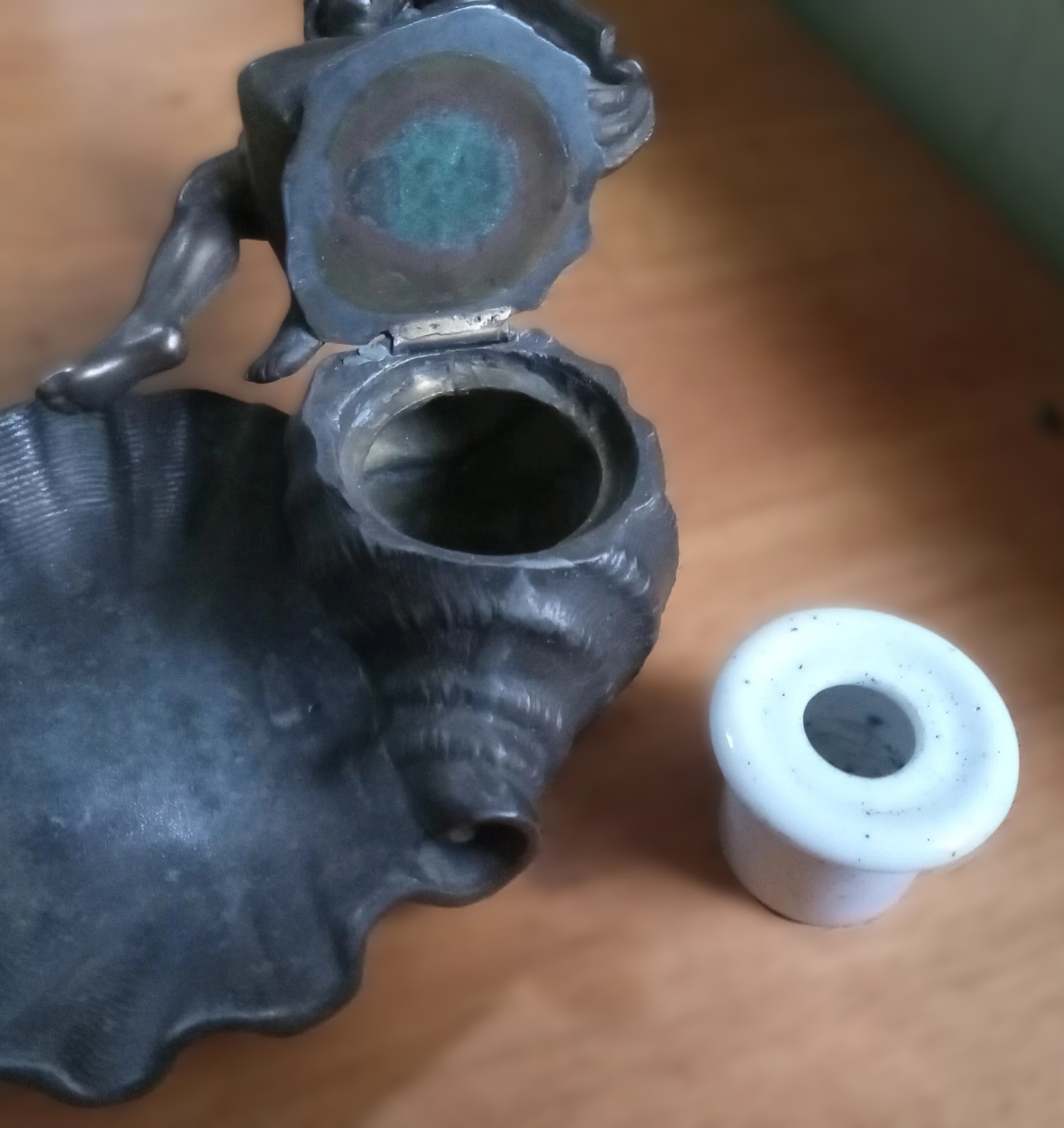
- Materials: The inkstand is cast in a durable base metal (spelter—a zinc alloy popular in European decorative art during this era). The inkstand houses its original, removable white glazed porcelain insert.
- Design: The composition is divided into two organic marine motifs.
- The Tray: The sweeping front foreground is formed as a large, fluted clam shell with pronounced, radiating ribs and an undulating, scalloped rim, serving as a pen rest and catch-all tray.
- The Inkwell Reservoir: Rising behind the tray is a naturalistically rendered nautilus shell, its textured, ridged chambers forming the body of the ink reservoir.
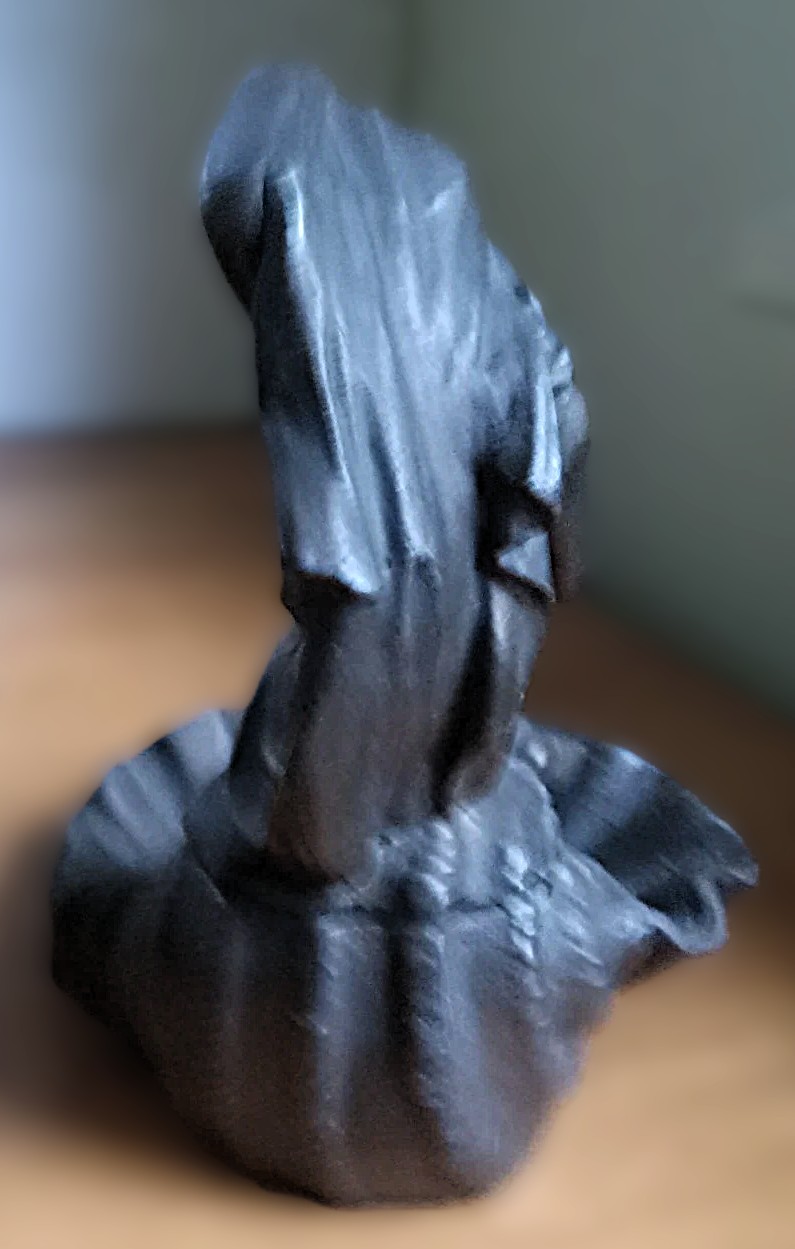
- The Nude Figure: Seated atop the nautilus shell is a classical female nude rendered with soft, naturalistic contours typical of turn-of-the-century sculpture. Her hair is styled in gentle waves, while a substantial piece of flowing drapery or fabric cascades down her back, framing her silhouette and billowing behind her in theatrical folds. One of her hands reaches up to gather or adjust this fabric near her head, while her legs relax down the side of the shell, with one delicate foot hovering just above the edge of the clam shell tray below.
- Functionality: The upper portion of the nautilus shell functions has a hinged lid. When lifted, it reveals the inner white porcelain ink pot. The hinge is discreetly integrated into the shell’s natural ridges.
Where, By Whom, and When Was It Made?
- When: It was made during the height of the Art Nouveau period, roughly circa 1895–1910.
- Where & Who: This style of decorative metalware was predominantly produced in continental Europe, most notably in France (Parisian foundries) and Germany (such as the artistic metalwork centers in Nuremberg and Berlin. Pieces of this nature were frequently unsigned, as they were mass-produced for the high-end decorative goods market rather than created as unique fine art sculptures by a single named artist.
Cultural Context: Erotic Art, Gentleman’s Studies, or General Display?
During the late 19th and early 20th centuries, representations of the female nude in art underwent a significant shift. How this piece would have been viewed depends heavily on context:
- Mythological and Allegorical Cover: In academic and fin-de-siècle art, the female nude emerging from or interacting with seashells was universally understood as an allegory for Venus (Aphrodite) rising from the sea, or as a mythical naiad/water nymph. Because the imagery was safely anchored in classical mythology and nature, polite society accepted it as high art rather than erotica.
- Appropriate for Display Anywhere vs. Gentleman’s Study:
- The Gentleman’s Study / Library: Desk accessories featuring reclining or seated classical nudes were popular choices for a gentleman’s private study, library, or office desk. In these masculine spaces, art featuring the unclad female form was entirely customary, symbolizing culture, classical learning, and refined aesthetic taste.
- Public Salons / General Display: While a conservative household might have kept such a piece tucked away in a private study or a gentleman’s smoking room rather than the formal family parlor, the organic fluidity of Art Nouveau made nature-inspired nudes widely acceptable in bourgeois and artistic households across Europe and America by 1900. It bridged the gap between functional office stationery and decorative salon sculpture.
Sold for $140 in September 2026
Content disclaimer. The information posted is the owner’s best knowledge and may not have been vetted by the SOIC. We welcome comments, corrections, and additions, working to make our website information comprehensive and accurate.
Join the Society of Inkwell Collectors (SOIC) – it’s free!
Founded in 1981 as a non-profit organization,
we are documenting inkwells (and accessories).
We’re here to help and inform!