

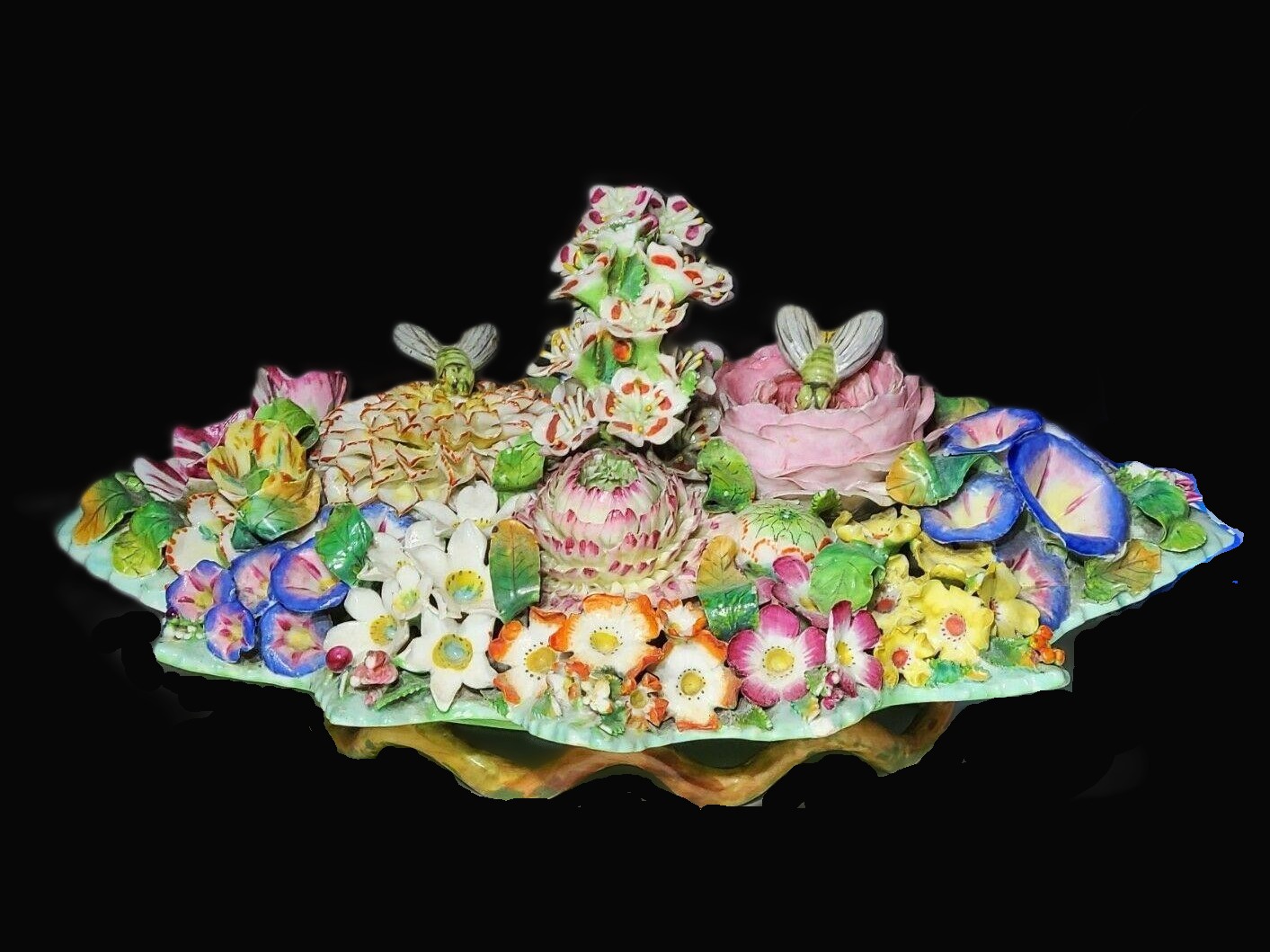
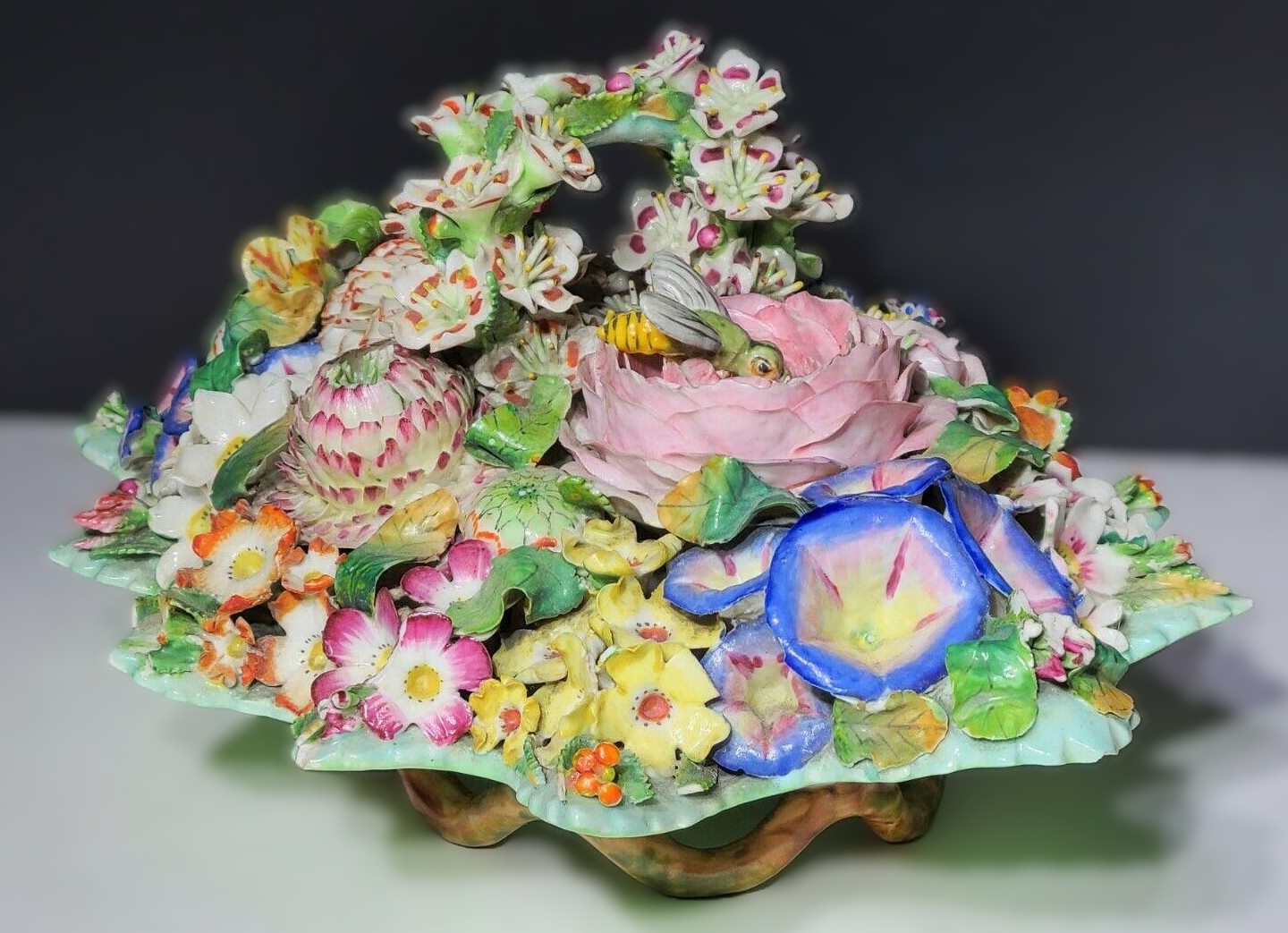
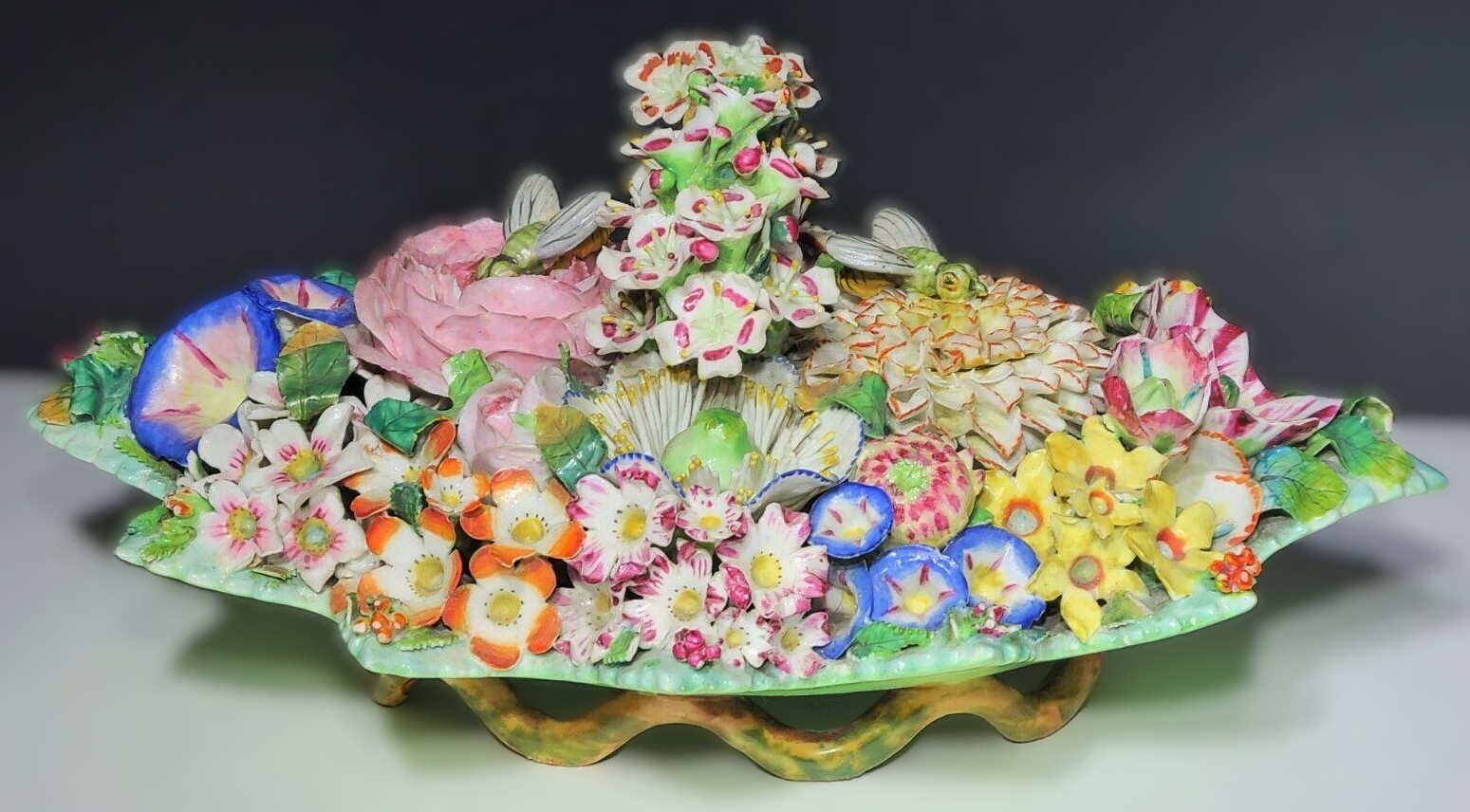
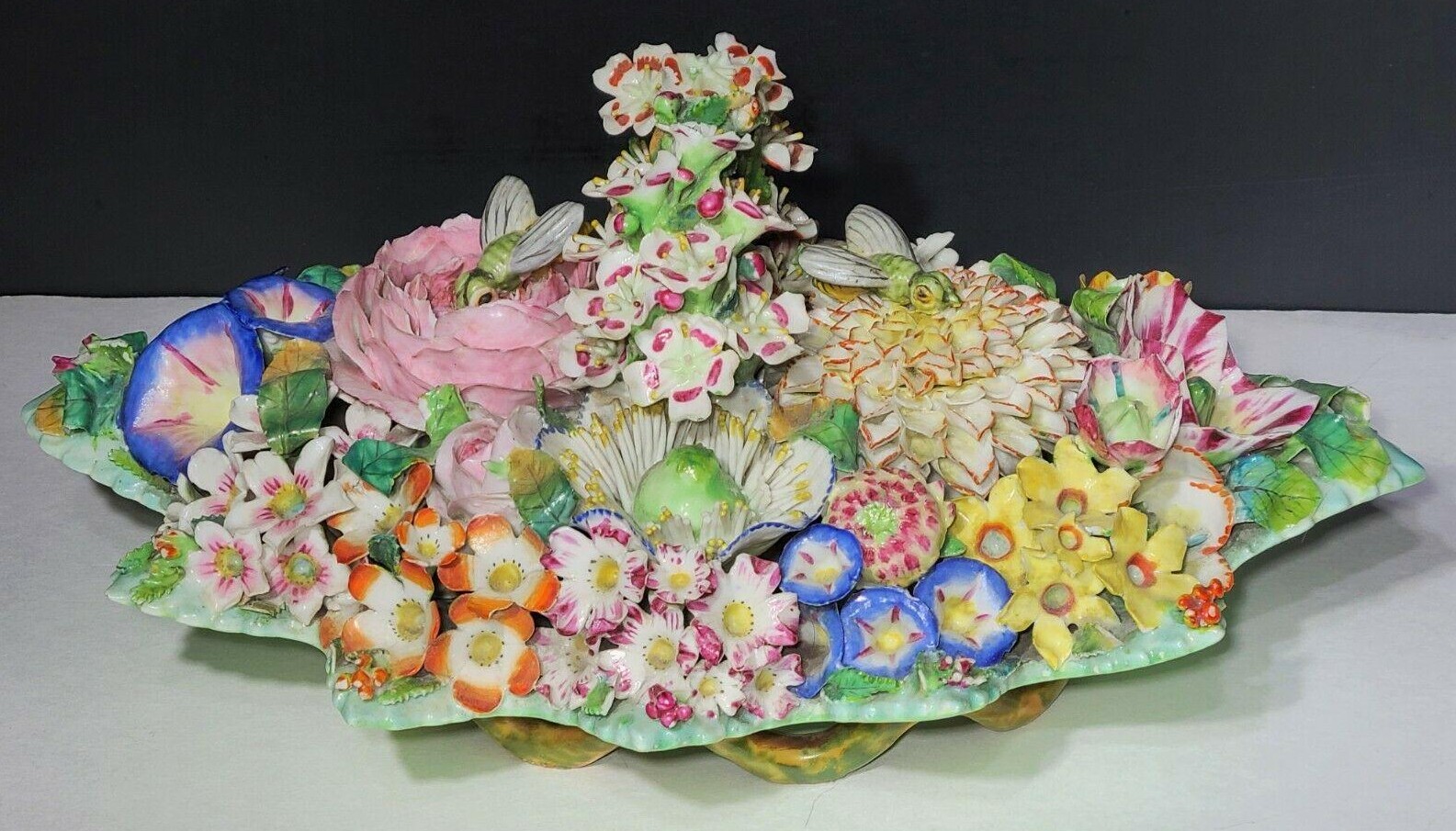
Floral Encrusted Porcelain Inkstand with Bees
| Categories | Ceramics/Porcelain "Named" Makers |
| Material | Porcelain |
| Markings | See Narrative |
| Manufacturer | Jacob Petit |
| Origin | France |
| Date or Era | circa 1840 |
| Measuring | 10 ½” x 7 ¼” x 4 ¾” high |
Description
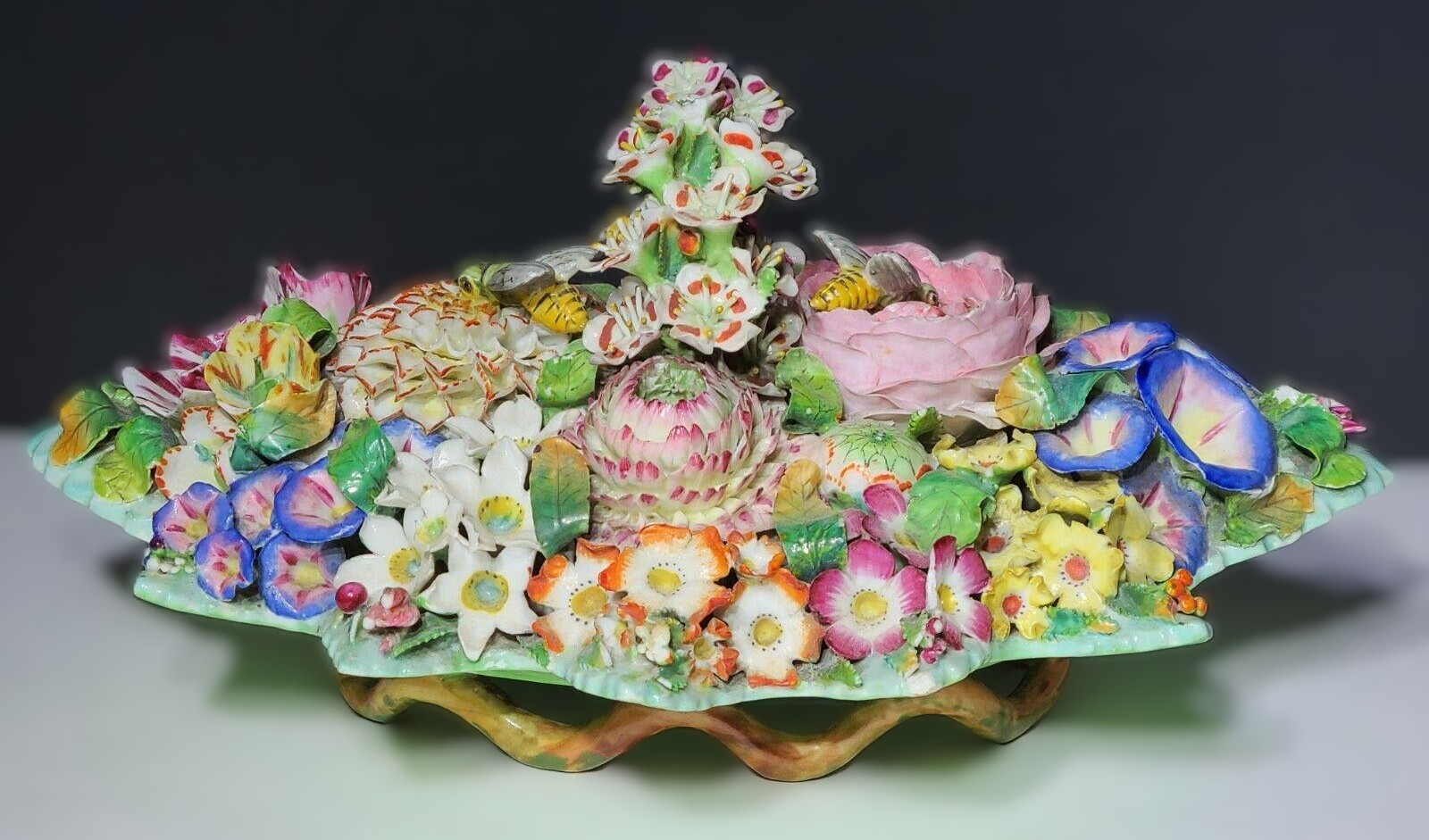
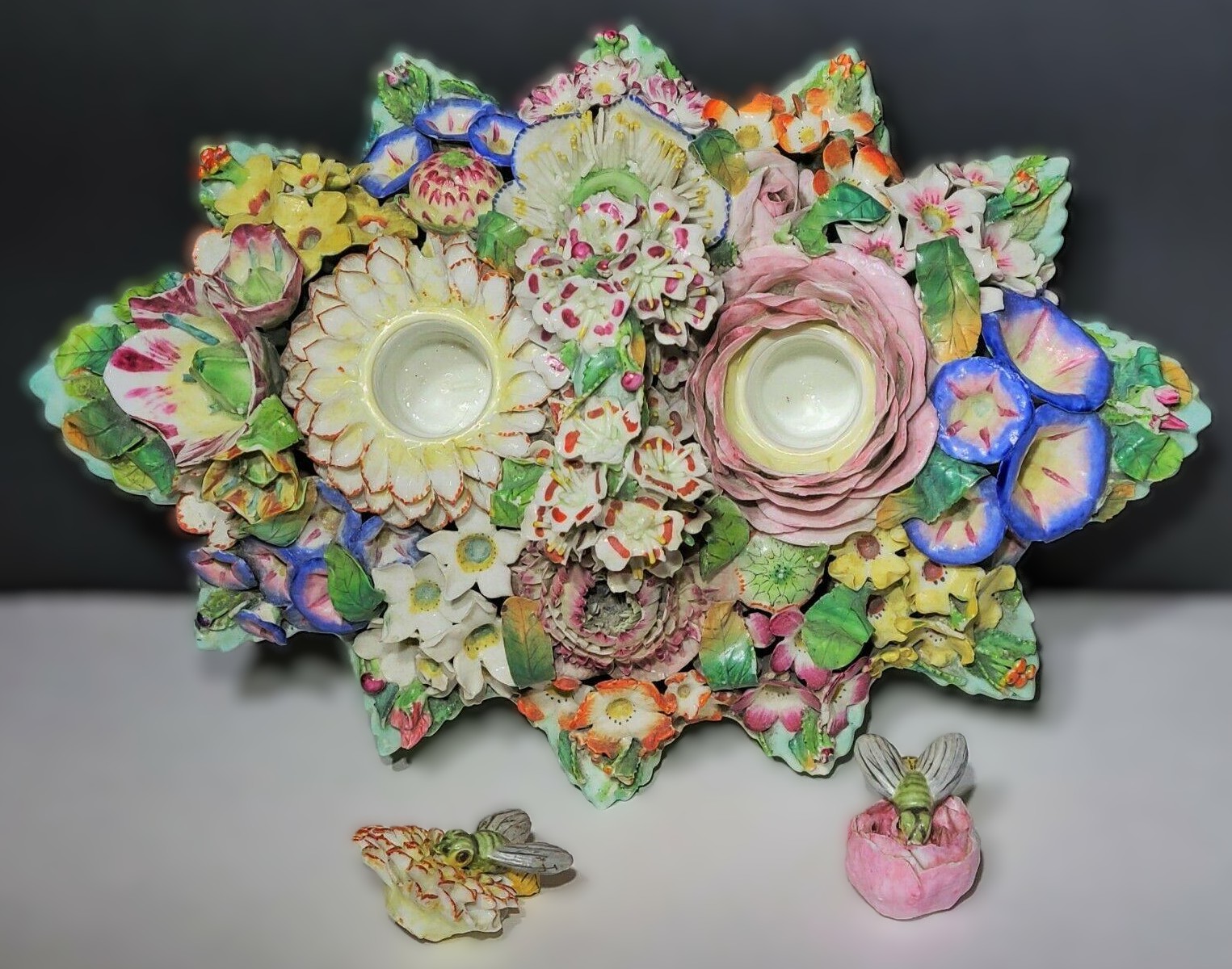
This lavishly detailed 19th century encrier (inkstand) is a quintessential example of high-Victorian Rococo revival decorative arts, taking the form of an overflowing floral basket or garden bouquet.
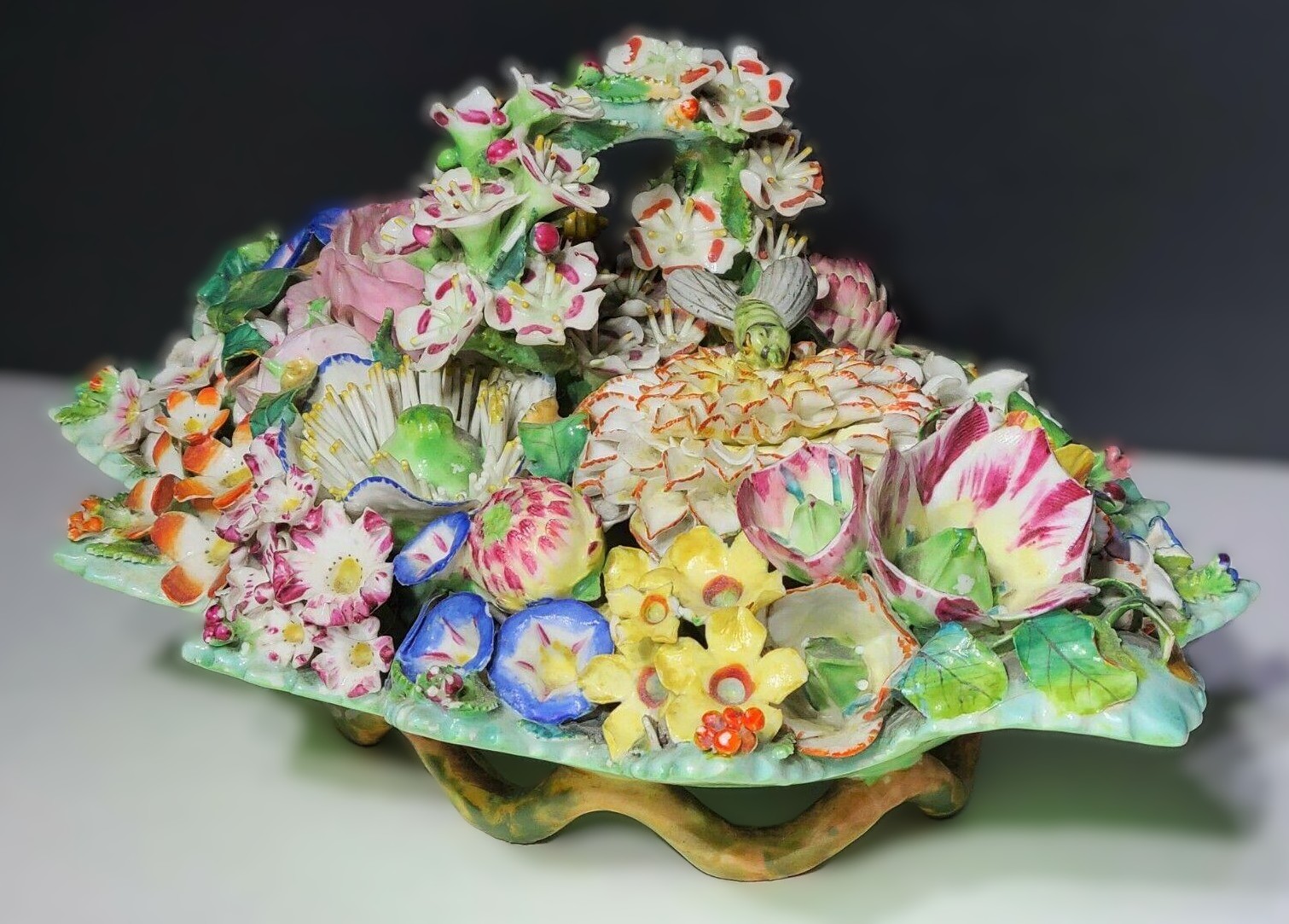
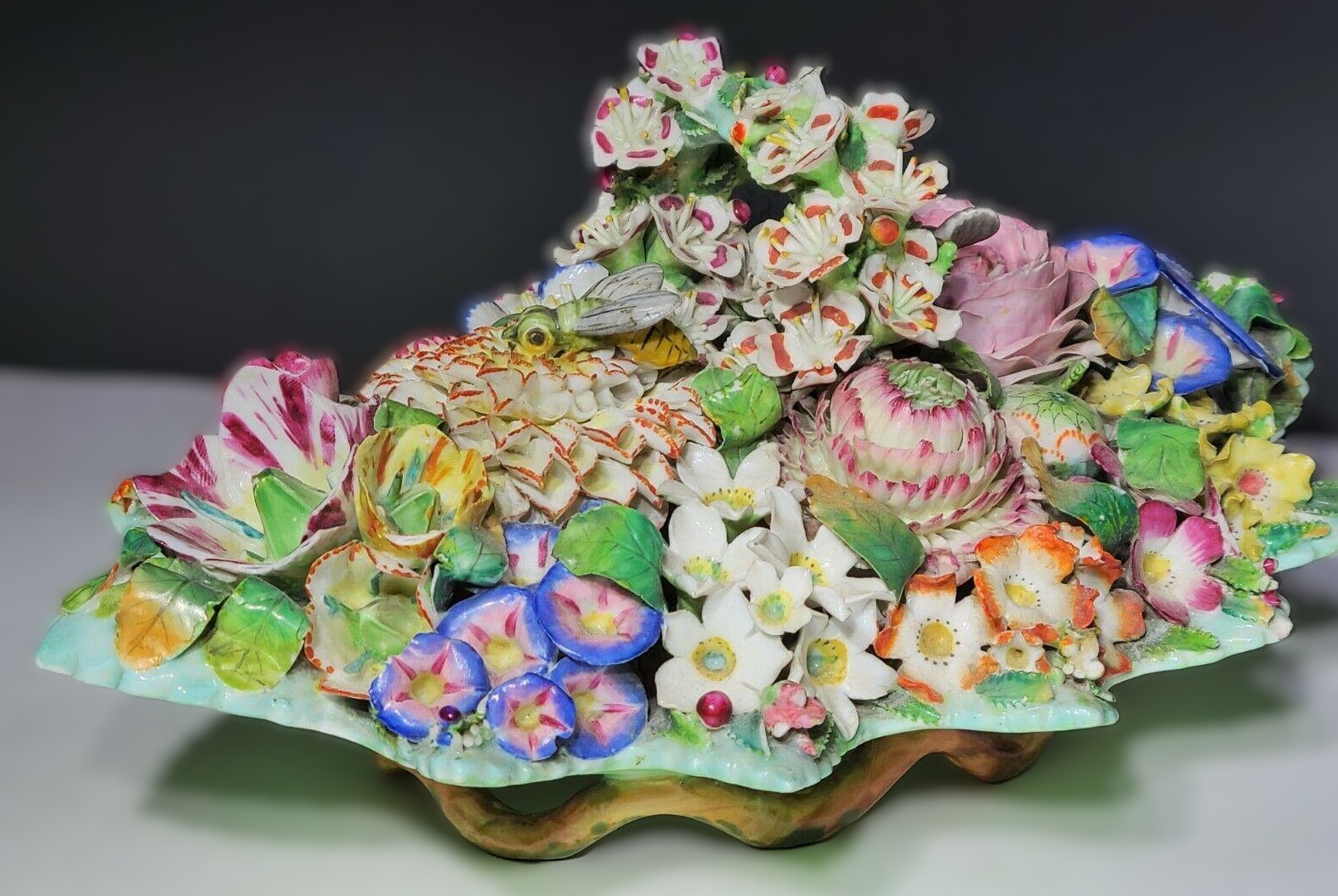
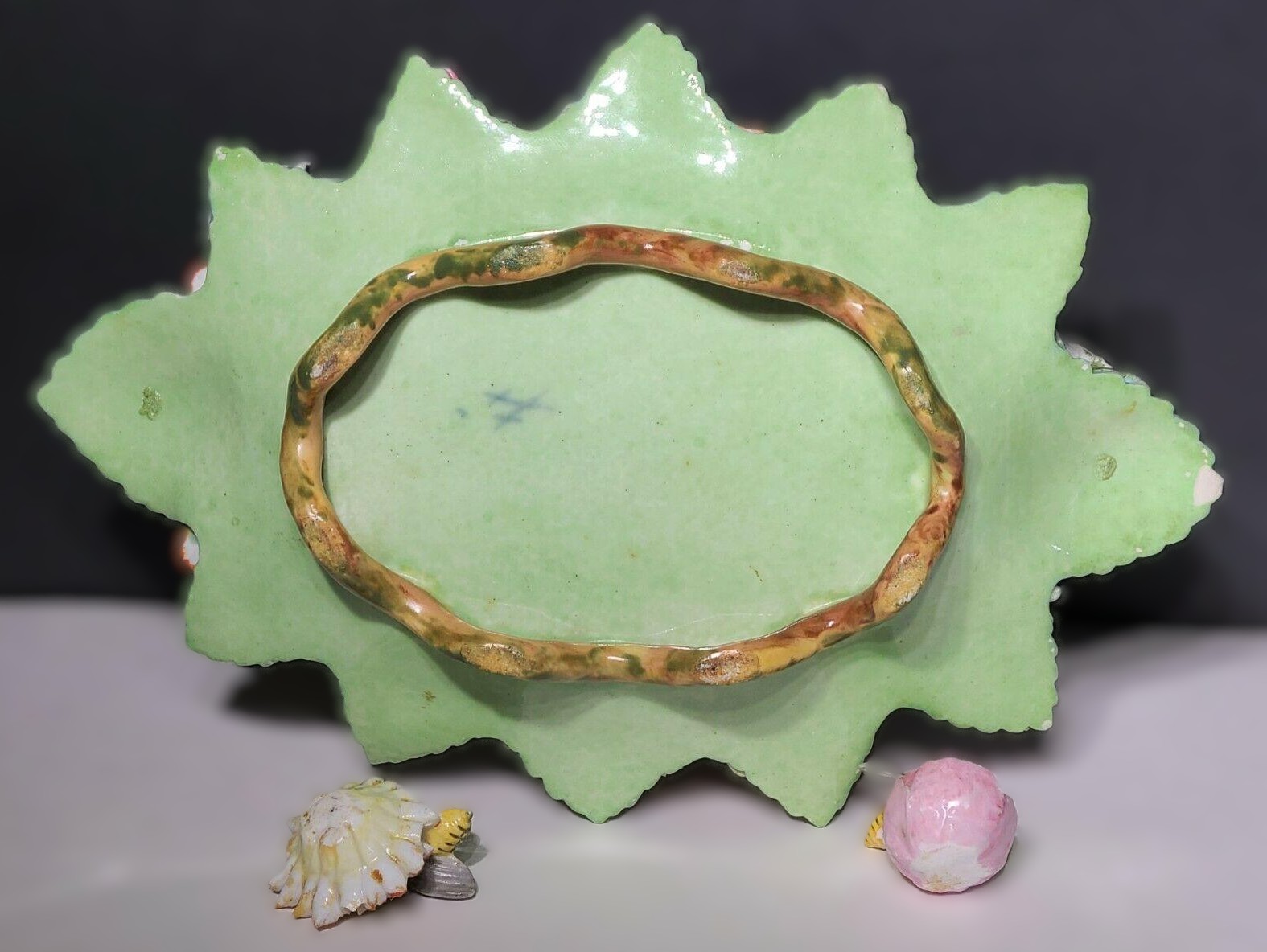
- The Body and Base: The inkstand is modeled on an asymmetrical, multi-pointed leaf or shell-form undulating base glazed in a soft, medium-celadon or apple green, supported underneath by an organic, twig-and-branch-form openwork foot highlighted in brownish-ochre and gilt.
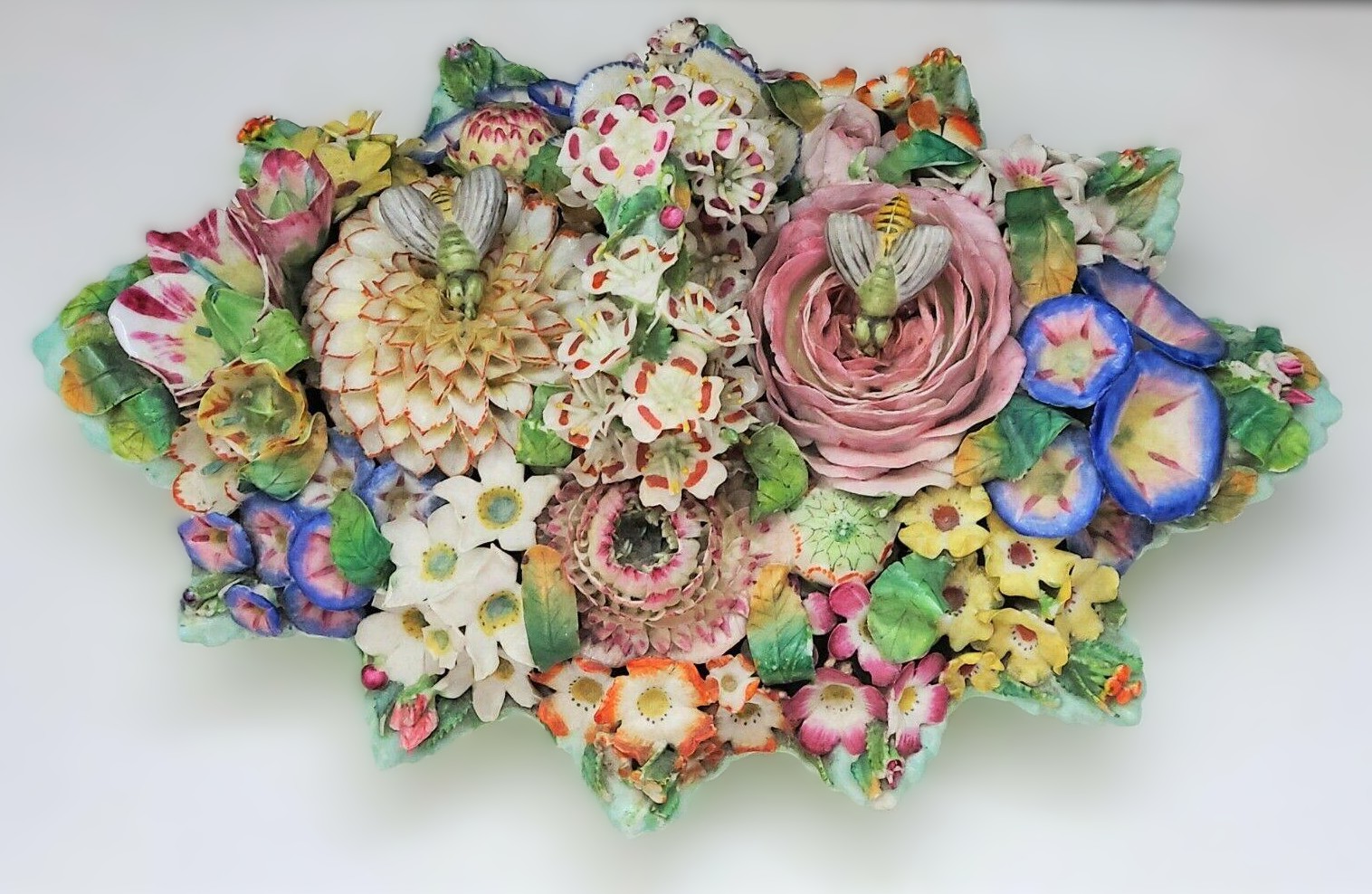
- The Floral Encrustation (Fleurs en Relief): The entire upper surface is densely encrusted with a breathtaking profusion of meticulously sculpted, hand-applied polychrome flowers in high relief. The botanical assortment includes full-blown pink roses, multi-petaled chrysanthemums, delicate morning glories in shades of vibrant blue and purple, tulips, and dense clusters of small field and blossom flowers.
- The Inkwells and Insects: Nestled seamlessly amidst the vibrant floral thicket are two cylindrical inkwell inserts, concealed and integrated beneath flower-form lids (one styled as a large dahlia/chrysanthemum and the other as a pink rose). Each inkwell cover is topped by a hand-modeled, life-like bee or insect with delicately veined wings poised for flight. A central vertical cluster of blossoming branches rises like a handle or central bouquet feature through the middle of the piece.
Understanding the Mark
The mark on the underside (visible as a faint blue signature beneath the green glaze) consists of a crossed-batons or crossed-swords motif accompanied by dots. It is a signature of Jacob Petit.
During the mid-19th century, French Paris porcelain manufacturers frequently borrowed, adapted, or playfully emulated historical marks—such as Meissen’s famous crossed swords—as a nod of supreme craftsmanship to 18th-century prototypes. Jacob Petit was heavily inspired by Saxon/Meissen aesthetics (notably pioneering his own extravagant versions of Schneeballen and floral-encrusted wares), and he frequently marked his luxury decorative pieces with underglaze blue pseudo-marks alongside or interlinked with his signature “J.P.” initials.
Who Made It and When?
- Maker: Jacob Petit (born Jacob Mordecai, 1796–1868), one of the most celebrated, imaginative, and flamboyant Parisian porcelain makers of the 19th century. Petit originally studied painting under Antoine-Jean Gros, traveled extensively across Europe studying various industrial arts, and established his renowned Paris and Fontainebleau-area workshops around 1830–1831. He won acclaim at successive French Industrial Exhibitions for his intensely chromatic, highly sculptural, and eclectic luxury objects.
- Date of Manufacture: Circa 1835–1855 (Second Quarter to Mid-19th Century), during the height of Petit’s prolific production period for high-end decorative porcelain, fancy inkstands, and novelty scent bottles.
Sold for $455 in January 2021
Content disclaimer. The information posted is the owner’s best knowledge and may not have been vetted by the SOIC. We welcome comments, corrections, and additions, working to make our website information comprehensive and accurate.
Join the Society of Inkwell Collectors (SOIC) – it’s free!
Founded in 1981 as a non-profit organization,
we are documenting inkwells (and accessories).
We’re here to help and inform!