

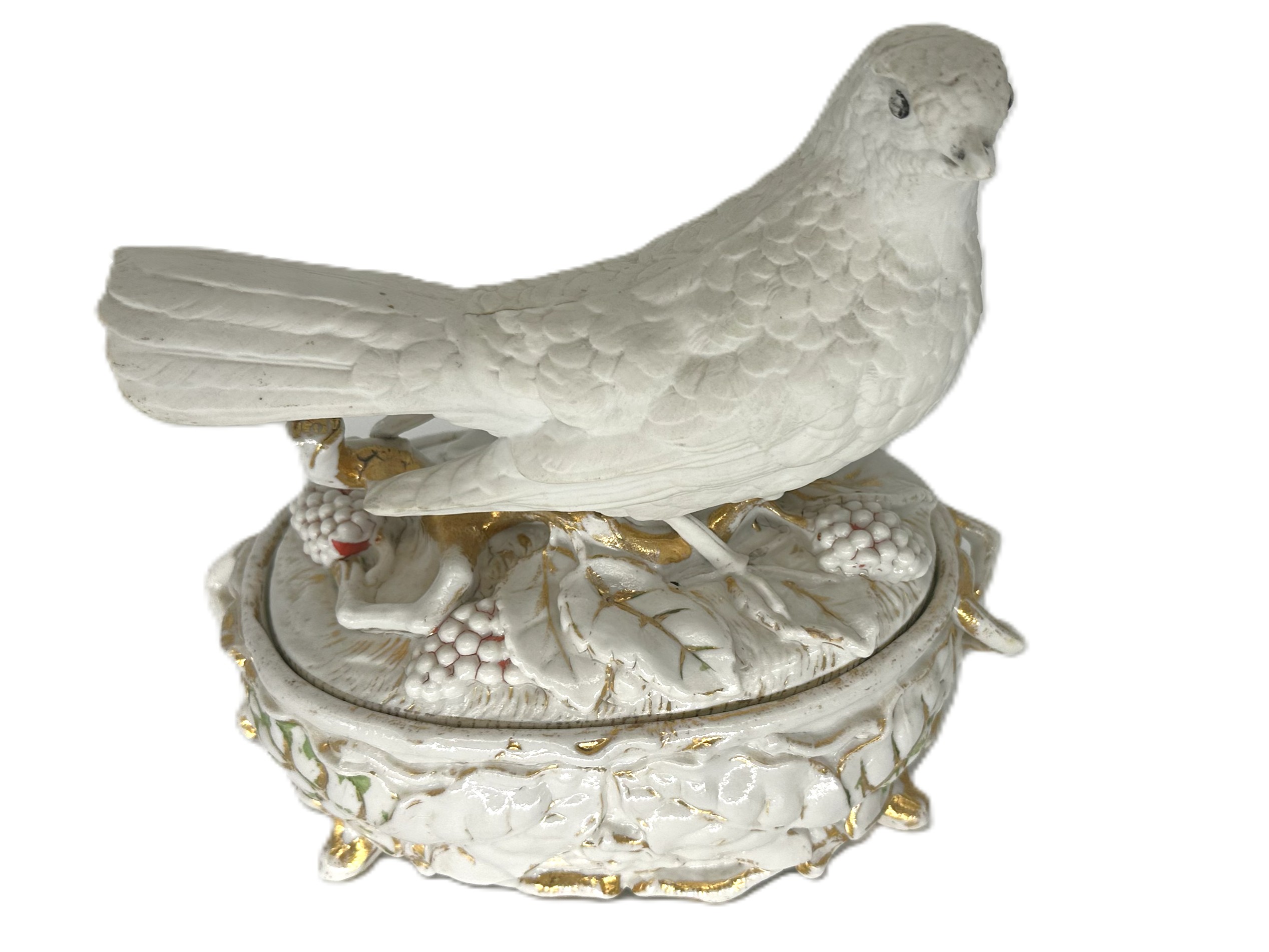
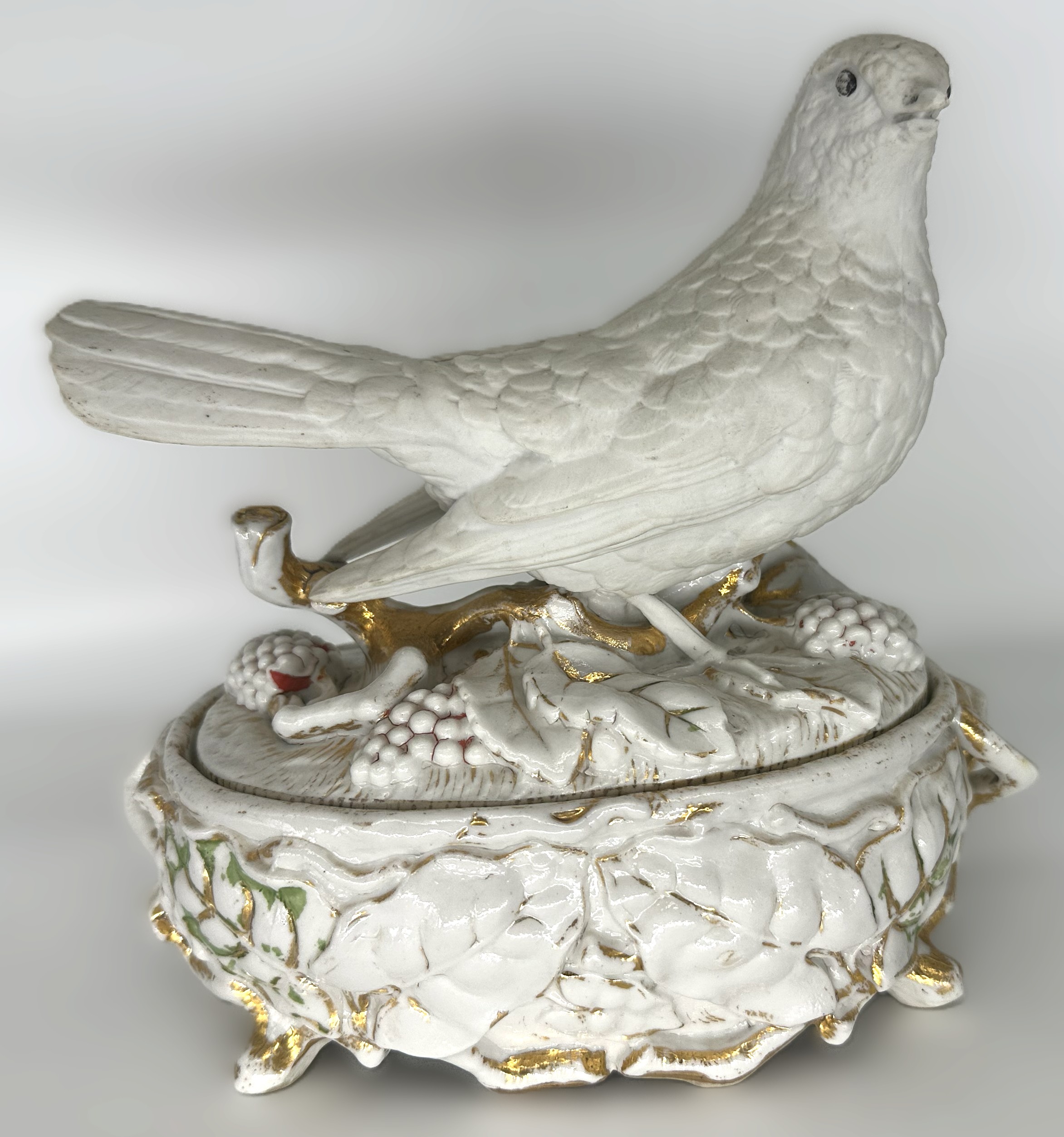
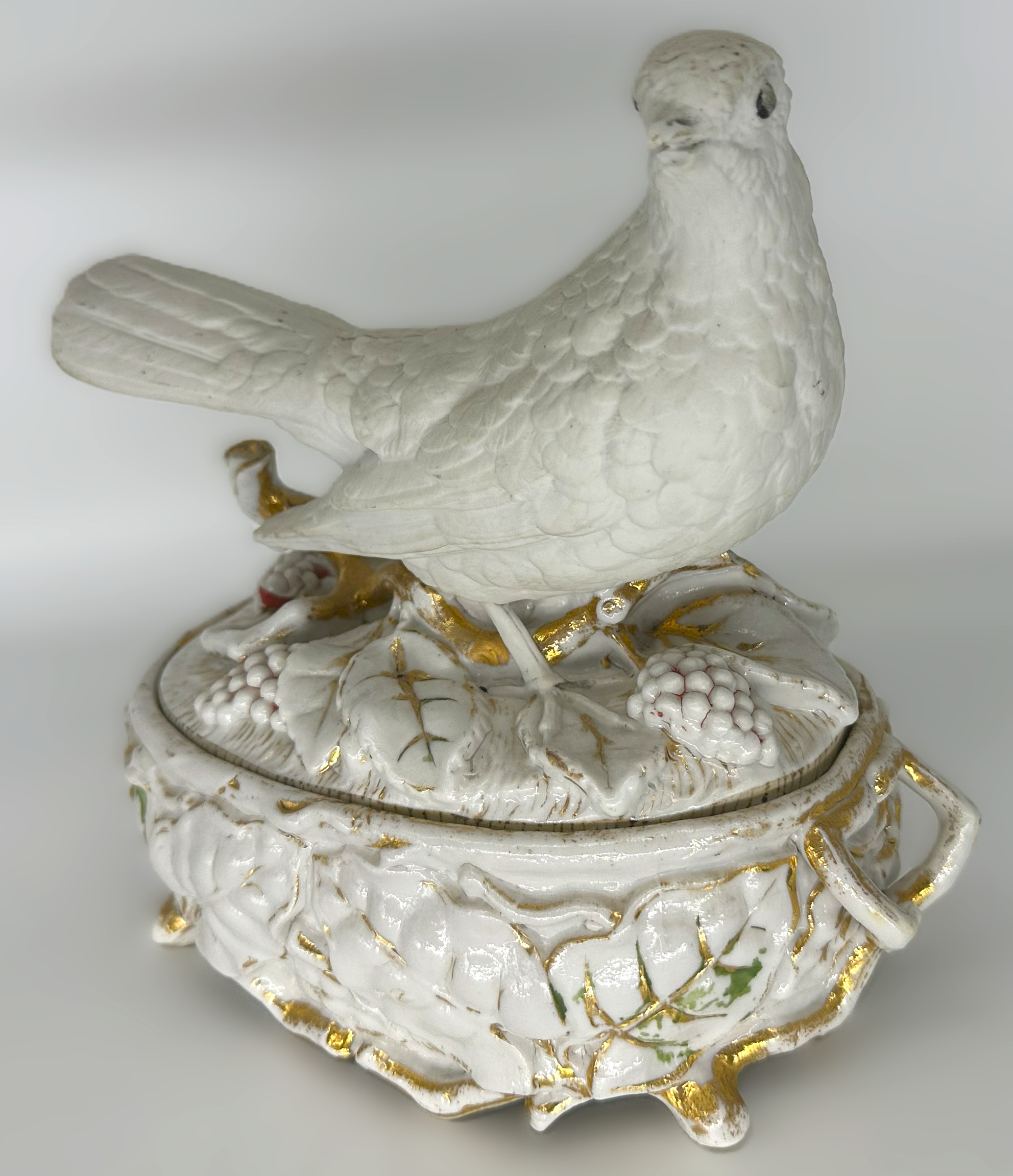
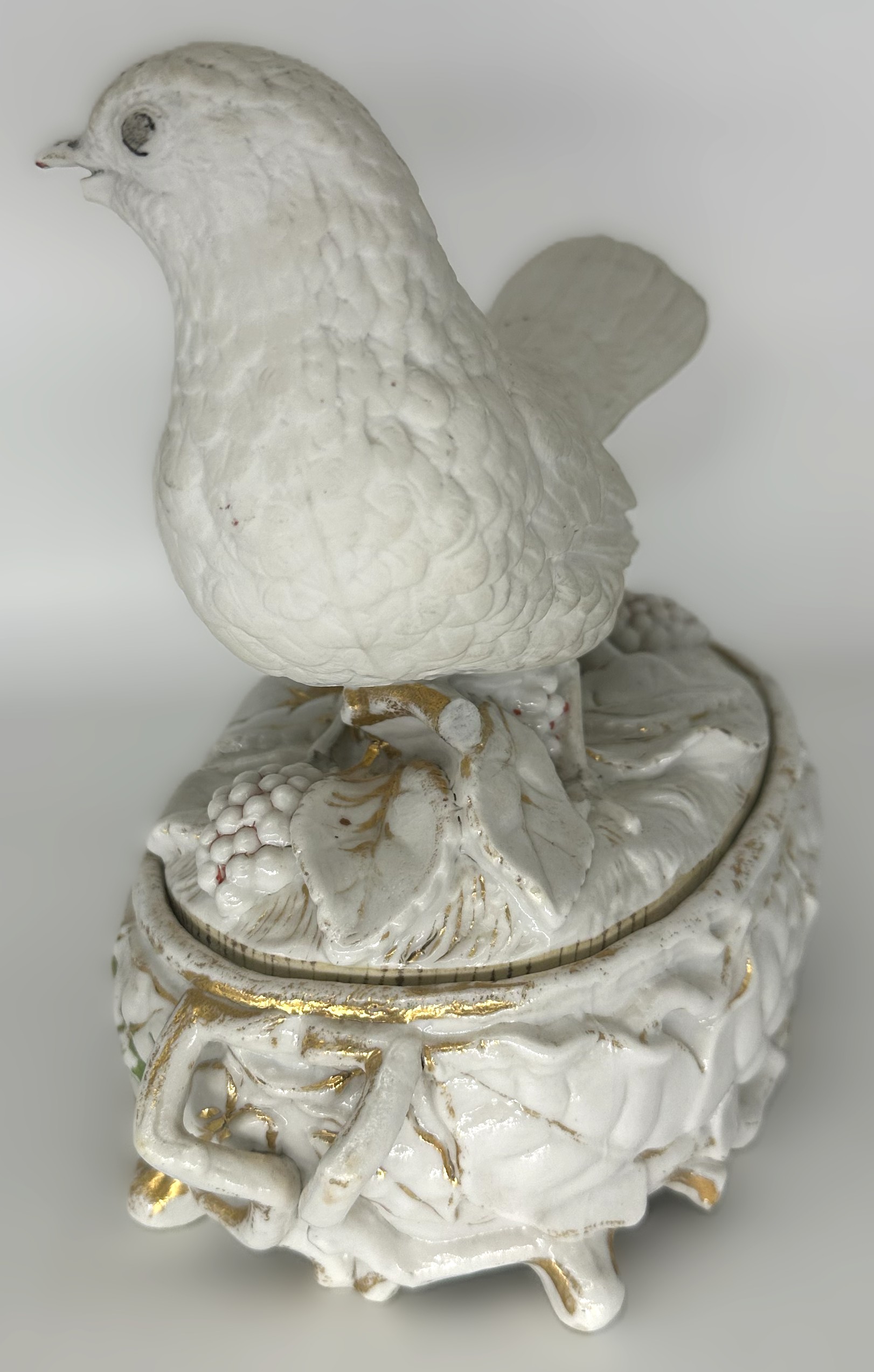
Porcelain Dove Inkstand
| Categories | Ceramics/Porcelain Figural |
| Type | Bird |
| Material | Porcelain |
| Markings | See Narrative |
| Manufacturer | Undetermined |
| Origin | Undetermined |
| Date or Era | circa 1890 |
| Measuring | 7 ¾″ Long × 4 ¾″ Wide × 7″ High |
Description
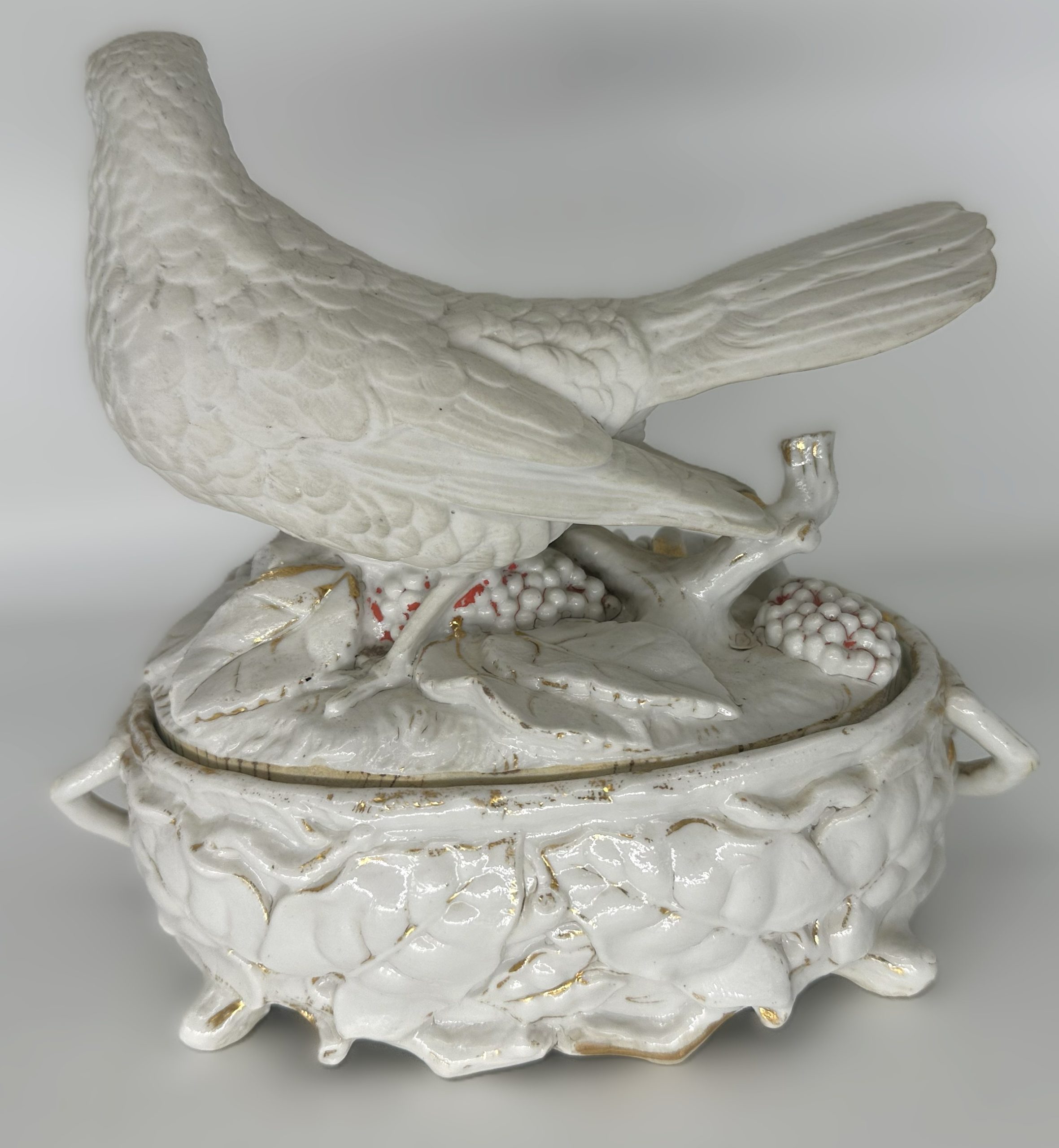
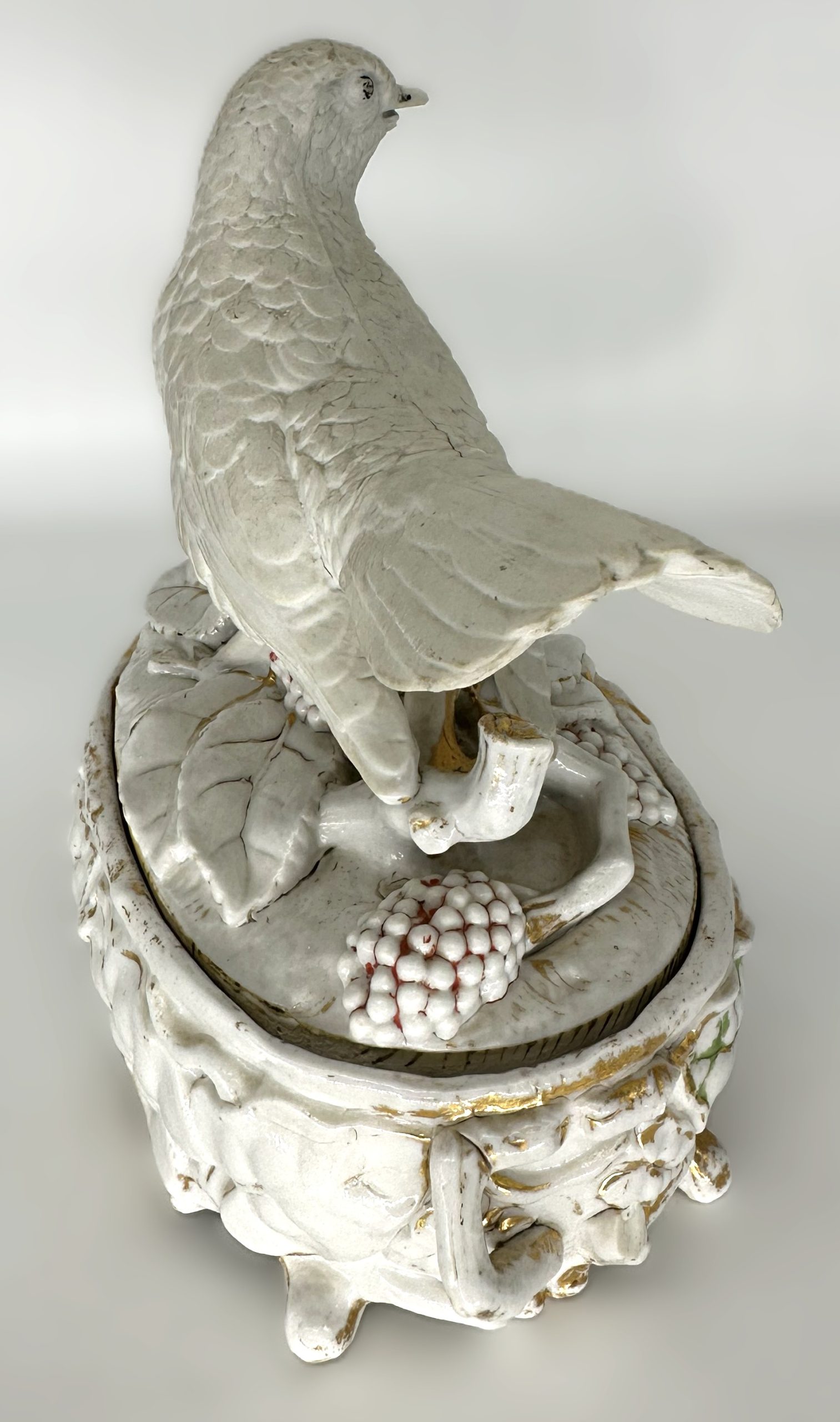
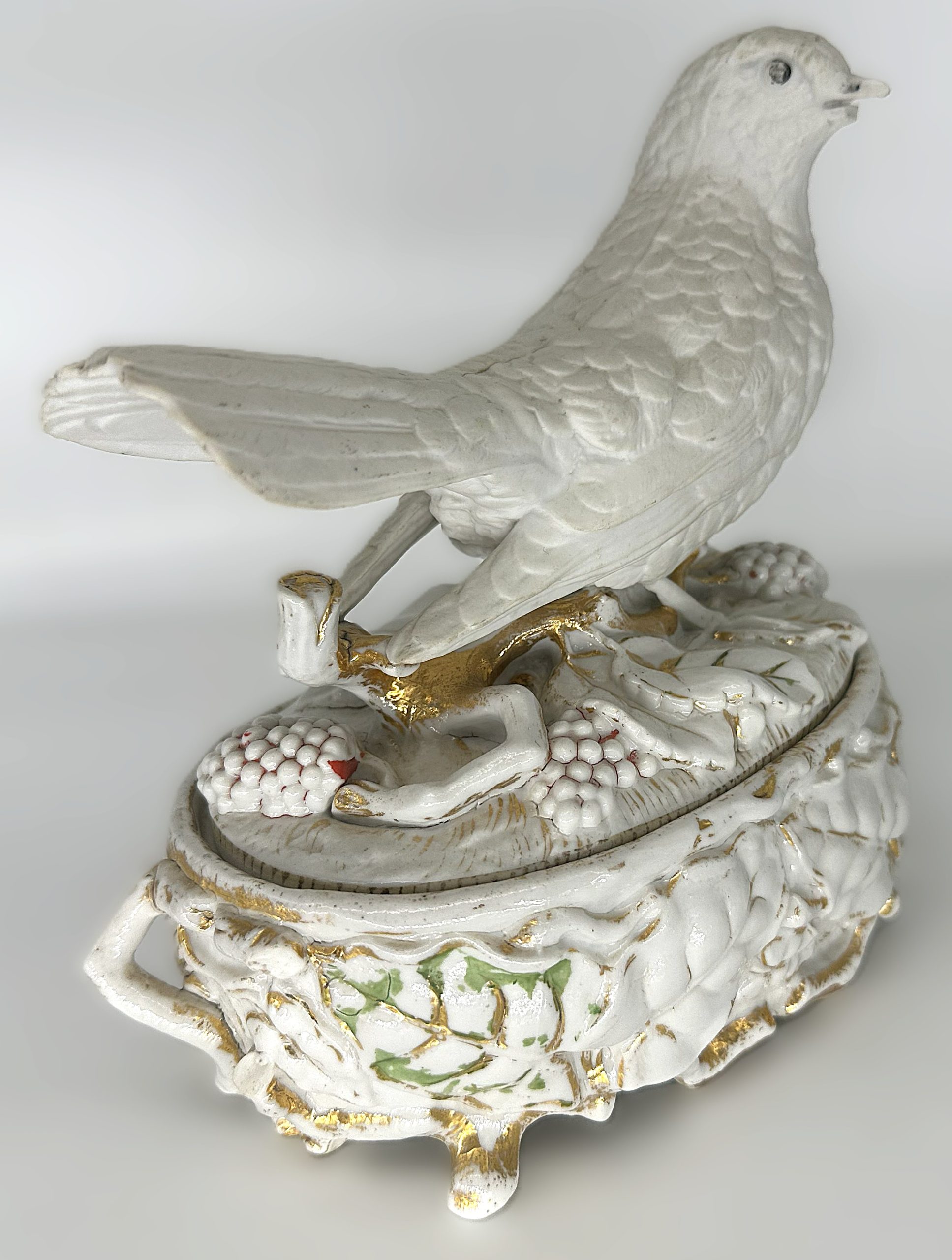
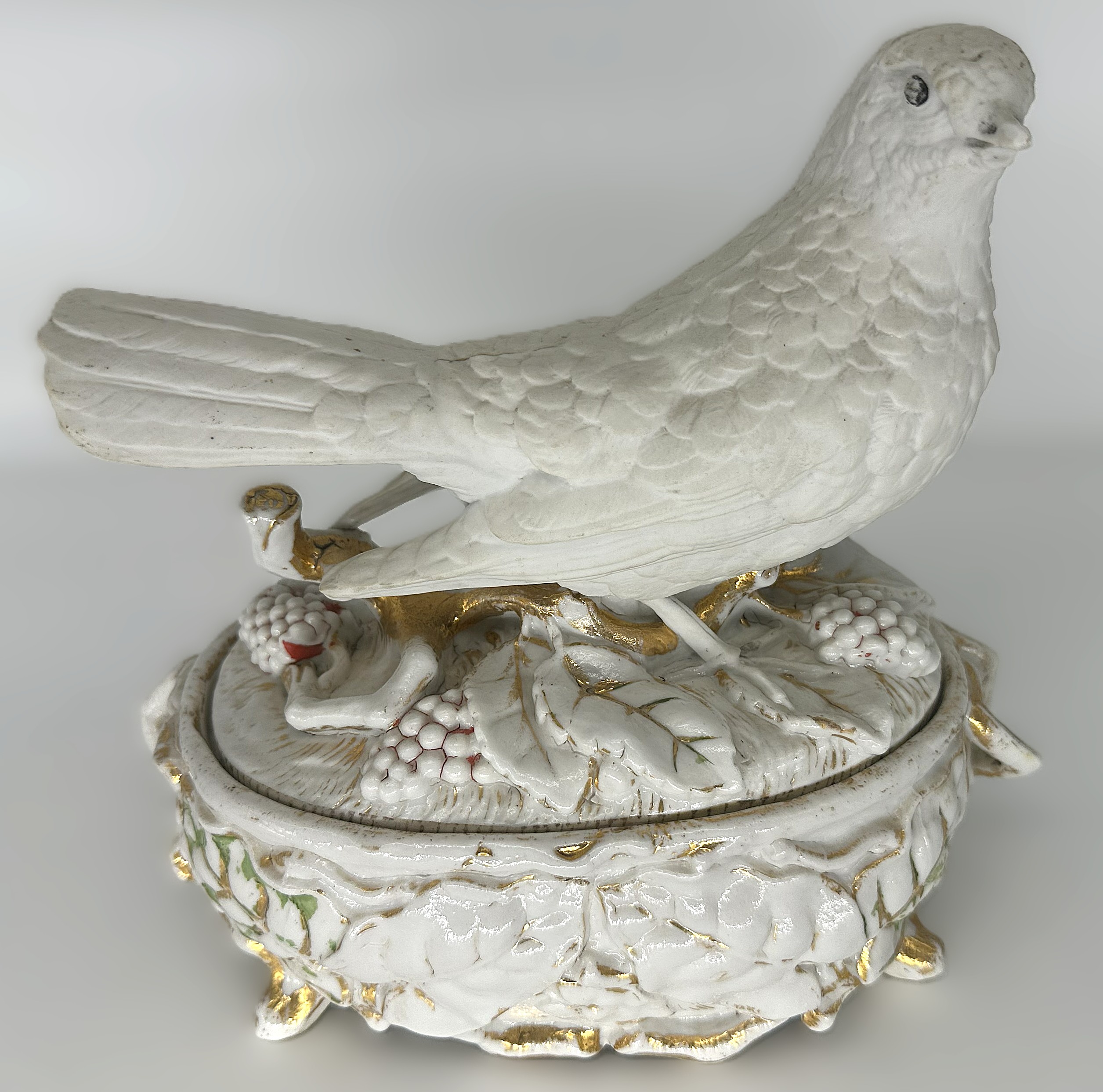
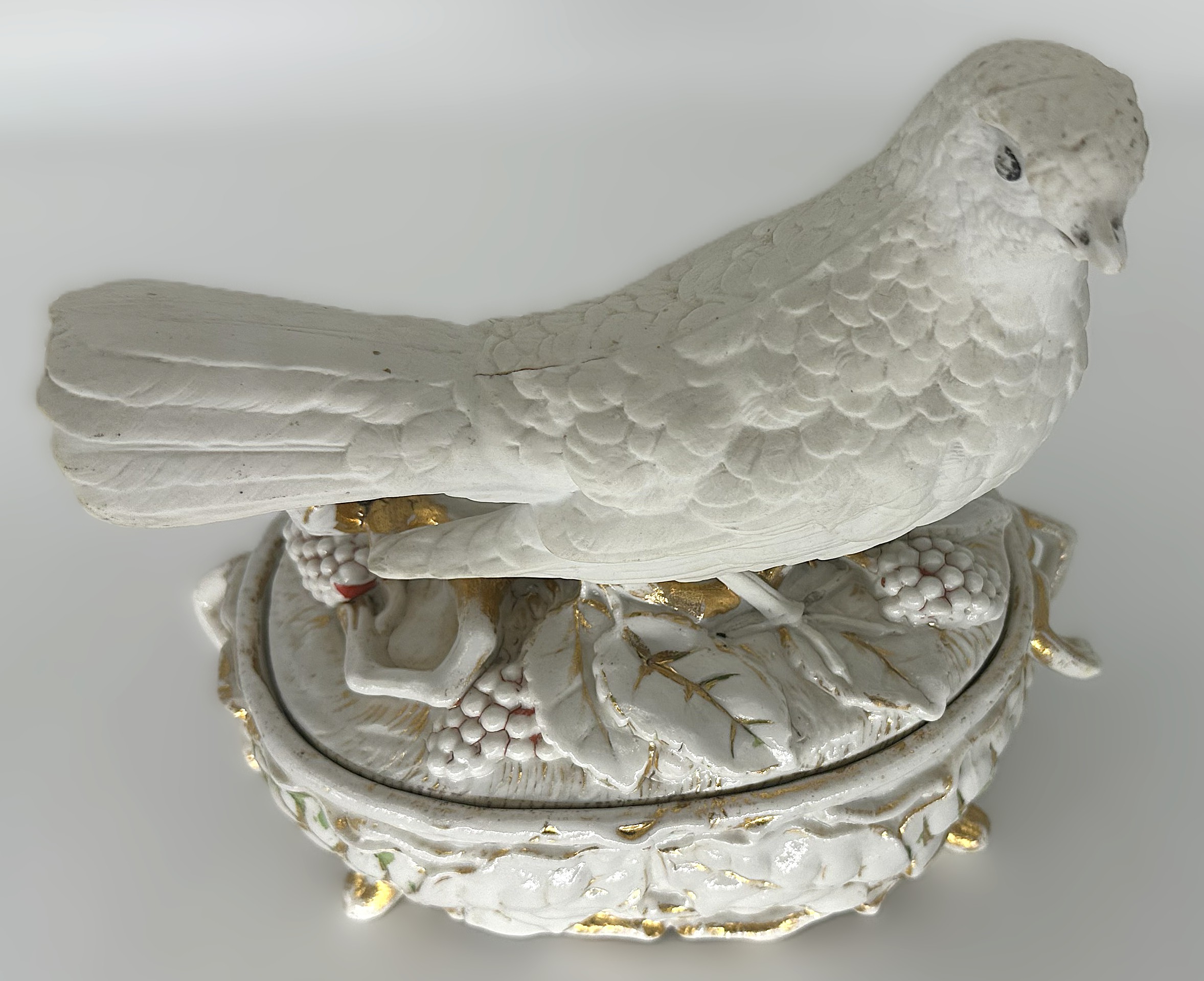
- Form & Composition: The inkstand is constructed as a two-part covered desk set. The base is a molded, oval-shaped basin resting on four low bracket feet, framed by dynamic scrollwork handles on either end.
- Figural Lid: The cover features a full-figure white dove perched atop a leafy branch nestled among textured clusters of grapes and foliage. The bird is rendered with a matte or unglazed bisque-like texture, contrasting against the glazed porcelain body.
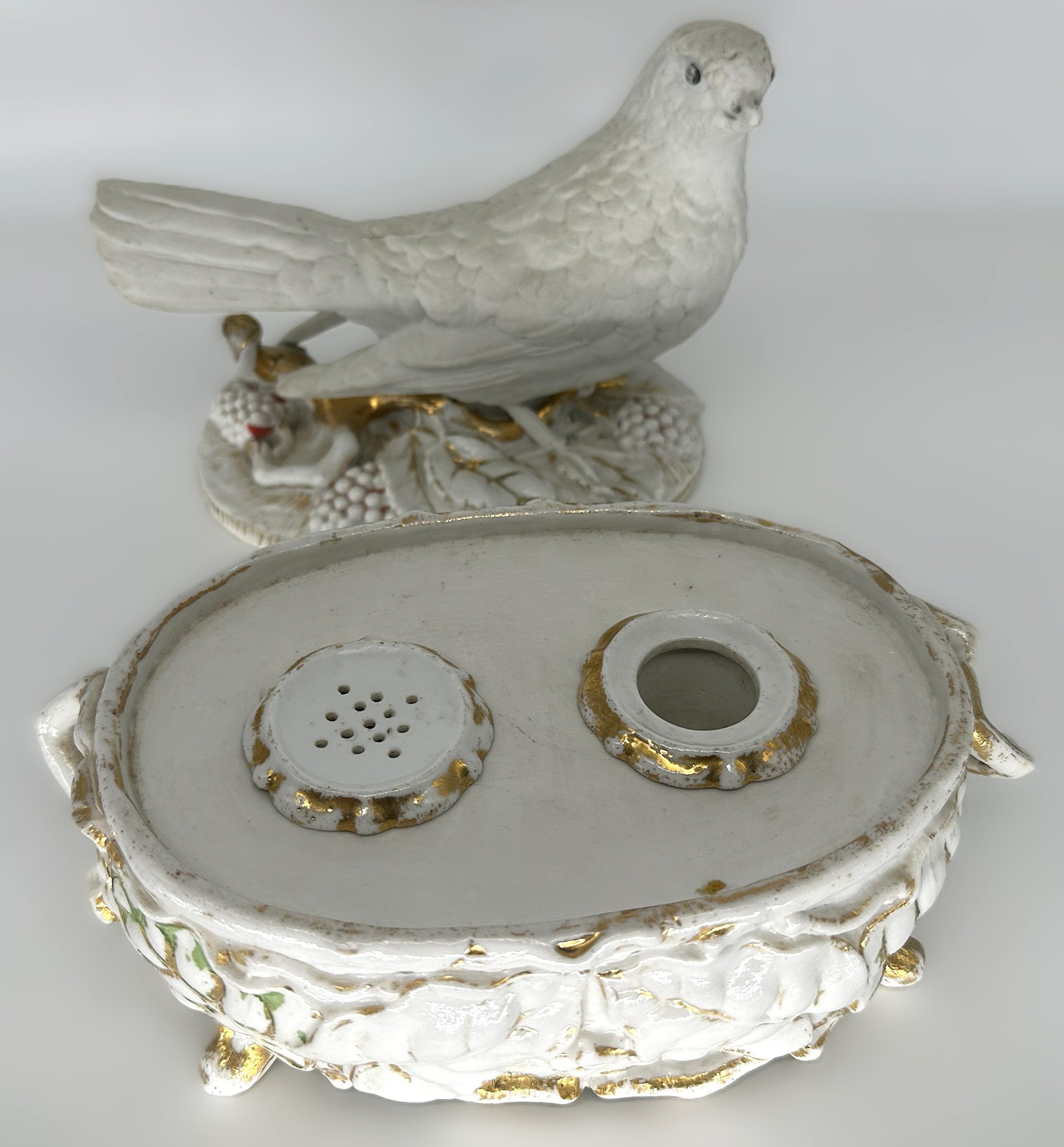
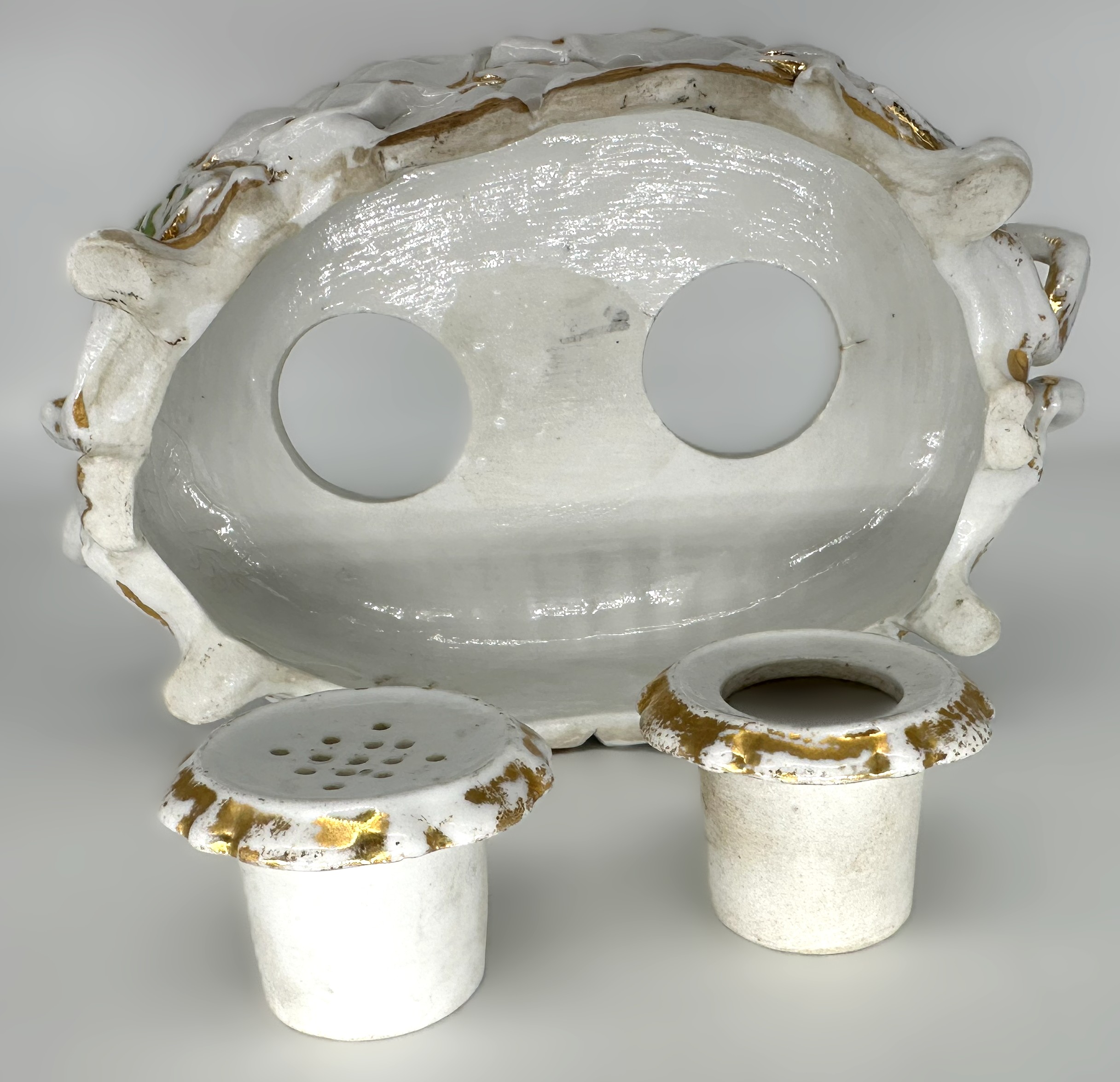
- Interior Elements: Removing the main cover reveals a fitted flat inner shelf housing two removable cylindrical porcelain inserts:
- Inkwell Insert: An open-top cylindrical cup framed by a scalloped, gilded lip.
- Sander (Pounce Pot): A matching insert featuring a pierced dome top with a 13-hole pepper-caster perforation pattern used to sprinkle pounce (drying sand) onto wet ink.
- Decoration & Palette: The piece relies primarily on a stark white porcelain body with heavy accenting in sponge-gilded and brushed gold leaf along the base rim, feet, handles, grape leaves, and insert collars. Subtle green and red hand-painted enamel accents highlight the grape clusters and leaf veins.
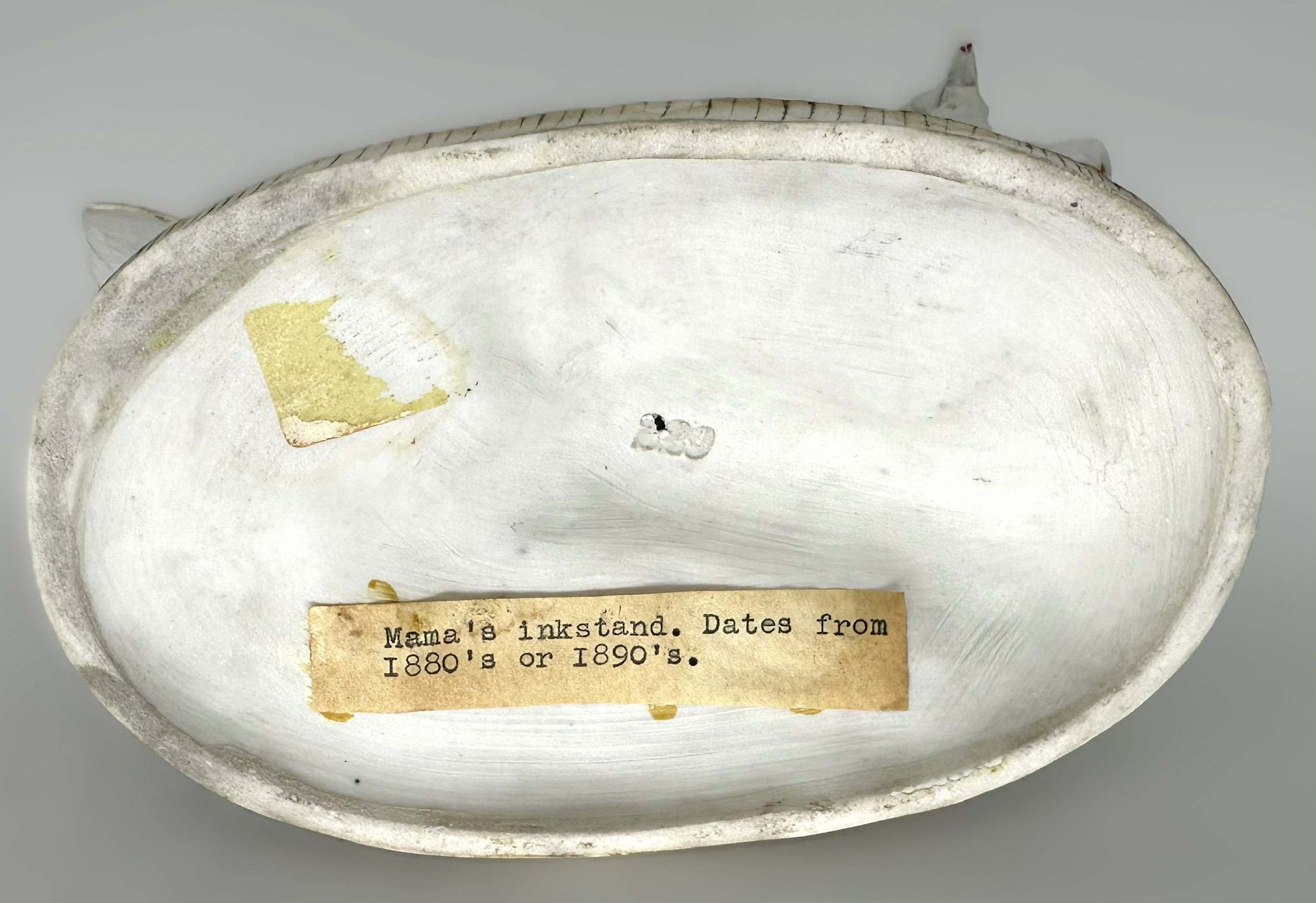
- Marks: The underside exhibits an impressed mold number “220” centered on the base. It carries no manufacturer’s mark, along with a typed historical note: “Mama’s inkstand. Dates from 1880’s or 1890’s.”
Origin, Manufacturer & Date Analysis
- Is the 1880s–1890s Date Accurate?
Yes, the handwritten note’s date estimate of the late 19th century (circa 1880–1895) is visually and structurally accurate.
- Stylistic Indicators: The Rococo Revival aesthetic—characterized by relief-molded foliage, heavy scrollwork, and asymmetrical natural forms—flourished in European porcelain manufacture throughout the late 1800s.
- Functional Evidence: Desk sets containing a pounce pot/sander alongside an inkwell were standard throughout the 18th and 19th centuries. By the late 1880s, blotting paper had largely replaced loose sand, making late 19th-century sander inkstands decorative revival items as much as utilitarian tools.
- Where Was It Made & Who Made It?
- Origin: Germany or France (Continental Europe).
- Manufacturer Identification: Unmarked porcelain pieces bearing only three-digit mold or shape numbers (such as 220) were standard output for major 19th-century German manufacturers like Conta & Boehme, Sitzendorf, Volkstedt, or various Thuringian porcelain factories, as well as French Old Paris (Vieux Paris) makers.
- These factories produced un-marked white and gilt decorative porcelain (Blanc de Chine style with relief) usually for export to the British and American markets. The mold number 220 signifies the factory’s production mold shape.
- Bird Species
While 19th-century porcelain factories often produced generalized avian figures rather than ornithologically precise species, this bird exhibits key anatomical features characteristic of a dove or pigeon (Columbidae family):
- Head & Bill: It features a small, rounded head with a short, stout beak and a distinct, soft cere (the small fleshy swell at the base of the upper bill).
- Body & Tail: The broad, plump breast combined with long, straight tail feathers extending horizontally behind the perch is classic for dove modeling.
- Plumage Texture: The fine, soft scale-like feather molding across the nape and back mimics the smooth, downy plumage of a dove rather than the defined, separated wing coverts of songbirds or game birds.
- Victorian Symbolism: In 19th-century European decorative art, doves perched among grapevine foliage (representing peace, fidelity, and abundance) were popular motifs for personal desk accessories.
Summary Specifications
| Feature | Details |
| Dimensions | 7 ¾″ Long × 4 ¾″ Wide × 7″ High |
| Material | Glazed and bisque porcelain with hand-painted enamels and gold leaf gilding |
| Origin | Germany / Continental Europe |
| Date | Late Victorian, c. 1880–1895 |
| Inscriptions | Impressed mold number 220 on base |
Estimated value: $150
Content disclaimer. The information posted is the owner’s best knowledge and may not have been vetted by the SOIC. We welcome comments, corrections, and additions, working to make our website information comprehensive and accurate.
Join the Society of Inkwell Collectors (SOIC) – it’s free!
Founded in 1981 as a non-profit organization,
we are documenting inkwells (and accessories).
We’re here to help and inform!