

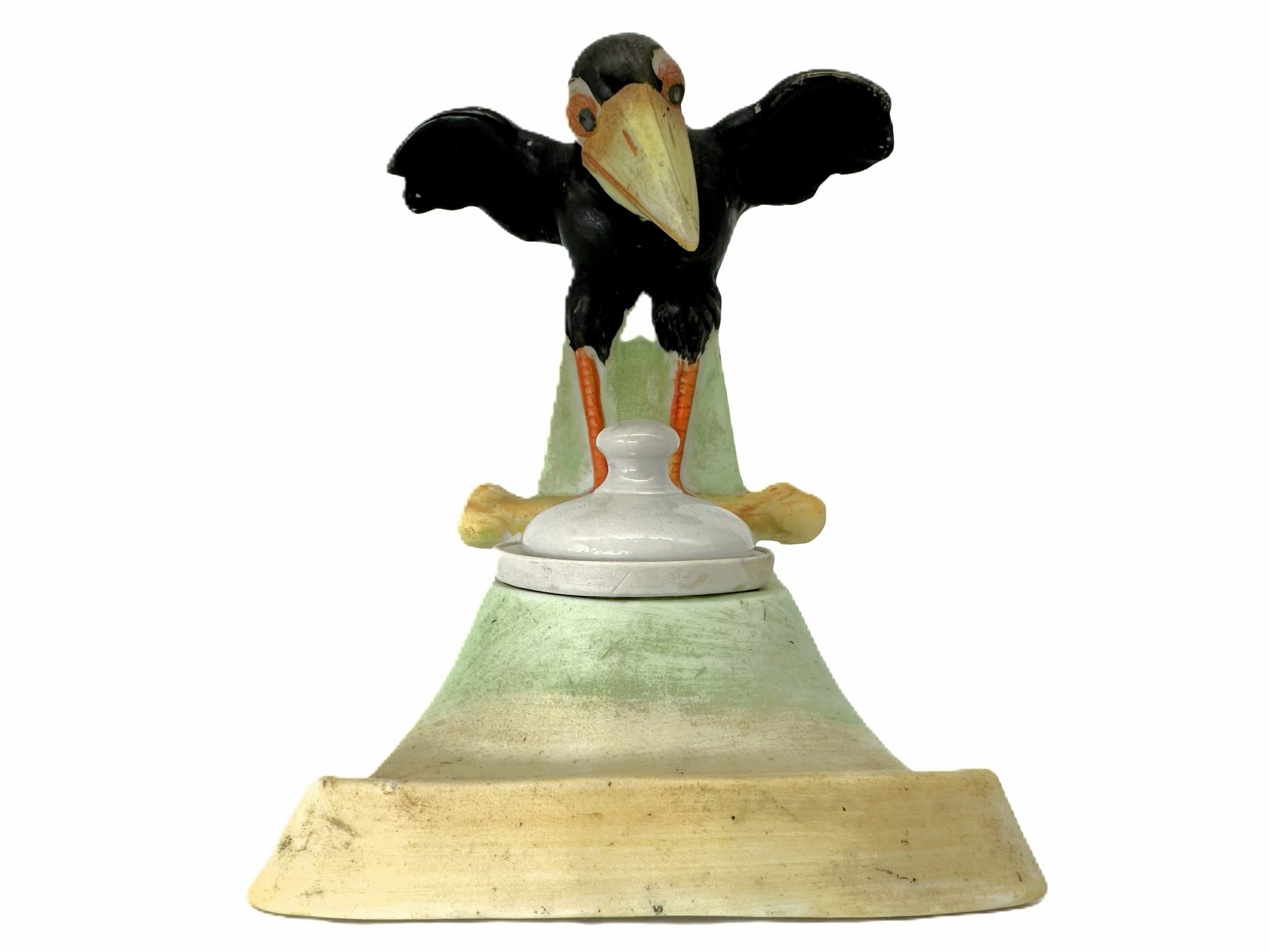
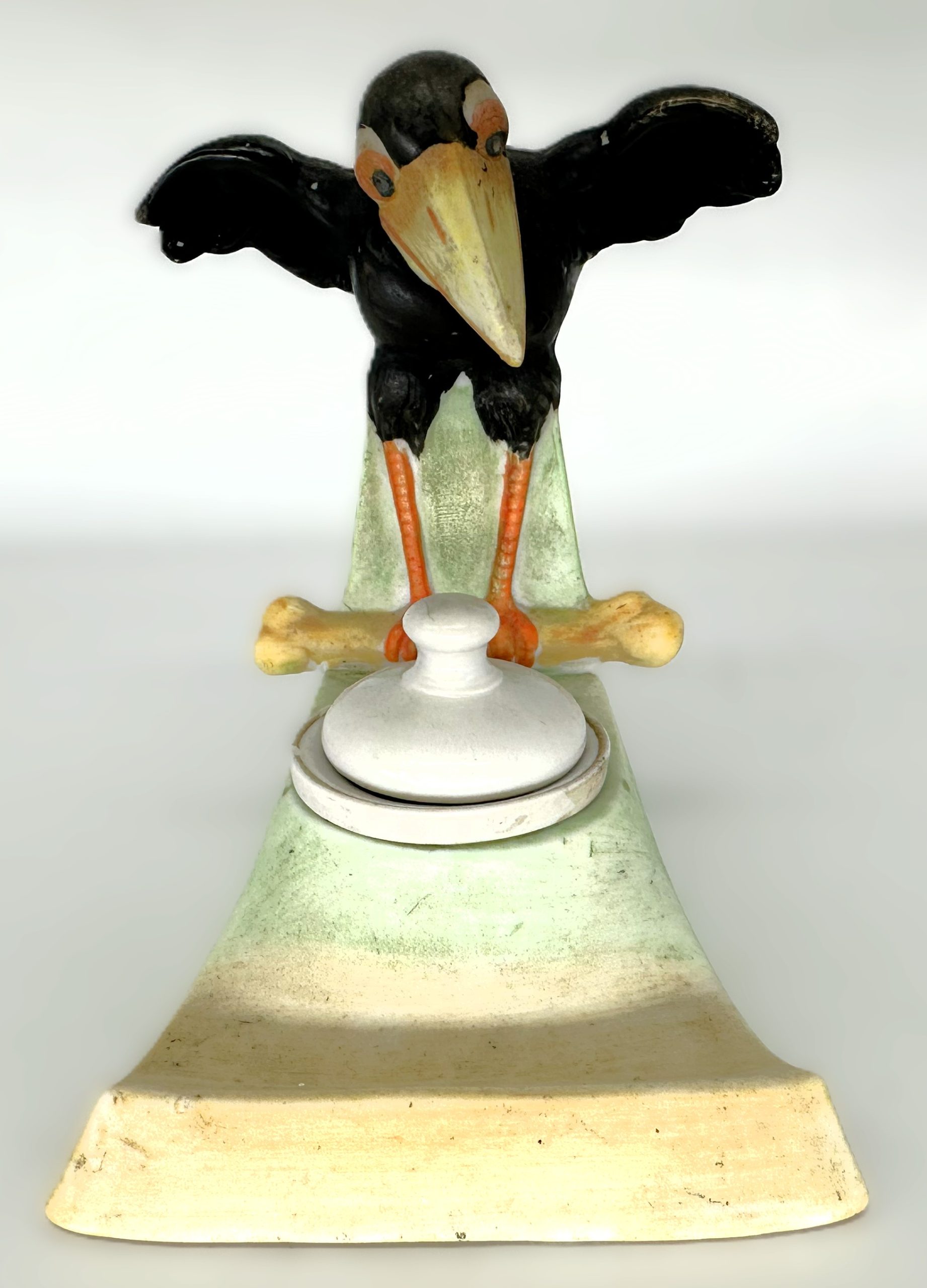
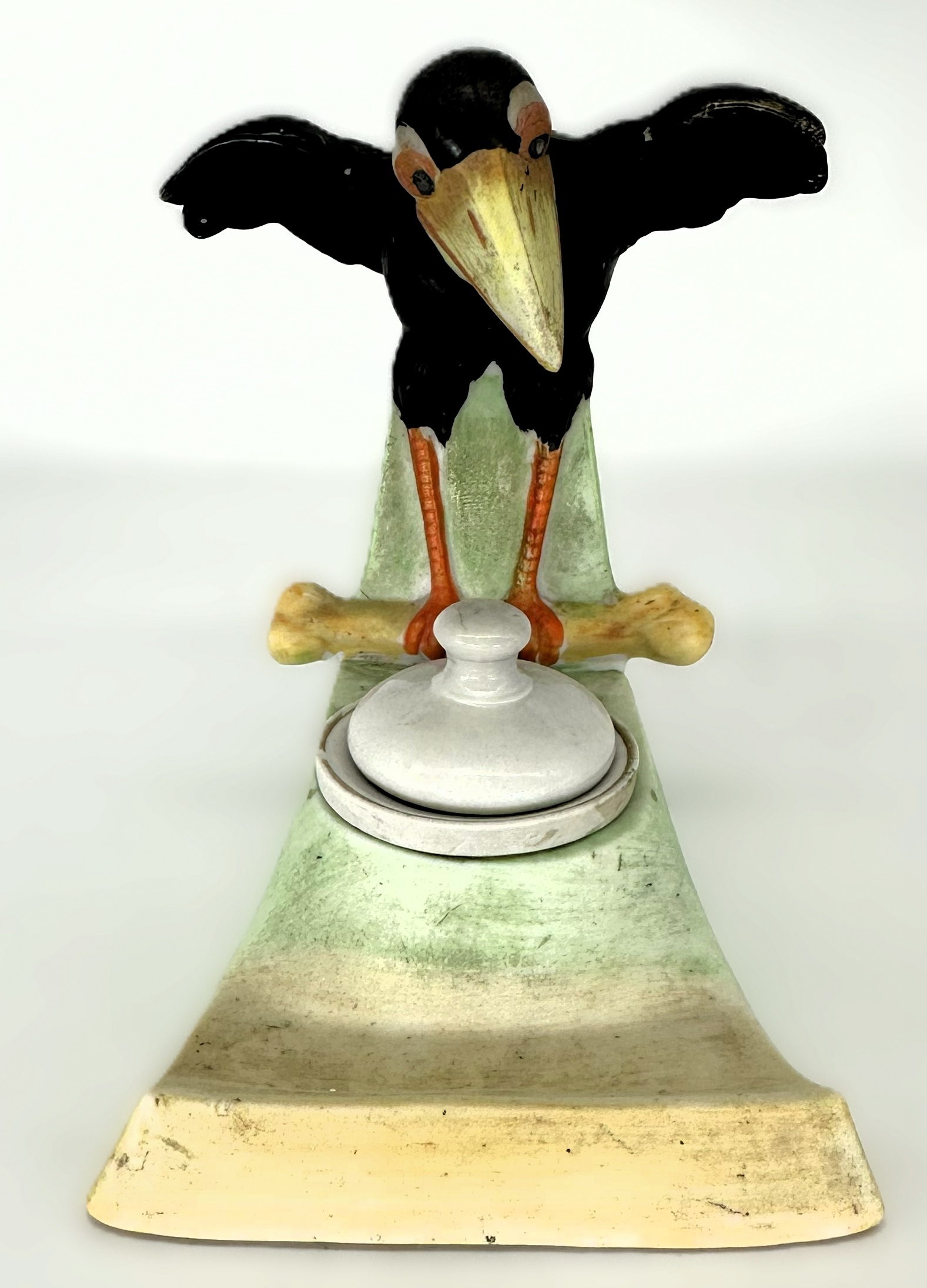
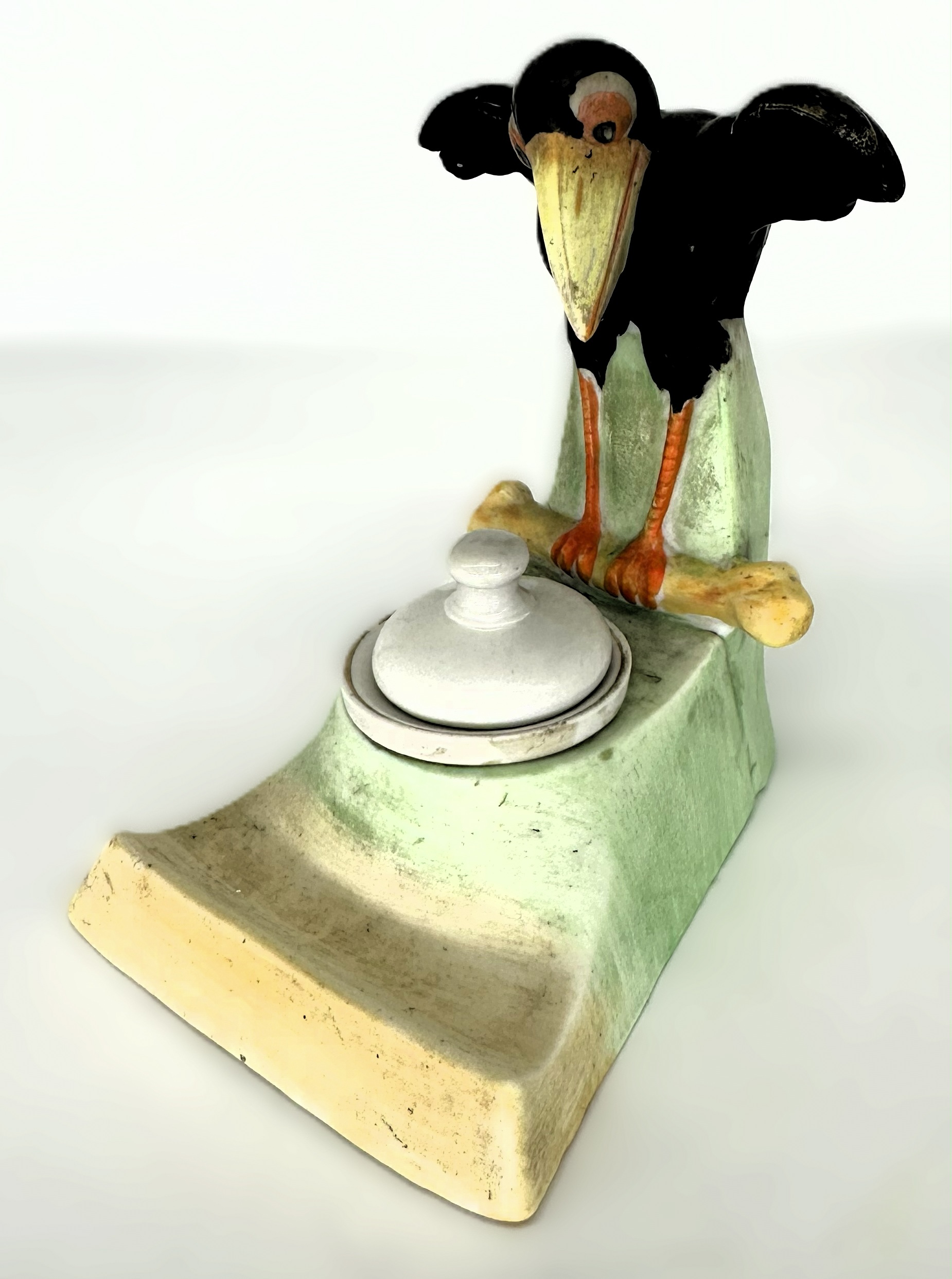
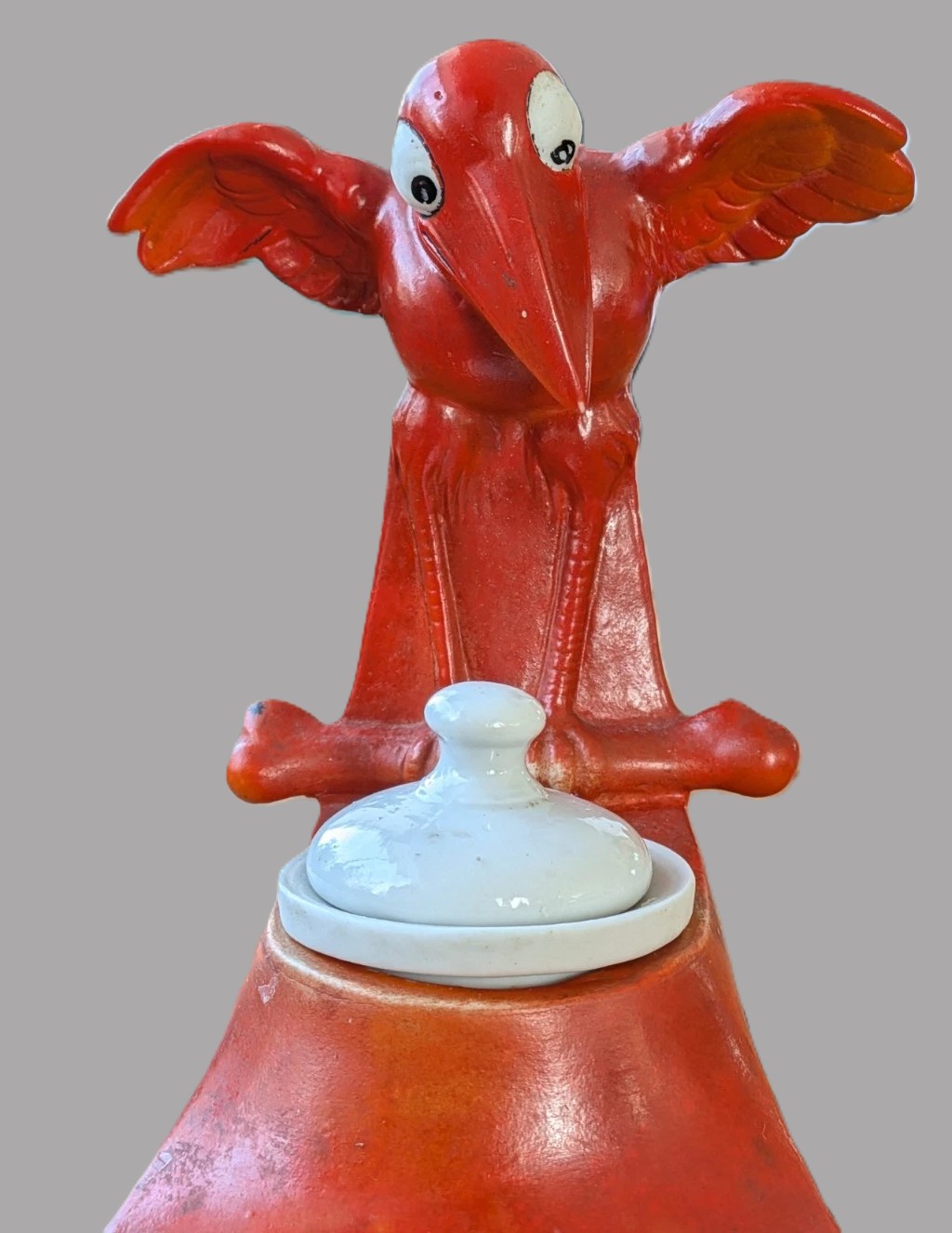
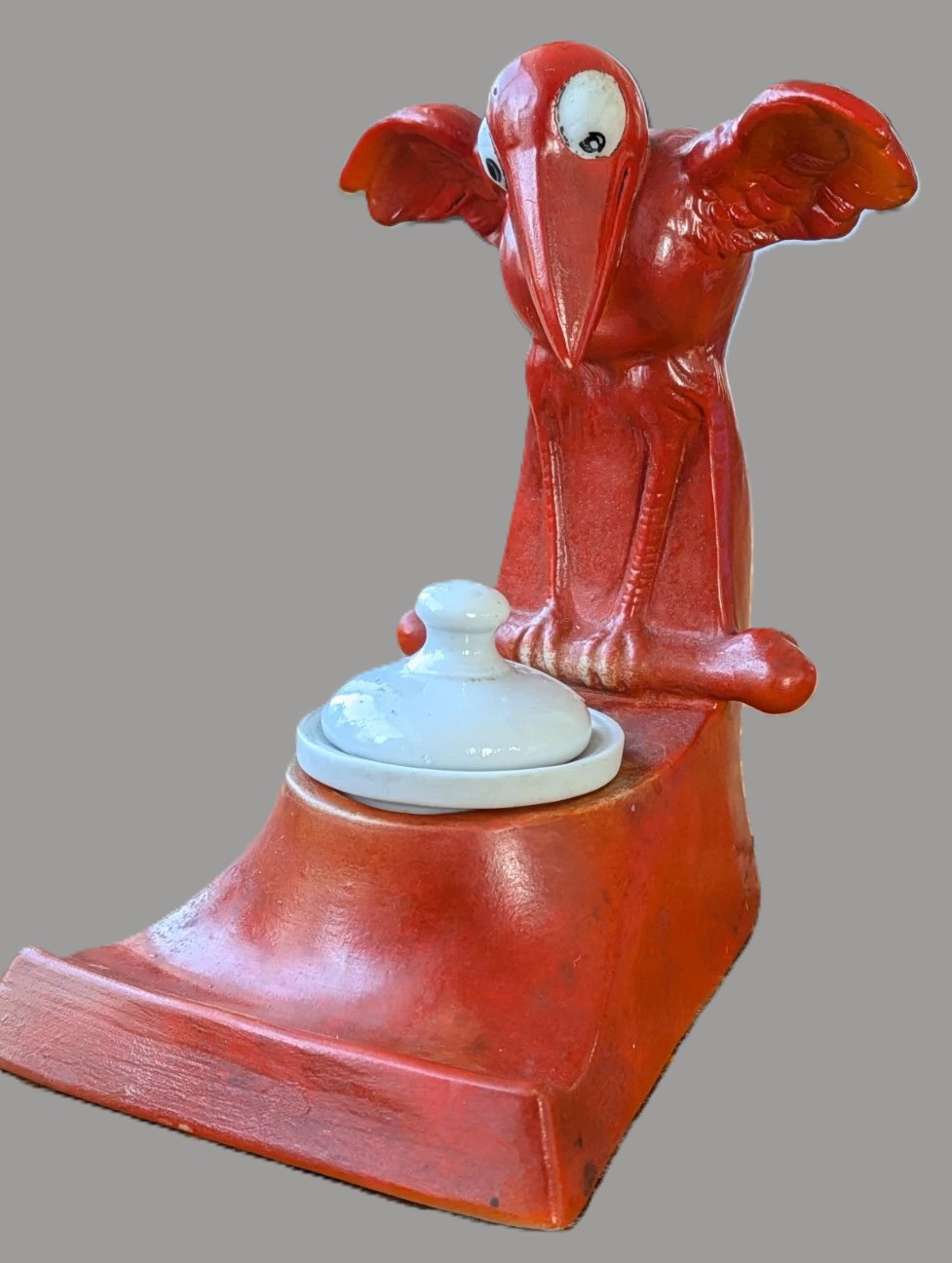
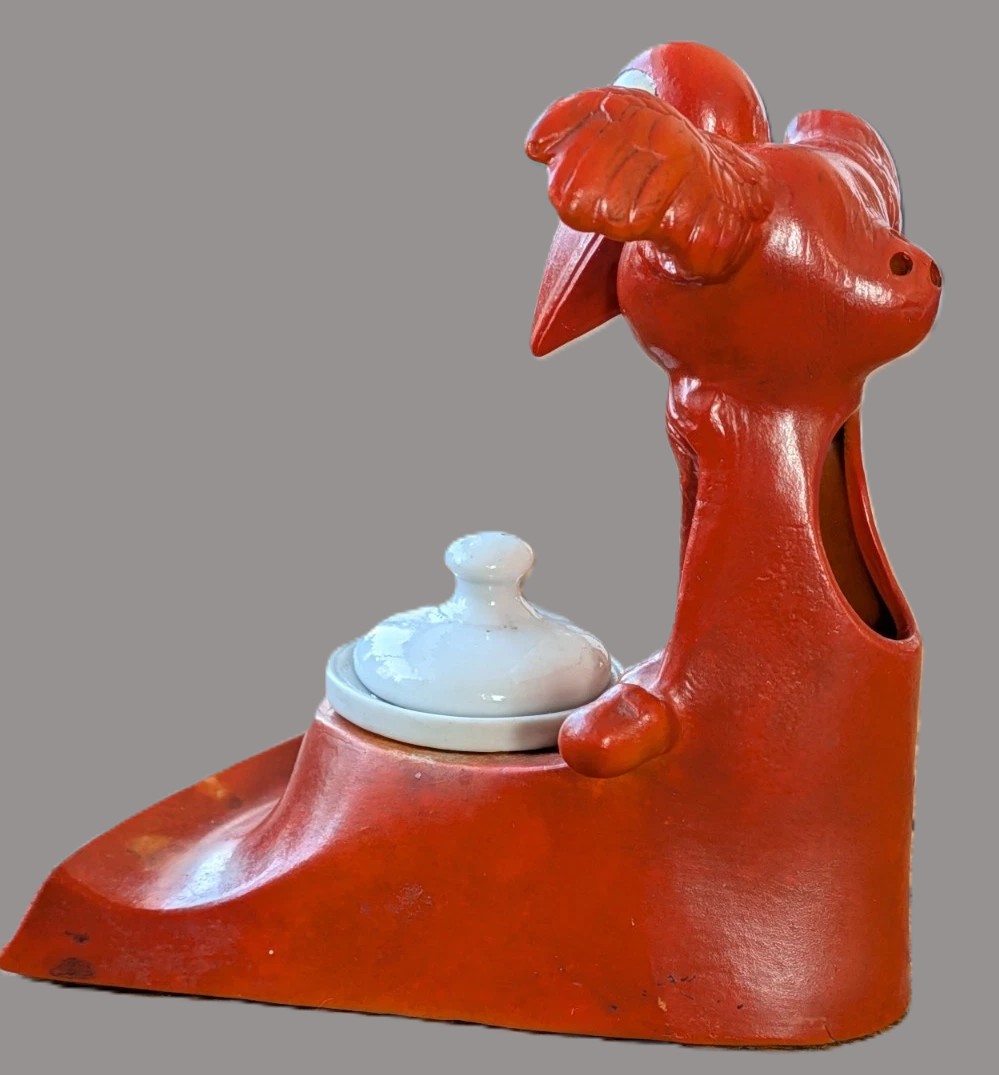
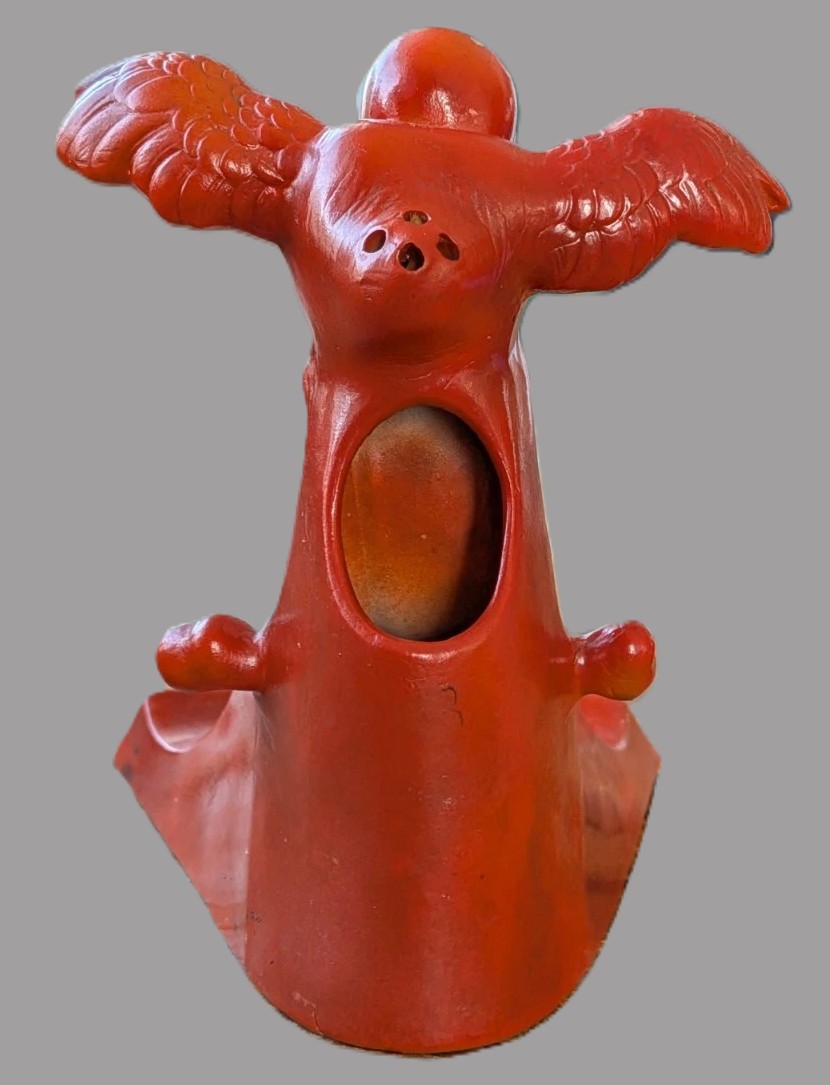
“Mischievous Raven on Bone” Novelty Inkstand
| Categories | Ceramics/Porcelain "Named" Makers |
| Type | Bird |
| Material | Porcelain |
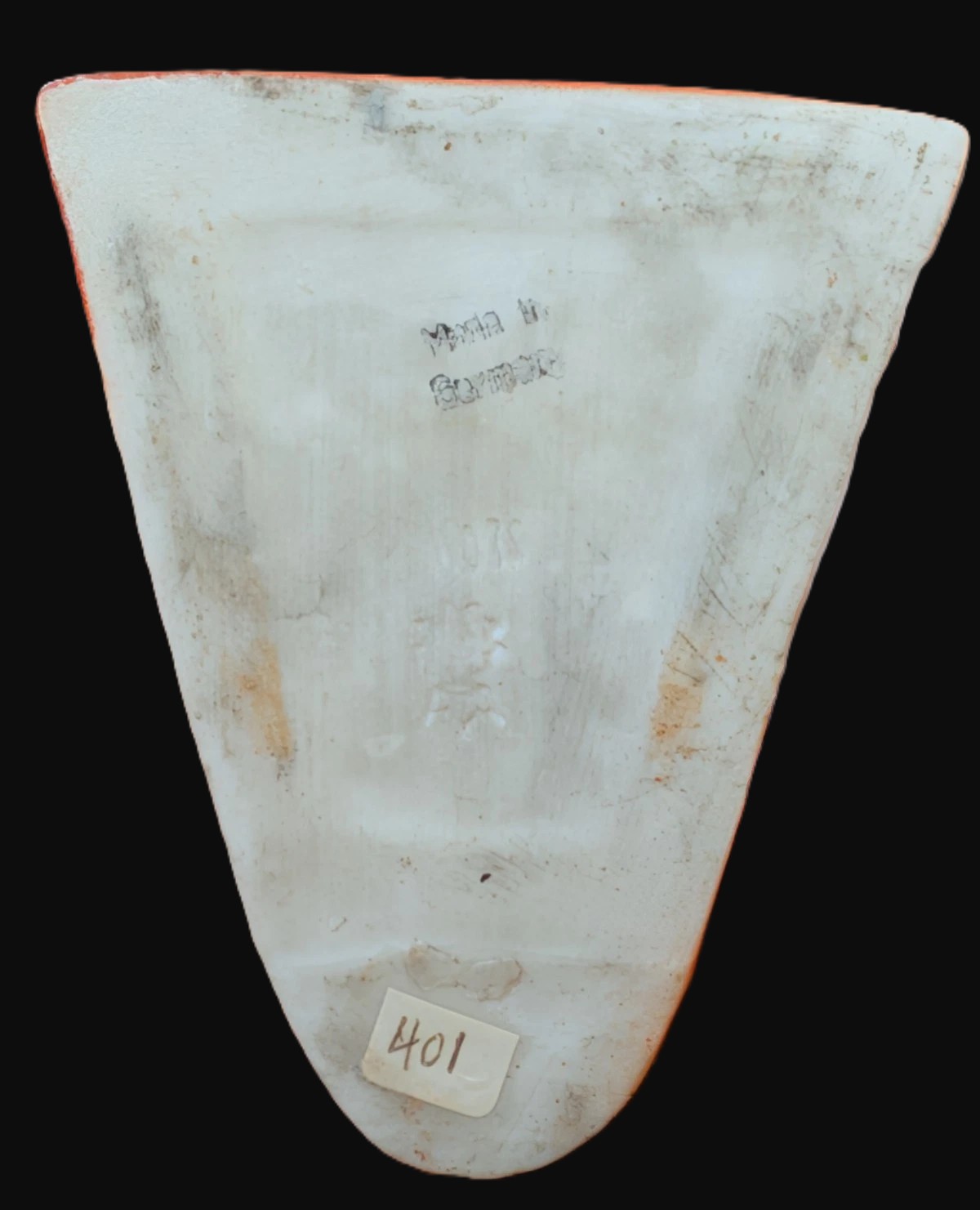
| Markings | See Narrative |
| Manufacturer | Schafer and Vater |
| Origin | Germany |
| Date or Era | circa 1910 |
| Measuring | 4” x 3 ¼” x 4 ½” high |
“Mischievous Raven on Bone” Novelty Inkstand
Manufacturer: Schäfer & Vater (Thuringia, Germany) | Circa: 1900–1920s
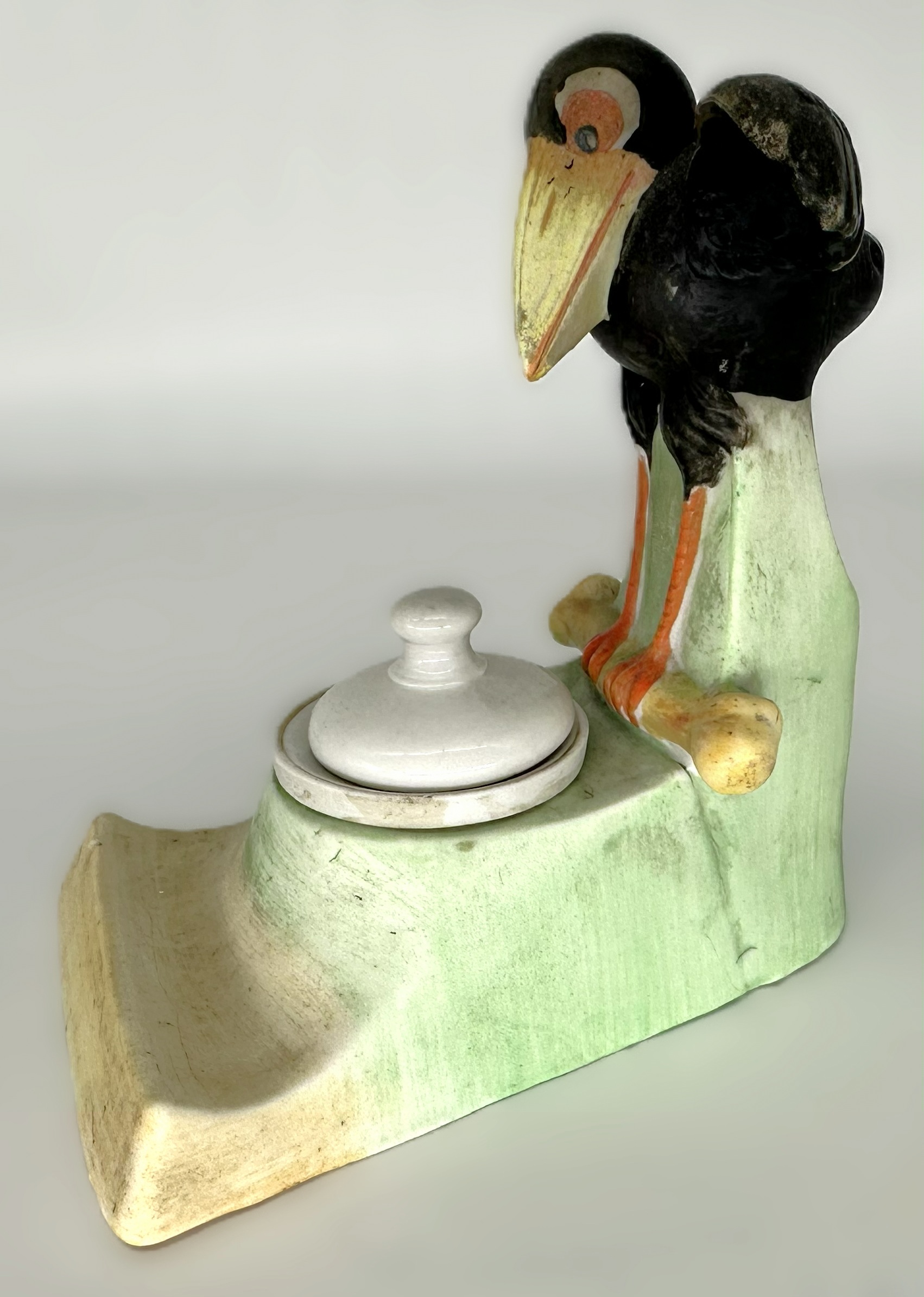
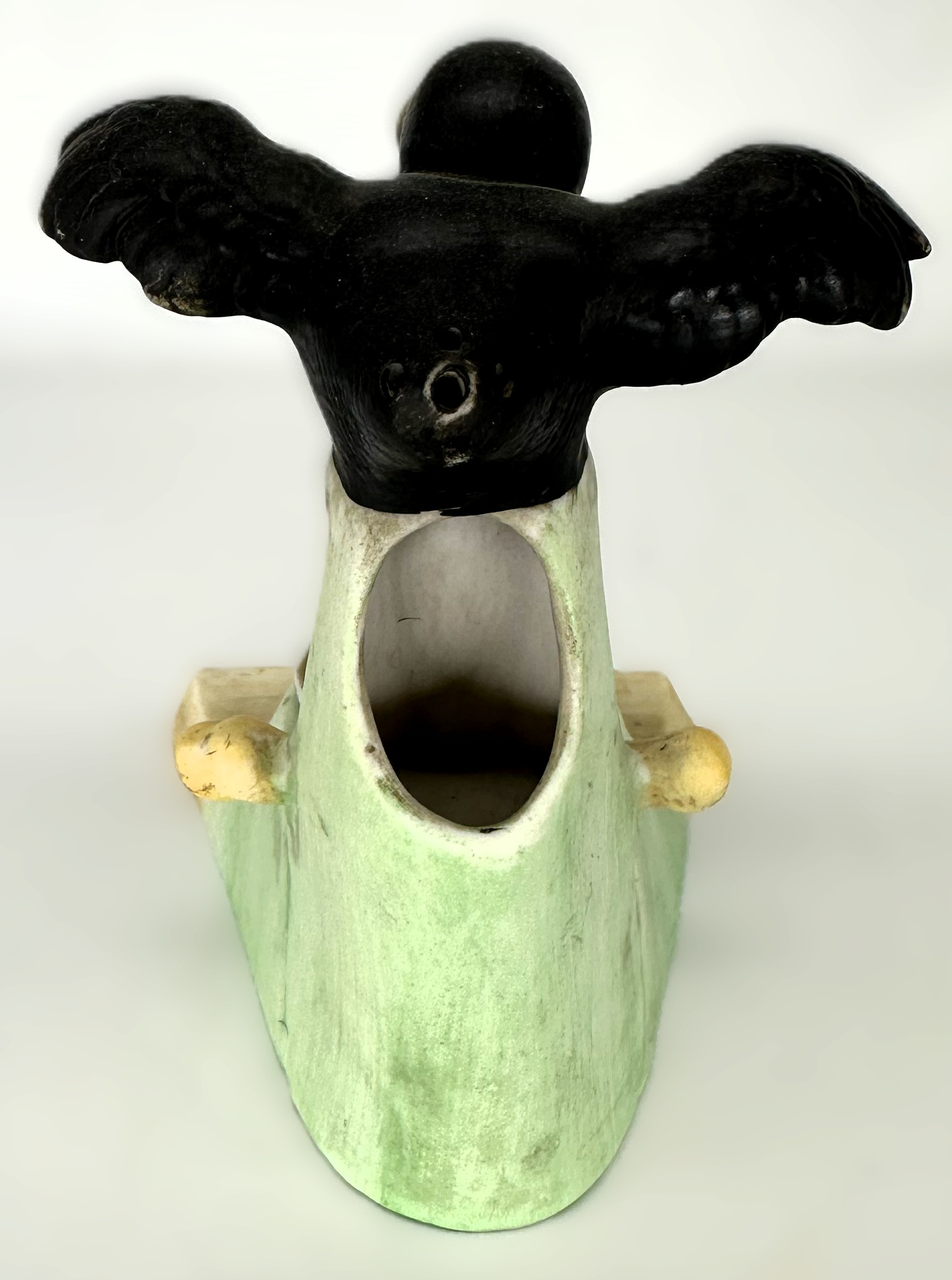
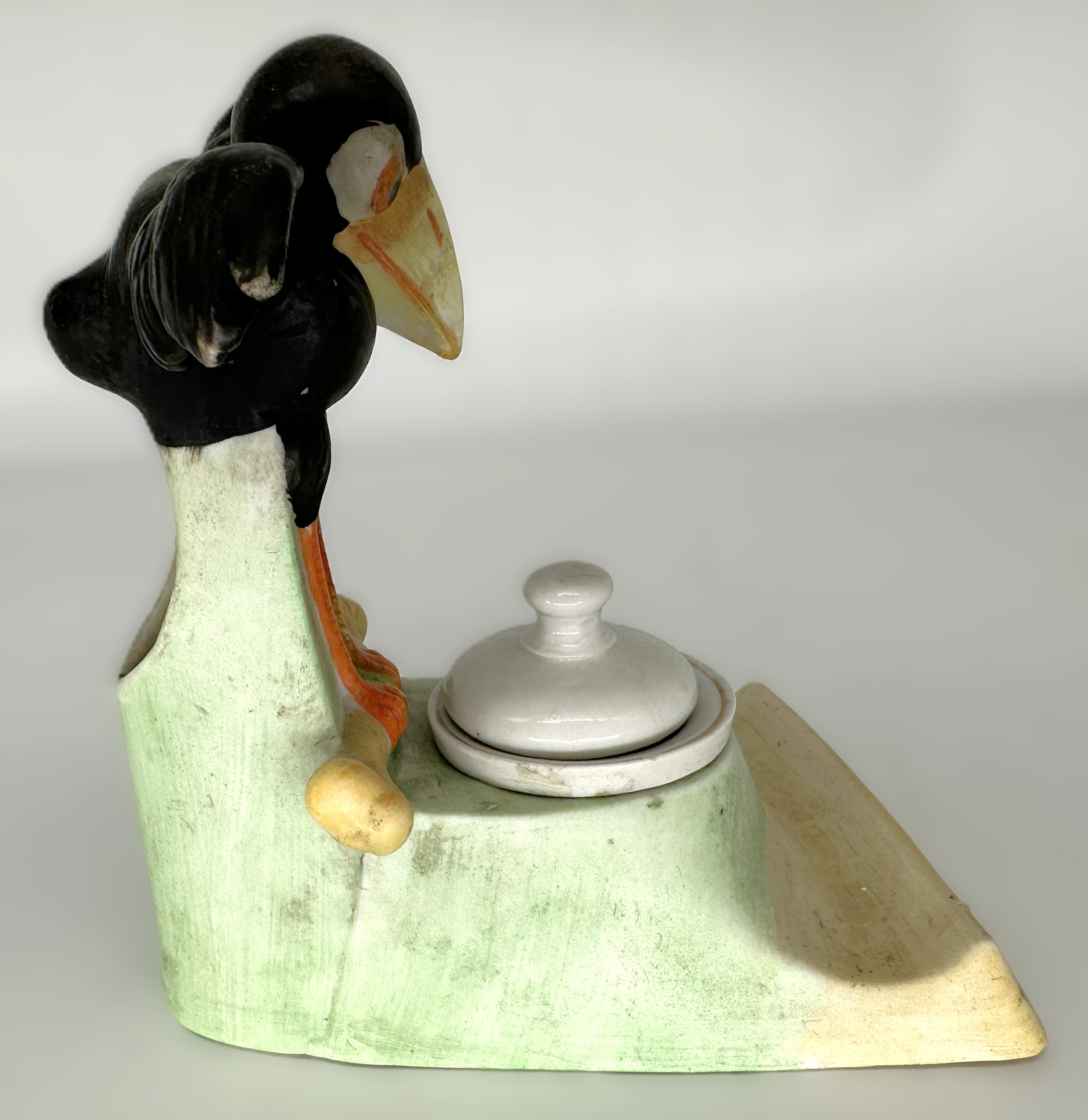
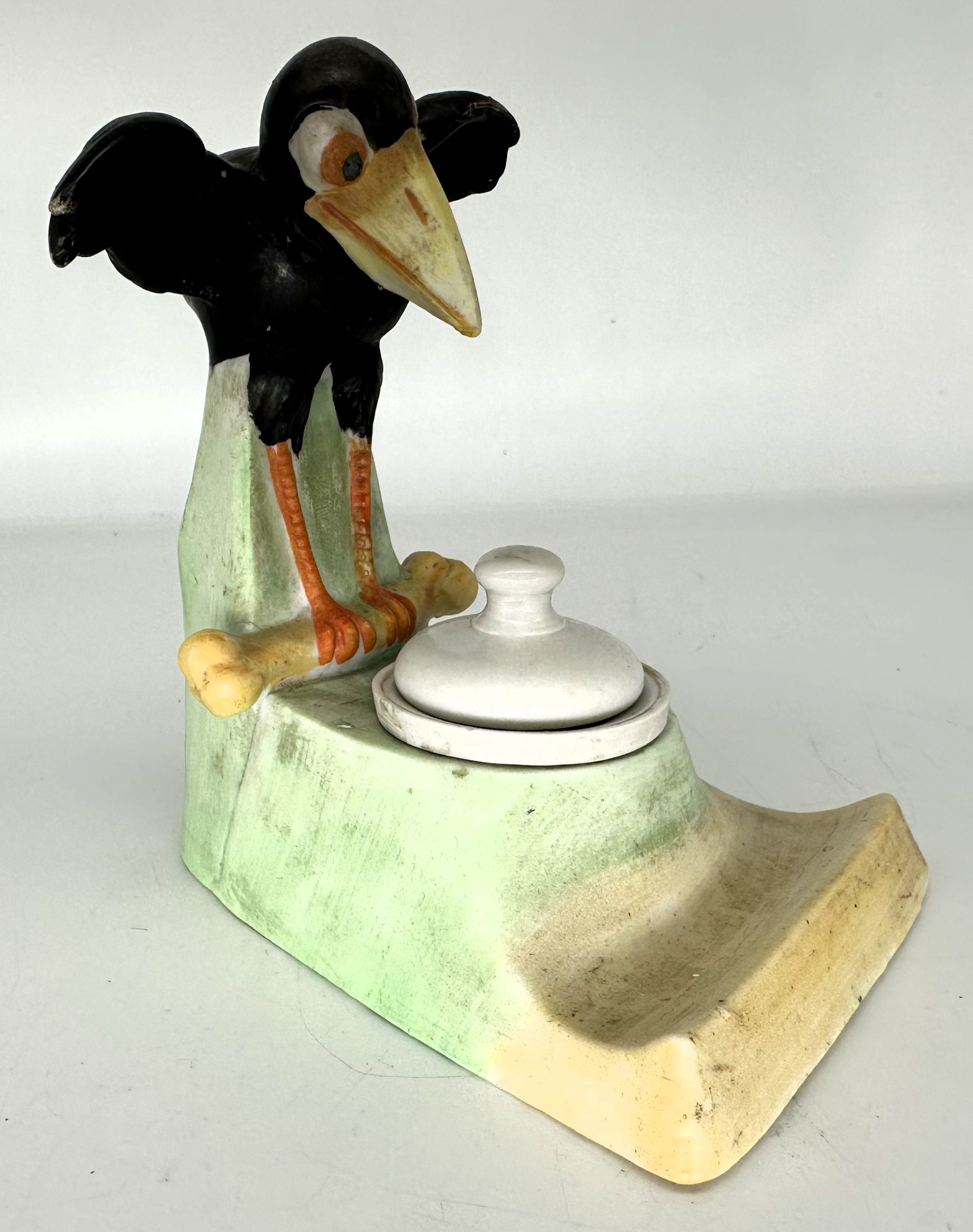
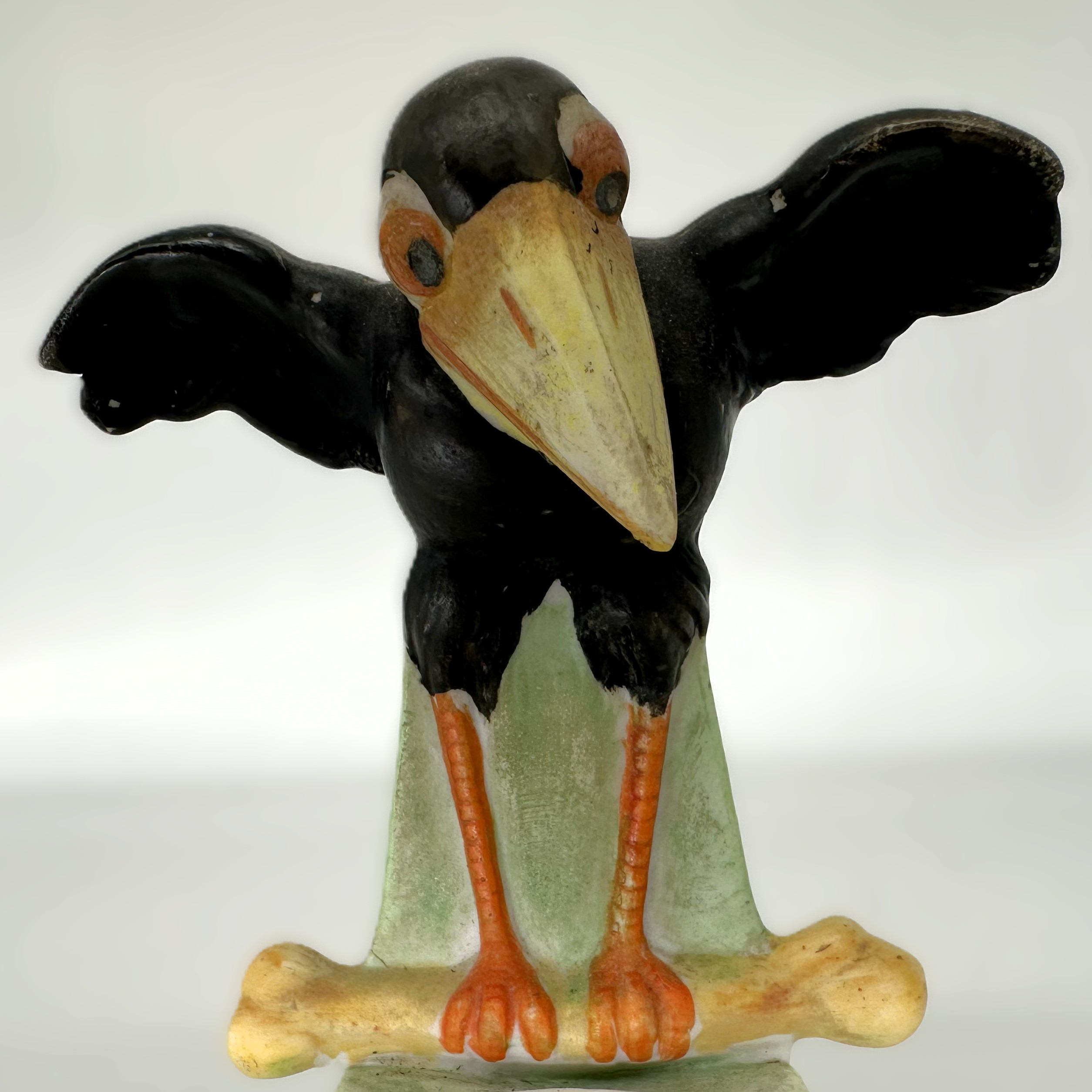
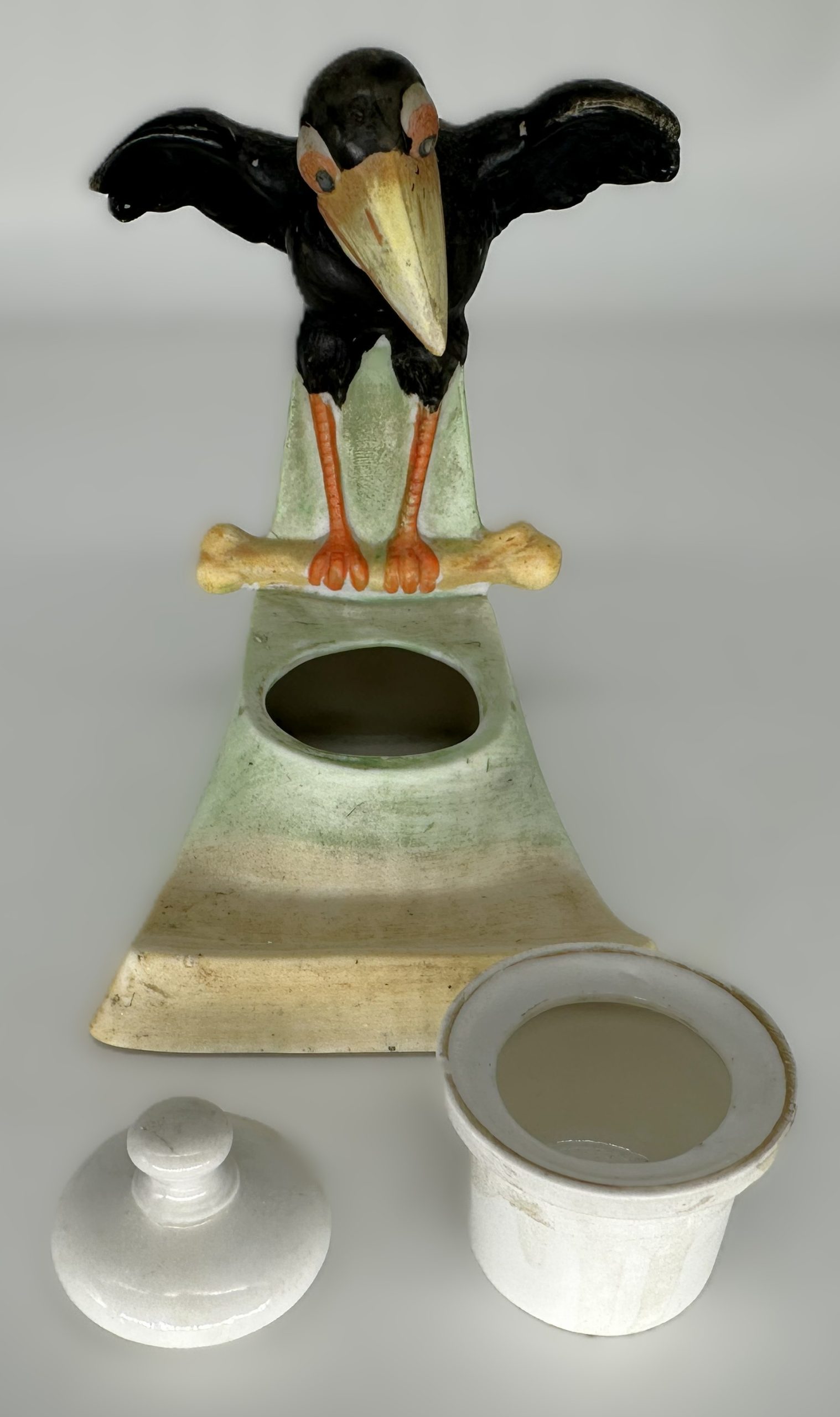
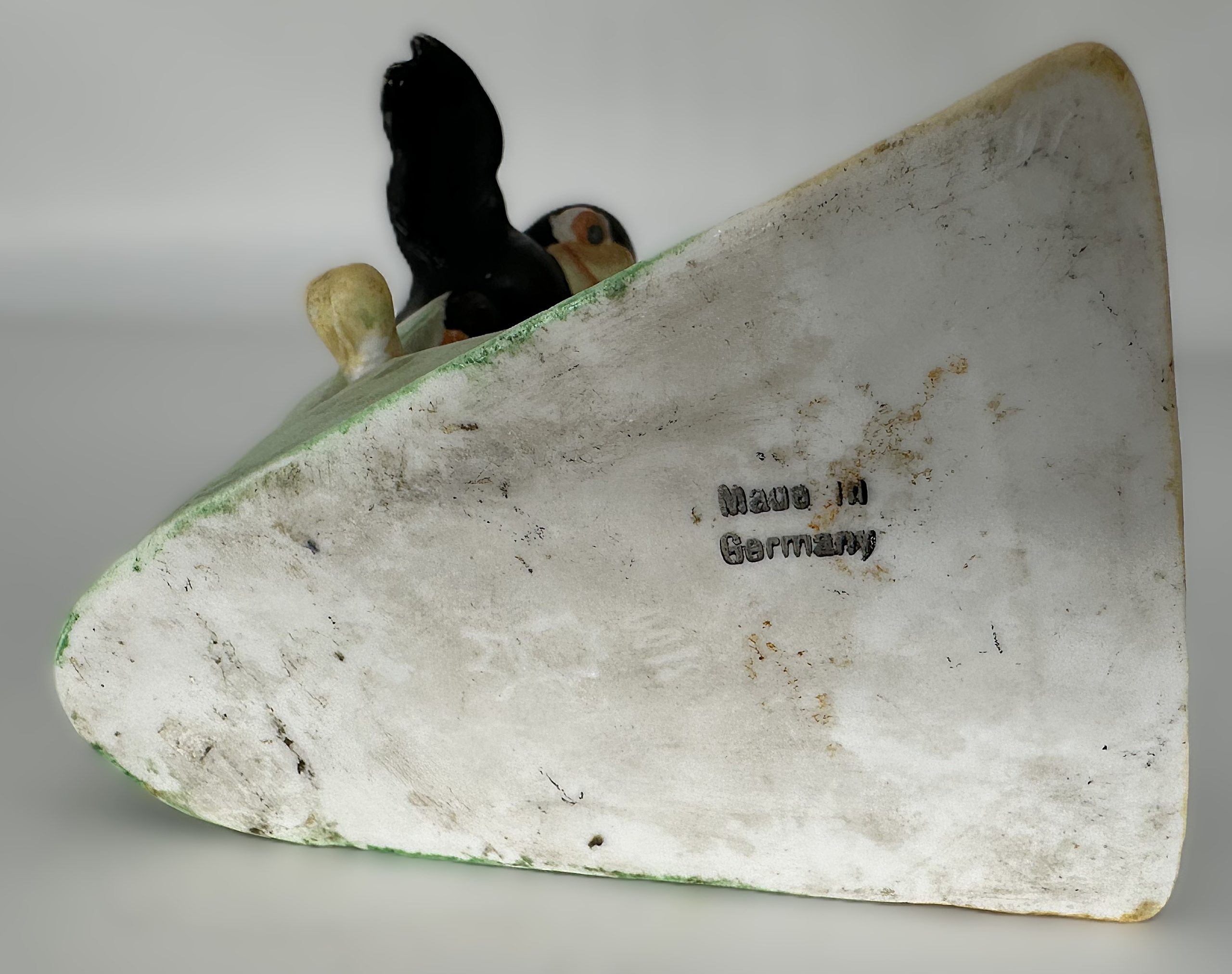
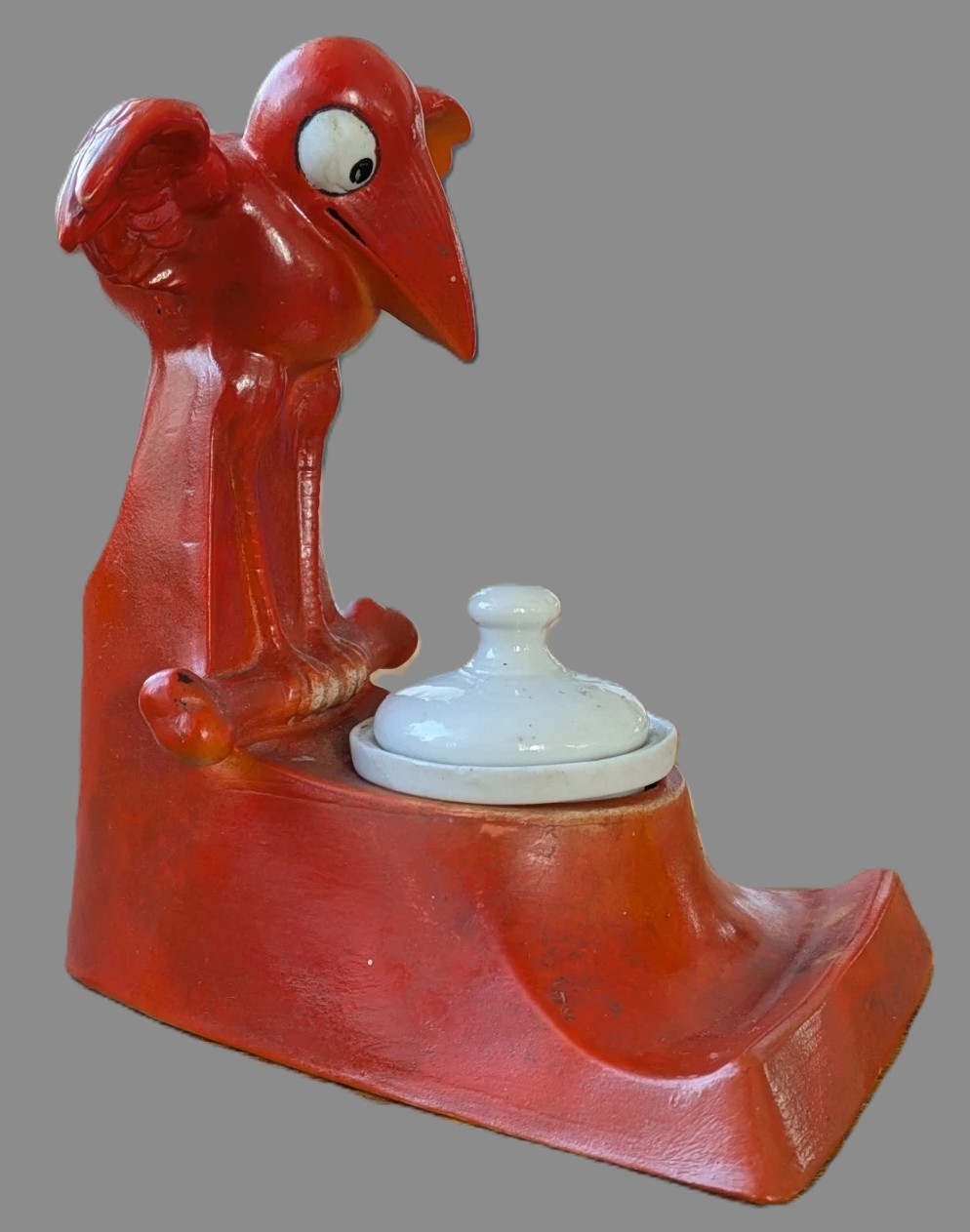
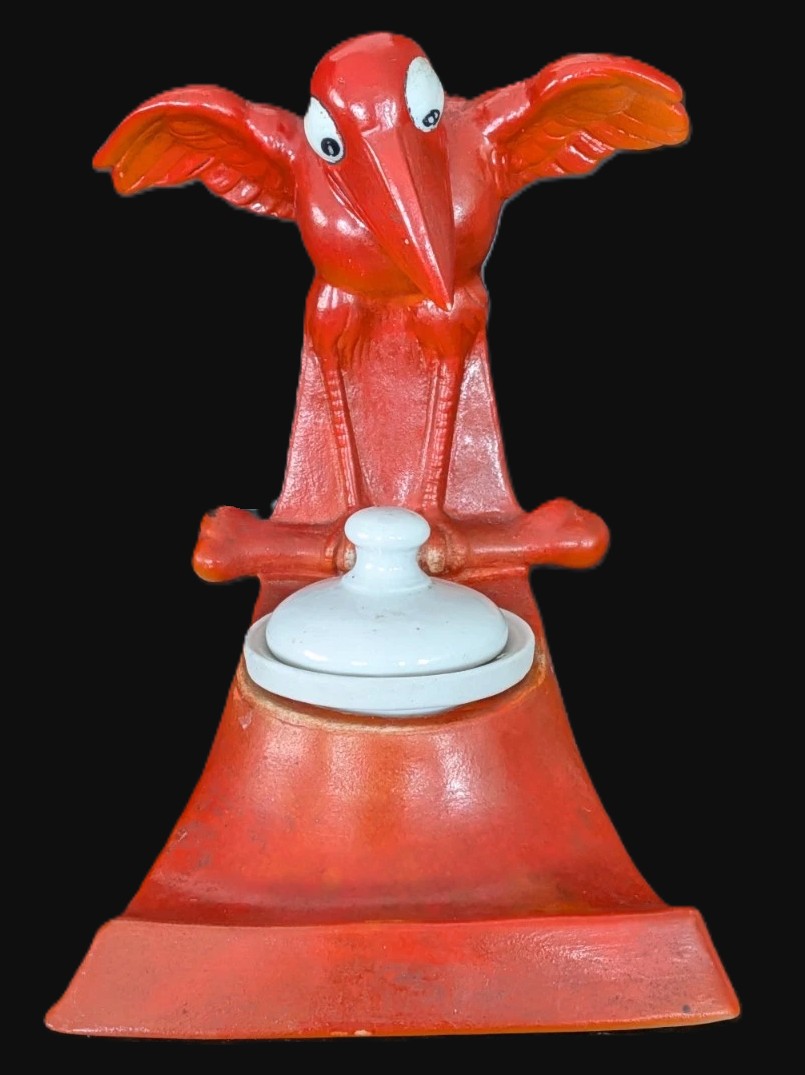
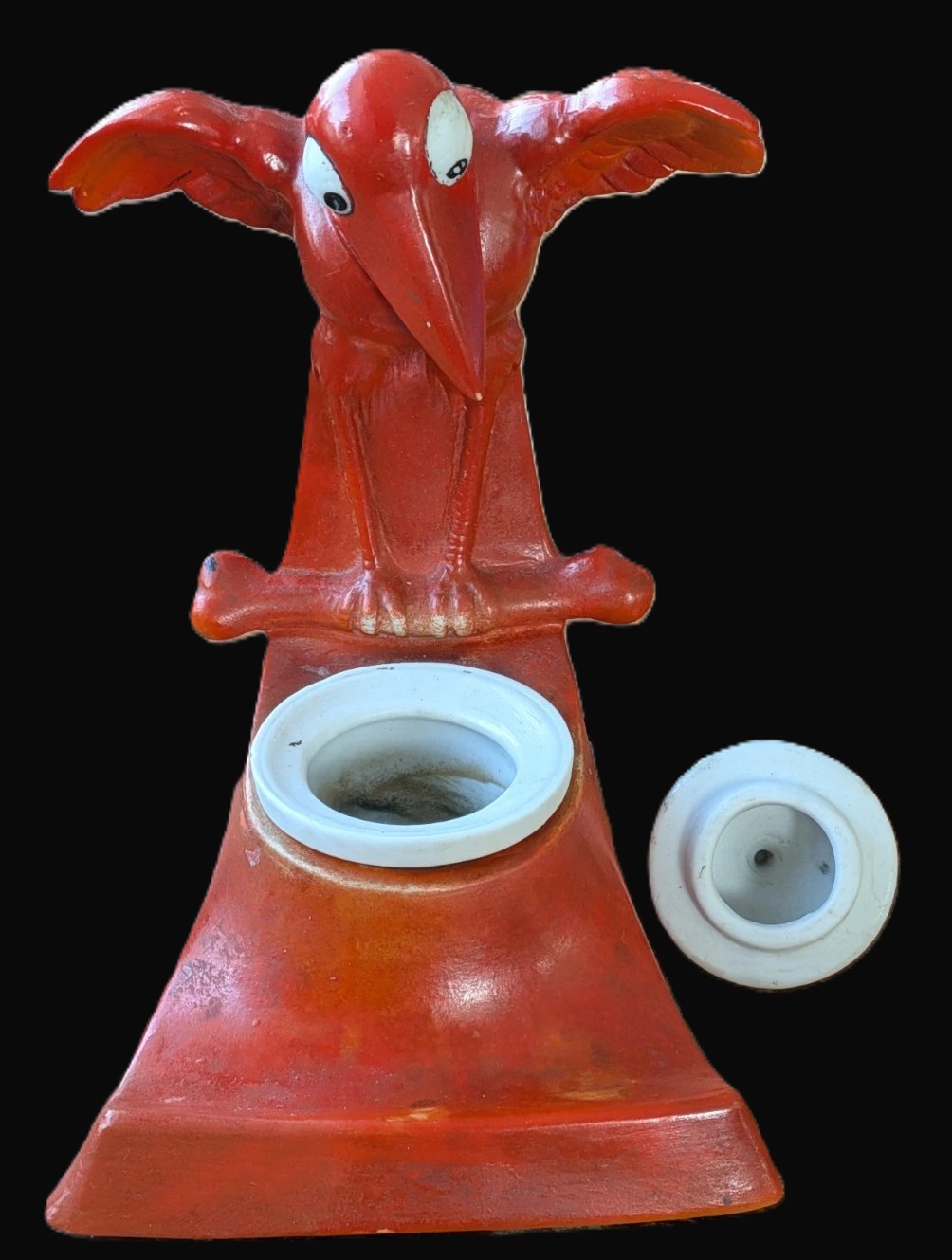
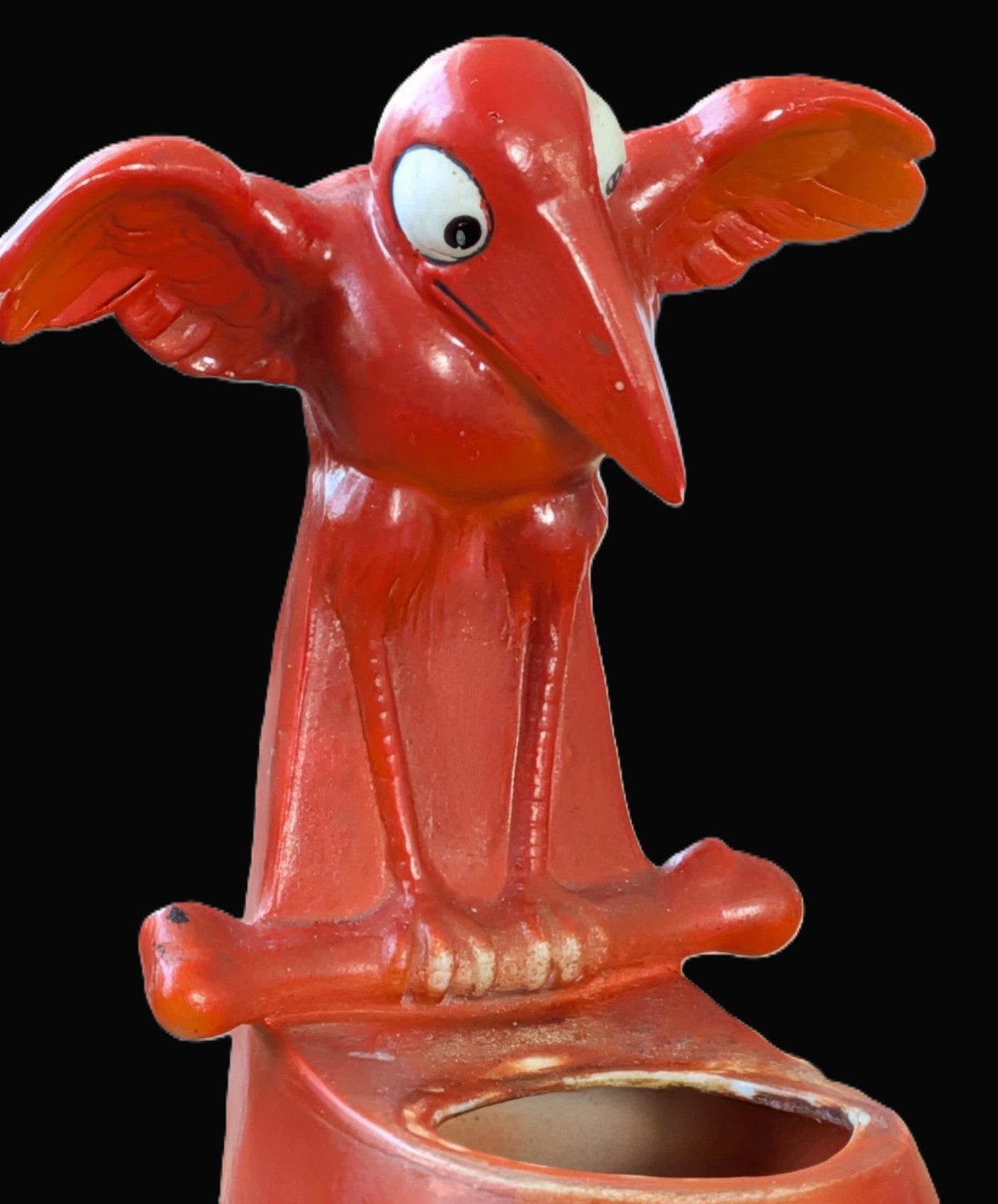
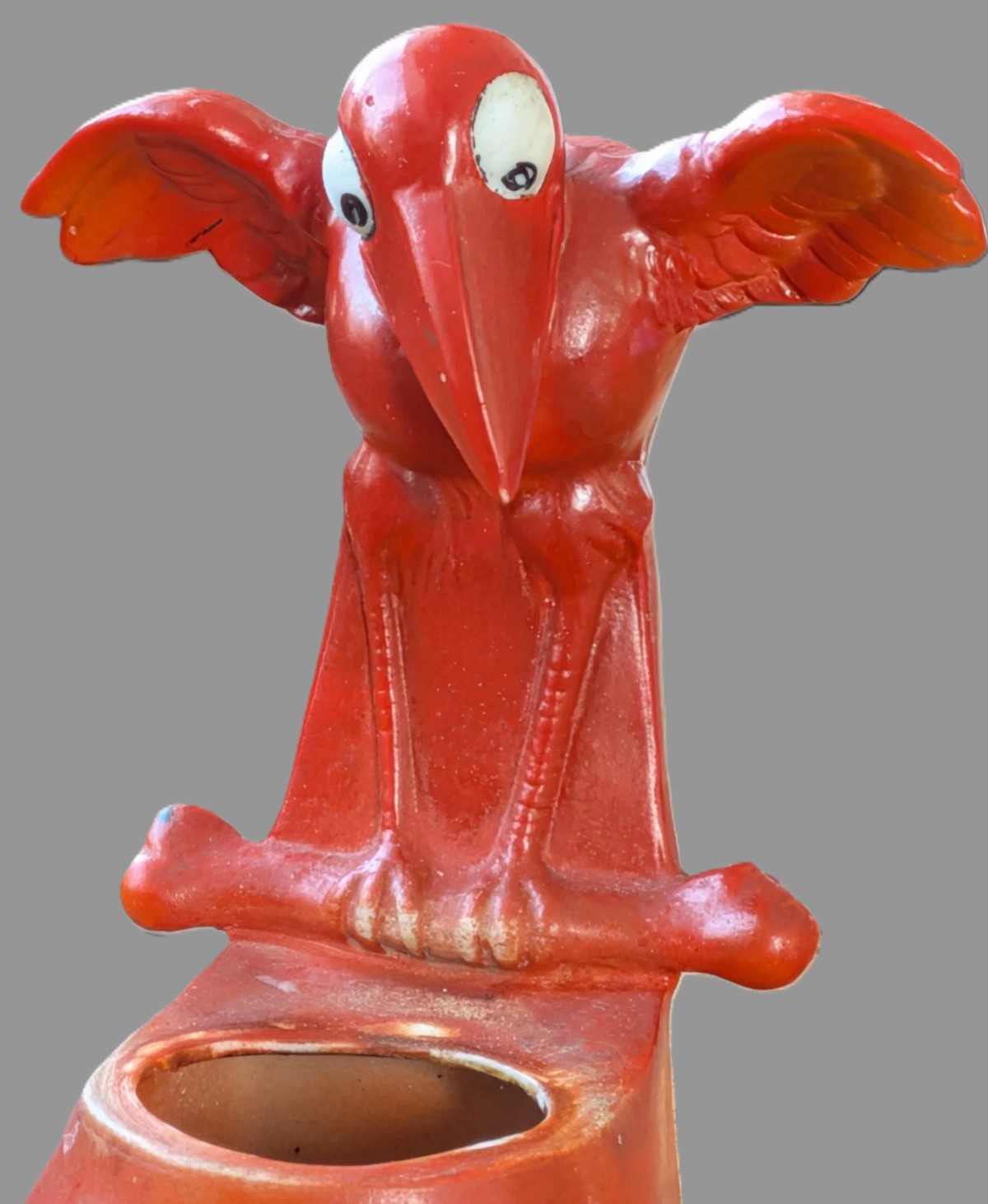
This German dark-humor porcelain inkwell is made in unglazed matte bisque porcelain. It depicts a comical, wide-eyed raven or crow perched atop a bone, hovering over a removable porcelain inkwell and fitted lid. Features an integrated front pen channel and a hollowed rear quill-holder. Stamped “Made in Germany” on the underside.
This eccentric piece is an authentic Schäfer & Vater (Thuringia, Germany) bisque porcelain novelty inkstand dating from the early 20th century (circa 1900–1920s).
Identification & Features
- Manufacturer: Schäfer & Vater (Volkstedt-Rudolstadt, Thuringia). The distinctive unglazed matte/bisque textured finish, soft sage-green wash, exaggerated facial expressions, and caricature styling are signature hallmarks of Schäfer & Vater.
- Perch/Base: The bird is perched on a stylized bone resting across the back, adding to the macabre humor.
- Pen Rest Design: The wide curved basin in front is an integrated pen rest.
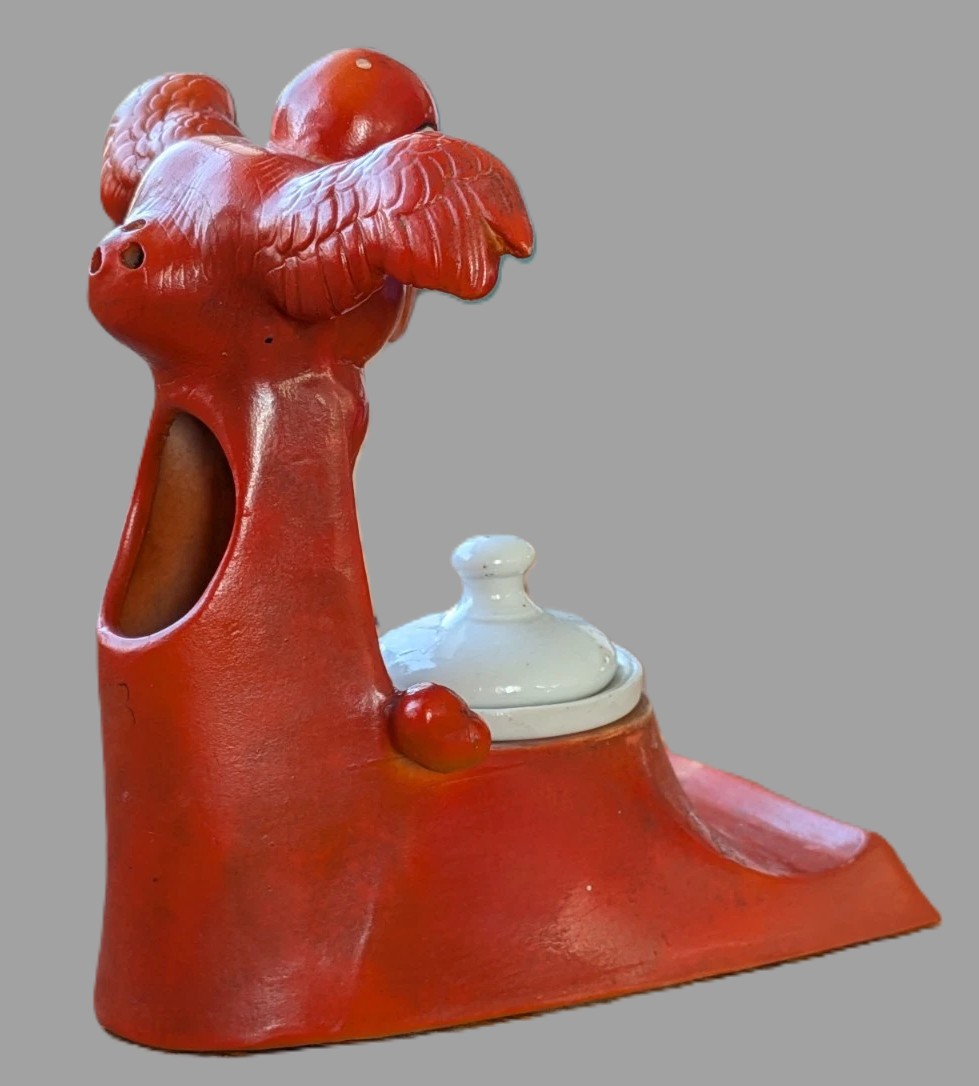
- The Back Openings: The large oval cavity behind the riser serves as a feather quill / dip pen holder (or well for rolled blotters/stamps). The small round hole on the back of the bird’s head is a firing/vent hole—essential in manufacturing hollow bisque porcelain to prevent the piece from exploding in the kiln during high temperatures.
Physical Description
| Feature | Description |
| Subject | Stylized raven/crow perched wide-winged on a bone over an ink reservoir. |
| Material | Un-glazed matte bisque / porcelain with hand-painted underglaze polychrome accents. |
| Color Palette | Soft sage-green base fading to cream, jet black bird body, orange legs, yellow beak, and ivory bone perch. |
| Components | Inkstand base with integrated pen trough, removable porcelain ink insert, lid, and hollow quill-well back cavity. |
| Markings | Stamped “Made in Germany” on the unglazed base (conforming to McKinley Tariff import requirements post-1891). |
What the Marks Tells Us
- The Crown Mark: This is the factory mark for Schäfer & Vater (Volkstedt-Rudolstadt, Thuringia, Germany).
- Their primary hallmark consists of an embossed/impressed crown featuring an “R” inside a starburst or shield beneath it (the “R” standing for Rudolstadt).
- On bisque novelties, this mark was pressed into the wet clay mold before firing. Because of the matte finish and mold wear, the “R” and starburst detail often fill in or soften, leaving only the distinct outline of the crown visible to the naked eye.
- The Mold/Model Number (5100):
- Schäfer & Vater assigned a specific 4-digit mold/model number to every design cataloged in their factory production lines.
- Authenticity: Schäfer & Vater items were heavily emulated by other German and Japanese porcelain manufacturers during the early 20th century. Having both the impressed crown and the impressed 4-digit shape number firmly distinguishes an authentic Volkstedt-Rudolstadt piece from later reproductions or unverified imitations.
- Provenance Verification: Mold numbers in the 5000-series typically align with Schäfer & Vater’s peak novelties catalog produced between roughly 1905 and 1915, right when their whimsical desk novelties and match strikers were being widely imported into the American and British markets.
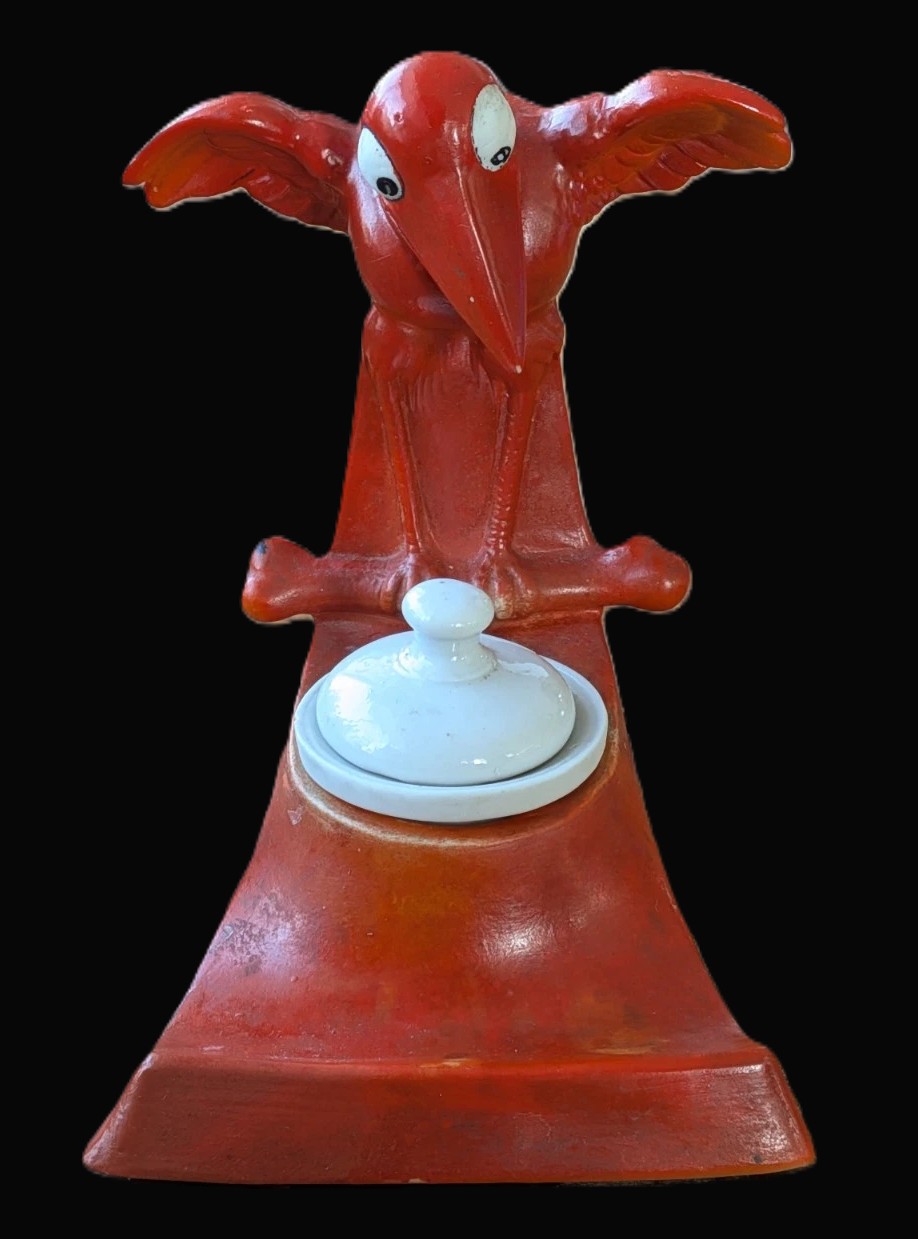
- Variation: Pictures of a reddish-orange example added.
Cultural Context & Literary Inspiration
Schäfer & Vater were famous for their grotesque, satirical, and dark-comedy desk accessories, barware, and novelties. Rather than a standard nursery rhyme, the raven/crow motif in writing equipment from this period drew from several rich pop-culture and literary connections:
- Edgar Allan Poe’s “The Raven”: Published in 1845, Poe’s famous poem (“Nevermore”) created an enduring literary association between ravens, ink, writing desks, and somber/gothic humor across Europe and America throughout the late 19th and early 20th centuries.
- Wilhelm Busch & German Satire: German humor of the late 19th century was heavily shaped by satirist Wilhelm Busch (creator of Max und Moritz and Hans Huckebein, der Unglücksrabe / “Hans Huckebein, the Unlucky Raven”). German porcelain foundries frequently produced caricature crows referencing Hans Huckebein—a comical, mischievous bird who constantly got into household trouble (including spilling ink).
- Lewis Carroll’s Famous Riddle: The famous riddle posed by the Mad Hatter in Alice’s Adventures in Wonderland—“Why is a raven like a writing desk?”—made pairing ravens with inkwells a popular visual joke among European novelty ceramic makers of the Art Nouveau era.
Sold for $173 in April 2008
Orange-red version sold for $250 in August 2026
Content disclaimer. The information posted is the owner’s best knowledge and may not have been vetted by the SOIC. We welcome comments, corrections, and additions, working to make our website information comprehensive and accurate.
Join the Society of Inkwell Collectors (SOIC) – it’s free!
Founded in 1981 as a non-profit organization,
we are documenting inkwells (and accessories).
We’re here to help and inform!