

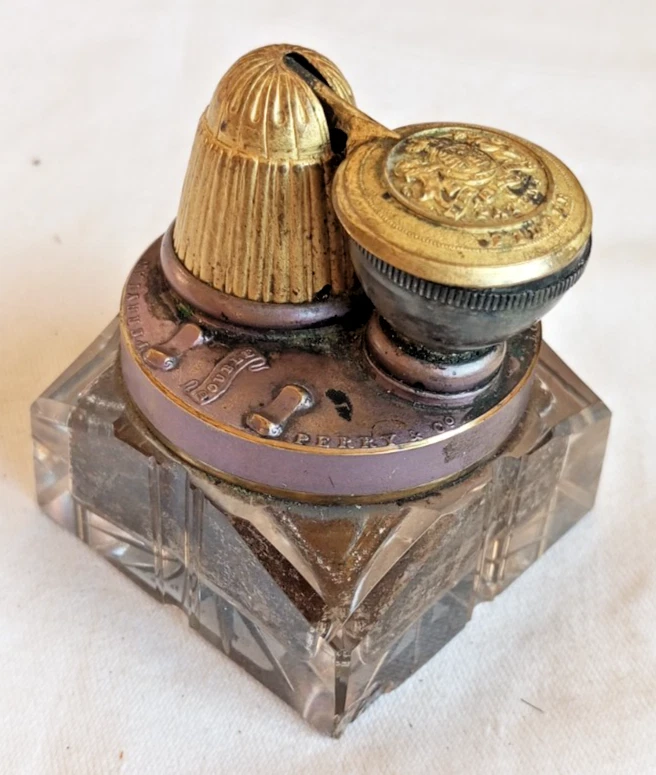
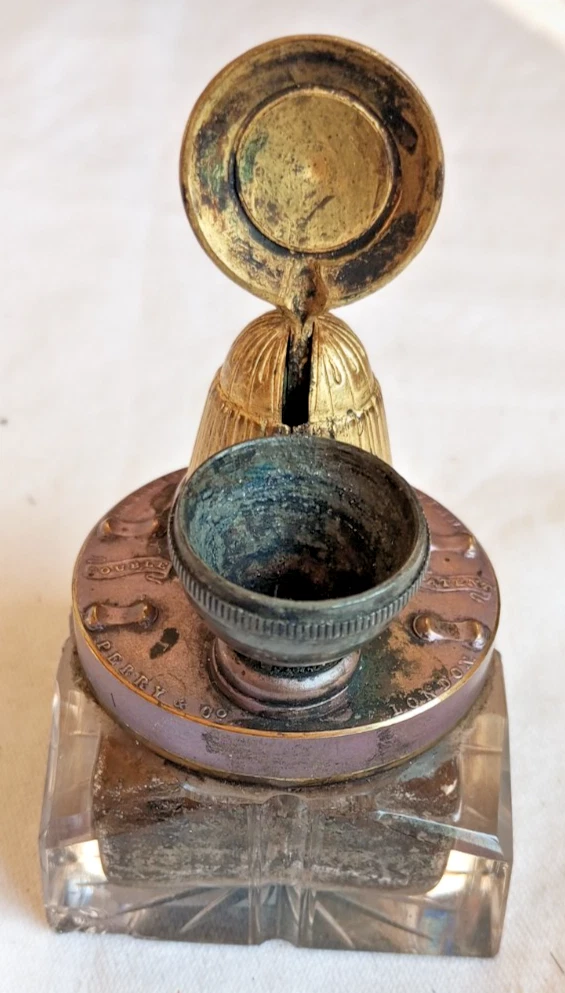
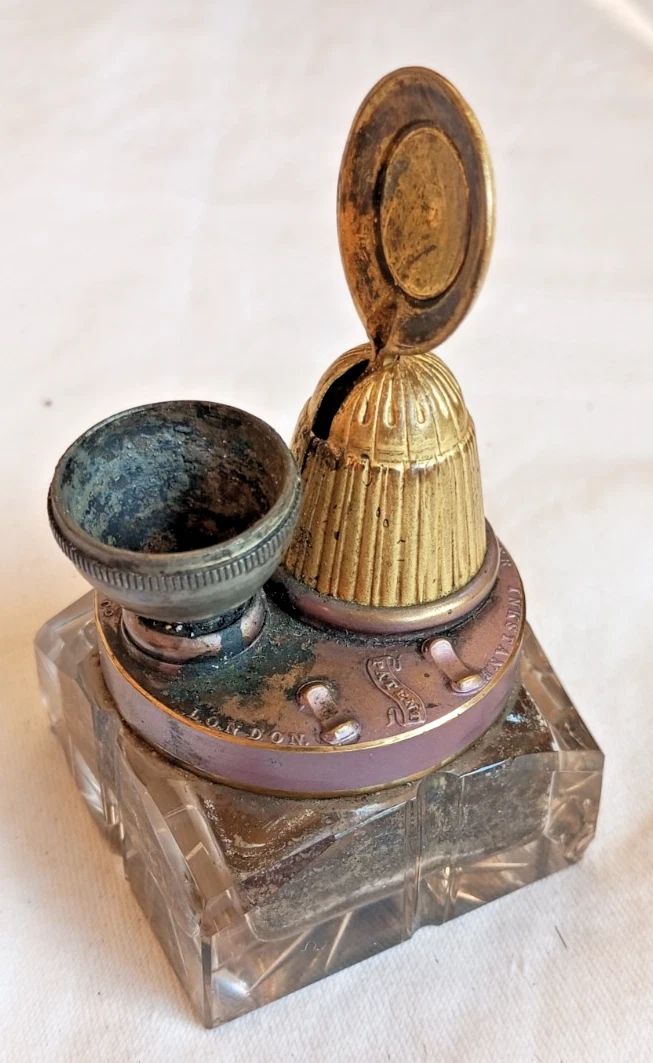
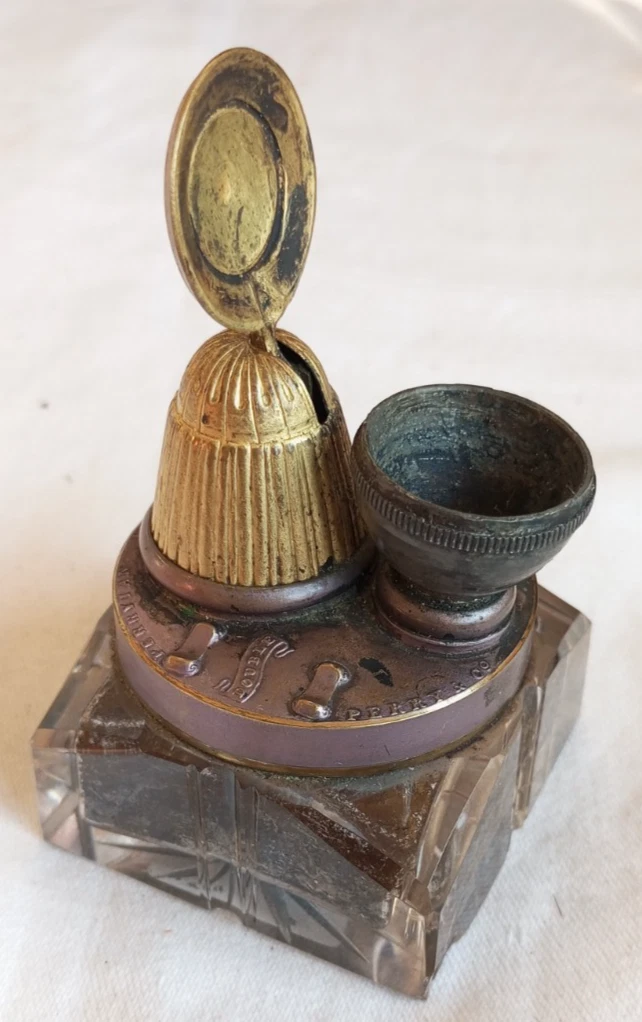
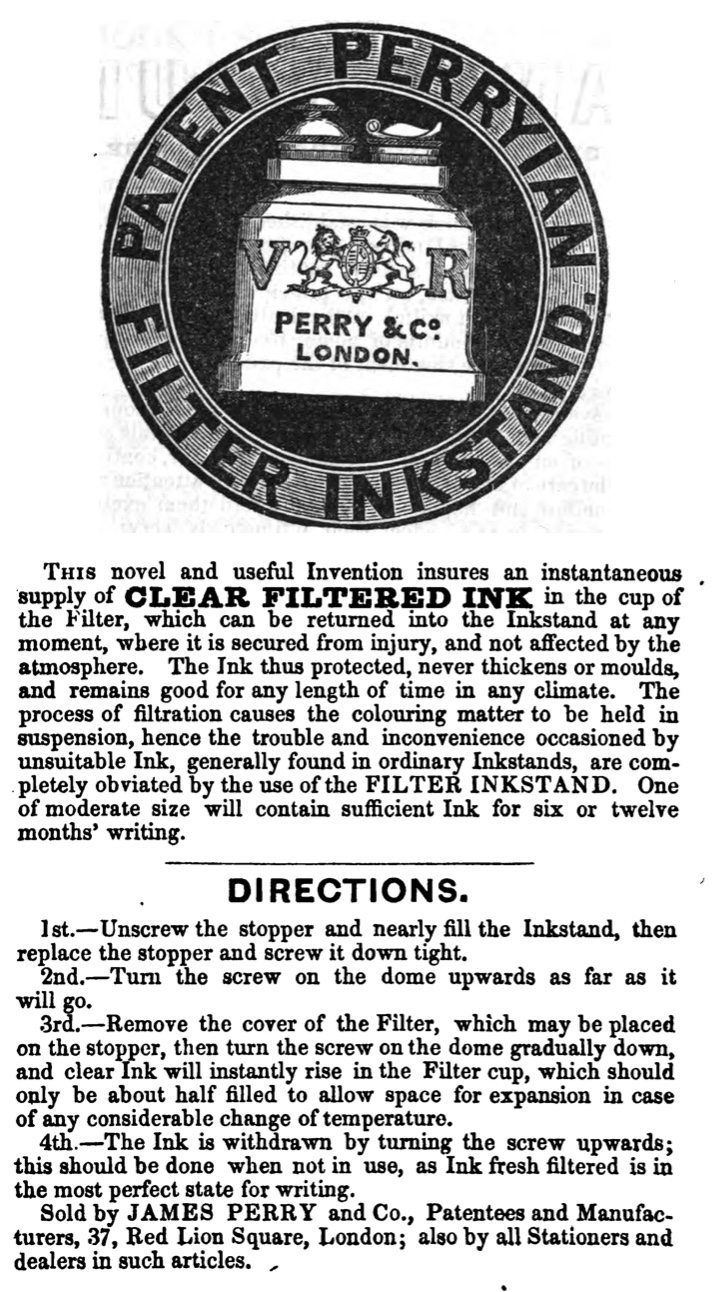
Perry & Co. “Double Patent Perryian” Filter Inkstand
| Categories | Mechanical - Pump / Siphon |
| Material | Brass, Glass |
| Markings | See Narrative |
| Manufacturer | Perry & Co. |
| Origin | England |
| Date or Era | circa 1850 |
| Measuring | 2” x 2” x 4” high |
| Patent | Patent No. 8731 (December 1840) |
Perry & Co. “Double Patent Perryian” Filter Inkstand
London, c. 1845–1855
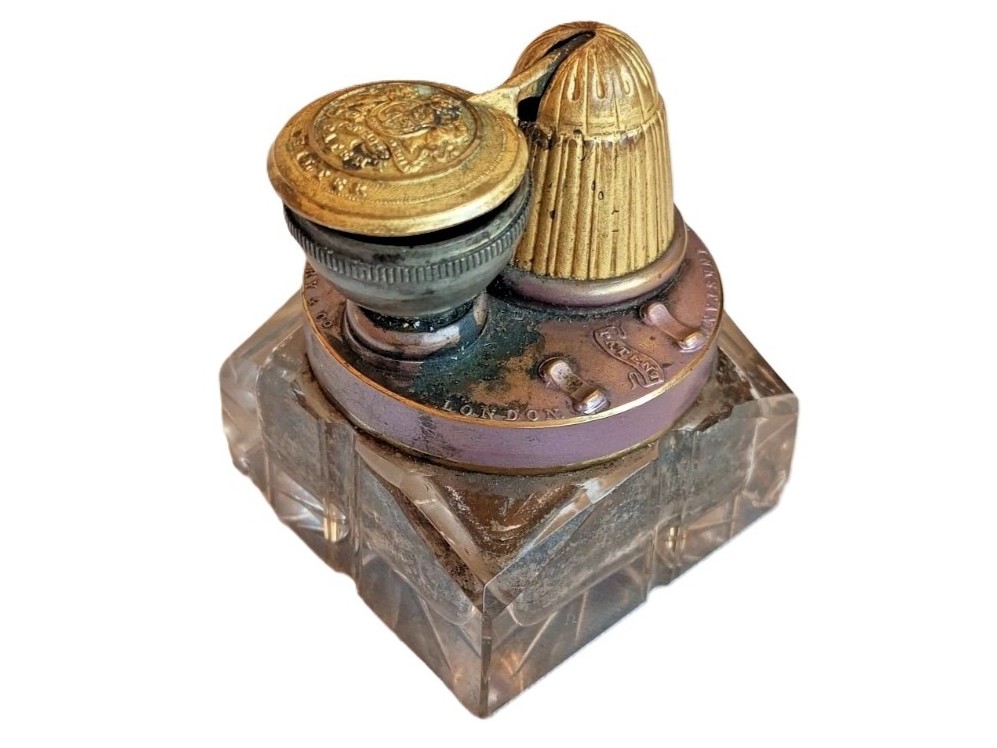
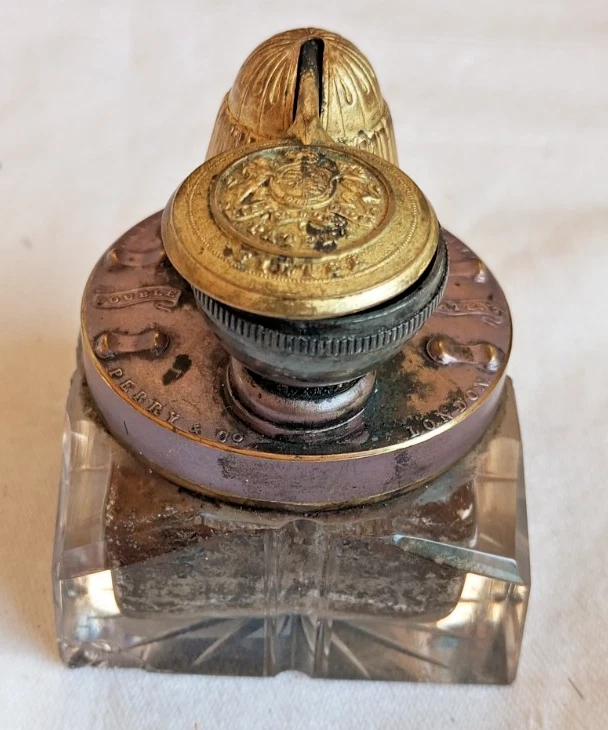
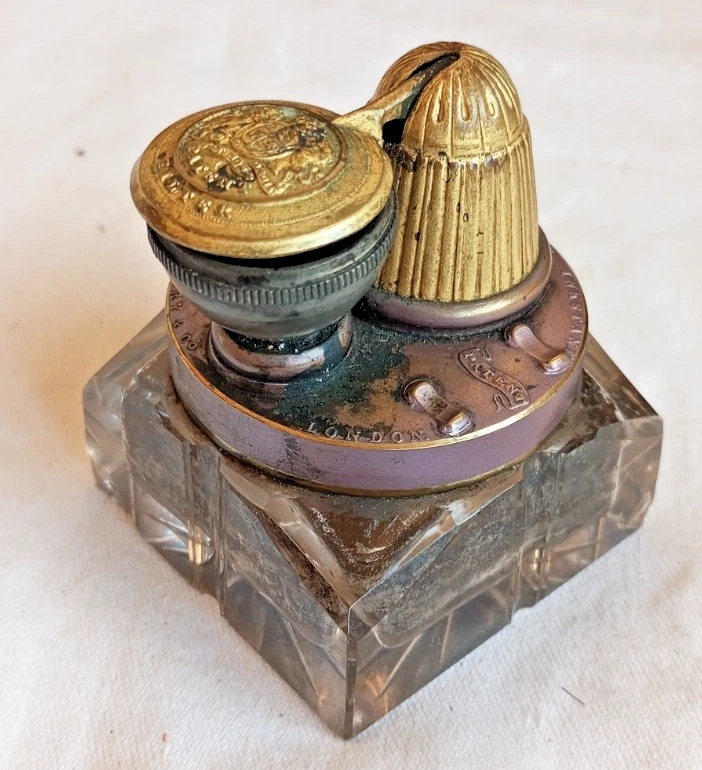
A mechanical inkstand manufactured by James Perry & Co., London. Featuring a heavy cut-crystal square reservoir surmounted by a complex engine-turned and gilded brass collar.
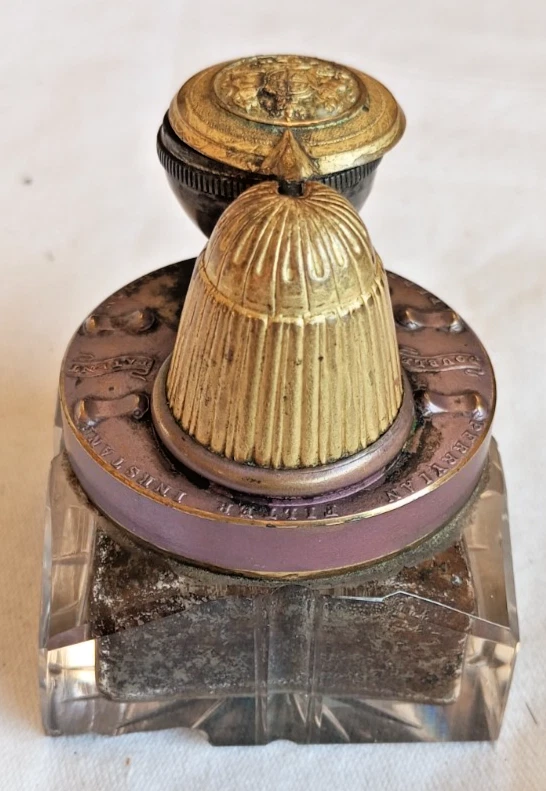
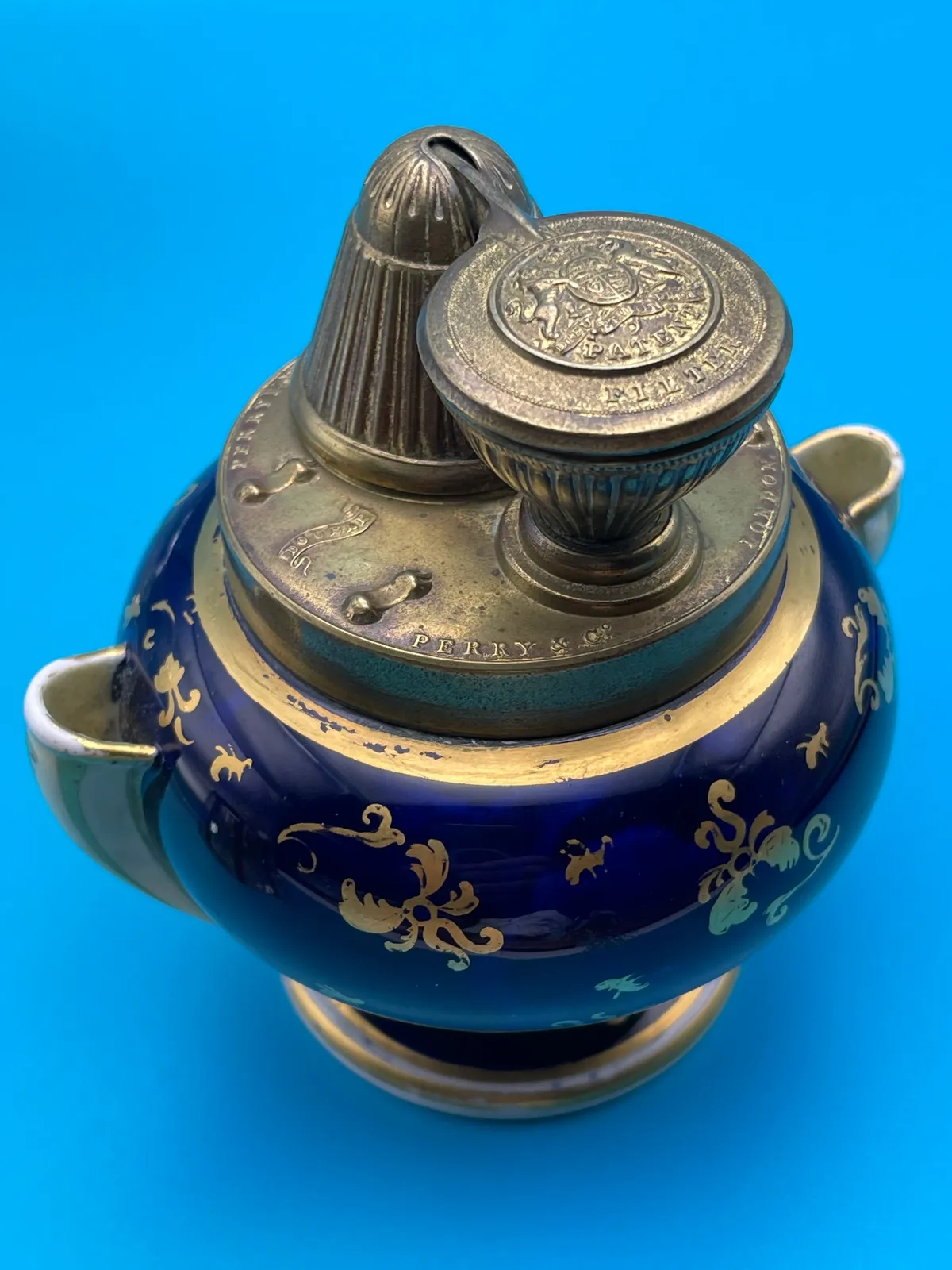
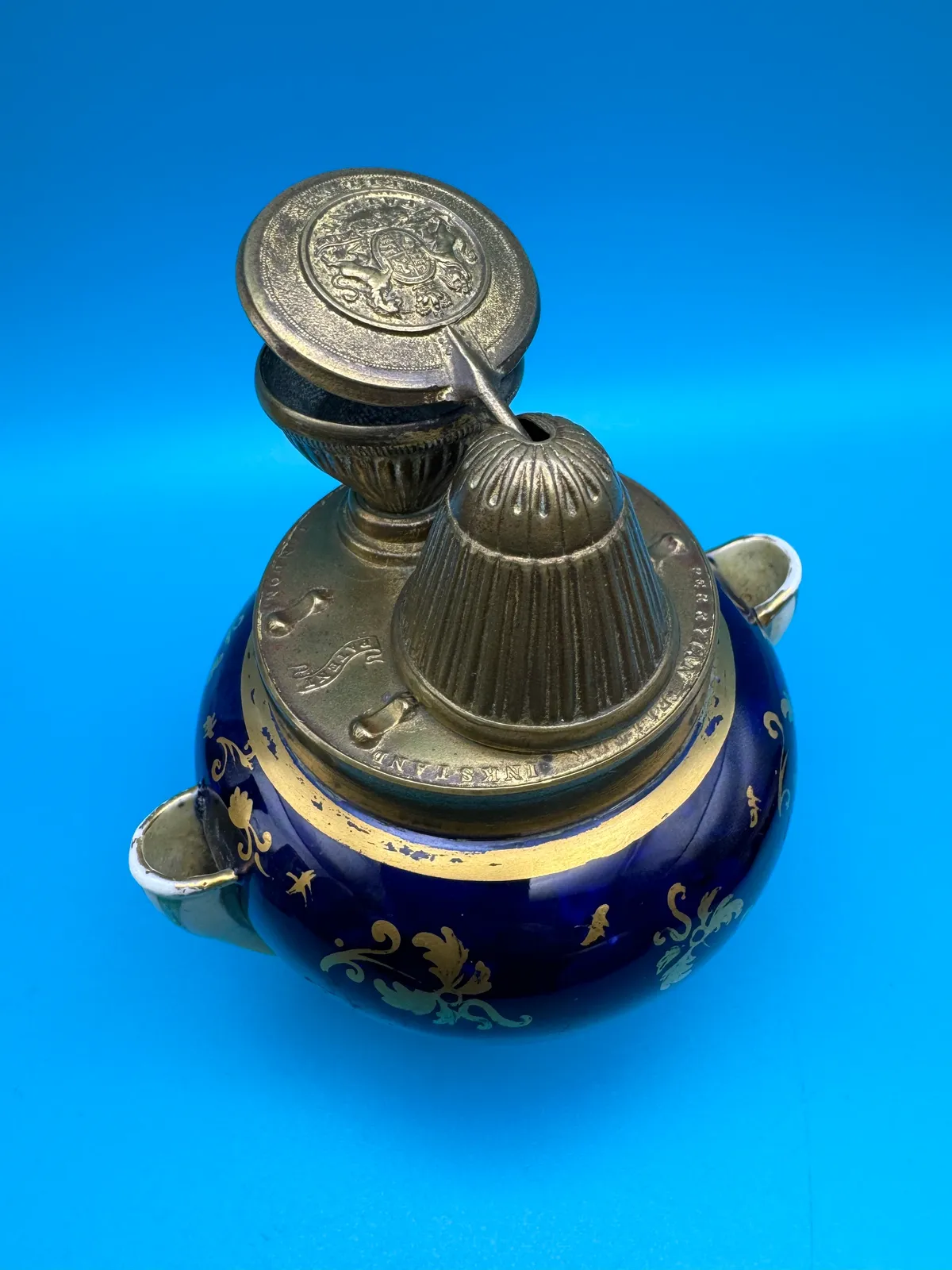
Inscribed around the upper plate “PERRY & CO. LONDON” and “PERRYIAN FILTER INKSTAND”, featuring dual “DOUBLE PATENT” scroll banners. The top lid displays a deeply embossed Royal Coat of Arms.
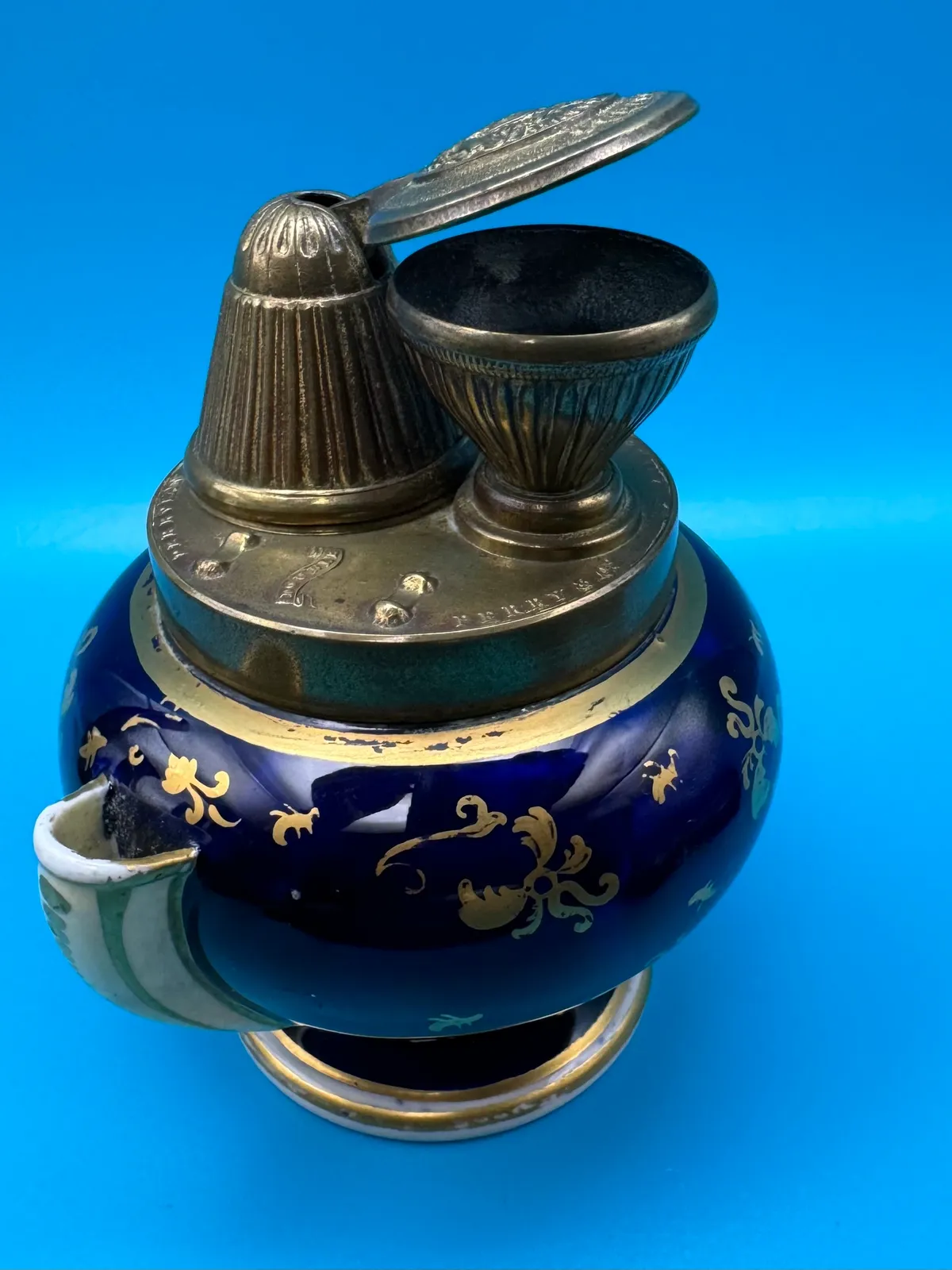
Mechanism: Designed to supply pristine ink on demand. Opening the hinged lid operates an internal lever mechanism within the fluted rear dome, driving a pneumatic pump. Air pressure forces ink up from the main glass cistern through an internal filtration screen and into the elevated conical dipping cup. Closing the lid seals the chamber and returns excess ink back into the reservoir, keeping the main supply free of dust and evaporation.
The Perry & Co. Double Patent “Perryian” Filter Inkstand (manufactured by James Perry & Co., London, introduced circa 1840–1850s) represents a high-water mark of Victorian mechanical desk apparatuses. Designed to combat the persistent issues of ink evaporation, airborne dust, and sediment thickening, this design combined precision brass work with heavy cut lead glass.
Key Technical Details & Inscriptions
- Maker: Perry & Co., London (marked PERRY & CO. and LONDON on the primary brass collar).
- Model Marks: Stamped PERRYIAN FILTER INKSTAND along the rear perimeter band, alongside raised scroll banners reading DOUBLE and PATENT.
- Plunger Crest: The gilded brass cap atop the dipping well features the Royal Coat of Arms of Great Britain (bearing the Dieu et mon droit scroll and Honi soit qui mal y pense garter), signifying royal patent privilege or patronage.
- Cistern Base: Heavy lead crystal base with diamond/hobnail cut facet patterns to anchor the piece and provide clear visibility of the stored ink reserve.
Mechanical Operation & How It Works
The dual-patent mechanism operates on a pneumatic pump and internal filtration cycle, isolating the bulk ink supply while presenting a fresh, sediment-free pool in the dipping well on demand:
- Pneumatic Pump Action: The fluted brass dome behind the dipping cup acts as a mechanical housing for an internal piston or diaphragm. Opening the top lid engages an articulated rear arm sliding through the slotted dome cover. Raising the lid depresses or draws the internal pump component, compressing air within the sealed glass cistern below.
- Upward Fluid Transfer & Filtration: The forced air pressure pushes ink from the bottom of the main reservoir upward through an internal central feed tube. Before entering the upper hemispherical cup, the fluid passes through a internal mesh or fabric filter disk tucked within the neck mount. This traps dried dregs, dust, and sediment.
- Controlled Dipping Reservoir: Filtered, fluid ink fills the conical dipping bowl just high enough for a steel nib or quill to draw ink cleanly without dipping too deep or touching bottom sludge.
- Retraction & Evaporation Seal: When writing is complete, closing the lid relieves internal pressure (or creates slight suction), causing unused ink to drain back down through the filter into the main cistern. Closing the lid completely seals the dipping cup, preventing evaporation and thickening.
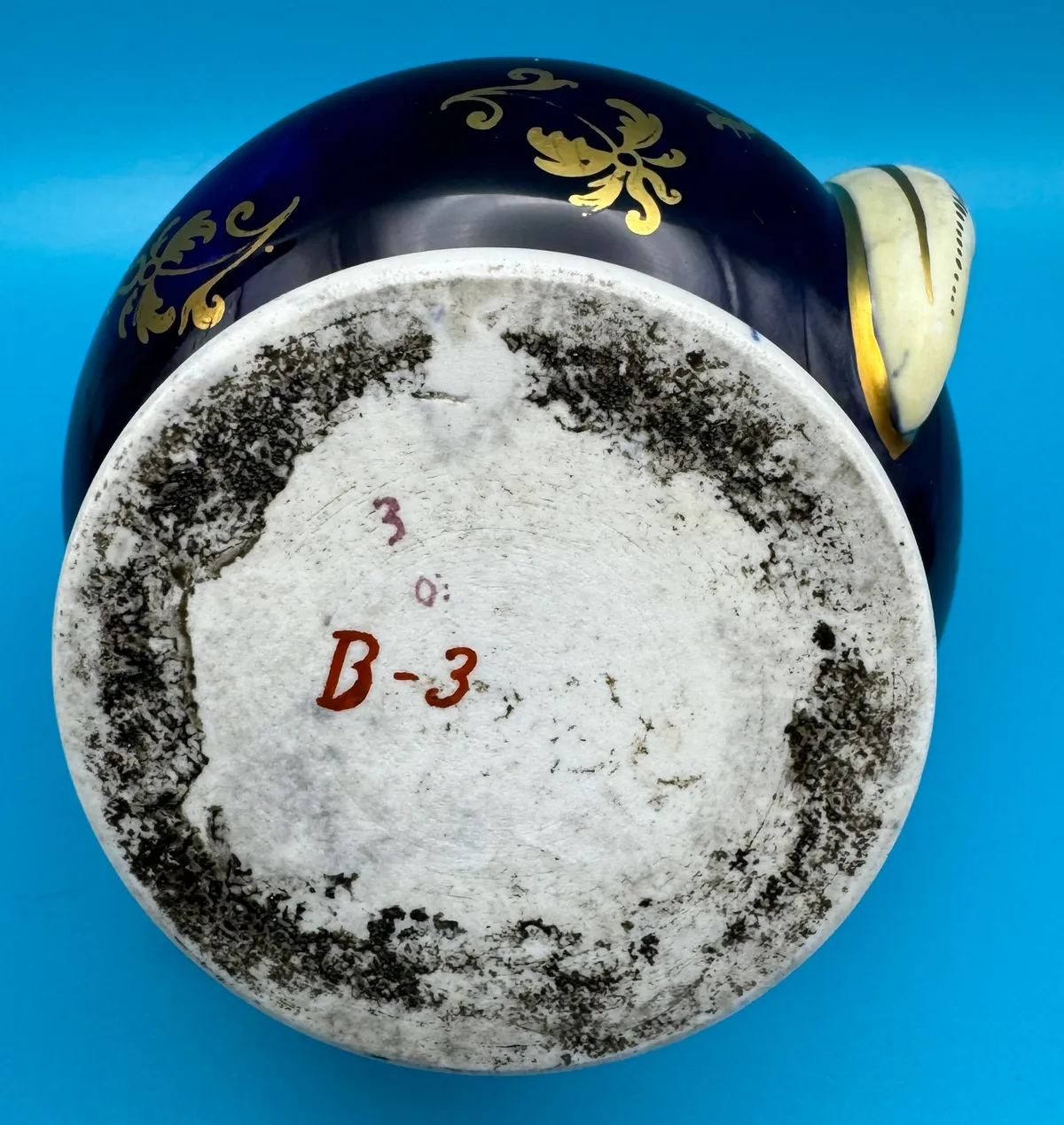
Pictures of a second example added. The cistern is decorated with polychrome floral sprays in gilt-bordered cartouches on a dark blue background. It works as described above. The ink was filtered as it was pumped from the cistern into the covered conical dipping well. The pump action raising and lowering the ink into the dipping well by raising and lowering the lid.
Under the British patent system prior to the Patent Law Amendment Act of 1852, patents were granted as Letters Patent under the monarch’s Great Seal and tracked primarily by the patentee’s name and enrollment date rather than an assigned numeric sequence on the product. Instead of numbers, manufacturers stamped the terminology “Patent” or “Double Patent” to signify legal protection under royal privilege.
Understanding the “Double Patent” Distinction
The phrase “Double Patent” on Perry & Co. pieces does not refer to a single patent registration number; rather, it indicates that the object incorporates two distinct patented inventions held by James Perry (and his assigned partners):
-
The Pneumatic Pump Mechanism: Covered under Perry’s late-1830s British patents for pneumatic pressure inkstands (which replaced manual cork plungers with piston/dome air displacement to raise ink on demand).
-
The Internal Filter & Dipping Cup Assembly: Covered under Perry’s circa 1840 British patent for the mechanical filtration disk and self-draining/sealing dipping cup system.
Primary British Patent Grants to James Perry (1830–1842)
If cross-referencing against the Great Seal Patent Office archives (Pre-1852 Chronological Index of Patents), the key British Letters Patent covering James Perry’s mechanical inkstands and writing instruments during this period are:
-
Patent No. 6031 (1830): James Perry’s foundational patent for pen construction and initial fluid regulators.
-
Patent No. 6211 (1832): Perry’s second major patent, which established the trade phrase “Perryian Double Patent” across his stationery line.
-
Patent No. 7977 (February 1839): James Perry – Improvements in Inkstands and Apparatus for Writing, covering early air-compression/pneumatic ink wells.
-
Patent No. 8731 (December 1840): James Perry – Improvements in Inkstands, specifically introducing the internal filter disk, pneumatic dome linkage, and self-closing dipping cup mechanism featured on the Perryian Filter Inkstand.
When cataloging or describing the piece for display, note that the term “Double Patent” reflects Perry’s dual protection under these 1839 and 1840 Letters Patent grants rather than a stamped numerical sequence.
Sold for $300 in August 2026
Content disclaimer. The information posted is the owner’s best knowledge and may not have been vetted by the SOIC. We welcome comments, corrections, and additions, working to make our website information comprehensive and accurate.
Join the Society of Inkwell Collectors (SOIC) – it’s free!
Founded in 1981 as a non-profit organization,
we are documenting inkwells (and accessories).
We’re here to help and inform!