

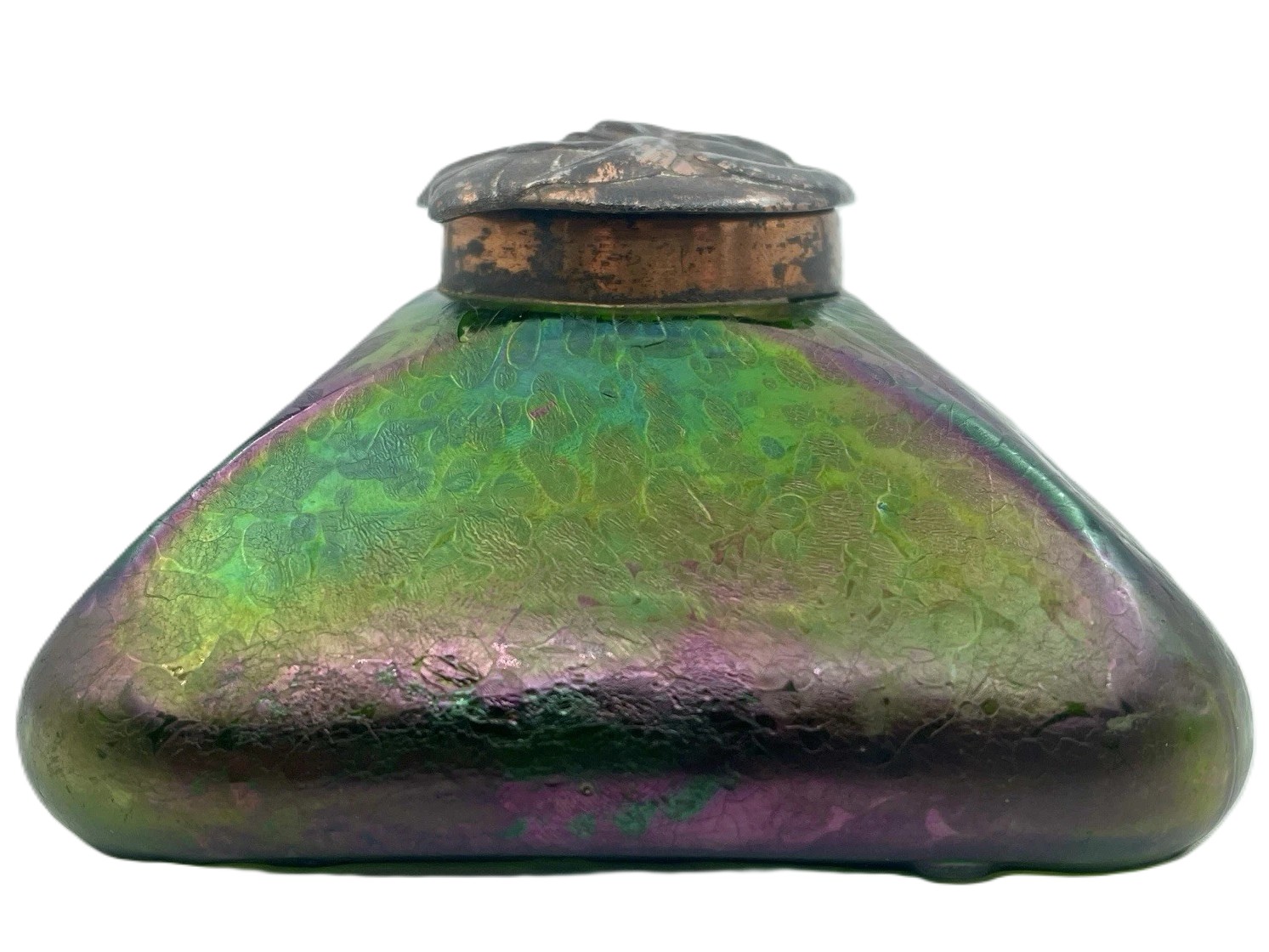
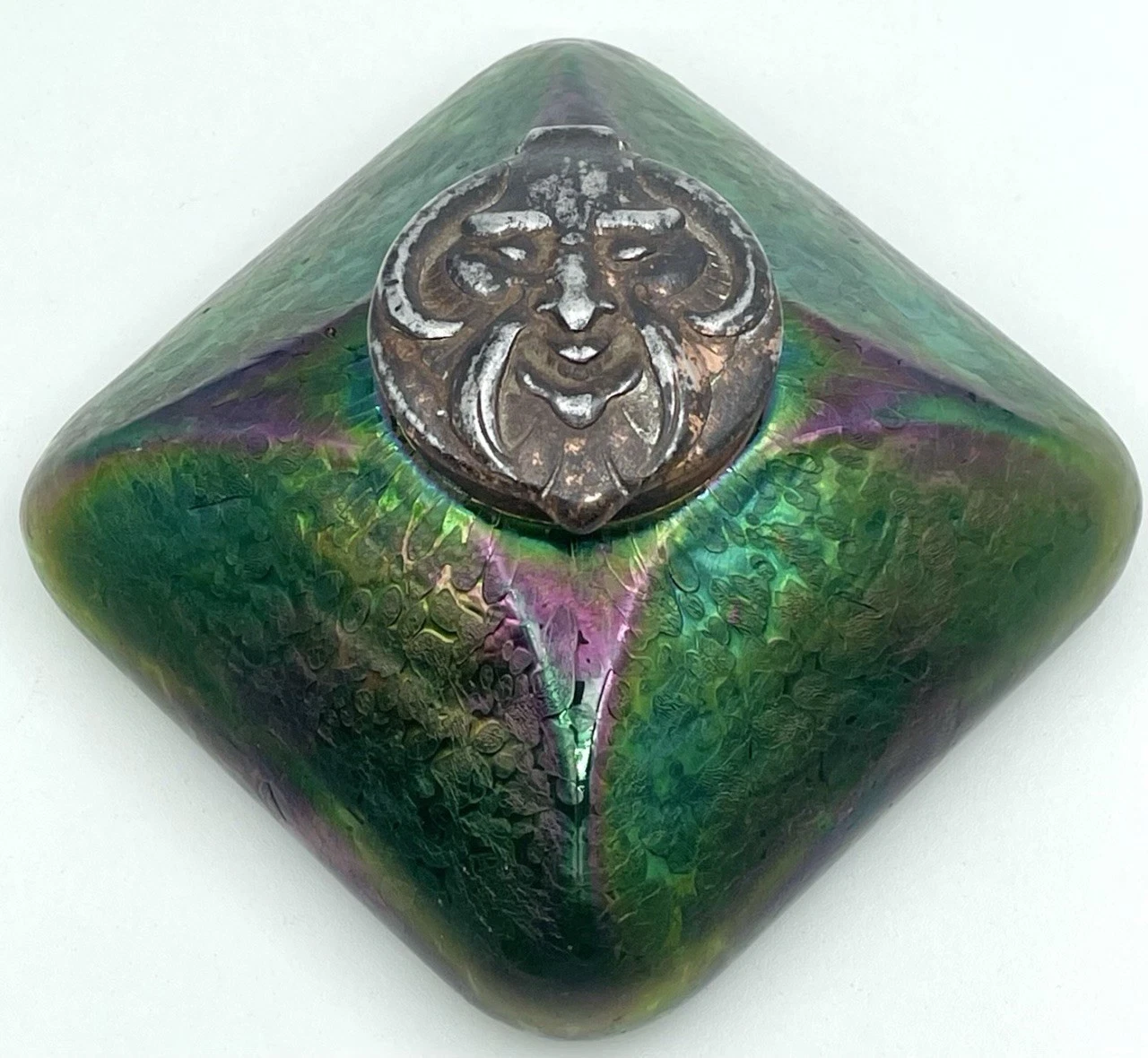
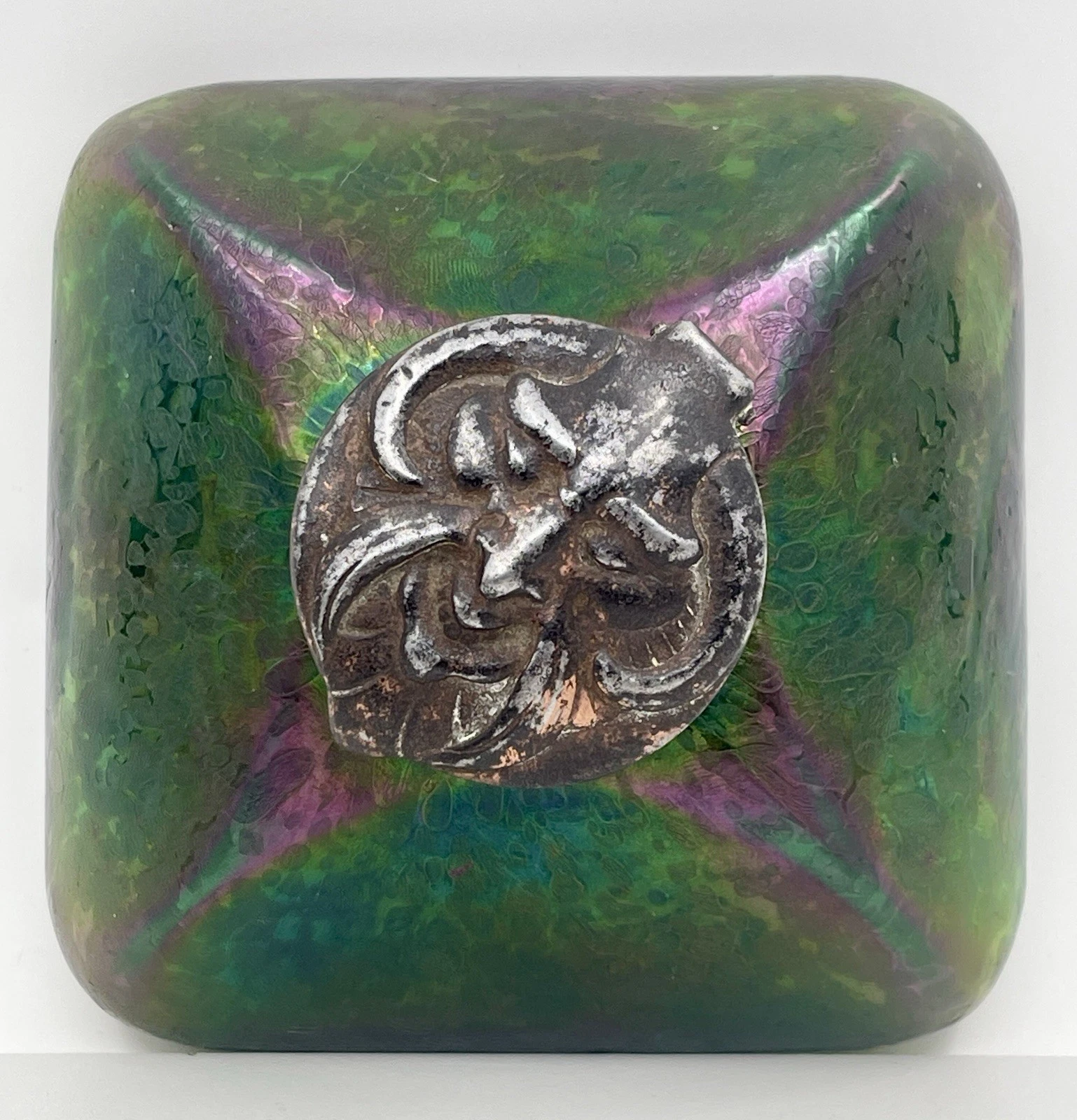
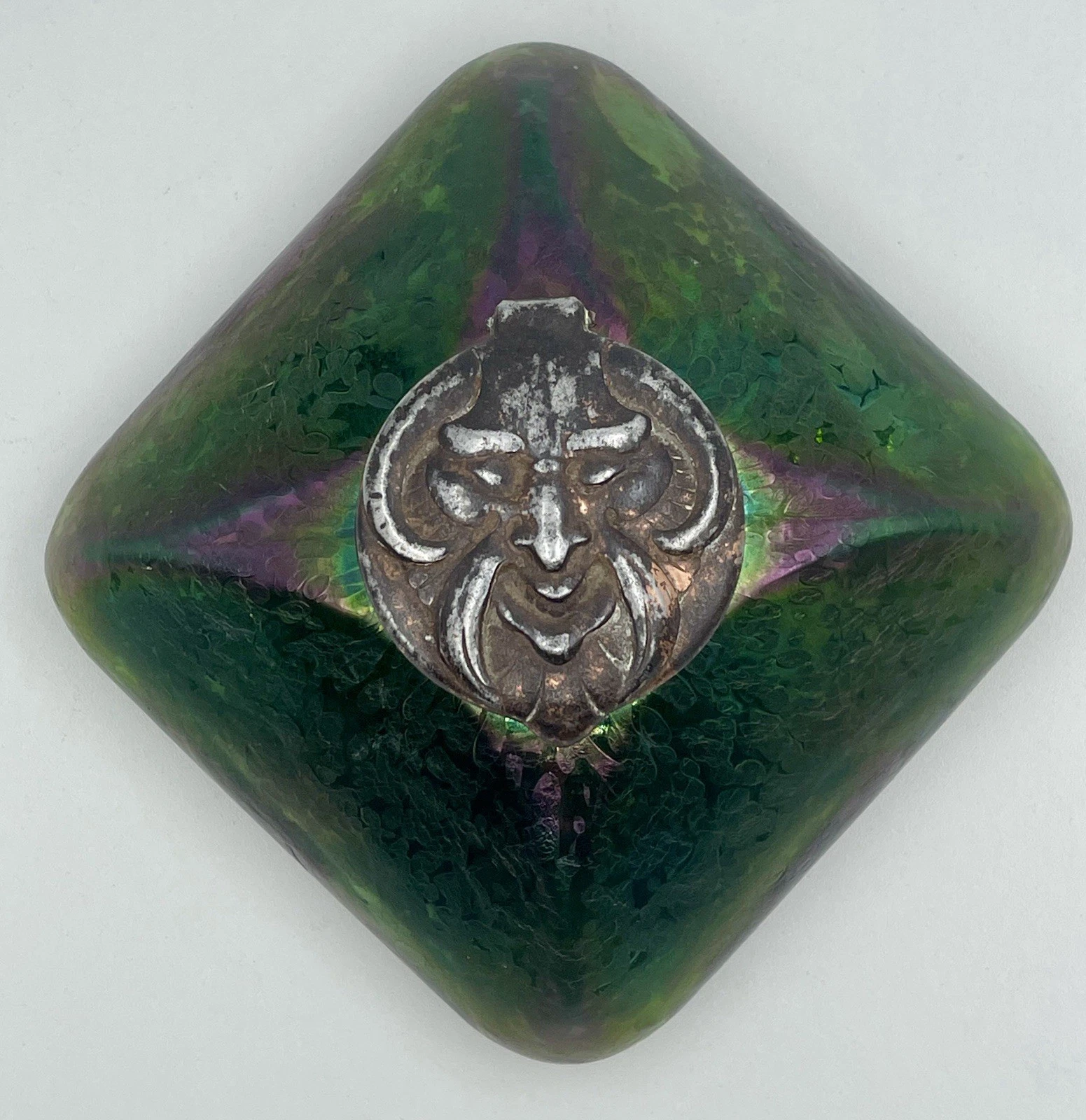
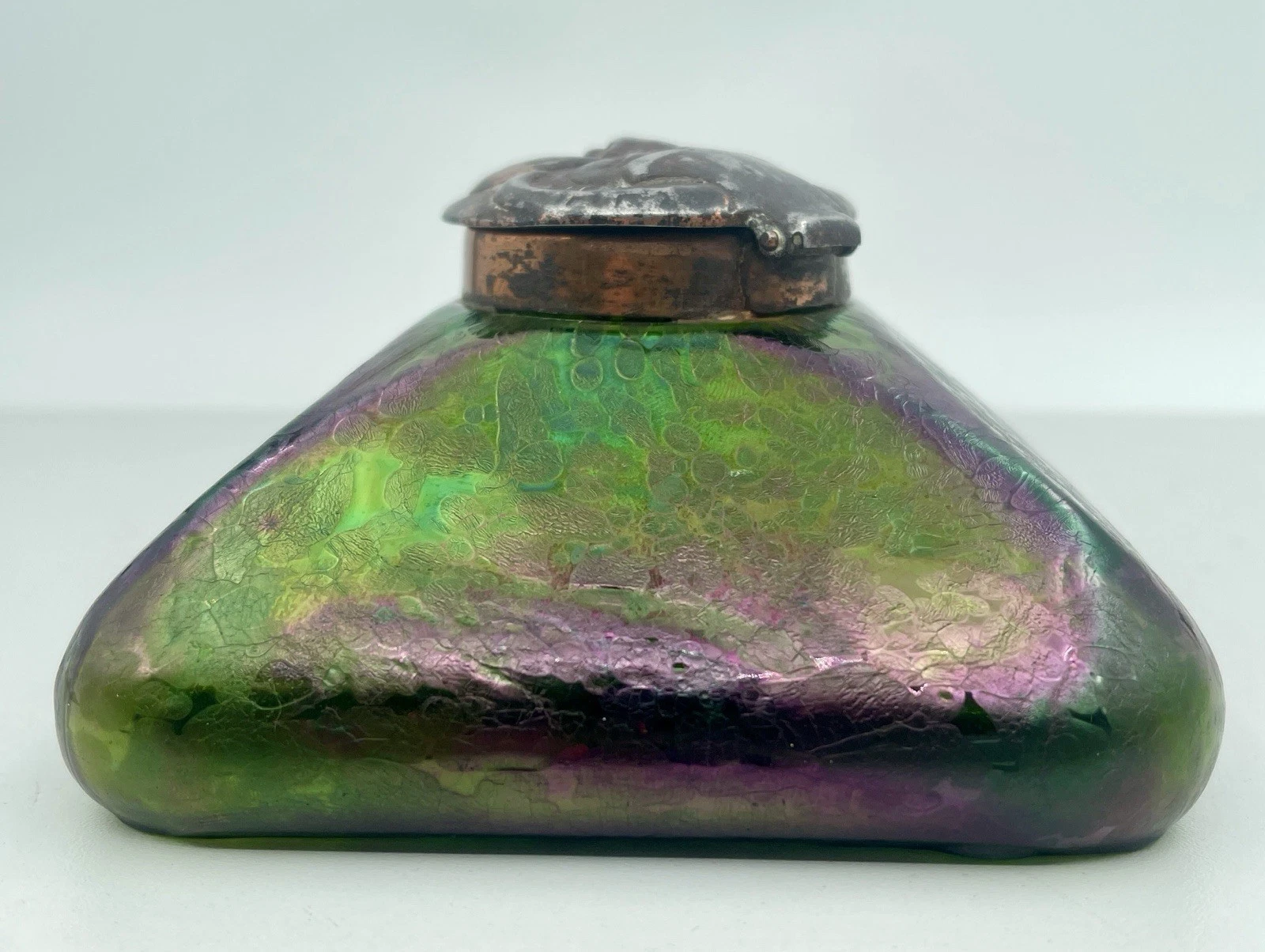
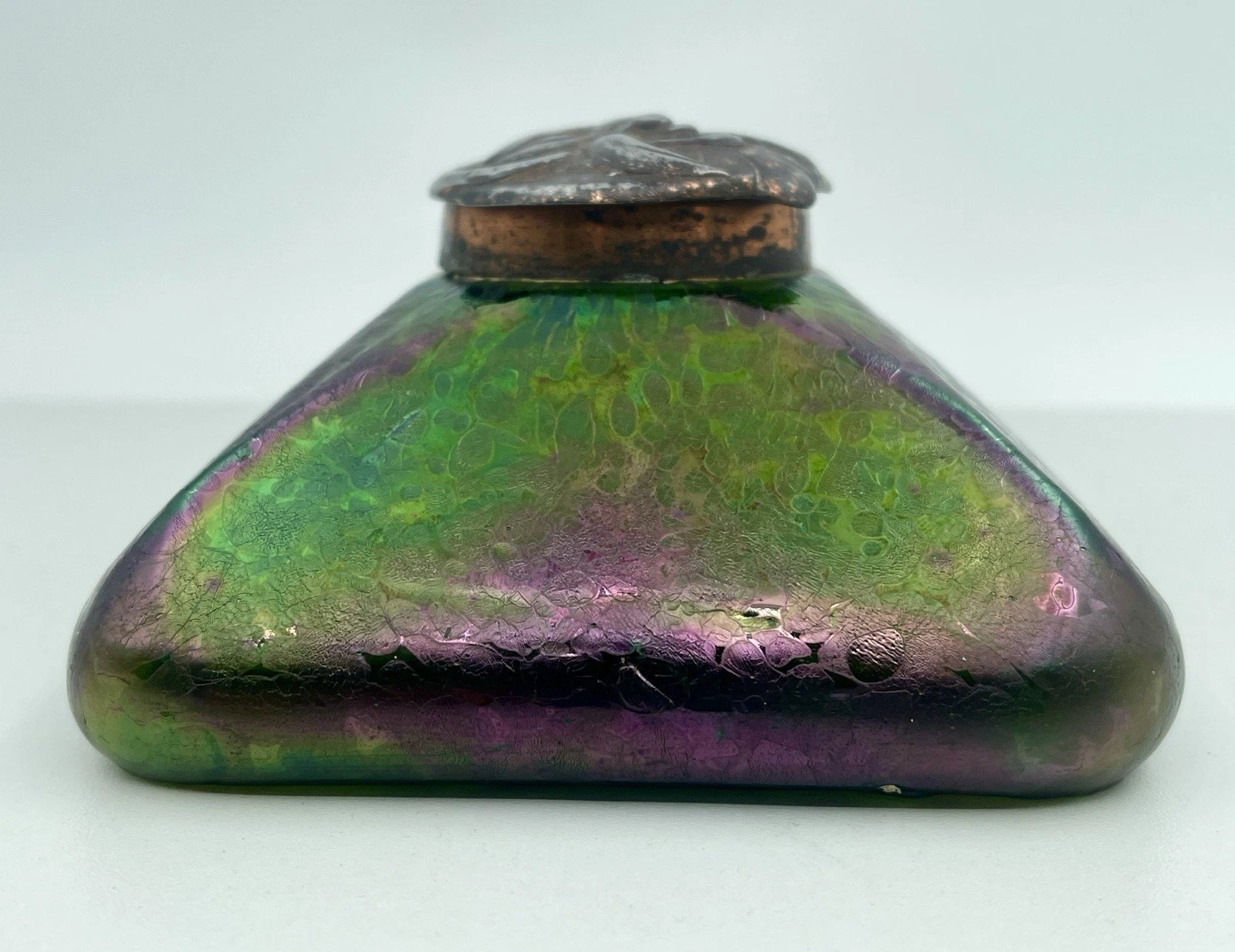
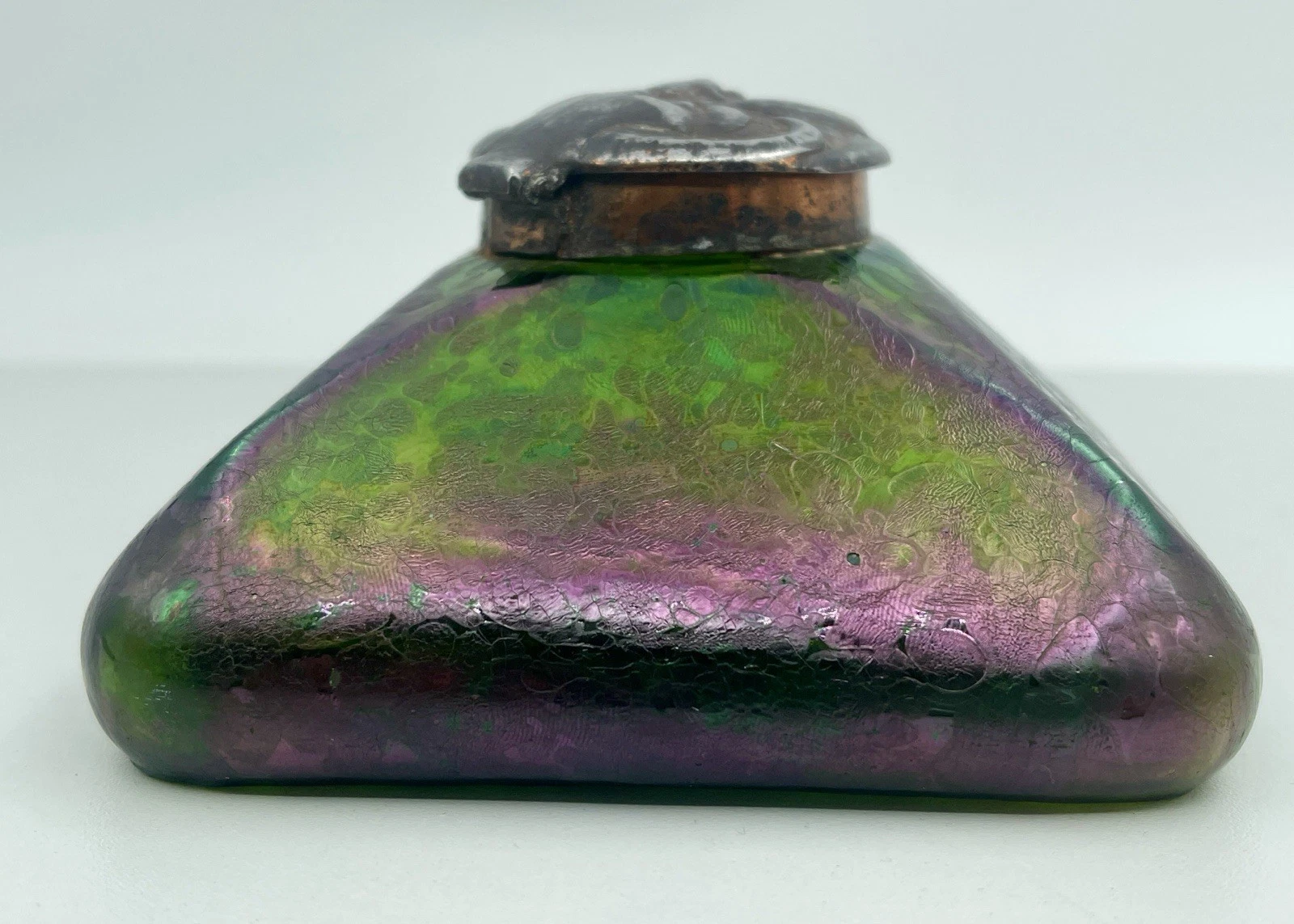
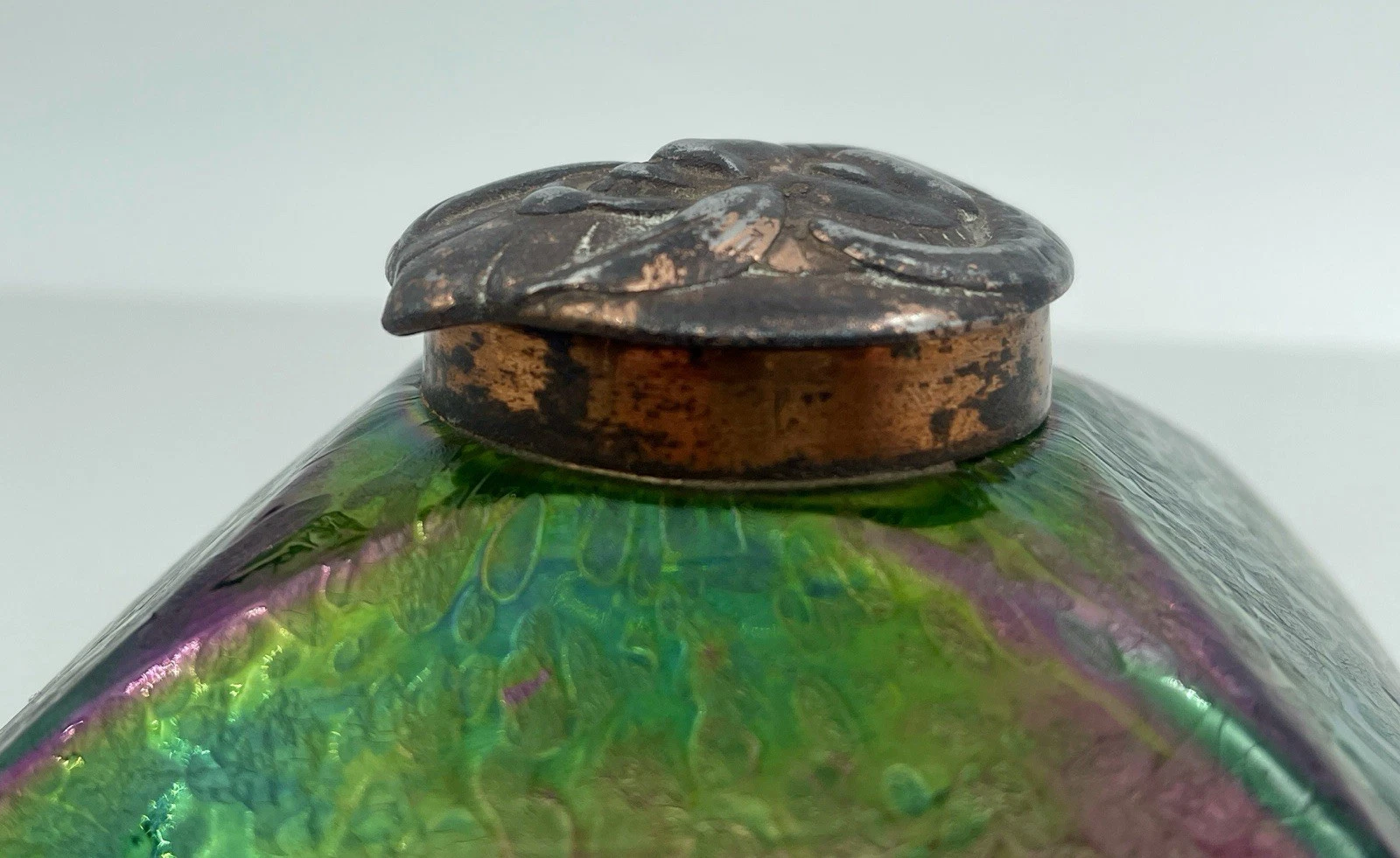
Art Glass Inkwell by Kralik
| Categories | Bohemian Art Glass |
| Material | Glass |
| Markings | See Narrative |
| Manufacturer | Kralik |
| Origin | Bohemia |
| Date or Era | circa 1900 |
| Measuring | 4 ½” x 4 ½” x 2 ½” high |
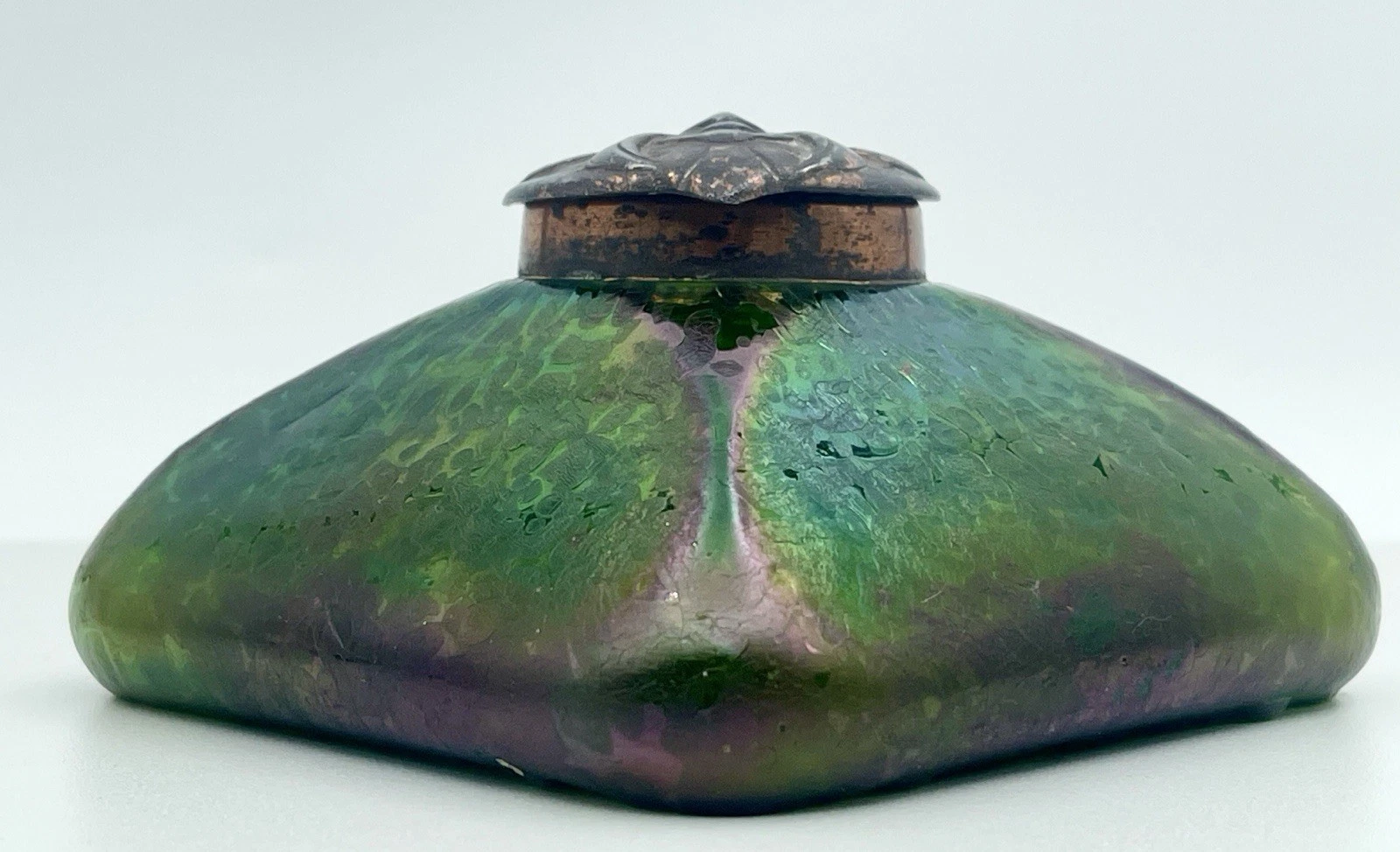
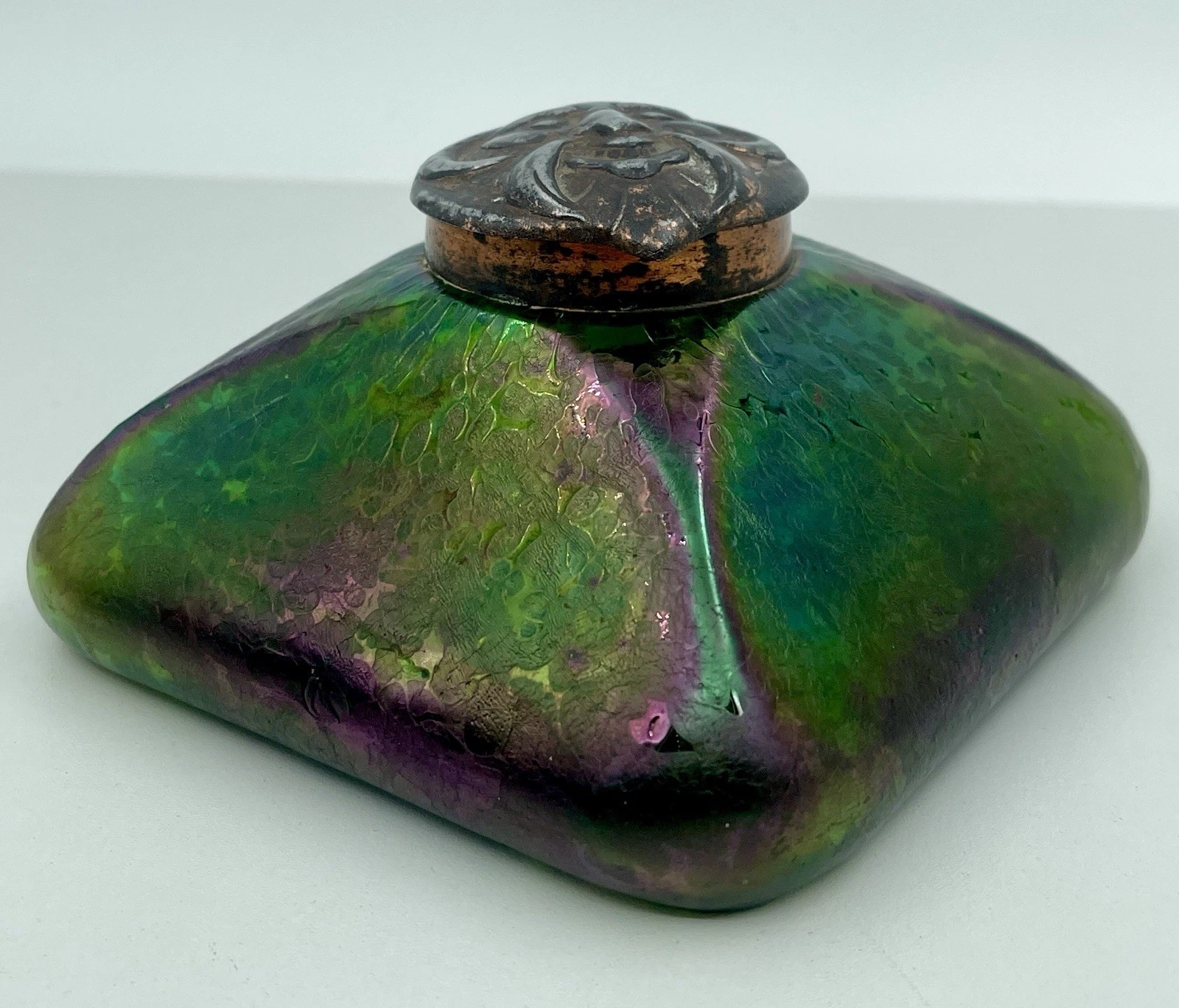
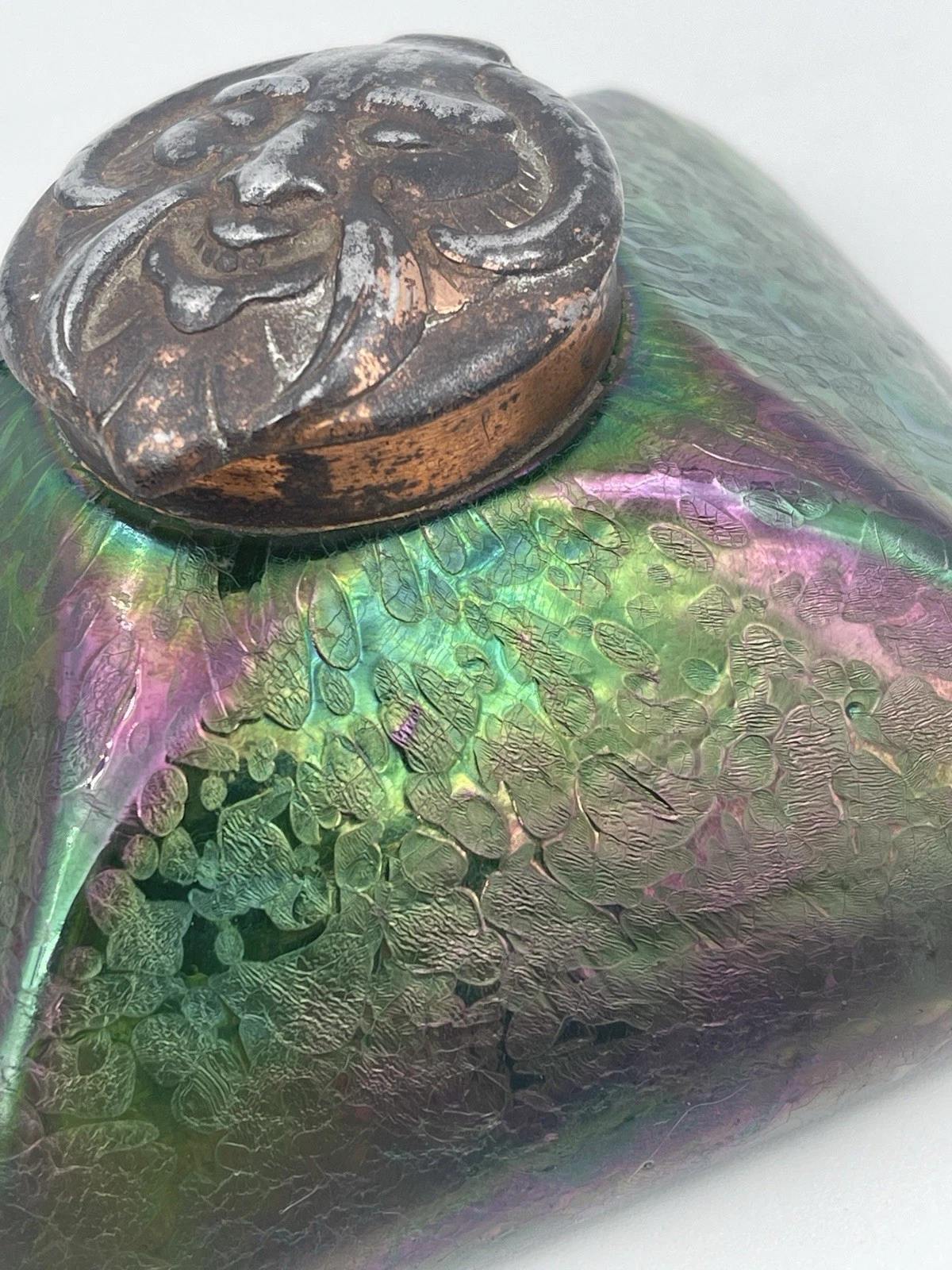
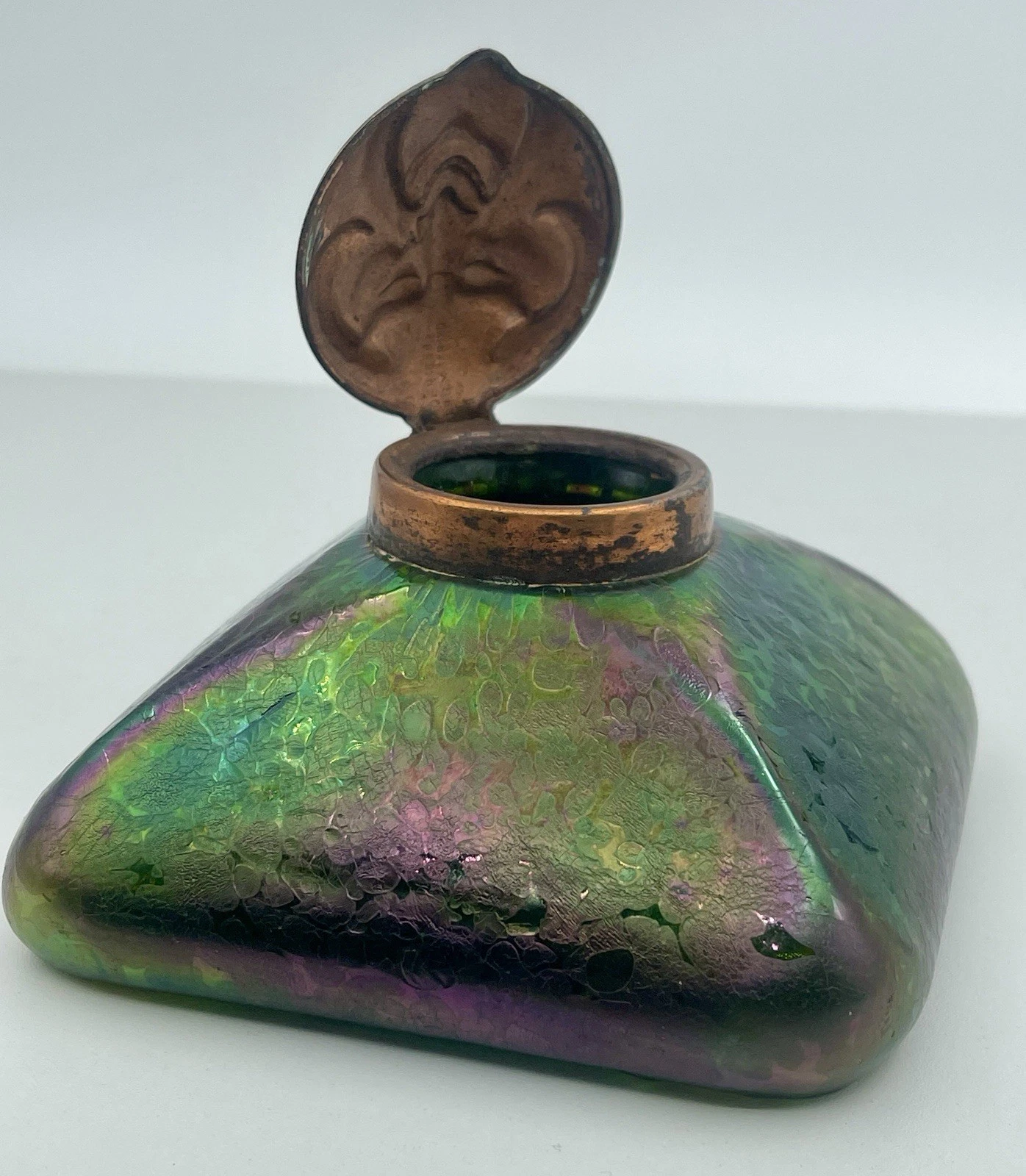
This striking piece is a wonderful example of Bohemian Art Nouveau (Jugendstil) desk art, combining a richly iridescent molded glass body with an expressive, heavy metal-mounted lid.
Deciphering the Underside Markings on the Lid
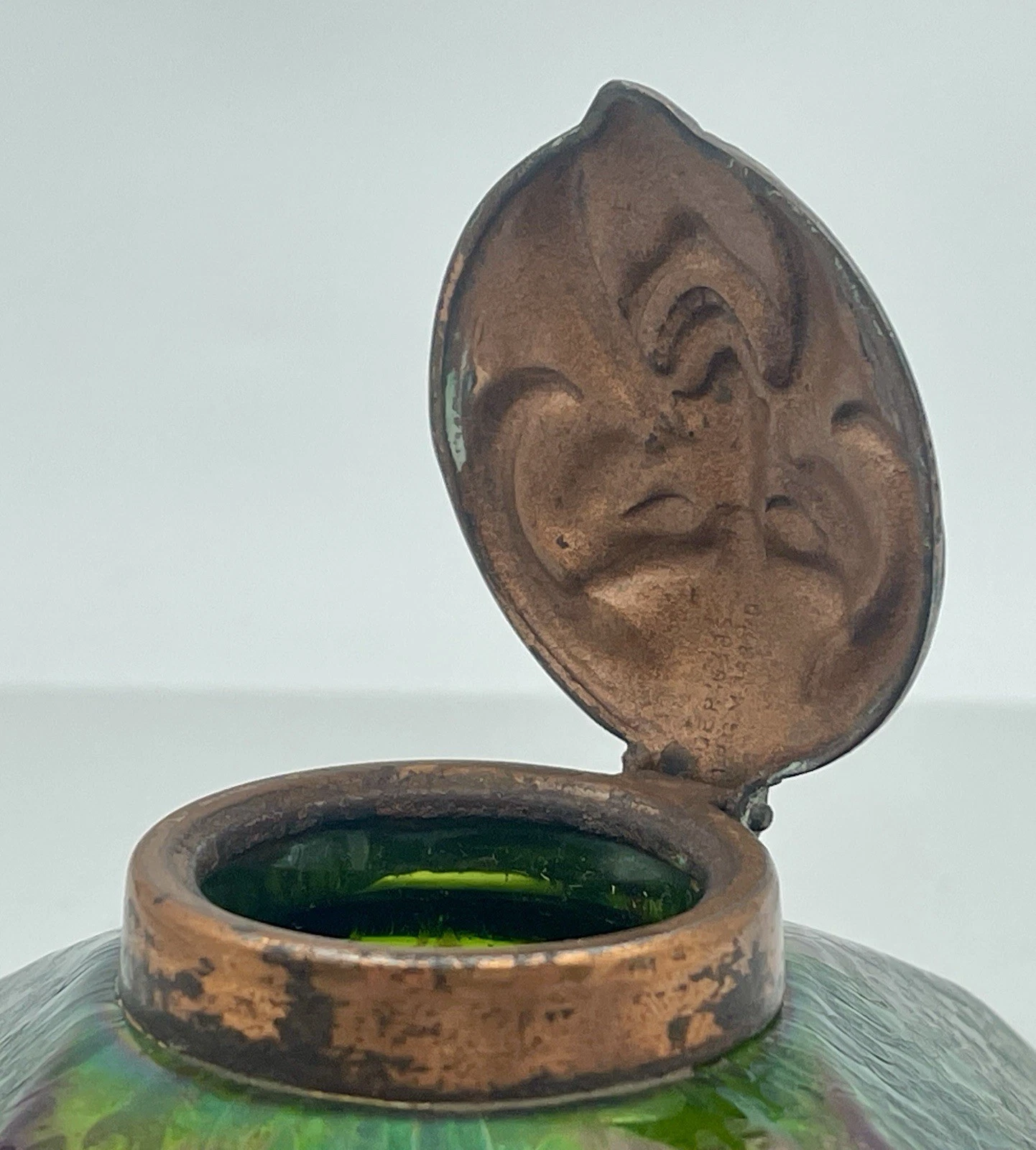
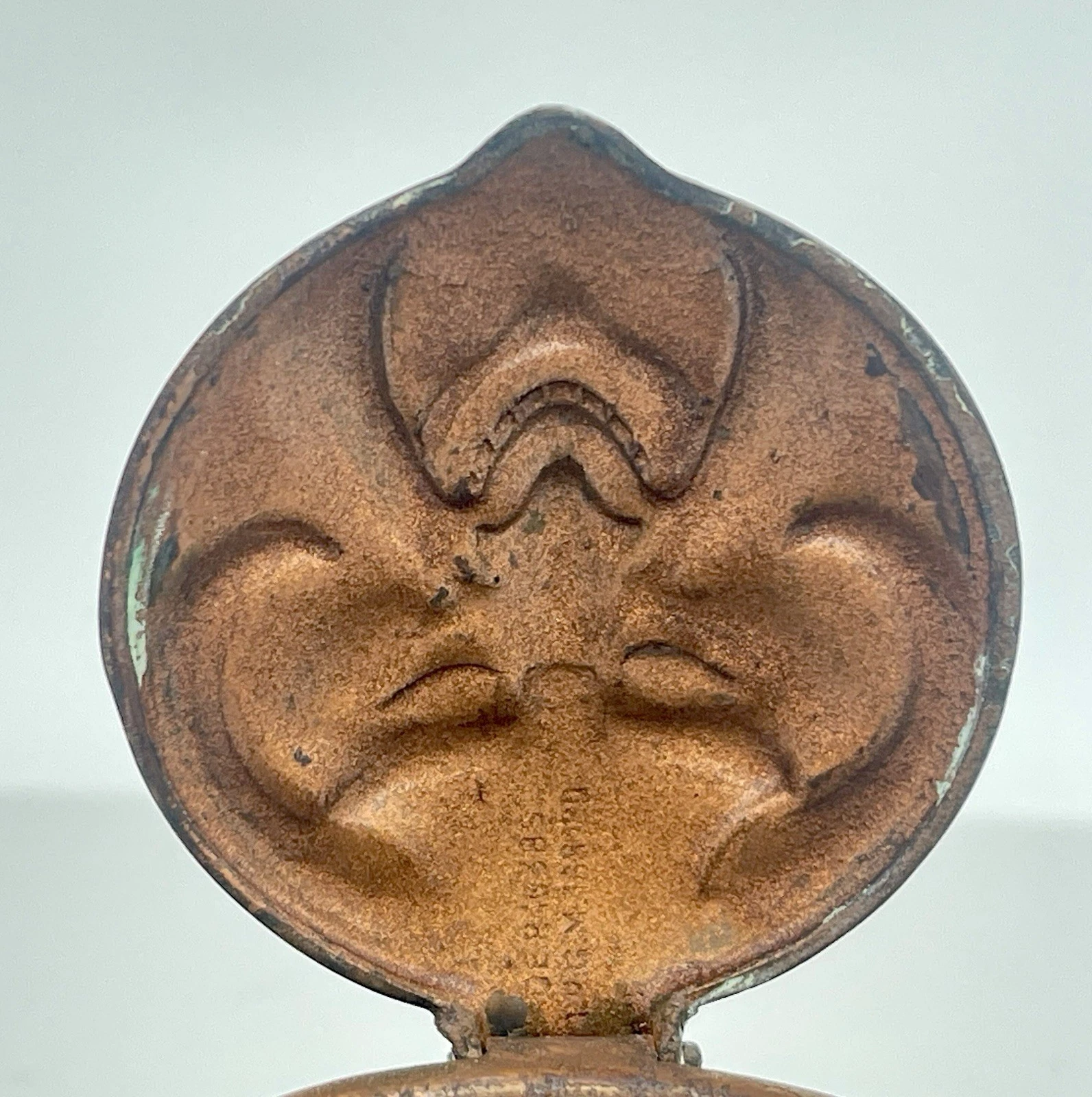
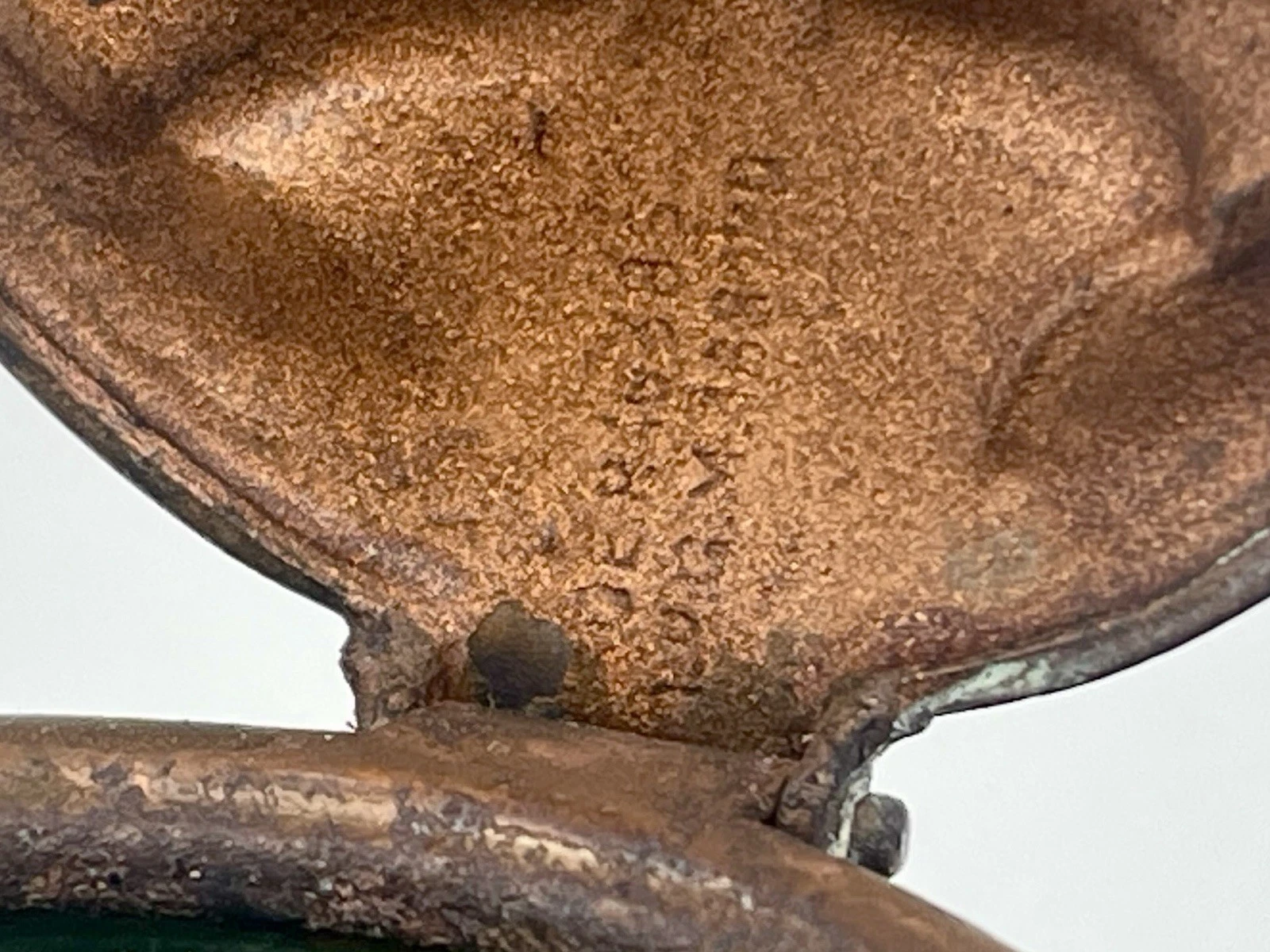
The text stamped on the underside of the lid reads:
- D.R.G.M. (Deutsches Reichsgebrauchsmuster): This indicates a “German Imperial Design Patent” or utility model registration system used from 1891 until roughly 1945. It protected the mechanical design, function, or assembly of the item (such as the hinge and collar mechanism) rather than a fine-art sculptural copyright.
- GER. 163835 (and/or accompanying registration numbers): This is the specific design registration serial number for the hardware component, pointing to a German foundry or hardware manufacturer that specialized in mass-producing functional metal lids and collars for the luxury and desk-ware trades.
Who or What is Depicted on the Lid?
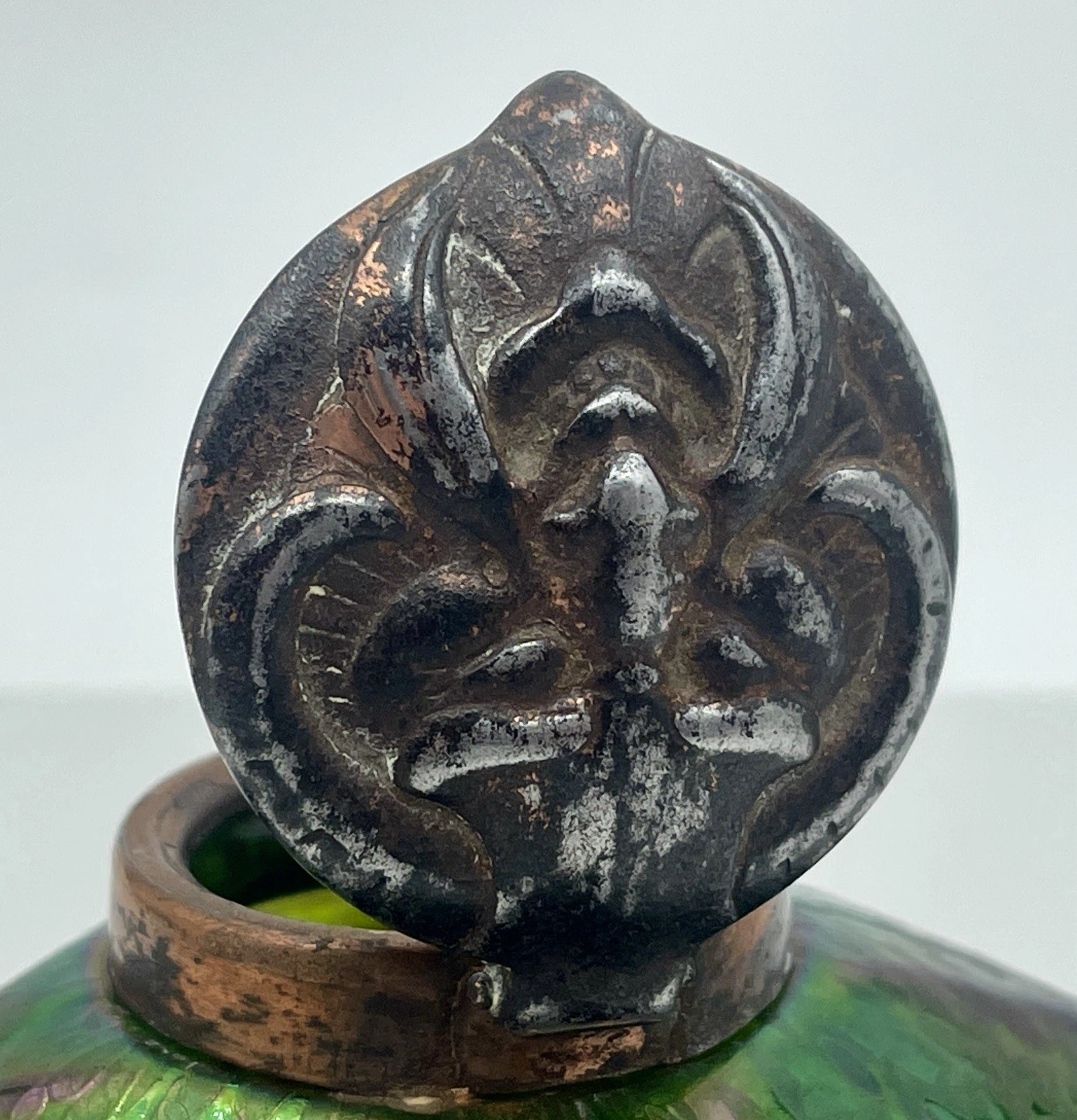
The lid features a repoussé and cast metal grotesque mask, Green Man, or mythical woodland spirit (frequently styled with horned or sweeping ram-like ears, arched brows, a prominent nose, and a flowing, stylized beard). In Art Nouveau and Jugendstil design, mythological motifs, folklore figures, and nature-inspired “green men” were immensely popular. They symbolized the untamed vitality of nature, aligning closely with the organic aesthetics of turn-of-the-century design.
Did the Lid Help Determine the Glass House? (Were Lids Made Separately?)
Lids and mounts were manufactured separately. During the peak of the Bohemian art glass era (roughly 1890–1914), a flourishing ecosystem of specialized hardware foundries and metal-goods manufacturers (often based in Germany and Austria) produced standardized collars, hinges, and hinged lids.
Glass houses like Loetz, Kralik, Rindskopf, and Harrach frequently sourced their metal mounts from independent hardware suppliers or specialized workshops. Because the same hardware suppliers sold components to multiple glass factories, a specific lid or D.R.G.M. number cannot definitively prove which glass house blew the body. The same mount could easily appear on a piece of glass from Kralik, Loetz, or another contemporary Bohemian concern.
The BIG Question: Loetz, Kralik, or Someone Else?
Discerning between Loetz and Kralik (or other Bohemian makers like Johann Loetz Witwe, Wilhelm Kralik Sohn, or Frantisek Halama) requires analyzing the physical characteristics of the glass itself rather than the metal hardware:
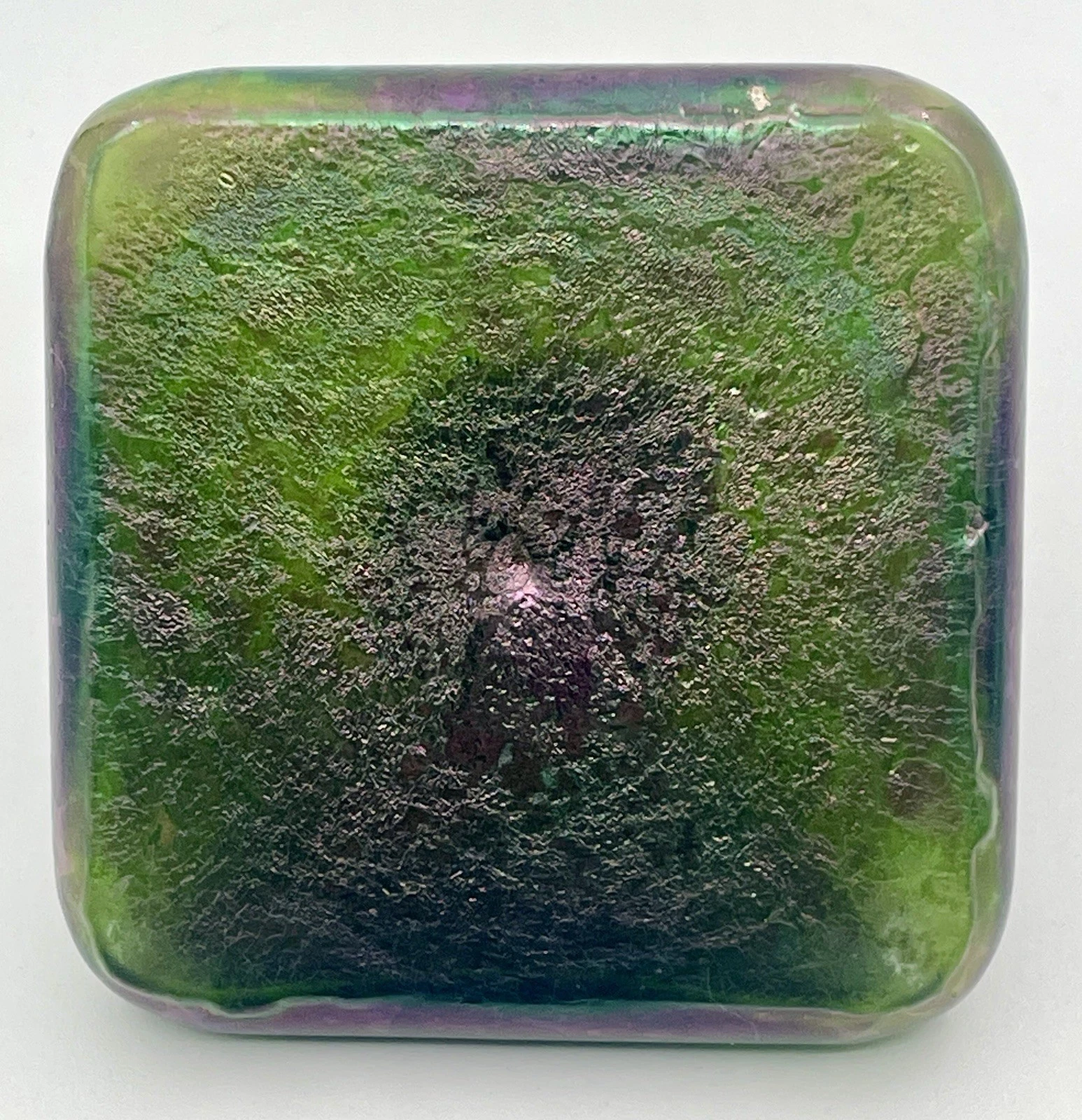
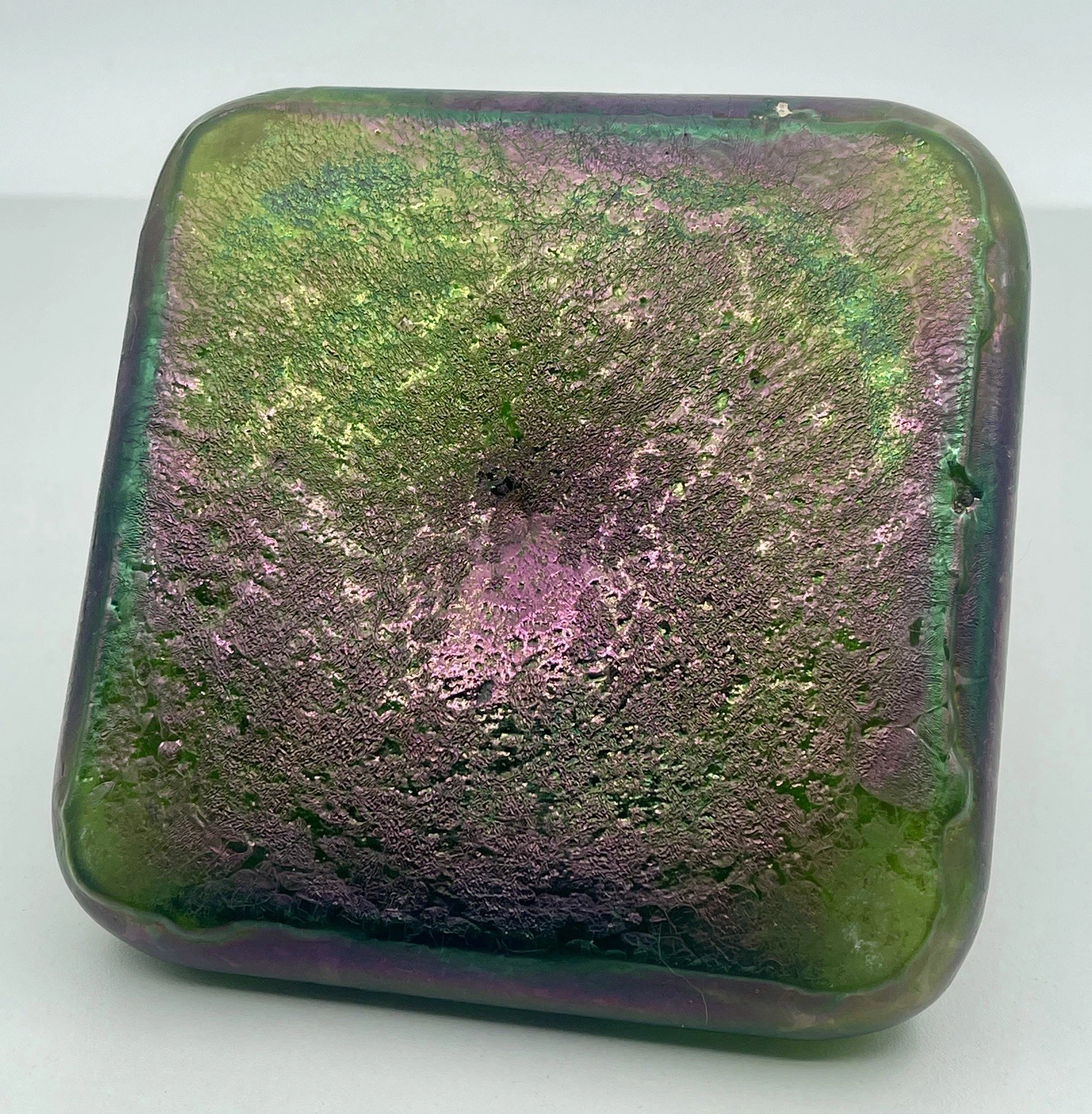
- The Glass Body & Décor: This inkwell exhibits a deep emerald-green base covered in a distinct, textured “veined,” “webbed,” or “crackle” surface pattern (sometimes associated with decors akin to Kralik’s “Pampas” or “Veined” lines).
- Texture vs. Finish: Loetz iridescent glass is renowned for having a smoother, highly polished, oily, or mirror-like iridescence with seamless color gradations. In contrast, Kralik’s veined and crackled finishes frequently exhibit a more tactile, deeply textured, frost-like network where the metallic webbing is physically pronounced.
- Verdict: Given the heavily webbed surface texture, deep multi-hued oil-spot iridescence (shifting from emerald green to deep violet), and typical heavy square-form molding, this piece is most confidently attributed to Wilhelm Kralik Söhne, though historical crossover in Bohemian production means it belongs squarely in the upper tier of Austro-Hungarian Art Nouveau art glass.
The Glassmaking Process & Achieving Iridescence
- Forming the Glass Body
- The Gather & Mold: A gather of molten glass (in this case, tinted a rich cobalt or green base) was taken on the end of a blowpipe.
- Creating the Webbed Texture: To achieve the characteristic webbed or crackled surface, the hot glass was often rolled over fine glass threads, dipped into colored glass granules (frit), or subjected to thermal shock by briefly cooling and reheating the outer layer. As the artisan continued to blow and expand the glass into a multi-lobed, heavy-walled square mold, those outer layers stretched and fractured into an organic, web-like matrix.
- Achieving the Iridescent Effect
The breathtaking metallic shimmer (often called a Lustre or Favrile-style finish) was created through chemical vapor reduction:
- While the glass vessel was still hot from the blowing process, it was placed into a specialized kiln or chamber saturated with metallic vapors (commonly a blend of stannous chloride, bismuth, or silver nitrate salts).
- When these hot metallic fumes hit the reactive chemicals on the surface of the cooling glass, they bonded instantly, forming an extremely thin, microscopic metallic-oxide film.
- Light striking this ultra-thin film refracts at varying angles, creating the signature oil-slick rainbow of greens, purples, golds, and blues characteristic of the Art Nouveau period.
Sold for $290 in August 2026
Content disclaimer. The information posted is the owner’s best knowledge and may not have been vetted by the SOIC. We welcome comments, corrections, and additions, working to make our website information comprehensive and accurate.
Join the Society of Inkwell Collectors (SOIC) – it’s free!
Founded in 1981 as a non-profit organization,
we are documenting inkwells (and accessories).
We’re here to help and inform!