

Japanese Yatate
| Categories | Far East / Oriental |
| Type | Yatate |
| Material | Bronze |
| Markings | Unmarked |
| Manufacturer | Undetermined |
| Origin | Japan |
| Date or Era | circa 1870 |
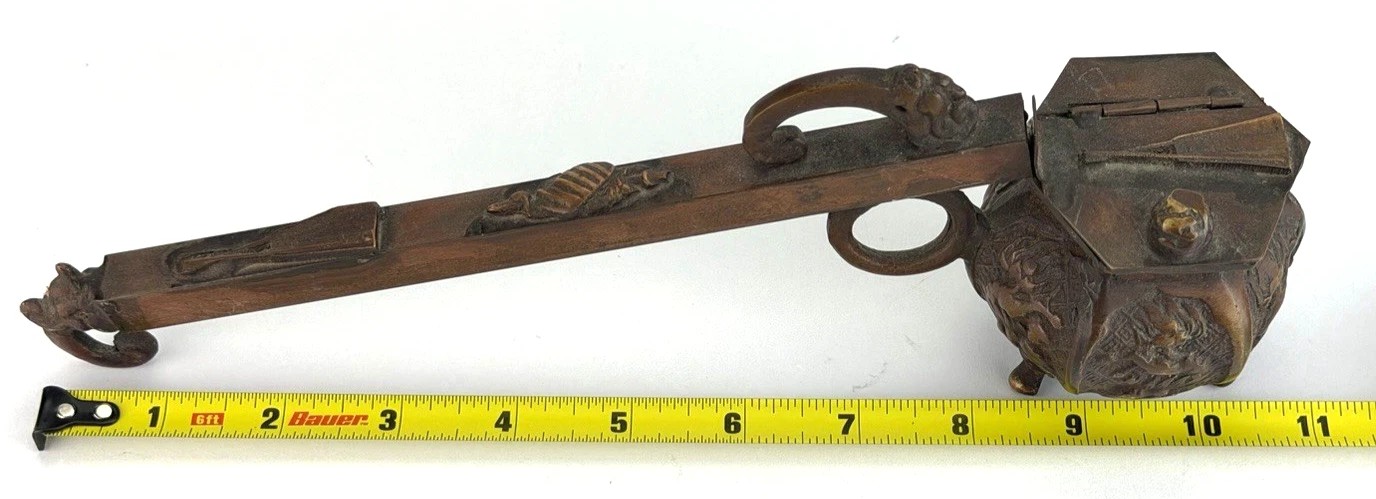
| Measuring | 10 ½” long |
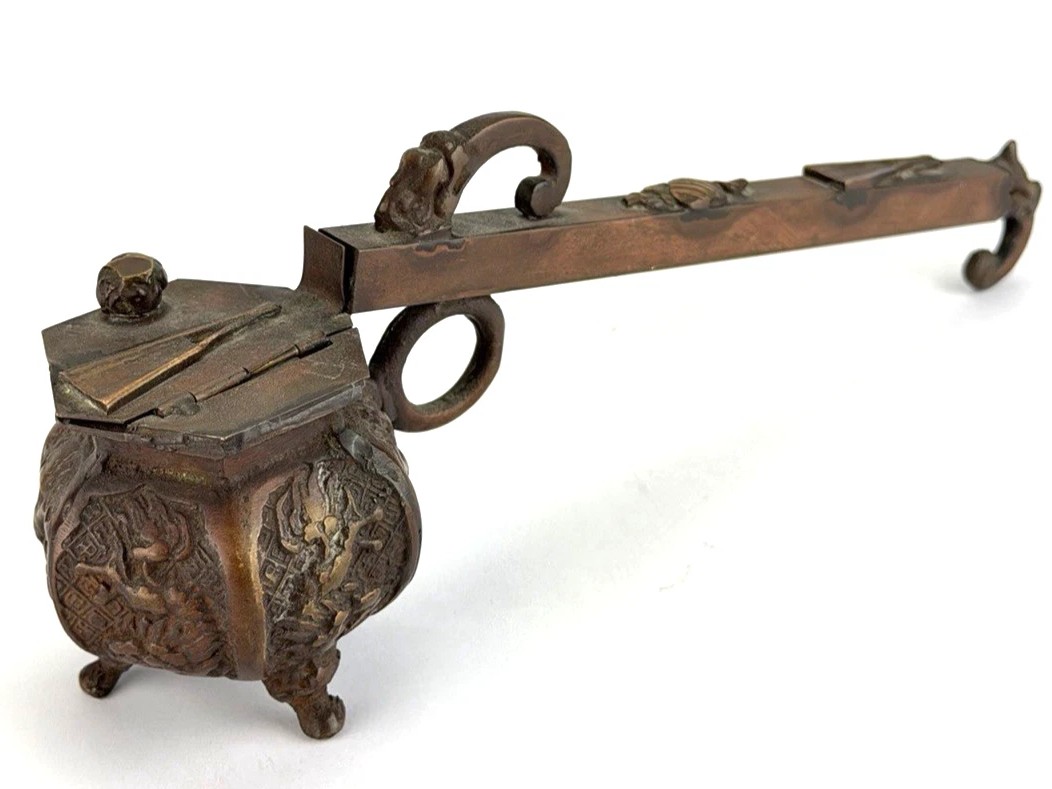
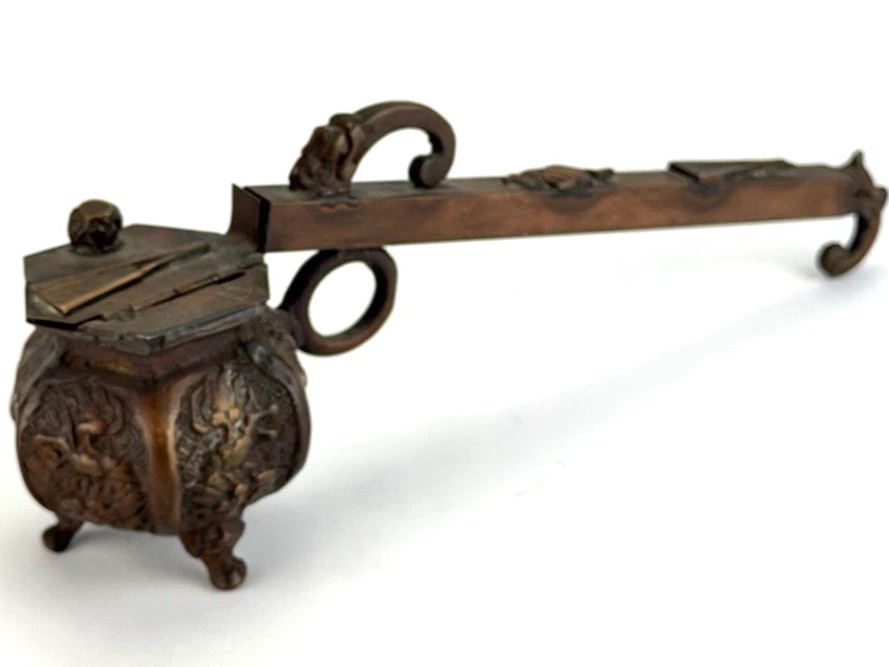
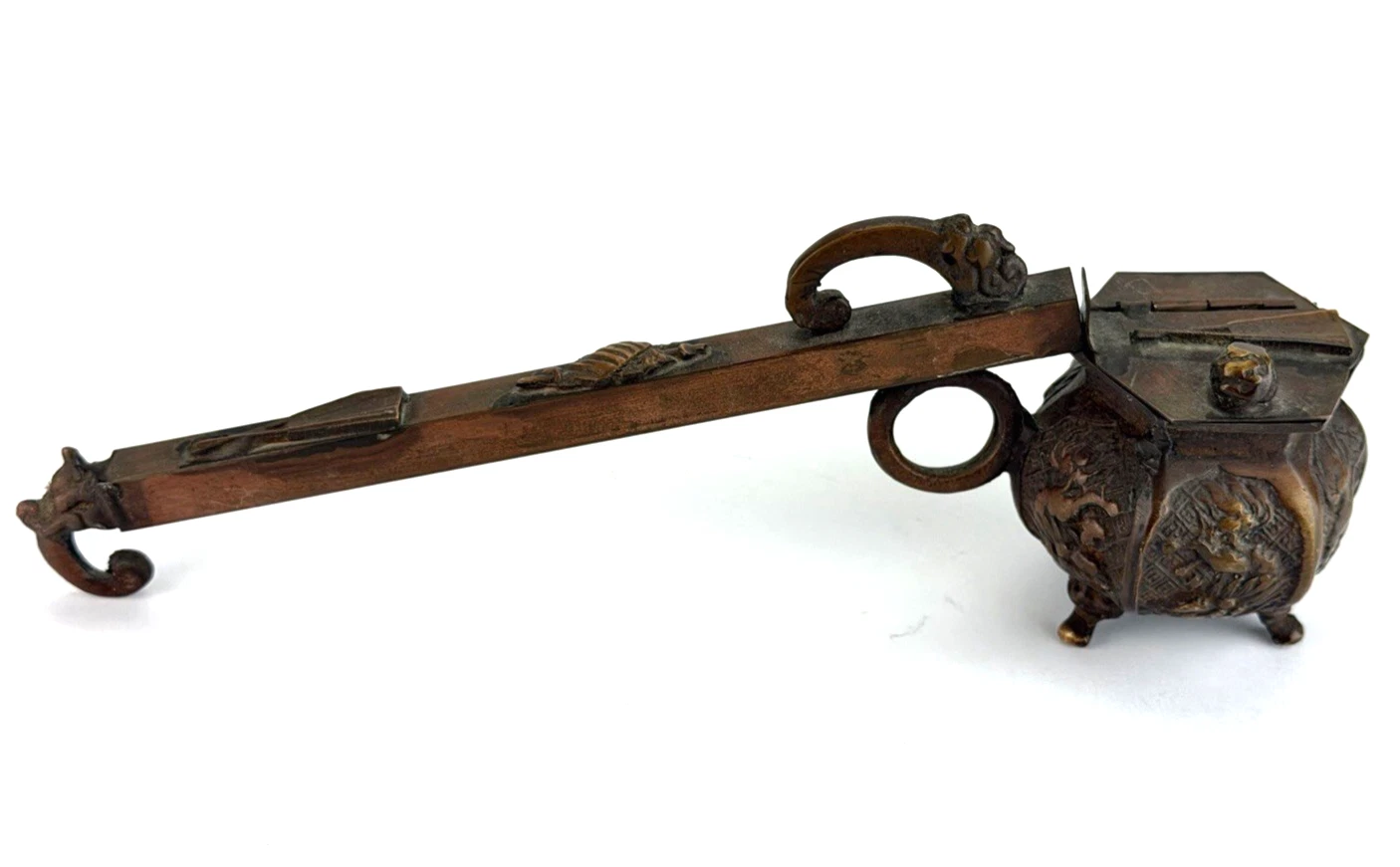
This piece is a traditional Japanese yatate (矢立), a portable writing set carried by scholars, merchants, monks, and travelers to take notes on the road. Cast and assembled primarily from bronze and copper alloy, it measures approximately 10.5 inches (27 cm) in length.
Anatomy and Function
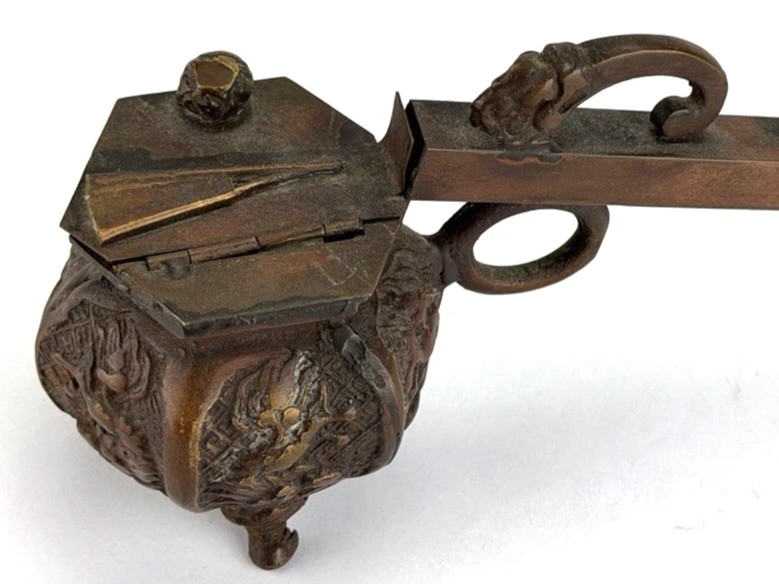
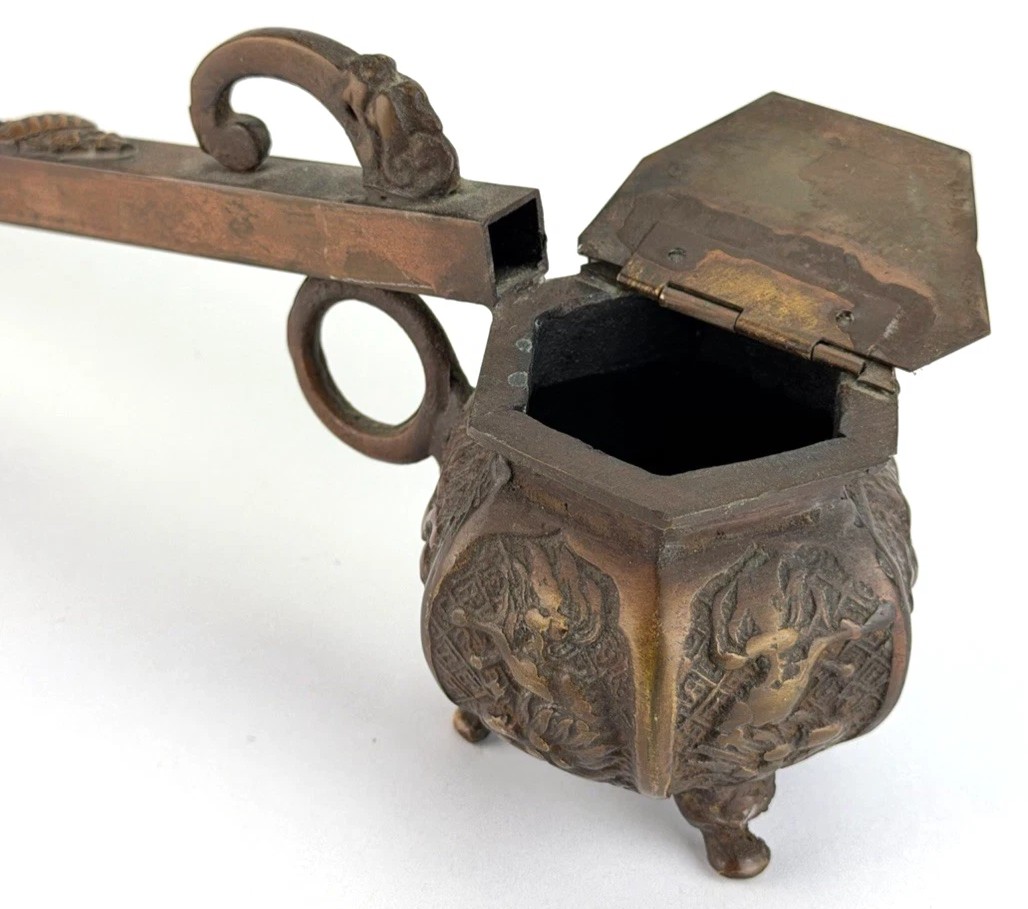
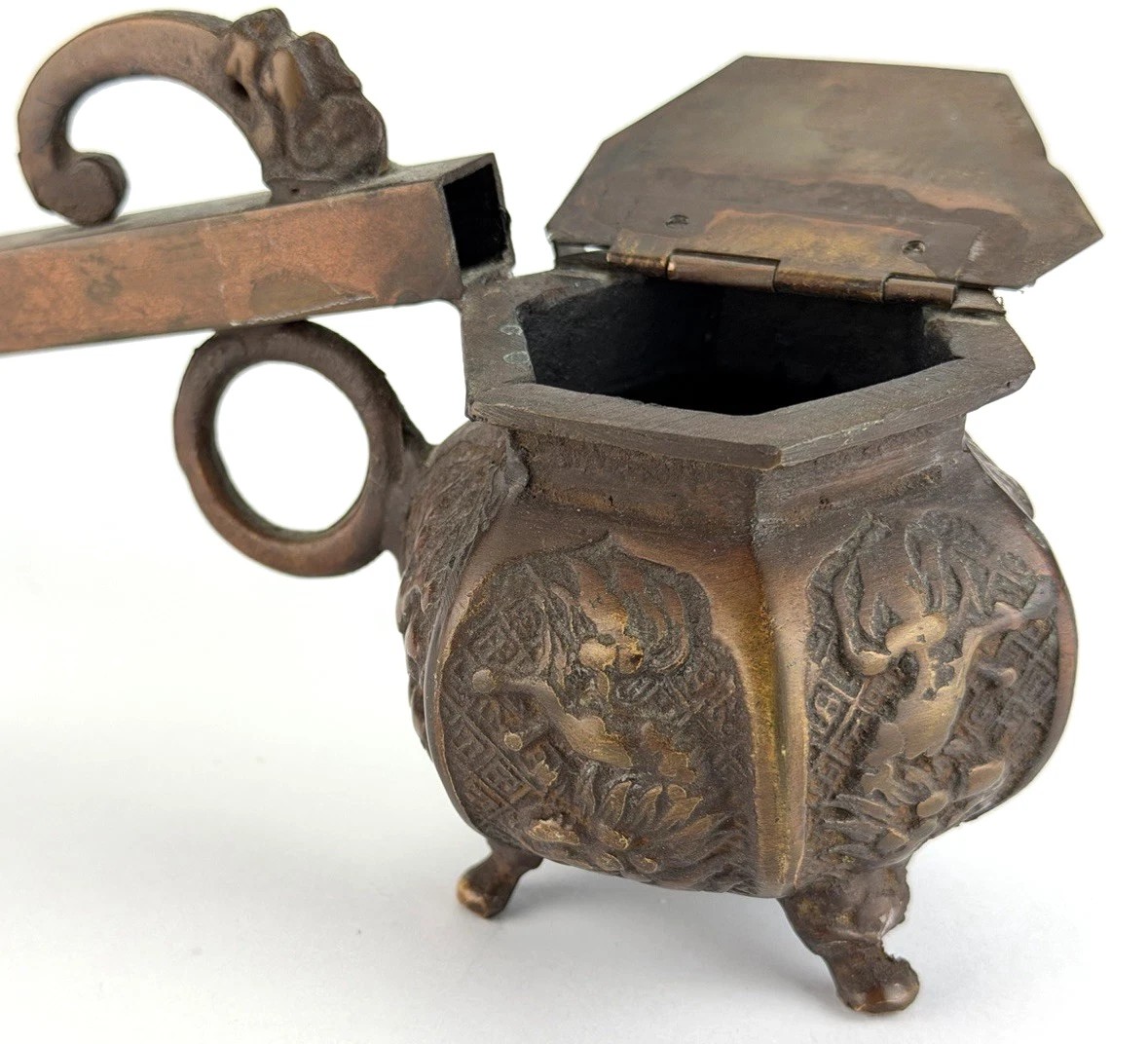
- Ink Reservoir (Sumi-tsubo): The bulbous, hexagonal tripod pot on cabriole feet held a wad of silk or cotton fiber saturated with liquid sumi ink. The fiber kept the ink suspended so it would not spill during transit.
- Brush Shaft (Fude-tsutsu): The long, hollow rectangular shaft stored one or two fine writing brushes (fude). Notice how the shaft opens directly toward the inkwell; when the hinged lid shuts, its side flange seals the open mouth of the brush chamber, locking the brush safely inside.
- Hinged Lid: The faceted lid swings open on a pin hinge to access the ink and extract the brush. It features a faceted finial knob for lifting.
- Suspension Rings & Terminals:
- The circular ring underneath and the scrolled crest above served both as ergonomic grip supports and connection points for a cord (himo).
- A yatate was worn tucked through the kimono sash (obi), functioning like a toggle or netsuke, with the heavy inkwell resting over the sash edge to prevent the set from slipping through.
Iconography and Decoration
- The Inkpot Panels: Cast with deeply undercut relief depictions of a Ryu (Japanese dragon) amidst billowing clouds, set against a diaper-pattern ground (sayagata or geometric fretwork). In Japanese tradition, the dragon symbolizes water, power, and good fortune—a fitting guardian for an ink vessel (symbolizing rain/fluidity to keep the ink moist).
- The Shaft Motifs:
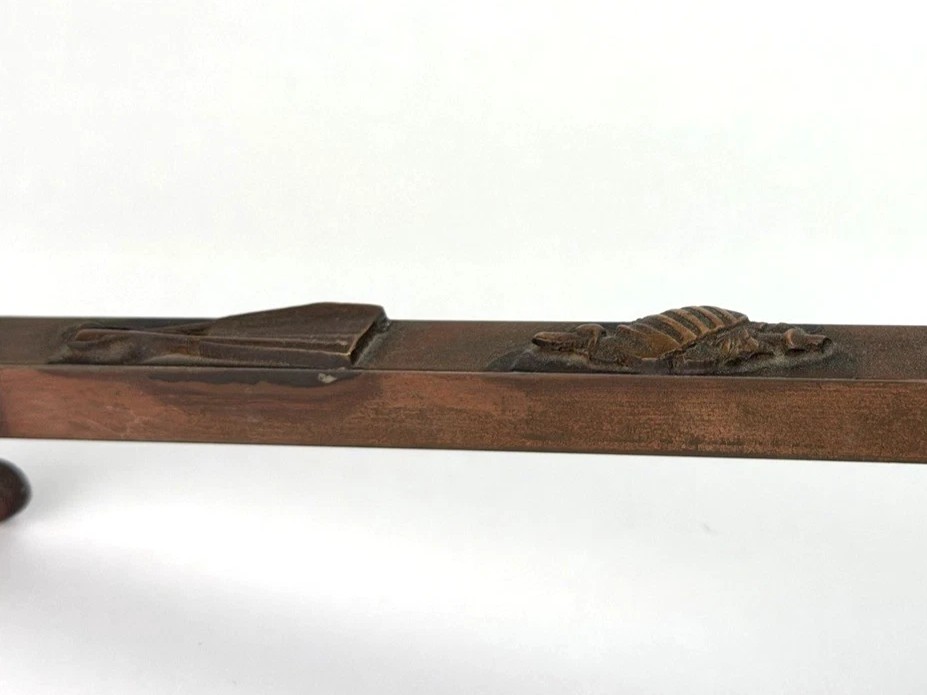
- The raised motif along the midpoint depicts a Minogame (the legendary long-lived moss-tailed turtle), an auspicious symbol of longevity and endurance.
- Further down is a relief of traditional scholarly or travelers’ accoutrements (resembling a folded fan or ceremonial whisk/scroll).
- The handle and terminal end are sculpted into stylized zoomorphic creatures (a dragon/Makara or shishi temple lion).
Maker and Date
- Maker: Unsigned. The vast majority of bronze yatate were cast by specialist metalworkers (kinko-shi) and foundry workshops rather than individual named master artists.
- Date: Late Edo to Meiji Period (19th century). The heavy cast construction, hex-lobed tripod pot, and classic auspicious motifs are characteristic of mid-to-late 19th-century Japanese travel ware, made just before Western fountain pens largely displaced yatates in the late Meiji era.
Sold for $73 in August 2026
Content disclaimer. The information posted is the owner’s best knowledge and may not have been vetted by the SOIC. We welcome comments, corrections, and additions, working to make our website information comprehensive and accurate.
Join the Society of Inkwell Collectors (SOIC) – it’s free!
Founded in 1981 as a non-profit organization,
we are documenting inkwells (and accessories).
We’re here to help and inform!