

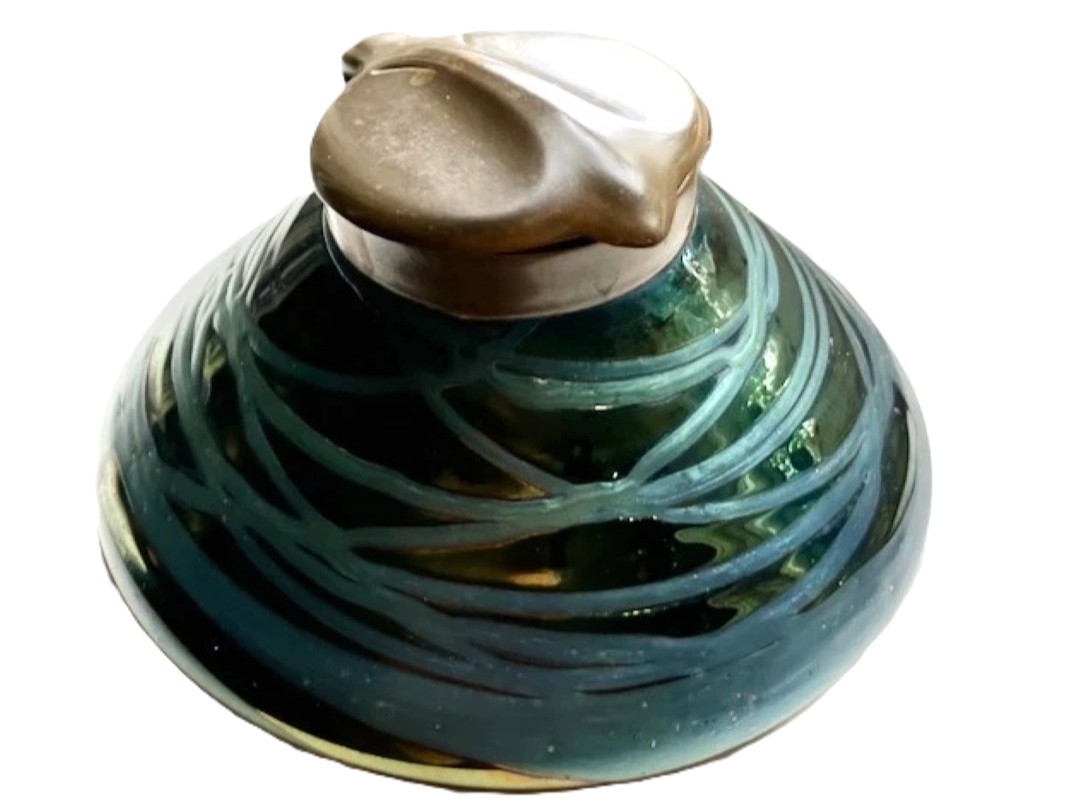
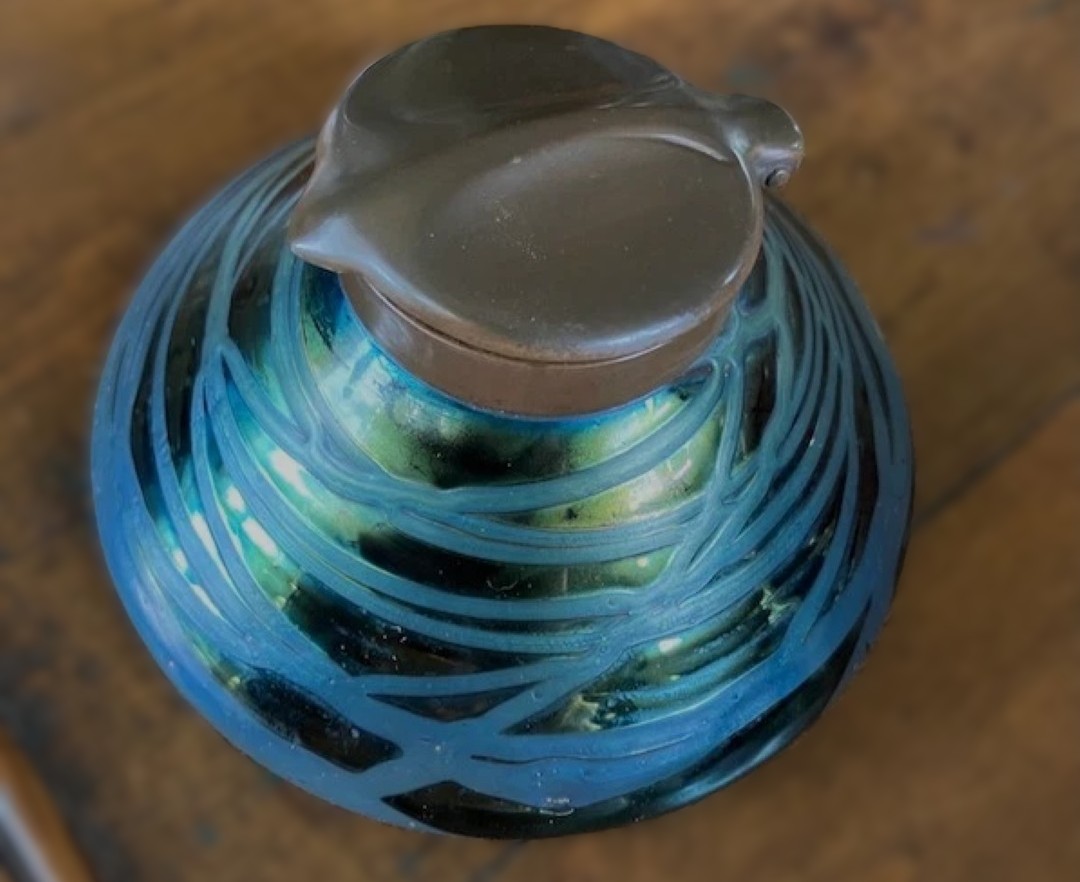
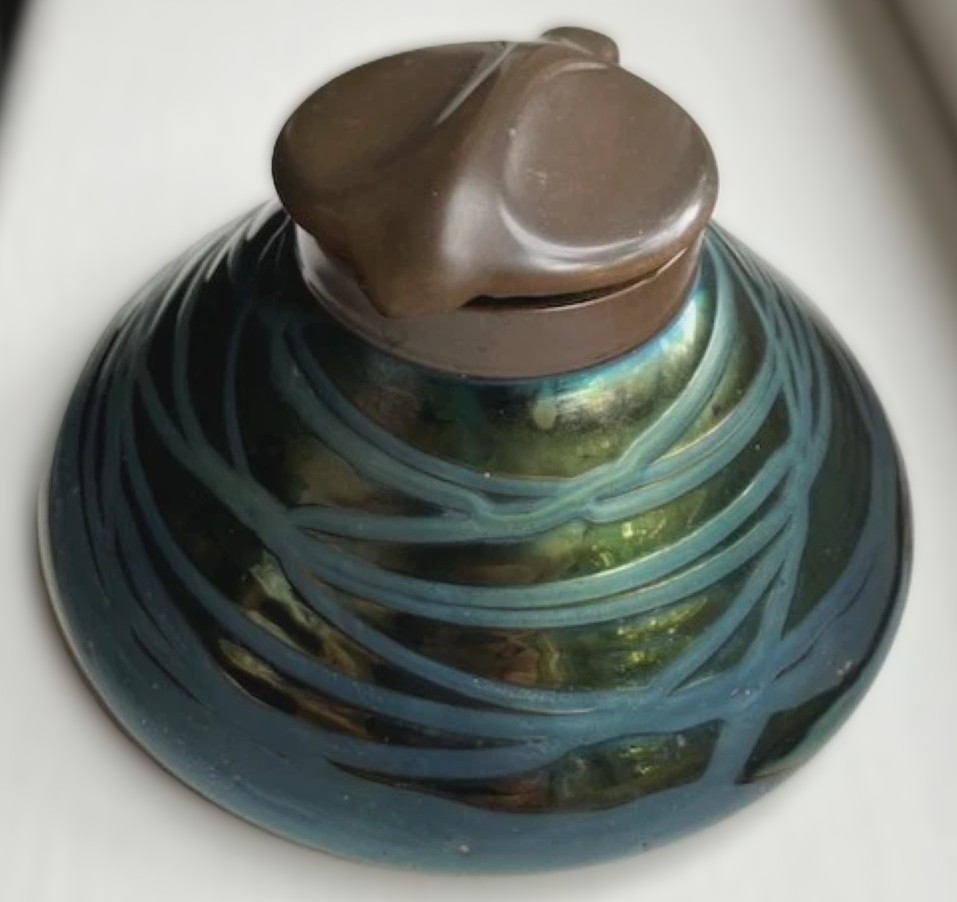
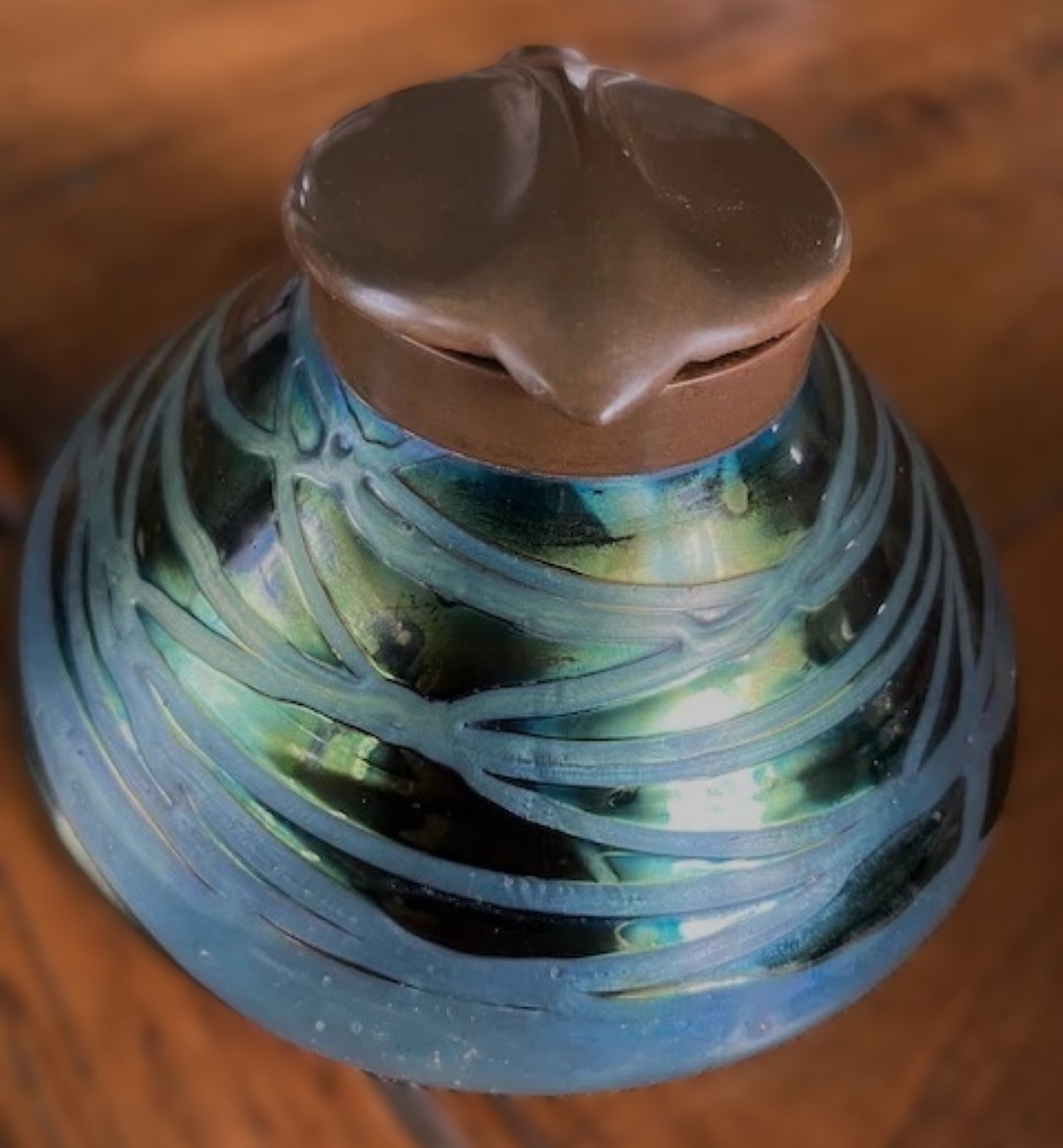
Bohemian Art Glass Inkwell by Kralik
| Categories | Bohemian Art Glass |
| Material | Glass |
| Markings | See Narrative |
| Manufacturer | Kralik |
| Origin | Bohemia |
| Date or Era | circa 1905 |
| Measuring | 4” diameter; 2 ½” high |
Overview
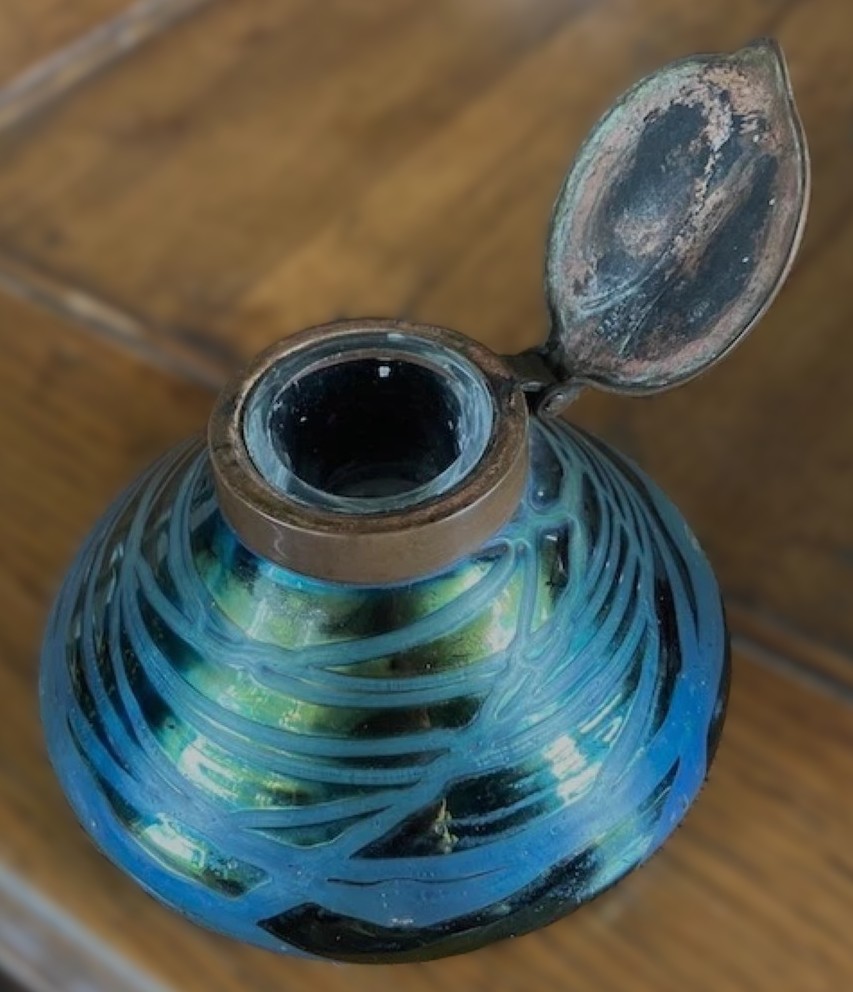
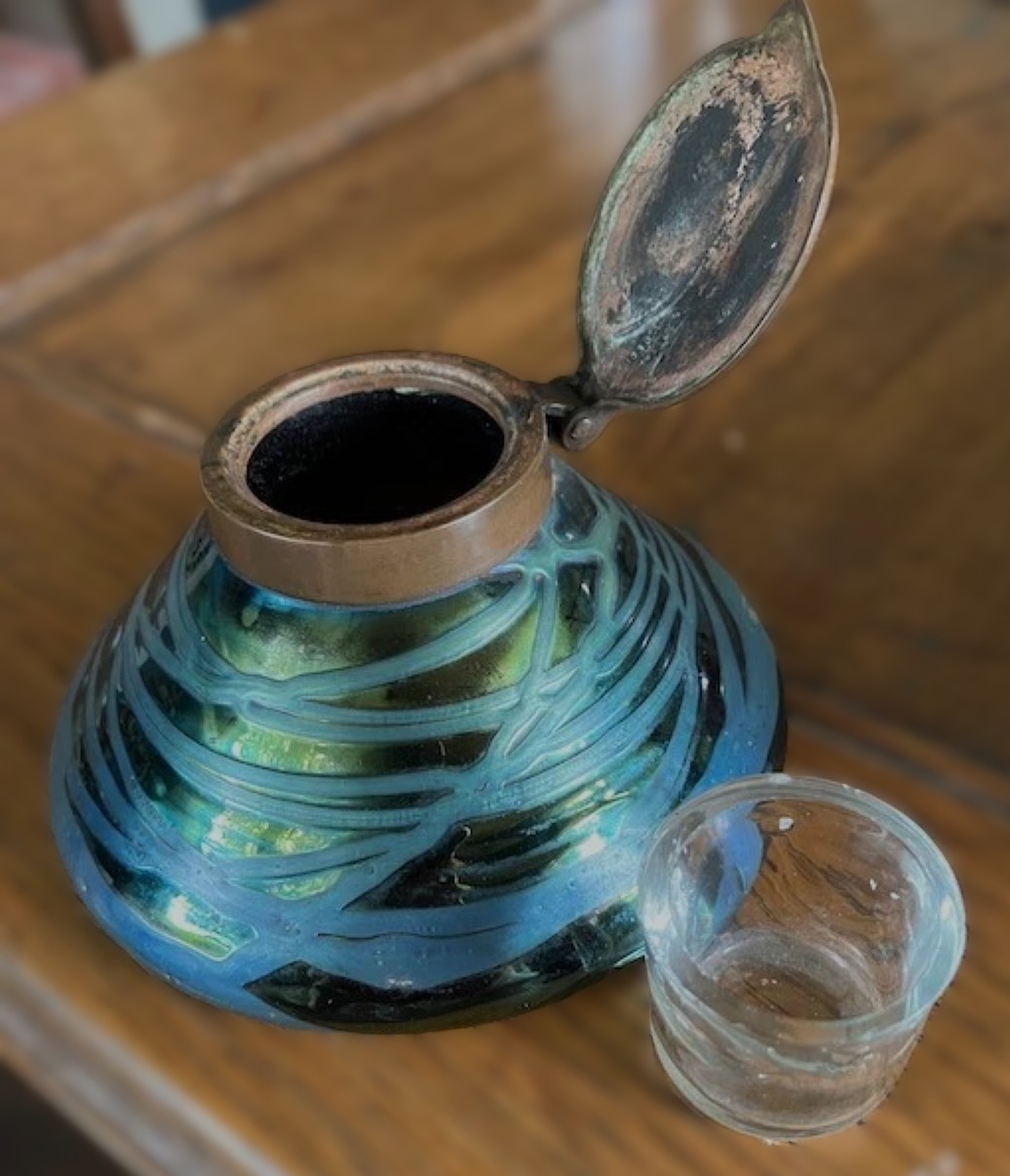
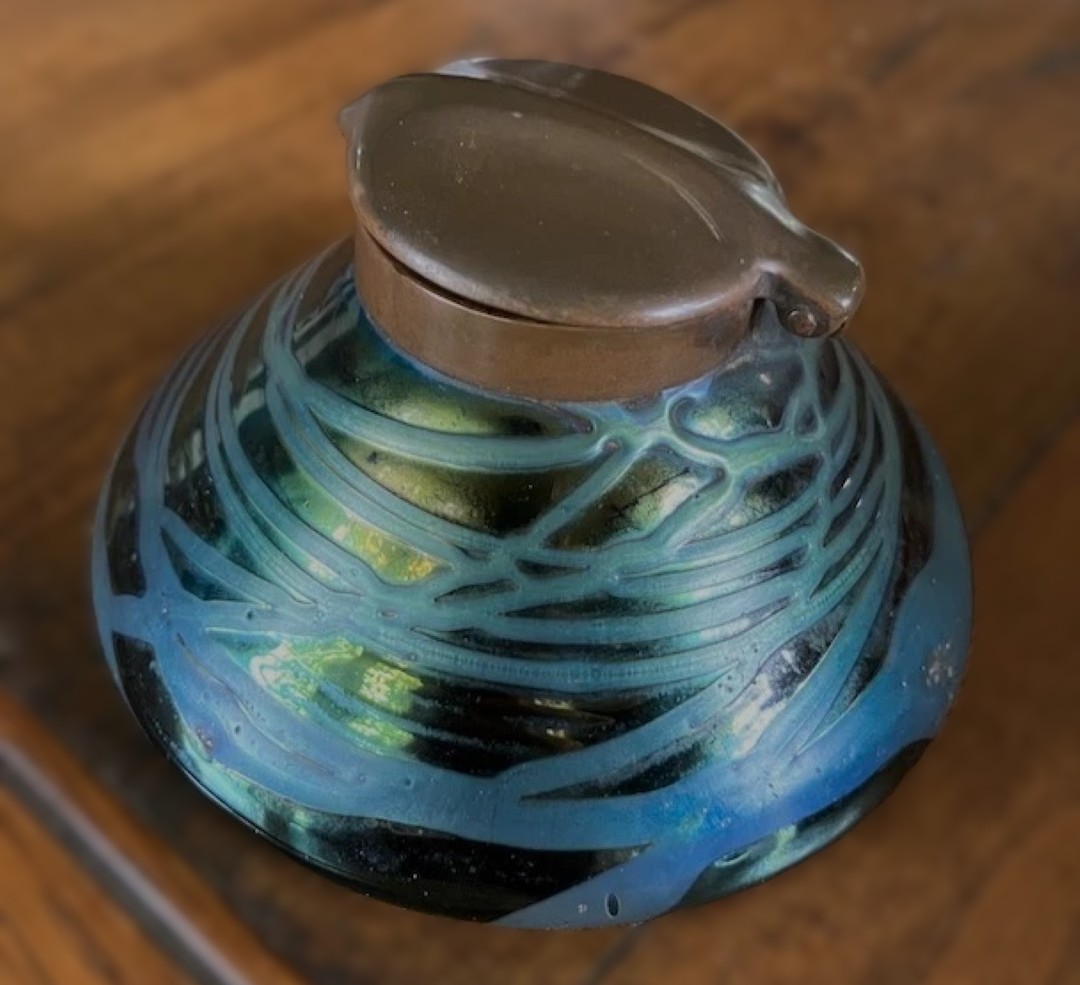
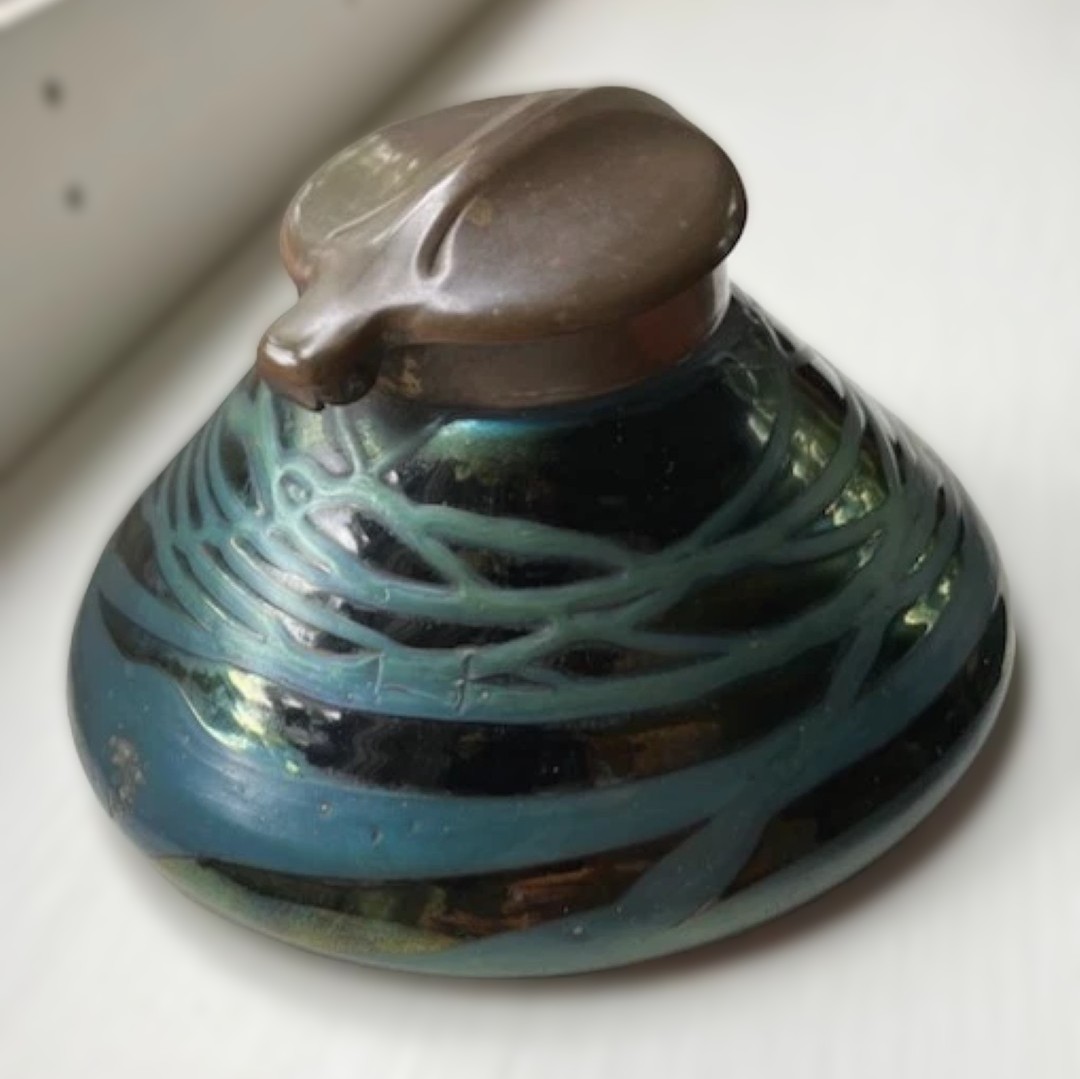
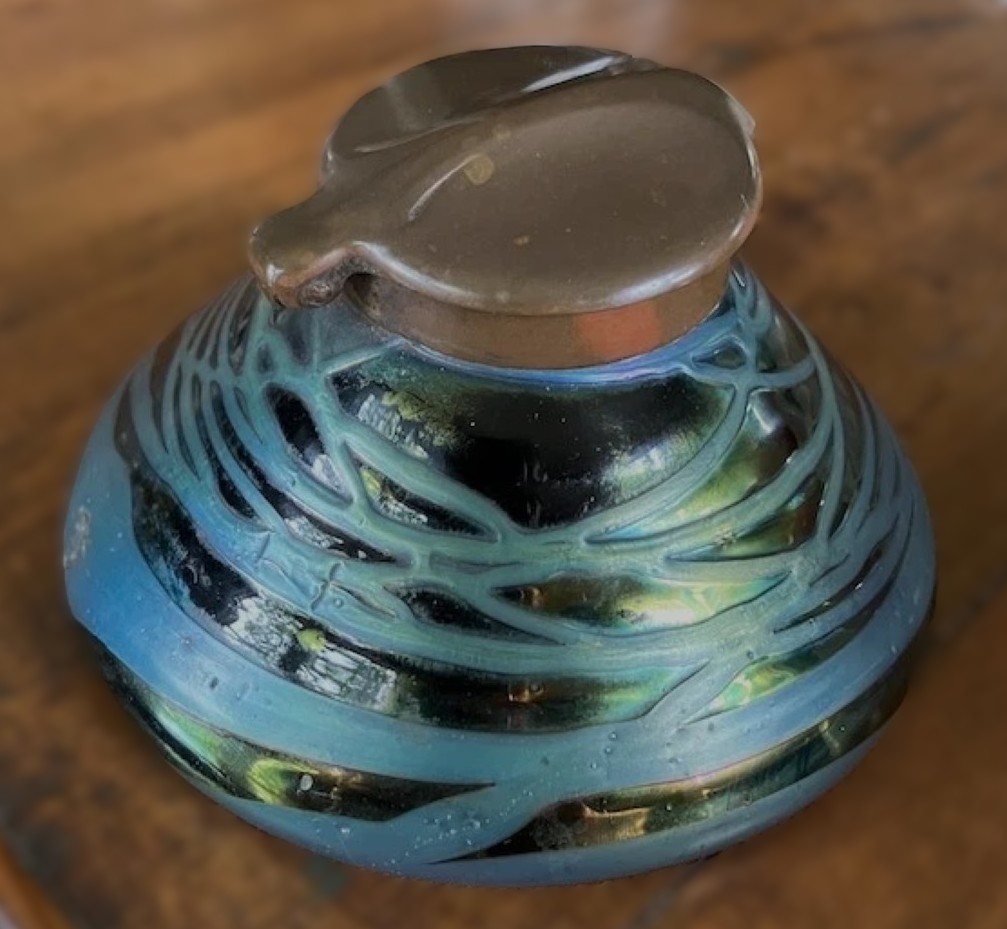
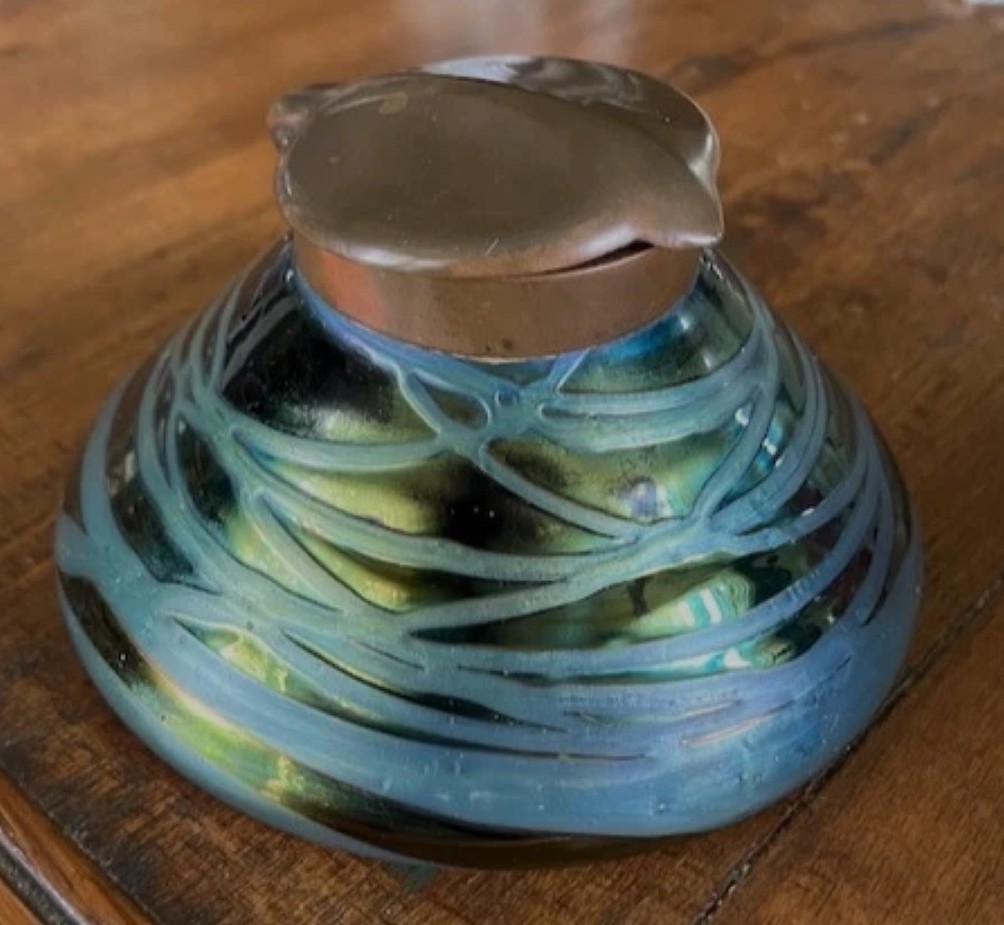
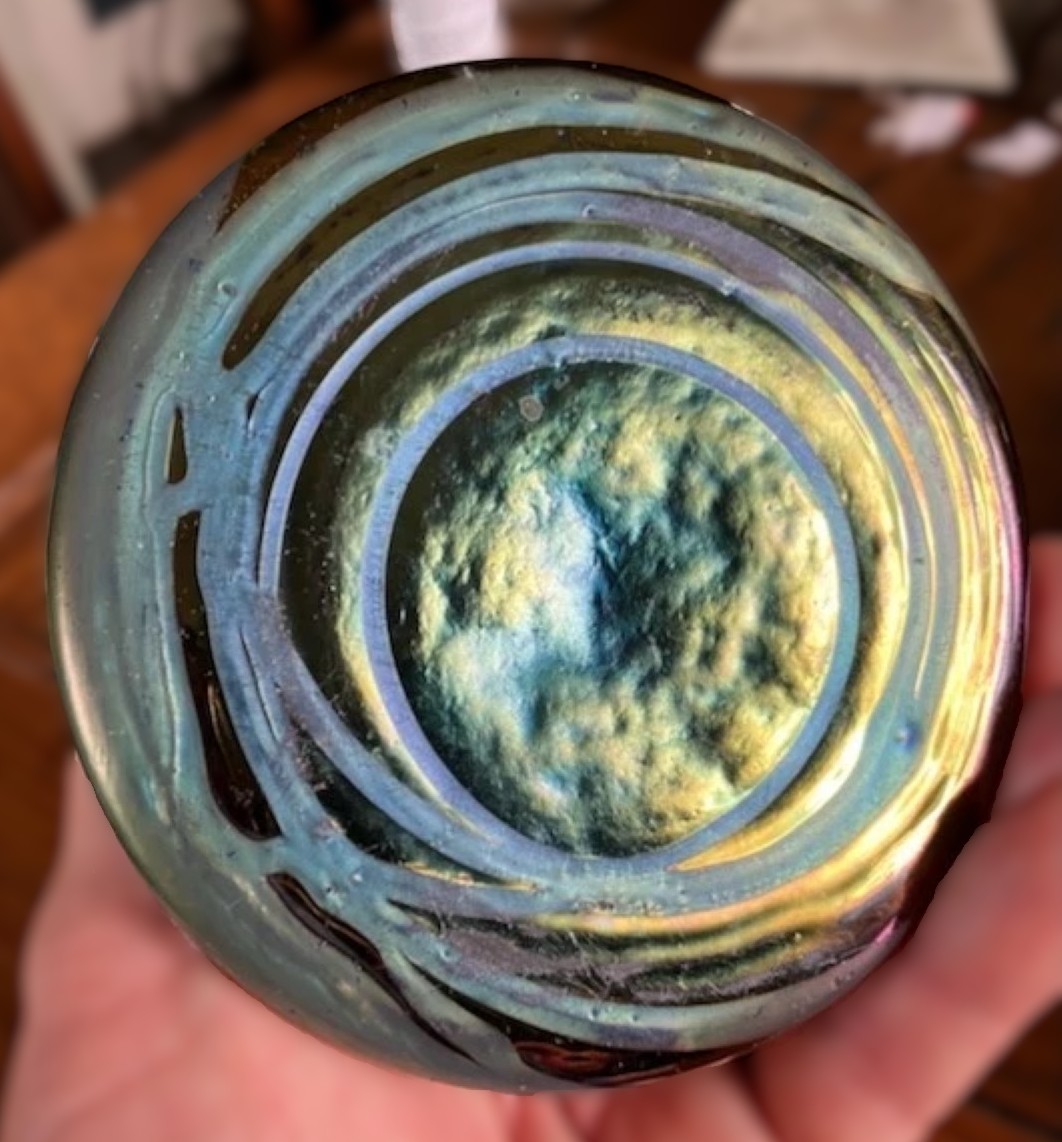
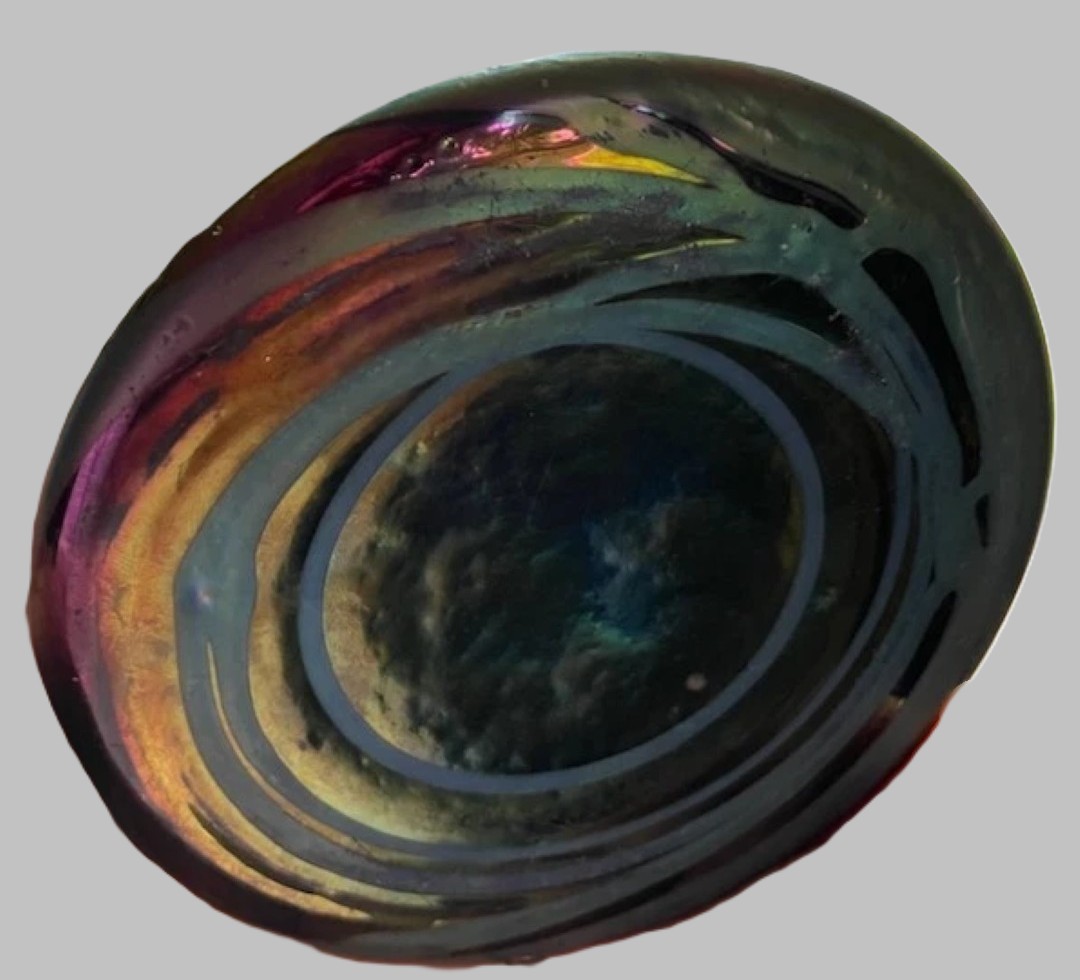
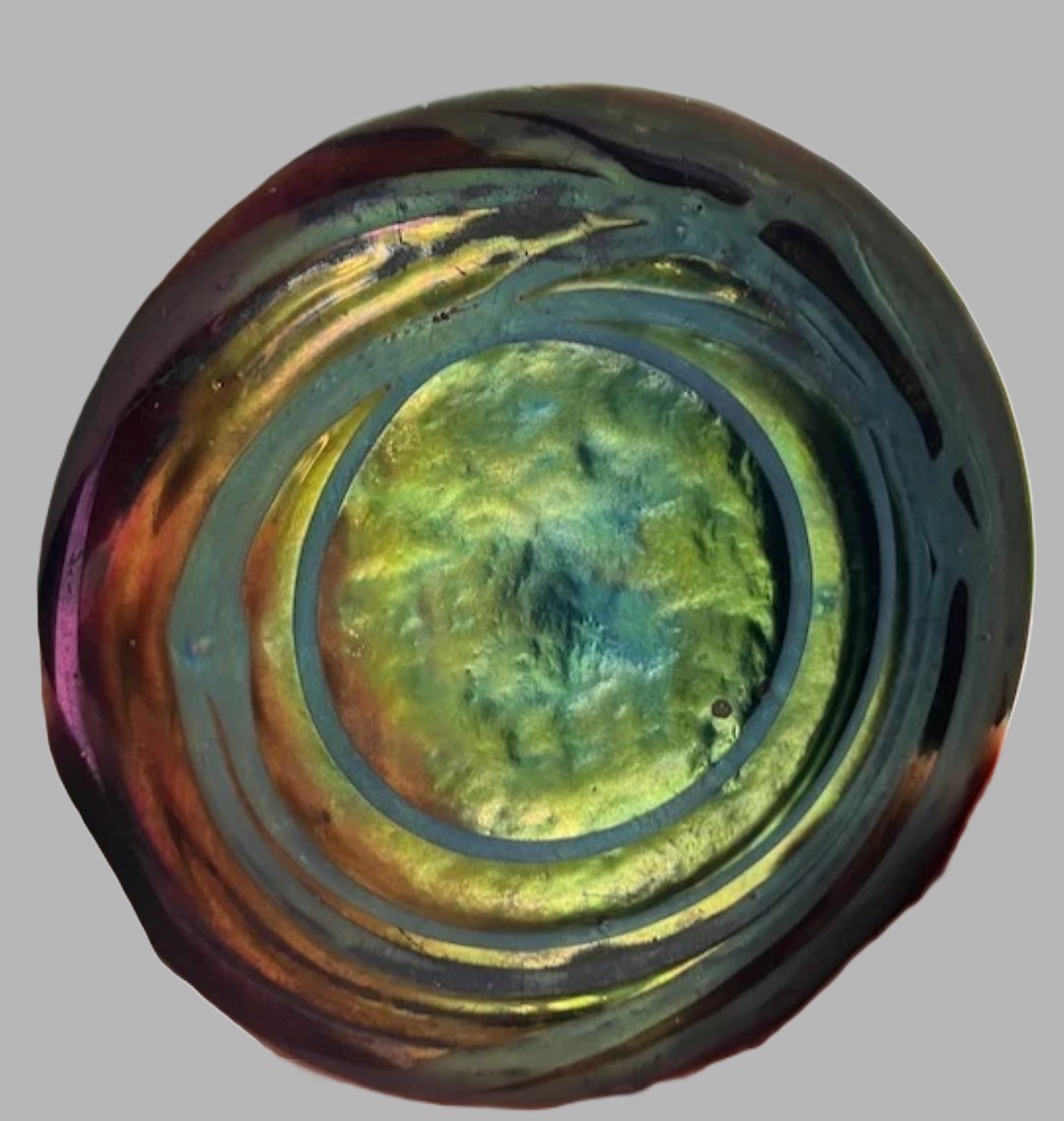
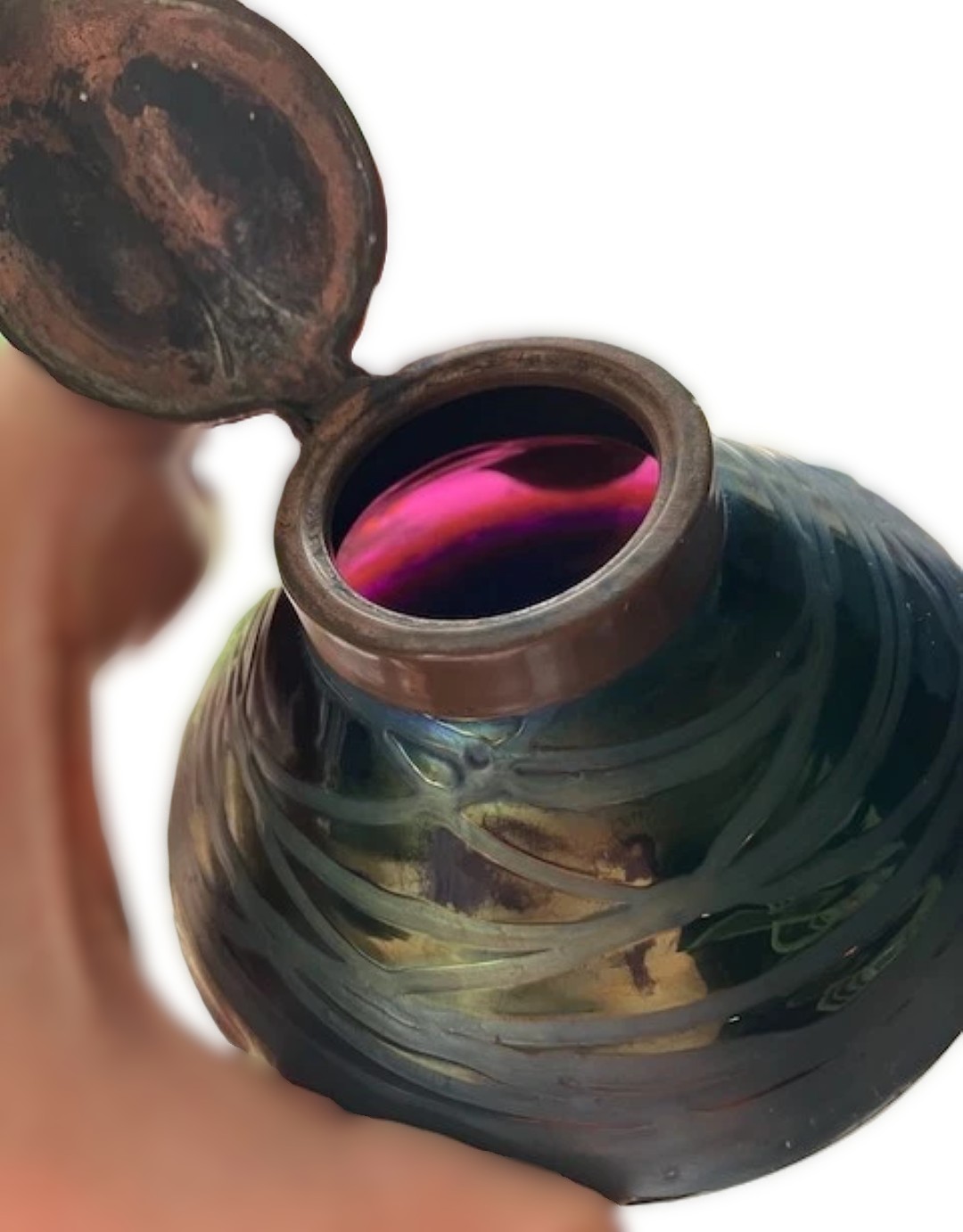
- Form & Color: A squat, conical Art Nouveau (Jugendstil) desk inkwell crafted from blown glass featuring an iridescent petrol-blue and emerald-green ground that shifts into magenta under transmitted light.
- Surface Decoration: Applied contrasting light blue/aqua glass threading wrapped across the body in an organic, webbed pattern.
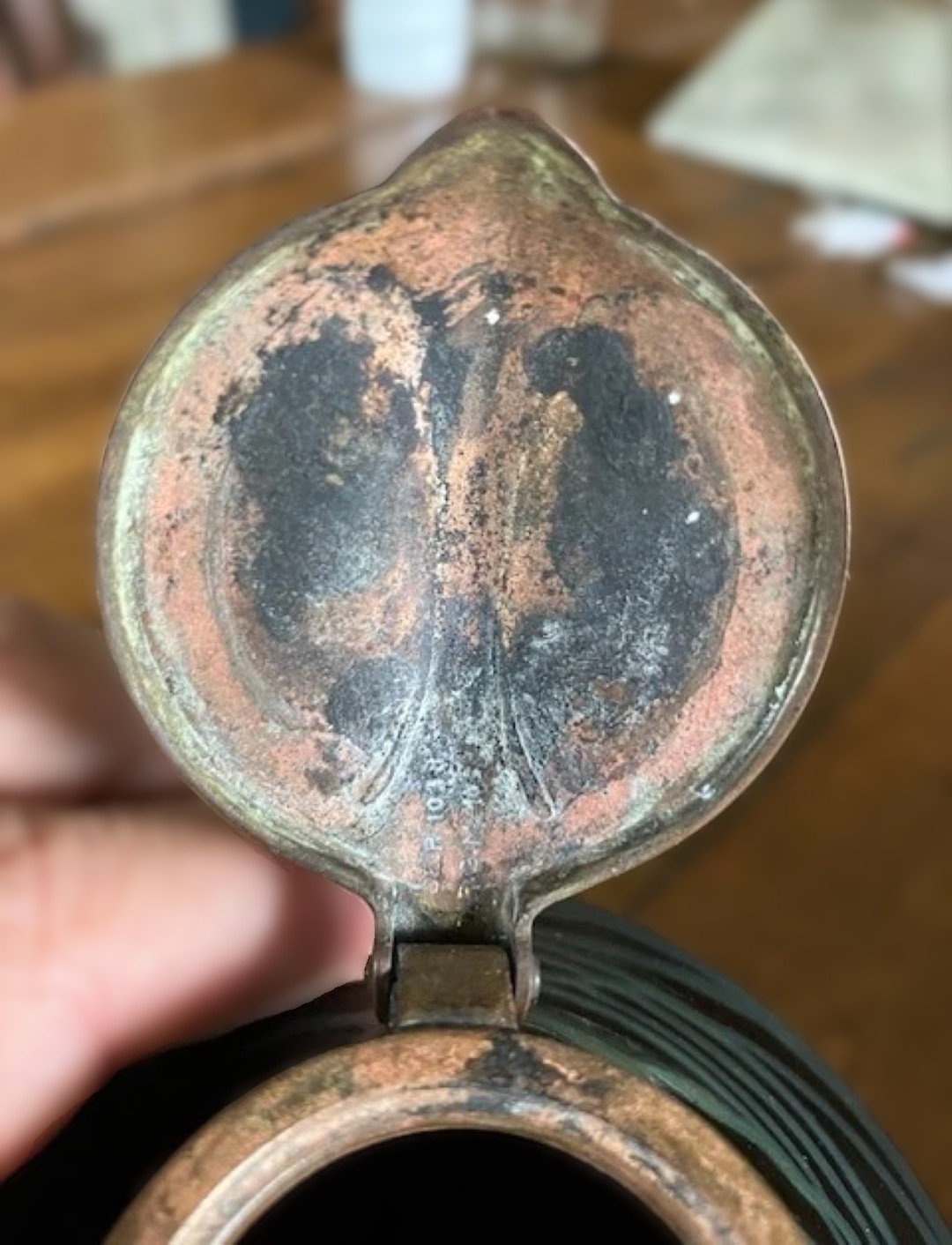
- Mount & Fitments: Fitted with an original hinged brass collar and lid cast in a stylized bud or whiplash-leaf motif, complete with its removable clear glass ink liner.
The “Veining” (Threading) Technique Kralik achieved this distinctive surface decor through a multi-step hot-glass application:
- The Core Gather: The glassmaker blew the primary gather of molten dark glass to form the inkwell’s base shape.
- Applied Threading: While the gather remained red-hot, contrasting strands of molten glass were spun, trailed, and wrapped across the exterior surface.
- Expansion & Integration: The piece was reheated and blown further into its final mold, which stretched and flattened the threads against the vessel walls, creating raised, vein-like webbing.
- Reduction Fuming: While still hot, the piece was exposed to vaporized metallic chlorides (such as stannous chloride) in a reduction kiln, depositing a thin, shimmering metallic iridescence across both the body and the veining.
Date of Manufacture This inkwell dates to circa 1902–1905, during the height of the Bohemian Art Nouveau glass movement.
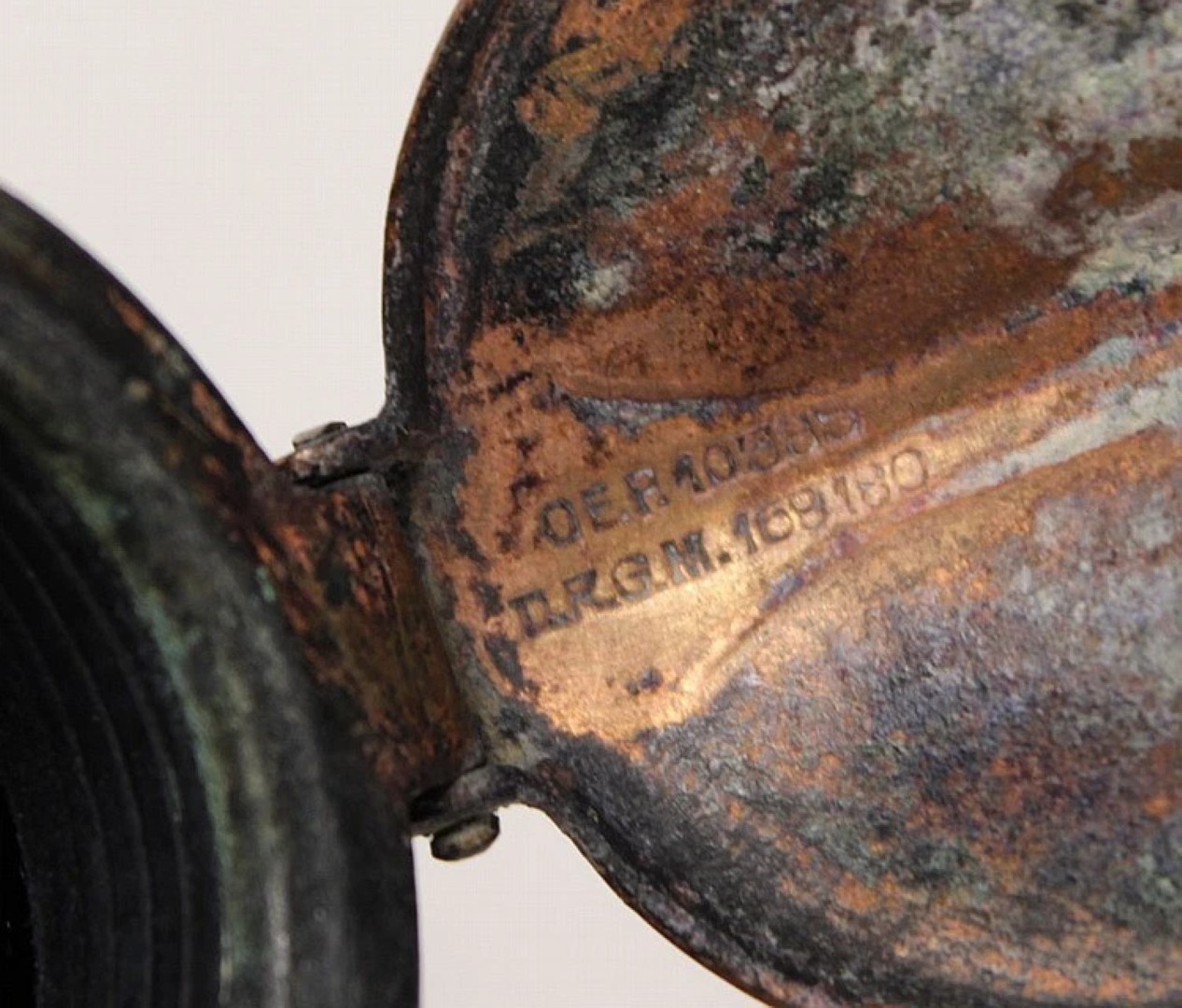
Patent & Registration Marks The underside of the hinged lid bears dual patent marks:
- D.R.G.M. 168180: Deutsches Reichsgebrauchsmuster (German Imperial Design Protection / Utility Patent). Registered around 1901–1902, this provided short-term protection for the lid’s hinge and seal mechanism in the German market.
- O.E.P. 10585: Österreichisches Patent (Austrian Patent). Because Bohemia was part of the Austro-Hungarian Empire, manufacturers regularly registered their hardware under both Austrian and German patent systems to secure cross-border trade across Central Europe.
History of Kralik
- Origins: The glassworks traces its lineage to Josef Meyr, who established the glassworks at Eleonorenhain (now Lenora, Czech Republic) in the 1830s.
- Wilhelm Kralik Sohn: Meyr’s nephew, Wilhelm Kralik, assumed leadership and expanded the business. Following Wilhelm’s death in 1877, the firm was divided among his sons, operating as Wilhelm Kralik Sohn.
- Art Nouveau Era: Around 1900, the firm shifted heavily into iridescent art glass to rival nearby competitor Johann Loetz Witwe. Kralik specialized in patterned threadings, cracked-ice effects, marbled designs, and mounted glass wares that achieved wide international distribution.
- Later Years: Following World War I and the formation of Czechoslovakia, Kralik transitioned into brightly colored Art Deco tango glass before ceasing operations during World War II.
To see other examples, link to: Kralik Art Glass Inkwell – The Society of Inkwell Collectors (SOIC)
Sold for $300 in July 2026
Content disclaimer. The information posted is the owner’s best knowledge and may not have been vetted by the SOIC. We welcome comments, corrections, and additions, working to make our website information comprehensive and accurate.
Join the Society of Inkwell Collectors (SOIC) – it’s free!
Founded in 1981 as a non-profit organization,
we are documenting inkwells (and accessories).
We’re here to help and inform!