

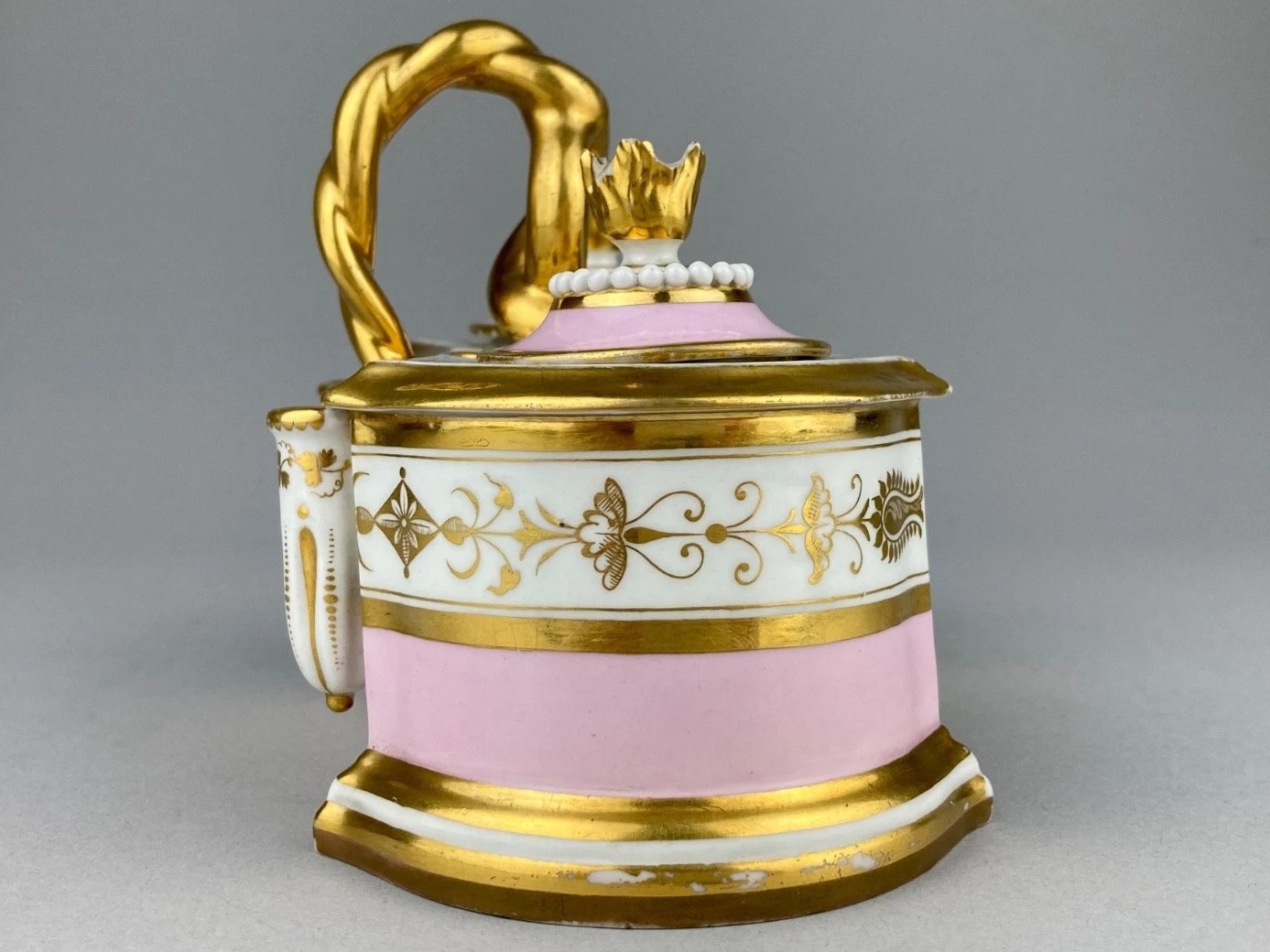
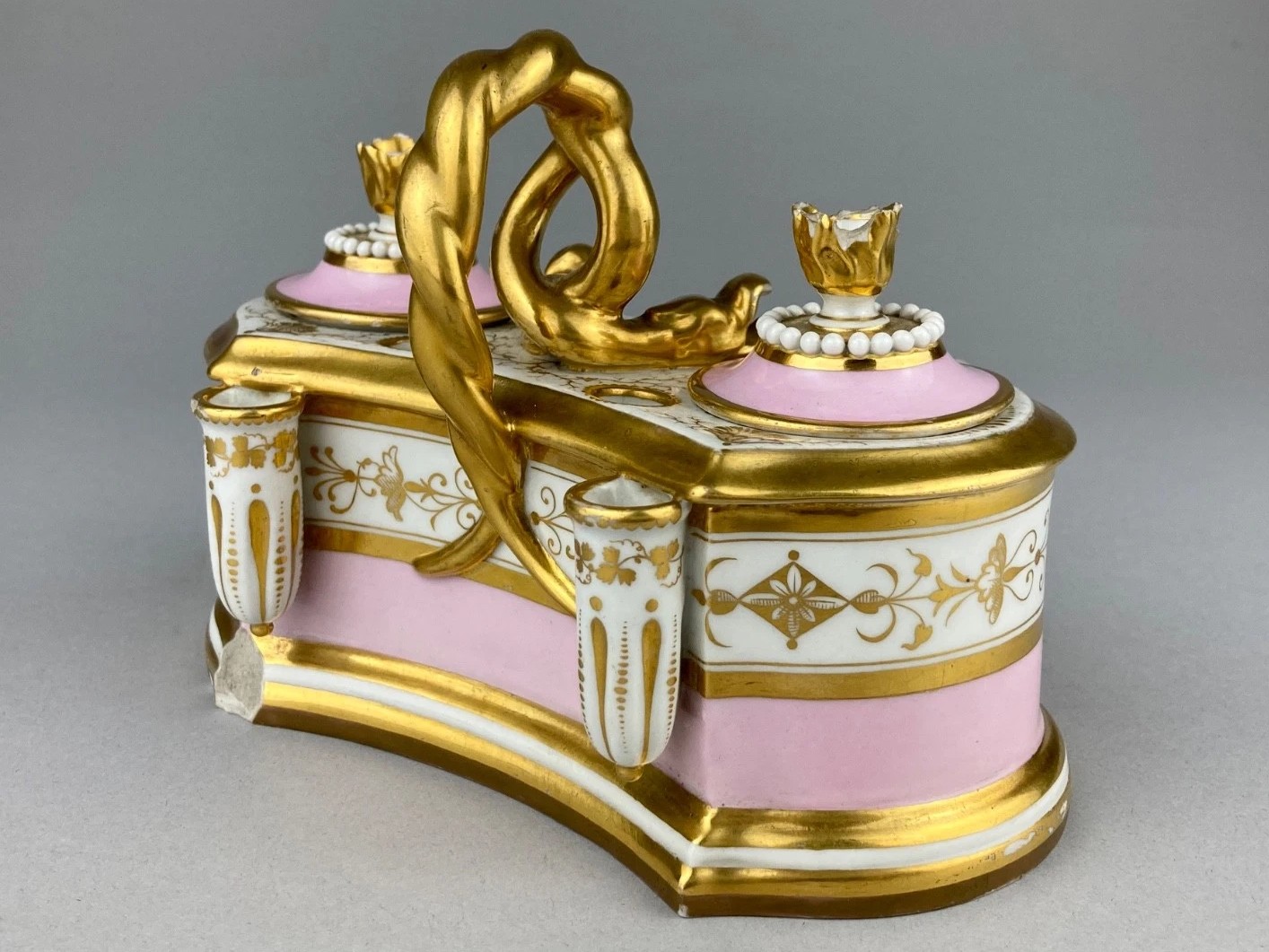
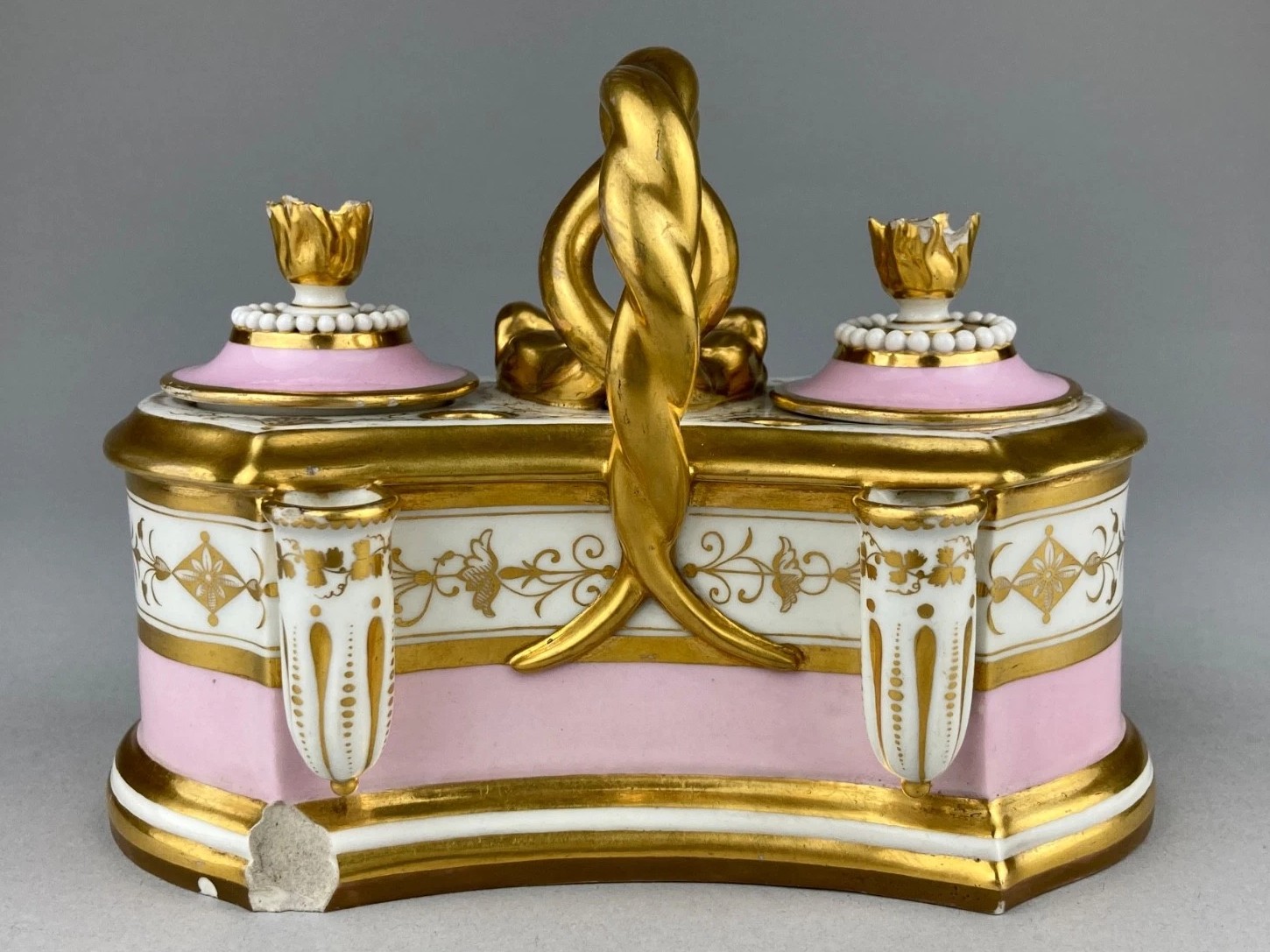
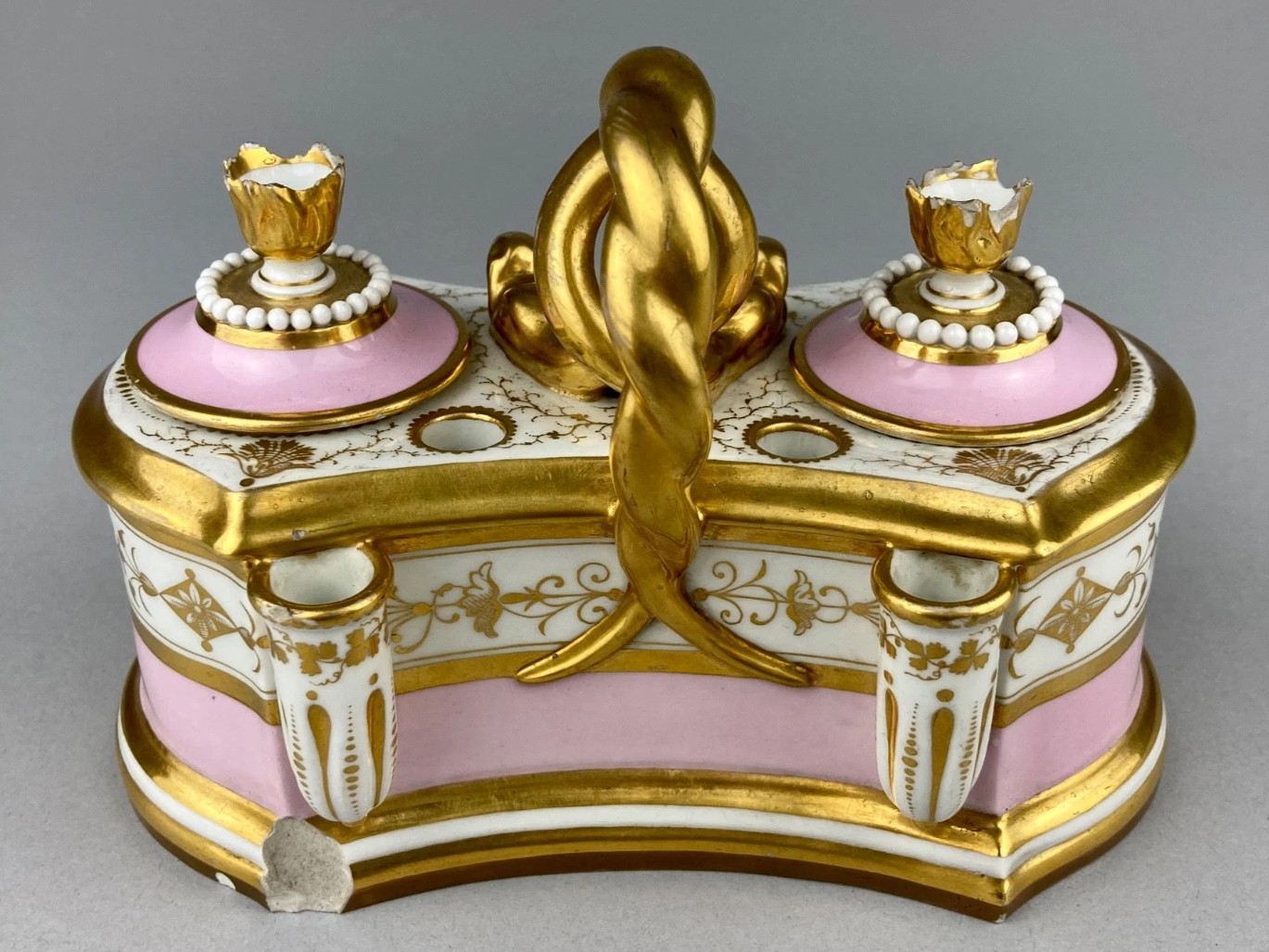
Flight, Barr & Barr (Worcester) Porcelain Kidney-Shaped Inkstand
| Categories | Ceramics/Porcelain "Named" Makers |
| Material | Porcelain |
| Markings | See Narrative |
| Manufacturer | Worcester Royal Porcelain Works |
| Origin | England |
| Date or Era | circa 1820 |
| Measuring | 6” diameter |
Circa 1813–1821
Date Refinements
- Narrowing the Date Range
- While the Worcester factory operated under various partnerships from 1783 to 1840, the specific name “Flight, Barr & Barr” (FBB) was used strictly between 1813 and 1840.
- Narrowing to 1813–1821:
- Attribution Context: Assuming the topographical panel is attributable to Thomas Baxter, the date range tightens to circa 1813–1821. Baxter worked for Flight, Barr & Barr from 1814–1816 and again from 1819 until his death in April 1821.
- Factory Style: The Regency aesthetic—specifically the rich ground color, heavy gilding, beaded trim (pearls), and entwined serpent handle—is typical of FBB production between 1813 and 1825.
- Layout & Structure
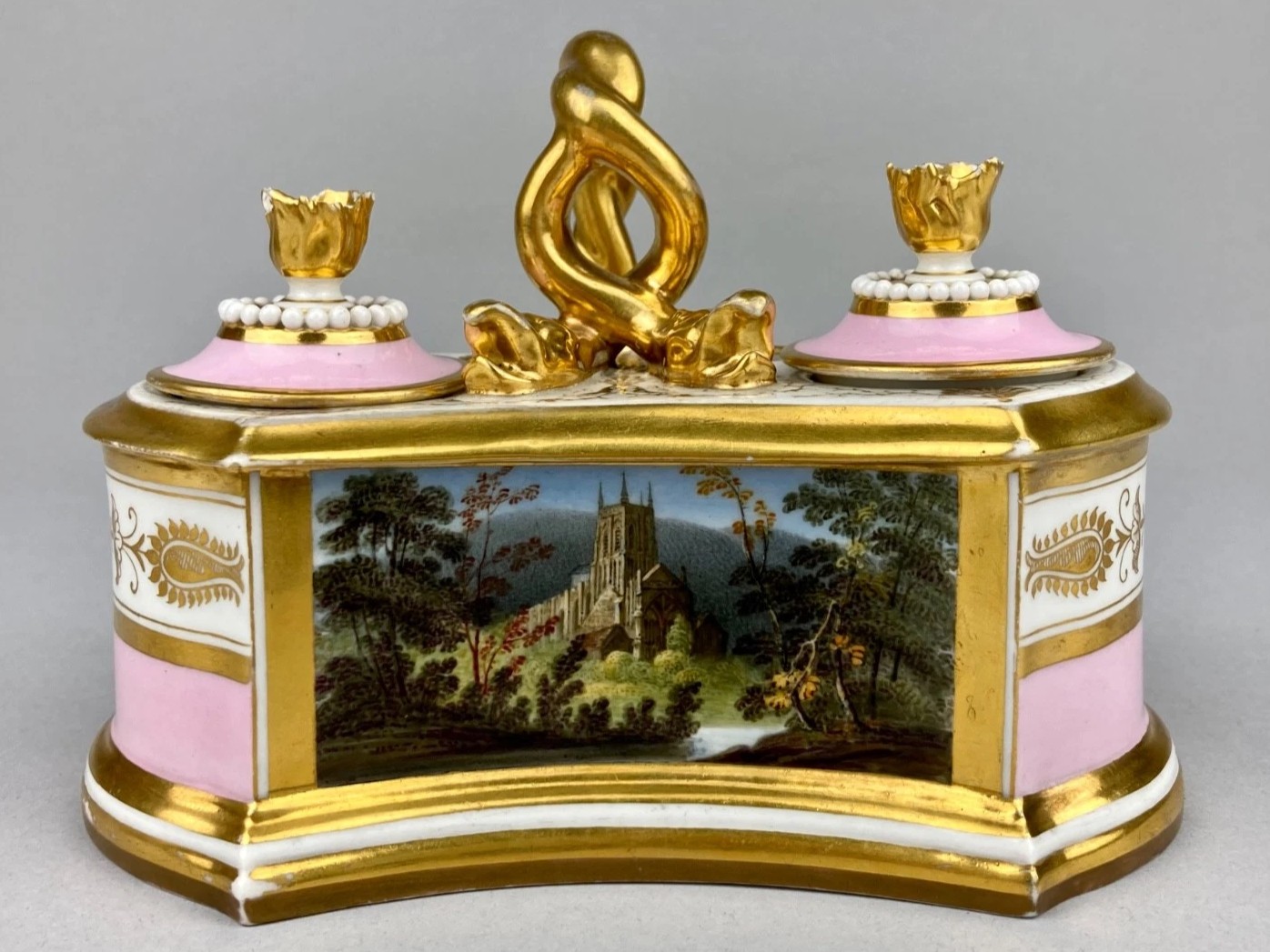
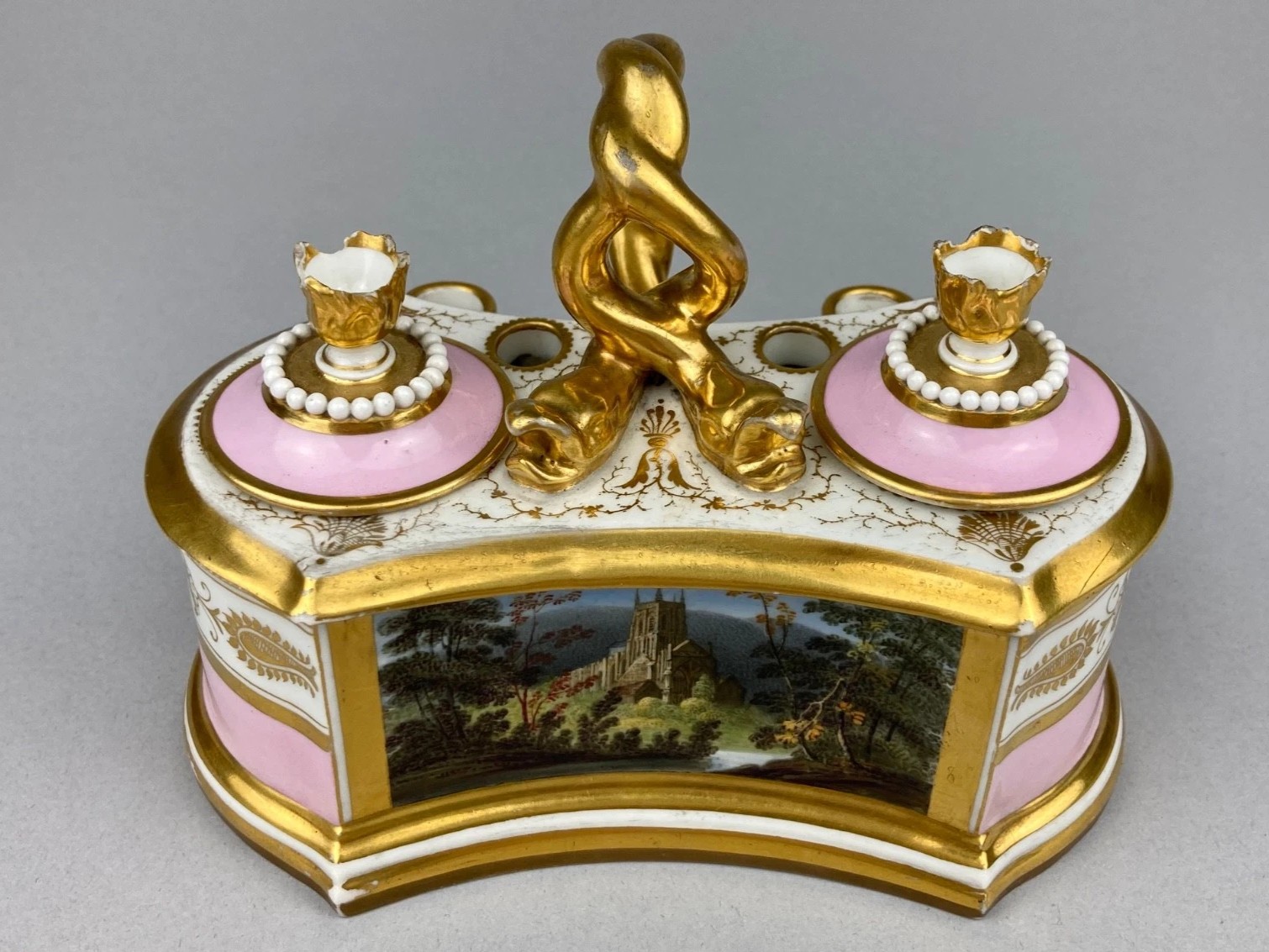
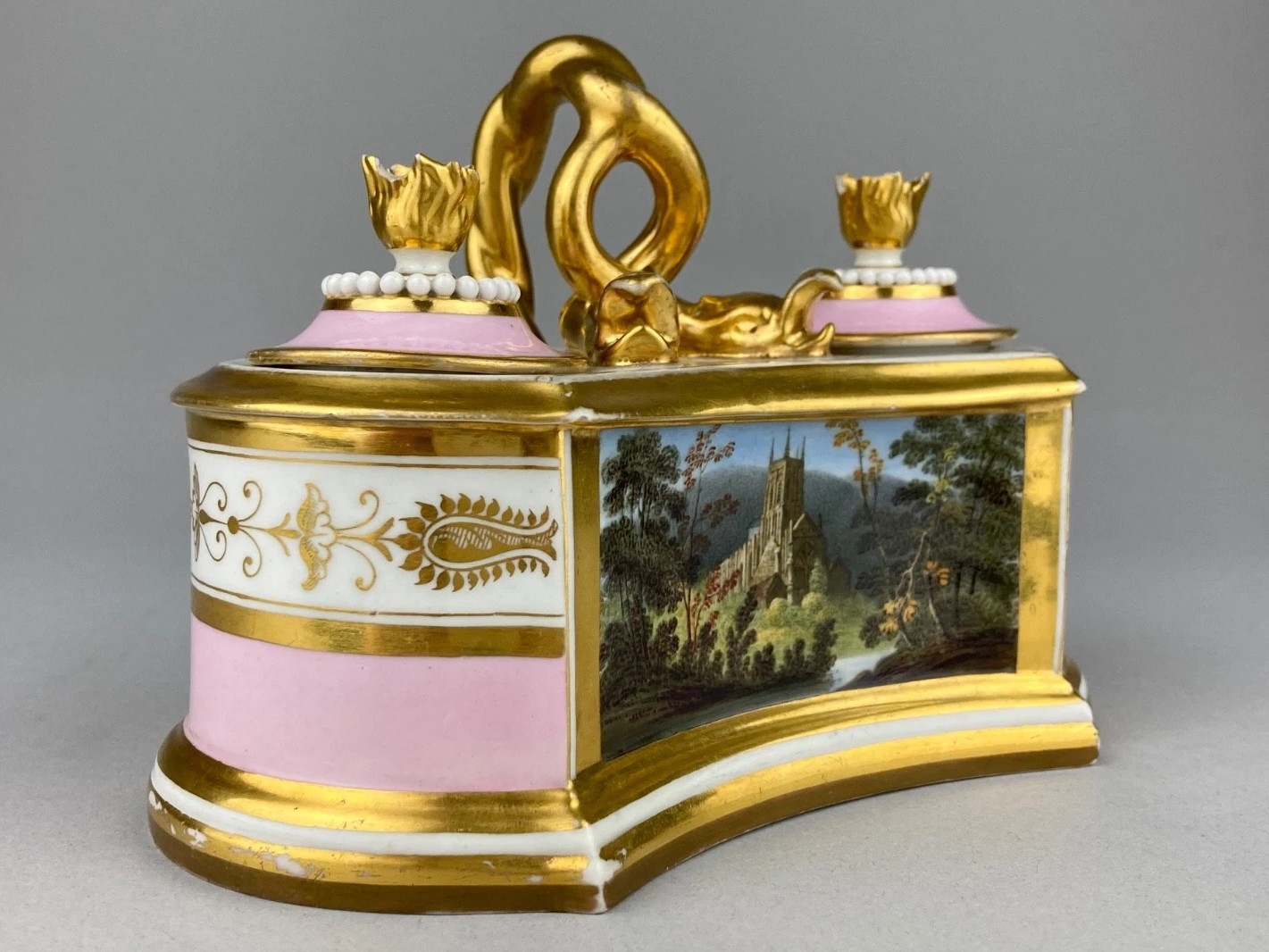
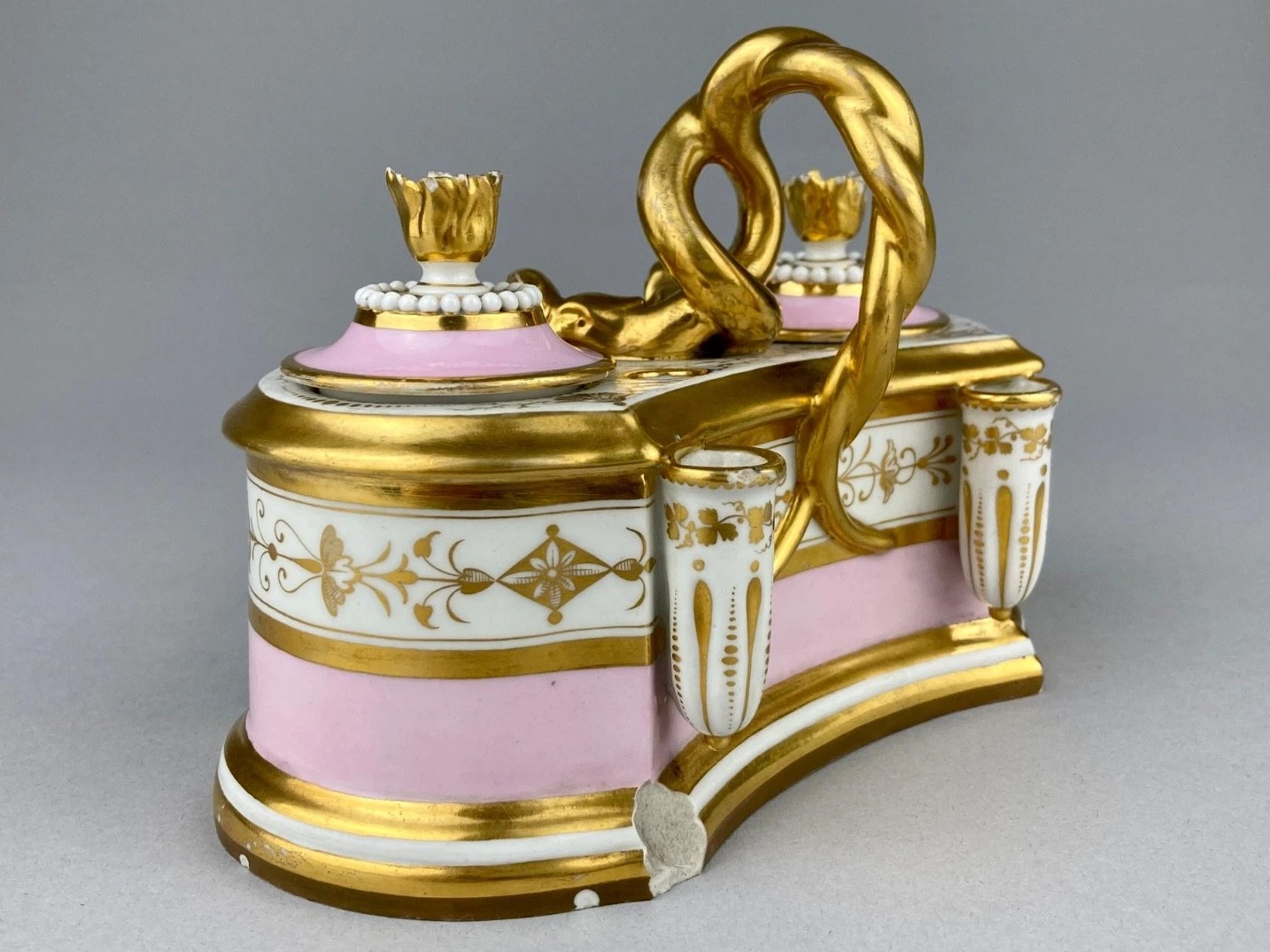
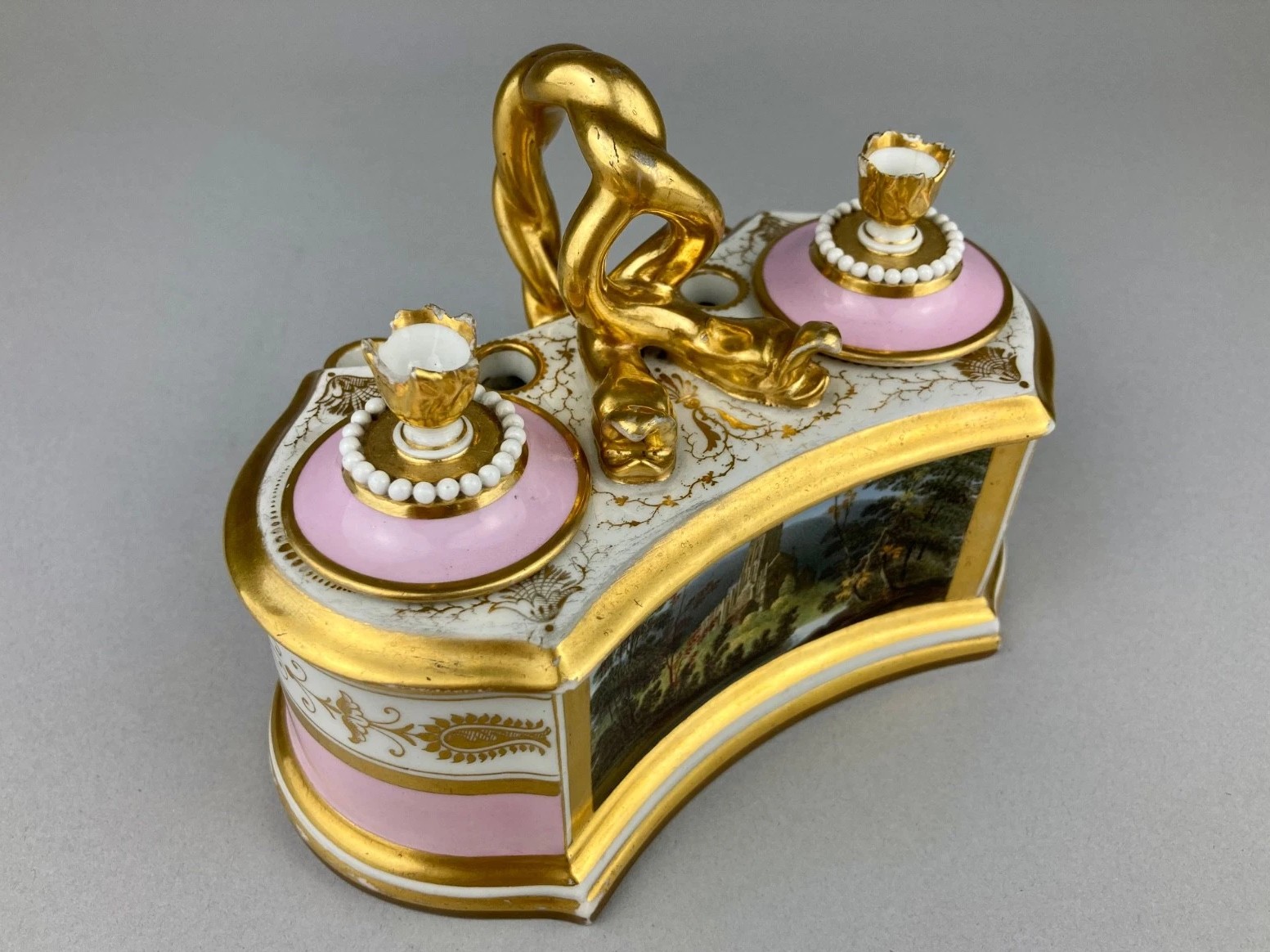
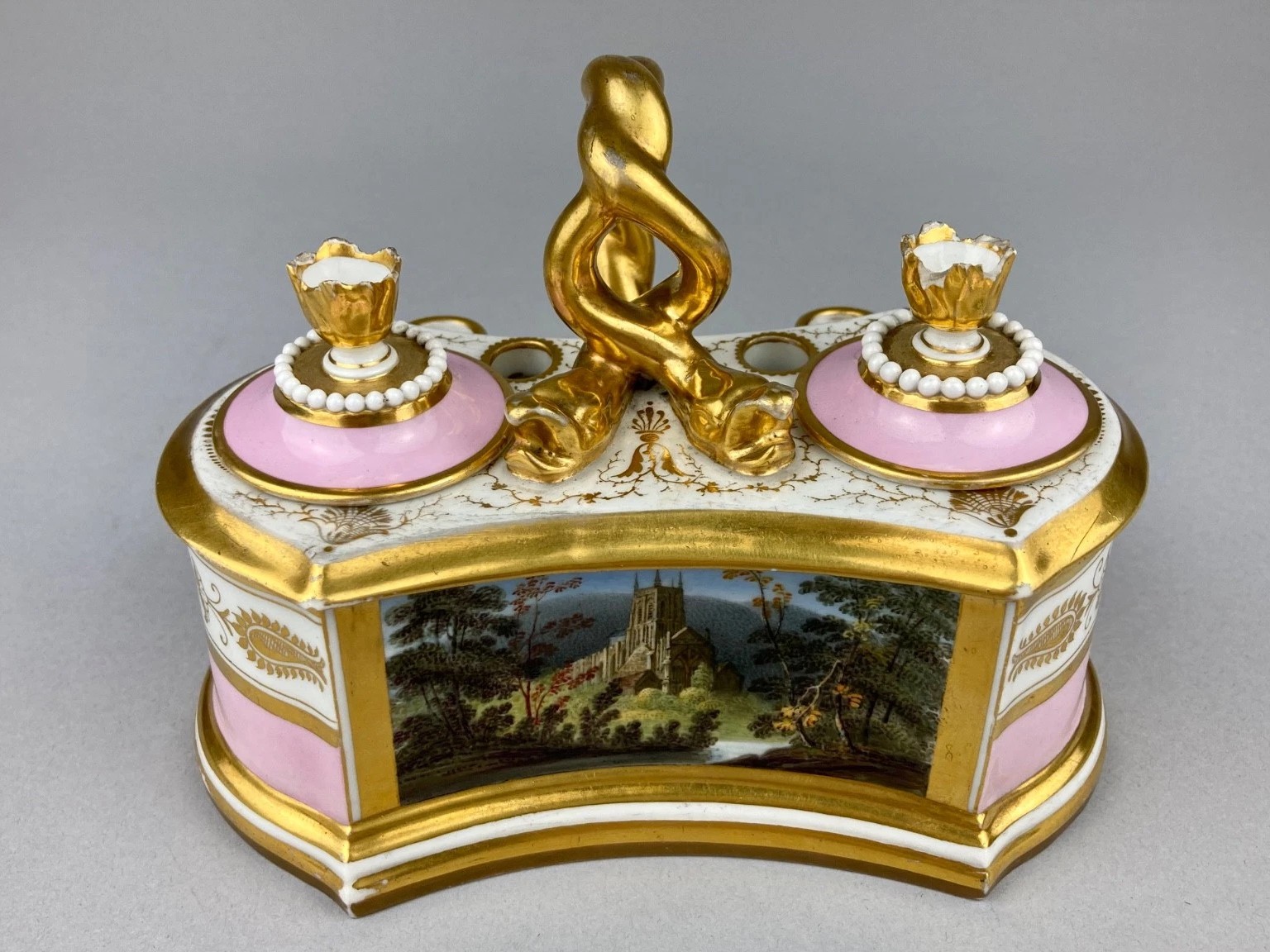
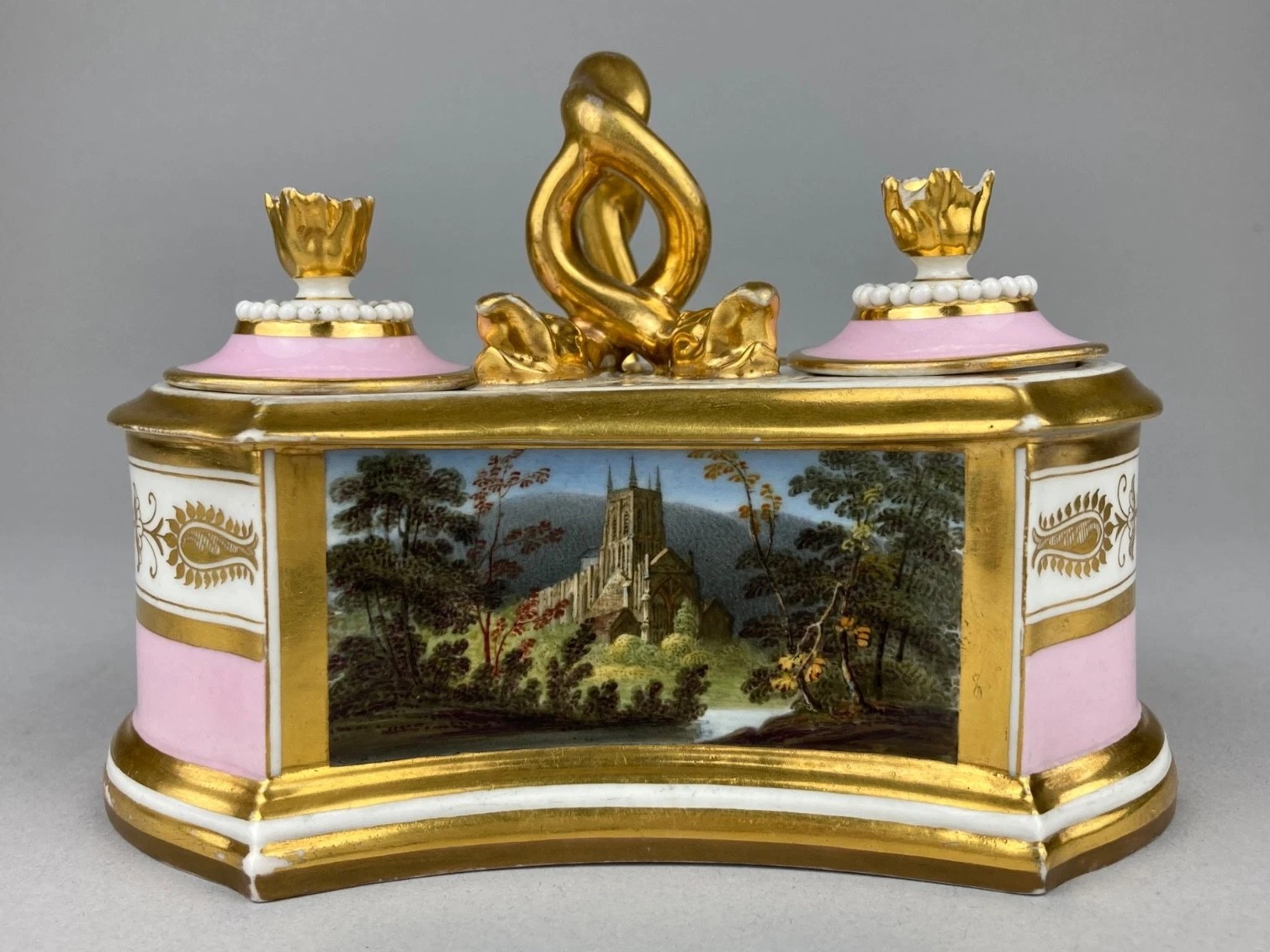
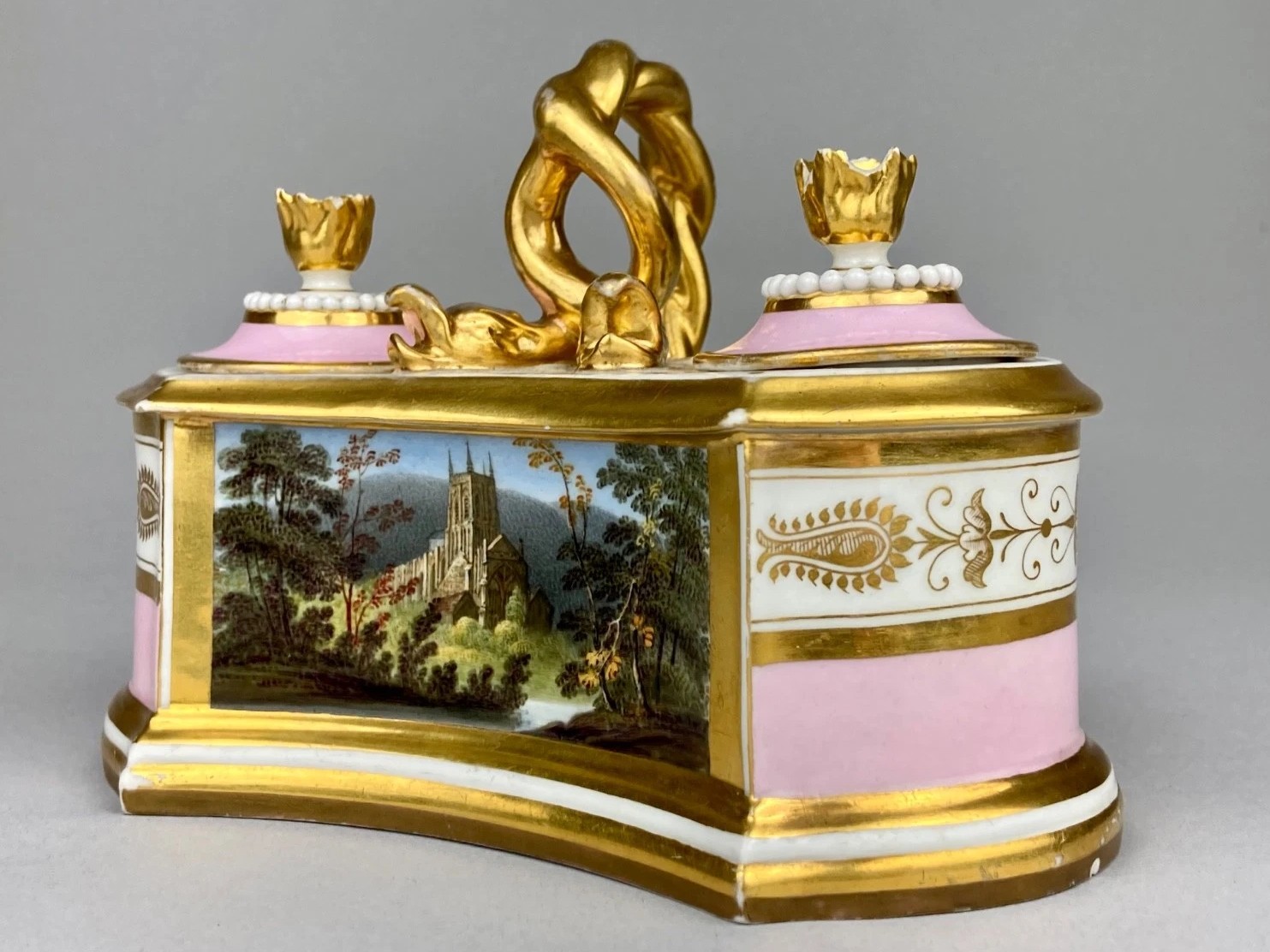
- Shape: The body is a classic kidney shape (or crescent/curved front).
- Wells & Recesses:
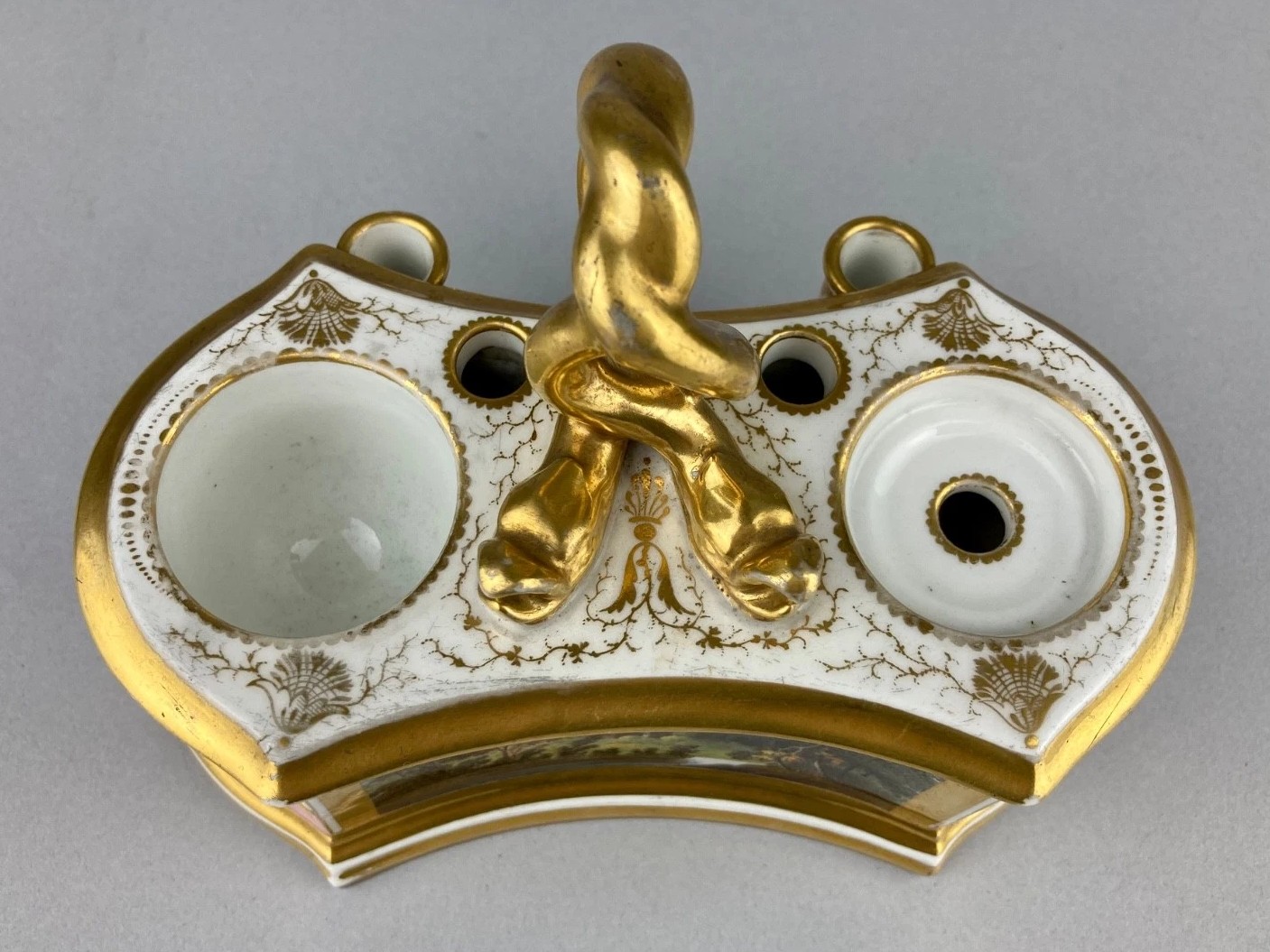
- Two Main Receptacles: Formed to hold two removable inkwells.
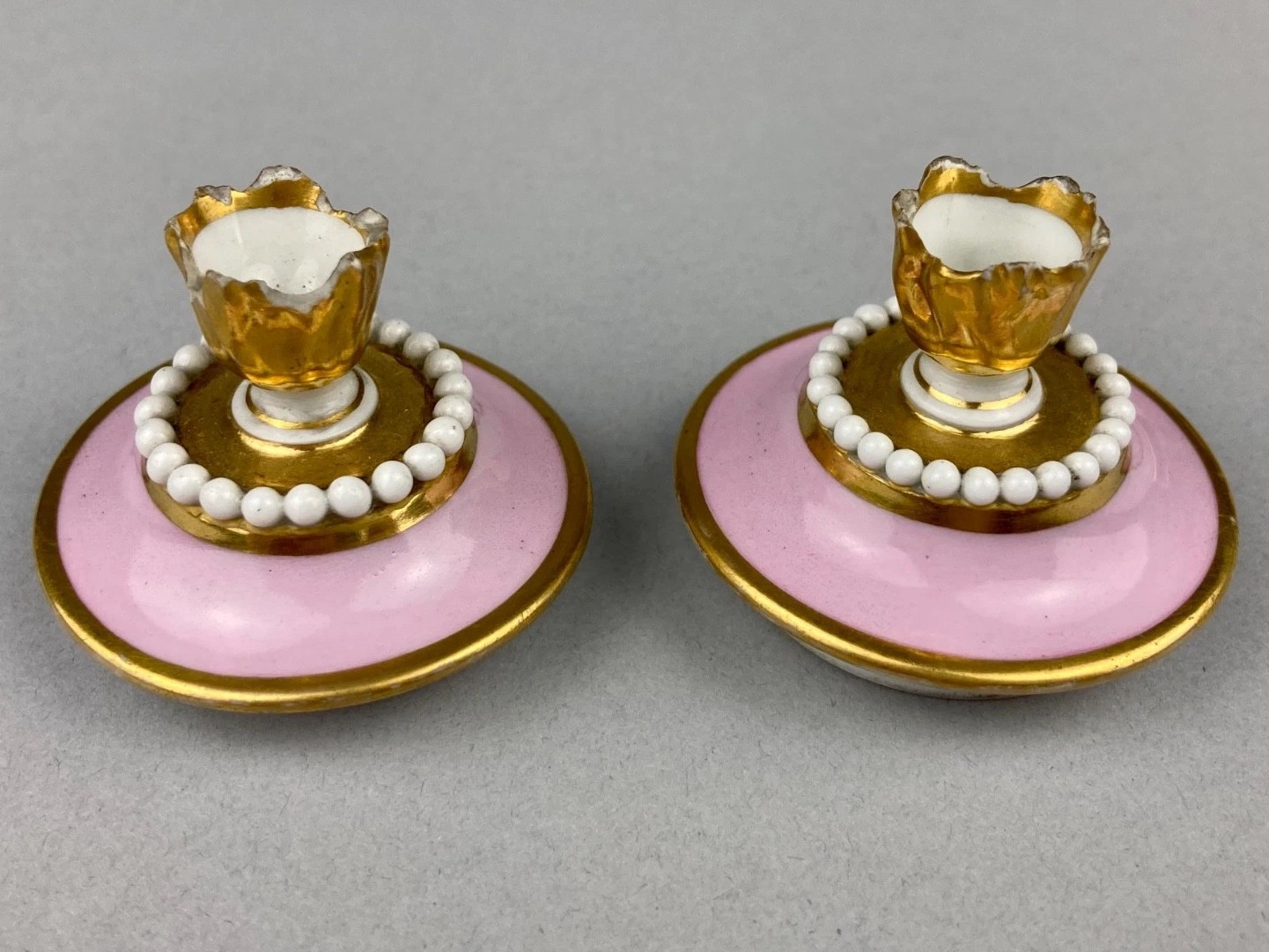
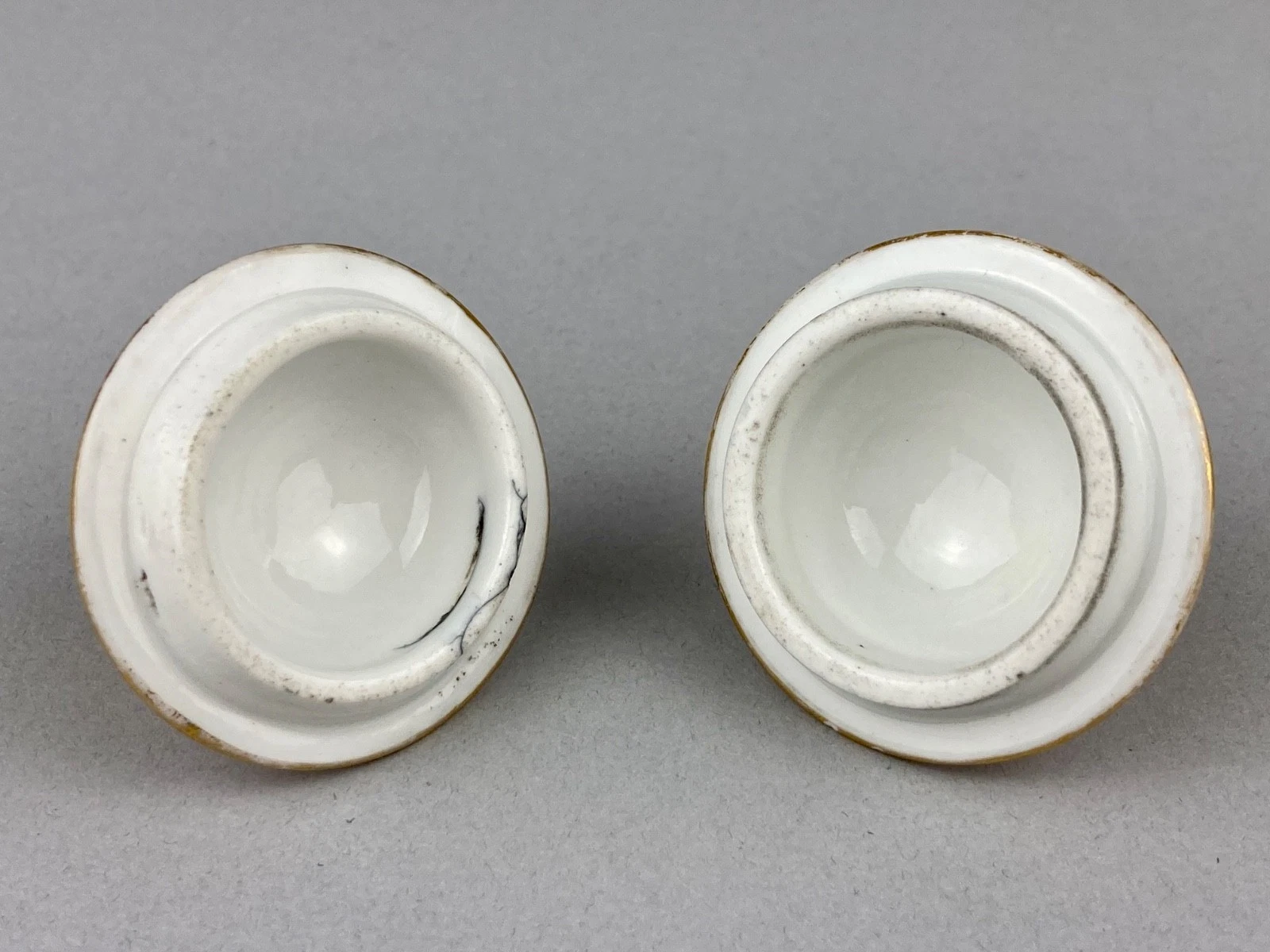
- Covers: It retains both original pink/puce-ground covers, each topped with a gilded flame finial and framed by an applied white-enameled “beaded” (pearl) border.
- Pen Holes & Holders: Behind the main covers are four circular pen-aperture holes cut directly into the deck, decorated with delicate gilt foliate sprigs.
- Integral Quill Holders: Mounted vertically to the reverse (back) elevation are two integral cylindrical taper/quill holders with flared rims, adorned with gold grape and vine leaf motifs.
- Decorative Details & Artistic Attribution
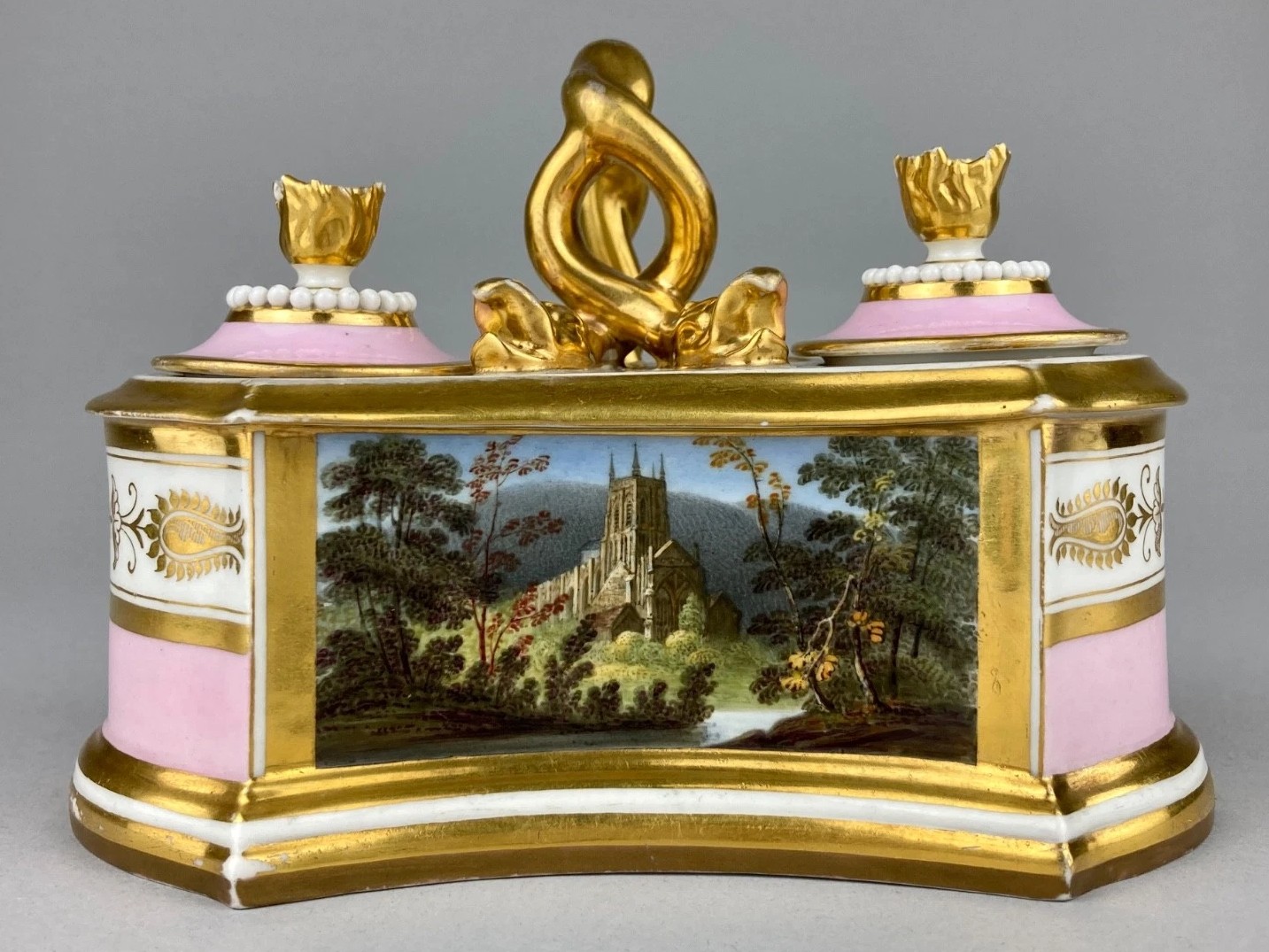
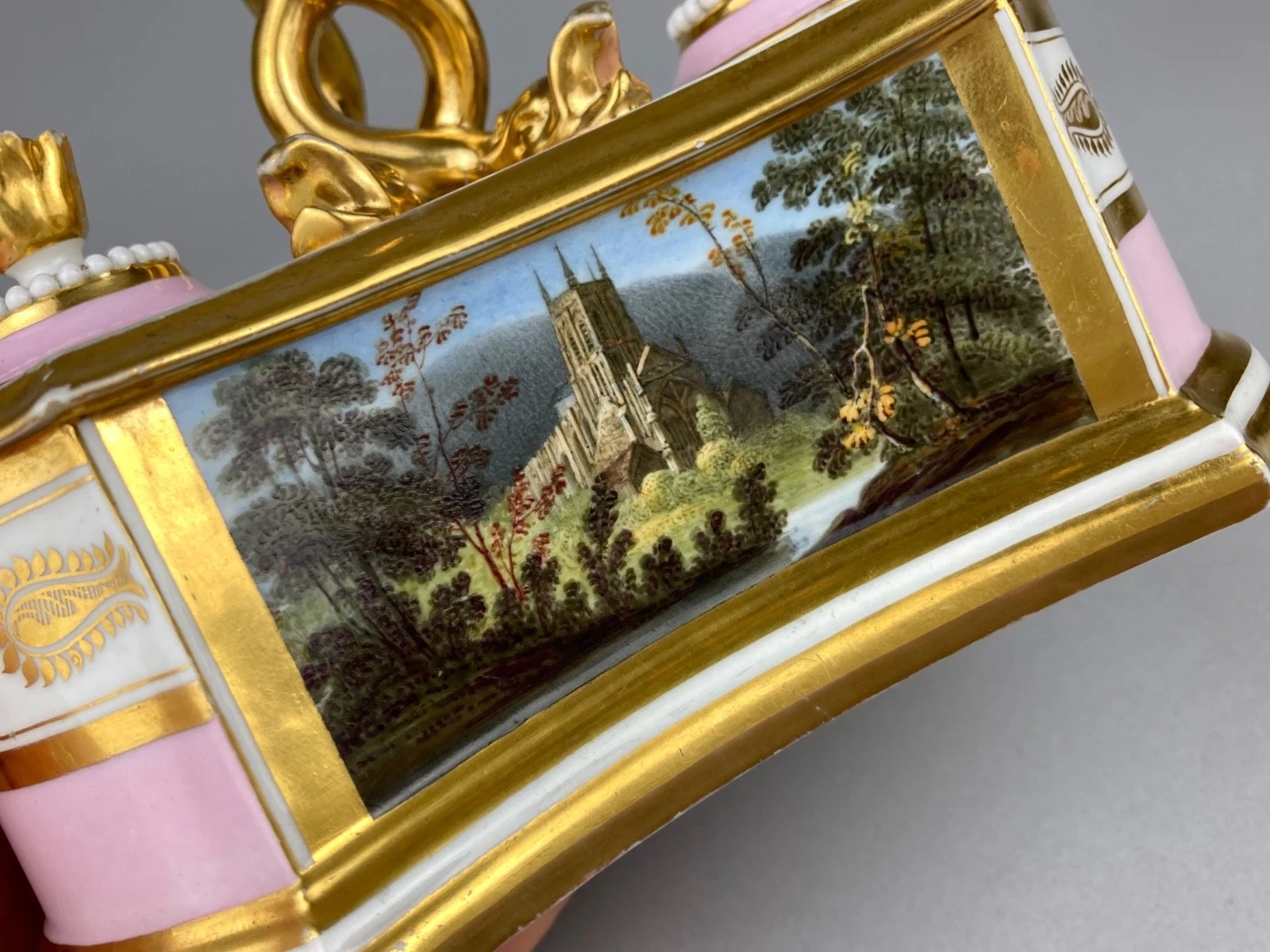
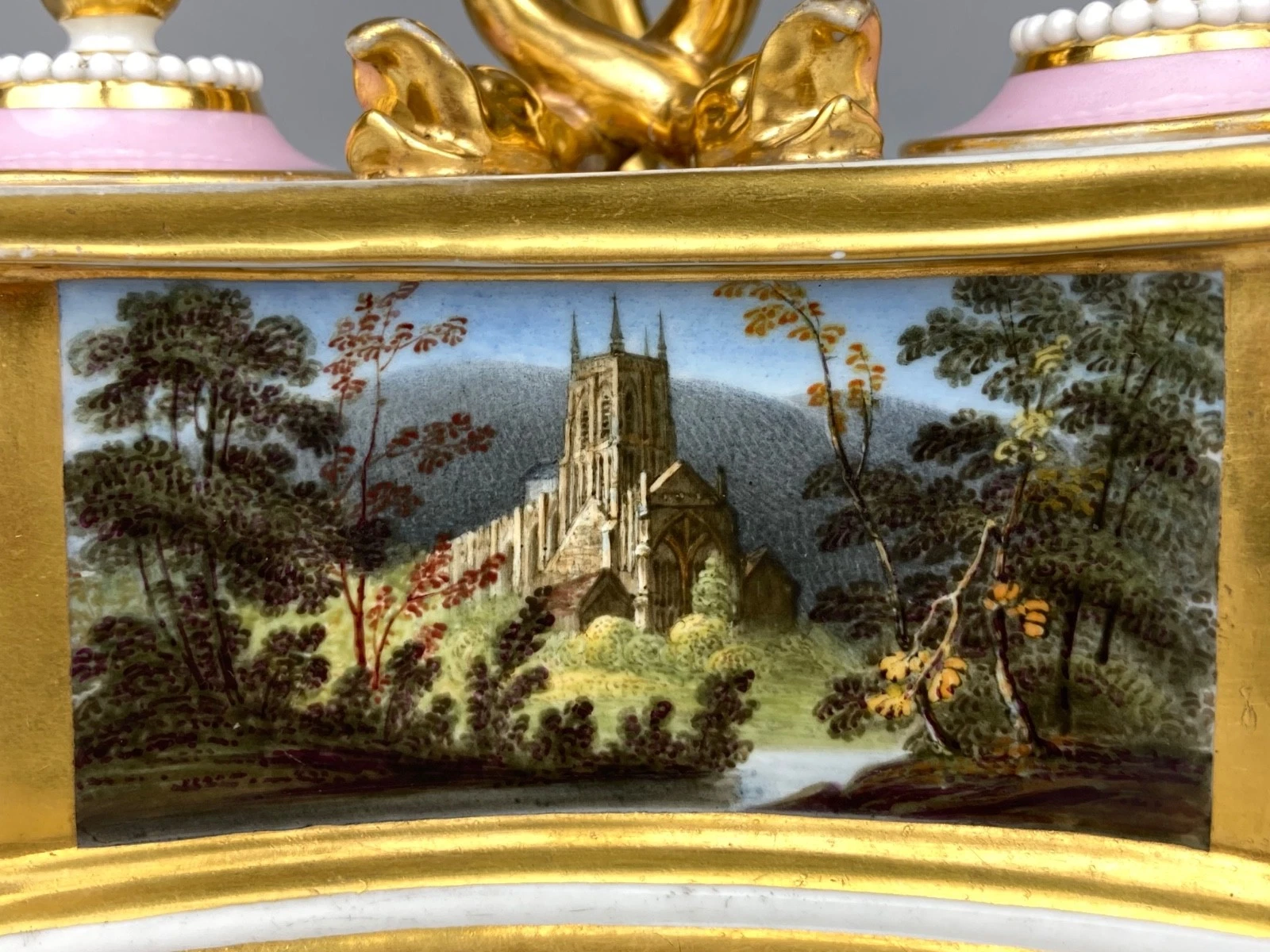
- The Central Vignette: A finely painted rectangular landscape panel framed in burnished gold depicts Malvern Church, Worcestershire (Great Malvern Priory) set against the Malvern Hills under a soft blue sky.
- Attribution to Thomas Baxter (1782–1821): The panel exhibits the crisp architectural drawings, delicate foliage rendering, and muted tonal palette characteristic of Baxter’s landscape work during his Worcester tenures.
- Gilding & Palette: Flanked by rich puce/pink ground panels, the porcelain is highlighted with neoclassical gold palmettes, paisley/anthemion motifs, and trailing gilt vines. The central handle is sculpted as a bold, gilded pair of entwined serpents, adding a classical Regency motif.
Underside Inscription (Mark Analysis)
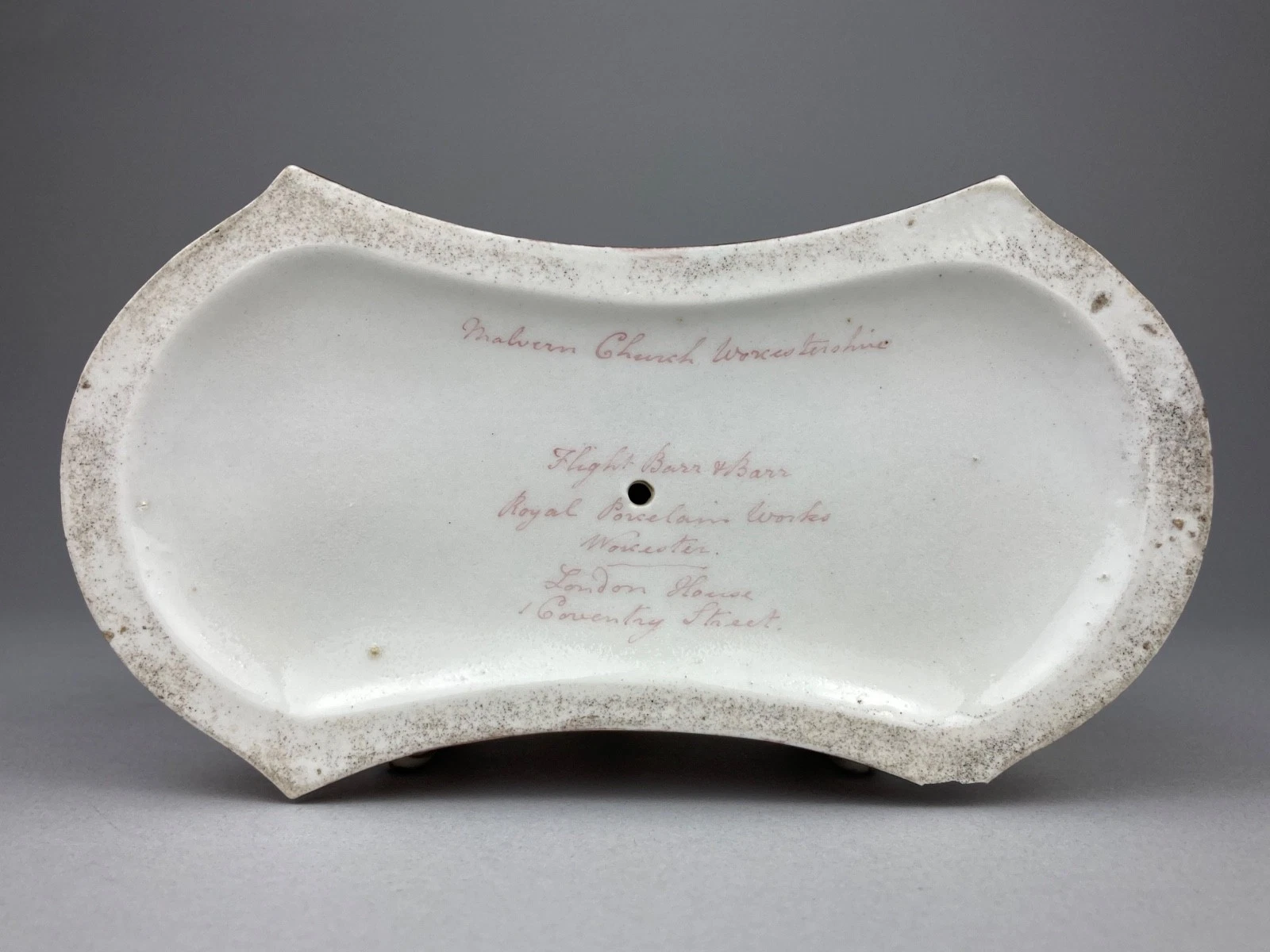
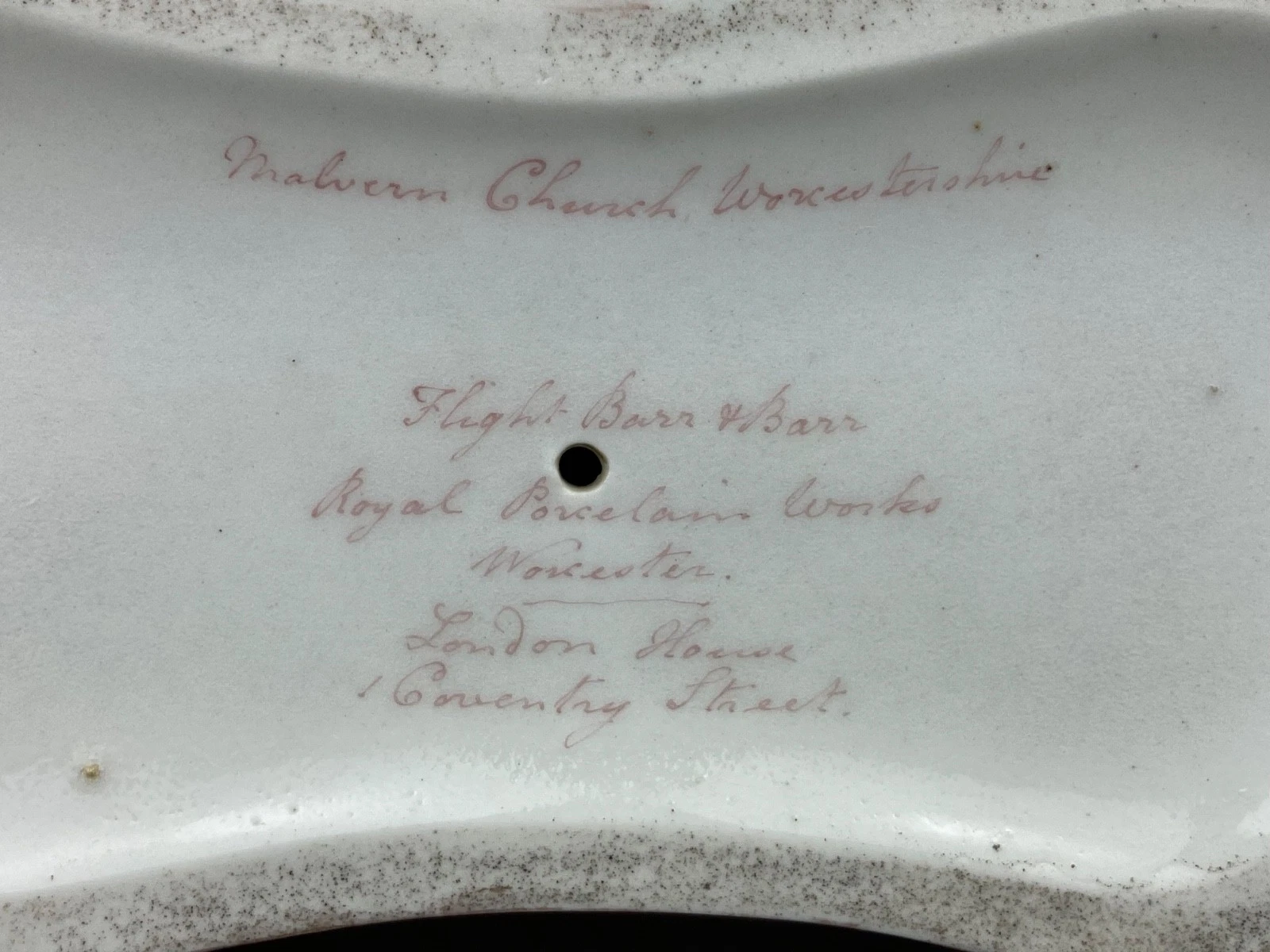
The underside features a fully hand-written inscription in fine puce script around a central drain/firing hole:
Malvern Church Worcestershire
Flight Barr & Barr
Royal Porcelain Works
Worcester
London House
1 Coventry Street
Note on London House: The Coventry Street address was FBB’s flagship showroom in London, catering directly to aristocracy and wealthy patrons of the Regency era.
This piece was produced through a collaboration between the factory’s owners, top painters, and skilled workshop gilders:
- The Manufacturer & Factory Partnership
- Factory: Worcester Royal Porcelain Works.
- Partnership: Flight, Barr & Barr (FBB).
- The Proprietors: During this era (1813–1840), the factory was owned and operated by Joseph Flight alongside brothers Martin Barr Jr. and George Barr. Under their direction, the firm specialized in producing luxury porcelain for British aristocracy and royal patrons.
- The Vignette Artist (Attribution)
- Landscape Painter: Attributable to Thomas Baxter (1782–1821), widely regarded as the master porcelain artist of the Regency period.
- Background: Baxter received classical training at the Royal Academy in London before moving to Worcester to paint for Flight & Barr. He worked at the factory during two distinct windows—1814–1816 and 1819–1821—which closely pinpoints when this landscape panel was painted.
- The Workshop Artisans & Gilders
- Gilders & Decorators: The elaborate burnished gold trailing, neoclassical anthemion/paisley motifs, and applied white enamel “jeweled” beads were executed by the factory’s elite gilders and enamellers.
- Quality Standard: Uniquely for the era, Flight, Barr & Barr paid their decorators by time rather than by piecework. This allowed artisans to spend hours perfecting intricate details like the twin-serpent handle, gold grapevines, and pearl-beaded borders without rushing.
Sold for $925 in July 2026
Content disclaimer. The information posted is the owner’s best knowledge and may not have been vetted by the SOIC. We welcome comments, corrections, and additions, working to make our website information comprehensive and accurate.
Join the Society of Inkwell Collectors (SOIC) – it’s free!
Founded in 1981 as a non-profit organization,
we are documenting inkwells (and accessories).
We’re here to help and inform!