


The Adlai E. Stevenson Senate Presentation Standish (1897)
| Categories | Presentation Piece |
| Type | Political |
| Material | Silver |
| Markings | See Narrative |
| Manufacturer | Jacob Karr |
| Origin | United States |
| Date or Era | circa 1897 |
| Measuring | 13 ⅞” across; 8 ½” high |
This magnificent sterling silver presentation inkstand is a premier decorative piece in the U.S. Senate Collection (Accession Number: 57.00010.001). Adlai Stevenson I served as the 23rd Vice President of the United States under President Grover Cleveland from March 4, 1893, to March 4, 1897.
Description
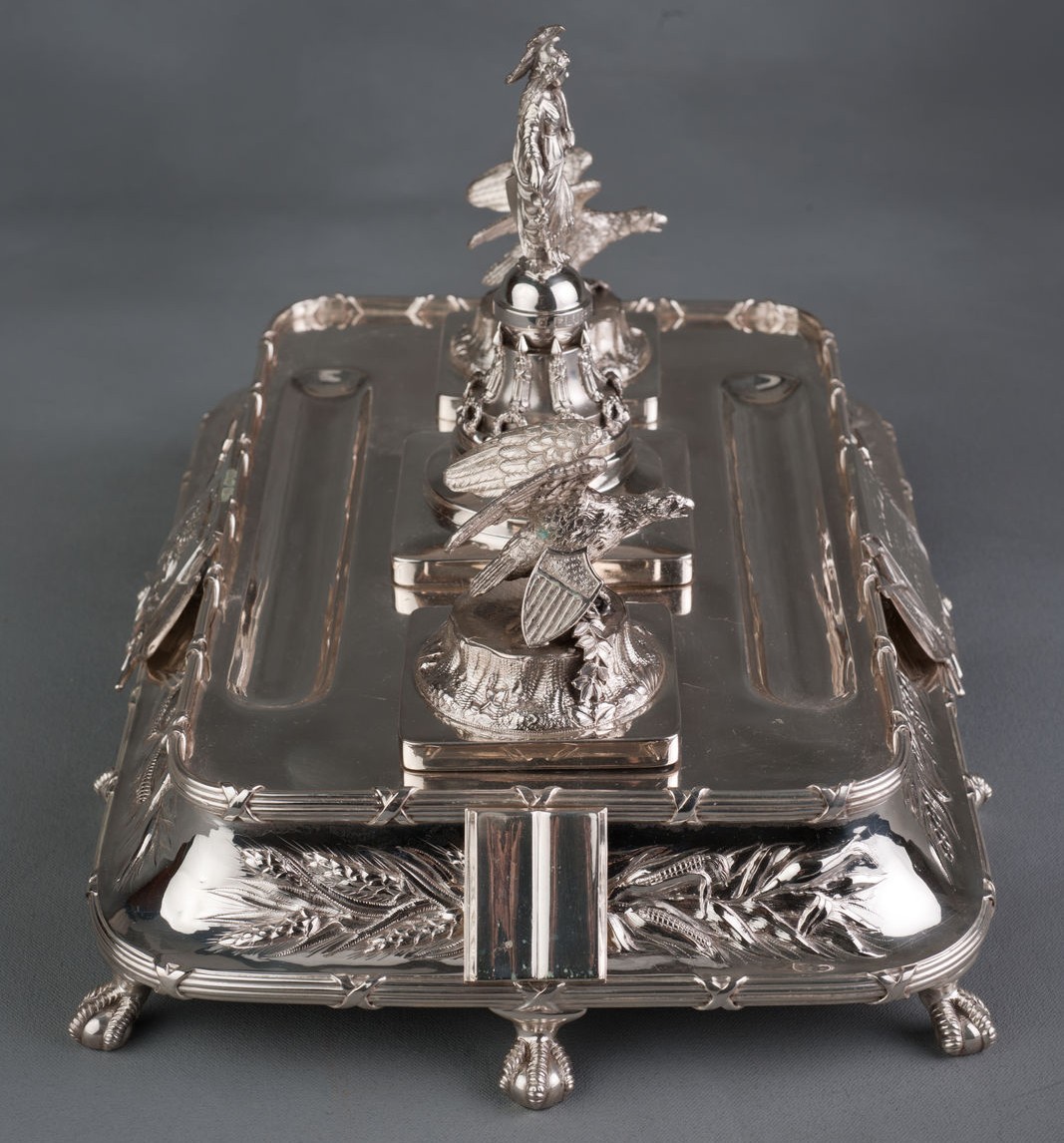
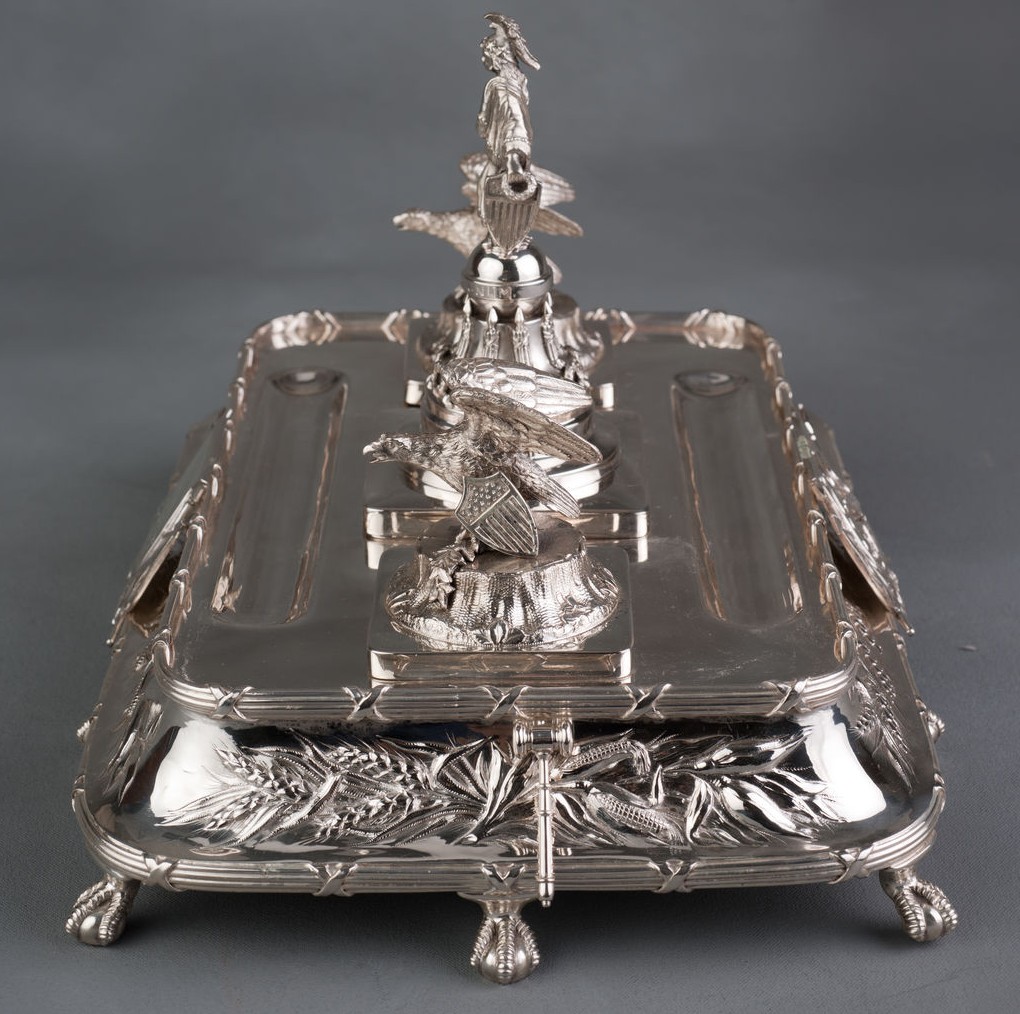
The inkstand is an elaborate, late-Victorian presentation piece measuring roughly 13.88 inches wide by 8.5 inches high. It is elevated on eight heavily cast claw-and-ball feet that support a substantial, double-tiered base with rounded corners.
- The Base and Edges: The entire perimeter features a stylized, bound reed or “fasces-style” border trim. The sloping sides of the base are decorated with high-relief repoussé work depicting stalks of wheat and corn tied with ribbons, symbolizing American agricultural abundance and prosperity.
- The Platform Layout: The top tier functions as a flat platform flanked by long, recessed, oval pen trays on the front and rear. It houses three central components:
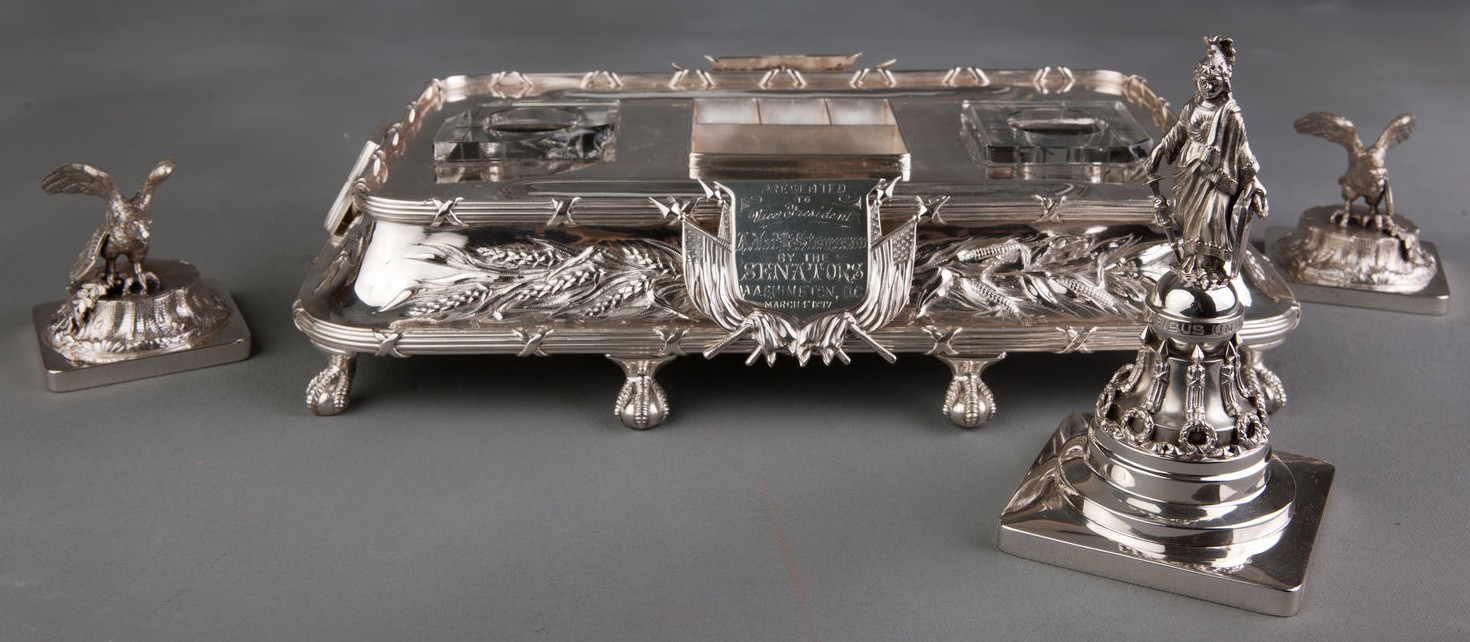
- Two Inkwells (Flanking): Positioned on square stepped bases, two silver covers are modeled as tree stumps or rocky crags. Perched on top of each cover is a finely cast, spread-winged American Eagle. When lifted, these hinged covers reveal the original heavy cut-glass inkwells nestled inside.
- Central Box: Between the inkwells sits a square, stepped compartment. Its removable lid serves as a pedestal for a grand architectural and figurative monument.
Iconography: What the Figures and Markings Represent
The inkstand is saturated with patriotic, nationalistic, and state-level political iconography:
- The Central Monumental Figure
Surmounting the central box is a miniature globe inscribed with the words “E PLURIBUS UNUM”. Standing atop the globe is a classical female allegorical figure. She wears a feathered helmet and is holding a sword in one hand and a shield emblazoned with stars and stripes in the other. This is the Statue of Freedom (also known as Armed Freedom), mimicking the colossal bronze statue designed by Thomas Crawford that tops the dome of the U.S. Capitol building. The circular architectural drum supporting her is adorned with cast floral wreaths.
- The Flanking Eagles
The two cast eagles on the inkwell lids hold small, draped American shields against their chests. Beyond being standard symbols of American sovereignty, they stand as guardians over the ink—the literal tool used by the Vice President to sign Senate legislation.
- The Front Presentation Shield
The front of the standish features a highly ornate cartouche flanked by two draped American flags on crossed staff poles. It is engraved with the formal dedication:
PRESENTED / TO / Vice President / Adlai E. Stevenson / BY THE / SENATORS / WASHINGTON, D.C. / MARCH 4th 1897
- The Rear Shield (State of Illinois Seal)
The cartouche on the reverse side features a beautifully engraved rendition of the Great Seal of the State of Illinois, featuring an eagle perched on a rock holding a banner with the state motto: “State Sovereignty, National Union.” This directly honors Vice President Stevenson’s home state and his political roots.
- Maker Markings
Stamping on the underside reads “J. Karr / Sterling”. This indicates it was retailed or commissioned through Jacob Karr, a prominent late-19th-century jeweler, watchmaker, and silversmith who operated a well-known establishment on Pennsylvania Avenue in Washington, D.C., frequently catering to government officials.
Historical Context & Senate Records
According to historical records from the U.S. Senate Historical Office, this inkstand was presented to Adlai E. Stevenson I on March 4, 1897—his final day in office as the 23rd Vice President under Grover Cleveland.
Because the Vice President acts as the President of the Senate, they spend years working directly with the chamber’s members. At the time, it was a traditional, bipartisan gesture for the body of Senators to take up a collection and present the departing Vice President with a high-end, custom token of esteem on Inauguration Day. In an oral history interview, former Senate Curator James Ketchum highlighted this exact inkstand as a standout example of the magnificent ceremonial pieces gifted by the Senate to its retiring leaders.
Was it Customary to Donate the Inkwell?
No, it was not customary. When a Vice President was gifted a presentation piece like this by the Senators, it became their personal property to take home. This standish went home with Stevenson to Illinois and remained cherished by the Stevenson family for generations.
The inkstand only found its way into the permanent U.S. Senate Collection much later as an institutional acquisition/donation. In the mid-20th century, as the Senate began formally archiving its historical material culture, pieces belonging to former Vice Presidents were actively sought out. The donation of this particular piece by Stevenson’s descendants actually helped set a precedent, “lighting a fire” under other political families to donate historic artifacts back to the Capitol so they could be preserved and displayed in the restored historic rooms of the Senate.
Content disclaimer. The information posted is the owner’s best knowledge and may not have been vetted by the SOIC. We welcome comments, corrections, and additions, working to make our website information comprehensive and accurate.
Join the Society of Inkwell Collectors (SOIC) – it’s free!
Founded in 1981 as a non-profit organization,
we are documenting inkwells (and accessories).
We’re here to help and inform!