

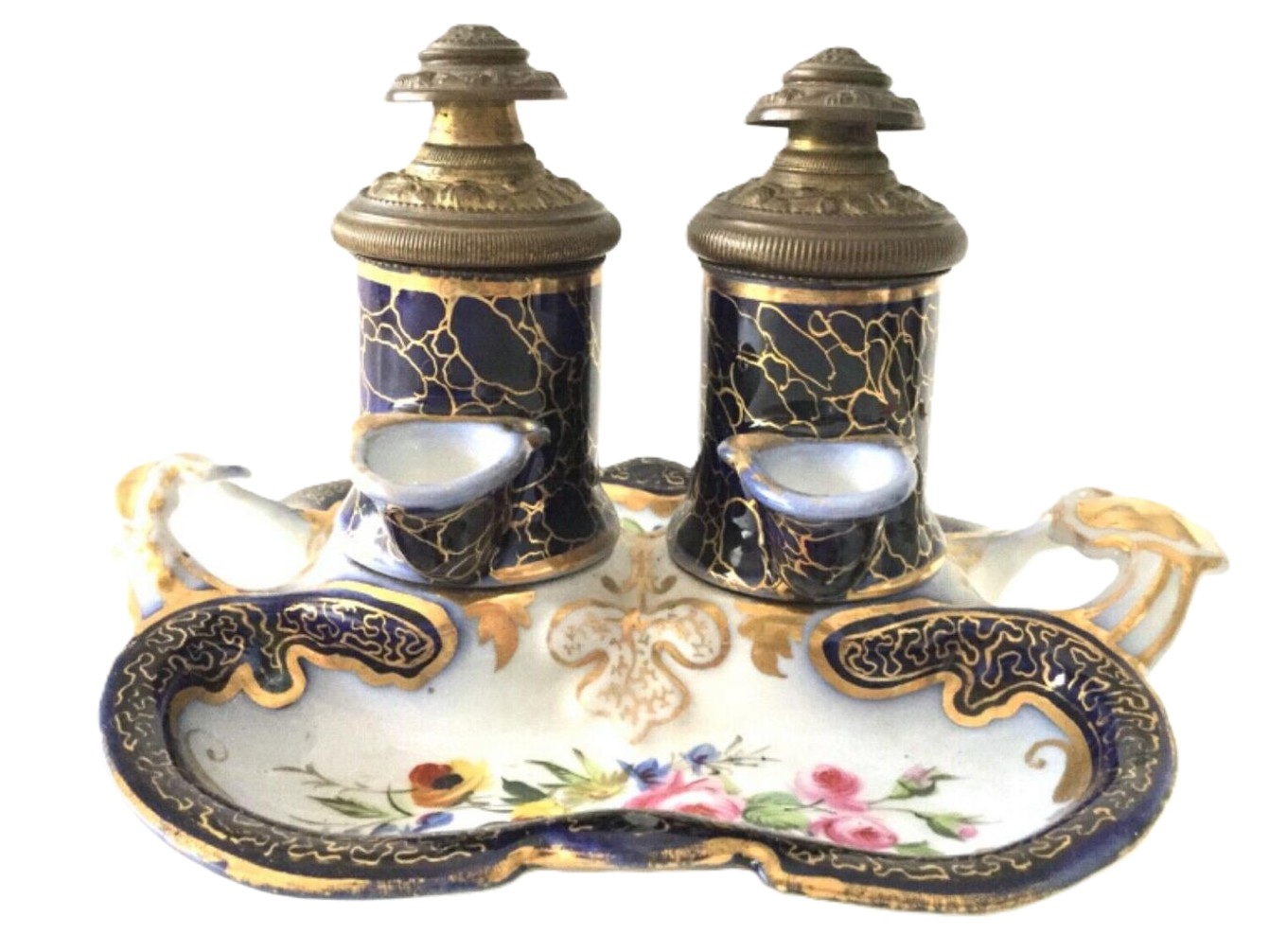
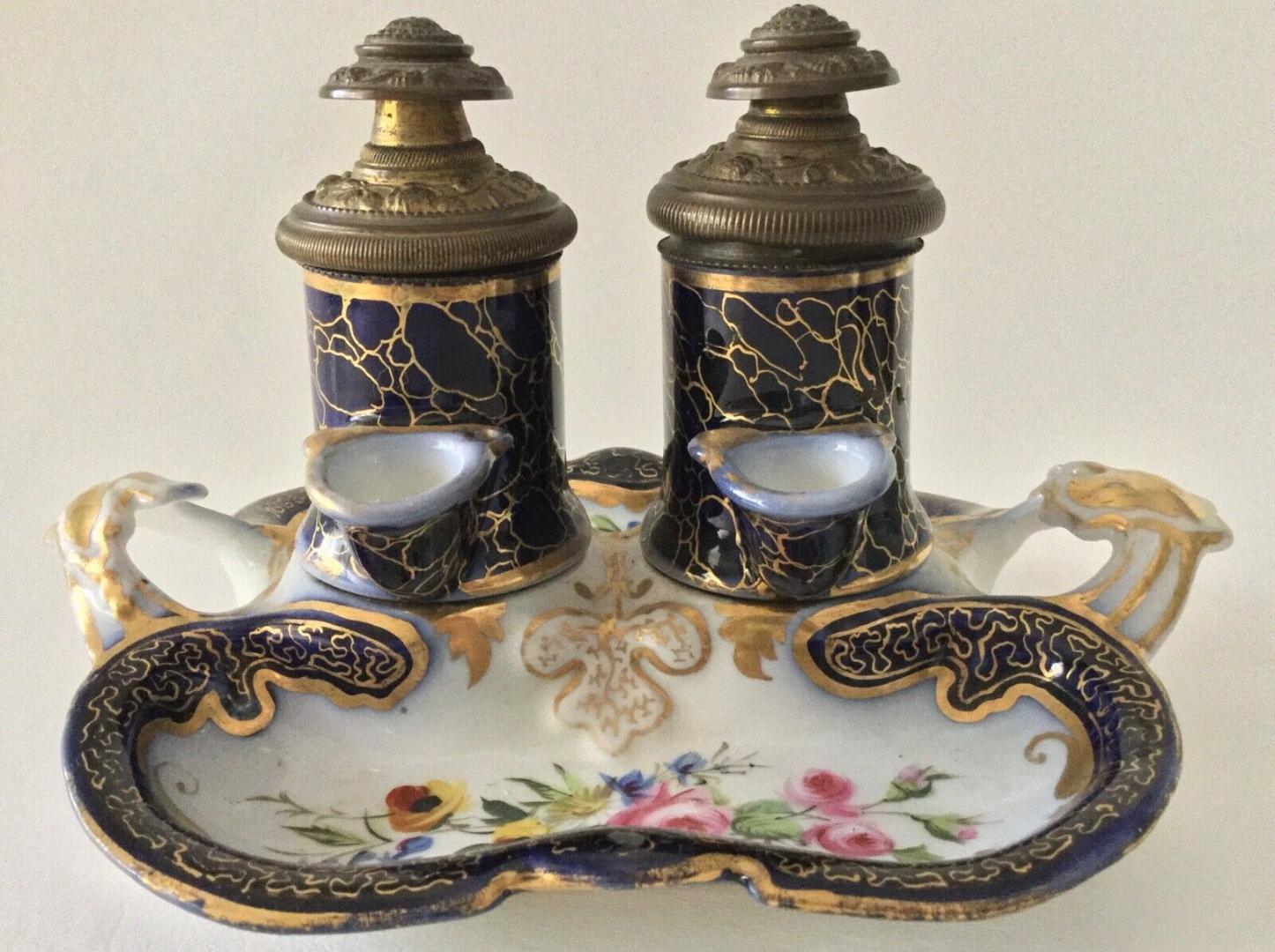
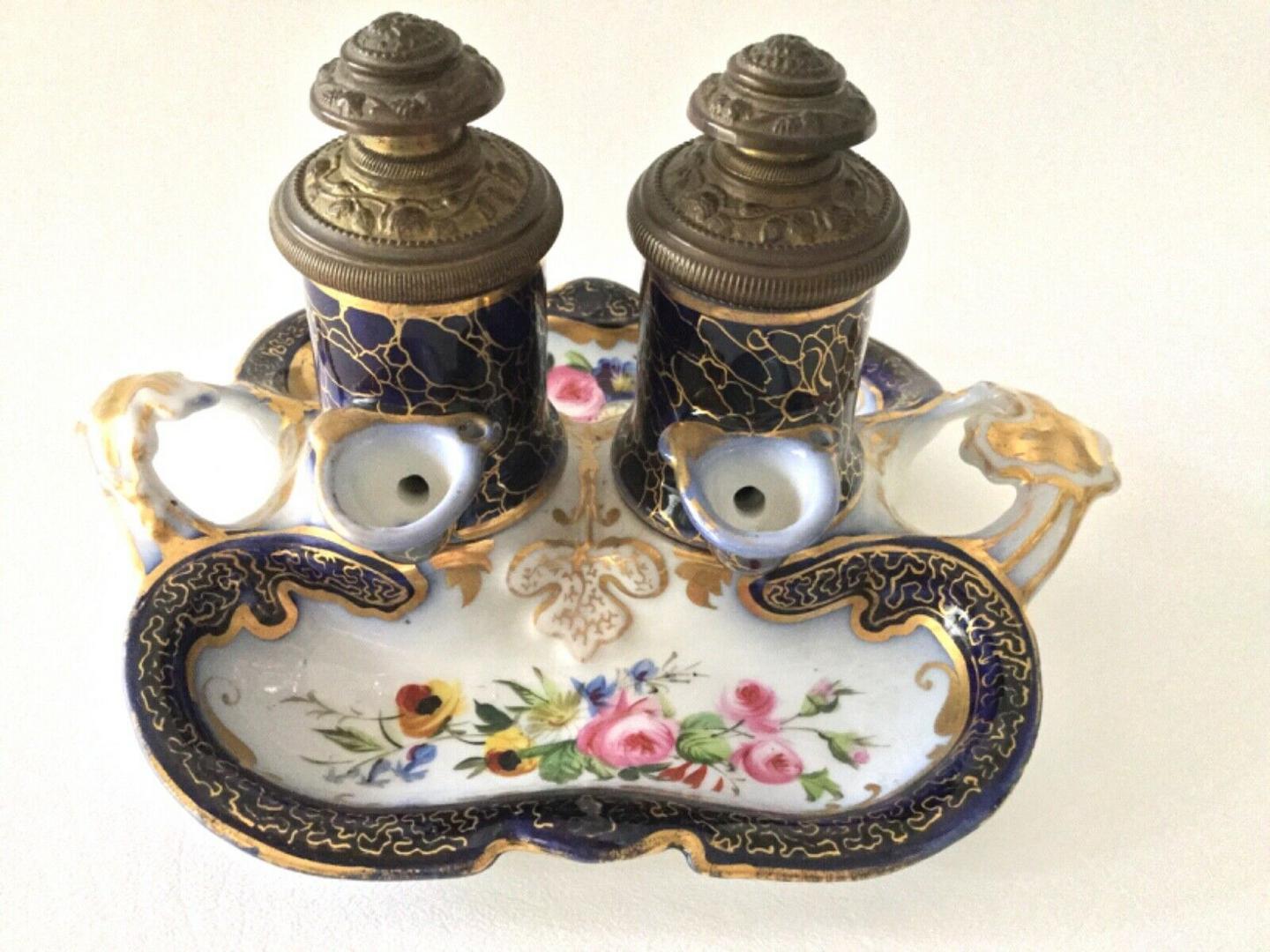


French “Old Paris” Porcelain Dual Pump Inkstand
| Categories | Mechanical - Pump / Siphon |
| Type | Pump |
| Material | Brass, Porcelain |
| Markings | Unmarked |
| Manufacturer | Undetermined |
| Origin | France |
| Date or Era | circa 1850 |
| Measuring | 7 ½” x 6” x 5” high |
This classic French hydrostatic inkstand (popularly known in France as an encrier à pompe or pump inkwell) combines ingenious 19th-century mechanical engineering with the high-style decorative arts of nineteenth-century French porcelain.
The “Pump” (Hydrostatic) Mechanism
Hydrostatic: using the principles of fluid weight, atmospheric pressure, and displacement.
The design solves two of the greatest annoyances of the dip-pen era: ink evaporation and sediment contamination.
- The Piston Assembly: The ornate brass lids are fitted with a central threaded rod attached to a heavy, fluted (lobed) white porcelain float or piston.
- The Fluid Dynamics: The lobed shape of the porcelain float is intentionally engineered to fit closely within the smooth internal bore of the cylinder. When the brass knob is turned clockwise, the reverse screw drives the heavy porcelain mass downward. This mass displaces the ink, forcing it forward and upward into the small, protruding front dipping fonts.
- Retraction: When writing is finished, turning the knob counterclockwise raises the piston. This creates a vacuum that draws the ink back into the main reservoir, sealing it away from the air to prevent drying out and accidental spills.
Materials & Decorative Aesthetics
Porcelain & Palette
The inkstand is made of fine hard-paste French porcelain, exhibiting the classic traits of Vieux Paris (Old Paris) porcelain.
- The Cylinders: Decorated in a rich cobalt blue (bleu de Sèvres) overlaid with an intricate, hand-painted gilded network mimicking a luxurious marbling or bleu caillouté (pebbled) pattern. Brass font covers, which would have been attached with a small chain, are missing.
- The Tray: Features a brilliant white glaze ground adorned with finely hand-painted polychrome floral sprays, including classic romantic pink roses, blue forget-me-nots, and yellow blooms.
Gilding & Form
The inkstand embraces a pronounced Rococo Revival aesthetic:
- The Handles: Elegant, organic, open-work scrolling handles heavily accented in bright burnished gold.
- The Borders: The front pen tray is framed by a deep cobalt border accented with delicate, looping gold filigree scrollwork.
- The Underside: Features an unglazed base with twin flat support rails and open ports showing the undersides of the two ink reservoirs. The lack of an official factory backstamp is entirely characteristic of Old Paris porcelain, which was frequently produced by independent porcelain blanks manufacturers and decorated in smaller Parisian ateliers.
How Old is This Inkstand?
This inkstand dates firmly to the mid-19th century, specifically circa 1840–1860, spanning the late Louis Philippe period to the early Napoleon III era.
Diagnostic Evidence for Dating:
- The Patent History: Mechanical pump inkwells of this exact type were heavily pioneered and popularized in France by inventor Louis-Honoré Boquet (sometimes spelled Bocquet), who secured several patents for encriers à pompe starting in the 1830s. The vogue for these high-end desktop mechanisms reached its peak between 1840 and 1860.
- The Stylistic Elements: The combination of vibrant cobalt blue, heavy hand-applied gilding, scrolling asymmetrical handles, and naturalistic floral bouquets is the definitive hallmark of French Rococo Revival decorative arts from the 1840s and 1850s.
- Manufacturing Details: The style of the brass knurling, the hand-cut reverse threading on the iron/brass screws, and the thick, hand-pressed porcelain pistons all align perfectly with mid-19th-century industrial craftsmanship.
Estimated value: $225
Content disclaimer. The information posted is the owner’s best knowledge and may not have been vetted by the SOIC. We welcome comments, corrections, and additions, working to make our website information comprehensive and accurate.
Join the Society of Inkwell Collectors (SOIC) – it’s free!
Founded in 1981 as a non-profit organization,
we are documenting inkwells (and accessories).
We’re here to help and inform!