

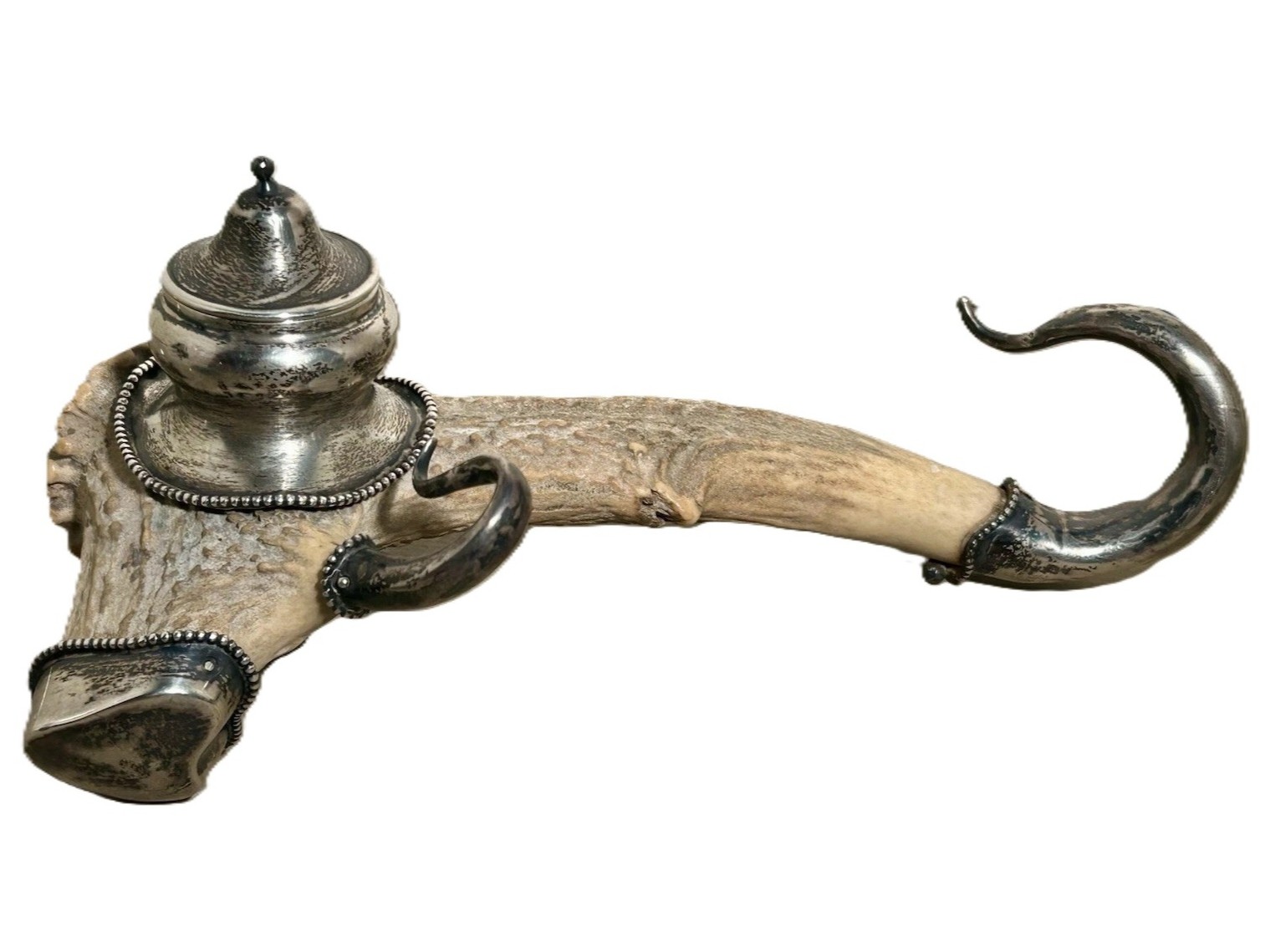


Antler Inkstand
| Categories | Stone/Marble/Ivory/Bone/Hoof/Leather |
| Material | Antler, Silver |
| Markings | Unmarked |
| Manufacturer | Undetermined |
| Origin | Undetermined |
| Date or Era | circa 1900 |
| Measuring | 9” long |
Description
- The Antler: The base is crafted from a section of a natural stag antler (likely European red deer or fallow deer, given the texture and curvature). It features the natural, rugged “pearling” or pebbled texture of the antler beam. The main beam tapers gracefully toward the tip, while the coronet (or a cut brow tine section) forms the wide, stable base on the left where the inkwell sits.
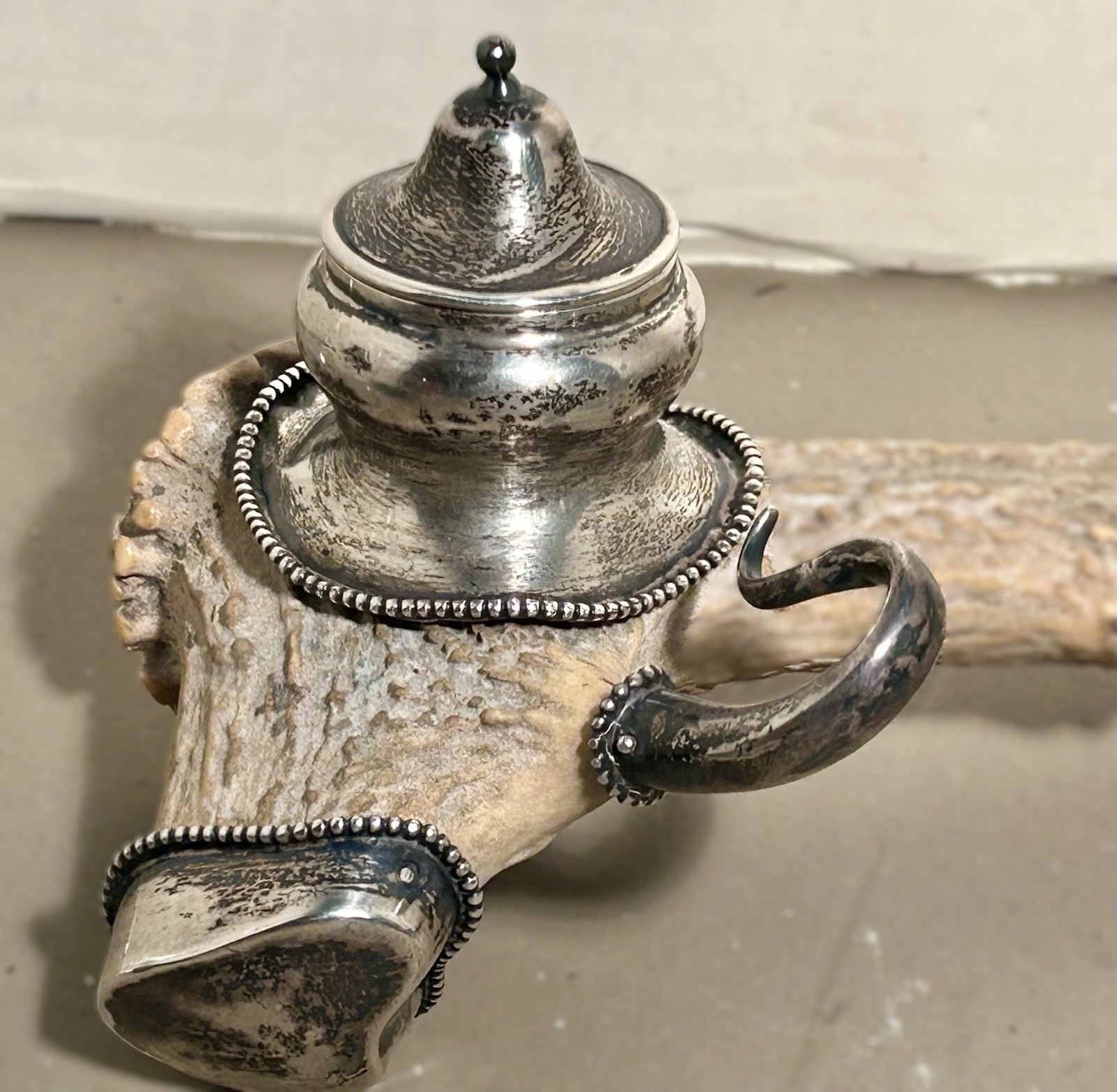
- The Ink Reservoir: Mounted on the widest part of the antler is a silver inkwell. It features a stepped, domed, hinged lid topped with a classic baluster finial. The lid opens to reveal a clean, integrated metal well. The base of the inkwell sits on a flared collar trimmed with a crisp, die-rolled beaded border.
- The Mounts & Accents: Left End Cap: The cut base of the antler is neatly enclosed by a contoured silver cap, finished with a matching beaded border.
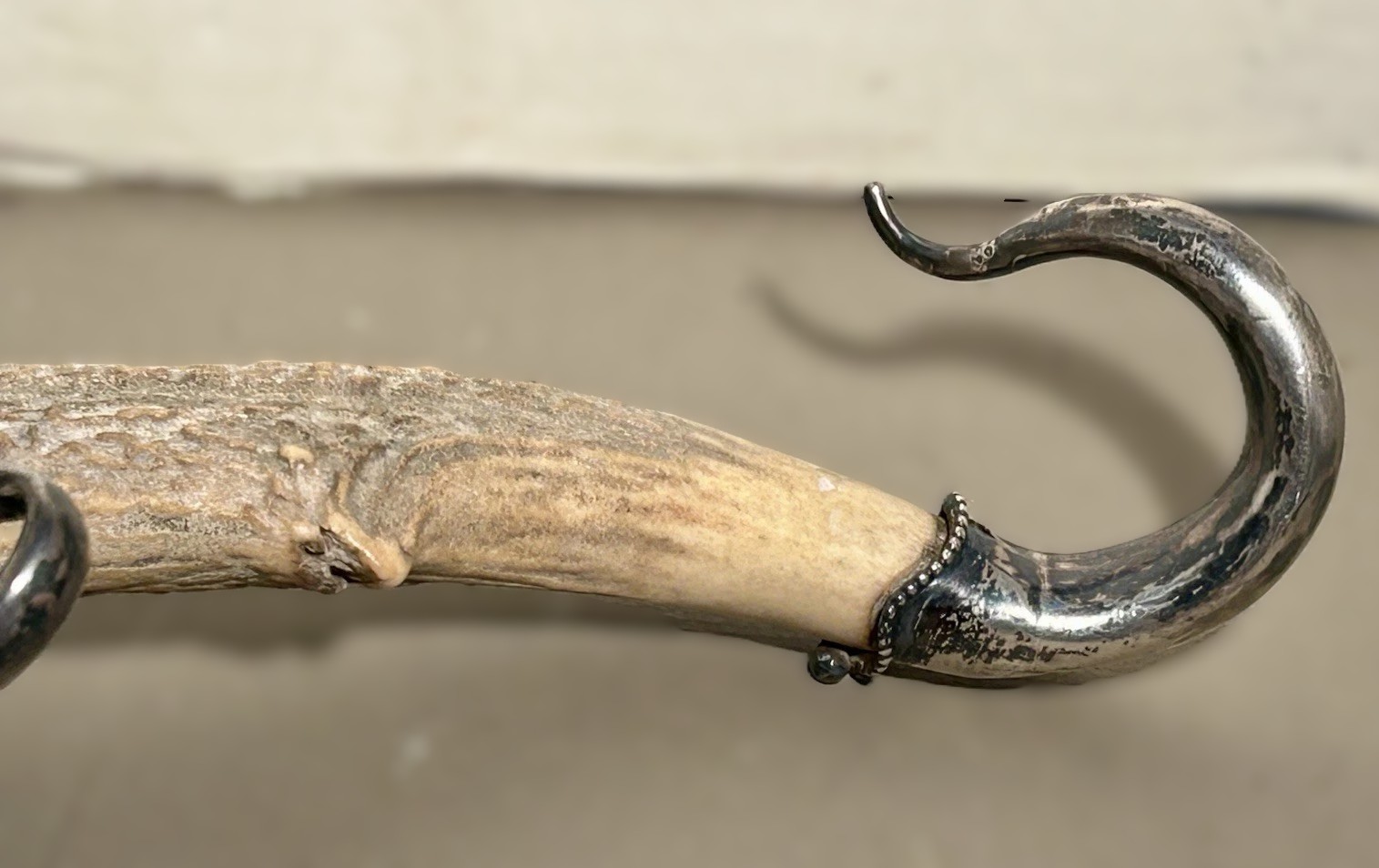
- The Tip: The tapering end of the antler is fitted into an elongated silver ferrule that terminates in an elegant, stylized, upward-curling horn finial. It is secured cleanly to the bone with a small pin.
- Side Loop / Pen Rest: Branching out from the side near the inkwell is an additional curved silver horn or hook, also mounted with a beaded collar. This serves a dual purpose: it acts as a decorative flourish and functions as a pen rest to cradle a dip pen across the antler beam.
Historical Context: Antler & Horn Inkwells
During the mid-to-late Victorian era (roughly 1860–1900), there was a massive cultural craze for “hunting lodge,” rustic, and naturalistic decor. This trend was largely fueled by Queen Victoria and Prince Albert’s deep affection for Balmoral Castle in Scotland, which popularized Scottish high-country style, taxidermy, and antler furniture across Great Britain and North America. Simultaneously, Germany’s “Black Forest” and Jägerei (hunting) traditions produced similar rustic desk items.
Luxury silversmiths realized that the natural curves and forks of deer antlers provided the perfect ready-made geometry for desk accessories—the weight provided stability, the texture was visually engaging, and the tines naturally formed pen troughs or rests. High-end pieces combined these raw, organic elements with heavy sterling silver or high-quality electroplated nickel silver (EPNS).
Origin and Estimated Age
- Estimated Age: Circa 1880–1910. The specific combination of the stepped, domed lid, the classic baluster finial, and the precise rolled beaded borders are textbook design vocabulary for British and Continental desktop metalwork from this specific window.
- Where It Was Made: Most likely Great Britain (with Sheffield, Birmingham, or London being the primary manufacturing hubs) or Germany. Top-tier Sheffield firms like James Dixon & Sons, Walker & Hall, and Mappin & Webb excelled at producing these exact types of silver-mounted horn and antler novelties for the country house market.
Sold for $322 in April 2026
Content disclaimer. The information posted is the owner’s best knowledge and may not have been vetted by the SOIC. We welcome comments, corrections, and additions, working to make our website information comprehensive and accurate.
Join the Society of Inkwell Collectors (SOIC) – it’s free!
Founded in 1981 as a non-profit organization,
we are documenting inkwells (and accessories).
We’re here to help and inform!