



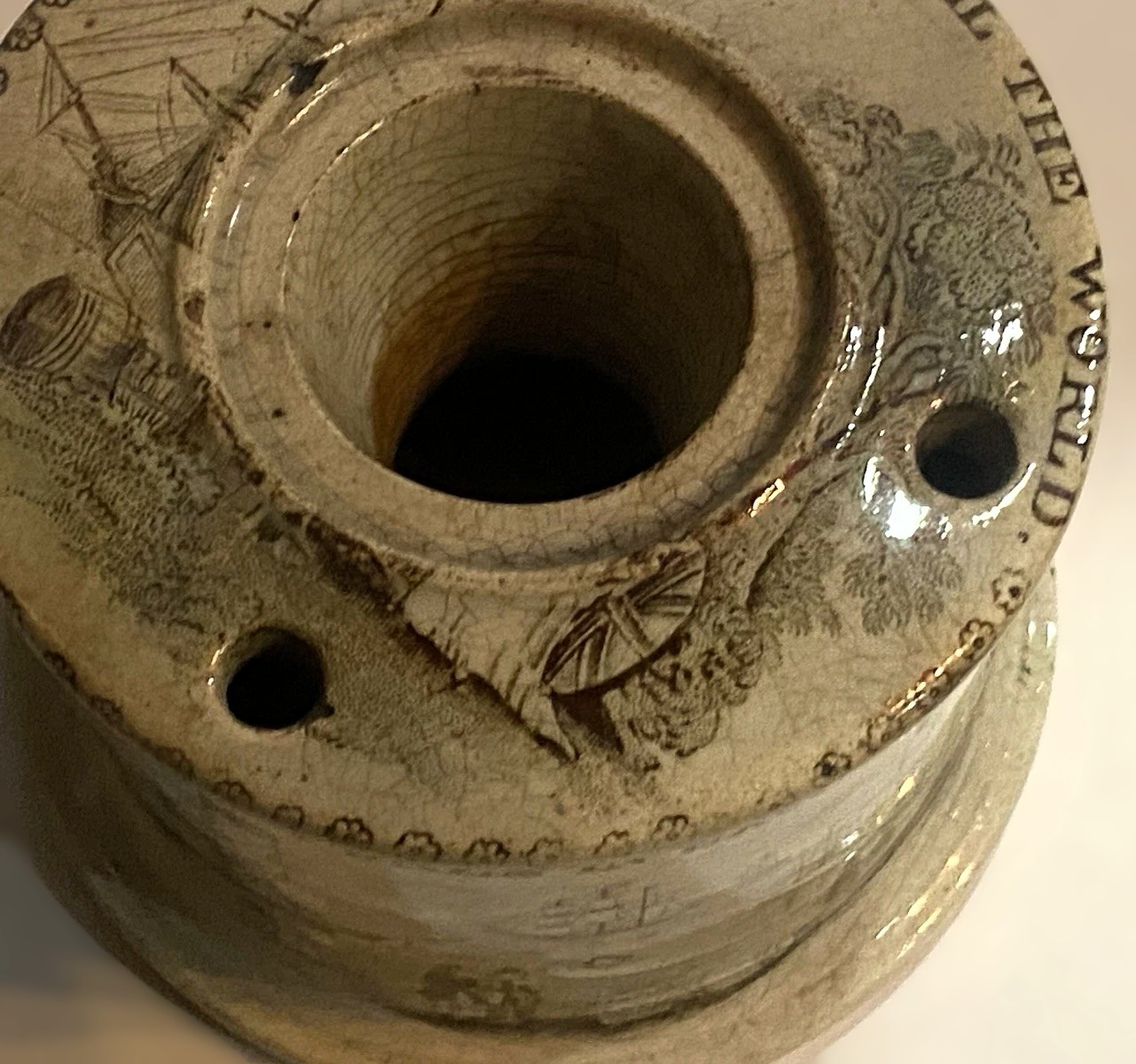

Anti-Corn Law League Inkwell
| Categories | Ceramics/Porcelain non-Figural |
| Type | Political, Historical |
| Material | Pottery |
| Markings | See Narrative |
| Manufacturer | Undetermined |
| Origin | England |
| Date or Era | circa 1845 |
| Measuring | 3 ⅝” diameter; 3” high |
This is a significant piece of political memorabilia: an Anti-Corn Law League inkwell, dating to approximately 1840–1846. This inkwell, Staffordshire Pearlware with brown transfer, served as a functional propaganda tool during one of the most heated political debates in 19th-century Britain: the fight to repeal the Corn Laws.
The Manufacturing Process
This inkwell was made using the transfer-printing process, a technique that revolutionized the pottery industry in the Staffordshire “Potteries” district.
- Engraving: A craftsman first engraved the intricate port and symbolic scenes onto a copper plate.
- Inking and Tissue: The plate was inked with a brown ceramic pigment. A thin sheet of tissue paper was pressed onto the plate to pick up the design.
- Transfer: The wet tissue was then applied to the “biscuit-fired” (unglazed) clay body of the inkwell. The paper was washed away, leaving the ink on the clay.
- Glazing: Finally, the piece was dipped in a clear lead glaze—often with a hint of cobalt to give pearlware its characteristic slight bluish tint—and fired again to seal the design. The fine network of lines you see across the surface is crazing, which occurs naturally over time as the glaze and body expand and contract at different rates.
Descriptions of the Scenes and Their Significance
The imagery on the inkwell is a visual manifesto for the Anti-Corn Law League.
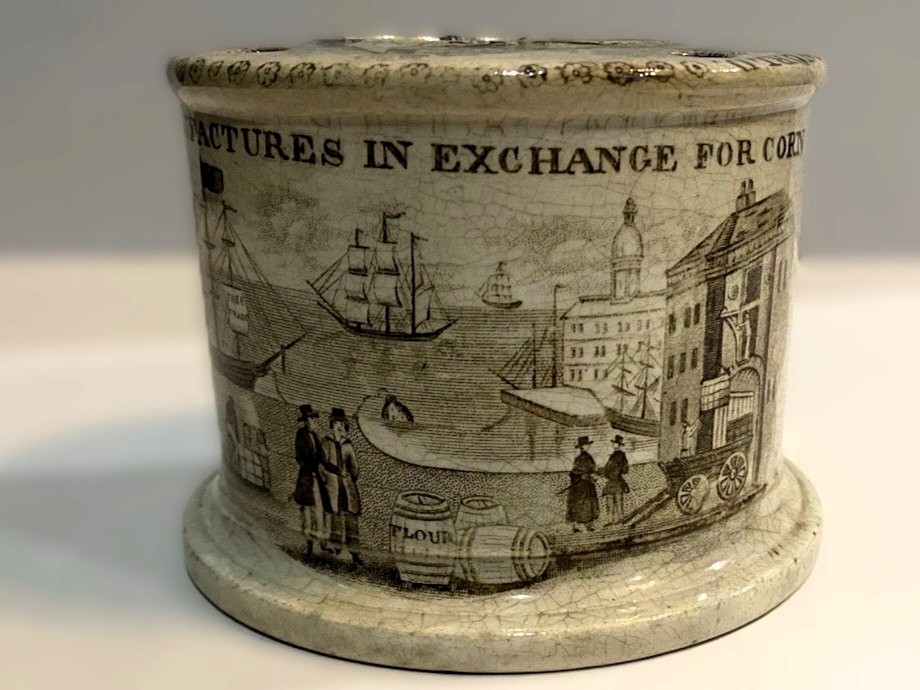
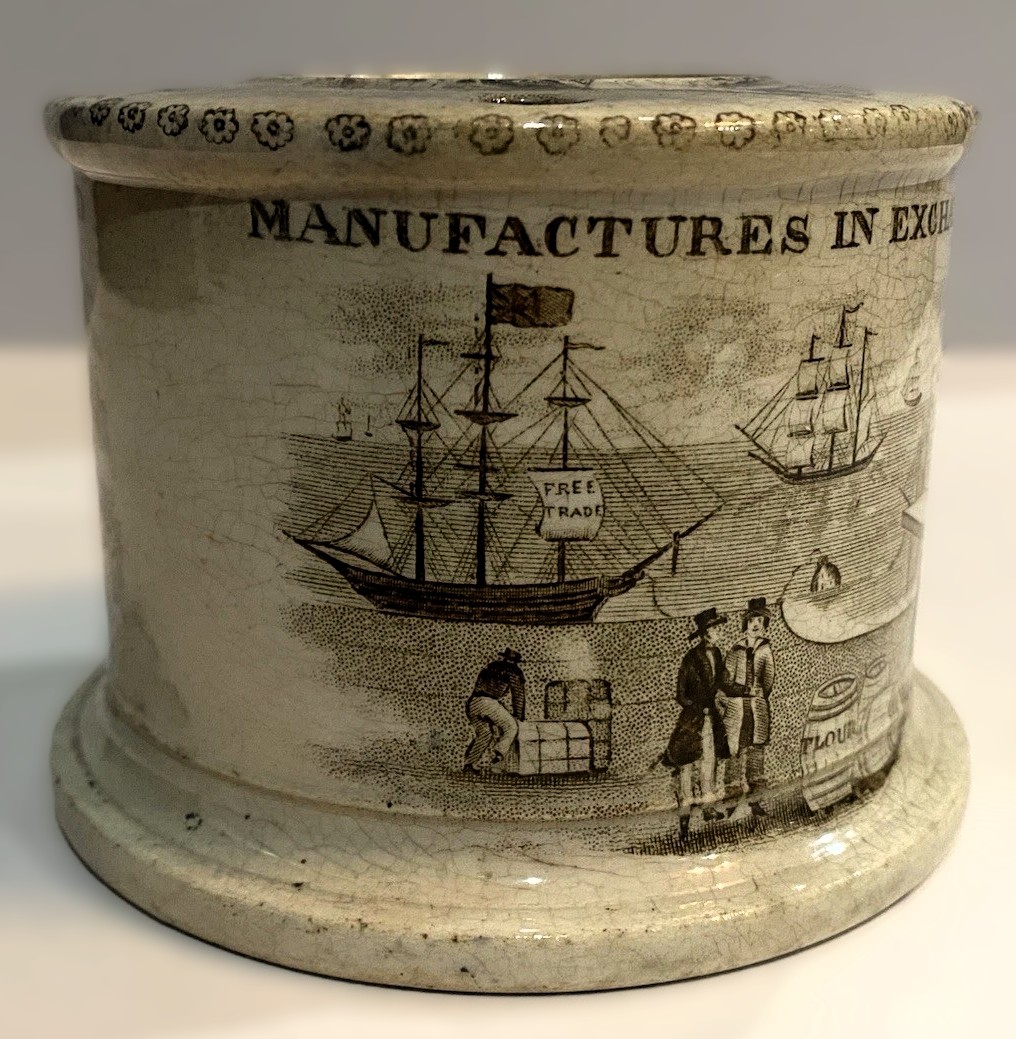
- Shipping Ports and Commerce: Several scenes depict bustling maritime ports. You can see a warehouse with a crane or pulley system actively loading or unloading heavy crates. This imagery represented the League’s vision of a prosperous, industrially dominant Britain.
- The “Free Trade” Ships: Several sailing vessels are shown with flags or pennants explicitly labeled “FREE TRADE”. This identified the movement’s goal: removing all tariffs on imported goods.
- Barrels of Flour: Prominent barrels labeled “FLOUR” appear in the foreground. This was the “Cheap Bread” argument. The League argued that by removing tariffs on foreign grain, the price of bread would drop, significantly improving the lives of the working class.
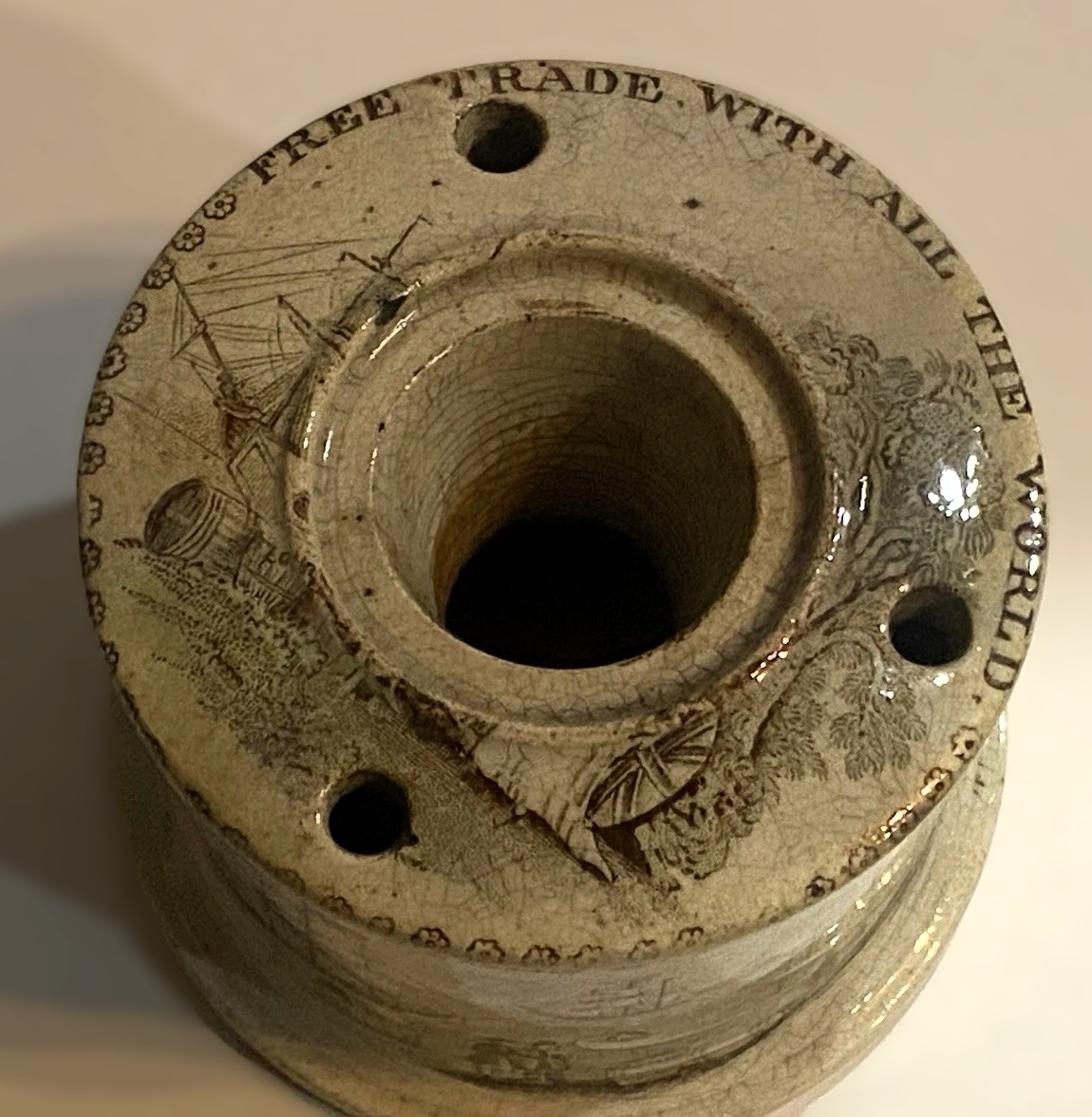
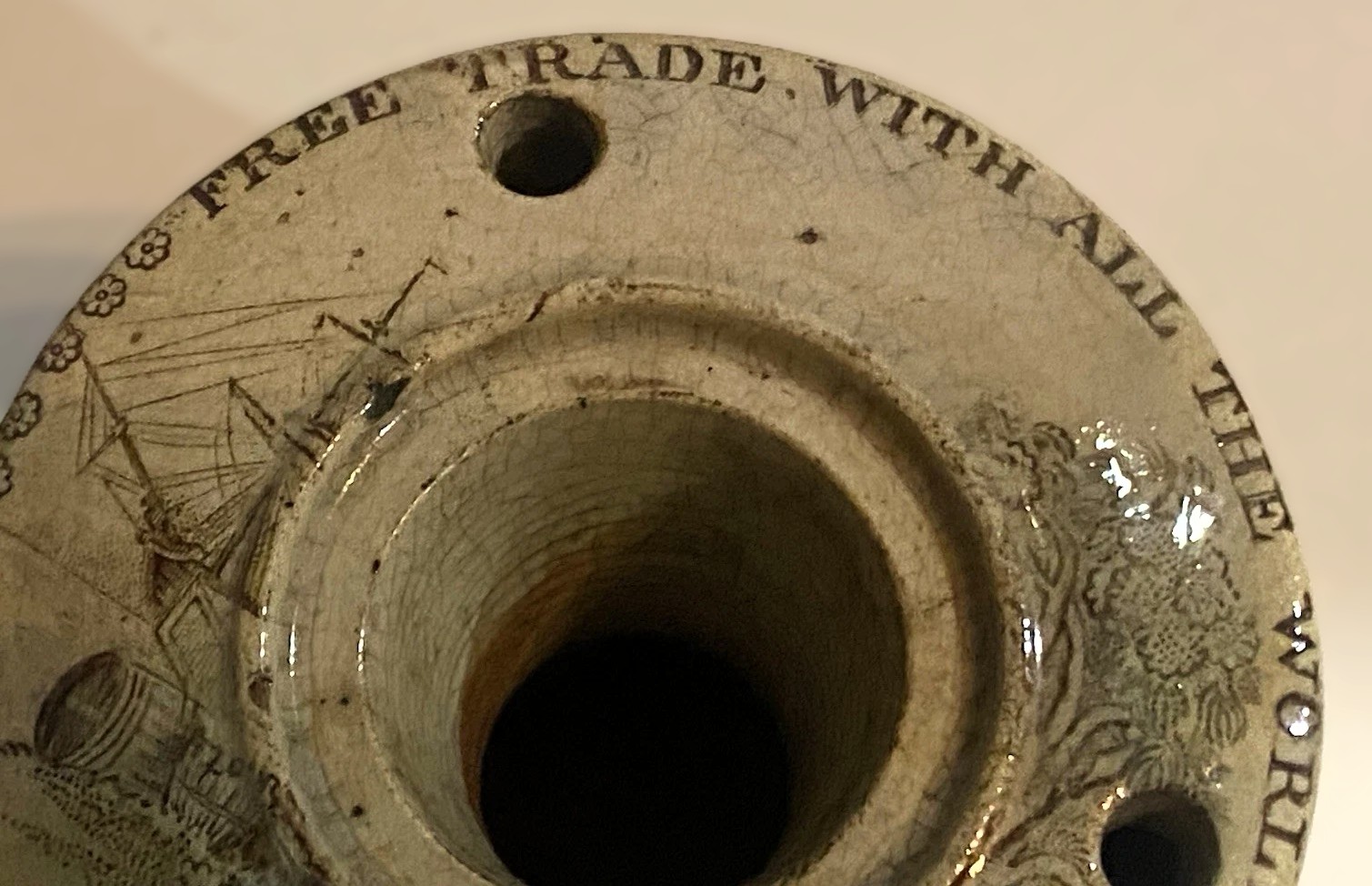
- Symbolic Global Exchange: This is the most significant scene. It depicts Britannia (wearing a Corinthian helmet and holding a shield with the Union Jack) exchanging a document labeled “FREE TRADE” with a figure representing the Americas or the colonies (identified by the feathered headdress). This symbolized the League’s belief that free trade would bring about global peace and mutual prosperity through commerce.
The Political Message: “Free Trade with All the World”
The inscriptions on the top and sides carry the core slogans of the Anti-Corn Law League:
- “Manufactures in Exchange for Corn”: This was the economic heart of the debate. Britain was the “workshop of the world.” The League argued that Britain should export its manufactured goods (textiles, iron, pottery) and, in return, import cheap “corn” (grain) from abroad.
- “Free Trade with All the World”: This was the League’s ultimate goal—a world without trade barriers, led by British industrial might.
The History and Organization
The Anti-Corn Law League was founded in 1838 in Manchester by Richard Cobden and John Bright. They were brilliant campaigners who used every medium available—lectures, pamphlets, and household items like this inkwell—to spread their message.
The Corn Laws were tariffs on imported grain designed to keep domestic grain prices high, which benefited wealthy landowners but made bread unaffordable for the poor and kept wages high for factory owners. The League successfully pressured Parliament, and the laws were finally repealed in 1846 by Prime Minister Robert Peel.
Because this inkwell is a “message piece,” it was likely owned by someone who was a member or a vocal supporter of the League. It is a rare survivor of a movement that fundamentally changed the global economy.
Sold for $465 in April 2026
Content disclaimer. The information posted is the owner’s best knowledge and may not have been vetted by the SOIC. We welcome comments, corrections, and additions, working to make our website information comprehensive and accurate.
Join the Society of Inkwell Collectors (SOIC) – it’s free!
Founded in 1981 as a non-profit organization,
we are documenting inkwells (and accessories).
We’re here to help and inform!