


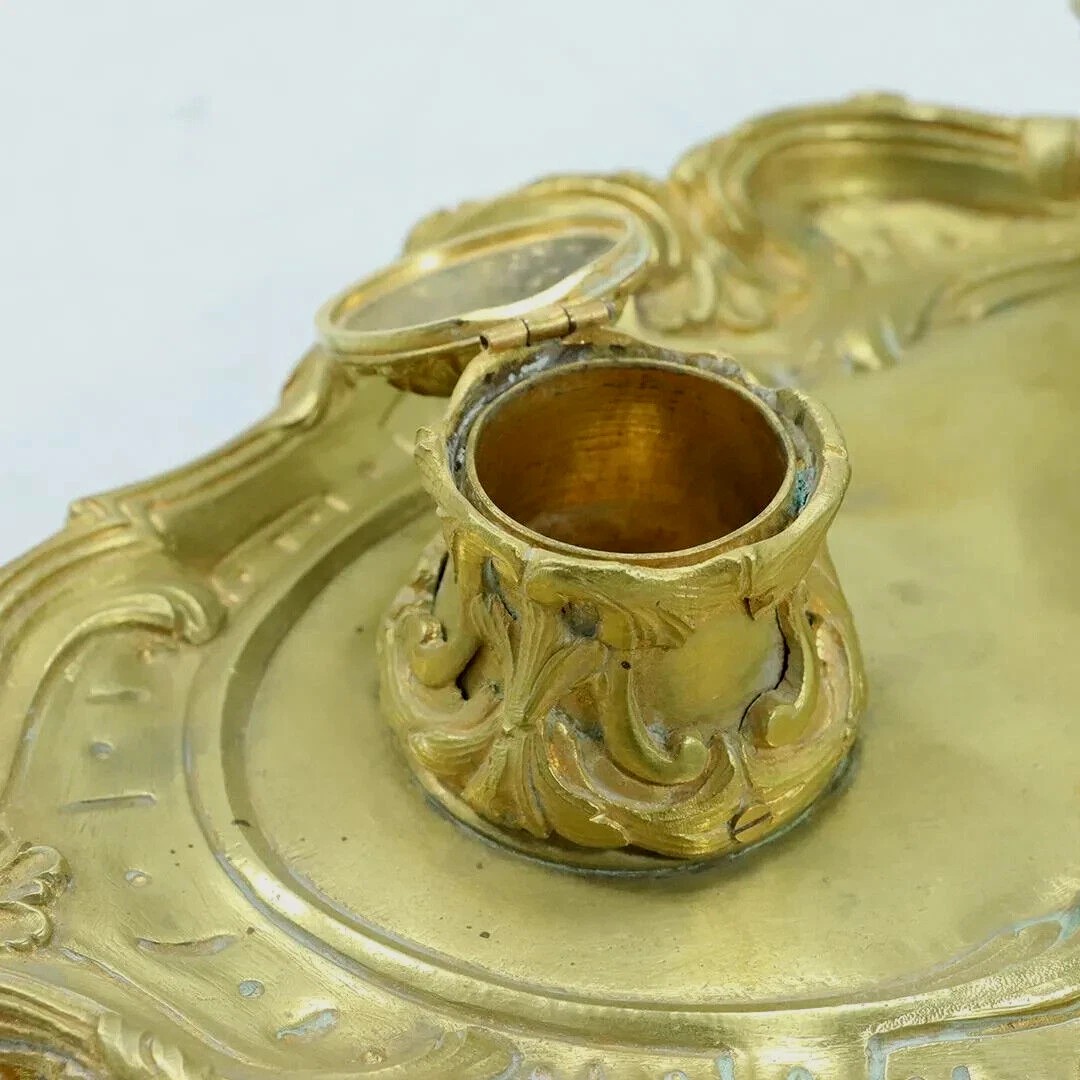


Gilt Bronze Double Inkstand
| Categories | Art Nouveau |
| Material | Ormolu |
| Markings | See Narrative |
| Origin | France |
| Date or Era | circa 1895 |
| Measuring | 12 ½” x 8 ½” x 3” high |
This double inkwell is a classic example of French Art Nouveau design from the turn of the 20th century (c. 1890–1900). The piece is crafted from gilt bronze (often referred to as bronze doré or ormolu), a hallmark of high-quality Parisian decorative arts of the Belle Époque.
Description
The inkwell features a sophisticated, organic silhouette characteristic of the Art Nouveau movement, though it retains a strong Rococo Revival (Louis XV style) influence in its use of heavy, asymmetrical scrolling foliage and acanthus leaf motifs.
- The Tray: The scalloped, tray-like base rests on four stylized foliate feet. It features two integrated, scroll-form handles and a central oval plateau designed to hold pens or other writing instruments.
- The Inkwells: Two separate, bulbous inkwell containers are mounted to the tray. Each is adorned with deep-relief carvings of swirling leaves and topped with a hinged lid. The lids are crowned with bud-like finials (representing an artichoke or flower bud), which serve as thumb-pieces to open the reservoirs.
- Casting & Finish: The underside reveals the heavy casting of the bronze and the square nuts used to secure the components – a common assembly method for high-end Parisian bronzes of the period. The rich, golden “gilt” finish has aged beautifully, showing a warm patina and some expected oxidation in the recesses.
Interpretation of the Marks
The markings on this inkstand are typical of the production systems used by major Parisian bronze foundries (bronziers) to track designs and inventory.
| Mark | Interpretation |
| GA | This is most likely the mark of Gagneau Frères (founded by Edouard Gagneau), a prestigious Parisian firm located at 115 rue Lafayette. They were renowned for their high-quality decorative bronzes, lighting, and desk accessories. |
| 4104 | This is the model or catalog number. Foundries like Gagneau maintained massive catalogs of designs; “4104” would have identified this specific “Double Encrier” pattern for ordering and production. |
| 197 | This is likely a serial or batch number indicating the specific production run or a tracking number for the artisan who finished the piece. |
| V-D 46 | This is a foundry stamp or an artisan’s mark. “V.D.” frequently appears on French bronzes of this era and is often attributed to the workshop of Vandevoorde (a prominent French/Belgian bronzier who worked in Paris) or occasionally Victor Desmaret, a sculptor known for Art Nouveau desk sets. The “46” is likely a size or part-matching indicator. |
Summary
- Origin: Paris, France.
- Period: Art Nouveau (c. 1895).
- Maker: Likely Gagneau Frères, possibly cast by the Vandevoorde foundry.
Sold for $166 in April 2026
Content disclaimer. The information posted is the owner’s best knowledge and may not have been vetted by the SOIC. We welcome comments, corrections, and additions, working to make our website information comprehensive and accurate.
Join the Society of Inkwell Collectors (SOIC) – it’s free!
Founded in 1981 as a non-profit organization,
we are documenting inkwells (and accessories).
We’re here to help and inform!