

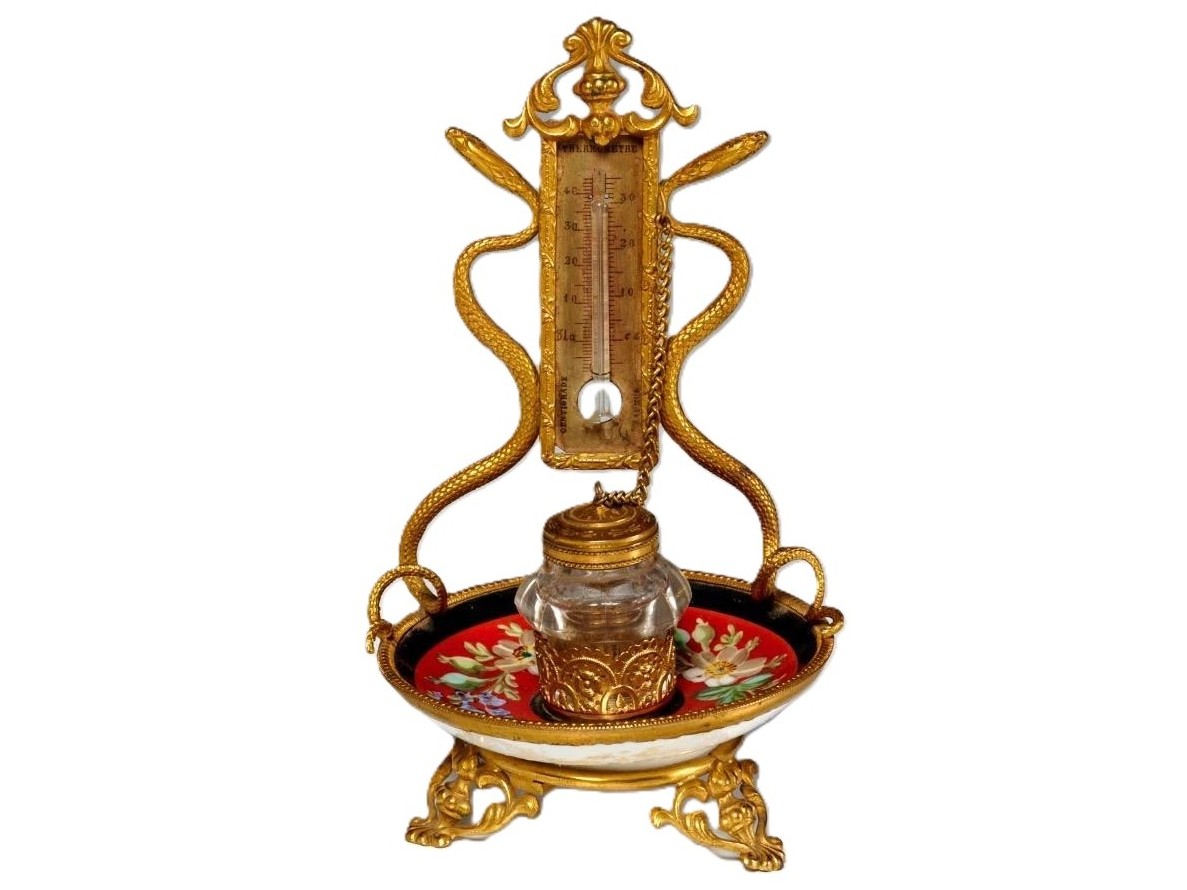
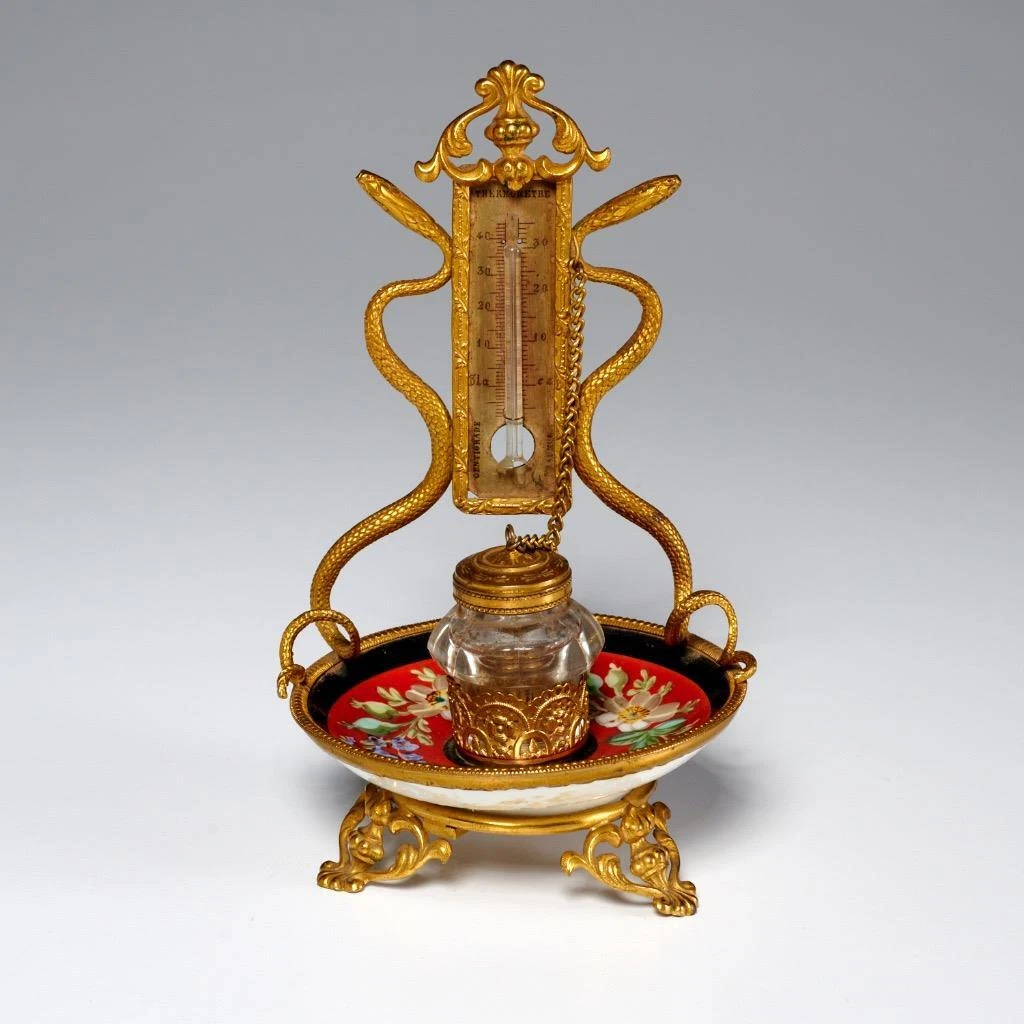
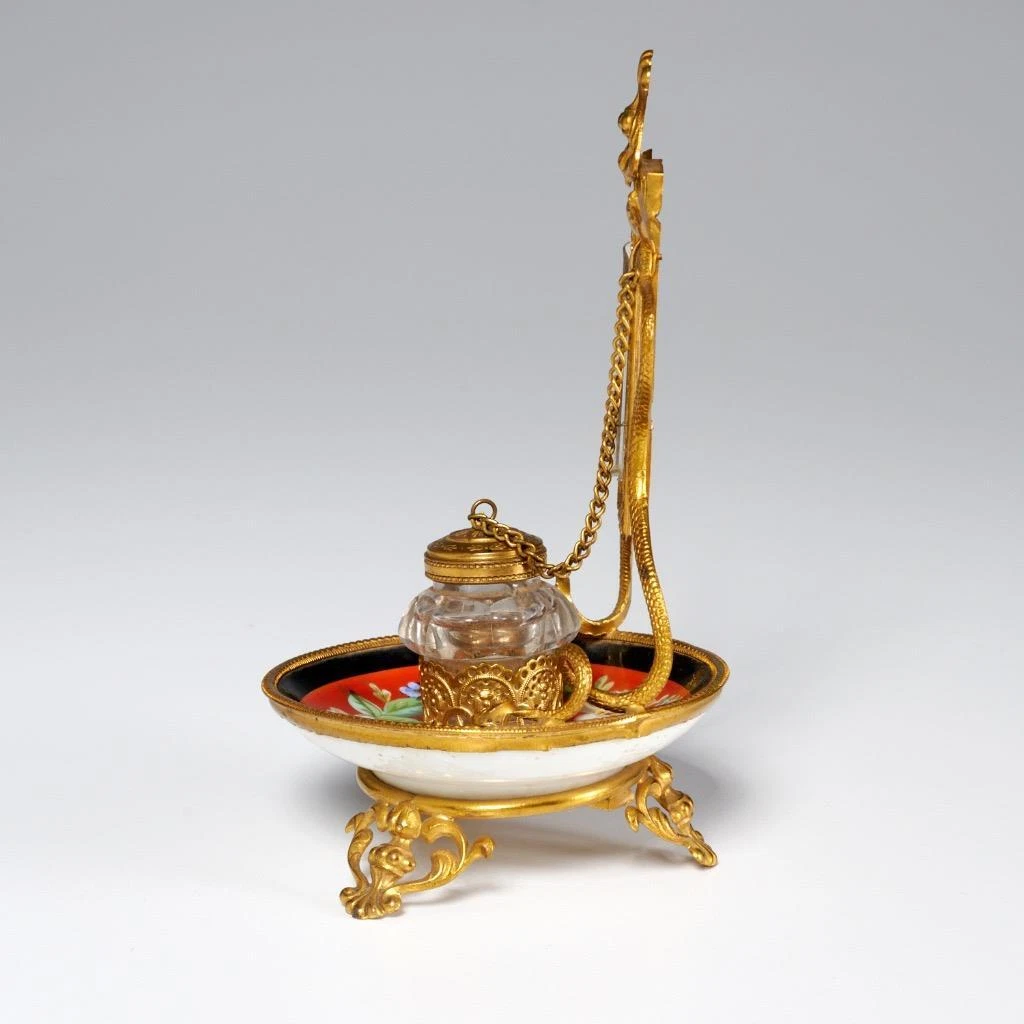
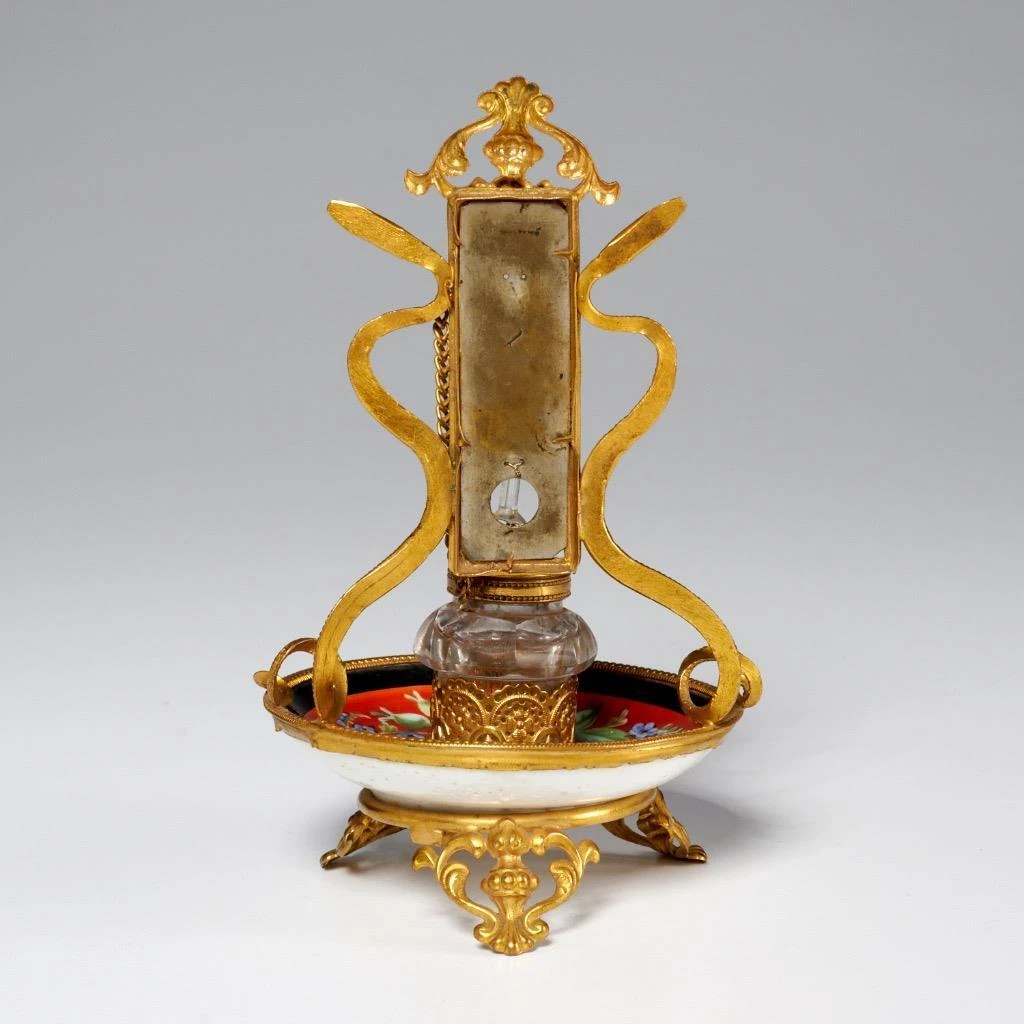
French Inkstand with Thermometer
| Categories | Dual Purpose Inkstands |
| Type | Thermometer |
| Material | Gilt Bronze, Glass, Porcelain |
| Markings | See narrative |
| Manufacturer | Undetermined |
| Origin | France |
| Date or Era | circa 1870 |
| Measuring | 3 ¾” diameter; 6” high |
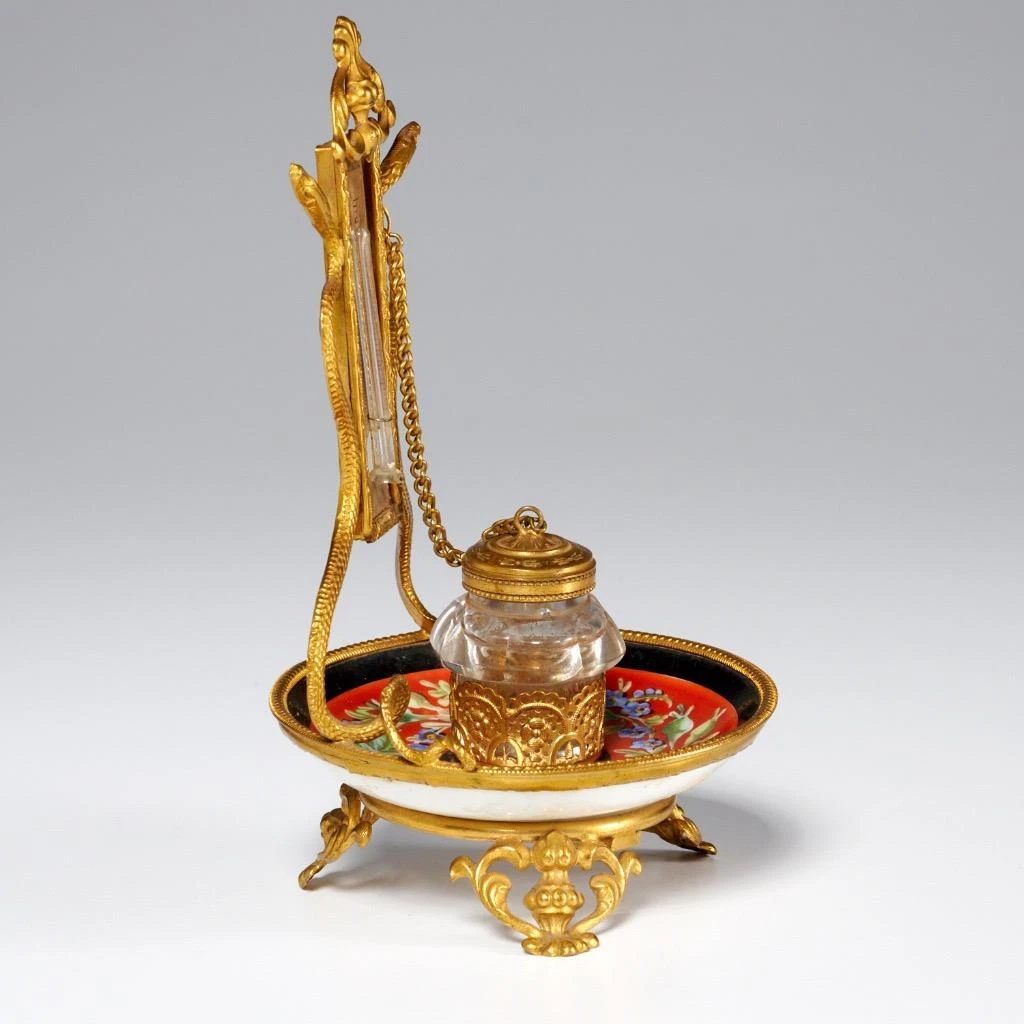
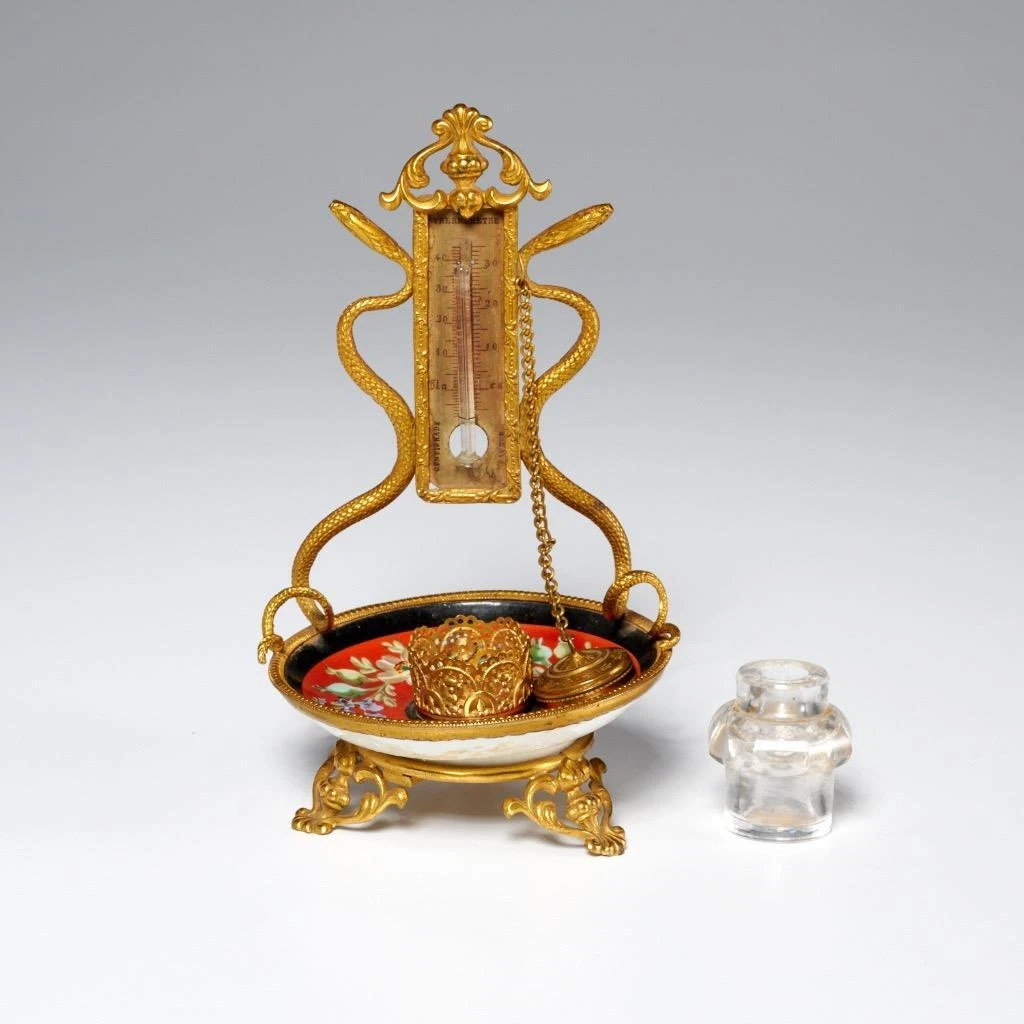
This mid-to-late 19th-century French desk set is a combination inkstand and thermometer. Based on the markings and style, this piece likely dates to the Napoleon III era (1852–1870) or slightly later, into the early Third Republic.
Description
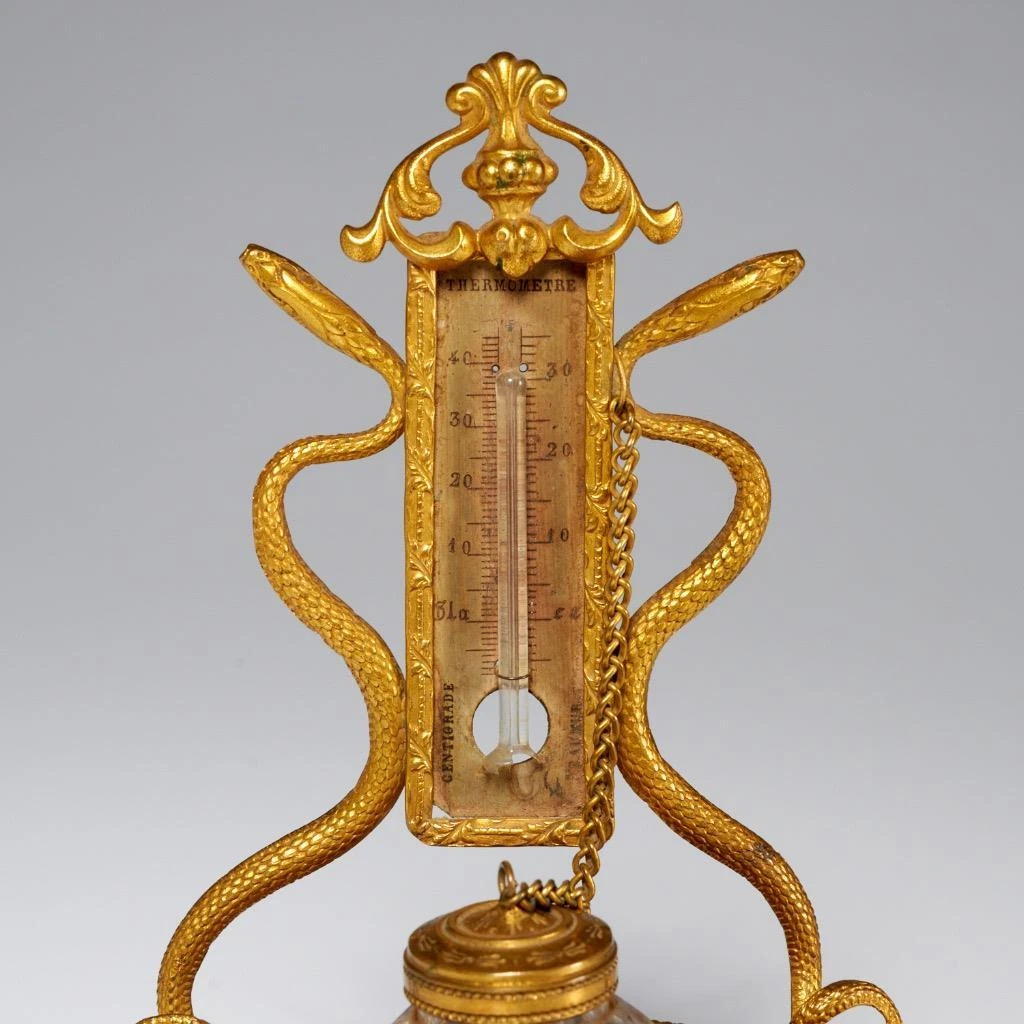
- The Stand: The elaborate base is made of gilt brass (ormolu if fire-gilded, or simply laiton poli). The most striking feature is the pair of serpents that form the structural uprights. In 19th-century French design, serpents were often used as Neo-Greco motifs symbolizing wisdom or immortality, though they were also simply popular decorative elements in the “Eclectic” style of the period.
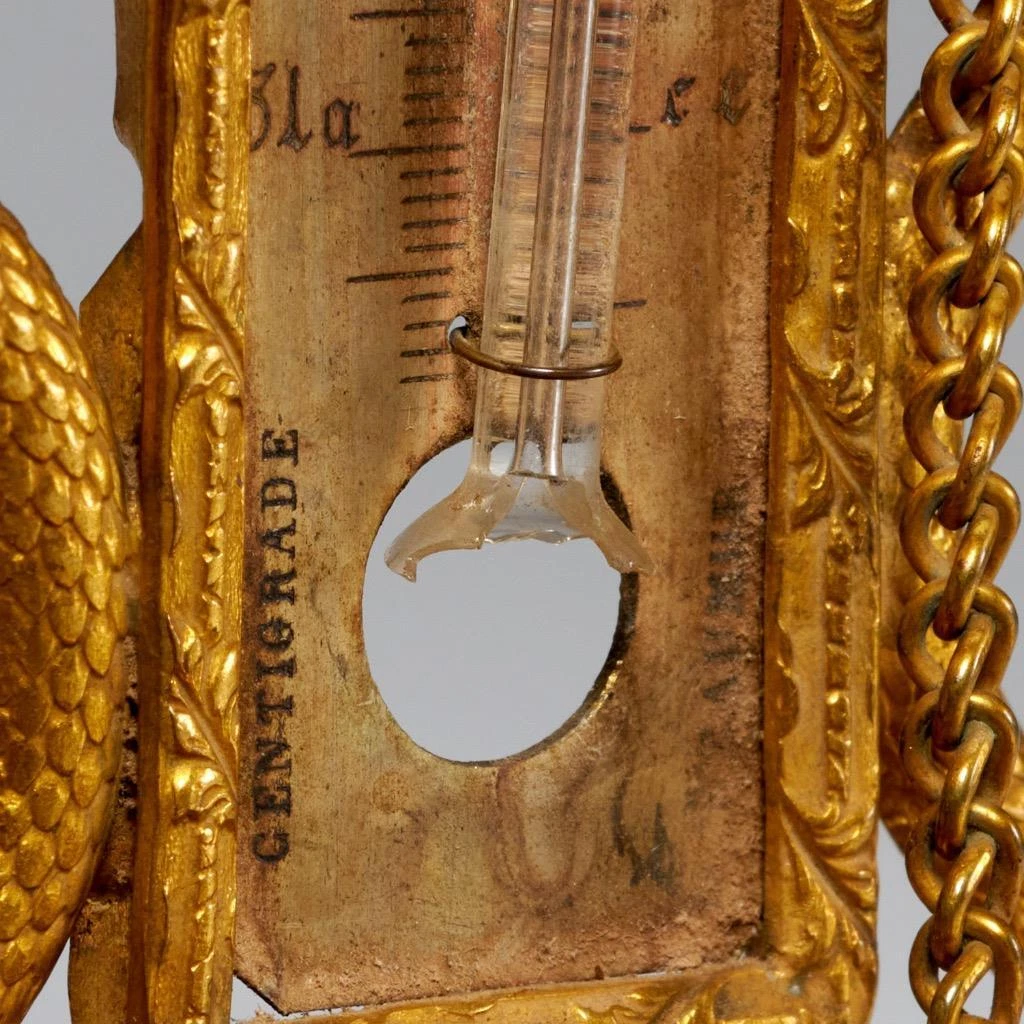
- The Thermometer: The scale is printed on a paper. It is a dual-scale thermometer:
- Centigrade (Left): This is the standard Celsius scale we use today.
- Réaumur (Right): This scale was invented by René-Antoine Ferchault de Réaumur in 1730. It set the freezing point of water at 0º and the boiling point at 80º. It was the dominant temperature scale in France and parts of Europe throughout the 18th and 19th centuries before being fully supplanted by Celsius.
- Condition: The glass tube is damaged; the bulb at the bottom is broken – the thermometric liquid (mercury or tinted alcohol) has long since escaped.
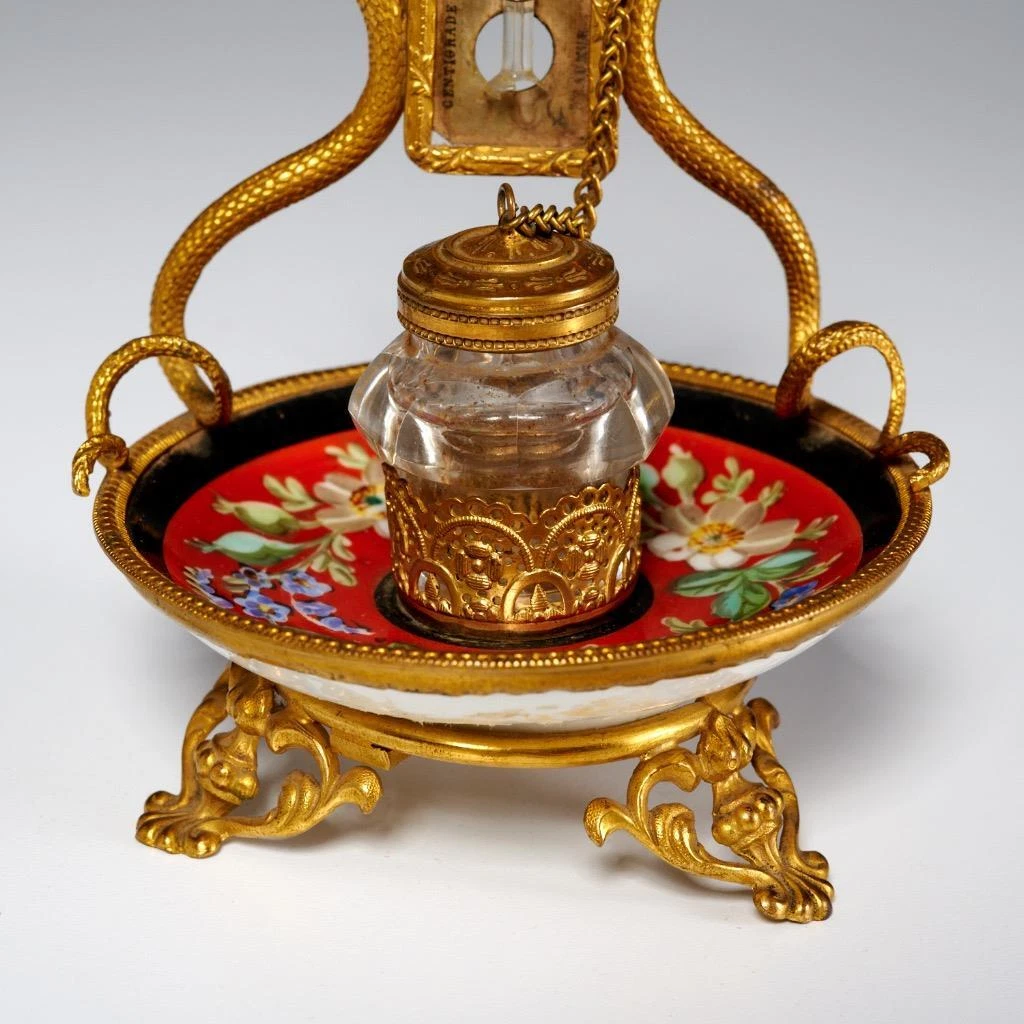
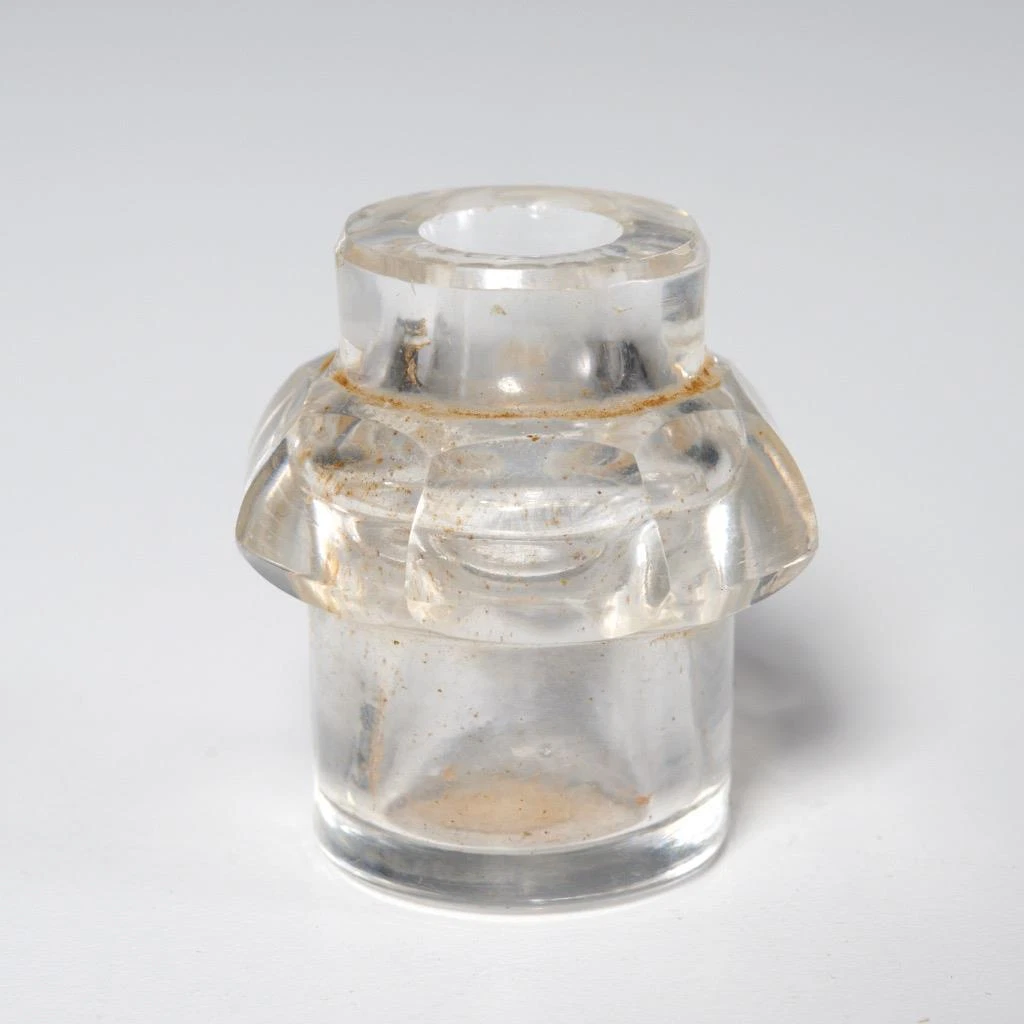
- The Inkwell: The glass pot is made of heavy lead crystal by Baccarat. The cut-glass pattern is a classic “diamond” or “faceted” style. The brass lid is attached to the main frame by a security chain, a common feature to prevent the lid from being misplaced.
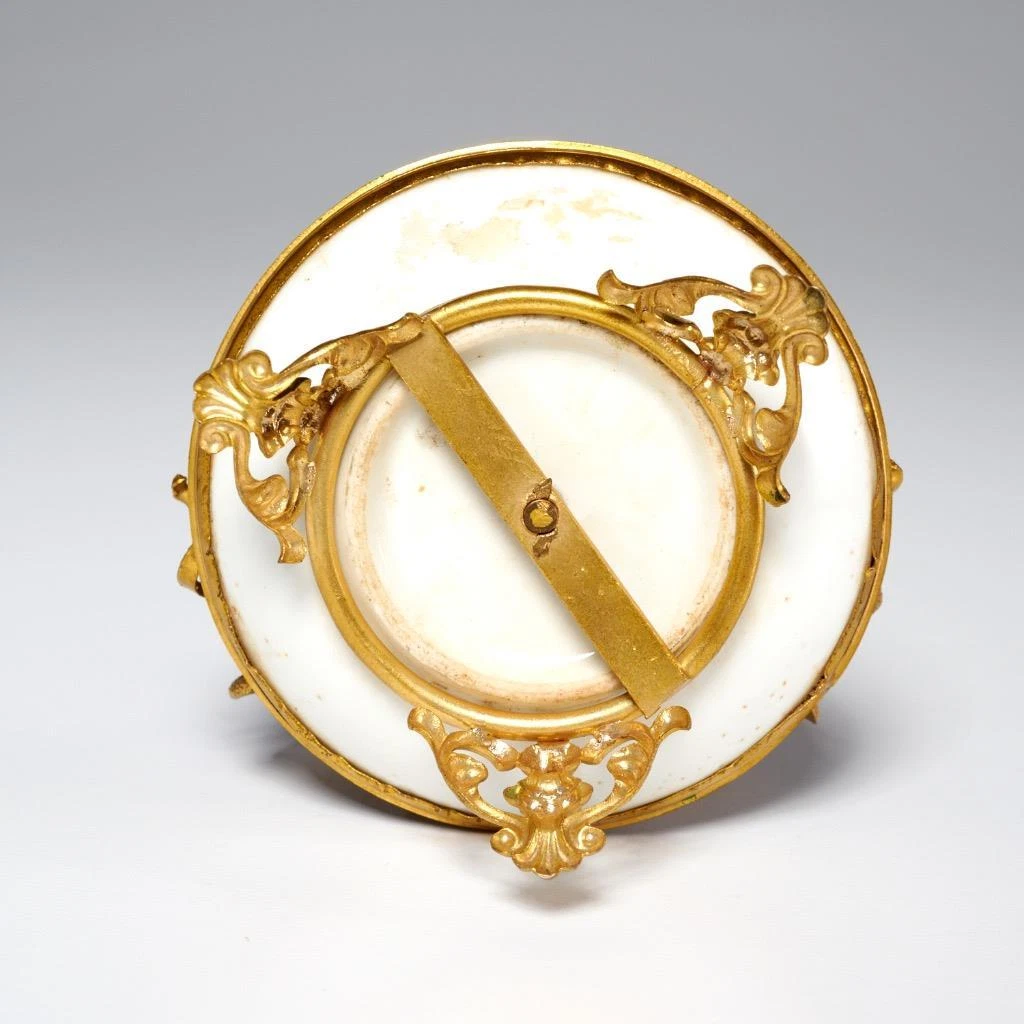
- The Dish: The ceramic base is porcelaine de Paris (Paris Porcelain) decorated in the “Chinoiserie” or “famille rose” style, meant to mimic Chinese imports. These were frequently used in French luxury “Palais Royal” goods to add color and exoticism.
Manufacturing & History
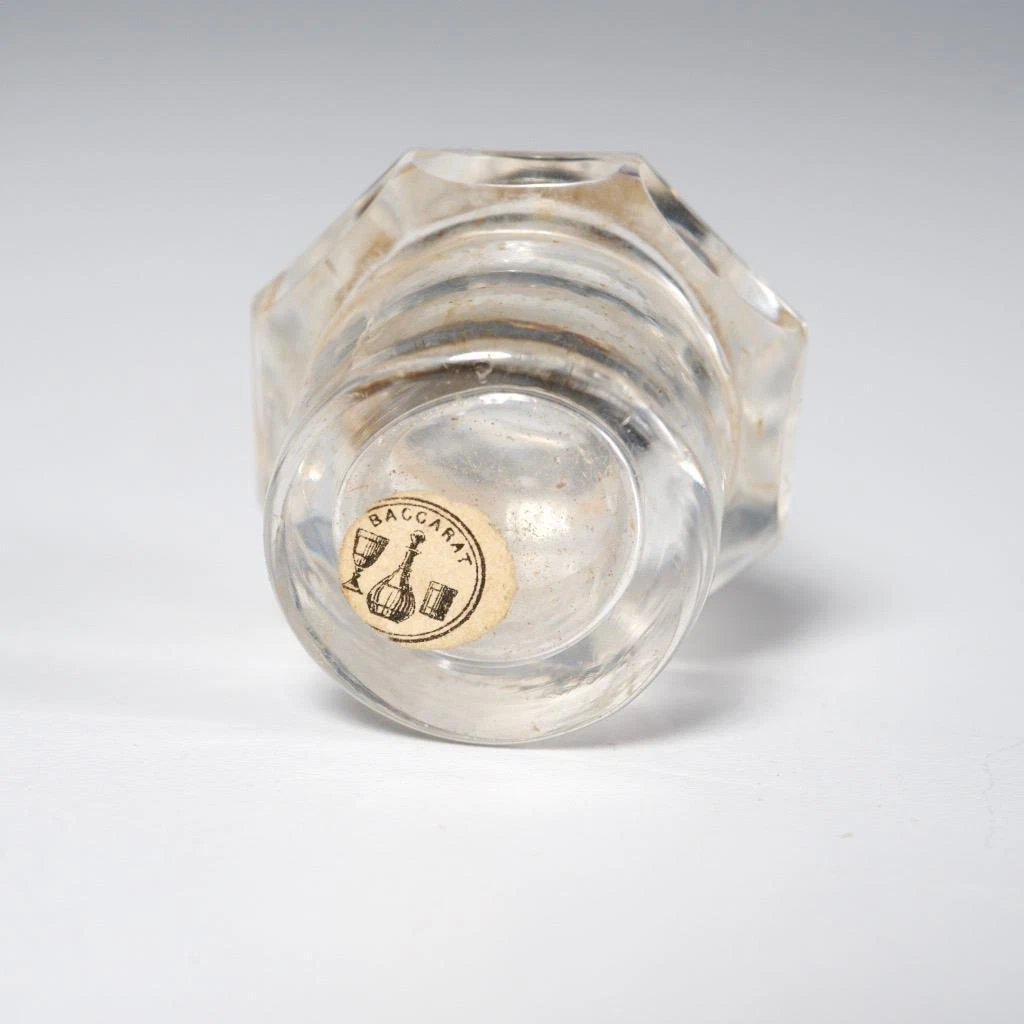
The key to dating this piece is the paper label on the bottom of the glass inkwell.
- The Label: This specific circular label—featuring a carafe, a wine glass, and a goblet—was the first trademark registered by Baccarat in October 1860.
- The Date: Before 1860, Baccarat pieces were rarely signed. After 1936, they moved to acid-etched marks. Because this piece still bears the paper label (which often fell off over time), it is highly likely to have been produced between 1860 and 1890.
- The Maker: While the glass is definitively Baccarat, the entire assembly was likely sold by a high-end Parisian “merchand-mercier” (luxury retailer). Baccarat frequently supplied glass components to “bronziers” (brass workers) who would create the metal frames and add the porcelain elements to create a finished desk accessory.
Is it “Napoleon Era”?
It is not from the “First Empire” (Napoleon I, early 1800s), but it fits perfectly into the Second Empire (Napoleon III). This era was famous for “The Style of the Three Sultans”—a mix of heavy gilding, revivalist motifs (like the serpents), and high-quality materials like crystal and porcelain.
Summary Table
| Feature | Details |
| Origin | France (Paris) |
| Date | c. 1860–1880 |
| Materials | Gilt Brass, Baccarat Crystal, Paris Porcelain |
| Scales | Centigrade (0 -100) and Réaumur (0 – 80) |
| Trademark | Circular Baccarat label (Registered 1860) |
This would have been a high-end luxury item for a well-appointed library or study. Despite the damage to the thermometer, the presence of the original Baccarat label and the intact porcelain make it an interesting piece of French social history.
Sold for $155 in April 2026
Content disclaimer. The information posted is the owner’s best knowledge and may not have been vetted by the SOIC. We welcome comments, corrections, and additions, working to make our website information comprehensive and accurate.
Join the Society of Inkwell Collectors (SOIC) – it’s free!
Founded in 1981 as a non-profit organization,
we are documenting inkwells (and accessories).
We’re here to help and inform!