




Pietra Dura and Cloisonné Inkstand
| Categories | Enameled Metal |
| Type | Cloisonné |
| Material | Enameled Brass/Bronze/Metal, Marble |
| Markings | Unmarked |
| Manufacturer | Undetermined |
| Origin | France |
| Date or Era | circa 1880 |
| Measuring | 7 ½” x 5” x 4” high |
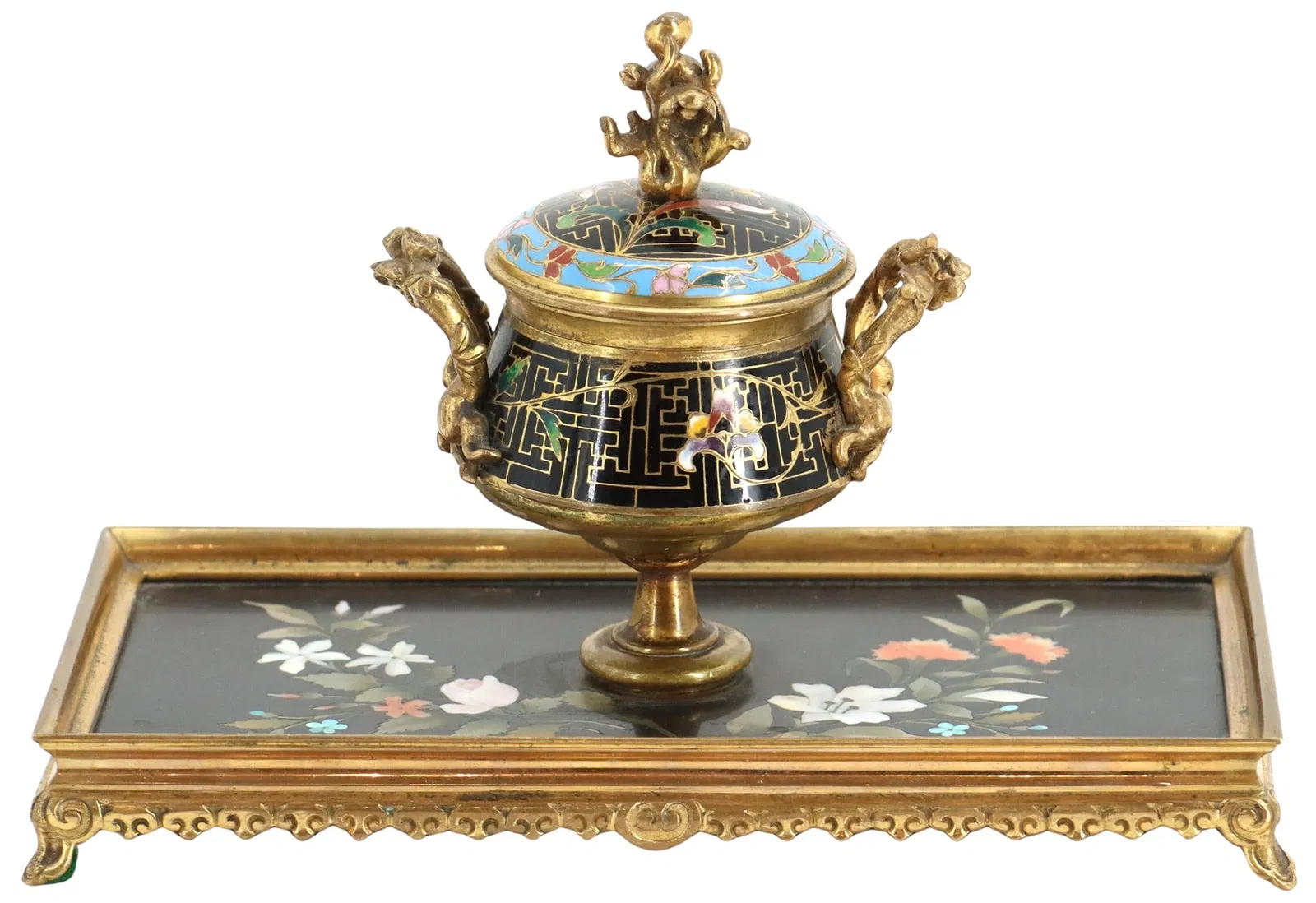
This is an example of late 19th-century eclectic luxury, likely produced during the Napoleon III era (c. 1870–1890). It represents a sophisticated “Grand Tour” style, combining Italian lapidary work with French bronze d’art and Asian-inspired enamel.
Terminology & Techniques
- Pietra Dura (Pietre Dure): From the Italian for “hard stone.” This is a Florentine mosaic technique where highly polished, colored semi-precious stones (such as jasper, agate, or lapis lazuli) are precisely cut and inlaid into a base of black marble or slate. The goal is to create a seamless “painting in stone,” typically featuring floral or botanical motifs.
- Cloisonné: An ancient enameling technique where fine metal wires (cloisons, or “cells”) are soldered to a metal surface to form a pattern. These cells are then filled with colored glass paste and fired in a kiln. The surface is then ground smooth and polished to reveal the intricate design.
Description
The Tray (Pietra Dura)
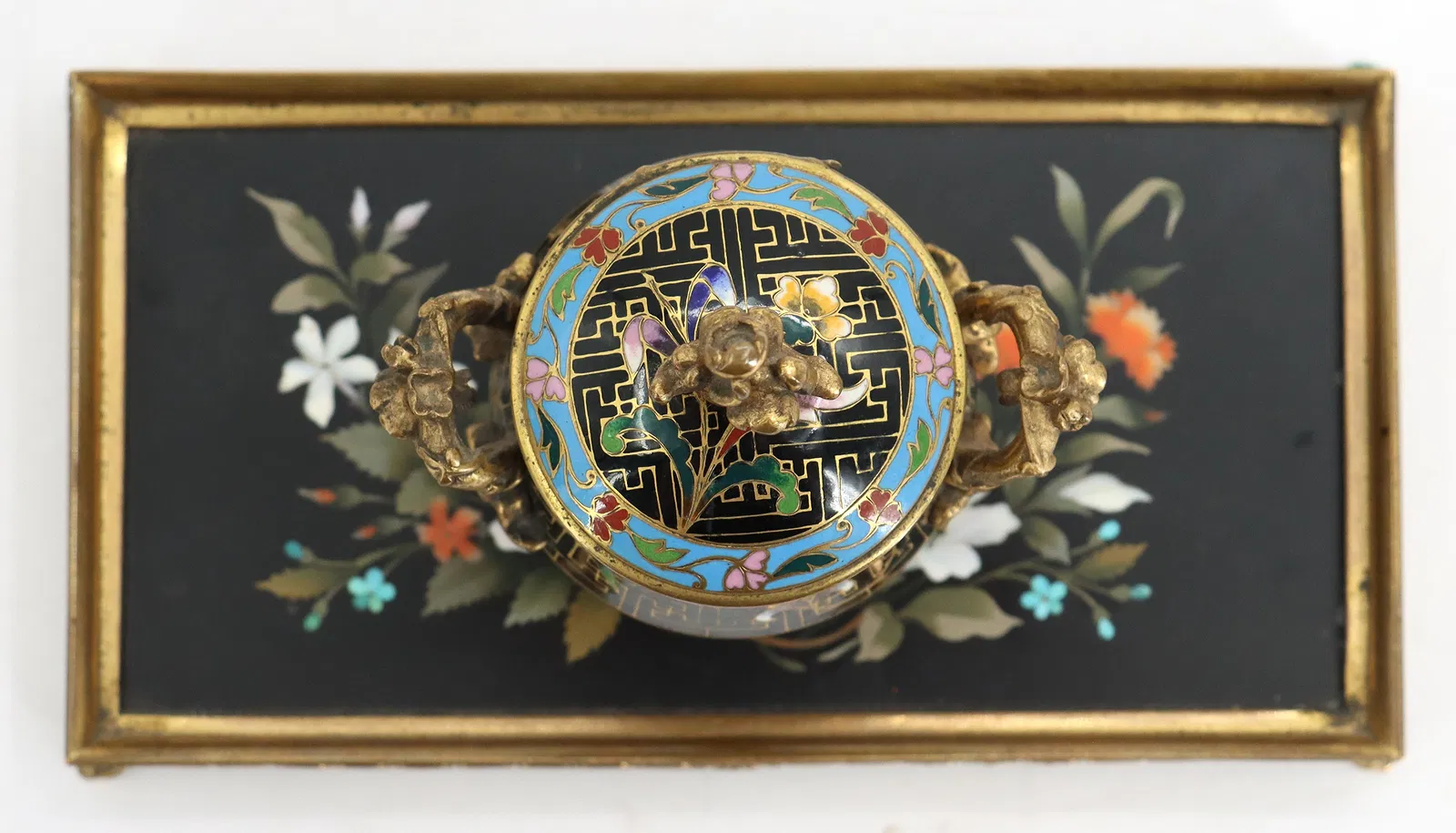
The rectangular tray features a black marble (likely Belgian Black) or slate base. It is decorated with delicate Pietra Dura floral sprays, including white lilies, pink roses, and orange-toned carnations or primulas.
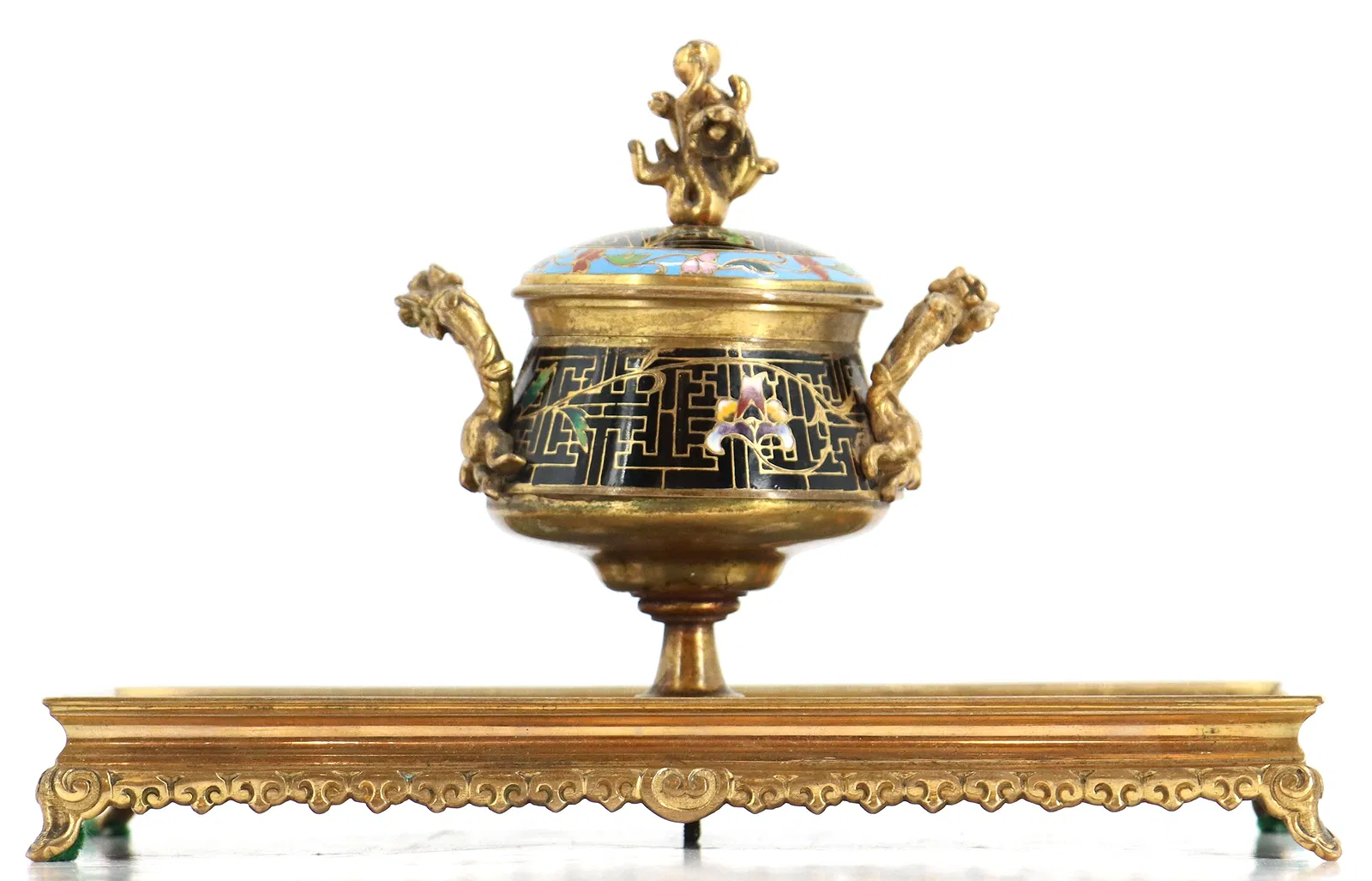
- The Frame: The stone is housed in a heavy cast brass or gilt-bronze frame. It features a pierced, scrolled gallery with a repeating “S-curve” or “sea-scroll” pattern.
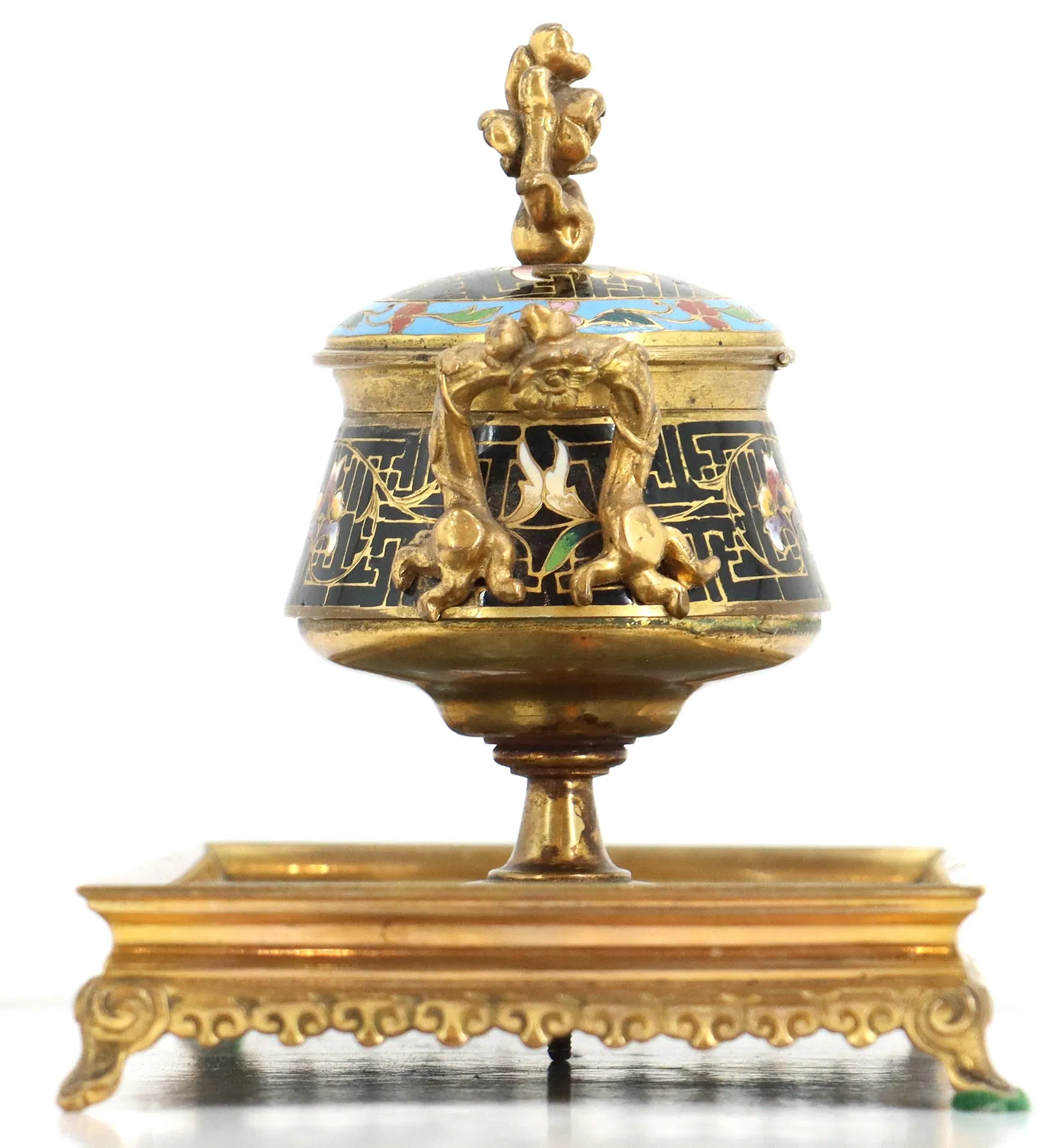
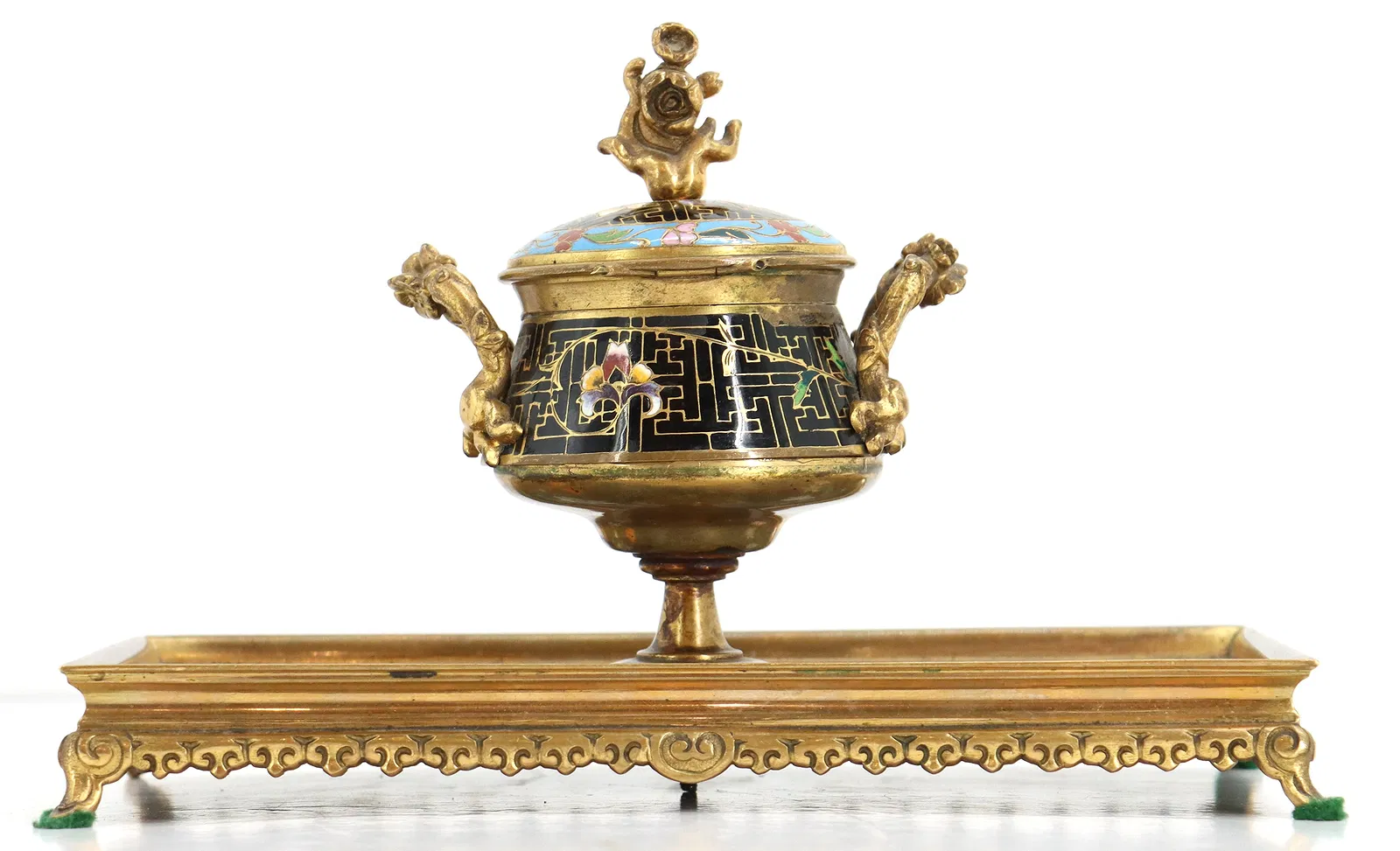
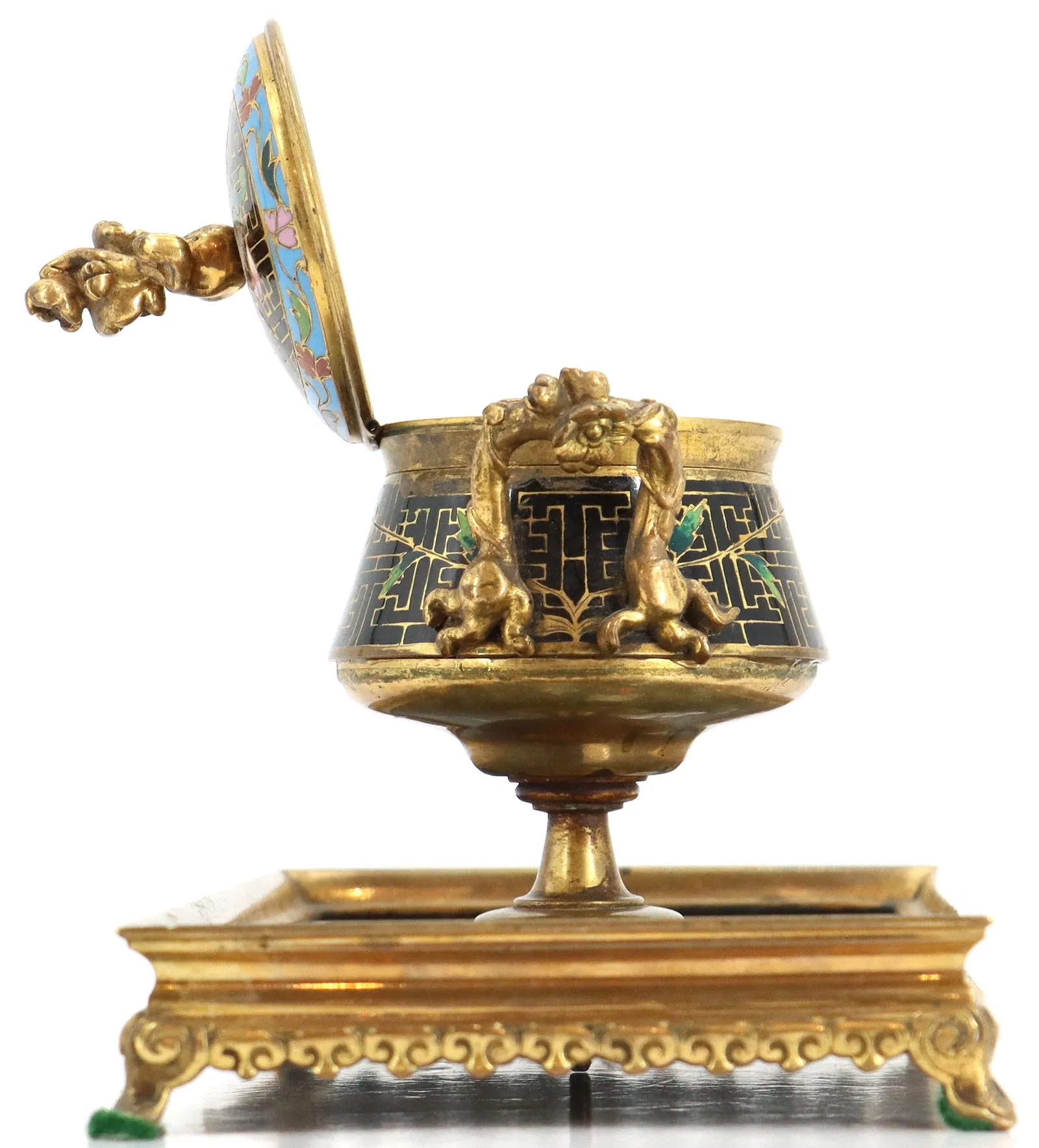
- The Base: It sits on four ornate acanthus leaf-style bracket feet. The underside shows a clean slate/marble slab secured to the pedestal by a central square nut and threaded rod.
The Inkwell (Cloisonné & Brass)
The inkwell is of a classical pedestal or urn form, elevated above the tray to provide a sense of grandeur.
- The Enamel: The body and lid are decorated with black-ground Cloisonné. It features a striking gold-wire geometric fret (meander) pattern that serves as a backdrop for vibrant enameled irises and floral vines in shades of lavender, yellow, and blue.
- The Handles: Flanking the urn are two cast brass handles in the form of stylized dragons or chimaeras, a hallmark of the 19th-century “Japonisme” or “Chinoiserie” movement.
- The Finial: The hinged lid is topped with a heavy, foliate cluster finial, representing a bud or fruit.
- The Interior: Opening the lid reveals a brass-lined well (which would originally have held a glass or ceramic liner).
Origin and Manufacture
- Where & Who: While the Pietra Dura stonework was almost certainly produced in Florence, Italy, the finished inkstand was likely assembled in Paris, France. High-end French firms like Leuchars & Son, Tahan, or Maison Alphonse Giroux frequently imported Italian stone panels and mounted them in their own elaborate bronze and enamel frames to sell to the European elite.
- When: Circa 1875–1885. This period saw a peak in the popularity of “multimedia” desk sets that combined different artistic traditions (Italian, Asian, and French) into a single decorative object.
Sold for $448 in April 2026
Content disclaimer. The information posted is the owner’s best knowledge and may not have been vetted by the SOIC. We welcome comments, corrections, and additions, working to make our website information comprehensive and accurate.
Join the Society of Inkwell Collectors (SOIC) – it’s free!
Founded in 1981 as a non-profit organization,
we are documenting inkwells (and accessories).
We’re here to help and inform!