




French Silver Inkwell with Guilloché Enamel
| Categories | Enameled Metal |
| Material | Enamel, Silver |
| Markings | See narrative |
| Manufacturer | Boin-Taburet |
| Origin | France |
| Date or Era | circa 1890 |
| Measuring | 4” diameter |
This is a nice example of French silverwork, combining high-purity sterling silver with the delicate artistry of guilloché enamel.
Description
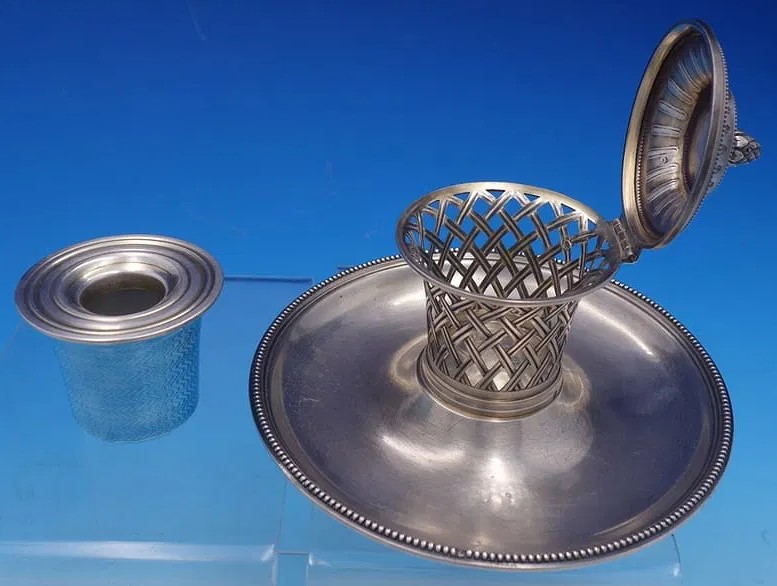
This French silver inkstand consists of a circular, saucer-shaped underplate with a central, integrated inkwell. The piece is crafted in the Louis XVI Revival style, which was highly popular in Paris around the turn of the 20th century.
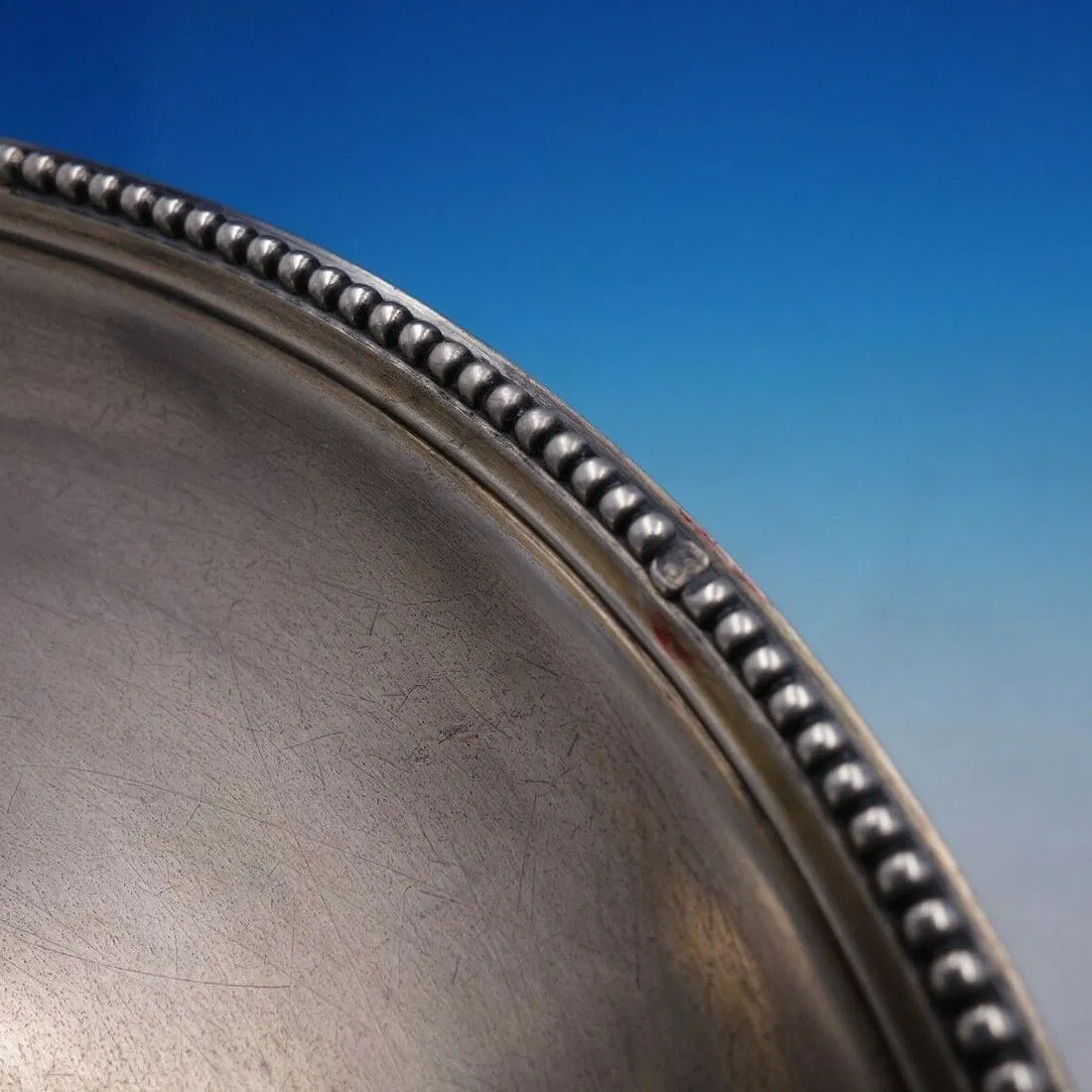
- The Base: The tray features a wide, shallow well and a distinctive beaded (perlé) rim, a classic neoclassical motif. The silver has a soft, lustrous patina typical of high-grade French silver.
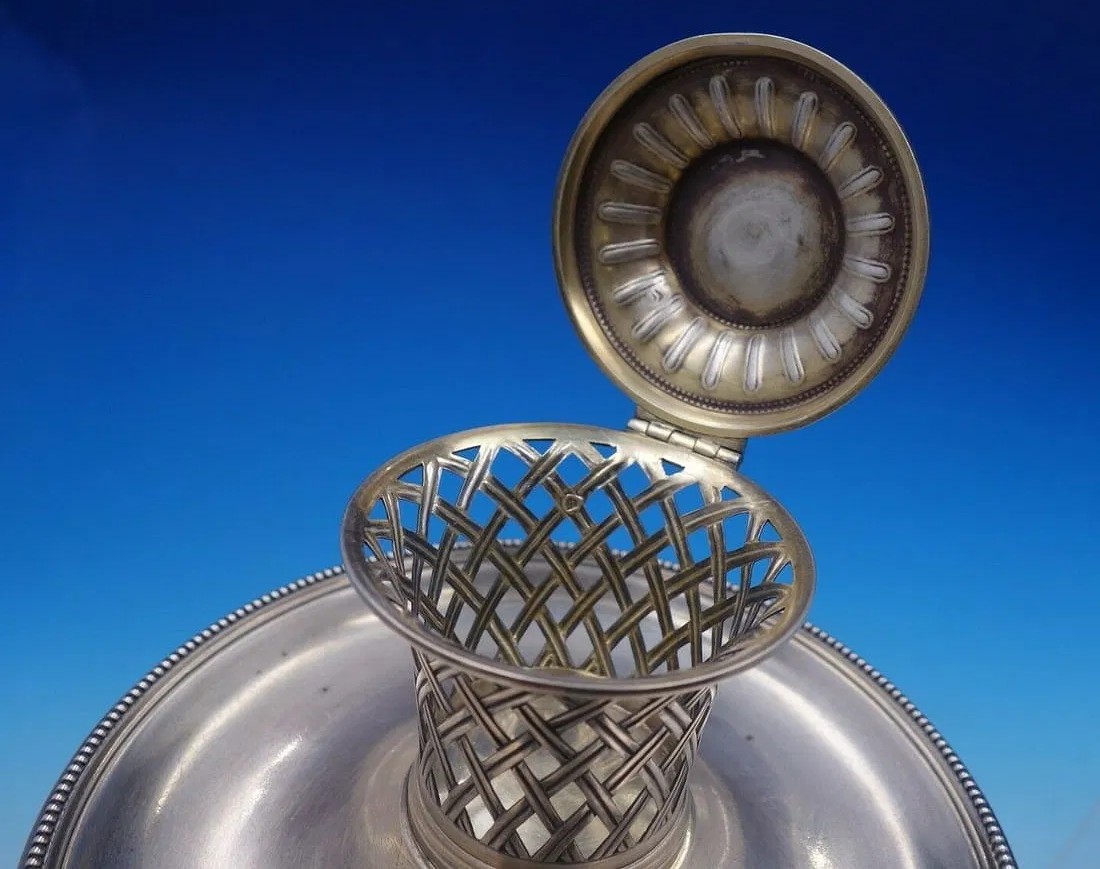
- The Inkwell Body: The central vessel is the focal point, featuring a vibrant, translucent cerulean blue enamel over a machine-engraved ground. This enameled core is encased in an intricate silver lattice or basket-weave overlay. This “filigree” style allows the light to pass through the silver “windows,” catching the textured pattern of the enamel beneath.
- The Lid & Finial: The domed, hinged lid is decorated with radiating gadroons and a matching beaded border. It is crowned by a finely cast pinecone (or artichoke) finial, symbolizing longevity and rejuvenation.
Understanding Guilloché Enamel
Guilloché (pronounced gee-oh-shay) is a decorative technique that involves two distinct stages:
- Engine Turning: A craftsman uses a specialized lathe (called a rose engine) to mechanically engrave precise, repetitive, and intricate geometric patterns into the surface of the silver. These patterns—often waves, zigzags, or sunbursts—create a shimmering effect.
- Enameling: A layer of translucent colored glass (enamel) is applied over the engraved metal and fired in a kiln. Because the enamel is translucent, the engine-turned pattern remains visible through the color, catching and reflecting light like a gemstone.
Marks and Identification
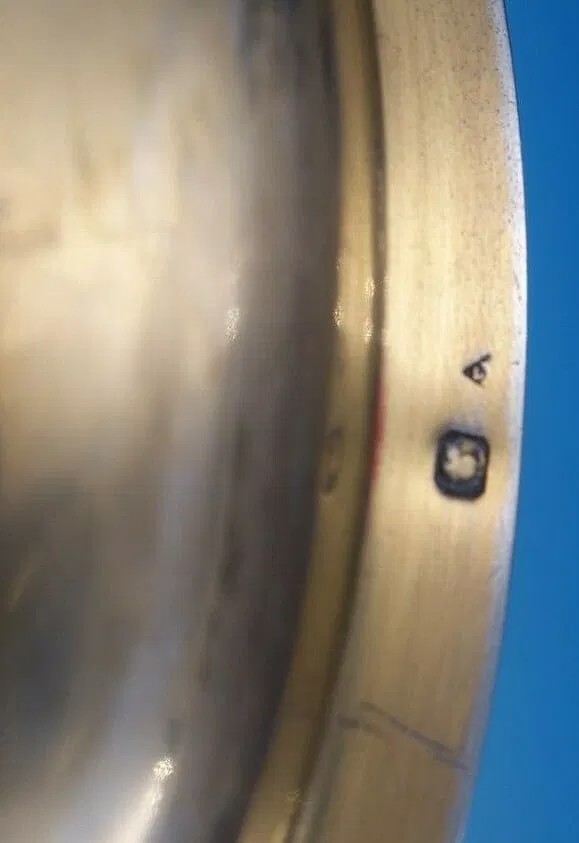
Based on the hallmarks, we can identify both the silver quality and the prestigious maker:
- The Purity Mark (Minerva): The small profile of a woman’s head in a rectangle with clipped corners is the Minerva 1st Standard hallmark. This guarantees a silver purity of 950/1000 (95% pure silver), which is higher than the British Sterling standard of 925.
- The Maker’s Mark: The lozenge-shaped stamp contains the initials G and B with a small symbol in the center. This is the mark of Georges Boin, of the famed Parisian firm Boin-Taburet.
- The Symbol: The tiny object between the initials is a tabouret (a small footstool), a play on the name of his partner and father-in-law, Emile Taburet.
- Date: This specific mark was used by the firm between approximately 1875 and 1900. Given the refined “Louis XVI” neoclassical elements and the specific blue enamel, a date of circa 1890–1900 is most likely.
Boin-Taburet was one of the most celebrated silversmiths in Paris, winning a gold medal at the 1889 Paris Exposition Universelle. They were renowned for their “revival” pieces that captured the elegance of 18th-century French royalty.
The video below offers a fascinating look at how the guilloché patterns are created on a vintage rose engine lathe, showing the precision required for a piece like this inkwell.
This video is relevant because it demonstrates the mechanical “engine-turning” process used to create the intricate patterns beneath the blue enamel of this inkwell.
Sold for $1,188 in April 2026
Content disclaimer. The information posted is the owner’s best knowledge and may not have been vetted by the SOIC. We welcome comments, corrections, and additions, working to make our website information comprehensive and accurate.
Join the Society of Inkwell Collectors (SOIC) – it’s free!
Founded in 1981 as a non-profit organization,
we are documenting inkwells (and accessories).
We’re here to help and inform!