




Arabic Portable Scribe’s Kit
| Categories | Early - Primitive, Middle East / Africa |
| Material | Brass |
| Markings | See Narrative |
| Manufacturer | Undetermined |
| Origin | Syria |
| Date or Era | 15th to early 16th century |
| Measuring | 13 ⅜” long |
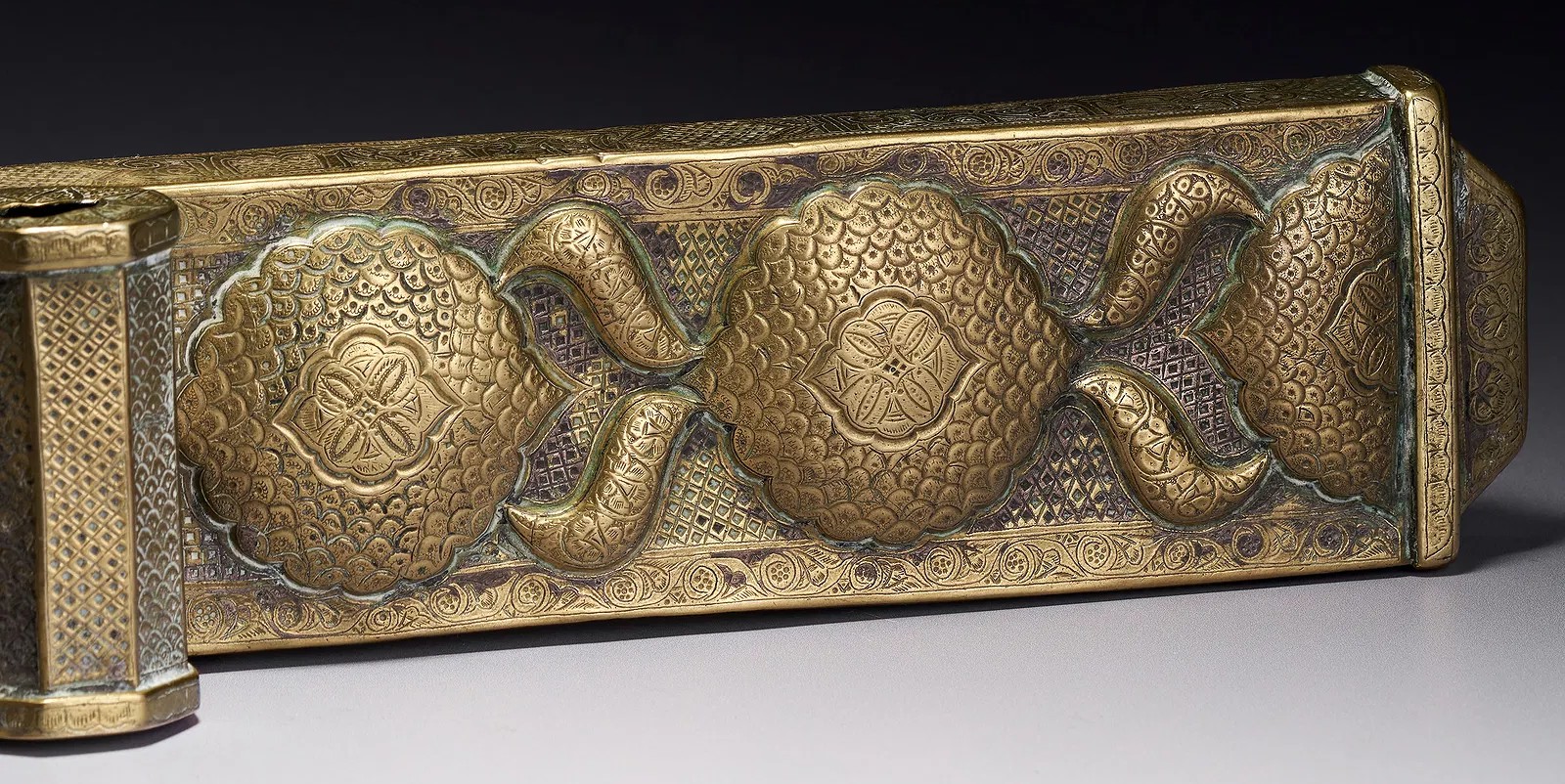
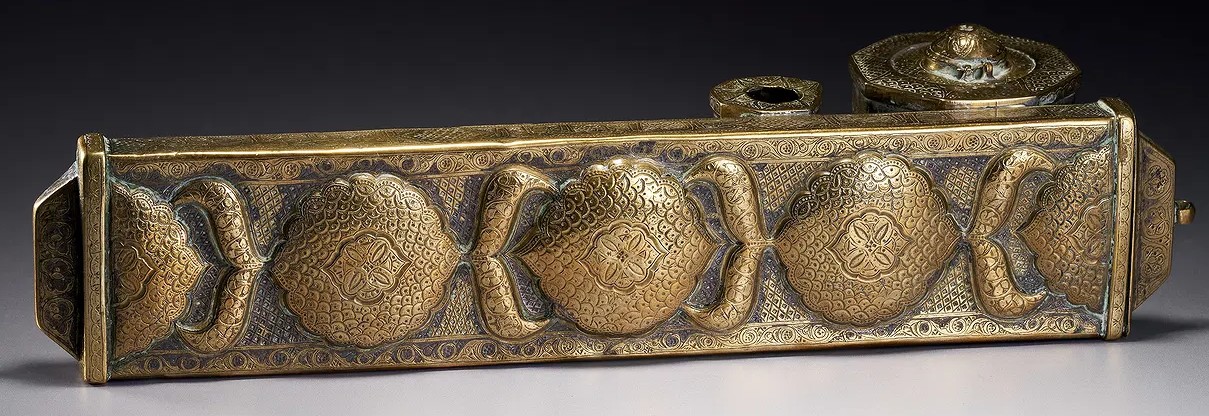
This is an example of a qalamdan (Arabic/Persian), a portable scribe’s kit designed to hold all the necessary tools for calligraphy. Its origin is likely Rasulid (Yemen) or Late Mamluk (Egypt/Syria) from the 15th to early 16th century as this heavy, architectural brass style preceded the more slender, rounded Ottoman versions that became dominant later.
Description
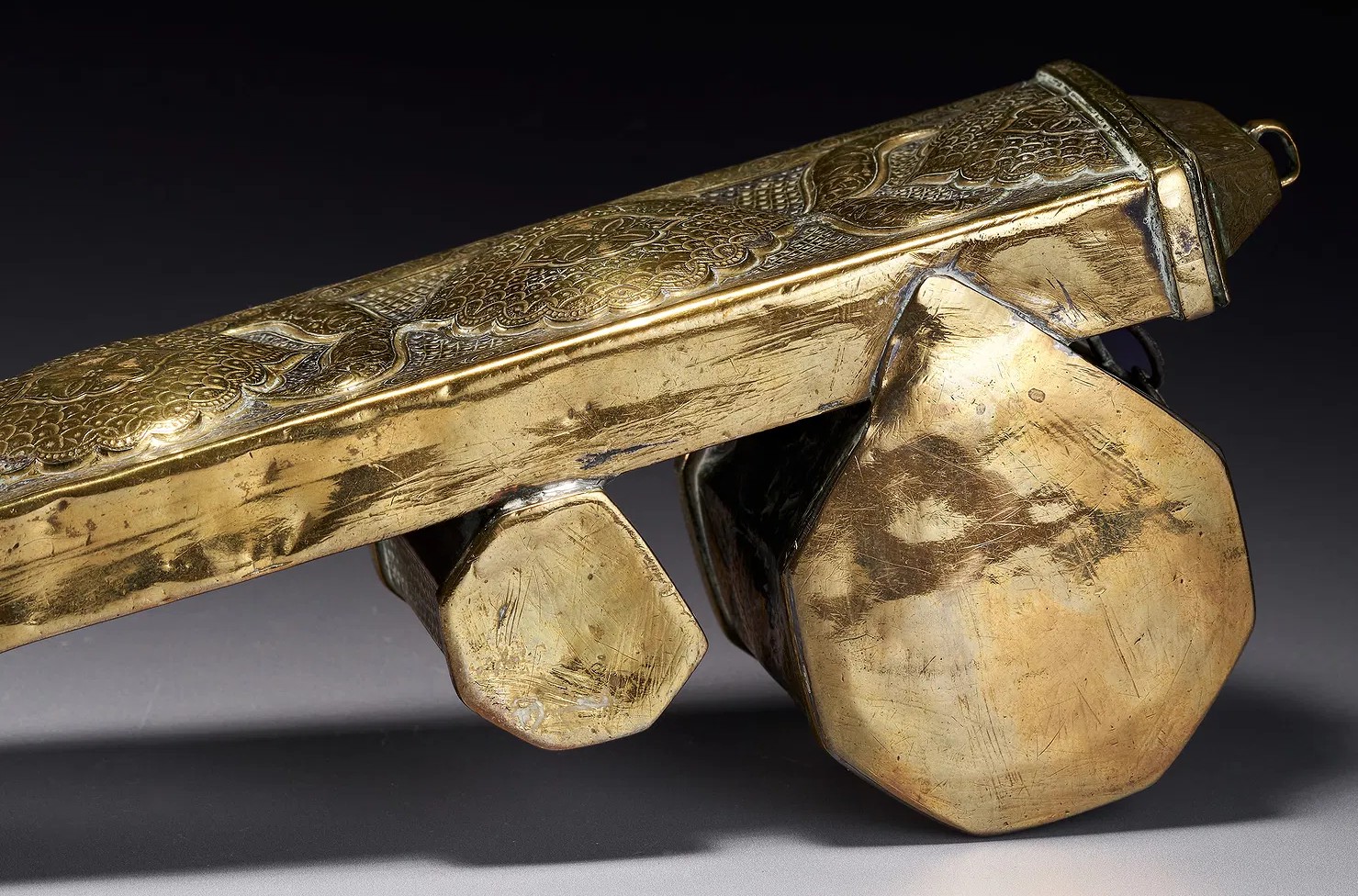
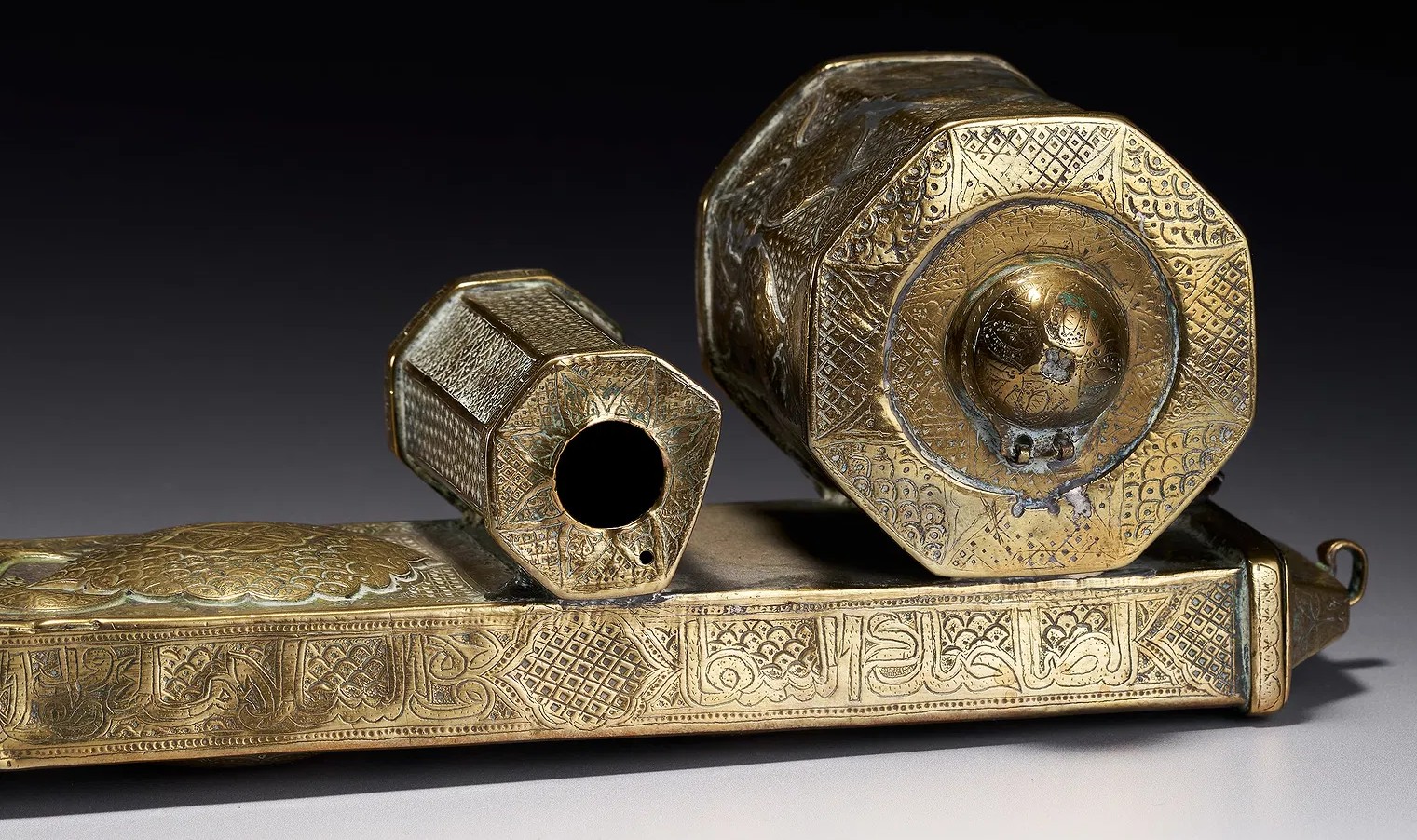
- Form & Construction: A heavy-gauge brass divit consisting of a long rectangular qalamdan (pen case) for reed pens (qalam) and an attached, protruding octagonal dawat (inkwell). The secondary octagonal socket was likely used for sand (to blot wet ink), silk fibers (to regulate ink flow), or a second color of ink (often red for titles).
- Decorative Program: The surfaces feature dense high-relief chasing and engraving. The three circular medallions on the lid are framed by quatrefoils (four-lobed motifs). While the five-petalled rosette is the royal emblem of the Rasulid Sultans, the quatrefoil seen here was a common regional variation used by high-ranking administrators or non-royal elites.
- Inscriptions: There is a band of Thuluth script, a monumental Arabic calligraphy style. It appears to contain a standard “Benedictory Inscription” common to high-status metalwork, beginning with “Al-’izz al-da’im…” (Eternal Glory…) or “Li-sahibihi…” (To its owner…), conveying blessings of prosperity and long life.
- Technique: The recessed “background” areas (scale patterns and cross-hatching) were originally intended to hold silver or gold inlay (and sometimes a black bituminous compound called niello). The visible “silvery” patches on the inkwell are likely the remnants of this original silver sheet or wire.
Usage and Social Context
- Who used it? This was not a tool for a common student but a “badge of office” for a katib (scribe), munshi (secretary), or a high-ranking government official in the Rasulid or Mamluk chancery. In the Islamic world, the pen box was a symbol of state power—comparable to a sword for a soldier.
- How was it used?
- The Case: Held several reed pens, a small knife for trimming nibs, and a makta (nibbing block).
- The Inkwell: Calligraphers typically filled the well with likka (raw silk or wool yarn) soaked in soot-based ink. This prevented the ink from spilling if the box was tilted and ensured the pen only took up exactly what it needed.
- Portability: These were often tucked into a waist sash (zunnar) or carried in the hand as a sign of the owner’s literacy and administrative status.
Verification of Age and Origin
- Origin: The “heavy” octagonal form of the inkwell is strongly associated with Yemen (Rasulid) and Egypt/Syria (Mamluk) metalwork of the 14th–15th centuries. The scale pattern (imbrication) and the geometric cross-hatching are classic “Mamlukizing” motifs that were heavily exported to or imitated in Yemen.
- Age: The transition from the 15th to the 16th century is the “sweet spot” for this piece. By the mid-1500s, under Ottoman influence, the “bulky” rectangular cases were gradually replaced by slimmer, rounded-end brass tubes. The architectural rigidity of this piece (the sharp octagonal corners and flat-faced box) points toward the earlier, late-medieval tradition.
Sold for $1,300 in April 2026
Content disclaimer. The information posted is the owner’s best knowledge and may not have been vetted by the SOIC. We welcome comments, corrections, and additions, working to make our website information comprehensive and accurate.
Join the Society of Inkwell Collectors (SOIC) – it’s free!
Founded in 1981 as a non-profit organization,
we are documenting inkwells (and accessories).
We’re here to help and inform!