

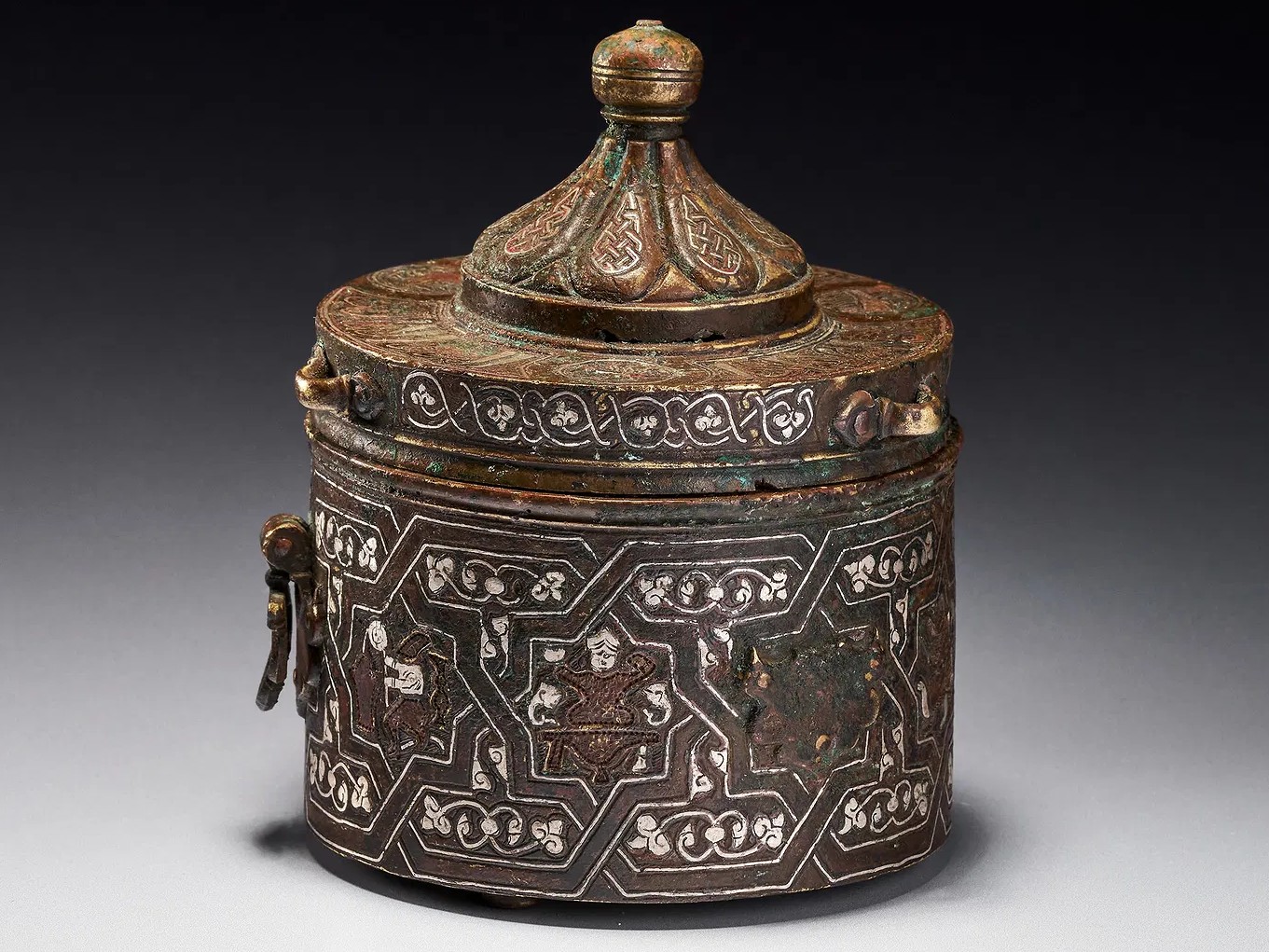



Silver-Inlaid Cylindrical Inkwell (Dawat) with Zodiacal Imagery
| Categories | Early - Primitive, Middle East / Africa |
| Material | Coppered metal, Silver |
| Markings | See Narrative |
| Manufacturer | Undetermined |
| Origin | Afghanistan |
| Date or Era | Late 12th to early 13th century |
| Measuring | 5 ⅛” diameter |
This is a magnificent example of a Khurasan silver-inlaid copper-alloy inkwell (dawat), a hallmark of 12th- and 13th-century Persian metalwork.
Description
Overview & Attribution
- Object: Cylindrical lidded inkwell (dawat).
- Culture/Period: Seljuk/Ghurid period, Khurasan School.
- Origin: Likely Herat (modern-day Afghanistan) or Nishapur. Herat was the preeminent center for this “high-style” inlaid metalwork before the Mongol invasions of 1221.
- Date: Late 12th to early 13th century.
- Material: Cast copper alloy (often referred to as brass or “leaded bronze”) with silver inlay and traces of black organic paste (bitumen) used to highlight the engraving.
The Body: Zodiacal & Planetary Iconography
The “seated personages” represent the Zodiac and Seven Planets, a standard decorative program for high-status Khurasan metalwork.
- Trellis Work: The interlocking “Y-shaped” or geometric trellis creates a series of hexagonal cartouches.
- Figurative Detail: One figure holds a set of balance scales, identifying the sign of Libra. Other figures, such as the musician (likely representing the planet Venus/al-Zuhra) and the figure holding a crescent moon (the Moon/al-Qamar), indicate a celestial protective scheme intended to bring the owner “good fortune” through astrological alignment.
- Background: The background is filled with a dense, scrolling foliate vine, often merging into the “waq-waq” style (where vines end in human or animal heads), though here it remains primarily botanical.
The Lid & Suspension System
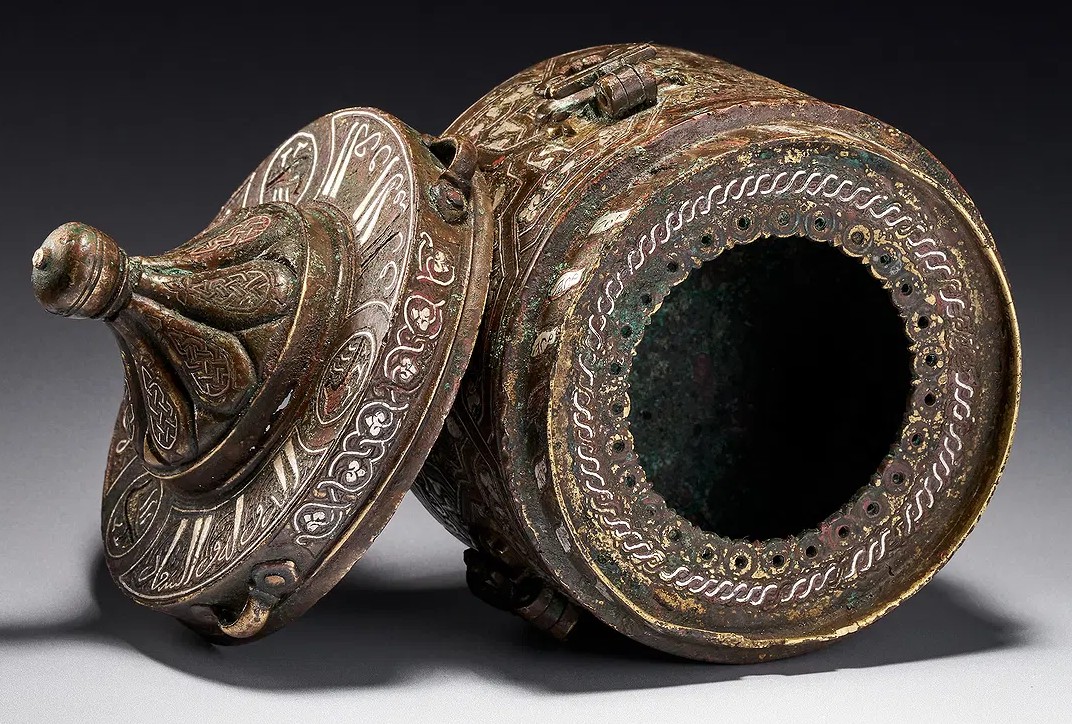
- Finial: The domed, lobed finial resembles the architectural “fluted domes” found in Seljuk funerary architecture. The geometric knotwork on the lobes is a “seal of Solomon” variation, intended as a protective motif.
- Suspension Loops: Note the three sets of protruding loops on the lid that align with corresponding loops on the body. These were functional; silk or leather cords would be threaded through them, allowing the inkwell to be carried securely at a scribe’s waist.
- Interior Rim: The band of repetitive birds (resembling ducks or waterfowl) is a “water” motif, symbolically appropriate for a vessel containing liquid ink.
The Base: Epigraphy & Feet
- Inscription: The script is a sophisticated floriated Kufic or early Naskhi. These “benedictory” inscriptions were standard, typically wishing the owner “Glory, Prosperity, Power, and Happiness” (al-izza wa al-iqbal wa al-dawla wa al-sa’ada).
- Feet: The three teardrop-shaped feet (often called “nipple feet” in some catalogs) are cast as part of the base to provide stability.
- Central Medallion: The base features a complex, twelve-pointed interlaced geometric knot, mirroring the celestial themes on the body.
Summary Description
Title: Silver-Inlaid Cylindrical Inkwell (Dawat) with Zodiacal Imagery Region: Khurasan (likely Herat), Eastern Iran/Afghanistan Date: Late 12th–Early 13th Century
Description: A heavy, cast copper-alloy inkwell of cylindrical form with a hinged, domed lid. The exterior is elaborately decorated with silver inlay against an engraved ground. The body features a geometric trellis forming six hexagonal cartouches, each containing a seated figure representing a sign of the Zodiac or a planetary body; notably, the figure of Libra is visible holding scales. The lid is surmounted by a fluted, lobed finial with silver-inlaid interlace, flanked by concentric bands of scrolling foliate motifs and three suspension loops for portable use.
The interior shoulder displays a delicate band of repetitive water birds and a “rope” border. The underside of the vessel is supported by three teardrop feet and is centered by a complex interlaced medallion. A wide circular band of silver-inlaid Arabic script in floriated Kufic provides a series of benevolent wishes (as-sa’ada being prominent). The patina shows characteristic verdigris and oxidation consistent with an early 13th-century attribution.
A Note on Condition
The hinge and clasp are intact, though there is significant loss of silver inlay in the recessed areas – a common occurrence where the “keying” (the tiny hatched lines that hold the silver) has worn down. The verdigris inside the rim is a natural result of the copper alloy reacting to moisture or the acidic components of medieval ink (which often contained iron gall or carbon).
Sold for $3,499 in April 2026
Content disclaimer. The information posted is the owner’s best knowledge and may not have been vetted by the SOIC. We welcome comments, corrections, and additions, working to make our website information comprehensive and accurate.
Join the Society of Inkwell Collectors (SOIC) – it’s free!
Founded in 1981 as a non-profit organization,
we are documenting inkwells (and accessories).
We’re here to help and inform!