







Sailboat Theme – Nippon Porcelain
| Categories | Ceramics/Porcelain "Named" Makers, Far East / Oriental |
| Type | Nautical |
| Material | Porcelain |
| Markings | See Narrative |
| Manufacturer | Nippon |
| Origin | Japan |
| Date or Era | circa 1915 |
| Measuring | 5 ½” x 4 ¼” x 2 ¾” high |
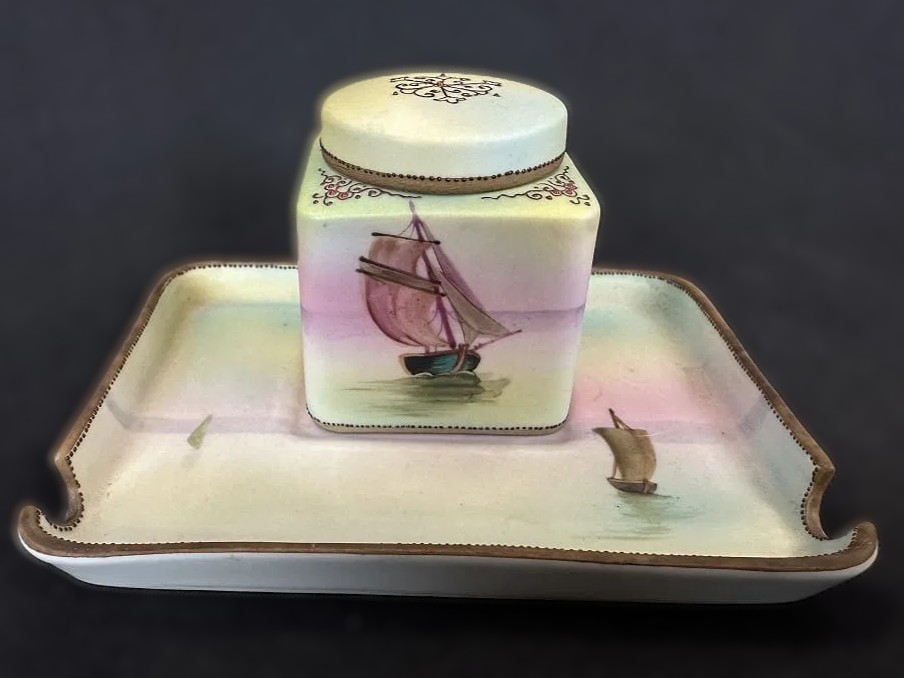
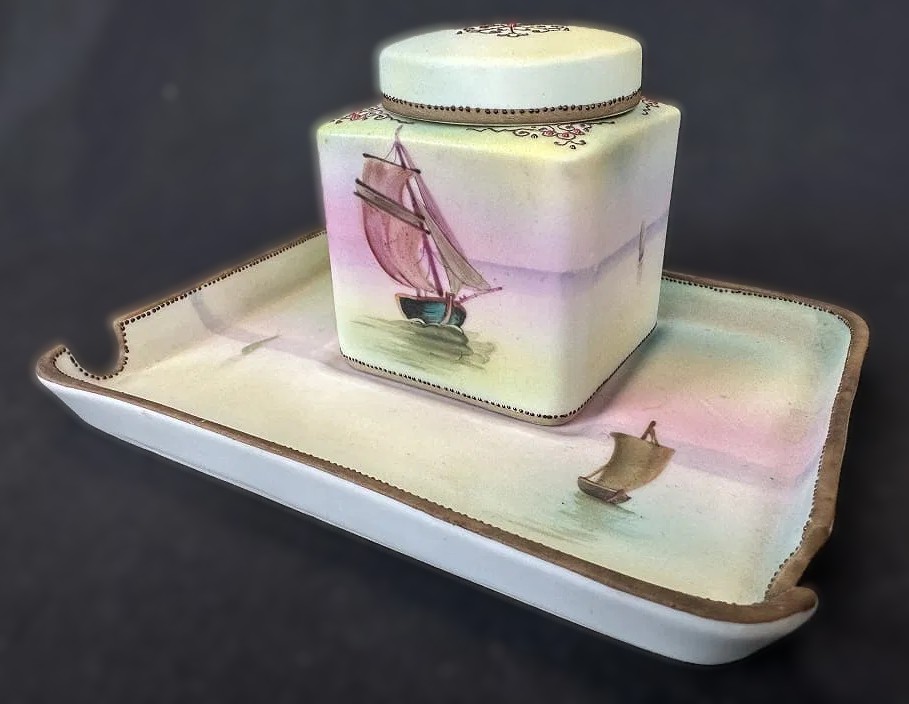
This is a nice example of Morimura Brothers porcelain, showcasing the tranquil “Seascape” or “Sailboat” motif that was favored by Western collectors during the late Meiji and Taishō eras. The set is notable not only for its hand-painted artistry but for its completeness.
Description
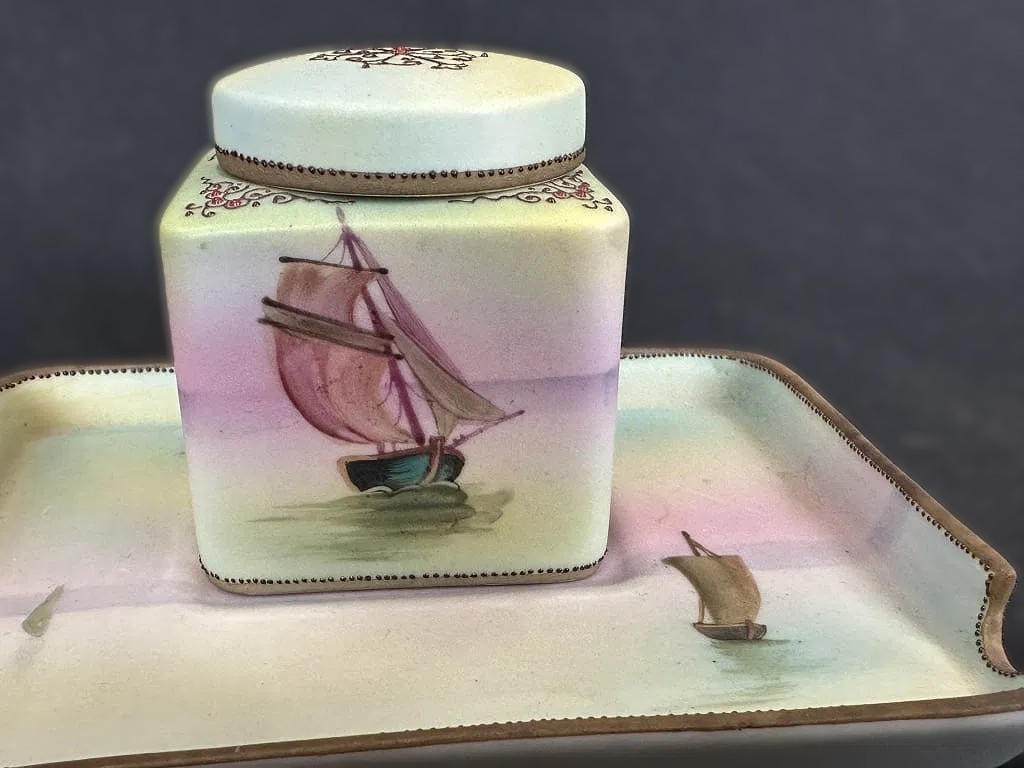
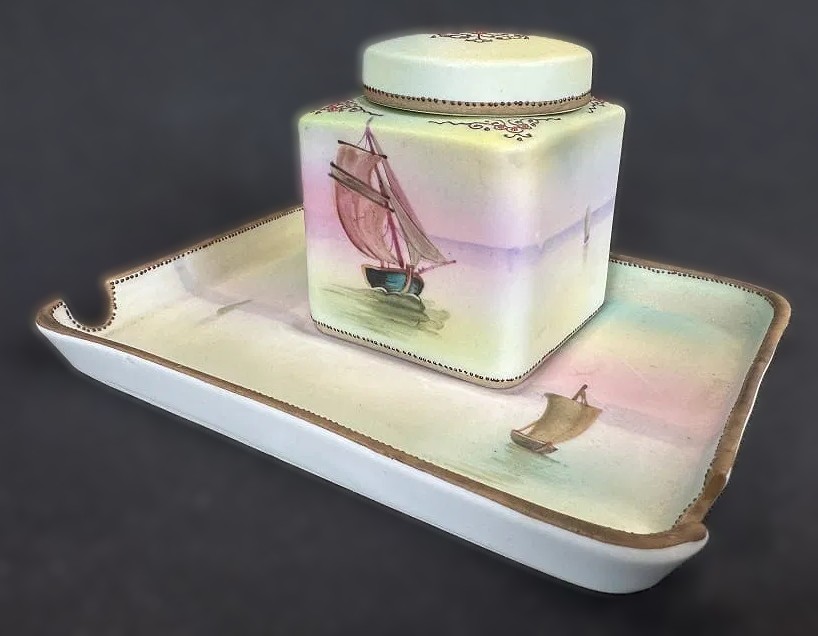
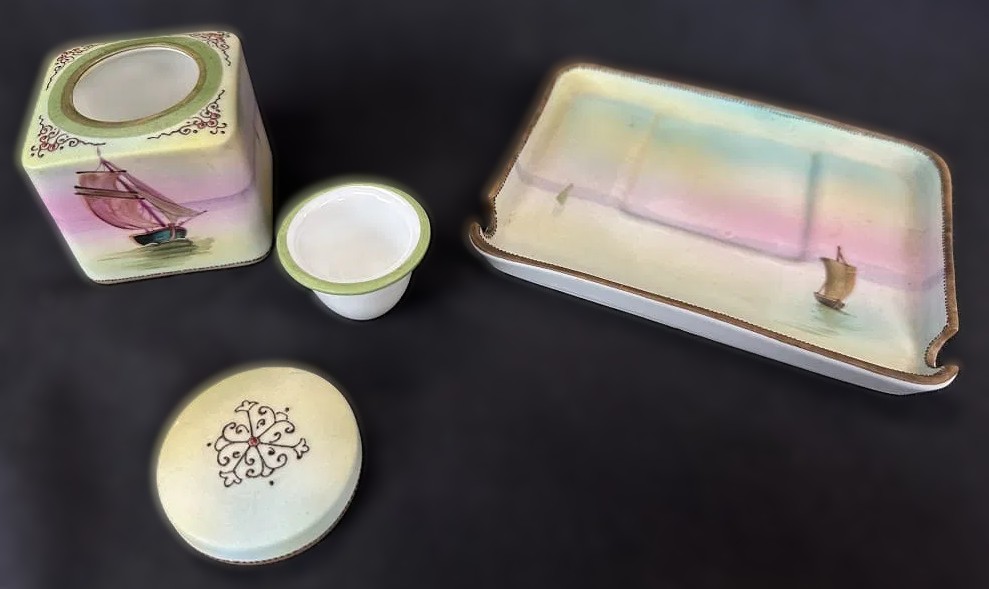
Overall Aesthetic and Palette This two-piece porcelain desk set consists of a square-form inkwell and a wide, rectangular matching pen tray. The set is executed in a tonalist nautical style, characterized by a soft, matte “satin” finish. The palette features a sophisticated blend of pastels—dusky pink, pale lemon yellow, and sage green—seamlessly blended to evoke a hazy, atmospheric sunset or sunrise over calm waters.
The Inkwell and Lid
- Form: The inkwell is a robust, square vessel with softly rounded shoulders.
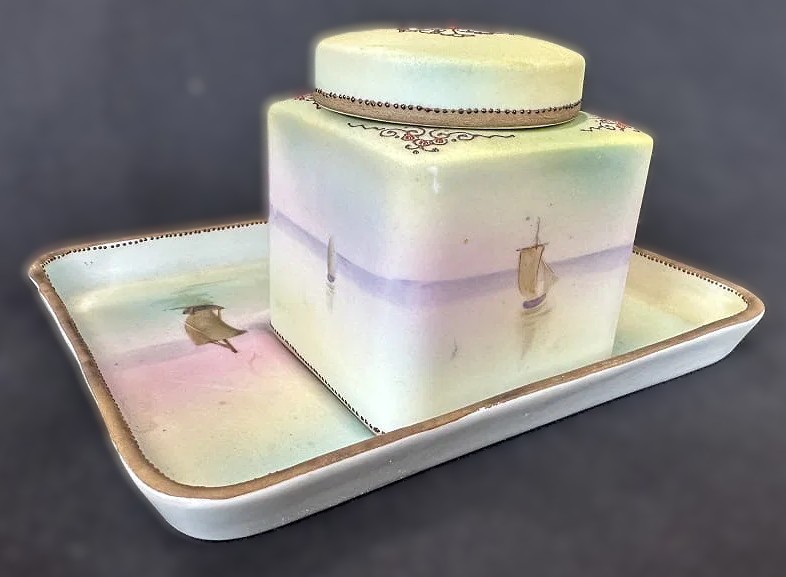
- Decoration: The front face features a prominent, hand-painted sailboat with detailed sienna-colored sails and a dark-blue hull, rendered with fine, sketchy brushwork to suggest movement. The seascape continues around the sides with smaller “ghost” ships on the horizon, providing a sense of immense scale and depth.
- Moriage Work: The shoulders of the inkwell and the top of the lid are adorned with intricate moriage (raised enamel) scrollwork. The lid features a central stylized “jeweled” medallion in black enamel with coral-red dots.
- Interior: The set is complete with its original, removable white porcelain liner insert.
The Pen Tray (Underplate)
- Form: A wide rectangular tray with “notched” or recessed corners, designed to serve as both a protective base for the inkwell and a resting place for pens.
- Design: The tray mirrors the inkwell’s seascape, featuring a smaller sailboat to the right and a distant sail to the left, maintaining the composition’s balance. The entire perimeter is finished with a “beaded” moriage border in a dark bronze or chocolate tone, which provides a crisp frame for the soft pastel imagery.
Mark and Dating
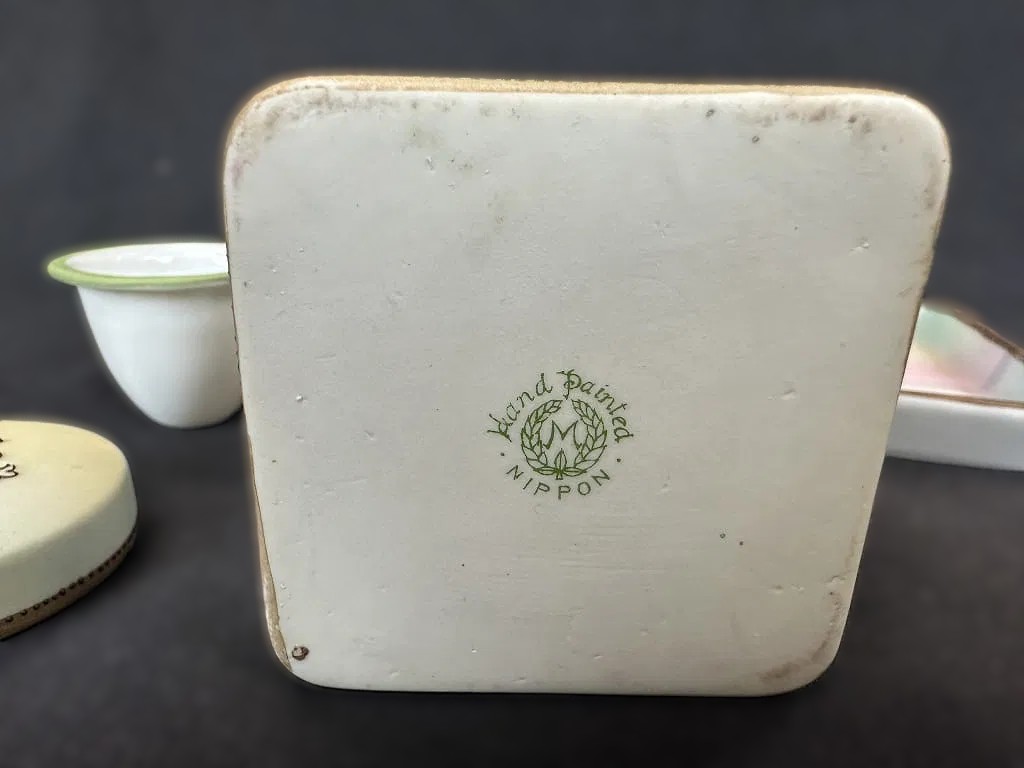
Maker’s Mark: The underside of the inkwell bears the green “M-in-Wreath” mark, surmounted by the words “Hand Painted” and “NIPPON” below. The “M” stands for the Morimura Brothers, the visionary importers who bridged the gap between Japanese craftsmanship and American Victorian/Edwardian tastes.
Dating: c. 1911–1921
- The specific “M-in-Wreath” mark was registered in 1911 and used extensively until 1921.
- In 1921, U.S. Import Customs regulations changed (under the McKinley Tariff Act) to require that goods be marked with the English name of the country of origin (“Japan”) rather than the Japanese name (“Nippon”). Consequently, pieces marked “Nippon” almost certainly pre-date 1921.
Historical Context
- The Noritake Connection: The Morimura Brothers (Ichitaro and Toyo) founded the company that would eventually become the world-renowned Noritake. This inkwell represents the pinnacle of their “Nippon” era, where the goal was to compete with fine European porcelain houses like Limoges and Sèvres by offering high-quality, hand-decorated wares.
- Technical Artistry: The “Sailboat” or “Lake” themes were often produced by artists at the Morimura-kumi factory in Nagoya. They utilized a “fukiye” (spray) technique or very soft blending with brushes to achieve the atmospheric sky, which was then punctuated by the sharp, detailed lines of the rigging and the tactile texture of the moriage.
Sold for $100 in April 2026
Content disclaimer. The information posted is the owner’s best knowledge and may not have been vetted by the SOIC. We welcome comments, corrections, and additions, working to make our website information comprehensive and accurate.
Join the Society of Inkwell Collectors (SOIC) – it’s free!
Founded in 1981 as a non-profit organization,
we are documenting inkwells (and accessories).
We’re here to help and inform!