





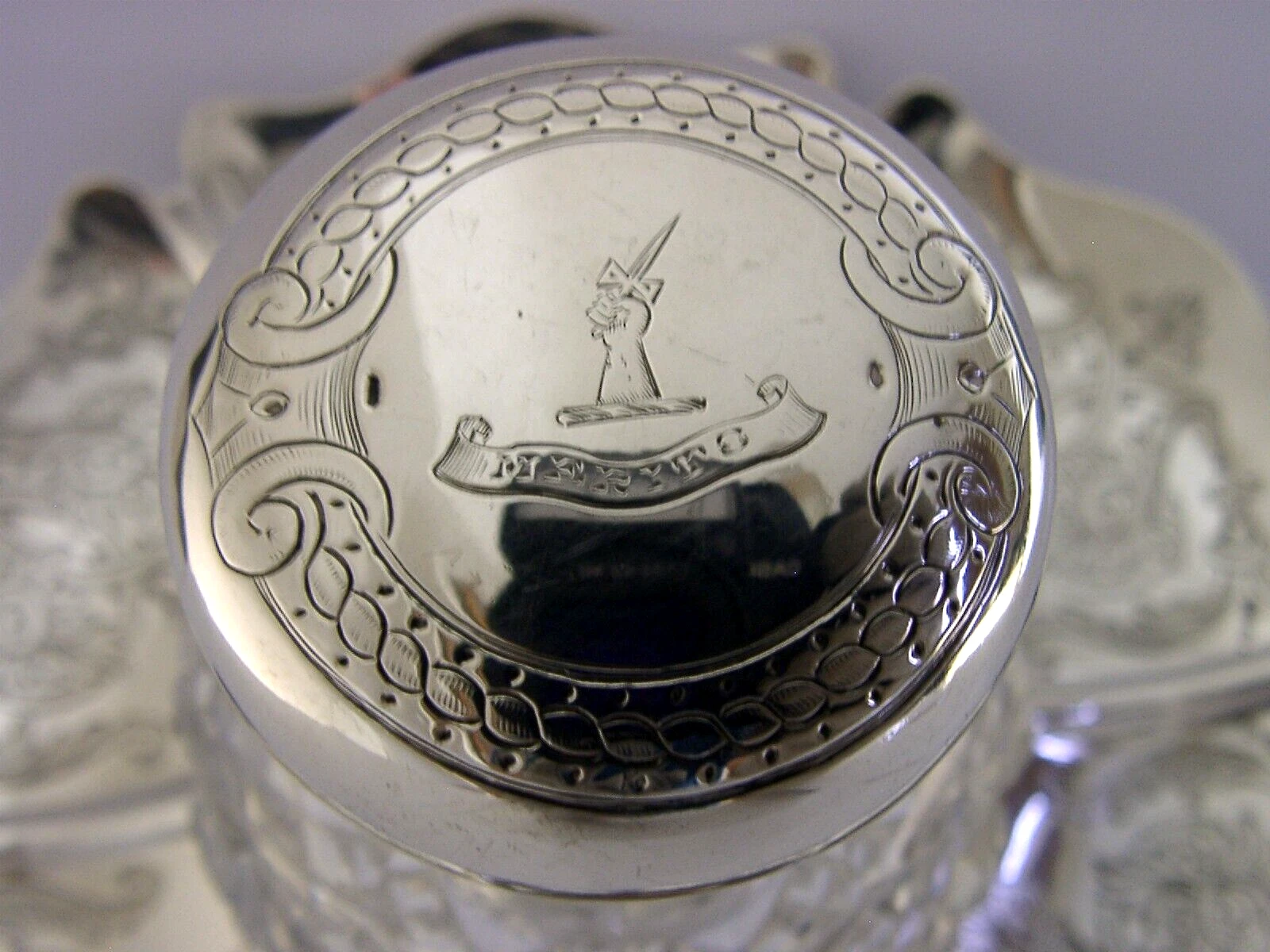


Sterling Silver & Cut-Glass Inkstand (1866)
| Categories | Silver |
| Material | Glass, Silver |
| Markings | See Narrative |
| Manufacturer | Edward Ker Reid |
| Origin | England |
| Date or Era | circa 1866 |
| Measuring | 7” across (the base); 3 ¾” high x 3 ¼” diameter (inkwell) |
The Silver Stand
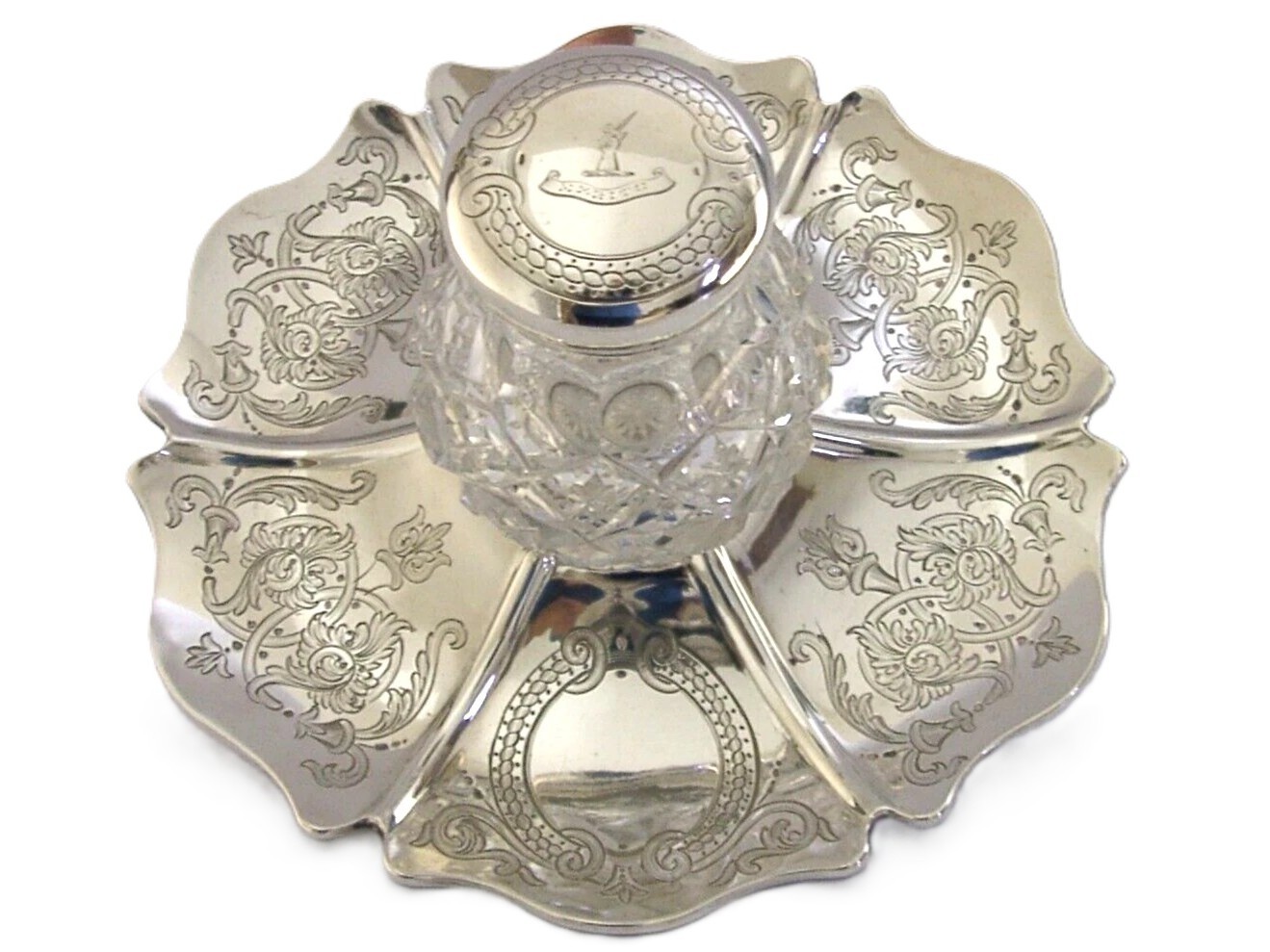
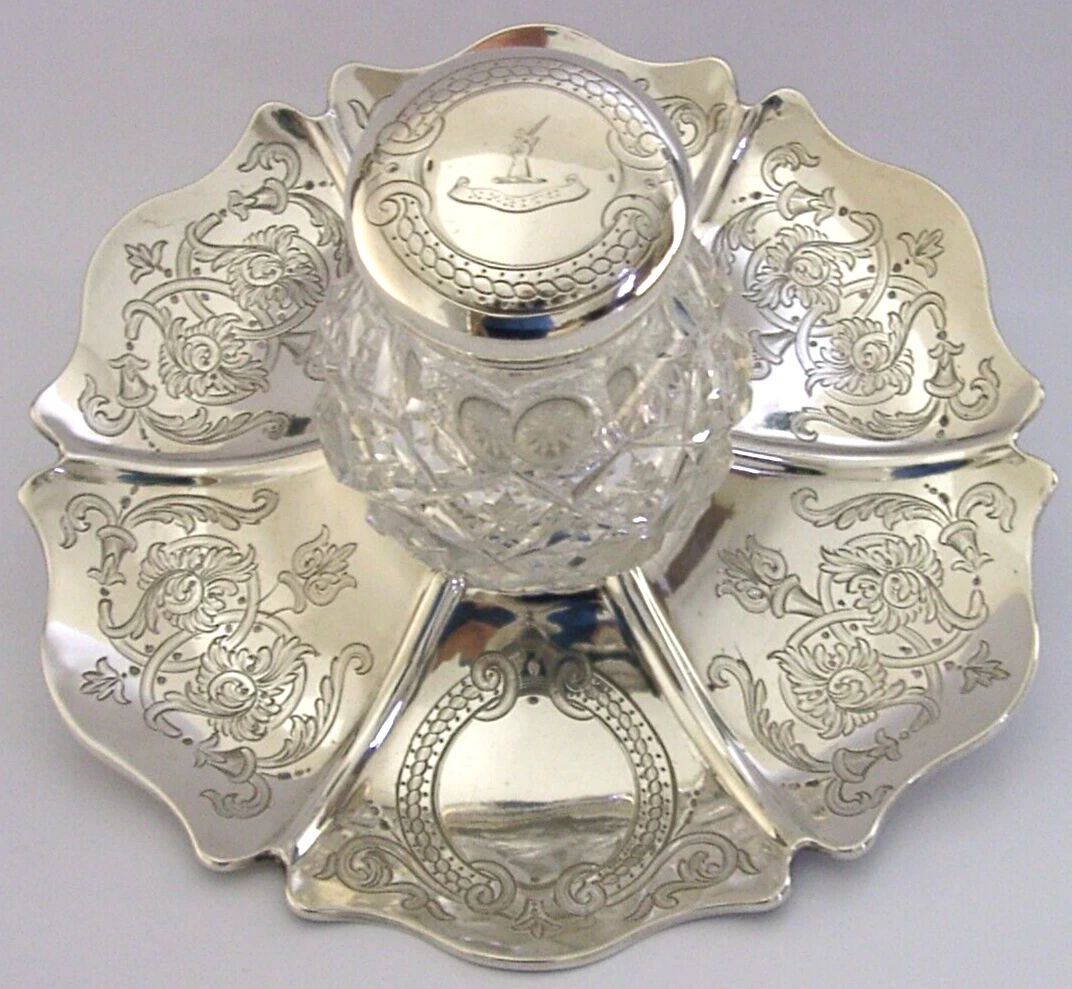
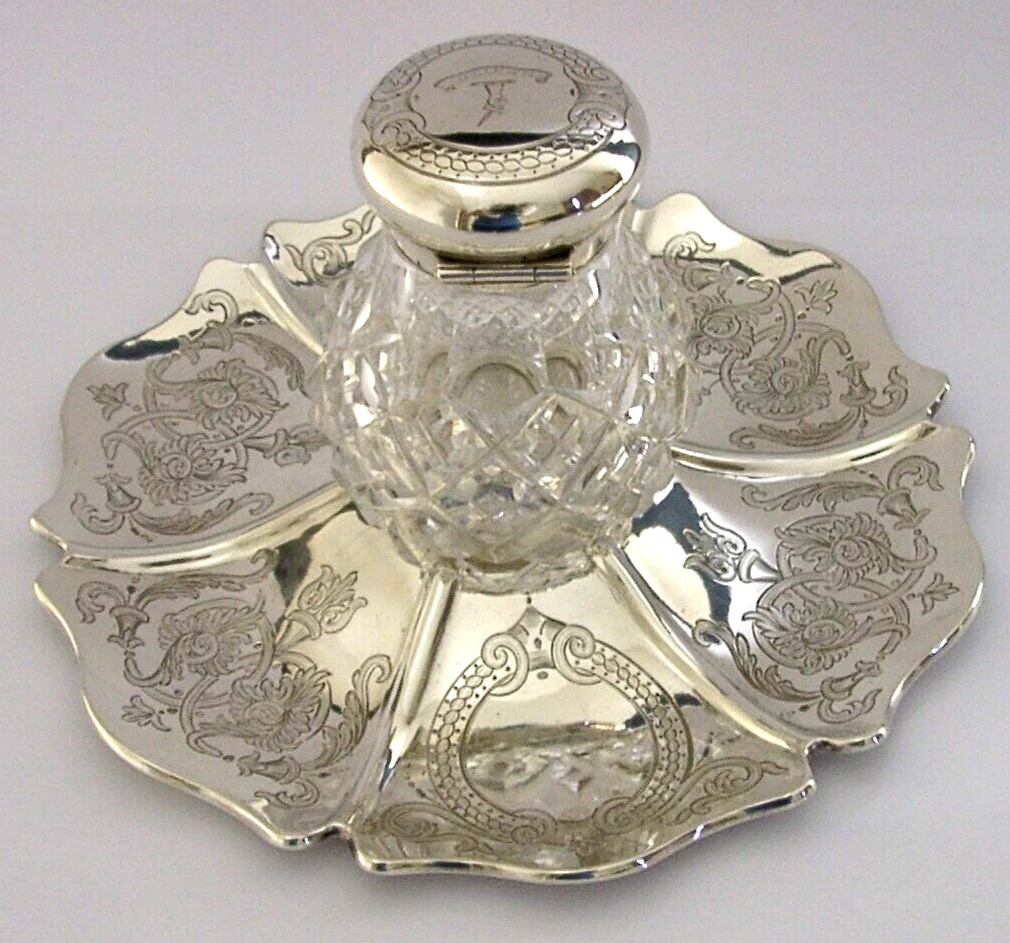
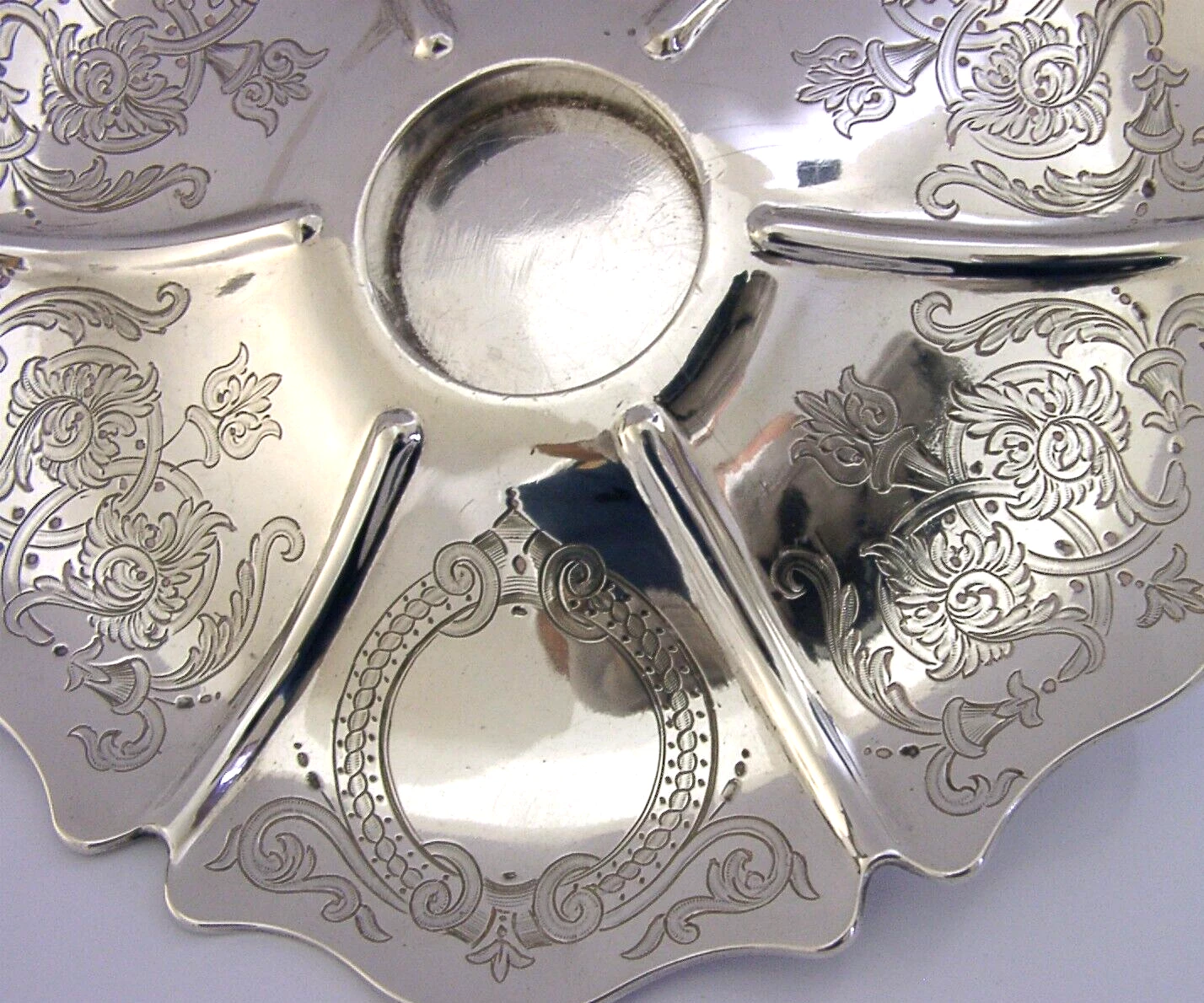
The stand is crafted from solid sterling silver with a distinctive lobed or scalloped perimeter, featuring six elegant sections. The surface is elaborately decorated with hand-engraved foliate scrolls, floral motifs, and “C-scrolls” that give the piece a sense of movement and depth.
- Design: The stand features a central recessed ring designed to securely hold the glass inkwell.
- Dividers: Raised ridges radiate from the center, dividing the tray into hexagonal segments, each filled with intricate “bright-cut” style engravings.
- Edge: The rim is slightly up-turned, finished with a smooth, polished border that contrasts beautifully with the dense engraving of the interior.
The Cut-Glass Inkwell
The inkwell itself is made of heavy, high-clarity flint glass (lead crystal), featuring a deep diamond-cut (hobnail) pattern.
- Body: The globular body catches the light at various angles, a hallmark of mid-Victorian glasswork.
- Collar & Lid: The glass is fitted with a sterling silver collar and a substantial domed, hinged lid. The lid is finished with a smooth, high-polish shine to highlight the family crest at its center.
Heraldry: The Dunlop Family
The lid is masterfully engraved with the Dunlop family crest:
- Crest: A dexter (right) hand holding a dagger erect.
- Motto: The banner below reads “MERITO,” which is Latin for “Deservedly.” Significance: Clan Dunlop is a historic Scottish family from Ayrshire. The motto reflects a spirit of merit and earned success, common in the martial and social history of the Scottish Lowlands.
The Maker: Edward Ker Reid (EKR)
Edward Ker Reid was a member of one of Britain’s most prestigious silversmithing dynasties.
- Reid & Sons: The firm was founded in Newcastle in 1788 by Christian Ker Reid. By the time this piece was made in 1866, the family had earned a Royal Appointment from Queen Victoria (granted in 1838) and had exhibited at the Great Exhibition of 1851.
- Pedigree: Edward was the son of William Ker Reid. He further solidified the family’s elite status by marrying Anna Barnard, the daughter of John Barnard. This union effectively merged the Reid family with the Barnard family, the most prolific and famous silver manufacturing firm of the 19th century.
- Style: Reid’s work from the 1860s is known for its structural integrity and “High Victorian” elegance—balancing heavy, durable materials with delicate, precise engraving.
Hallmarks Summary
The piece bears a full set of English hallmarks for London, 1866:
- EKR: The maker’s mark for Edward Ker Reid.
- Lion Passant: Authenticating the silver as .925 sterling.
- Leopard’s Head: The city mark for the London Assay Office.
- Date Letter “l”: Indicating the year 1866.
- Queen Victoria’s Head: The duty mark, showing that the required tax had been paid to the Crown.
Sold for $820 in March 2026
Content disclaimer. The information posted is the owner’s best knowledge and may not have been vetted by the SOIC. We welcome comments, corrections, and additions, working to make our website information comprehensive and accurate.
Join the Society of Inkwell Collectors (SOIC) – it’s free!
Founded in 1981 as a non-profit organization,
we are documenting inkwells (and accessories).
We’re here to help and inform!