




Courting Couple on a Tandem
| Categories | Advertising, Sports |
| Type | Bicycle |
| Material | Cast iron |
| Markings | See Narrative |
| Manufacturer | Undetermined |
| Origin | United States |
| Date or Era | circa 1895 |
| Measuring | 10” across; 11” high |
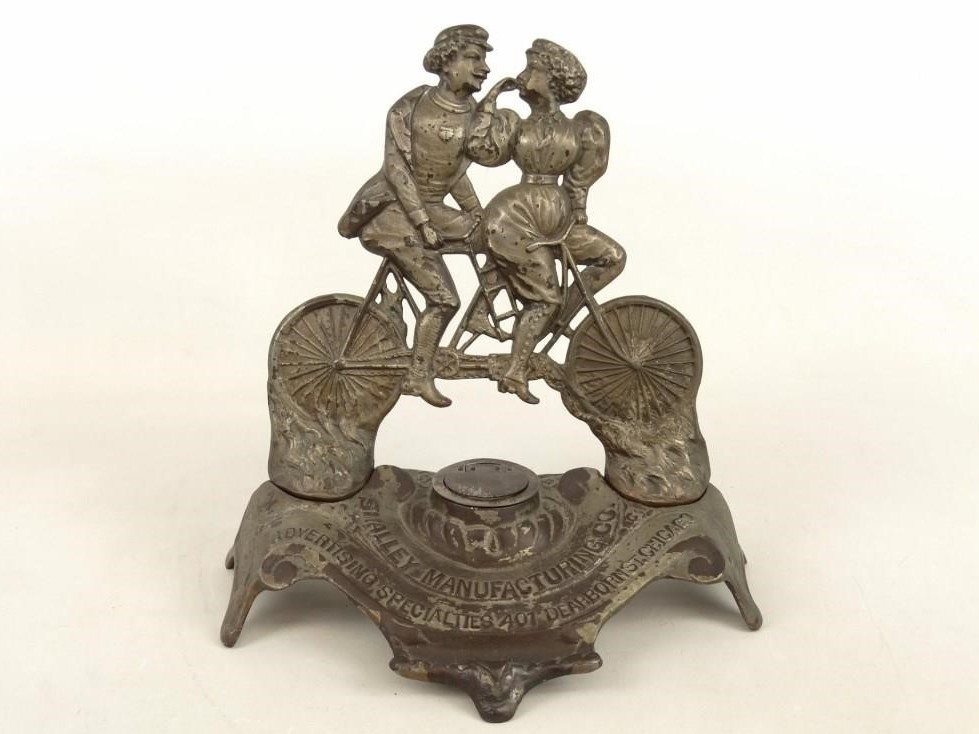
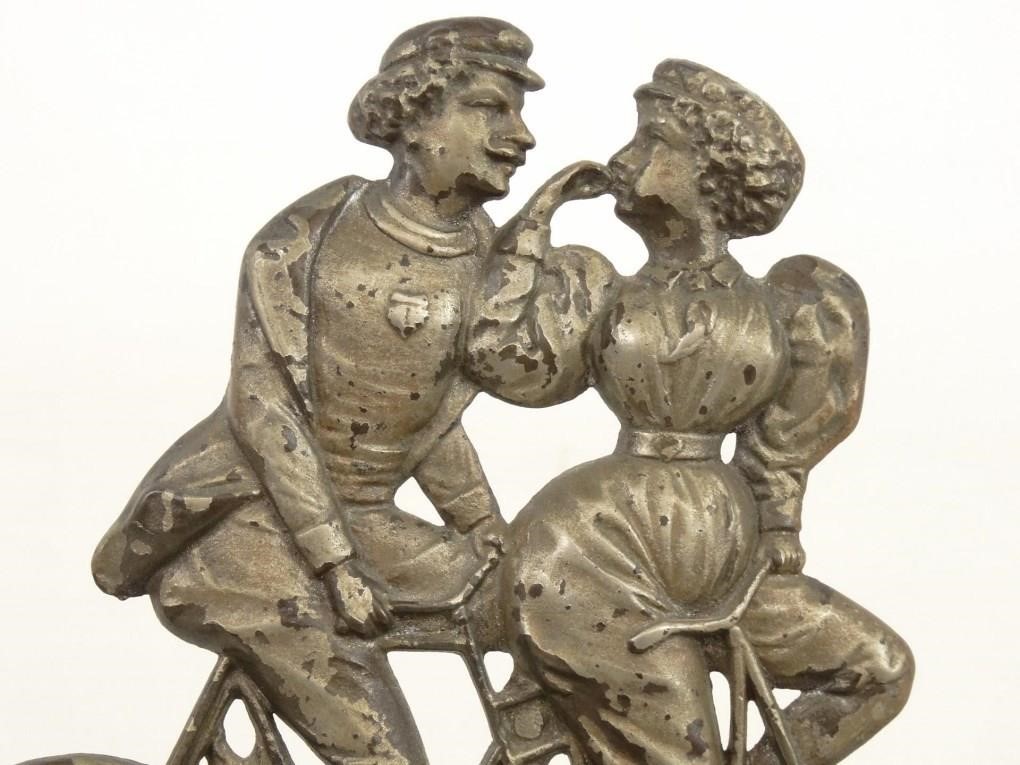
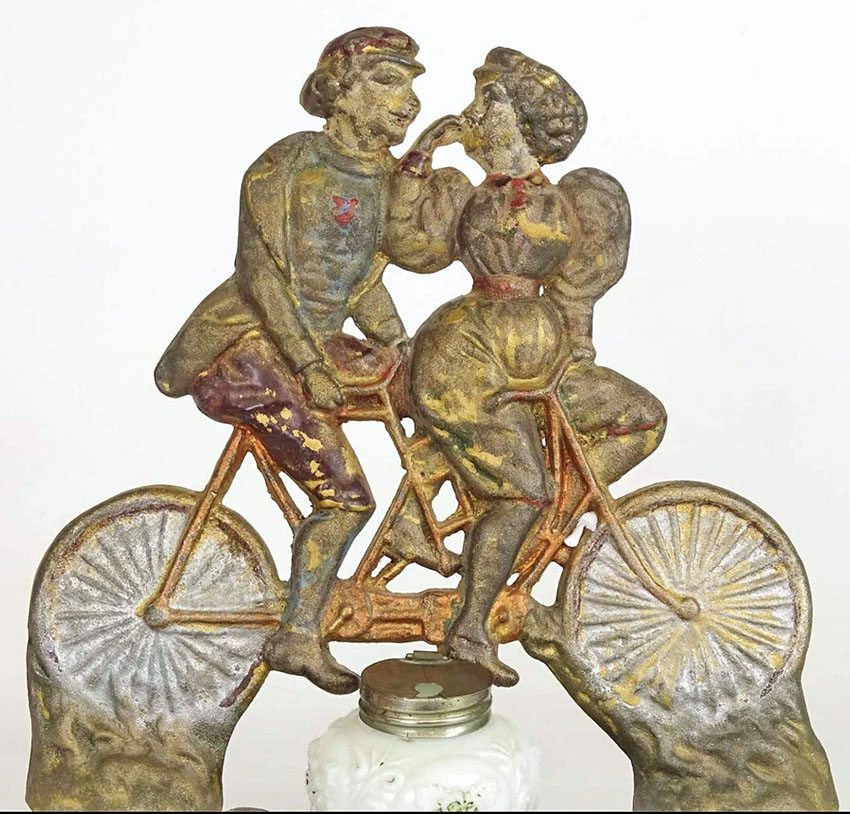
These charming inkstands are examples of novelty metalware from the late 1890s, capturing the peak of the American bicycle craze. The design depicts a man and a woman on a “lady-front” tandem, a configuration that was both a technical innovation and a social gamechanger.
The “Courting Tandem”
The “lady-front” style (popular roughly 1895–1899) placed the woman in the front seat, but the bicycle was actually steered from the rear via a linkage system. This allowed the man to control the direction while the couple engaged in what was then considered a daringly private activity.
During this era, social etiquette strictly required young couples to be accompanied by a chaperone. However, the tandem bicycle provided a loophole: a fit young couple could simply out-pedal an older chaperone on foot or in a carriage. This earned the bicycle its nickname, the “courting tandem,” as it became a symbol of independence and romantic freedom for the “New Woman” of the 1890s.
Description of the Two Inkstands
While both pieces share the same figural casting, they represent two different “lives” for this design:
The Advertising Specialty (Smalley Manufacturing Co.):
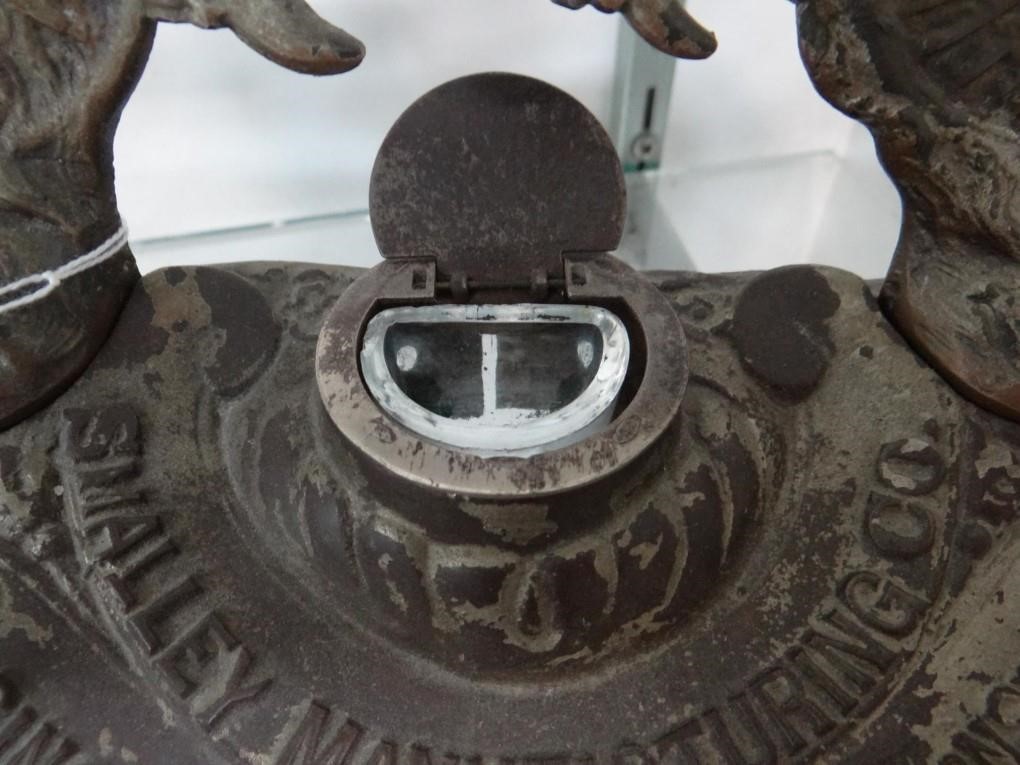
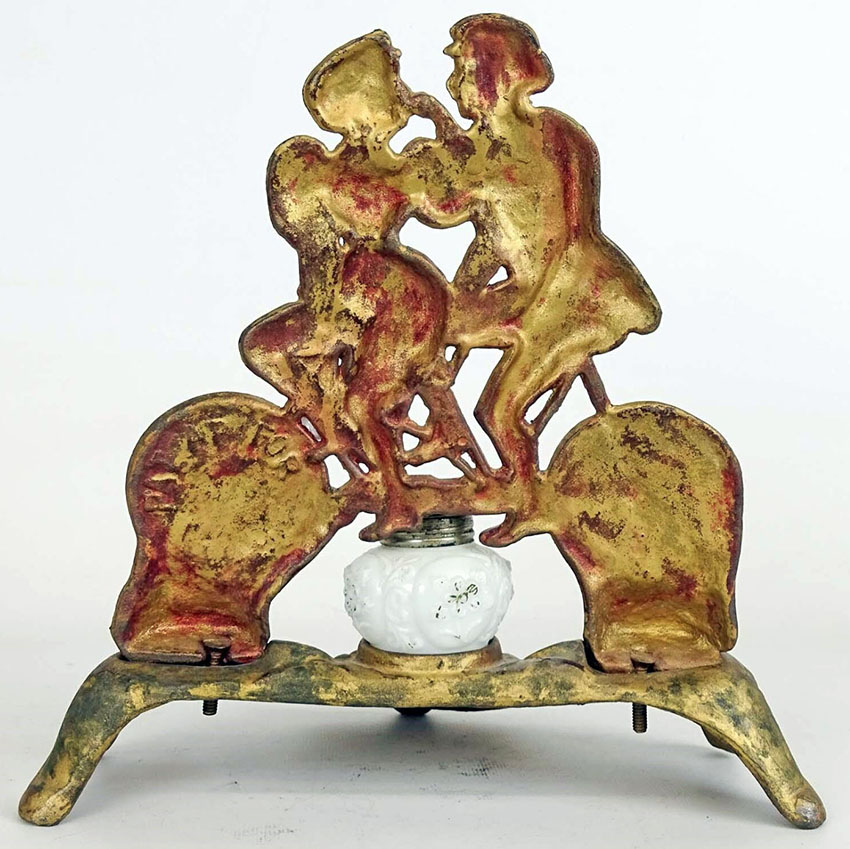
Markings: The base is clearly embossed with: “SMALLEY MANUFACTURING CO. / ADVERTISING SPECIALTIES 401 DEARBORN ST. CHICAGO.”
- Context: 401 Dearborn Street was the site of the Pontiac Building, a historic Chicago skyscraper that housed numerous printing and advertising firms. Smalley likely acted as a distributor, purchasing “blank” inkstands from a foundry to be customized as high-end promotional gifts for corporate clients.
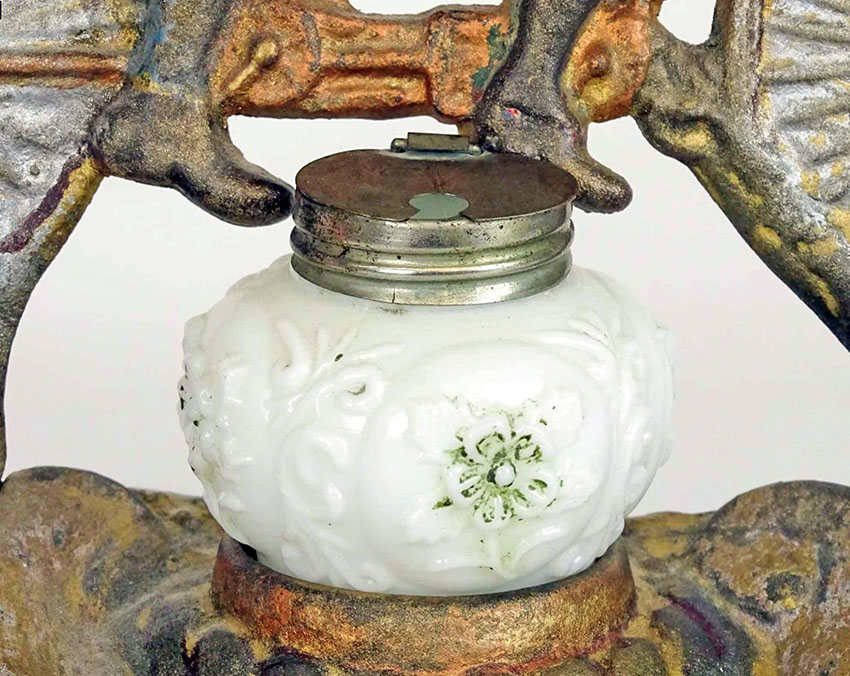
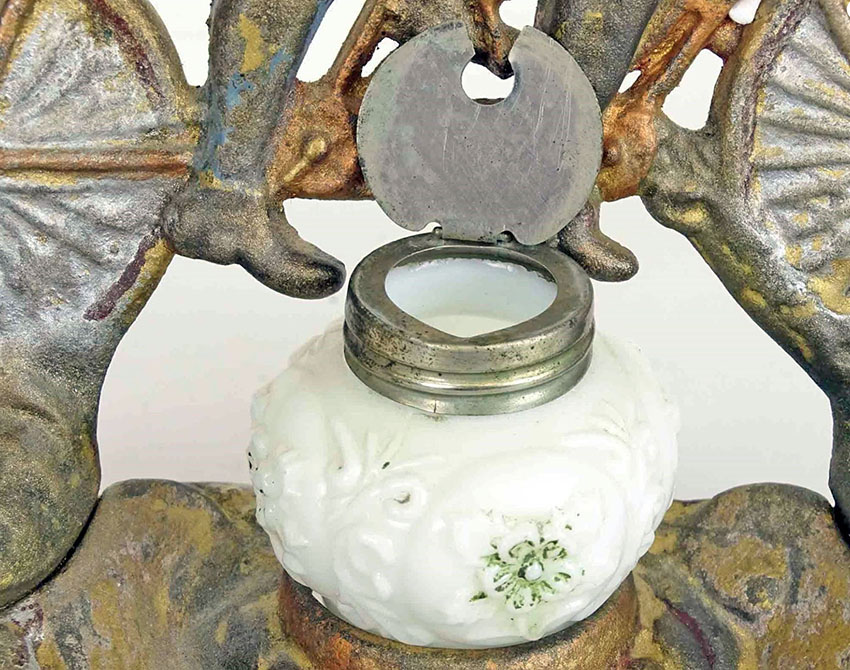
- Mechanism: This version features a recessed well designed for a removable glass insert and a hinged metal lid integrated into the base.
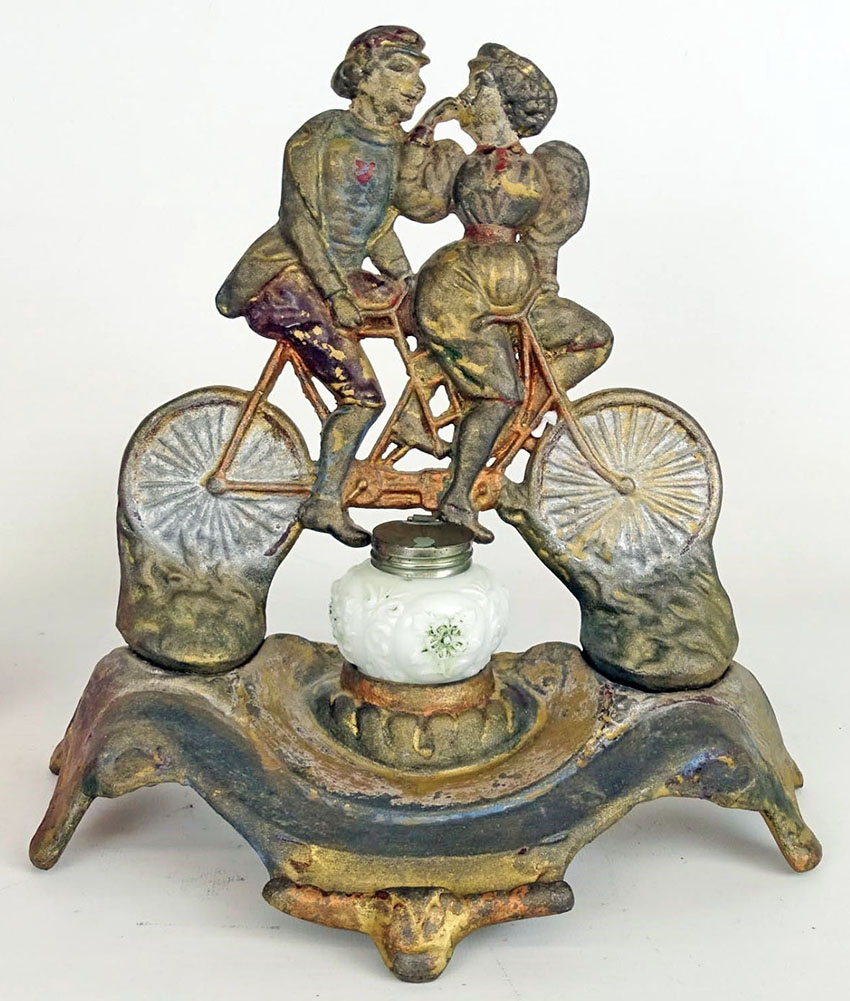
The Polychrome / Gilt Version:
- Appearance: This piece retains more of its original decorative finish (either a gilt “bronze” wash or polychrome paint).
- Inkwell: It features a milk glass inkwell with an embossed floral pattern, which is a separate component sitting in the central cradle. This style was often sold for home use in stationary shops.
Manufacturer and Patent Information
These inkstands are widely attributed to the H.L. Judd Manufacturing Co. of Wallingford, Connecticut. Judd was famous for its “bronzed” cast iron novelty items and held numerous patents for desk accessories.
The Patent Search: The marking “PAT AP FOR” (Patent Applied For) on the advertising piece indicates it was produced while a design patent was pending. While a specific number for this exact “tandem couple” design is elusive in modern digital databases (as many 19th-century design patents were filed under generic titles like “Design for an Inkstand”), it is consistent with Judd’s production timeline. Similar Judd bicycle-themed pieces, such as their “Safety Bicycle” inkwells, often carry patent dates around 1896 or 1897.
Advertising model sold for $667 in April 2017
Content disclaimer. The information posted is the owner’s best knowledge and may not have been vetted by the SOIC. We welcome comments, corrections, and additions, working to make our website information comprehensive and accurate.
Join the Society of Inkwell Collectors (SOIC) – it’s free!
Founded in 1981 as a non-profit organization,
we are documenting inkwells (and accessories).
We’re here to help and inform!