

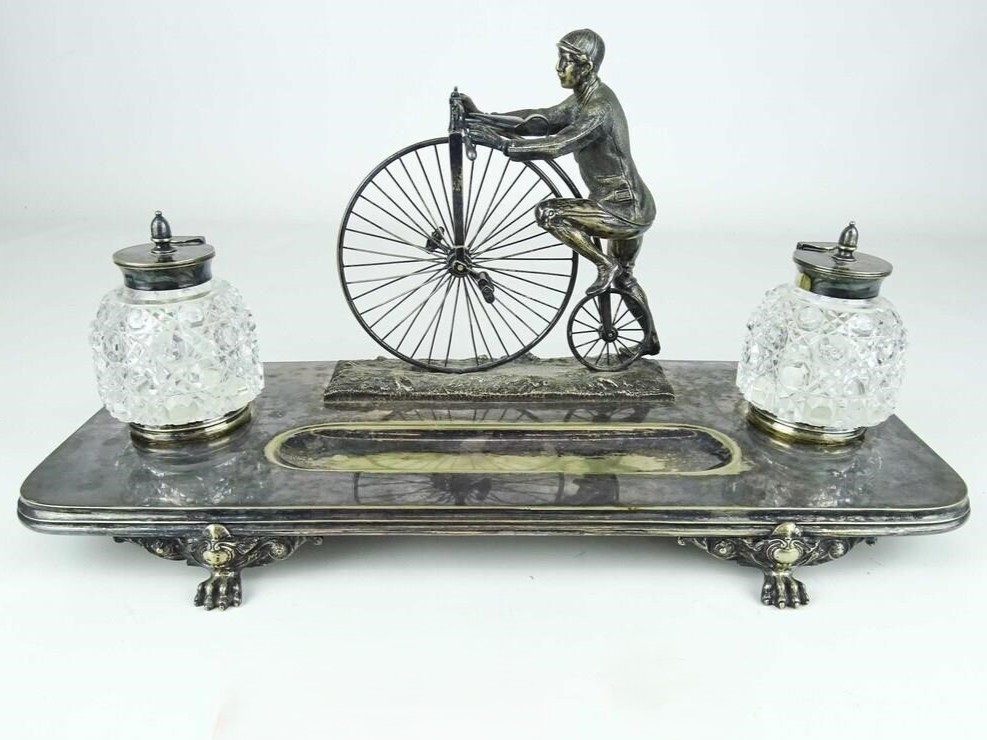
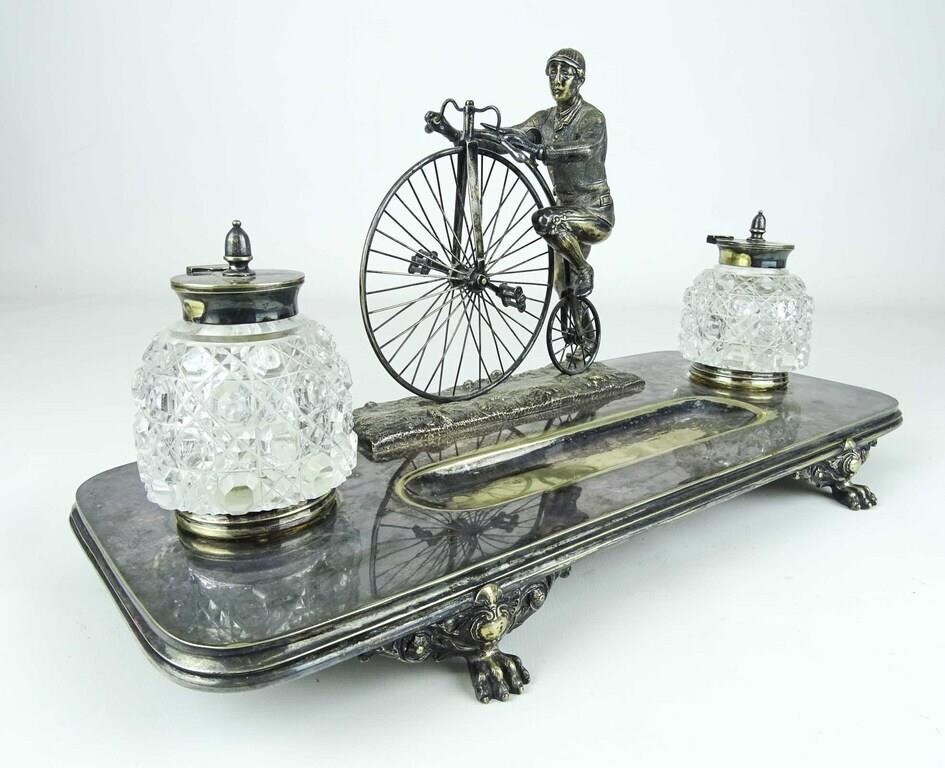

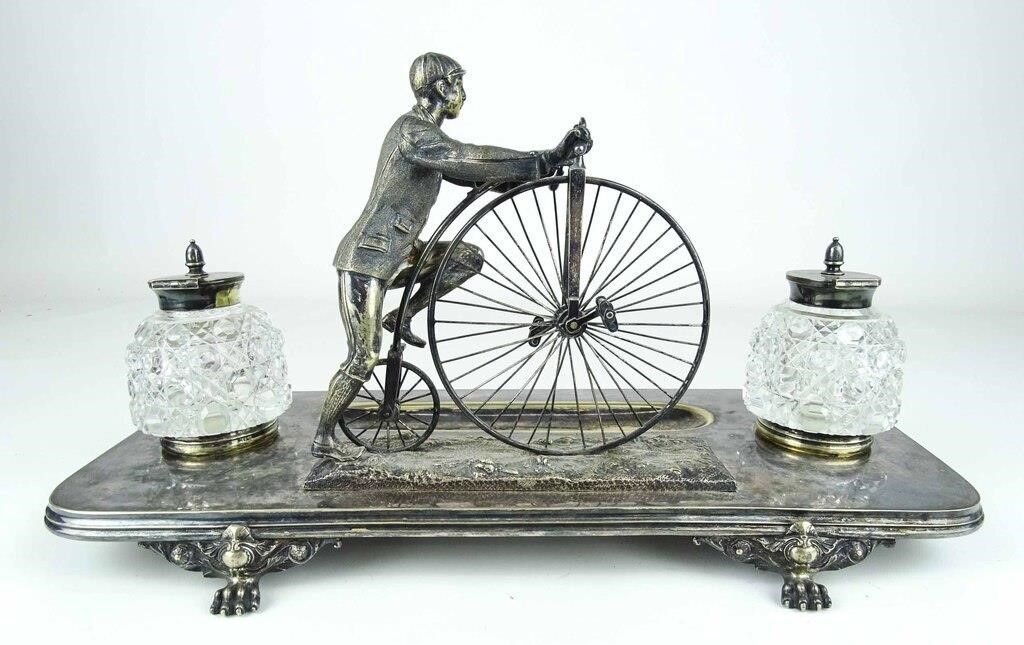

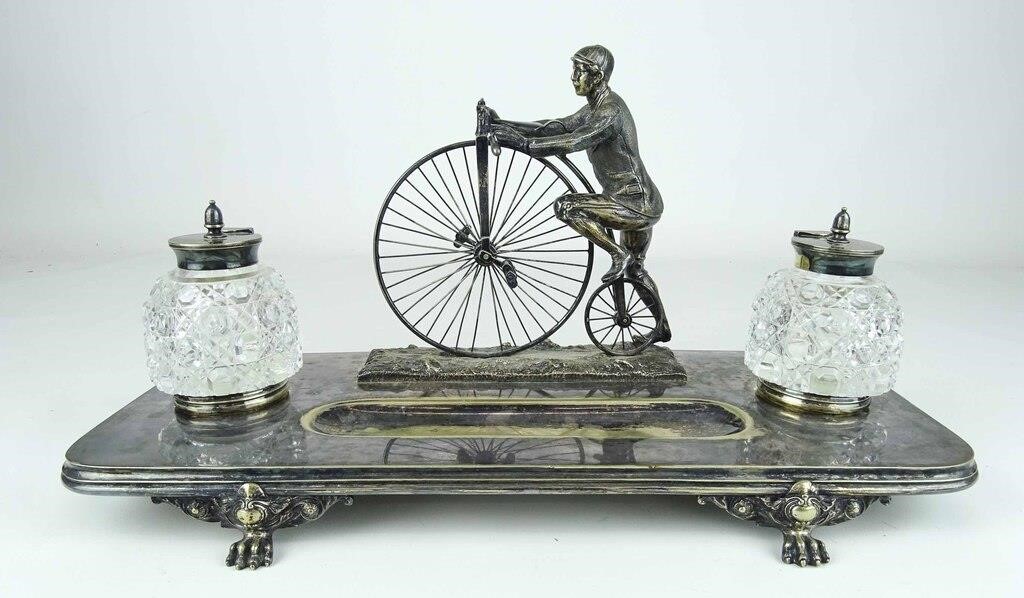
Silverplated Double Inkstand with High-Wheel Bicycle
| Categories | Sports |
| Type | Bicycle |
| Material | Glass, Silverplate |
| Markings | See Narrative |
| Manufacturer | Richard Richardson |
| Origin | England |
| Date or Era | circa 1880 |
| Measuring | 15 ½” x 6 ½” x 8 ½” high |
This silverplated double inkstand was likely made in Sheffield, England, during the late 1870s and early1880s. Items of this nature were often produced as presentation pieces or “novelty” desk sets for enthusiasts, particularly during the “bicycle craze” of the late 19th century.
Description
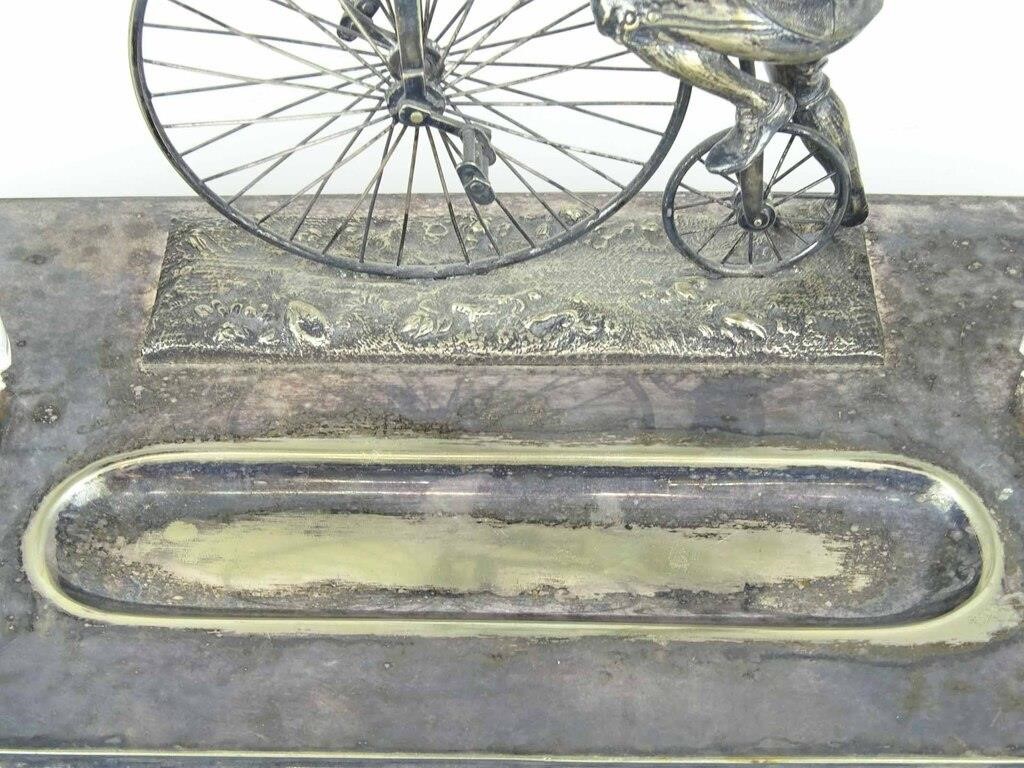
- Central Figure: The centerpiece is a realistically cast silvered metal figure of a cyclist riding a high-wheel bicycle (commonly known as a “penny-farthing”). The rider is depicted in period-accurate attire, including a cycling cap, jacket, and breeches, leaning forward over the “mustache” handlebars.
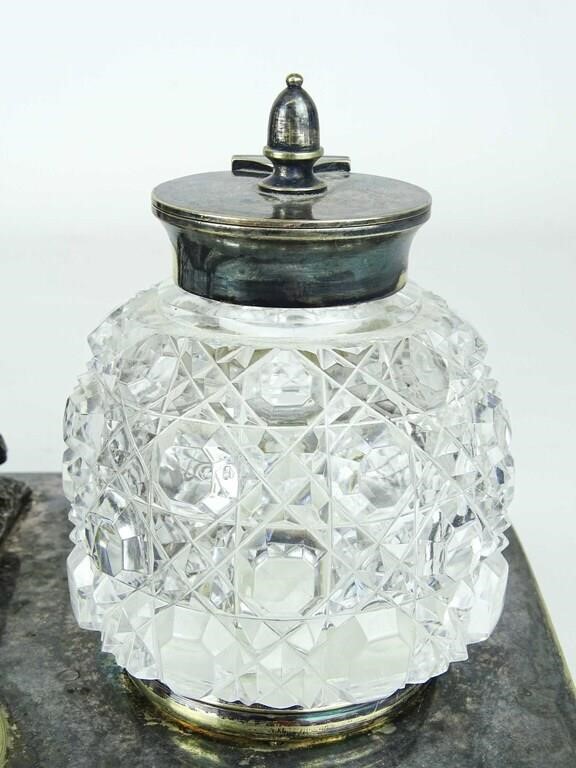
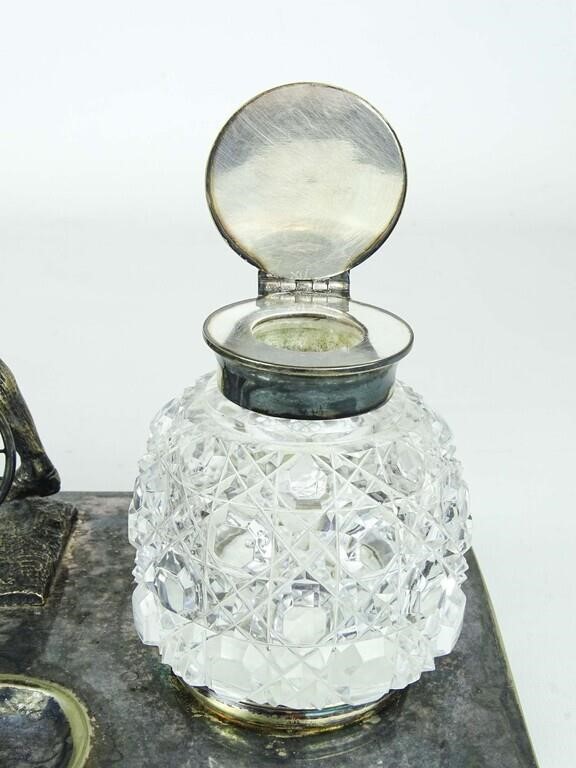
- Inkwells: The stand features two large, heavy diamond-cut crystal inkwells. These are fitted with silverplated collars and hinged lids.
- The Stand (Standish): The rectangular base is made of silverplate (over a base metal like Britannia metal or nickel silver). It has a central recessed pen tray for resting dip pens.
- Feet: The entire piece is supported by four highly ornate claw-and-ball feet (specifically resembling lion or mythical creature paws), a signature flourish of high-end Victorian silverplate.
The Maker: Richard Richardson
Richard Richardson was a prominent silversmith and manufacturer of electroplated wares based in Sheffield, England. While the business traces its roots back to 1796, the firm became a significant industrial force in the mid-to-late Victorian era under the leadership of Richard Richardson himself.
The “Cornwall Works” Significance
The mention of “Cornwall Works” (located on Pond Hill in Sheffield) is the most critical piece of evidence for dating:
- The Window: The firm operated specifically under the name Cornwall Works between 1873 and 1883.
- The Move: In 1884, the business relocated to 167 Norfolk Street, and later to Scotland Street in 1891.
- The Conclusion: Because this piece is stamped with the “Cornwall Works” address rather than the later Norfolk or Scotland Street addresses, it was almost certainly manufactured during that 1873–1883 decade.
Catalog Number 2405
The number 2405 is the pattern or design number. In the late 19th century, large Sheffield firms produced massive illustrated catalogs. Every unique design—from simple spoons to elaborate figural inkstands—was assigned a number.
Age:
The popularity of the High-Wheel Bicycle (the Penny-Farthing) peaked between 1878 and 1885. When you combine the era of the bicycle with the documented dates of the Cornwall Works factory (1873–1883), the “Goldilocks” zone for this inkstand’s manufacture is approximately 1880–1883.
Sold for $3120 in October 2023
Content disclaimer. The information posted is the owner’s best knowledge and may not have been vetted by the SOIC. We welcome comments, corrections, and additions, working to make our website information comprehensive and accurate.
Join the Society of Inkwell Collectors (SOIC) – it’s free!
Founded in 1981 as a non-profit organization,
we are documenting inkwells (and accessories).
We’re here to help and inform!