









Allyn’s Patented Non-Corrosive Pen Wiper
| Categories | Accessories |
| Type | Pen Wipe |
| Material | Majolica |
| Markings | See Narrative |
| Manufacturer | Undetermined |
| Origin | United States |
| Date or Era | circa 1885 |
| Patent | No. 331,270 Patented Dec. 1, 1885 |
Description
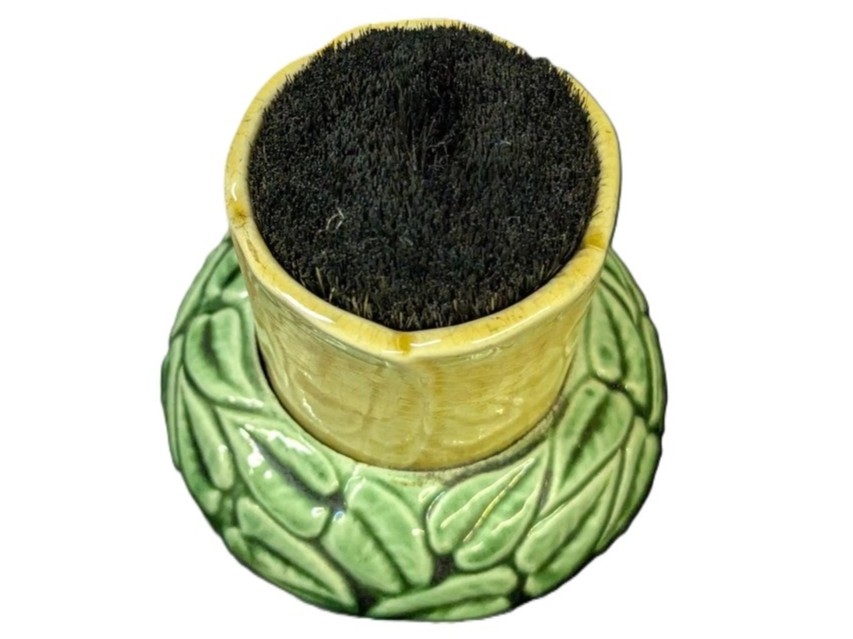
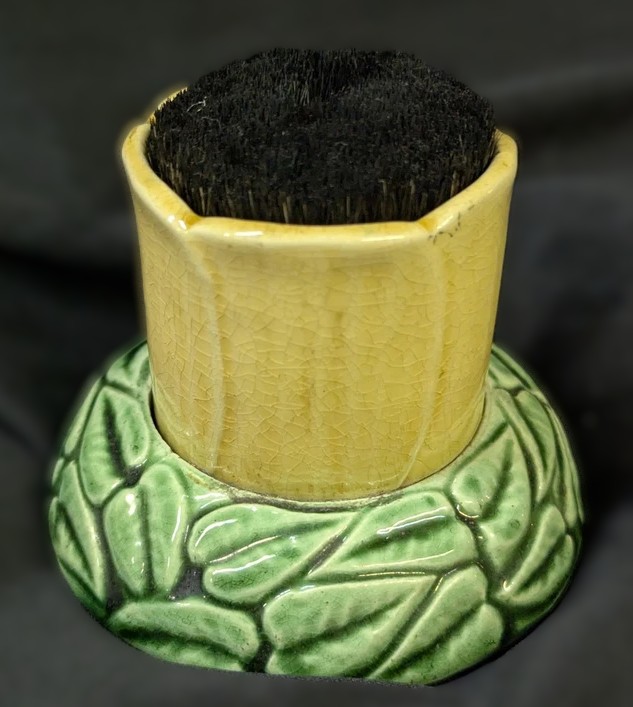
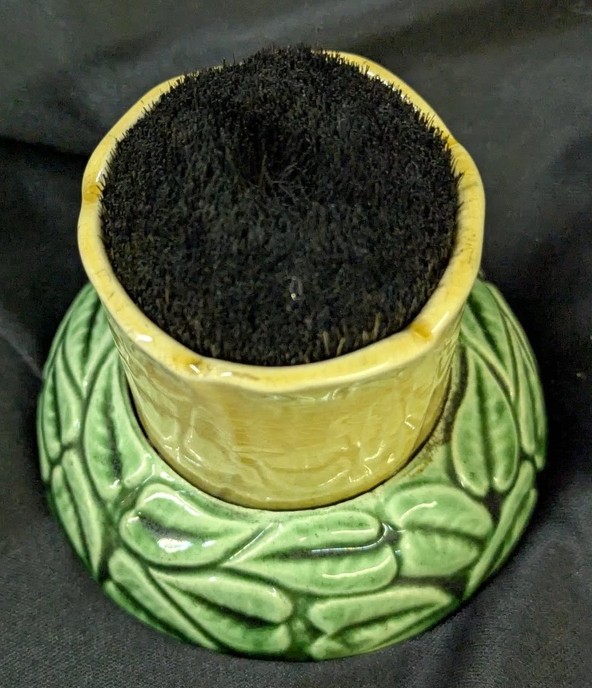
The item is an Allyn’s Non-Corrosive Pen Wiper, housed in a decorative two-piece ceramic holder.
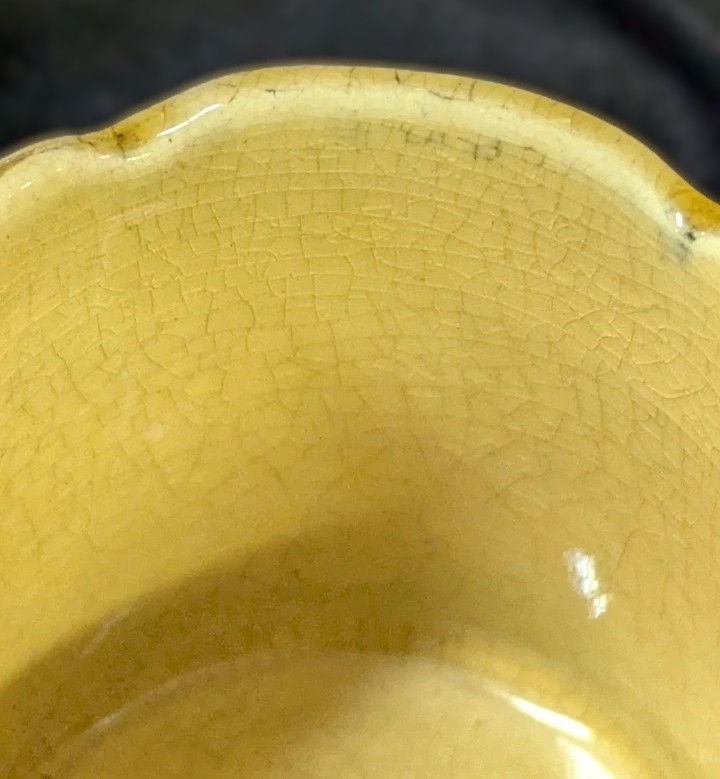
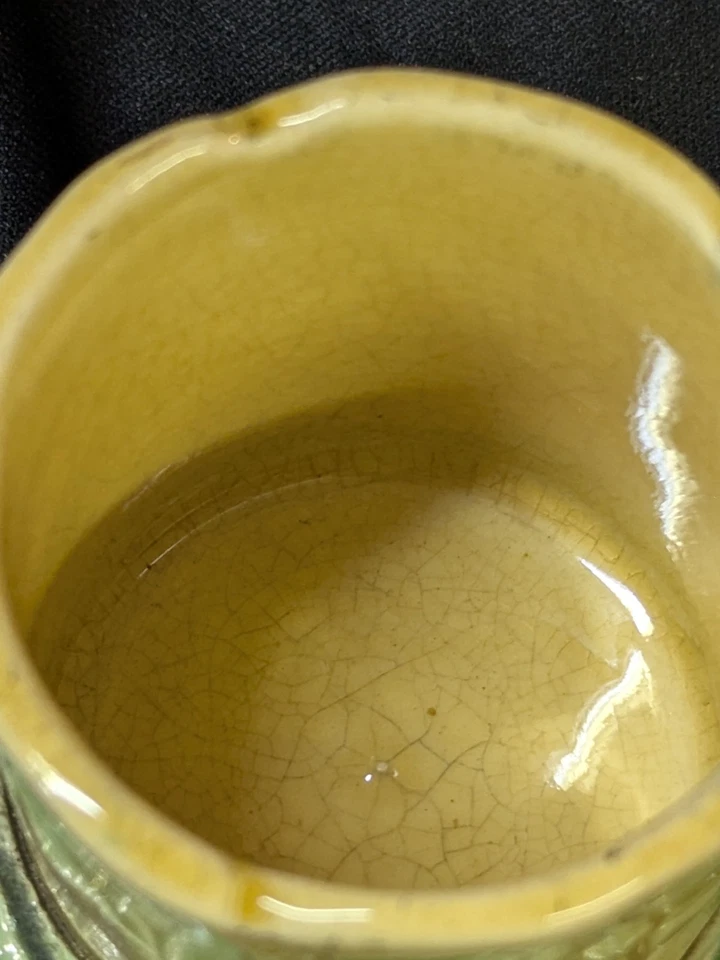
- The Holder: Features a pale yellow, octagonal central cup with a heavy “crackle” glaze. It sits within a separate green base molded with a lush leaf pattern. The underside of the green base shows three unglazed kiln marks, typical of pottery fired on stilts.
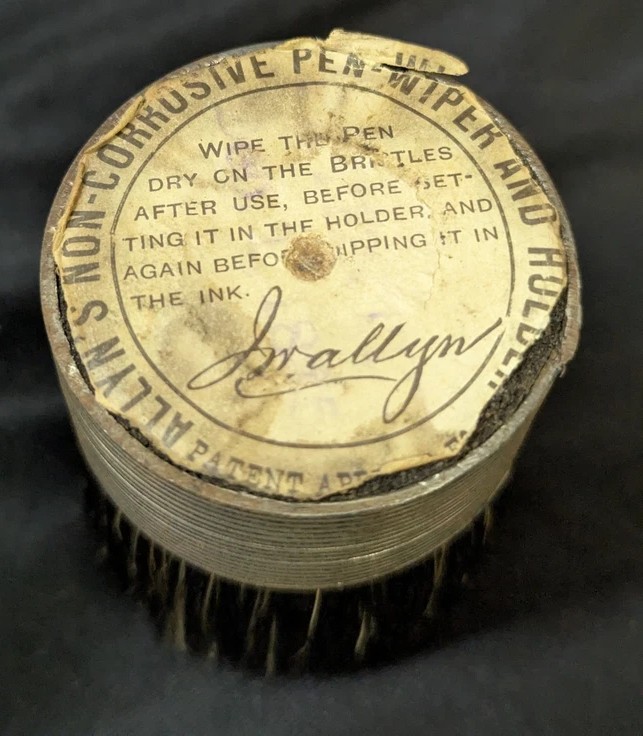
- The Pen Wiper: A removable cylindrical unit consisting of a dense bunch of dark, stiff bristles held together by a metal band (likely tin).
- The Label: The paper label on the bottom confirms it is “Allyn’s Non-Corrosive Pen-Wiper and Holder” with the text “Patent Appd For.”
Manufacturer & History
Isaac W. Allyn was the inventor and manufacturer behind this device.
- Location: Philadelphia, Pennsylvania.
- Origin: According to the patent, Allyn was a citizen of the United States residing in Philadelphia.
- Date: While the label says “Patent Appd For,” the patent was granted on December 1, 1885. This suggests this wipe was likely manufactured right around that transition period—roughly 1884 to 1890.
Materials
- Ceramic Holder: This is Majolica (or a Majolica-style earthenware). The vivid, translucent colored glazes (green and yellow) and the naturalistic molded leaf pattern are hallmark characteristics of Victorian-era Majolica pottery, which was highly popular in the late 19th century.
- Bristles: Historically, high-quality pen wipes of this era used natural hog hair or horsehair. They were chosen for their stiffness and ability to scrub away dried ink without scratching the delicate metal nibs of dip pens.
Patent Summary: No. 331,270
Inventor: Isaac W. Allyn
Issued: December 1, 1885
The patent describes an “Improvement in Pen Wipers and Holders” with several specific technical goals:
- Corrosion Prevention: The most unique feature is that Allyn “sprinkled a finely-powdered substance” (specifically talc or soapstone) between the bristles. This powder acted as a dry lubricant and protective barrier to prevent the metal pen nibs from corroding or rusting after being wiped.
- The Bristle Construction: The bristles are cemented or glued together at the base and secured by a metal band (Band E). A second, slightly larger adjustable band (Band F) could be moved up or down to tighten or loosen the bristle spread.
- The Holder Design: While this holder is a stand-alone ceramic piece, the patent illustrates a version where the wiper is integrated into a larger inkstand base with two inkwells. The “receptacle” is designed to hold the wiper vertically so the pen can be stored directly in the bristles when not in use.
- Tapered Shape: The patent notes that the bristles are cut to present an oval top surface, which Allyn found more effective for cleaning the pen.
Note
The label provides specific instructions that reflect the ritual of 19th-century writing:
“Wipe the pen dry on the bristles after use, before setting it in the holder, and again before dipping it in the ink.”
By using the wiper before dipping, the writer ensured no dust or old, dry ink contaminated the fresh inkwell.
Sold for $211 in March 2026
Content disclaimer. The information posted is the owner’s best knowledge and may not have been vetted by the SOIC. We welcome comments, corrections, and additions, working to make our website information comprehensive and accurate.
Join the Society of Inkwell Collectors (SOIC) – it’s free!
Founded in 1981 as a non-profit organization,
we are documenting inkwells (and accessories).
We’re here to help and inform!