

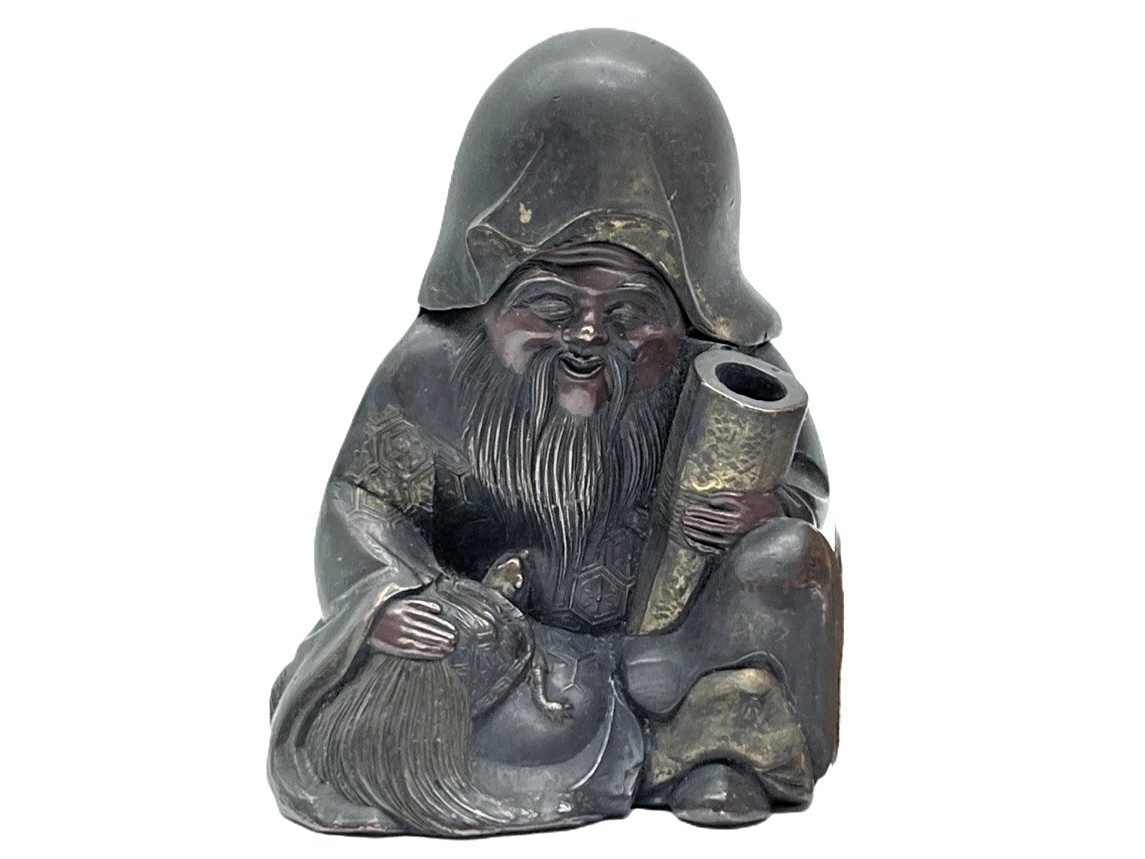
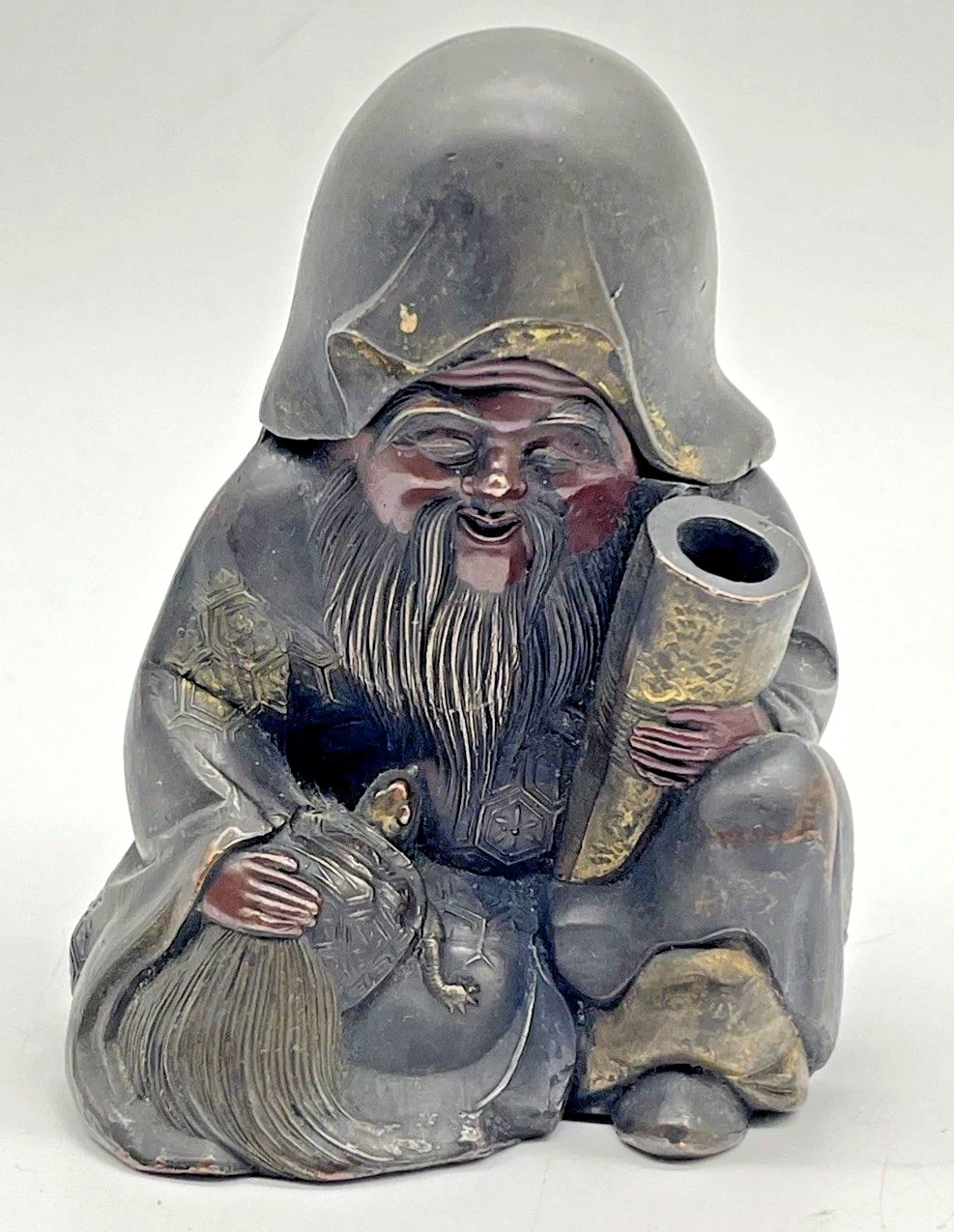
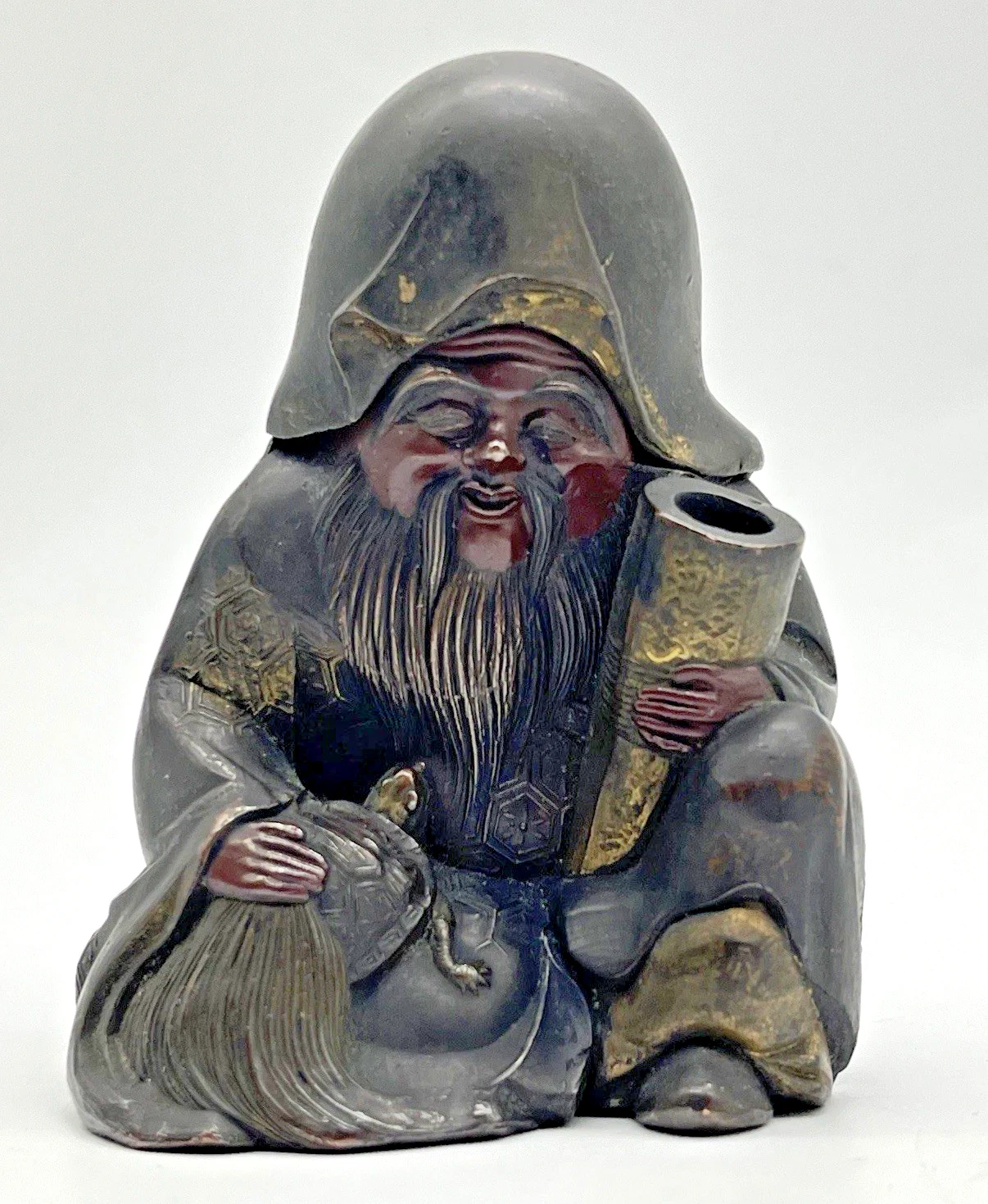
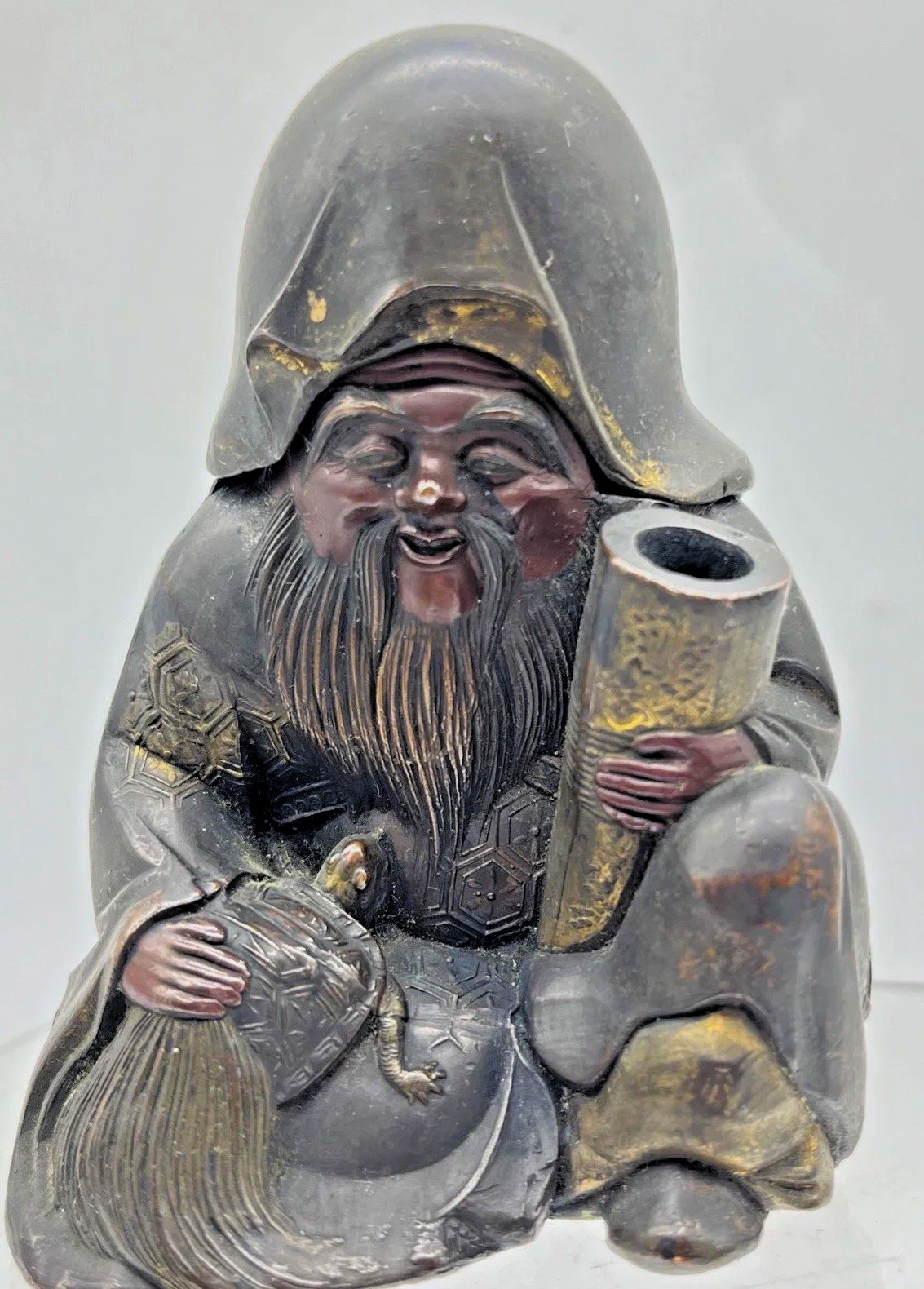
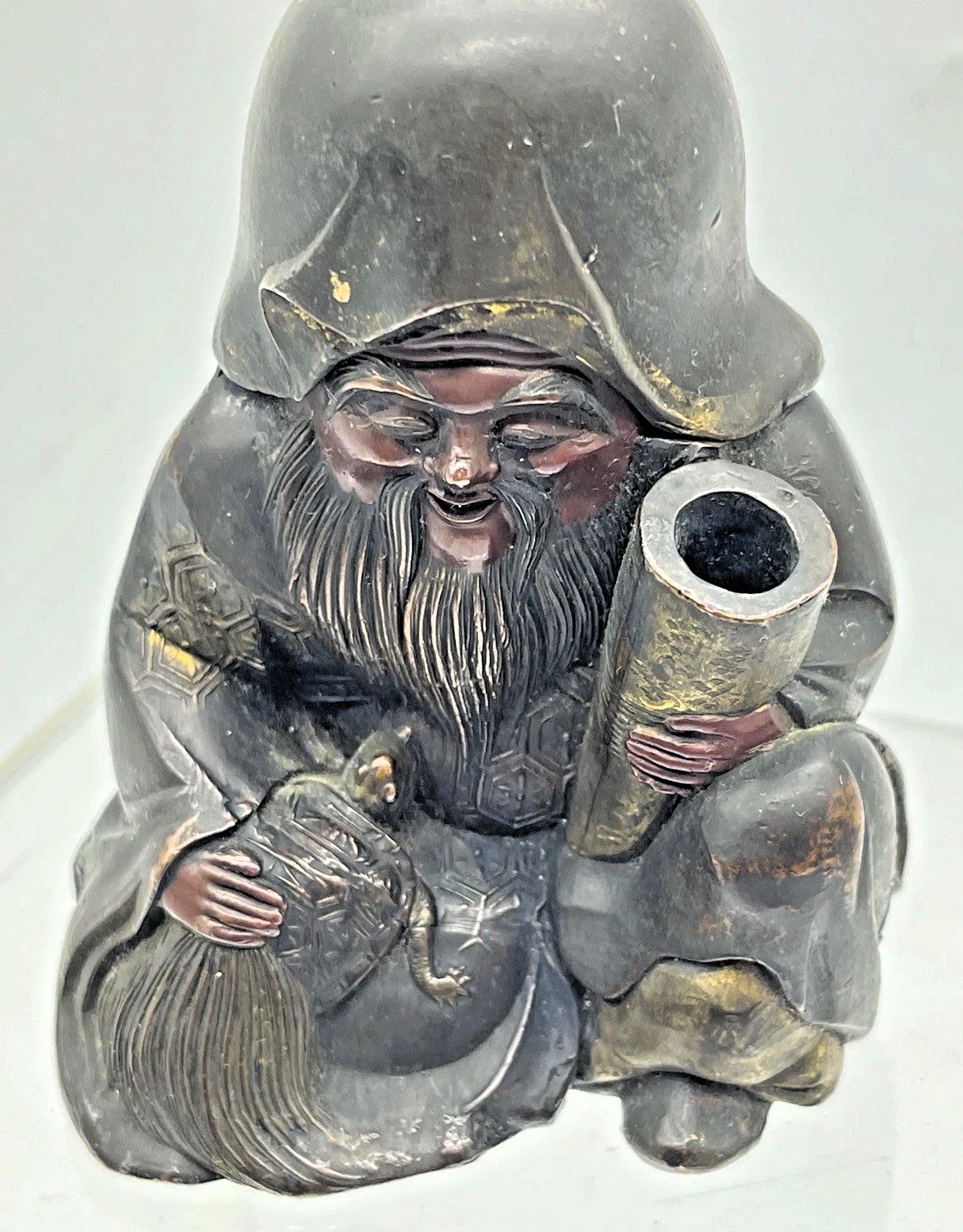
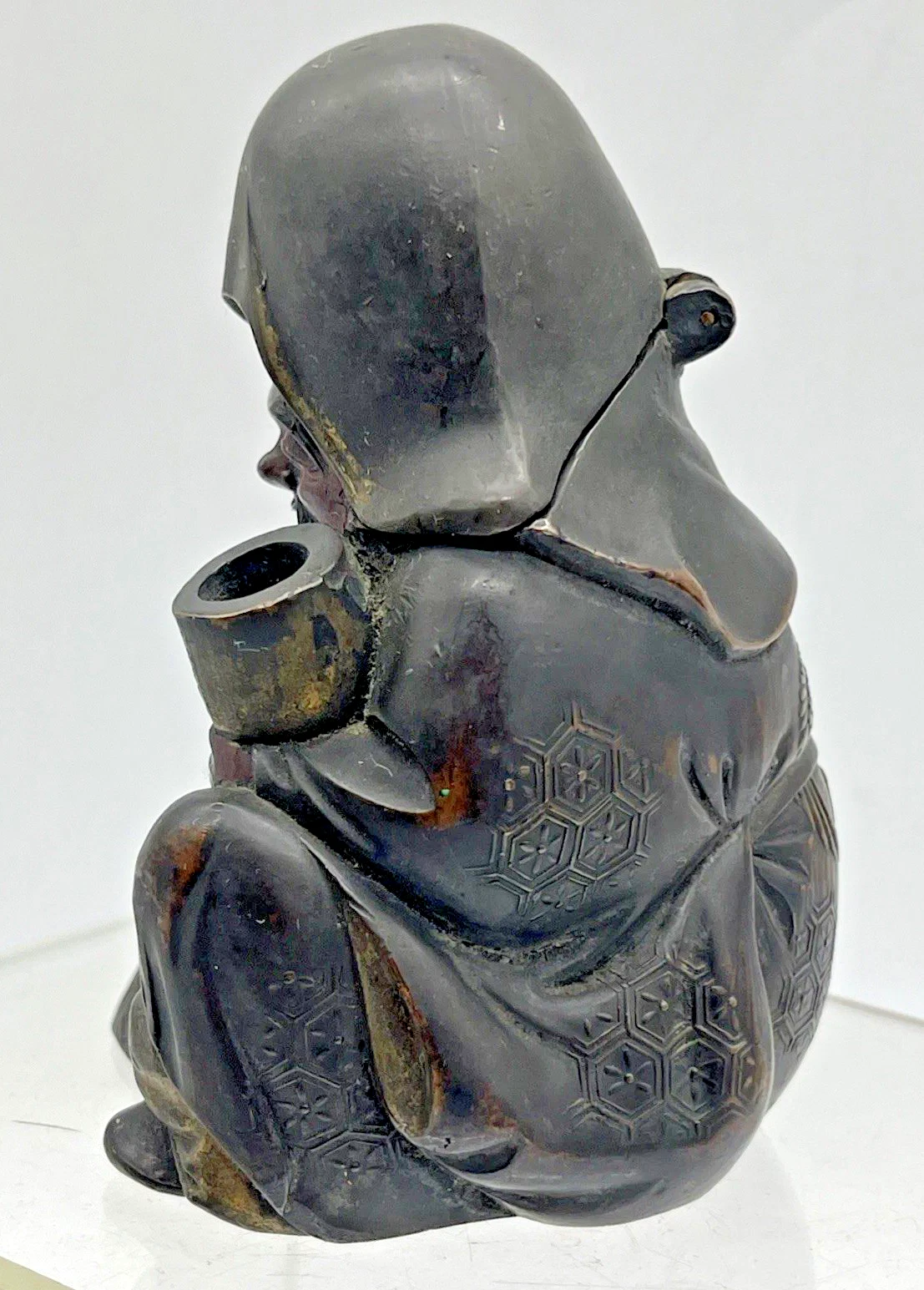
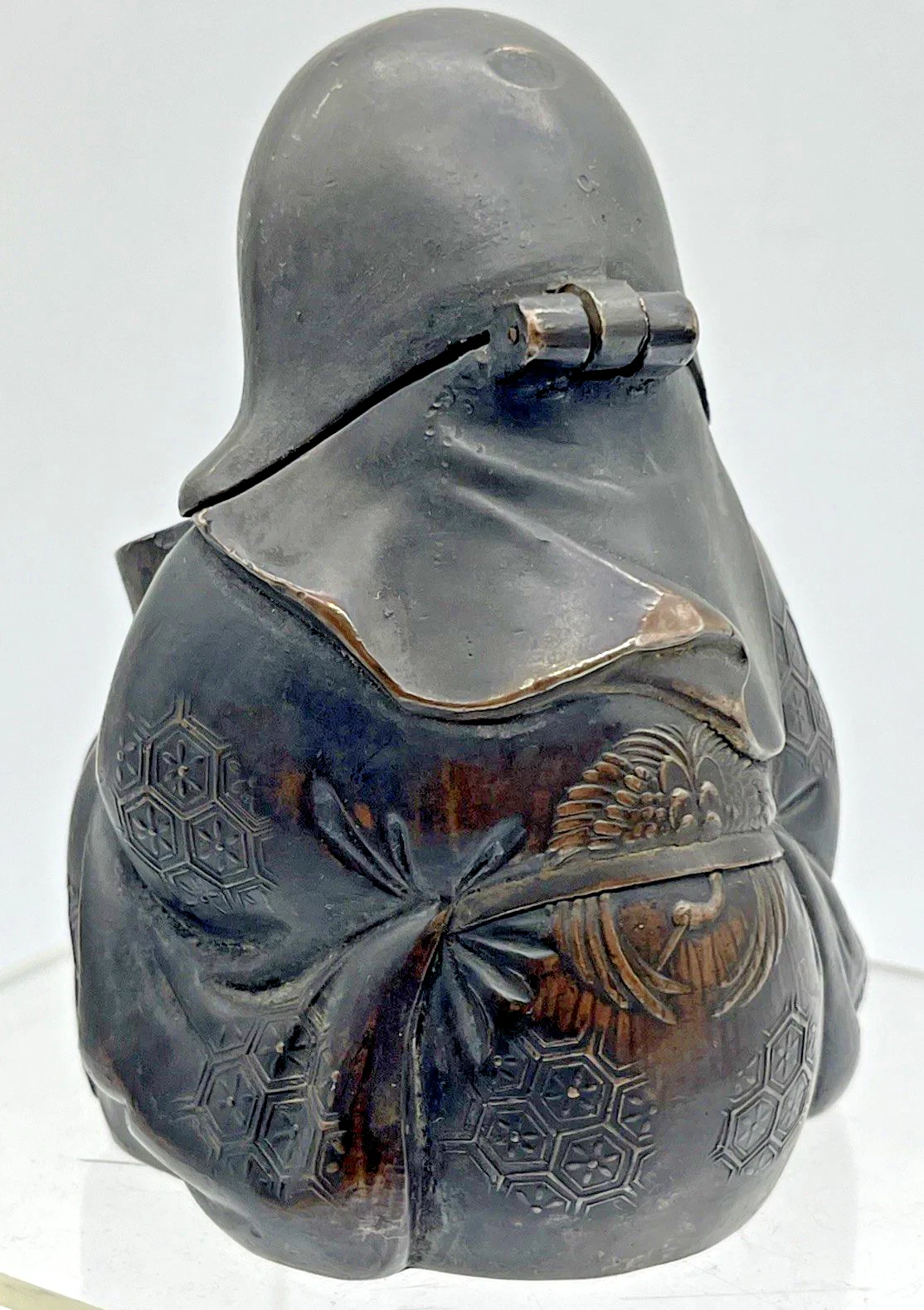
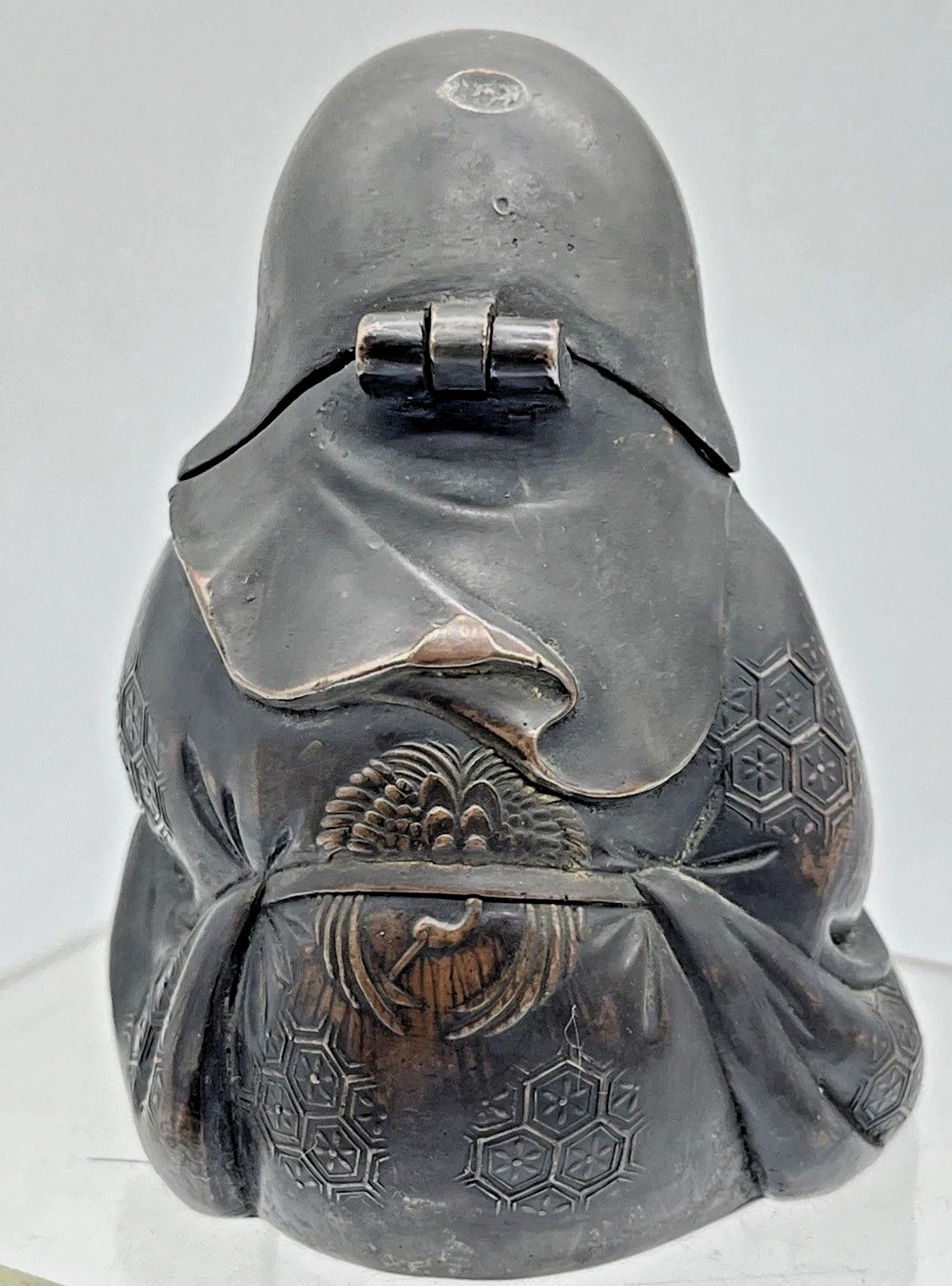
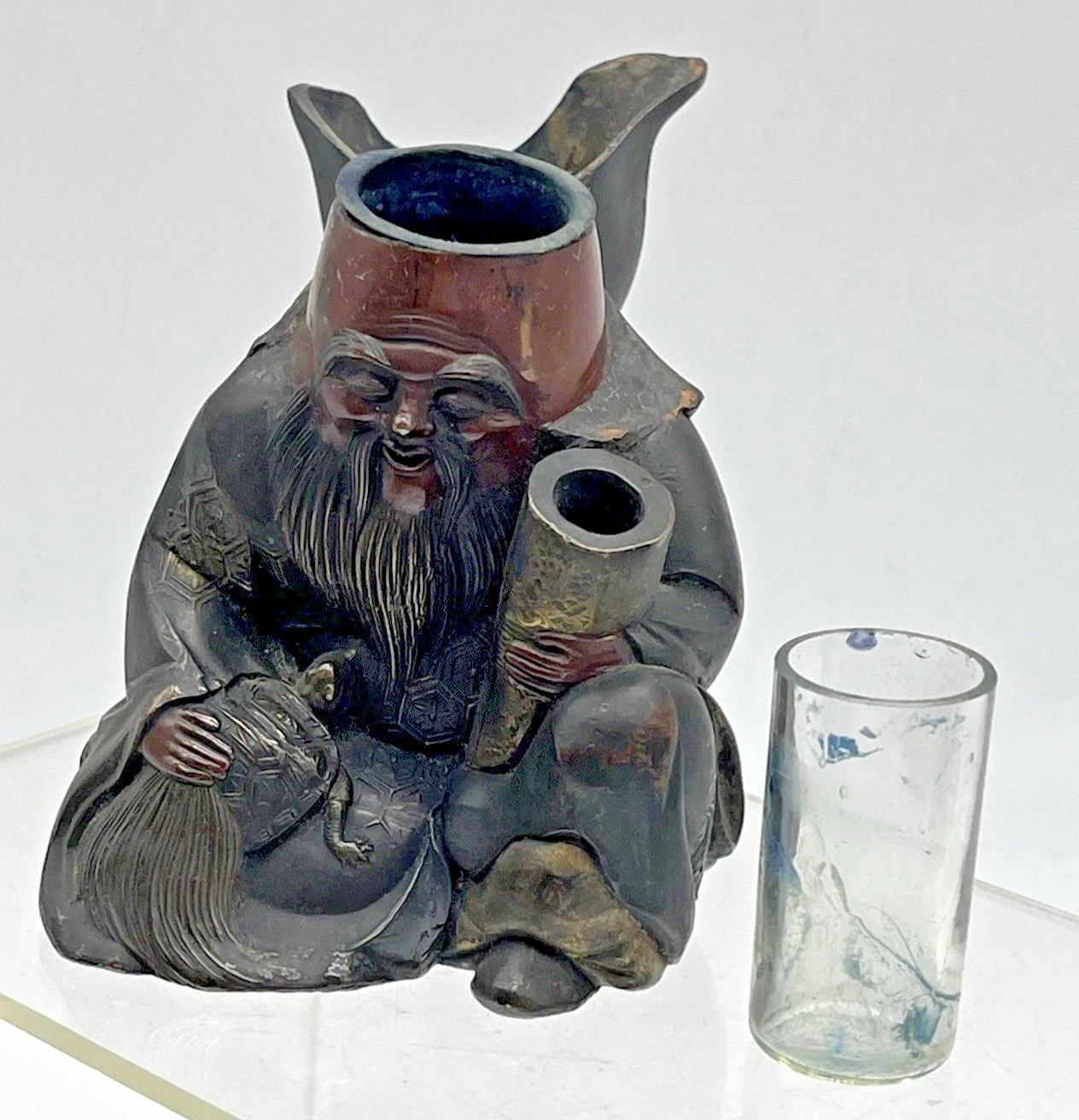
Figural Inkwell Depicting Fukurokuju
| Categories | Far East / Oriental |
| Type | Religion |
| Material | Bronze |
| Markings | Unmarked |
| Manufacturer | Undetermined |
| Origin | Japan |
| Date or Era | circa 1890 |
| Measuring | 3” x 2 ½” x 4” high |
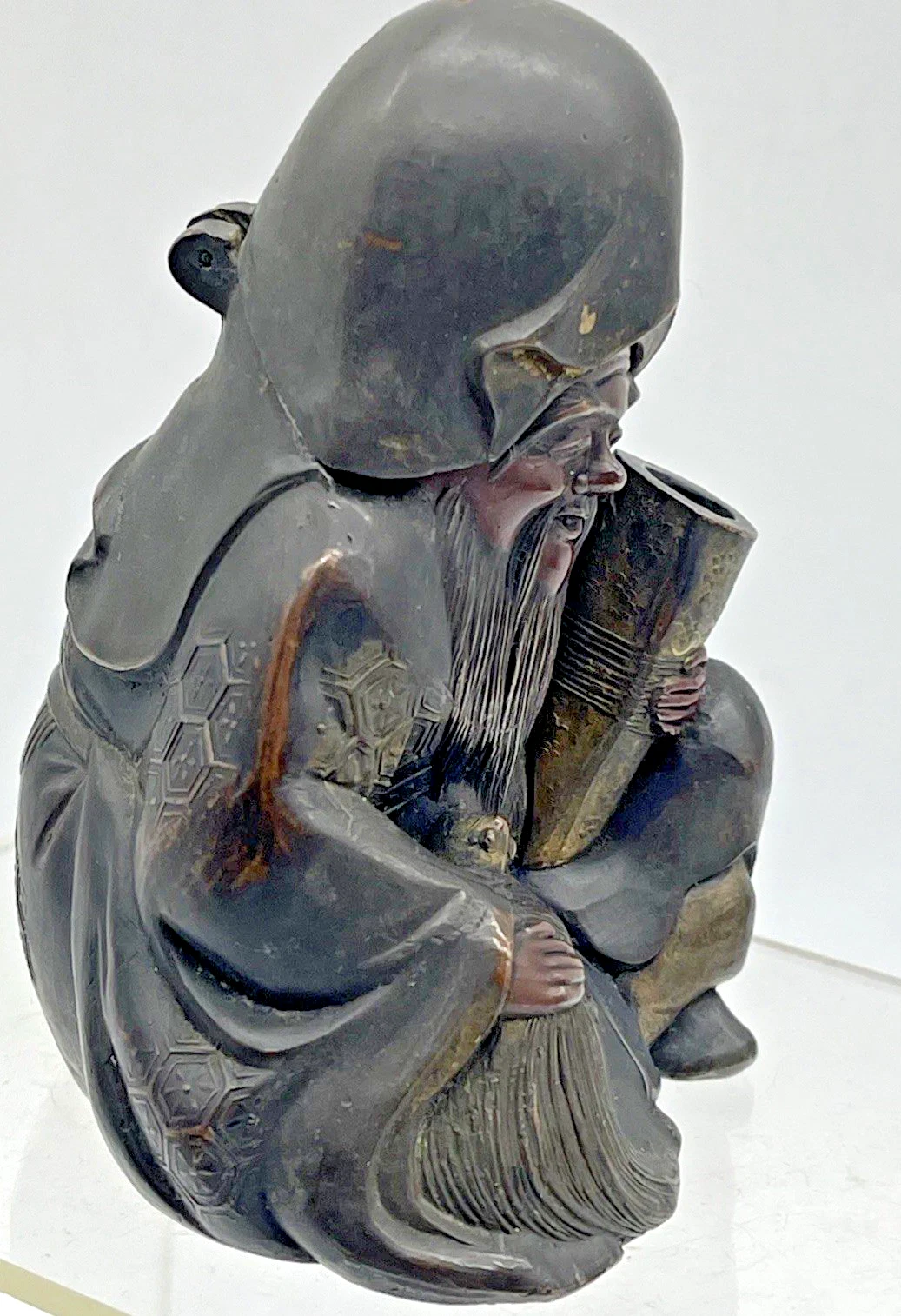
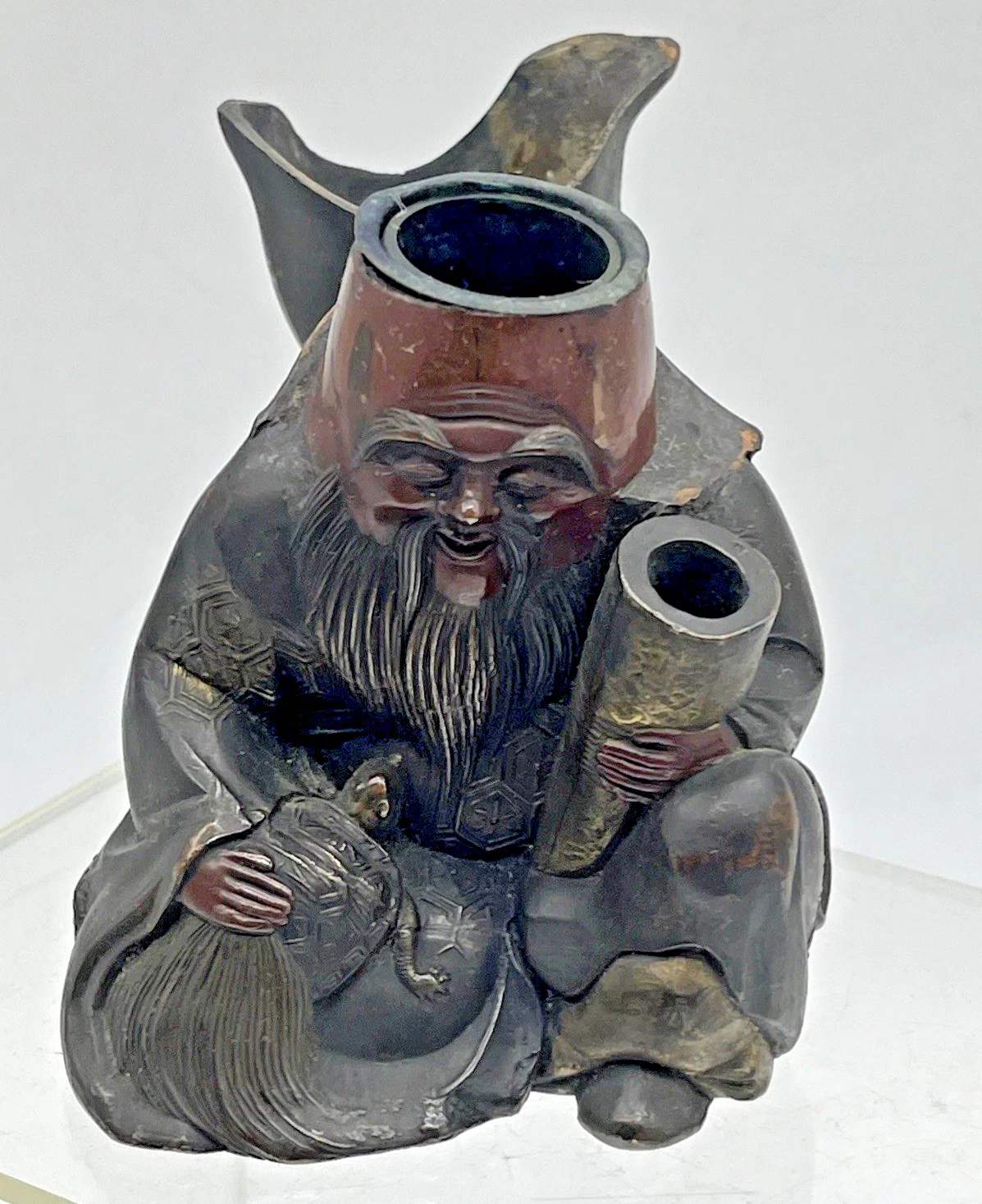
This Meiji-era Japanese export bronze figural inkwell depicts Fukurokuju, one of the Shichifukujin (Seven Lucky Gods), who is identified by his remarkably high forehead and jovial expression.
The Figure: Fukurokuju
Fukurokuju is the god of Wisdom, Wealth, and Longevity. His name is a compound of three Chinese characters:
- Fuku (福): Fortune or luck.
- Roku (禄): Prosperity or professional success.
- Ju (寿): Longevity.
In this piece, he is depicted with his classic attributes:
- The Scroll (Makimono): Held in his left hand, the scroll is said to contain the lifespan of every person on Earth or, alternatively, sacred Buddhist sutras. In this specific casting, the scroll serves a dual purpose—it has a deep cylindrical opening at the top designed to act as a pen holder.
- The Turtle (Minogame): Under his right hand is a long-tailed turtle. In Japanese folklore, the minogame is a tortoise that has lived for thousands of years and grown a “tail” of seaweed and algae. It is a potent symbol of long life.
Markings & Symbolism
The robe is rich with “hidden” meanings that reinforce the theme of immortality and good fortune.
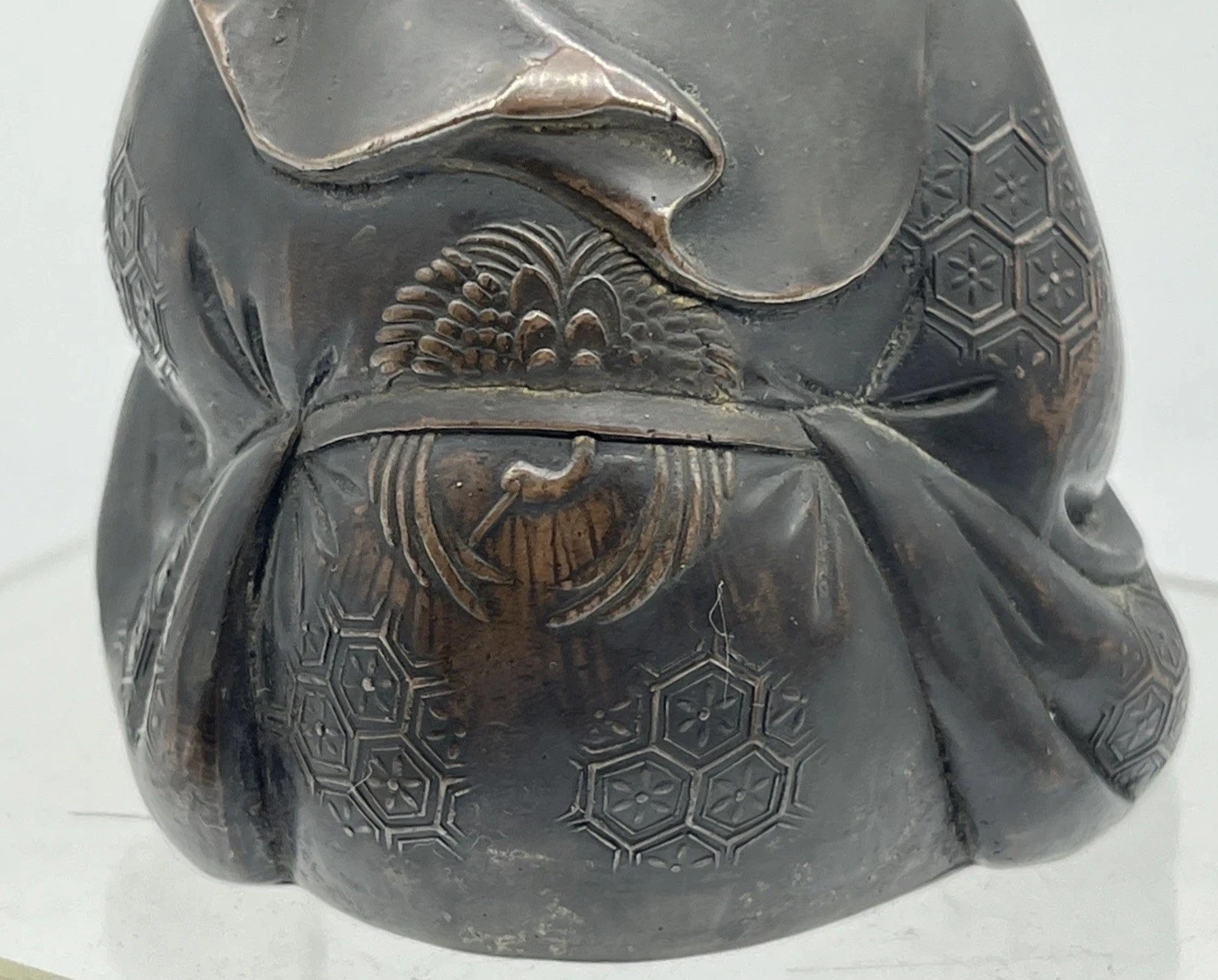
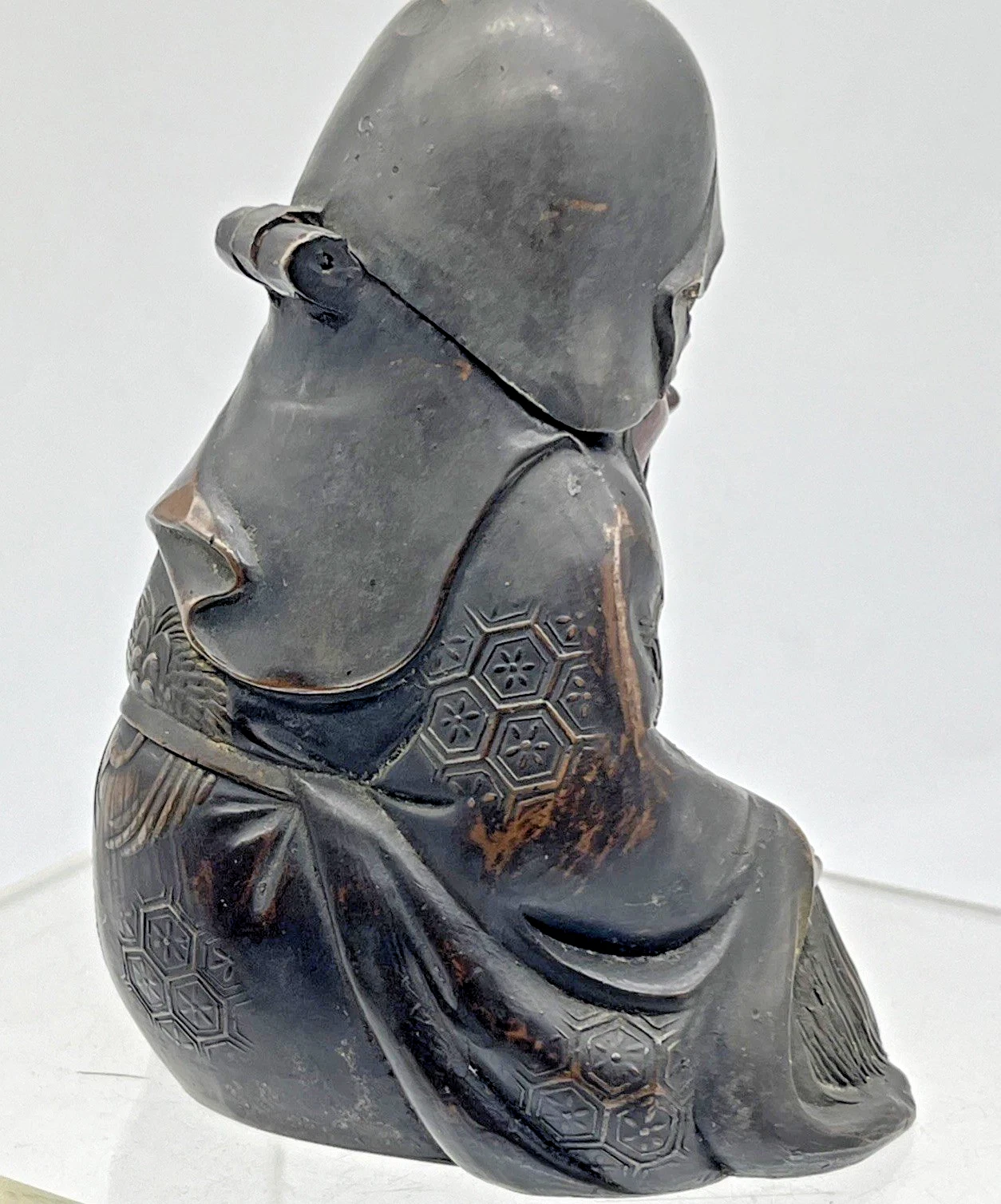
- Hexagonal Pattern (Kikko-mon): The repeating hexagons on the robe represent the pattern of a tortoise shell. This is one of the most common symbols of longevity in Japanese art.
- The Crane (Tsuru): On the back of the robe, there is a beautifully cast crane. In Japanese tradition, the crane is said to live for 1,000 years.
- The “Tsuru-Kame” Connection: Combining the crane and the tortoise (tsuru-kame) is a classic auspicious motif used for celebratory occasions, essentially doubling the wish for a long and healthy life.
Age and Origin
- Origin: This was made in Japan, likely in a metalworking center like Kyoto or Tokyo.
- Period: It dates to the Late Meiji Period (1868–1912).
- Context: During this time, Japanese metalworkers—who had lost their primary patrons after the samurai class was abolished—turned their incredible skills toward the Western export market. Figural “novelty” inkwells like this were highly prized in Europe and America for their technical “trick” elements (like the hinged head) and the high quality of the bronze patination and gilding.
Technical Details
- Construction: The bronze shows a dark “chocolate” patina typical of the era, with selective gilding (gold highlight) on the scroll and the robe patterns to make the auspicious symbols pop.
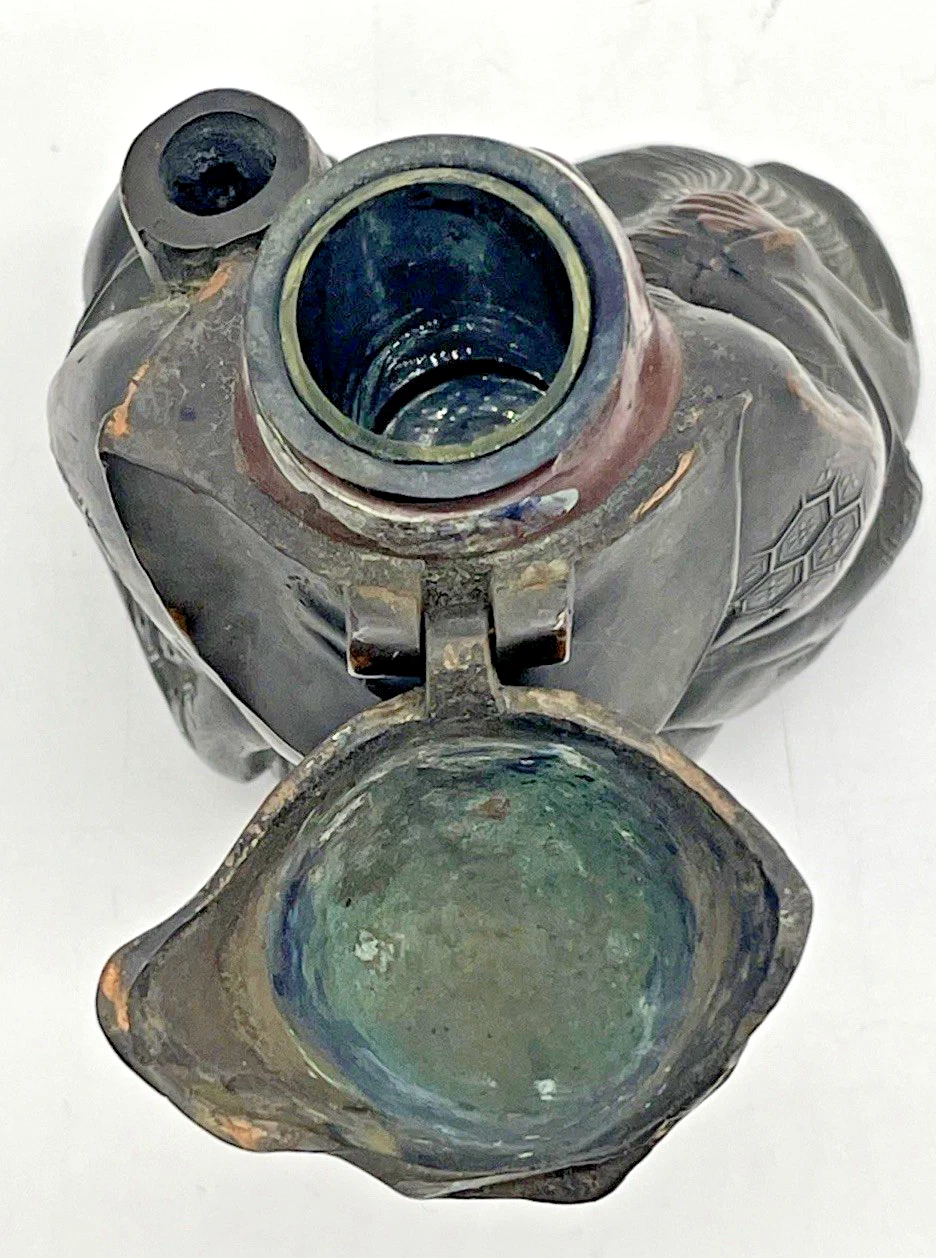
- The Reservoir: The hinged head opens to reveal the ink reservoir. The original glass insert is present.
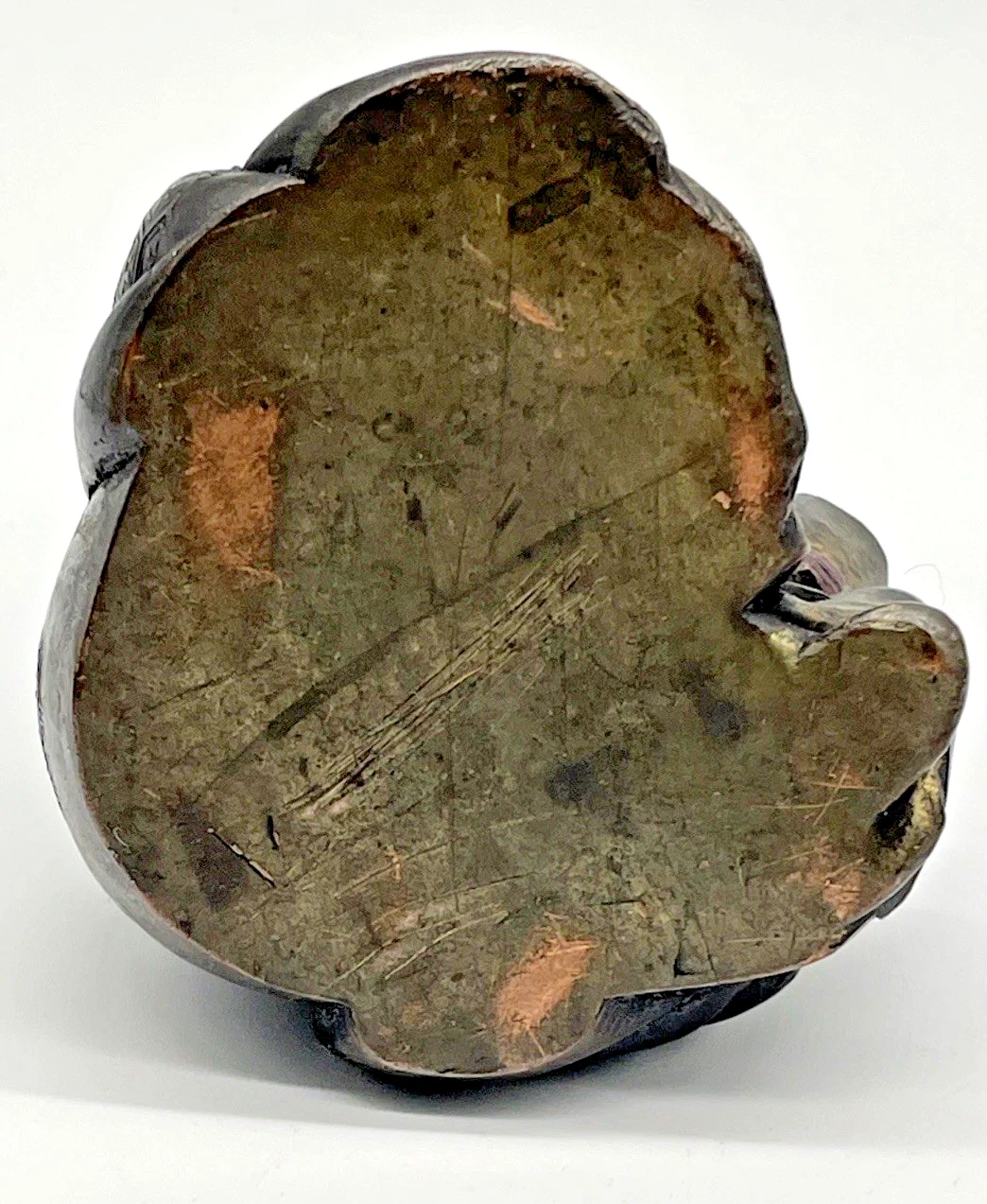
- The Base: A clean, hand-finished cast base. While there is no obvious artist’s “chop” or signature visible, the quality of the casting in the face and the fine detail in the robe patterns suggest a skilled foundry.
Sold for $425 in March 2026
Content disclaimer. The information posted is the owner’s best knowledge and may not have been vetted by the SOIC. We welcome comments, corrections, and additions, working to make our website information comprehensive and accurate.
Join the Society of Inkwell Collectors (SOIC) – it’s free!
Founded in 1981 as a non-profit organization,
we are documenting inkwells (and accessories).
We’re here to help and inform!